

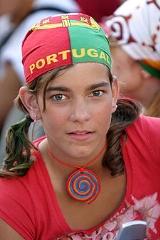
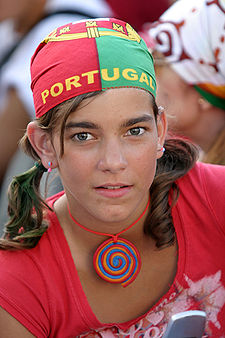
Kerchief

Encyclopedia
Triangle
A triangle is one of the basic shapes of geometry: a polygon with three corners or vertices and three sides or edges which are line segments. A triangle with vertices A, B, and C is denoted ....
or square
Square (geometry)
In geometry, a square is a regular quadrilateral. This means that it has four equal sides and four equal angles...
piece of cloth tied around the head
Human head
In human anatomy, the head is the upper portion of the human body. It supports the face and is maintained by the skull, which itself encloses the brain.-Cultural importance:...
or around the neck
Neck
The neck is the part of the body, on many terrestrial or secondarily aquatic vertebrates, that distinguishes the head from the torso or trunk. The adjective signifying "of the neck" is cervical .-Boner anatomy: The cervical spine:The cervical portion of the human spine comprises seven boney...
for protective or decorative purposes. The popularity of head kerchiefs may vary by culture or religion, as among Amish
Amish
The Amish , sometimes referred to as Amish Mennonites, are a group of Christian church fellowships that form a subgroup of the Mennonite churches...
women, Orthodox Jewish
Orthodox Judaism
Orthodox Judaism , is the approach to Judaism which adheres to the traditional interpretation and application of the laws and ethics of the Torah as legislated in the Talmudic texts by the Sanhedrin and subsequently developed and applied by the later authorities known as the Gaonim, Rishonim, and...
women, Muslim
Hijab
The word "hijab" or "'" refers to both the head covering traditionally worn by Muslim women and modest Muslim styles of dress in general....
women, and older Orthodox Christian
Orthodox Christianity
The term Orthodox Christianity may refer to:* the Eastern Orthodox Church and its various geographical subdivisions...
women.
A "handkerchief
Handkerchief
A handkerchief , also called a handkercher or hanky, is a form of a kerchief, typically a hemmed square of thin fabric that can be carried in the pocket or purse, and which is intended for personal hygiene purposes such as wiping one's hands or face, or blowing one's nose...
" or "hanky" primarily refers to a napkin
Napkin
A napkin, or face towel is a rectangle of cloth used at the table for wiping the mouth while eating. It is usually small and folded...
made of cloth, used to dab away perspiration, clear the nostril
Nostril
A nostril is one of the two channels of the nose, from the point where they bifurcate to the external opening. In birds and mammals, they contain branched bones or cartilages called turbinates, whose function is to warm air on inhalation and remove moisture on exhalation...
s, or, in Victorian
Victorian era
The Victorian era of British history was the period of Queen Victoria's reign from 20 June 1837 until her death on 22 January 1901. It was a long period of peace, prosperity, refined sensibilities and national self-confidence...
times, as a means of flirtation. A woman could intentionally drop a dainty square of lacy or embroidered fabric to give a favored man a chance to pick it up as an excuse to speak to her while returning it. Handkerchiefs were sometimes scented to be used like a nosegay
Nosegay
A nosegay, tussie-mussie, or posy/posey/posie is a small flower bouquet, typically given as a gift. They have existed in some form since at least medieval times, when they were carried or worn around the head or bodice....
or tussy-mussy, a way of protecting those who could afford them from the obnoxious scents in the street.
Bandanna
A bandanna or bandana (from the HindiHindi
Standard Hindi, or more precisely Modern Standard Hindi, also known as Manak Hindi , High Hindi, Nagari Hindi, and Literary Hindi, is a standardized and sanskritized register of the Hindustani language derived from the Khariboli dialect of Delhi...
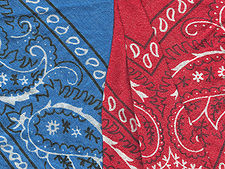
: बन्धन bandhana, "to tie") is a type of large, usually colorful, kerchief, usually worn on the head or around the neck of a person or pet and is not considered to be a hat. Bandannas are frequently printed in a paisley
Paisley (design)
Paisley or Paisley pattern is a droplet-shaped vegetable motif of Indian, Pakistani and Persian origin. The pattern is sometimes called "Persian pickles" by American traditionalists, especially quiltmakers,The Persian Pickle Club, Sandra Dallas. St. Martin's Press,...
pattern.
Bandanas are most often used to hold hair back, either as a fashionable head accessory, or for practical purposes:
Colors, and sometimes designs, can be worn as a means of communication or identification, as with the prominent California
California
California is a state located on the West Coast of the United States. It is by far the most populous U.S. state, and the third-largest by land area...
criminal gangs, the Bloods
Bloods
The Bloods are a street gang founded in Los Angeles, California. The gang is widely known for its rivalry with the Crips. They are identified by the red color worn by their members and by particular gang symbols, including distinctive hand signs...
, the Crips
Crips
The Crips are a primarily, but not exclusively, African American gang. They were founded in Los Angeles, California, in 1969 mainly by Raymond Washington and Stanley Williams...
, the Norteños
Norteños
The Norteños , also Norte, are affiliated with Nuestra Familia , are a coalition of traditionally Latino gangs in Northern California A member of these gangs is a Norteño or Norteña based on Spanish usage...
, and the Sureños
Sureños
Sureños are a group of Mexican American street gangs with origins in the oldest barrios of Southern California. Although they are based in California, the influence of the Sureños has spread to many parts of the US and other countries as well such as Germany and Japan...
. In the so-called hanky code, sexual subcultures, particularly gay men, signal their preferred sexual practices by wearing a particular bandana color or design in one of their pockets.
In gang subcultures, the bandana could be worn in a pocket or, in some cases, around the leg. In the late 1980s/early 1990s, the Bloods
Bloods
The Bloods are a street gang founded in Los Angeles, California. The gang is widely known for its rivalry with the Crips. They are identified by the red color worn by their members and by particular gang symbols, including distinctive hand signs...
and the Crips
Crips
The Crips are a primarily, but not exclusively, African American gang. They were founded in Los Angeles, California, in 1969 mainly by Raymond Washington and Stanley Williams...
, wore red or blue paisley bandanas as a signifier of gang affiliation.
See also
- Ascot tieAscot tieAn ascot tie, or ascot, is a narrow neckband with wide pointed wings, traditionally made of pale grey patterned silk. This wide, formal tie is usually patterned, folded over, and fastened with a stickpin or tie tack. It is usually reserved for wear with morning dress for formal daytime weddings and...
- Do-ragDo-ragA do-rag, also spelled doo-rag, du-rag, durag, is a piece of cloth used to cover the head. According to the Oxford English Dictionary and Merriam-Webster the term derives from do as in hairdo.- History :...
- CravatCravatThe cravat is a neckband, the forerunner of the modern tailored necktie and bow tie, originating from 17th-century Croatia.From the end of the 16th century, the term band applied to any long-strip neckcloth that was not a ruff...
- FichuFichuA fichu is a large, square kerchief worn by women in the 18th century to fill in the low neckline of a bodice. The fichu was generally of linen fabric and was folded diagonally into a triangle and tied, pinned, or tucked into the bodice in front.-See also:...
- HachimakiHachimakiA hachimaki is a stylized headband in Japanese culture, usually made of red or white cloth, worn as a symbol of perseverance or effort by the wearer. These are worn on many occasions, for example, by sports spectators, by women giving birth, students in cram school, office workers, expert...
- HandkerchiefHandkerchiefA handkerchief , also called a handkercher or hanky, is a form of a kerchief, typically a hemmed square of thin fabric that can be carried in the pocket or purse, and which is intended for personal hygiene purposes such as wiping one's hands or face, or blowing one's nose...
- Handkerchief codeHandkerchief codeHandkerchief code or hanky code is color-coded system, employed usually among the gay male casual-sex seekers or BDSM practitioners in the leather subculture in the United States, Canada and Europe, to indicate preferred fetishes, what kind of sex they are seeking, and whether they are a...
- HeadbandHeadbandA headband is a clothing accessory worn in the hair or around the forehead, usually to hold hair away from the face or eyes. Headbands generally consist of a loop of elastic material or a horseshoe-shaped piece of flexible plastic or metal...
- HeadscarfHeadscarfHeadscarves or head scarves are scarves covering most or all of the top of a woman's hair and her head. Headscarves may be worn for a variety of purposes, such as for warmth, for sanitation, for fashion or social distinction; with religious significance, to hide baldness, out of modesty, or other...
- HijabHijabThe word "hijab" or "'" refers to both the head covering traditionally worn by Muslim women and modest Muslim styles of dress in general....
- ScarfScarfA scarf is a piece of fabric worn around the neck, or near the head or around the waist for warmth, cleanliness, fashion or for religious reasons. They can come in a variety of different colours.-History:...
- NeckerchiefNeckerchiefA neckerchief, necker or less commonly scarf is a type of neckwear associated with Scouts, cowboys and sailors. It consists of a triangular piece of cloth or a rectangular piece folded into a triangle. The long edge is rolled towards the point, leaving a portion unrolled...
- VeilVeilA veil is an article of clothing, worn almost exclusively by women, that is intended to cover some part of the head or face.One view is that as a religious item, it is intended to show honor to an object or space...