


Dalmatic

Encyclopedia
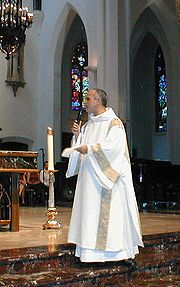
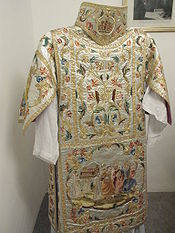
Tunic
A tunic is any of several types of clothing for the body, of various lengths reaching from the shoulders to somewhere between the hips and the ankles...
, which serves as a liturgical vestment
Vestment
Vestments are liturgical garments and articles associated primarily with the Christian religion, especially among Latin Rite and other Catholics, Eastern Orthodox, Anglicans, and Lutherans...
in the Roman Catholic, Lutheran, Anglican, and United Methodist Churches, which is sometimes worn by a deacon
Deacon
Deacon is a ministry in the Christian Church that is generally associated with service of some kind, but which varies among theological and denominational traditions...
at the Mass
Mass (liturgy)
"Mass" is one of the names by which the sacrament of the Eucharist is called in the Roman Catholic Church: others are "Eucharist", the "Lord's Supper", the "Breaking of Bread", the "Eucharistic assembly ", the "memorial of the Lord's Passion and Resurrection", the "Holy Sacrifice", the "Holy and...
or other services. Although infrequent, it may also be worn by bishops above the alb and below the chasuble. Like the chasuble
Chasuble
The chasuble is the outermost liturgical vestment worn by clergy for the celebration of the Eucharist in Western-tradition Christian Churches that use full vestments, primarily in the Roman Catholic, Anglican and Lutheran churches, as well as in some parts of the United Methodist Church...
worn by priests and bishops, it is an outer vestment and is supposed to match the liturgical colors of the day.
A dalmatic is also worn by the British
United Kingdom
The United Kingdom of Great Britain and Northern IrelandIn the United Kingdom and Dependencies, other languages have been officially recognised as legitimate autochthonous languages under the European Charter for Regional or Minority Languages...
monarch during the coronation
Coronation
A coronation is a ceremony marking the formal investiture of a monarch and/or their consort with regal power, usually involving the placement of a crown upon their head and the presentation of other items of regalia...
ceremony.
History
Historically, the dalmatic was a garment of Byzantine dressByzantine dress
Byzantine dress changed considerably over the thousand years of the Empire, but was essentially conservative. The Byzantines liked colour and pattern, and made and exported very richly patterned cloth, especially Byzantine silk, woven and embroidered for the upper classes, and resist-dyed and...
, and was adopted by Emperor Paul I
Paul I of Russia
Paul I was the Emperor of Russia between 1796 and 1801. He also was the 72nd Prince and Grand Master of the Order of Malta .-Childhood:...
of the Russian Empire
Russian Empire
The Russian Empire was a state that existed from 1721 until the Russian Revolution of 1917. It was the successor to the Tsardom of Russia and the predecessor of the Soviet Union...
as a coronation and liturgical vestment. In Orthodox
Eastern Orthodox Church
The Orthodox Church, officially called the Orthodox Catholic Church and commonly referred to as the Eastern Orthodox Church, is the second largest Christian denomination in the world, with an estimated 300 million adherents mainly in the countries of Belarus, Bulgaria, Cyprus, Georgia, Greece,...
icon
Icon
An icon is a religious work of art, most commonly a painting, from Eastern Christianity and in certain Eastern Catholic churches...
s of Jesus Christ as King
Monarch
A monarch is the person who heads a monarchy. This is a form of government in which a state or polity is ruled or controlled by an individual who typically inherits the throne by birth and occasionally rules for life or until abdication...
and Great High Priest he is shown in a dalmatic.
It was a normal item of clothing at the time when ecclesiastical clothes began to develop separately around the fourth century, worn over a longer tunic by the upper classes, and as the longest part of the dress of men of lower rank.
Roman Catholic Church
The dalmatic is a robe with wide sleeves; it reaches to at least the knees or lower. In 18th Century vestment fashion, it is customary to slit the under side of the sleeves so that the dalmatic becomes a mantle like a scapularScapular
The term scapular as used today refers to two specific, yet related, Christian Sacramentals, namely the monastic and devotional scapulars, although both forms may simply be referred to as "scapular"....
with an opening for the head and two square pieces of the material falling from the shoulder over the upper arm. Modern dalmatics tend to be longer and have closed sleeves, with the sides being open below the sleeve. The distinctive ornamentation of the vestment consists of two vertical stripes running from the shoulder to the hem; according to Roman usage these stripes are narrow and sometimes united at the bottom by two narrow cross-stripes. Outside of Rome the vertical stripes are quite broad and the cross-piece is on the upper part of the garment. At a Pontifical High Mass
Pontifical High Mass
In the context of the Tridentine Mass of the Roman Catholic Church, a Pontifical High Mass, also called Solemn Pontifical Mass, is a Solemn or High Mass celebrated by a bishop using certain prescribed ceremonies. The term is also used among Anglo-Catholic Anglicans.-Origins:In the early Church,...
, a dalmatic (usually made of lighter material) is worn by the bishop under the chasuble. At solemn papal liturgical occasions the Pope is assisted by two Cardinal-Deacons vested in a dalmatic and wearing a mitra simplex (simple white mitre
Mitre
The mitre , also spelled miter, is a type of headwear now known as the traditional, ceremonial head-dress of bishops and certain abbots in the Roman Catholic Church, as well as in the Anglican Communion, some Lutheran churches, and also bishops and certain other clergy in the Eastern Orthodox...
).
In the Roman Catholic Church the subdeacon
Subdeacon
-Subdeacons in the Orthodox Church:A subdeacon or hypodeacon is the highest of the minor orders of clergy in the Orthodox Church. This order is higher than the reader and lower than the deacon.-Canonical Discipline:...
s wore a vestment called the tunicle
Tunicle
The tunicle is a liturgical vestment associated with Roman Catholicism and Anglicanism.For a description of the tunicle, see dalmatic, the vestment with which it became identical in form, although earlier editions of the Caeremoniale Episcoporum indicated that it should have narrower sleeves...
which was originally distinct from a dalmatic but by the 17th century the two became identical, though a tunicle was often less ornamented than a dalmatic, the main difference often being only one horizontal stripe versus the two becoming a deacon's vestment. Additionally, unlike deacons, subdeacons do not wear a stole under their tunicle. Today, the tunicle is rare in the Roman Catholic Church as only certain authorized clerical societies (such as the Priestly Fraternity of St. Peter
Priestly Fraternity of St. Peter
The Priestly Fraternity of St. Peter is a traditionalist Catholic Society of Apostolic Life of priests and seminarians in good standing with the Holy See.-Canonical status:...
) have subdeacons.
Traditionally the dalmatic was not used in the Roman rite by deacons during Lent. In its place, depending on the point in the liturgy, was worn either a folded chasuble
Chasuble
The chasuble is the outermost liturgical vestment worn by clergy for the celebration of the Eucharist in Western-tradition Christian Churches that use full vestments, primarily in the Roman Catholic, Anglican and Lutheran churches, as well as in some parts of the United Methodist Church...
or what was called a broad stole, which represented a rolled-up chasuble. This tradition went back to a time at which the dalmatic was still considered an essential secular garment and thus not appropriate to be worn during the penitential season of Lent.
Eastern tradition
In the Eastern Orthodox ChurchEastern Orthodox Church
The Orthodox Church, officially called the Orthodox Catholic Church and commonly referred to as the Eastern Orthodox Church, is the second largest Christian denomination in the world, with an estimated 300 million adherents mainly in the countries of Belarus, Bulgaria, Cyprus, Georgia, Greece,...
es and Eastern Catholic Churches, there are two vestments very similar to the dalmatic. The first is the sticharion
Sticharion
The sticharion is a liturgical vestment of the Eastern Orthodox and Eastern Catholic Churches, roughly analogous in function to the alb of the Western Church...
worn as the outer vestment by subdeacon
Subdeacon
-Subdeacons in the Orthodox Church:A subdeacon or hypodeacon is the highest of the minor orders of clergy in the Orthodox Church. This order is higher than the reader and lower than the deacon.-Canonical Discipline:...
s and deacons and servers and as an undergarment by priests and bishop
Bishop
A bishop is an ordained or consecrated member of the Christian clergy who is generally entrusted with a position of authority and oversight. Within the Catholic Church, Eastern Orthodox, Oriental Orthodox Churches, in the Assyrian Church of the East, in the Independent Catholic Churches, and in the...
s, strictly speaking, corresponding to a Western Alb
Alb
The alb , one of the liturgical vestments of the Roman Catholic, Anglican and many Protestant churches, is an ample white garment coming down to the ankles and usually girdled with a cincture. It is simply the long linen tunic used by the Romans...
. The second is the sakkos
Sakkos
The Sakkos is a vestment worn by Orthodox and Greek Catholic bishops instead of the priest's phelonion. The garment is a tunic with wide sleeves, and a distinctive pattern of trim. It reaches below the knees and is fastened up the sides with buttons or tied with ribbons...
, which is more elaborately decorated and more amply cut, worn as an outer vestment by the bishops, derived from Byzantine imperial dress, and hence identical in origin to the Western Dalmatic.