

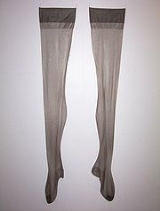
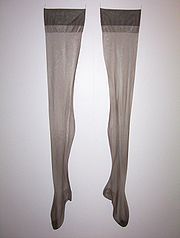
Stocking

Encyclopedia
Clothing
Clothing refers to any covering for the human body that is worn. The wearing of clothing is exclusively a human characteristic and is a feature of nearly all human societies...
covering the foot and lower part of the leg. Stockings vary in color, design and transparency. By analogy, the term is also used to describe a type of horse marking
Horse markings
Markings on horses usually are distinctive white areas on an otherwise dark base coat color. Most horses have some markings, and they help to identify the horse as a unique individual. Markings are present at birth and do not change over the course of the horse's life...
in which the white coloring extends from the horse's hoof to just above the knee.
Today, stockings are primarily worn by women for fashion and aesthetics
Aesthetics
Aesthetics is a branch of philosophy dealing with the nature of beauty, art, and taste, and with the creation and appreciation of beauty. It is more scientifically defined as the study of sensory or sensori-emotional values, sometimes called judgments of sentiment and taste...
, usually in association with mid-length skirt
Skirt
A skirt is a tube- or cone-shaped garment that hangs from the waist and covers all or part of the legs.In the western world, skirts are usually considered women's clothing. However, there are exceptions...
s. They can also be worn for increased warmth. They are also sometimes worn by men
Pantyhose for men
In American English, the term pantyhose refers to a garment traditionally worn by women, at least since their introduction in 1959. However, some manufacturers also produce pantyhose for men .-History:...
, and in cross-dressing
Cross-dressing
Cross-dressing is the wearing of clothing and other accoutrement commonly associated with a gender within a particular society that is seen as different than the one usually presented by the dresser...
and fetishism.
History
Historically, even though the word sock is at least as ancient in origin, what men normally wore were often referred to as stockings, probably especially when referring to longer hose at times when they were the fashion for men. The word stock used to refer to the bottom "stumpStump
In its most general sense, stump is an English word. It may refer to:*Tree stump, the rooted remains of a felled tree*Stump, the remains of a limb after amputation...
" part of the body, and by analogy
Analogy
Analogy is a cognitive process of transferring information or meaning from a particular subject to another particular subject , and a linguistic expression corresponding to such a process...
the word was used to refer to the one-piece covering of the lower trunk and limbs of the 15th century—essentially tights
Tights
Tights are a kind of cloth leg garment, most often sheathing the body from about the waist to the feet with a more or less tight fit, hence the name....
consisting of the upper-stocks (later to be worn separately as knee breeches) and nether-stocks (later to be worn separately as stockings). (See Hose
Hose (clothing)
Hose are any of various styles of men's clothing for the legs and lower body, worn from the Middle Ages through the 17th century, when the term fell out of use in favor of breeches and stockings. The old plural form of "hose" was hosen...
.)
Before the 1590s, stockings were made of woven cloth. The first knitting machine
Knitting machine
A knitting machine is a device used to create knitted fabrics in a semi- or fully automated fashion.There are numerous types of knitting machines, ranging from the simple, non-mechanical, to the highly complex and electronic. All, however, produce various types of knitted fabrics, usually either...
s were for making stockings. The stockings themselves were made of cotton, linen
Linen
Linen is a textile made from the fibers of the flax plant, Linum usitatissimum. Linen is labor-intensive to manufacture, but when it is made into garments, it is valued for its exceptional coolness and freshness in hot weather....
, wool
Wool
Wool is the textile fiber obtained from sheep and certain other animals, including cashmere from goats, mohair from goats, qiviut from muskoxen, vicuña, alpaca, camel from animals in the camel family, and angora from rabbits....
or silk
Silk
Silk is a natural protein fiber, some forms of which can be woven into textiles. The best-known type of silk is obtained from the cocoons of the larvae of the mulberry silkworm Bombyx mori reared in captivity...
. A polished cotton called lisle
Lisle
Lisle is a type of cotton fabric that has been processed to give it a smooth finish. The process burns off lint and threads as well as fibre ends, leaving a smooth edge...
was common, as were those made in the town of Balbriggan
Balbriggan
Balbriggan is a town in the northern part of the administrative county of Fingal, within County Dublin, Ireland. The 2006 census population was 15,559 for Balbriggan and its environs.- Name :...
.
Before the 1920s, women's stockings, if worn, were worn for warmth. In the 1920s, as hemline
Hemline
The hemline is the line formed by the lower edge of a garment, such as a skirt, dress or coat, measured from the floor.The hemline is perhaps the most variable style line in fashion, changing shape and ranging in height from hip-high to floor-length...
s of women's dresses rose, women began to wear stockings to cover the exposed legs. These stockings were sheer, first made of silk or rayon
Rayon
Rayon is a manufactured regenerated cellulose fiber. Because it is produced from naturally occurring polymers, it is neither a truly synthetic fiber nor a natural fiber; it is a semi-synthetic or artificial fiber. Rayon is known by the names viscose rayon and art silk in the textile industry...
(then known as "artificial silk"), and after 1940 of nylon. The first pantyhose
Pantyhose
Pantyhose are sheer, close-fitting legwear, covering the wearer's body from the waist to the feet. Mostly considered to be a woman's and girl's garment, pantyhose appeared in the 1960s, and they provided a convenient alternative to stockings...
made an appearance in the 1940s and 1950s, when film and theater productions had stockings sewn to the briefs of actresses and dancers, according to actress-dancer Ann Miller
Ann Miller
Johnnie Lucille Collier, better known as Ann Miller was an American singer, dancer and actress.-Early life:...
and seen in popular films such as Daddy Long Legs
Daddy Long Legs (film)
Daddy Long Legs is a Hollywood musical comedy film set in France, New York City, and the fictional college town of "Walston" in Massachusetts. The film was directed by Jean Negulesco, and stars Fred Astaire, Leslie Caron, Terry Moore, Fred Clark, and Thelma Ritter, with music and lyrics by Johnny...
. Today, stockings are commonly made using knitted
Knitting
Knitting is a method by which thread or yarn may be turned into cloth or other fine crafts. Knitted fabric consists of consecutive rows of loops, called stitches. As each row progresses, a new loop is pulled through an existing loop. The active stitches are held on a needle until another loop can...
wool, silk, cotton or nylon (see hosiery
Hosiery
Hosiery, also referred to as legwear, describes garments worn directly on the feet and legs. The term originated as the collective term for products of which a maker or seller is termed a hosier; and those products are also known generically as hose...
). The introduction of pantyhose in 1959 provided a convenient alternative to stockings, and the use of stockings declined dramatically. In 1970, U.S. sales of pantyhose exceeded stockings for the first time, and has remained this way ever since.
Benefits and drawbacks
Stockings are sometimes preferred to pantyhose for a number of reasons. These may include the perception that stockings, and the associated use of garterGarter (stockings)
Garters are articles of clothing: narrow bands of fabric fastened about the leg, used to keep up stockings, and sometimes socks. Normally just a few inches in width, they are usually made of leather or heavy cloth, and adorned with small bells and/or ribbons...
s, lace, high fashion, appliqué
Applique
In its broadest sense, an appliqué is a smaller ornament or device applied to another surface. In the context of ceramics, for example, an appliqué is a separate piece of clay added to the primary work, generally for the purpose of decoration...
and the exposure of the thigh, are more aesthetically pleasing, or sexually attractive, than pantyhose. They are also regarded as cleaner and healthier, while pantyhose tends to create a humid and warm environment in the crotch area, increasing perspiration and potentially promoting fungal and bacterial growth. Stockings, on the other hand, provide ventilation in the crotch, resulting in a reduction of fungal and bacterial growth.
However, stockings have a drawback in colder weather, because more skin is exposed to the cold compared to pantyhose. Also, pantyhose does not require garters and garter belts, does not need to be adjusted as much, and leaves a smoother line under form-fitting clothing.
Support

- A garter belt (AmEAmerican EnglishAmerican English is a set of dialects of the English language used mostly in the United States. Approximately two-thirds of the world's native speakers of English live in the United States....
), or suspender belt (BrEBritish EnglishBritish English, or English , is the broad term used to distinguish the forms of the English language used in the United Kingdom from forms used elsewhere...
), is the most common way of holding up stockings. It is a piece of lingerie worn around the waist like a belt which has "suspenders" or "stays" that clip to the tops of the stockings to hold them in place.
- "Stay-ups"Hold-upsHold-ups or stay-ups are stockings with a band of elastic sewn to the top, designed to hold the stockings up when worn, without the need for a garter belt or garters...
is the second most common means of support. The inside of the top of the stockings has a band (typically siliconeSiliconeSilicones are inert, synthetic compounds with a variety of forms and uses. Typically heat-resistant and rubber-like, they are used in sealants, adhesives, lubricants, medical applications , cookware, and insulation....
) of elastic or highly tractive material that resists slipping down the thigh. Stay-ups have drawbacks because there is no consistent sizing for differences in thigh circumference, resulting in some stockings either falling down or being too tight, leaving red marks and possibly aggravating varicose veinsVaricose veinsVaricose veins are veins that have become enlarged and tortuous. The term commonly refers to the veins on the leg, although varicose veins can occur elsewhere. Veins have leaflet valves to prevent blood from flowing backwards . Leg muscles pump the veins to return blood to the heart, against the...
.
- A garterGarter (stockings)Garters are articles of clothing: narrow bands of fabric fastened about the leg, used to keep up stockings, and sometimes socks. Normally just a few inches in width, they are usually made of leather or heavy cloth, and adorned with small bells and/or ribbons...
is the least common means of support. It is slipped over the top of the stocking to hold the stocking by essentially clamping it to the leg. These are the garters typically seen at weddings. They have much the same disadvantages as "stay-ups".
Terminology
Tights
Tights are a kind of cloth leg garment, most often sheathing the body from about the waist to the feet with a more or less tight fit, hence the name....
or pantyhose (American English).
Other terms used with stockings include:
- Cuban heelCuban heelCuban heel may refer to:* Stocking with a heel made with folded over and sewn reinforcement* High-heeled footwear - Men* Heel - MaleSee also:* Beatle boots...
: A stocking with a heel made with folded over and sewn reinforcement. - Demi-toe: Stockings which have a reinforced toe with half the coverage on top as on the bottom. This results in a reinforcement that covers only the tip of the toes as opposed to the whole toe. These can be with or without a reinforced heel.
- Denier: The lower the denier number the sheerer the garment. Stockings knitted with a higher denier tend to be less sheer but more durable.
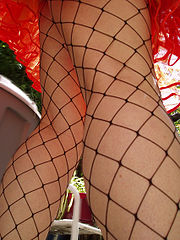
- FishnetFishnet (material)In the field of textiles, fishnet is hosiery with an open, diamond shaped knit; it is most often used as a material for stockings, tights or bodystockings. Fishnet is available in a multitude of colors, although it is most often sported in traditional matte black...
: Knitted stockings with a very wide open knit resembling a fish net. - Fencenet: Similar to fishnet, but with a much wider pattern. These are sometimes worn over another pair of stockings or pantyhose, such as matte or opaque, with a contrasting colour. Sometimes referred to as whalenets.
- Full FashionedFully fashioned stockingsFully fashioned stockings , are stockings that are knitted flat and then the two sides are sewn together forming what is the seam. The seam is an integral part of the stocking and not sewn on afterwards as is the case with more modern stockings...
: Fully fashioned stockings are knitted flat, the material is then cut and the two sides are then united by a seam up the back. Fully fashioned stockings were the most popular style until the 1960s. - Hold-upsHold-upsHold-ups or stay-ups are stockings with a band of elastic sewn to the top, designed to hold the stockings up when worn, without the need for a garter belt or garters...
or Stay-ups: Stockings that are held up by sewn-in elasticated bands (quite often a wide lace top band). In the US they are referred to as thigh-highs. - Knee-Highs: Stockings that terminate at or just barely below the knee. Also known as half-stockings, trouser socks, or socks.
- MatteMatteMatte may refer to:In film:* Matte , filmmaking and video production technology* Matte painting, a process of creating sets used in film and video* Matte box, a camera accessory for controlling lens glare...
: Stockings which have a dull or non-lustre finish. - Mock seam: A false seam sewn into the back of a seamless stocking.
- Nude heel: Stockings without reinforcement in the heel area.
- Opaque: Stockings made of yarn which give them a heavier appearance (usually 40 denier or greater).
- RHT: Abbreviation of reinforced heel and toe.
- Open-toed: Stockings that stop at the base of the toe with a piece that goes between the first and second toes to hold them down. They can be worn with some open-toed shoes, especially to show off pedicured toes.
- Sandalfoot: Stockings with a nude toe, meaning no heavier yarn in the toe than is in the leg.
- SeamedFully fashioned stockingsFully fashioned stockings , are stockings that are knitted flat and then the two sides are sewn together forming what is the seam. The seam is an integral part of the stocking and not sewn on afterwards as is the case with more modern stockings...
: Stockings manufactured in the old Full-Fashioned manner with a seam running up the back of the leg. In the past they were manufactured by cutting the fabric and then sewing it together. Today stockings are generally fully knitted and a fake or mock seam is added up the back for a particular fashion look. - SeamlessSeamlessSeamless means not to have a seam and may refer to:* Seamless robe of Jesus** Seamless garment, an abortion-related phrase referenced to the above*** Seamless Garment Network, a pro-life organization founded in 1987Technology...
: Stockings knit in one operation on circular machines (one continuous operation) so that no seaming is required up the back. - Sheers: Stockings generally of a 15 to 20 denier.
- Thigh-HighsHold-upsHold-ups or stay-ups are stockings with a band of elastic sewn to the top, designed to hold the stockings up when worn, without the need for a garter belt or garters...
: Stockings that terminate somewhere in the mid-thigh. - Ultra SheerUltra sheerUltra sheer refers to very light deniers of stockings or pantyhose, usually 10 or less. The denier of a stocking refers to the thickness of the nylon yarn used in the fabric. The greater the denier, the more durable the material and less prone to tearing . Ultra sheer stockings have a very light...
: A fine denier fiber which gives the ultimate in sheerness. Usually 10 denier. - WeltWeltA welt is an alternative name for a wheal, a skin lesion. Welt may also refer to:* Die Welt, a German national newspaper* Welt , a part of a shoe* Welt , an album by ohGr* Welt, Germany...
: A fabric knitted separately and machine-sewn to the top of a stocking. Knit in a heavier denier yarn and folded double to give strength for supporter fastening.
See also
- BodystockingBodystockingA bodystocking is a one-piece article of lingerie that covers the torso, legs and sometimes the arms of the wearer. Similar in texture and look to stockings or pantyhose, a bodystocking is not a unitard, which is worn as an outfit or article of clothing, or a leotard, which is used as a practice...
- CorsetCorsetA corset is a garment worn to hold and shape the torso into a desired shape for aesthetic or medical purposes...
- LeggingsLeggingsLeggings are a type of fitted clothing covering the legs, which can be worn by both men and women.Originally leggings were two separate garments, one for each leg....
- SockSockA sock is an item of clothing worn on the feet. The foot is among the heaviest producers of sweat in the body, as it is able to produce over of perspiration per day. Socks help to absorb this sweat and draw it to areas where air can evaporate the perspiration. In cold environments, socks decrease...
- Stocking fetishism
- TabiTabiare traditional Japanese socks. Ankle-high and with a separation between the big toe and other toes, they are worn by both men and women with zori, geta, and other traditional thonged footwear. Tabi are also essential with traditional clothing—kimono and other wafuku as well as being worn by...
Further reading
- Cox, Caroline (2000). Lingerie: a lexicon of style. Scriptum Editions. ISBN 1-902686-08-X.