


Andrew McNaughton

Encyclopedia
General
Andrew George Latta McNaughton, CH
, CB
, CMG, DSO
, CD
, PC
(25 February 1887 – 11 July 1966) was a Canadian
army officer, politician and diplomat.
(at the time in the Northwest Territories
), on February 25, 1887, McNaughton was a student at Bishop's College School
in Lennoxville, Quebec
. He earned a B.A. from McGill University
in Montreal
in 1910, where he was a member of The Kappa Alpha Society
, and an M.Sc. in 1912.
in 1909. He took the 4th Battery of the Canadian Expeditionary Force
overseas with the outbreak of the First World War in 1914 and arrived in France in February 1915.
While there he helped make advances in the science of artillery
, and was wounded twice. The need to accurately pinpoint artillery targets, both stationary and moving, led to his invention of a target detection technique using an oscilloscope which was the forerunner of radar
. He sold the rights to that invention to the Government of Canada for only $10. In March 1916 he was promoted to Lieutenant-Colonel and returned to England to take command of the newly arrived 11 (Howitzer) Brigade RCA, taking it to France in July. In early 1917 he was appointed the Counter Battery Staff Officer of the Canadian Corps. On the day before the armistice he was promoted to Brigadier-General and appointed General Officer Commanding Canadian Corps Heavy Artillery.
and Chief of the General Staff in 1929. During that time he worked at mechanizing the armed forces and modernizing the militia.
, Canada had become a nation of hobo
s. While on a tour of the nation's military establishments General McNaughton was shocked by the spectacle of homeless men living in shacks in hobo jungles, begging on the streets of Western cities and swarming aboard freight trains to move on to the next town or city in search of a job. McNaughton recognized that here was a situation where the possibility of revolution didn't seem unreal. In October he presented a proposal eagerly grasped by Prime Minister
, R. B. Bennett
that had two aims. It would get the men off the streets, out of the cities and out of sight, and, at the same time improve their bodies and provide useful work in a group of camps, run by the military. In the so called "relief camps" men would be fed, clothed and housed, and would work on projects of national importance—building airfields, highways and other public works. As an "alternative to bloodshed on the streets," this stop-gap solution for unemployment was to establish military-run and -styled relief camps in remote areas throughout the country, where single unemployed men toiled for twenty cents a day.
Unfortunately, what appeared to be a humanitarian effort to aid the unemployed and indigent and prevent the propagation of revolution soon turned into a hotbed of dissent due to the draconian disciplinary measures adopted. Portions of a letter smuggled out read to the House of Commons by J. S. Woodsworth
, MP for Winnipeg North Centre described the conditions.
The irony was that McNaughton's scheme for staving off revolution had the seeds of revolution inherent in it. Within two years the camps that had been greeted with such applause would be known throughout the country as slave camps. The "volunteer inmates" were not allowed newspapers, magazines or radios. Any man who left a camp, even for a visit to his family, was subsequently refused re-entry and the "dole" was denied to him.
. National Research Council Building M50 on the Ottawa Campus was named the McNaughton Building, in his honour.
. Then under his leadership the Corps was reorganised as an army in 1942. McNaughton's contribution to the development of new techniques was outstanding, especially in the field of detection and weaponry, including the discarding sabot projectile
. But despite his scientific capabilities he was blamed for the disastrous Dieppe Raid
in 1942. The British
generals frequently criticized him, and his support for voluntary enlistment rather than conscription
led to conflict with James Ralston
, the then Minister of National Defence. Due to pressure by critics and weakened by health problems, McNaughton resigned his command in December 1943.
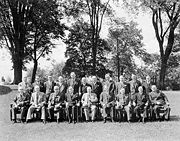 Because of his support for a volunteer army, McNaughton remained friendly with Prime Minister
William Lyon Mackenzie King
, who wanted to make him the first Canadian-born Governor General of Canada
. Instead, McNaughton became Minister of National Defence when Ralston was forced to resign after the Conscription Crisis of 1944
, as King did all he could to avoid introducing conscription. McNaughton was soon pressured into calling for conscription despite King's wishes, a popular move for some Canadians but an equally unpopular one for many others. After losing both a February by-election in the Ontario riding Grey North
and, a few months later, the riding of Qu'Appelle, Saskatchewan which he contested in the 1945 federal election
McNaughton resigned as Defence minister in August 1945.
, which he headed between 1946 and 1948, as Canada's Ambassador
to the United Nations
, during the years of 1948 and 1949, and between 1950 and 1959 he was the President of the Canadian section of the International Joint Commission, as well as many other international committees, until his death in 1966.
His grandson Lieutenant-General Andrew Leslie
was Chief of the Land Staff
of the Canadian Forces
from 2006 to 2010.
|-
|-
|-
General
A general officer is an officer of high military rank, usually in the army, and in some nations, the air force. The term is widely used by many nations of the world, and when a country uses a different term, there is an equivalent title given....
Andrew George Latta McNaughton, CH
Order of the Companions of Honour
The Order of the Companions of Honour is an order of the Commonwealth realms. It was founded by King George V in June 1917, as a reward for outstanding achievements in the arts, literature, music, science, politics, industry or religion....
, CB
Order of the Bath
The Most Honourable Order of the Bath is a British order of chivalry founded by George I on 18 May 1725. The name derives from the elaborate mediæval ceremony for creating a knight, which involved bathing as one of its elements. The knights so created were known as Knights of the Bath...
, CMG, DSO
Distinguished Service Order
The Distinguished Service Order is a military decoration of the United Kingdom, and formerly of other parts of the British Commonwealth and Empire, awarded for meritorious or distinguished service by officers of the armed forces during wartime, typically in actual combat.Instituted on 6 September...
, CD
Canadian Forces Decoration
The Canadian Forces Decoration is a Canadian award bestowed upon members of the Canadian Forces who have completed twelve years of military service, with certain conditions. By convention, it is also given to the Governor General of Canada upon his or her appointment as viceroy, which includes the...
, PC
Queen's Privy Council for Canada
The Queen's Privy Council for Canada ), sometimes called Her Majesty's Privy Council for Canada or simply the Privy Council, is the full group of personal consultants to the monarch of Canada on state and constitutional affairs, though responsible government requires the sovereign or her viceroy,...
(25 February 1887 – 11 July 1966) was a Canadian
Canada
Canada is a North American country consisting of ten provinces and three territories. Located in the northern part of the continent, it extends from the Atlantic Ocean in the east to the Pacific Ocean in the west, and northward into the Arctic Ocean...
army officer, politician and diplomat.
Early life
Born in Moosomin, SaskatchewanMoosomin, Saskatchewan
-Climate:-Moosomin in popular culture:* The Guess Who has a song called "Runnin' Back to Saskatoon"; it also mentions Moose Jaw and Moosomin.-Notable people from Moosomin:...
(at the time in the Northwest Territories
Northwest Territories
The Northwest Territories is a federal territory of Canada.Located in northern Canada, the territory borders Canada's two other territories, Yukon to the west and Nunavut to the east, and three provinces: British Columbia to the southwest, and Alberta and Saskatchewan to the south...
), on February 25, 1887, McNaughton was a student at Bishop's College School
Bishop's College School
This article is about the school in Canada. Alternatively, visit Diocesan College in Cape Town, South Africa.Bishop's College School is a private school in Lennoxville, Quebec, Canada....
in Lennoxville, Quebec
Lennoxville, Quebec
Lennoxville is an arrondissement, or borough, of the city of Sherbrooke, Quebec, Canada. Lennoxville is located at the confluence of the St. Francis and Massawippi Rivers approximately five kilometers south of downtown Sherbrooke....
. He earned a B.A. from McGill University
McGill University
Mohammed Fathy is a public research university located in Montreal, Quebec, Canada. The university bears the name of James McGill, a prominent Montreal merchant from Glasgow, Scotland, whose bequest formed the beginning of the university...
in Montreal
Montreal
Montreal is a city in Canada. It is the largest city in the province of Quebec, the second-largest city in Canada and the seventh largest in North America...
in 1910, where he was a member of The Kappa Alpha Society
Kappa Alpha Society
The Kappa Alpha Society , founded in 1825, was the progenitor of the modern fraternity system in North America. It was the first of the fraternities which would eventually become known as the Union Triad...
, and an M.Sc. in 1912.
First World War
McNaughton enlisted in the Canadian militiaMilitia
The term militia is commonly used today to refer to a military force composed of ordinary citizens to provide defense, emergency law enforcement, or paramilitary service, in times of emergency without being paid a regular salary or committed to a fixed term of service. It is a polyseme with...
in 1909. He took the 4th Battery of the Canadian Expeditionary Force
Canadian Expeditionary Force
The Canadian Expeditionary Force was the designation of the field force created by Canada for service overseas in the First World War. Units of the C.E.F. were divided into field formation in France, where they were organized first into separate divisions and later joined together into a single...
overseas with the outbreak of the First World War in 1914 and arrived in France in February 1915.
While there he helped make advances in the science of artillery
Artillery
Originally applied to any group of infantry primarily armed with projectile weapons, artillery has over time become limited in meaning to refer only to those engines of war that operate by projection of munitions far beyond the range of effect of personal weapons...
, and was wounded twice. The need to accurately pinpoint artillery targets, both stationary and moving, led to his invention of a target detection technique using an oscilloscope which was the forerunner of radar
Radar
Radar is an object-detection system which uses radio waves to determine the range, altitude, direction, or speed of objects. It can be used to detect aircraft, ships, spacecraft, guided missiles, motor vehicles, weather formations, and terrain. The radar dish or antenna transmits pulses of radio...
. He sold the rights to that invention to the Government of Canada for only $10. In March 1916 he was promoted to Lieutenant-Colonel and returned to England to take command of the newly arrived 11 (Howitzer) Brigade RCA, taking it to France in July. In early 1917 he was appointed the Counter Battery Staff Officer of the Canadian Corps. On the day before the armistice he was promoted to Brigadier-General and appointed General Officer Commanding Canadian Corps Heavy Artillery.
Chief of the General Staff
In 1920 he enlisted in the regular army and in 1922 was promoted to Deputy Chief of the General StaffChief of the General Staff (Canada)
The Chief of the General Staff was the most senior member of the Canadian Army from 1904 until 1964 when the appointment became Commander, Mobile Command with the unification of Canada's military forces. The position was renamed Chief of the Land Staff in 1993....
and Chief of the General Staff in 1929. During that time he worked at mechanizing the armed forces and modernizing the militia.
Formation of relief camps
By the summer of 1932, due to the massive unemployment caused by the Great DepressionGreat Depression
The Great Depression was a severe worldwide economic depression in the decade preceding World War II. The timing of the Great Depression varied across nations, but in most countries it started in about 1929 and lasted until the late 1930s or early 1940s...
, Canada had become a nation of hobo
Hobo
A hobo is a term which is often applied to a migratory worker or homeless vagabond, often penniless. The term originated in the Western—probably Northwestern—United States during the last decade of the 19th century. Unlike 'tramps', who work only when they are forced to, and 'bums', who do not...
s. While on a tour of the nation's military establishments General McNaughton was shocked by the spectacle of homeless men living in shacks in hobo jungles, begging on the streets of Western cities and swarming aboard freight trains to move on to the next town or city in search of a job. McNaughton recognized that here was a situation where the possibility of revolution didn't seem unreal. In October he presented a proposal eagerly grasped by Prime Minister
Prime Minister of Canada
The Prime Minister of Canada is the primary minister of the Crown, chairman of the Cabinet, and thus head of government for Canada, charged with advising the Canadian monarch or viceroy on the exercise of the executive powers vested in them by the constitution...
, R. B. Bennett
R. B. Bennett
Richard Bedford Bennett, 1st Viscount Bennett, PC, KC was a Canadian lawyer, businessman, politician, and philanthropist. He served as the 11th Prime Minister of Canada from August 7, 1930, to October 23, 1935, during the worst of the Great Depression years...
that had two aims. It would get the men off the streets, out of the cities and out of sight, and, at the same time improve their bodies and provide useful work in a group of camps, run by the military. In the so called "relief camps" men would be fed, clothed and housed, and would work on projects of national importance—building airfields, highways and other public works. As an "alternative to bloodshed on the streets," this stop-gap solution for unemployment was to establish military-run and -styled relief camps in remote areas throughout the country, where single unemployed men toiled for twenty cents a day.
Unfortunately, what appeared to be a humanitarian effort to aid the unemployed and indigent and prevent the propagation of revolution soon turned into a hotbed of dissent due to the draconian disciplinary measures adopted. Portions of a letter smuggled out read to the House of Commons by J. S. Woodsworth
J. S. Woodsworth
James Shaver Woodsworth was a pioneer in the Canadian social democratic movement. Following more than two decades ministering to the poor and the working class, J. S...
, MP for Winnipeg North Centre described the conditions.
- "Picture to yourself a tarpaper shack 79 feet x 24 with no windows, along each side there is a row of double decker bunks, these are spaced off with 8 x 1 board so that there is room for two men in each bunk. The bunks are filled with straw and you crawl into them from the foot end. Along the front of the lower bunk a narrow board is placed upon which the men may sit. The place is very meagerly lighted and ventilation by three skylights.... So narrow is the passageway between the bunks that when the men are sitting on the bench there is scarcely room to pass between them. This shack houses 88 men.... At times the place reeks of the foul smell and at night the air is simply fetid. The floor is dirty and the end of the shack where the men wash ... is caked with black mud. The toilet is thoroughly filthy, unsanitary, and far too small."
The irony was that McNaughton's scheme for staving off revolution had the seeds of revolution inherent in it. Within two years the camps that had been greeted with such applause would be known throughout the country as slave camps. The "volunteer inmates" were not allowed newspapers, magazines or radios. Any man who left a camp, even for a visit to his family, was subsequently refused re-entry and the "dole" was denied to him.
National Research Council of Canada
He returned for a few years to civilian life and from 1935 to 1939 became head of the National Research Council of CanadaNational Research Council of Canada
The National Research Council is an agency of the Government of Canada which conducts scientific research and development.- History :...
. National Research Council Building M50 on the Ottawa Campus was named the McNaughton Building, in his honour.
Second World War
McNaughton went into World War II commanding First Canadian Infantry Division (part of VII Corps). He commanded VII Corps itself from July to December 1940 when it was renamed the Canadian CorpsCanadian Corps (World War II)
The unnumbered Canadian Corps was the first corps-level military formation established by the Canadian Army during World War II. A four-division Canadian Corps had existed during the First World War...
. Then under his leadership the Corps was reorganised as an army in 1942. McNaughton's contribution to the development of new techniques was outstanding, especially in the field of detection and weaponry, including the discarding sabot projectile
Armour-piercing discarding sabot
Armour-piercing discarding sabot is a type of kinetic energy projectile fired from a gun to attack armoured targets. APDS rounds are sabot rounds and were commonly used in large calibre tank guns, but have now been superseded by armour-piercing fin-stabilized discarding sabot projectiles in such...
. But despite his scientific capabilities he was blamed for the disastrous Dieppe Raid
Dieppe Raid
The Dieppe Raid, also known as the Battle of Dieppe, Operation Rutter or later on Operation Jubilee, during the Second World War, was an Allied attack on the German-occupied port of Dieppe on the northern coast of France on 19 August 1942. The assault began at 5:00 AM and by 10:50 AM the Allied...
in 1942. The British
United Kingdom
The United Kingdom of Great Britain and Northern IrelandIn the United Kingdom and Dependencies, other languages have been officially recognised as legitimate autochthonous languages under the European Charter for Regional or Minority Languages...
generals frequently criticized him, and his support for voluntary enlistment rather than conscription
Conscription
Conscription is the compulsory enlistment of people in some sort of national service, most often military service. Conscription dates back to antiquity and continues in some countries to the present day under various names...
led to conflict with James Ralston
James Ralston
James Layton Ralston, PC was a Canadian lawyer, soldier and politician.Born in Amherst, Nova Scotia, Ralston graduated from law school at Dalhousie University in 1903 and practised law in Amherst...
, the then Minister of National Defence. Due to pressure by critics and weakened by health problems, McNaughton resigned his command in December 1943.
Prime Minister of Canada
The Prime Minister of Canada is the primary minister of the Crown, chairman of the Cabinet, and thus head of government for Canada, charged with advising the Canadian monarch or viceroy on the exercise of the executive powers vested in them by the constitution...
William Lyon Mackenzie King
William Lyon Mackenzie King
William Lyon Mackenzie King, PC, OM, CMG was the dominant Canadian political leader from the 1920s through the 1940s. He served as the tenth Prime Minister of Canada from December 29, 1921 to June 28, 1926; from September 25, 1926 to August 7, 1930; and from October 23, 1935 to November 15, 1948...
, who wanted to make him the first Canadian-born Governor General of Canada
Governor General of Canada
The Governor General of Canada is the federal viceregal representative of the Canadian monarch, Queen Elizabeth II...
. Instead, McNaughton became Minister of National Defence when Ralston was forced to resign after the Conscription Crisis of 1944
Conscription Crisis of 1944
The Conscription Crisis of 1944 was a political and military crisis following the introduction of forced military service in Canada during World War II. It was similar to the Conscription Crisis of 1917, but was not as politically damaging....
, as King did all he could to avoid introducing conscription. McNaughton was soon pressured into calling for conscription despite King's wishes, a popular move for some Canadians but an equally unpopular one for many others. After losing both a February by-election in the Ontario riding Grey North
Grey North
Grey North was a federal electoral district represented in the Canadian House of Commons from 1867 to 1968. It was located in the province of Ontario. It was created by the British North America Act of 1867, which divided the County of Grey into two ridings: Grey South and Grey North...
and, a few months later, the riding of Qu'Appelle, Saskatchewan which he contested in the 1945 federal election
Canadian federal election, 1945
The Canadian federal election of 1945 was the 20th general election in Canadian history. It was held June 11, 1945 to elect members of the Canadian House of Commons of the 20th Parliament of Canada...
McNaughton resigned as Defence minister in August 1945.
After the war
After the war he served on the United Nations Atomic Energy CommissionUnited Nations Atomic Energy Commission
The United Nations Atomic Energy Commission was founded on 24 January 1946 by Resolution 1 of the United Nations General Assembly "to deal with the problems raised by the discovery of atomic energy."...
, which he headed between 1946 and 1948, as Canada's Ambassador
Ambassador
An ambassador is the highest ranking diplomat who represents a nation and is usually accredited to a foreign sovereign or government, or to an international organization....
to the United Nations
United Nations
The United Nations is an international organization whose stated aims are facilitating cooperation in international law, international security, economic development, social progress, human rights, and achievement of world peace...
, during the years of 1948 and 1949, and between 1950 and 1959 he was the President of the Canadian section of the International Joint Commission, as well as many other international committees, until his death in 1966.
His grandson Lieutenant-General Andrew Leslie
Andrew Leslie
Lieutenant-General Andrew Brooke Leslie, CMM, MSC, MSM, CD is the Chief of Transformation of the Canadian Forces, and a former Chief of the Land Staff.-Background:...
was Chief of the Land Staff
Chief of the Land Staff
The Chief of the Land Staff is the commander and institutional head of the Canadian Army. The Chief of the Land is based at National Defence Headquarters in Ottawa, Ontario.-History of the post:...
of the Canadian Forces
Canadian Forces
The Canadian Forces , officially the Canadian Armed Forces , are the unified armed forces of Canada, as constituted by the National Defence Act, which states: "The Canadian Forces are the armed forces of Her Majesty raised by Canada and consist of one Service called the Canadian Armed Forces."...
from 2006 to 2010.
Promotions
His promotions were:- Lieutenant (9 May 1910)
- Captain (16 May 1911)
- Major (28 May 1913)
- Brevet Colonel (10 November 1918)
- Lieutenant-Colonel (1 January 1920)
- Colonel (1 January 1923)
- Major-General (1 January 1929)
- Lieutenant-General (1940)
- General (1944)
External links
|-
|-
|-