

Ancient Greek sculpture

Encyclopedia
Sculpture
Sculpture is three-dimensional artwork created by shaping or combining hard materials—typically stone such as marble—or metal, glass, or wood. Softer materials can also be used, such as clay, textiles, plastics, polymers and softer metals...
of Ancient Greece
Ancient Greece
Ancient Greece is a civilization belonging to a period of Greek history that lasted from the Archaic period of the 8th to 6th centuries BC to the end of antiquity. Immediately following this period was the beginning of the Early Middle Ages and the Byzantine era. Included in Ancient Greece is the...
. Modern scholarship identifies three major stages. They were used to depict the battles, mythology, and rulers of the land known as Ancient Greece.
Geometric
The origins of Greek sculpture have been ascribed the wooden cultCult
The word cult in current popular usage usually refers to a group whose beliefs or practices are considered abnormal or bizarre. The word originally denoted a system of ritual practices...
statues that were described by Pausanias
Pausanias (geographer)
Pausanias was a Greek traveler and geographer of the 2nd century AD, who lived in the times of Hadrian, Antoninus Pius and Marcus Aurelius. He is famous for his Description of Greece , a lengthy work that describes ancient Greece from firsthand observations, and is a crucial link between classical...
as xoana
Xoanon
A xoanon was an Archaic wooden cult image of Ancient Greece. Classical Greeks associated such cult objects, whether aniconic or effigy, with the legendary Daedalus. Many such cult images were preserved into historical times, though none have survived to the modern day, except where their image...
. No such statue survives, and the descriptions of them are vague despite the fact that some were objects of veneration
Veneration
Veneration , or veneration of saints, is a special act of honoring a saint: an angel, or a dead person who has been identified by a church committee as singular in the traditions of the religion. It is practiced by the Eastern Orthodox Church, the Roman Catholic, and Eastern Catholic Churches...
for hundreds of years. The first piece of Greek statuary to be reassembled since is probably the Lefkandi Centaur (Eretria Mus.) found on Euboia. This terra cotta
Terra cotta
Terracotta, Terra cotta or Terra-cotta is a clay-based unglazed ceramic, although the term can also be applied to glazed ceramics where the fired body is porous and red in color...
statue of circa 900 BC was constructed in parts before being dismembered and buried in two separate graves. Greeks made art to show how wonderful, and beautiful the gods and goddesses are. It seeks an intentional mark on its knee - it has been postulated that this indicates that the statue represents Cheiron and the wound from Herakles' arrow. If so, it would be the earliest known depiction of myth in Greek History.
The forms from the geometrical period (ca. 900 to 700 BC
700s BC
-Events and trends:* 706 BC—Spartan immigrants found Taras colony in southern Italy.* 706 BC—Sargon II dies.* 705 BC—Sennacherib succeeds his father Sargon II as king of Assyria....
) were chiefly terracotta figurines
Figurines
Figurines is an indie rock band from Denmark, formed in the mid-1990s. The band released their first EP, The Detour, in 2001 and their first full-length album, Shake a Mountain, in 2004. The band began to receive national attention in Denmark around the time of the full-length release, and began...
, bronze
Bronze
Bronze is a metal alloy consisting primarily of copper, usually with tin as the main additive. It is hard and brittle, and it was particularly significant in antiquity, so much so that the Bronze Age was named after the metal...
s and ivories
Ivory
Ivory is a term for dentine, which constitutes the bulk of the teeth and tusks of animals, when used as a material for art or manufacturing. Ivory has been important since ancient times for making a range of items, from ivory carvings to false teeth, fans, dominoes, joint tubes, piano keys and...
. The bronzes are chiefly tripod cauldron
Cauldron
A cauldron or caldron is a large metal pot for cooking and/or boiling over an open fire, with a large mouth and frequently with an arc-shaped hanger.- Etymology :...
s and freestanding figures or groups. Such bronzes were made using the lost-wax technique probably introduced from Syria and are almost entirely votive offerings left at the Hellenistic civilization
Civilization
Civilization is a sometimes controversial term that has been used in several related ways. Primarily, the term has been used to refer to the material and instrumental side of human cultures that are complex in terms of technology, science, and division of labor. Such civilizations are generally...
Panhellenic sanctuaries of Olympia
Olympia, Greece
Olympia , a sanctuary of ancient Greece in Elis, is known for having been the site of the Olympic Games in classical times, comparable in importance to the Pythian Games held in Delphi. Both games were held every Olympiad , the Olympic Games dating back possibly further than 776 BC...
, Delos
Delos
The island of Delos , isolated in the centre of the roughly circular ring of islands called the Cyclades, near Mykonos, is one of the most important mythological, historical and archaeological sites in Greece...
and Delphi
Delphi
Delphi is both an archaeological site and a modern town in Greece on the south-western spur of Mount Parnassus in the valley of Phocis.In Greek mythology, Delphi was the site of the Delphic oracle, the most important oracle in the classical Greek world, and a major site for the worship of the god...
. These were manufactured elsewhere and a number of local styles may be identified by finds from Athens
Athens
Athens , is the capital and largest city of Greece. Athens dominates the Attica region and is one of the world's oldest cities, as its recorded history spans around 3,400 years. Classical Athens was a powerful city-state...
, Argos
Argos
Argos is a city and a former municipality in Argolis, Peloponnese, Greece. Since the 2011 local government reform it is part of the municipality Argos-Mykines, of which it is a municipal unit. It is 11 kilometres from Nafplion, which was its historic harbour...
and Sparta
Sparta
Sparta or Lacedaemon, was a prominent city-state in ancient Greece, situated on the banks of the River Eurotas in Laconia, in south-eastern Peloponnese. It emerged as a political entity around the 10th century BC, when the invading Dorians subjugated the local, non-Dorian population. From c...
. Typical works of the era include the Karditsa warrior (Athens Br. 12831) and the many examples of the equestrian statuette (for example, NY Met. 21.88.24 online). The repertory of this bronze
Bronze
Bronze is a metal alloy consisting primarily of copper, usually with tin as the main additive. It is hard and brittle, and it was particularly significant in antiquity, so much so that the Bronze Age was named after the metal...
work is not confined to standing men and horses however, as with the vase painting of the time we also find stags, birds, beetles, hares, griffins and lions. There are no inscriptions on early to middle geometric sculpture until the appearance of the Mantiklos "Apollo
Apollo
Apollo is one of the most important and complex of the Olympian deities in Greek and Roman mythology...
" (Boston 03.997) of the early 7th century found in Thebes. This is a standing figure of a man with an almost daedalic
Orientalizing Period
In the history of ancient Greece, the Orientalizing period is the cultural and art historical period informed by the art of Anatolia, Syria, Assyria, Phoenicia and Egypt, which started during the later part of the 7th century BCE. It encompasses a new, Orientalizing style, spurred by a period of...
form with the legend "Mantiklos offers me as a tithe to Apollo of the silver bow; do you, Phoibos, give some pleasing favour in return" across his thighs in hexameter verse. Apart from the novelty of recording its own purpose this sculpture it adapts the formulae of oriental bronzes as seen in the shorter more triangular face and slightly advancing left leg. This is sometimes seen as anticipating the greater expressive freedom of the 7th century and as such the Mantiklos figure is referred to in some quarters as proto-daedalic. Later in the 1900s Greek sculpture was still bronze casts.
Greek sculptures were very detailed and decorative.
Classical
Contrapposto
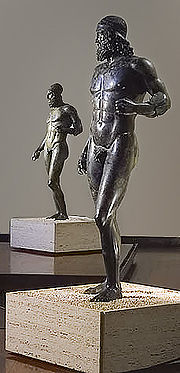
Contrapposto is an Italian term that means counterpose. It is used in the visual arts to describe a human figure standing with most of its weight on one foot so that its shoulders and arms twist off-axis from the hips and legs. This gives the figure a more dynamic, or alternatively relaxed...
, Severe style, high classical, Rich style, Late Classical Plain style. Is also a type of music.
The sculptor Polykleitos
Polykleitos
Polykleitos ; called the Elder, was a Greek sculptor in bronze of the fifth and the early 4th century BCE...
could be deemed as the creator of the Classical Period. He created works with a true naturalism and balance, unlike the rigid poses of the Archaic period. He was the first to use ideas of scale and mathematical proportions in order to create the perfectly proportioned figure, referred to as "The Polykleitan Canon of Proportion". Polykleitos was very influential in Greek Sculpture, his realistic proportions were recognized by other sculptors such as Skopas and Lysippos
Lysippos
Lysippos was a Greek sculptor of the 4th century BC. Together with Scopas and Praxiteles, he is considered one of the three greatest sculptors of the Classical Greek era, bringing transition into the Hellenistic period. Problems confront the study of Lysippos because of the difficulty of...
who successfully followed him using the ideas set out in his canon.
Lysippos
Lysippos
Lysippos was a Greek sculptor of the 4th century BC. Together with Scopas and Praxiteles, he is considered one of the three greatest sculptors of the Classical Greek era, bringing transition into the Hellenistic period. Problems confront the study of Lysippos because of the difficulty of...
was the successor of Polykleitos; he took the ideas used in creating perfect proportions and gave rise to the "Lysippan Canon of Proportion". Lysippos noted a greater realism could be captured in making the heads of his figures smaller as well as elongating the body, creating much more realistic sculptures; which was his primary aim. His scrutinising attention to detail emphasised this desire to make his sculptures as realistic as possible. This sense of realism brought about the transition into the Hellenistic Period where use of the Lysippan canon of proportion and Contrapposto
Contrapposto
Contrapposto is an Italian term that means counterpose. It is used in the visual arts to describe a human figure standing with most of its weight on one foot so that its shoulders and arms twist off-axis from the hips and legs. This gives the figure a more dynamic, or alternatively relaxed...
created extreme realism.
Creating realistic proportions was not the only way used to create statues as life like as possible. A perfectly proportioned figure will still look unnatural if in a rigid and unrelaxed pose. In the late classical period a combination of Contrapposto and "in the round" compositions (intended to be seen from multiple angles) created more interesting and natural poses. This was sparked by the sculptor Praxiteles
Praxiteles
Praxiteles of Athens, the son of Cephisodotus the Elder, was the most renowned of the Attic sculptors of the 4th century BC. He was the first to sculpt the nude female form in a life-size statue...
, with his creation of the "Praxitelean curve" or Contrapposto
Contrapposto
Contrapposto is an Italian term that means counterpose. It is used in the visual arts to describe a human figure standing with most of its weight on one foot so that its shoulders and arms twist off-axis from the hips and legs. This gives the figure a more dynamic, or alternatively relaxed...
. His fundamental aim was to create fluidity within the pose by changing from the conventional parallels of the shoulders, hips and knees to sloping angles. These angles, as seen in figures such as "Kritios Boy"- Early Classical Sculpture- and "Venus Braschi" (the first female nude) were much more comparable to the anatomy in real life, further emphasising naturalism and movement. This was a major step towards the extreme realism of the Hellenistic period.
Materials: stone and paint
Mostly marble and bronze were used in Greek sculpture. Although it was initially thought that Greek statues were mostly unadorned white marble, by the early 19th century the systematic excavation of ancient Greek sites brought forth a plethora of sculptures with traces of multicolored surfaces. Some of these traces are still visible to the naked eyeNaked eye
The naked eye is a figure of speech referring to human visual perception unaided by a magnifying or light-collecting optical device, such as a telescope or microscope. Vision corrected to normal acuity using corrective lenses is considered "naked"...
even today, though in most examples the remaining color has faded or disappeared entirely once the statues were exposed to light and air. In spite of this overwhelming evidence for painted statues, influential art historians such as Johann Joachim Winckelmann
Johann Joachim Winckelmann
Johann Joachim Winckelmann was a German art historian and archaeologist. He was a pioneering Hellenist who first articulated the difference between Greek, Greco-Roman and Roman art...
so strongly opposed the idea of painted Greek sculpture that proponents of painted statues were dismissed as eccentrics and their views largely dismissed for several centuries. It wasn't until published findings by German archaeologist Vinzenz Brinkmann in the late 20th century and early 21st century that painted Greek sculptures became an established undeniable fact. Using high intensity lamps, ultraviolet light, special cameras, plaster casts and certain powdered minerals, Brinkmann was able to scientifically prove that the entire Parthenon
Parthenon
The Parthenon is a temple on the Athenian Acropolis, Greece, dedicated to the Greek goddess Athena, whom the people of Athens considered their virgin patron. Its construction began in 447 BC when the Athenian Empire was at the height of its power. It was completed in 438 BC, although...
, including the actual structure as well as the statues, was in fact painted. He furthermore was able to reveal the pigments of the original paint and has created several painted replicas of Greek statues that are currently on tour throughout the world. Also in the collection, are replicas of works from other Greek and Roman sculptures showing that the practice of painting sculpture was widespread and in fact the normative practice rather than the exception in Greek and Roman culture. Museums to host the exhibit include the Glyptothek Museum in Munich
Munich
Munich The city's motto is "" . Before 2006, it was "Weltstadt mit Herz" . Its native name, , is derived from the Old High German Munichen, meaning "by the monks' place". The city's name derives from the monks of the Benedictine order who founded the city; hence the monk depicted on the city's coat...
, the Vatican Museum, and the National Archaeological Museum
National Archaeological Museum
National Archaeological Museum may refer to:* National Archaeological Museum, Athens, * National Archaeological Museum * National Archaeological Museum ,...
in Athens
Athens
Athens , is the capital and largest city of Greece. Athens dominates the Attica region and is one of the world's oldest cities, as its recorded history spans around 3,400 years. Classical Athens was a powerful city-state...
among others. The collection made its United States debut at Harvard University
Harvard University
Harvard University is a private Ivy League university located in Cambridge, Massachusetts, United States, established in 1636 by the Massachusetts legislature. Harvard is the oldest institution of higher learning in the United States and the first corporation chartered in the country...
in the Fall of 2007.