
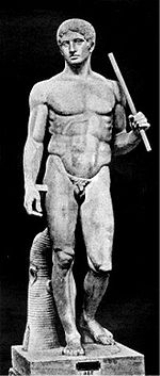
Polykleitos; called the Elder, was a
GreekAncient Greece is a civilization belonging to a period of Greek history that lasted from the Archaic period of the 8th to 6th centuries BC to the end of antiquity. Immediately following this period was the beginning of the Early Middle Ages and the Byzantine era. Included in Ancient Greece is the...
sculptorSculpture is three-dimensional artwork created by shaping or combining hard materials—typically stone such as marble—or metal, glass, or wood. Softer materials can also be used, such as clay, textiles, plastics, polymers and softer metals...
in bronze of the fifth and the early 4th century BCE. Next to
PhidiasPhidias or the great Pheidias , was a Greek sculptor, painter and architect, who lived in the 5th century BC, and is commonly regarded as one of the greatest of all sculptors of Classical Greece: Phidias' Statue of Zeus at Olympia was one of the Seven Wonders of the Ancient World...
,
MyronMyron of Eleutherae working circa 480-440 BC, was an Athenian sculptor from the mid-5th century BC. He was born in Eleutherae on the borders of Boeotia and Attica. According to Pliny's Natural History, Ageladas of Argos was his teacher....
and
KresilasKresilas was a Greek sculptor from Kydonia. He lived in the 5th century BC. He worked in Athens at the time of the Peloponnesian war, as a follower of the idealistic portraiture of Myron.-Pericles statue:...
, he is considered the most important sculptor of
Classical antiquityClassical antiquity is a broad term for a long period of cultural history centered on the Mediterranean Sea, comprising the interlocking civilizations of ancient Greece and ancient Rome, collectively known as the Greco-Roman world...
: the 4th-century catalogue attributed to
XenocratesXenocrates of Chalcedon was a Greek philosopher, mathematician, and leader of the Platonic Academy from 339/8 to 314/3 BC. His teachings followed those of Plato, which he attempted to define more closely, often with mathematical elements...
(the "Xenocratic catalogue"), which was Pliny's guide in matters of art, ranked him between Phidias and Myron.
He was of the school of
ArgosArgos is a city and a former municipality in Argolis, Peloponnese, Greece. Since the 2011 local government reform it is part of the municipality Argos-Mykines, of which it is a municipal unit. It is 11 kilometres from Nafplion, which was its historic harbour...
and a contemporary of
PhidiasPhidias or the great Pheidias , was a Greek sculptor, painter and architect, who lived in the 5th century BC, and is commonly regarded as one of the greatest of all sculptors of Classical Greece: Phidias' Statue of Zeus at Olympia was one of the Seven Wonders of the Ancient World...
(possibly also taught by
AgeladasAgeladas or Hagelaidas, was a celebrated Argive sculptor, who flourished in the latter part of the 6th and the early part of the 5th century BC....
). His figure of an
AmazonThe Amazons are a nation of all-female warriors in Greek mythology and Classical antiquity. Herodotus placed them in a region bordering Scythia in Sarmatia...
for
EphesusEphesus was an ancient Greek city, and later a major Roman city, on the west coast of Asia Minor, near present-day Selçuk, Izmir Province, Turkey. It was one of the twelve cities of the Ionian League during the Classical Greek era...
was regarded as superior to those by Phidias and
KresilasKresilas was a Greek sculptor from Kydonia. He lived in the 5th century BC. He worked in Athens at the time of the Peloponnesian war, as a follower of the idealistic portraiture of Myron.-Pericles statue:...
at the same time; and his colossal
gold and ivoryChryselephantine is a term that refers to the sculptural medium of gold and ivory...
statue of
HeraHera was the wife and one of three sisters of Zeus in the Olympian pantheon of Greek mythology and religion. Her chief function was as the goddess of women and marriage. Her counterpart in the religion of ancient Rome was Juno. The cow and the peacock were sacred to her...
which stood in her temple the
Heraion of ArgosThe Heraion of Argos was the temple in the greatest sanctuary in the Argolid, dedicated to Hera, whose epithet "Argive Hera" , is familiar to readers of Homer. Hera herself claims to be the protector of Argos in Iliad IV, 50–52): "The three towns I love best are Argos, Sparta and Mycenae of...
was compared with the
ZeusIn the ancient Greek religion, Zeus was the "Father of Gods and men" who ruled the Olympians of Mount Olympus as a father ruled the family. He was the god of sky and thunder in Greek mythology. His Roman counterpart is Jupiter and his Etruscan counterpart is Tinia.Zeus was the child of Cronus...
by Phidias. He also sculpted a famous
bronzeBronze is a metal alloy consisting primarily of copper, usually with tin as the main additive. It is hard and brittle, and it was particularly significant in antiquity, so much so that the Bronze Age was named after the metal...
male nude known as the
DoryphorosThe Doryphoros is one of the best known Greek sculptures of the classical era in Western Art and an early example of Greek classical contrapposto...
("Spear-carrier"), which survives in the form of numerous
RomanAncient Rome was a thriving civilization that grew on the Italian Peninsula as early as the 8th century BC. Located along the Mediterranean Sea and centered on the city of Rome, it expanded to one of the largest empires in the ancient world....
marble copies. Further sculptures attributed to Polykleitos are the
DiscophorosThe Discophoros, also spelled Discophorus, was a bronze sculpture by the classical Greek sculptor Polyclitus, creator of the Doryphoros and Diadumenos, and its many Roman marble copies...
("
DiscusDiscus, "disk" in Latin, may refer to:* Discus , a progressive rock band from Indonesia* Discus , a fictional character from the Marvel Comics Universe and enemy of Luke Cage* Discus , a freshwater fish popular with aquarium keepers...
-bearer"),
DiadumenosThe Diadumenos , together with the Doryphoros and Discophoros, are the three most famous figural types of the sculptor Polyclitus, forming three basic patterns of Ancient Greek sculpture that all present strictly idealised representations of young male athletes in a convincingly naturalistic...
("Youth tying a headband") and a
HermesHermes is the great messenger of the gods in Greek mythology and a guide to the Underworld. Hermes was born on Mount Kyllini in Arcadia. An Olympian god, he is also the patron of boundaries and of the travelers who cross them, of shepherds and cowherds, of the cunning of thieves, of orators and...
at one time placed, according to Pliny, in
Lysimachia (Thrace)Lysimachia was an important Hellenistic Greek town on the north-western extremity of the Thracian Chersonese in what is now the European part of Turkey, not far from the bay of Melas .- History :...
. Polykleitos'
Astragalizontes ("Boys Playing at Knuckle-bones") was claimed by the Emperor
TitusTitus , was Roman Emperor from 79 to 81. A member of the Flavian dynasty, Titus succeeded his father Vespasian upon his death, thus becoming the first Roman Emperor to come to the throne after his own father....
and set in a place of honour in his
atriumIn modern architecture, an atrium is a large open space, often several stories high and having a glazed roof and/or large windows, often situated within a larger multistory building and often located immediately beyond the main entrance doors...
.
Polykleitos, along with Phidias, created the Classical Greek style. Although none of his original works survive, literary sources identifying Roman marble copies of his work allow reconstructions to be made.
ContrappostoContrapposto is an Italian term that means counterpose. It is used in the visual arts to describe a human figure standing with most of its weight on one foot so that its shoulders and arms twist off-axis from the hips and legs. This gives the figure a more dynamic, or alternatively relaxed...
was a posture in his statues in which the weight was placed on one leg, and was a source of his fame.
Polykleitos consciously created a new approach to sculpture; he wrote a treatise (
KanonA canon in the sphere of visual arts and aesthetics, or an aesthetic canon, is a rule for proportions, so as to produce a harmoniously formed figure.-Evolution:...
) and designed a male nude (also known as
Kanon) exemplifying his
aesthetic theoriesAesthetics is a branch of philosophy dealing with the nature of beauty, art, and taste, and with the creation and appreciation of beauty. It is more scientifically defined as the study of sensory or sensori-emotional values, sometimes called judgments of sentiment and taste...
of the mathematical bases of artistic perfection, which motivated
Kenneth ClarkKenneth McKenzie Clark, Baron Clark, OM, CH, KCB, FBA was a British author, museum director, broadcaster, and one of the best-known art historians of his generation...
to place him among "the great puritans of art": His
Kanon "got its name because it had a precise commensurability (
symmetria) of all the parts to one another" "His general aim was clarity, balance, and completeness; his sole medium of communication the naked body of an athlete, standing poised between movement and repose" Kenneth Clark observed. Though the
Kanon may be represented by his
Doryphoros, the bronze has not survived, but references to it in other ancient books imply that its main principle was expressed by the Greek words
symmetria, the
HippocraticHippocrates of Cos or Hippokrates of Kos was an ancient Greek physician of the Age of Pericles , and is considered one of the most outstanding figures in the history of medicine...
principle of
isonomia ("equilibrium"), and
rhythmos. "Perfection, he said, comes about little by little (
para mikron) through many numbers". By this Polykleitos meant that a statue should be composed of clearly definable parts, all related to one another through a system of ideal mathematical proportions and balance, no doubt expressed in terms of the ratios established by
PythagorasPythagoras of Samos was an Ionian Greek philosopher, mathematician, and founder of the religious movement called Pythagoreanism. Most of the information about Pythagoras was written down centuries after he lived, so very little reliable information is known about him...
for the perfect
intervalIn music theory, an interval is a combination of two notes, or the ratio between their frequencies. Two-note combinations are also called dyads...
s of the
musical scaleIn music, a scale is a sequence of musical notes in ascending and descending order. Most commonly, especially in the context of the common practice period, the notes of a scale will belong to a single key, thus providing material for or being used to conveniently represent part or all of a musical...
: 1:2 (
octaveIn music, an octave is the interval between one musical pitch and another with half or double its frequency. The octave relationship is a natural phenomenon that has been referred to as the "basic miracle of music", the use of which is "common in most musical systems"...
), 2:3 (
harmonic fifthIn classical music from Western culture, a fifth is a musical interval encompassing five staff positions , and the perfect fifth is a fifth spanning seven semitones, or in meantone, four diatonic semitones and three chromatic semitones...
), and 3:4 (
harmonic fourthIn classical music from Western culture, a fourth is a musical interval encompassing four staff positions , and the perfect fourth is a fourth spanning five semitones. For example, the ascending interval from C to the next F is a perfect fourth, as the note F lies five semitones above C, and there...
). The refined detail of Polykleitos' models for casting executed in clay is revealed in a famous remark repeated in
PlutarchPlutarch then named, on his becoming a Roman citizen, Lucius Mestrius Plutarchus , c. 46 – 120 AD, was a Greek historian, biographer, essayist, and Middle Platonist known primarily for his Parallel Lives and Moralia...
's
Moralia, that "the work is hardest when the clay is under the fingernail".
Polykleitos and Phidias were of the first generation of Greek sculptors to have a
schools of followersA school of thought is a collection or group of people who share common characteristics of opinion or outlook of a philosophy, discipline, belief, social movement, cultural movement, or art movement....
. Polykleitos' school lasted for at least three generations, but it seems to have been most active in the late 4th century and early 3rd century BCE. The Roman writers
PlinyGaius Plinius Secundus , better known as Pliny the Elder, was a Roman author, naturalist, and natural philosopher, as well as naval and army commander of the early Roman Empire, and personal friend of the emperor Vespasian...
and
PausaniasPausanias was a Greek traveler and geographer of the 2nd century AD, who lived in the times of Hadrian, Antoninus Pius and Marcus Aurelius. He is famous for his Description of Greece , a lengthy work that describes ancient Greece from firsthand observations, and is a crucial link between classical...
noted the names of about twenty sculptors in Polykleitos' school, defined by their adherence to his principles of balance and definition. Skopas and Lysippus are the best-known successors of Polykleitos.
His son,
Polykleitos the YoungerPolykleitos the Younger was an ancient Greek sculptor of athletes. His greatest achievements, however, were as an architect. A renowned sculptor, Polykleitos the Younger was architect of the Theatre and Tholos at Epidaurus. Started around 360 BC, the Tholos exhibited elaborate detailing,...
, worked in the 4th century BCE. Although he was also a sculptor of athletes, his greatest fame was won as an architect. He designed the great theater at
EpidaurusEpidaurus was a small city in ancient Greece, at the Saronic Gulf. Two modern towns bear the name Epidavros : Palaia Epidavros and Nea Epidavros. Since 2010 they belong to the new municipality of Epidavros, part of the peripheral unit of Argolis...
.
The
main-beltThe asteroid belt is the region of the Solar System located roughly between the orbits of the planets Mars and Jupiter. It is occupied by numerous irregularly shaped bodies called asteroids or minor planets...
asteroidAsteroids are a class of small Solar System bodies in orbit around the Sun. They have also been called planetoids, especially the larger ones...
5982 Polykletus5982 Polykletus is a main-belt asteroid discovered on May 13, 1971 by Cornelis Johannes van Houten, Ingrid van Houten-Groeneveld and Tom Gehrels at Palomar Observatory....
is named after Polykleitos.
External links