
All Topics  
Contrapposto

 
Contrapposto

   Email Print
   Bookmark   Link


Contrapposto


Contrapposto is an Italian
Italian language

Italian is a Romance languages spoken by about 63 million people as a first language, primarily in Italy. In Switzerland, Italian is one of four Linguistic geography of Switzerlands....
 term meaning "counterpoise" used in the visual arts
Visual arts

The visual arts are Art#Art forms that focus on the creation of works which are primarily visual in nature, such as drawing, painting, photography, printmaking, and filmmaking....
 to describe a human figure standing with most of its weight on one foot so that its shoulders and arms twist off-axis from the hips and legs. This gives the figure a more dynamic, or alternatively relaxed appearance.


Discussion
Ask a question about 'Contrapposto'
Start a new discussion about 'Contrapposto'
Answer questions from other users
Full Discussion Forum


Encyclopedia


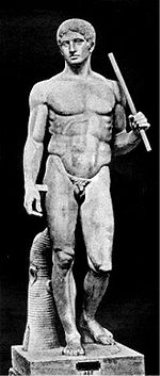
Doryphoros
Contrapposto is an Italian
Italian language

Italian is a Romance languages spoken by about 63 million people as a first language, primarily in Italy. In Switzerland, Italian is one of four Linguistic geography of Switzerlands....
 term meaning "counterpoise" used in the visual arts
Visual arts

The visual arts are Art#Art forms that focus on the creation of works which are primarily visual in nature, such as drawing, painting, photography, printmaking, and filmmaking....
 to describe a human figure standing with most of its weight on one foot so that its shoulders and arms twist off-axis from the hips and legs. This gives the figure a more dynamic, or alternatively relaxed appearance. It can also encompass the tension
Stress (medicine)

Stress is a biological term which refers to the consequences of the failure of a human or animal body to respond appropriately to emotional or body threats to the organism, whether actual or imagined....
 as a figure changes from resting on a given leg to walking or running upon it (so-called ponderation). Contrapposto is less emphasized than the more sinuous S-Curve.

Contrapposto has been used since the dawn of classical western sculpture. According to the canon of the Classical Greek Sculptor
Sculpture

Sculpture is Three-dimensional space artwork created by shaping or combining hard and or plastic material, sound, and or text and or light, commonly Stone sculpture , metal, glass, or wood....
 Polykleitos
Polykleitos

Polykleitos ; called the Elder, was a Ancient Greece Sculpture in bronze of the fifth and the early fourth century BC. Next to Phidias, Myron and Kresilas, he is considered the most important sculptor of Classical antiquity: the fourth-century catalogue attributed to Xenocrates , which was Pliny's guide in matters of art, ranked him between...
 in the fourth century B.C., it is one of the most important characteristics of his figurative works and those of his successors, Lysippos
Lysippos

Lysippos was a Greece sculpture of the 4th century BC. Together with Scopas and Praxiteles, he is considered one of the three great sculptors of the Ancient Greece era, bringing transition into the Hellenistic period....
, Skopas, etc. The Polykletian statues for example Discophoros
Discophoros

The Discophoros, also spelled Discophorus, was a bronze sculpture by the classical Greek sculptor Polyclitus , creator of the Doryphoros and Diadumenos, and its many Roman marble copies....
 (discus-bearer) and Doryphoros
Doryphoros

The Doryphoros is one of the best known Ancient Greek sculpture of the classical era in Western Art and an early example of Greek classical contrapposto....
 (spear-bearer) are idealized athletic young men with the divine sense, and captured in contrapposto. In these works, the pelvis is no longer axial
Axial

Axial has different meanings:* In geometry, it means: along the same line as an axis of rotation or centerline: parallel , contrary to radial, perpendicular or tangential...
 with the vertical statue as in the archaic style
Kouros

A kouros is the modern term given to those representations of male youths which first appear in the Archaic period in Greece. The term kouros, meaning youth, was first proposed for what were previously thought to be depictions of Apollo by V....
 of earlier Greek sculpture until the Ephebe
Ephebos

Ephebos , also anglicised as ephebe or archaically ephebus , is a Greek language word for an adolescent age group or a social status reserved for that age in Classical antiquity....
-statue of Kritios
Kritios

Kritios was an Athenian sculptor, probably a pupil of Antenor, working in the early 5th century BCE, whose manner is on the cusp of the Late Archaic and the Severe style of Early Classicism in Attica....
 ca. 480 B.C.

Contrapposto can be clearly seen in the Roman
Ancient Rome

Ancient Rome was a civilization that grew out of a small agricultural community founded on the Italian Peninsula as early as the 10th century BC....
 copies of the statues of Hermes
Hermes

Hermes is the messenger of the gods in Greek mythology. An Twelve Olympians, he is also the patron of boundaries and of the travelers who cross them, of shepherds and cowherds, of thieves and road travelers, of orators and wit, of literature and poets, of athletics, of weights and measures, of invention, of general commerce, and of the cunni...
 and Heracles
Heracles

In Greek mythology, Heracles or Herakles meaning "glory of Hera", or "Glorious through Hera" Alcides or Alcaeus " was a hero, the son of Zeus and Alcmene, foster son of Amphitryon and great-grandson of Perseus....
. A famous example is the marble statue of Hermes with the infant Dionysus
Dionysus

In classical mythology, Dionysus or Dionysos , is the God of wine, the inspirer of ritual madness and ecstasy, and a major figure of Greek mythology, and one of the twelve Olympians, among whom Greek mythology treated Dionysus as a late arrival....
 in Olympia
Olympia, Greece

Olympia , a sanctuary of ancient Greece in Elis, is known for having been the site of the Olympic Games in classical times, comparable in importance to the Pythian Games held in Delphi....
 by Praxiteles
Praxiteles

Praxiteles of Athens, the son of Cephisodotus the Elder, was the most renowned of the Attica sculptors of the 4th century BC. He was the first to sculpt the nude Woman in a life-size statue....
. It can also be seen in the Roman copies of Polyclitus' amazon
Amazons

The Amazons , ) are a nation of all-female warriors in Classical and Greek mythology, who were possibly historical. Herodotus placed them in a region bordering Scythia in Sarmatians....
.

Michelangelos David
Classical contrapposto was revived in the Renaissance
Renaissance

The Renaissance was a cultural movement that spanned roughly the 14th to the 17th century, beginning in Italy in the late Middle Ages and later spreading to the rest of Europe....
 by the Italian artists Donatello
Donatello

Donatello was a famous early Renaissance Italy artist and sculpture from Florence. He is, in part, known for his work in bas-relief, a form of shallow relief sculpture that, in Donatello's case, incorporated significant 15th-century developments in perspectival illusionism....
 and Leonardo da Vinci
Leonardo da Vinci

Leonardo di ser Piero da Vinci was an Italy polymath, being a scientist, mathematician, engineer, inventor, anatomist, Painting, sculptor, architect, botanist, musician and writer....
, followed by Michelangelo
Michelangelo

Michelangelo di Lodovico Buonarroti Simoni , commonly known as Michelangelo, was an Italian Renaissance Painting, sculptor, architect, poet, and engineer....
, Raphael
Raphael

Raphael Sanzio, usually known by his first name alone was an Italy Painting and architect of the High Renaissance, celebrated for the perfection and grace of his paintings and drawings....
 and other artists of the High Renaissance
High Renaissance

The High Renaissance, in the history of art, denotes the culmination of the art of the Italian Renaissance between 1450 and 1527. Because Pope Julius II patronized many artists during this time, the movement was centered in Rome; it had previously been centered in Florence....
. One of the major achievements of the Italian Renaissance
Italian Renaissance

The Italian Renaissance began the opening phase of the Renaissance, a period of great cultural change and achievement in Europe that spanned the period from the end of the 13th century to about 1600, marking the transition between Medieval and Early Modern Europe....
 was the re-discovery of contrapposto, although in Mannerism
Mannerism

Mannerism is a Art periods of European art which emerged from the later years of the Italian High Renaissance around 1520. It lasted until about 1580 in Italy, when a more Baroque style began to replace it, but continued into the seventeenth century throughout much of Europe....
 it became greatly over-used.

Contrapposto was an extremely important sculptural development for it is the first time in Western art that the human body is used to express a psychological disposition. The balanced, harmonious pose of the Kritios Boy
Kritios Boy

The marble Kritios boy or Kritian Boy belongs to the "Severe style" phase that lies between Archaic and Early Classical periods of ancient Greek sculpture; it is a precursor to the later classical sculptures of athletes....
 suggests a calm and relaxed state of mind, an evenness of temperament that is part of the ideal of man represented. From this point onwards Greek sculptors went on to explore how the body could convey the whole range of human experience, culminating in the desperate anguish and pathos of Laocoön and his Sons
Laocoön and his Sons

The statue of Laoco?n and His Sons, also called the Laoco?n Group, is a monumental marble sculpture now in the Vatican Museums, Rome....
 (1st century AD) in the Hellenistic period.

See also

  • Greek statue


External links