
All Topics  
Black Hawk War

 
Black Hawk War

   Email Print
   Bookmark   Link


Black Hawk War


The Black Hawk War was fought in 1832 in the Midwestern United States
Midwestern United States

The Midwestern United States is one of the four geographic regions within the United States of America that are officially recognized by the United States Census Bureau....
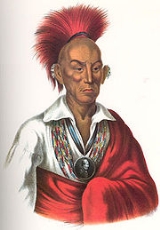
. The war was named for Black Hawk
Black Hawk (chief)

Black Hawk or Black Sparrow Hawk was a leader and warrior of the Sauk Native Americans in the United States tribe in what is now the United States....
, a war chief of the Sauk, Fox
Fox (tribe)

The Fox tribe of Native Americans in the United States?or Meskwaki?are an Algonquian language-speaking group that are now merged with the allied Sac tribe as the Sac and Fox Nation....
, and Kickapoo
Kickapoo

The Kickapoos are one of the Algonquian peoples speaking Native Americans in the United States tribes. According to the Anishinaabeg, the name "Kickapoo" means "Stands Here and there" and refers to the tribes migratory patterns....
 Native Americans
Native Americans in the United States

Native Americans in the United States are the Indigenous peoples of the Americas from the regions of North America now encompassed by the continental United States United States, including parts of Alaska and the island state of Hawaii....
, whose British Band
British Band

Black Hawk's Band of 1832, commonly referred to as the "British Band", was a group of Native Americans in the United States which fought against Illinois State and Michigan Territory militia units during the 1832 Black Hawk War....
 fought against the United States Army
United States Army

The United States Army is the branch of the United States Armed Forces responsible for Army operations. It is the largest and oldest established branch of the U.S....
 and militia
Militia

The term militia is commonly used today to refer to a military force composed of ordinary citizens to provide defense, emergency law enforcement, or paramilitary service, in times of emergency without being paid a regular salary or committed to a fixed term of service....
 from Illinois
Illinois

The State of Illinois is a U.S. state of the United States, the 21st to be admitted to the United States. Illinois is the most populous and demographically diverse Midwestern United States state and the fifth most populous state in the nation....
 and the Michigan Territory
Michigan Territory

Michigan Territory was an organized territory of the United States in the early 19th century, between June 30, 1805 and January 26, 1837, at which point it became Michigan, the 26th U.S....
 (present-day Wisconsin
Wisconsin

Wisconsin is one of the fifty U.S. state in the United States of America, located in the north central part of the United States. It borders two of the five Great Lakes and four U.S....
) for possession of lands in the area.

owing the Fox Wars
Fox Wars

The Fox Wars were two wars between the Fox Indians and the France which occurred in modern Michigan and Wisconsin, U.S.A.. The First Fox War broke out with the French when the Fox numbered some 3,500....
 in the western Great Lakes
Great Lakes

The St. Lawrence River Great Lakes are a chain of fresh water lakes located in eastern North America, on the Canada ? United States border. Consisting of Lakes Lake Superior, Lake Michigan, Lake Huron, Lake Erie, and Lake Ontario, they form the largest group of freshwater lakes on Earth....
 and Detroit regions, the remaining Sauk and Fox
Fox (tribe)

The Fox tribe of Native Americans in the United States?or Meskwaki?are an Algonquian language-speaking group that are now merged with the allied Sac tribe as the Sac and Fox Nation....
 sought refuge together in lands further west, extending north from the Wisconsin River
Wisconsin River

The Wisconsin River is a tributary of the Mississippi River in the U.S. state of Wisconsin. At approximately 430 miles long, it is the state's longest river....
 to the Illinois River
Illinois River

The Illinois River is a principal tributary of the Mississippi River, approximately long, in the U.S. state of Illinois. The river drains a large section of central Illinois, with a drainage basin of ....
 in the south.


Discussion
Ask a question about 'Black Hawk War'
Start a new discussion about 'Black Hawk War'
Answer questions from other users
Full Discussion Forum


Encyclopedia


The Black Hawk War was fought in 1832 in the Midwestern United States
Midwestern United States

The Midwestern United States is one of the four geographic regions within the United States of America that are officially recognized by the United States Census Bureau....
. The war was named for Black Hawk
Black Hawk (chief)

Black Hawk or Black Sparrow Hawk was a leader and warrior of the Sauk Native Americans in the United States tribe in what is now the United States....
, a war chief of the Sauk, Fox
Fox (tribe)

The Fox tribe of Native Americans in the United States?or Meskwaki?are an Algonquian language-speaking group that are now merged with the allied Sac tribe as the Sac and Fox Nation....
, and Kickapoo
Kickapoo

The Kickapoos are one of the Algonquian peoples speaking Native Americans in the United States tribes. According to the Anishinaabeg, the name "Kickapoo" means "Stands Here and there" and refers to the tribes migratory patterns....
 Native Americans
Native Americans in the United States

Native Americans in the United States are the Indigenous peoples of the Americas from the regions of North America now encompassed by the continental United States United States, including parts of Alaska and the island state of Hawaii....
, whose British Band
British Band

Black Hawk's Band of 1832, commonly referred to as the "British Band", was a group of Native Americans in the United States which fought against Illinois State and Michigan Territory militia units during the 1832 Black Hawk War....
 fought against the United States Army
United States Army

The United States Army is the branch of the United States Armed Forces responsible for Army operations. It is the largest and oldest established branch of the U.S....
 and militia
Militia

The term militia is commonly used today to refer to a military force composed of ordinary citizens to provide defense, emergency law enforcement, or paramilitary service, in times of emergency without being paid a regular salary or committed to a fixed term of service....
 from Illinois
Illinois

The State of Illinois is a U.S. state of the United States, the 21st to be admitted to the United States. Illinois is the most populous and demographically diverse Midwestern United States state and the fifth most populous state in the nation....
 and the Michigan Territory
Michigan Territory

Michigan Territory was an organized territory of the United States in the early 19th century, between June 30, 1805 and January 26, 1837, at which point it became Michigan, the 26th U.S....
 (present-day Wisconsin
Wisconsin

Wisconsin is one of the fifty U.S. state in the United States of America, located in the north central part of the United States. It borders two of the five Great Lakes and four U.S....
) for possession of lands in the area.

Background

Following the Fox Wars
Fox Wars

The Fox Wars were two wars between the Fox Indians and the France which occurred in modern Michigan and Wisconsin, U.S.A.. The First Fox War broke out with the French when the Fox numbered some 3,500....
 in the western Great Lakes
Great Lakes

The St. Lawrence River Great Lakes are a chain of fresh water lakes located in eastern North America, on the Canada ? United States border. Consisting of Lakes Lake Superior, Lake Michigan, Lake Huron, Lake Erie, and Lake Ontario, they form the largest group of freshwater lakes on Earth....
 and Detroit regions, the remaining Sauk and Fox
Fox (tribe)

The Fox tribe of Native Americans in the United States?or Meskwaki?are an Algonquian language-speaking group that are now merged with the allied Sac tribe as the Sac and Fox Nation....
 sought refuge together in lands further west, extending north from the Wisconsin River
Wisconsin River

The Wisconsin River is a tributary of the Mississippi River in the U.S. state of Wisconsin. At approximately 430 miles long, it is the state's longest river....
 to the Illinois River
Illinois River

The Illinois River is a principal tributary of the Mississippi River, approximately long, in the U.S. state of Illinois. The river drains a large section of central Illinois, with a drainage basin of ....
 in the south. Other settlements were established north of the Missouri River
Missouri River

The Missouri River is a tributary of the Mississippi River, and the longest river in the United States of America. The Missouri begins at the confluence of the Madison River, Jefferson River, and Gallatin River rivers in Montana, and flows through Missouri River Valley south and east into the Mississippi north of St....
. These lands were the area that Black Hawk
Black Hawk

Black Hawk may refer to:...
 and his band viewed as their homeland in 1832. The Sauk's main village, Saukenuk, was established in the mid-18th century. Black Hawk was born there in 1767 and lived much of his life in the village.

In 1804, William Henry Harrison
William Henry Harrison

William Henry Harrison was an Military history of the United States and Politics of the United States, the List of Presidents of the United States President of the United States, and the first president to die in office....
, Governor
Governor

A governor is a governing official, usually the Executive of a non-sovereign level of government, ranking under the head of state. In federations, a governor may be the title of each appointed or elected politician who governs a constitutive state....
 of Indiana Territory
Indiana Territory

Indiana Territory was an organized territory of the United States from 1800 to 1816, created by United States Congress and signed into law by President John Adams on May 7, 1800, effective on July 4....
 (which then included what would become Illinois), negotiated a treaty in St. Louis, Missouri
St. Louis, Missouri

St. Louis is an independent city in the U.S. state of Missouri, located near the confluence of the Mississippi River and the Missouri River. St....
 with a group of Sauk and Fox leaders, in which they ceded lands east of the Mississippi
Mississippi

Mississippi is a U.S. state located in the Deep South of the United States. Jackson, Mississippi is the state capital and largest city. The state's name comes from the Mississippi River, which flows along its western boundary, and takes its name from the Anishinaabe language word misi-ziibi ....
 in exchange for $1,000 per year and the condition that the tribes could continue to reside there until the land was surveyed and sold by the U.S. government. It was Article 2 which ceded the land to the United States "forever," and raised the ire of the Sauk and Fox tribes. This treaty was subsequently disputed by Black Hawk and other members of the tribes, since the full tribal councils had not been consulted, nor did those representing the tribes have authorization to cede lands. After the War of 1812
War of 1812

The War of 1812, between the United States of America and the British Empire , was fought from 1812 to 1815.There were several immediate stated causes for the U.S....
, in which Black Hawk had fought against the United States., he signed a peace treaty in May 1816 that re-affirmed the treaty of 1804, a provision of which Black Hawk later protested ignorance. While Black Hawk was away during the War of 1812, Keokuk
Keokuk (Sauk chief)

Keokuk was a chief of the Sauk or Sac tribe in central North America noted for his policy of cooperation with the U.S. government which led to conflict with Black Hawk who led part of their band into the Black Hawk War....
 had risen in prominence, and the two men became rivals.

The white population of Illinois exploded after the War of 1812, exceeding 50,000 in 1820 and 150,000 in 1830. In 1825, thirteen Sauk and six Fox signed another agreement re-affirming the 1804 treaty. In 1828, the U.S. government liaison, Thomas Forsyth
Thomas Forsyth (Indian Agent)

Major Thomas Forsyth was a 19th century American frontiersman and trader who served as a U.S. Indian agent to the Sauk and Fox during the 1820s and was replaced by Felix St....
, informed the tribes that they should begin vacating their settlements east of the Mississippi.

On July 15, 1830, U.S. Indian Commissioner William Clark signed another treaty with Sauk and Fox leaders, among other tribes, at Fort Crawford
Fort Crawford

Fort Crawford was an outpost of the United States Army located in Prairie du Chien, Wisconsin, during the 19th Century. The Second Fort Crawford Military Hospital was designated a U.S....
 in Prairie du Chien, Wisconsin
Wisconsin

Wisconsin is one of the fifty U.S. state in the United States of America, located in the north central part of the United States. It borders two of the five Great Lakes and four U.S....
. The treaty ceded about 26,500,000 acres (107,000 kmē) of Sauk land east of the Mississippi
Mississippi

Mississippi is a U.S. state located in the Deep South of the United States. Jackson, Mississippi is the state capital and largest city. The state's name comes from the Mississippi River, which flows along its western boundary, and takes its name from the Anishinaabe language word misi-ziibi ....
 to the government of the United States. It also created a "Neutral Ground" boundary between the Sauk and Foxes and their traditional enemies, the Sioux
Sioux

Sioux are a Native Americans in the United States and First Nations people. The term can refer to any ethnic group within the Great Sioux Nation or any of the nation's many dialects....
, for the purpose of preventing future hostilities between the tribes. The treaty was signed by Keokuk, and in November 1830 was approved by the Dakota Sioux.

Trigger

The land ceded in the treaty included the village of Saukenuk, but Black Hawk did not sanction the sale of this land and was determined to remain in his village. Despite opposition by Keokuk
Keokuk (Sauk chief)

Keokuk was a chief of the Sauk or Sac tribe in central North America noted for his policy of cooperation with the U.S. government which led to conflict with Black Hawk who led part of their band into the Black Hawk War....
 and the US authorities, Black Hawk's band returned to Saukenok in 1830 following their winter hunting. After a year of tension, they returned again in 1831, and Illinois Governor
Governor of Illinois

The Governor of Illinois is the chief executive of the Illinois and the various agencies and departments over which the officer has jurisdiction, as prescribed in the state constitution....
 John Reynolds
John Reynolds (U.S. politician)

John Reynolds was a United States politician from the state of Illinois. He was one of the original four justices of the Illinois Supreme Court, 1818-1825, a member of the Illinois House of Representatives from 1826-1830, 1846-1848, and 1852-1854 , and the 4th Illinois Governor from 1830-1834....
 proclaimed it an "invasion of the state."

Responding to Governor Reynolds's call, General Edmund Pendleton Gaines brought his federal troops from St. Louis, Missouri
St. Louis, Missouri

St. Louis is an independent city in the U.S. state of Missouri, located near the confluence of the Mississippi River and the Missouri River. St....
 to Saukenuk to insist upon Black Hawk's immediate departure. Black Hawk left but soon returned, remaining west of the Mississippi. He was threatened by Gaines' troops and an additional 1,400 militia called up by Reynolds on June 25, 1831. On June 30, Black Hawk and the chiefs of the so-called "British Band
British Band

Black Hawk's Band of 1832, commonly referred to as the "British Band", was a group of Native Americans in the United States which fought against Illinois State and Michigan Territory militia units during the 1832 Black Hawk War....
" were forced to sign a surrender agreement in which they promised to remain west of the Mississippi.

On April 5, 1832, chafing under the rule of Keokuk, Black Hawk and his group of 1,000 returned to Illinois. Ho-Chunk prophet White Cloud contributed to the outbreak of war by promising Black Hawk the support of the Ho-Chunk Nation
Ho-Chunk

The Ho-Chunk, or Winnebago , are a tribe of Native Americans in the United States, native to what are now Wisconsin and Illinois....
, when in fact he could only speak for his own tribe. Black Hawk was also misled by another ally, Neapope
Neapope

Neapope was a spiritual leader of the Sauk tribe and advisor to Black Hawk during the Black Hawk War....
, who promised British aid. Reynolds issued a proclamation on April 16, mustering five brigade
Brigade

A brigade is a military unit that is typically composed of two to five regiments or battalions, depending on the era and nationality of a given army....
s of volunteers to form at Beardstown
Beardstown, Illinois

Beardstown is a city in Cass County, Illinois, Illinois, United States. The population was 5,766 at the 2000 census.Beardstown was the birthplace of the jazz vibraphone pioneer Red Norvo....
 and to head north to force Black Hawk
Black Hawk

Black Hawk may refer to:...
 out of Illinois. Although one-half of all the federal troops of the United States Army
United States Army

The United States Army is the branch of the United States Armed Forces responsible for Army operations. It is the largest and oldest established branch of the U.S....
 were eventually involved in the conflict, the 9,000 volunteers from the Illinois Militia provided the majority of the U.S. combatants.

Black Hawk's British band was composed of about 500 warriors and 1,000 old men, women and children when they crossed the Mississippi on April 5,. The group comprised members of the Sauk, Fox
Fox (tribe)

The Fox tribe of Native Americans in the United States?or Meskwaki?are an Algonquian language-speaking group that are now merged with the allied Sac tribe as the Sac and Fox Nation....
 and Kickapoo
Kickapoo

The Kickapoos are one of the Algonquian peoples speaking Native Americans in the United States tribes. According to the Anishinaabeg, the name "Kickapoo" means "Stands Here and there" and refers to the tribes migratory patterns....
 Nations. They crossed near the mouth of the Iowa River
Iowa River

The Iowa River is a tributary of the Mississippi River in the state of Iowa in the United States. It is about long and is open to small river craft to Iowa City, Iowa, about from its mouth....
 and then followed the Rock River
Rock River (Illinois)

The Rock River is a tributary of the Mississippi River, approximately 285 miles long, in the U.S. states of Wisconsin and Illinois.It rises in southeast Wisconsin, in the Theresa Marsh near Theresa, Wisconsin in northeast Dodge County, Wisconsin approximately 17 miles south of Fond du Lac, Wisconsin....
 northeast. Along the way they passed the ruins of Saukenuk and headed for the village of the Ho-Chunk prophet White Cloud.

brevet
Brevet (military)

In the U.K. and U.S. military, brevet referred to a warrant authorizing a commissioned officer to hold a higher Military rank temporarily, but usually without receiving the pay of that higher rank....
 Brigadier General Henry Atkinson
Henry Atkinson

Henry Atkinson was a United States of America army officer. He was a native of Person County, North Carolina. He entered the army in 1808 as a Captain in the infantry, serving at various outposts on the Western frontier....
 was given charge of prosecuting the war. Federal authorities, along with Sauk and Fox tribal councils, ordered Black Hawk and his band to retreat west of the Mississippi, but they refused to leave. Soon after that, Black Hawk conferred with the Ho-Chunk and Potawatomi
Potawatomi

The Potawatomi are a Native Americans in the United States people of the upper Mississippi River region. They traditionally speak the Potawatomi language, a member of the Algonquian languages....
 tribes and learned that none of the Illinois or Michigan
Michigan

Michigan is a Midwestern United States U.S. state of the United States of America. It was named after Lake Michigan, whose name is a French adaptation of the Anishinaabe language term mishigama, meaning "large water" or "large lake"....
 tribes, or the British, would aid his band.

Chronology


Hostilities begin

On May 9, a small Illinois militia battalion began the pursuit of Black Hawk from the army's point of rendezvous on the Rock River at Dixon
Dixon, Illinois

Dixon is a city in Lee County, Illinois, Illinois, United States. The population was 15,941 at the 2000 census. Named for its founder John Dixon , it is the county seat of Lee County, Illinois....
. On May 10, 1832 the militia burned the Prophet's Village
Prophetstown, Illinois

Prophetstown is a city in Whiteside County, Illinois, Illinois, United States. The population was 2,023 at the 2000 census....
. Upon hearing of this Black Hawk decided to return with his band to Iowa
Iowa

The State of Iowa is a U.S. state in the Midwestern region of the United States of America, an area often referred to as the "American Heartland." It is bordered by Minnesota to the north, Wisconsin and Illinois to the east, Nebraska and South Dakota to the west, and Missouri to the south....
. Events at Stillman's Run
Stillman Creek (Illinois)

Stillman Creek, also known during different eras as Mud Creek, Old Man's Creek, Sycamore Creek, and Stillman's Run, is part of the Rock River watershed, and located in Ogle County, Illinois, United States....
 prevented this and the Black Hawk War began.

The first confrontation occurred on May 14, 1832 and resulted in an unexpected victory for Black Hawk's band of Sauk and Fox warriors over the disorganized militiamen commanded by Isaiah Stillman
Isaiah Stillman

Cavalry Major Isaiah Stillman led Illinois militia in the first armed confrontation of the Black Hawk War against Black Hawk ?s Sauk Indian Band....
. After a long march (the militia was mounted and followed by several supply wagons), the militiamen finally came into contact with Black Hawk and his warriors north of the Kishwaukee River
Kishwaukee River

The Kishwaukee River, sometimes locally known as simply "The Kish", is a river in the U.S. state of Illinois. "The Kish" is famous for its high number of bridges that cross within its 100-year floodplain....
, near present day Stillman Valley
Stillman Valley, Illinois

Stillman Valley is a village in Marion Township, Ogle County, Illinois, Ogle County, Illinois, Illinois, United States. It lies east of Byron, Illinois, south of Rockford, Illinois, and west of David Junction, Illinois....
. When the militia killed a member of a three-man parley
Parley

Parley is a discussion or Meeting, especially one between enemies over terms of a truce or other matters. The root of the word parley is parl?e, which is from the French verb parler "to speak"; specifically the conjugation parlez "you speak", whether as imperative or indicative....
 sent by Black Hawk, he rallied 40 mounted warriors and attacked the militia camp at dusk. Though Stillman's men numbered about 275, cohesion quickly collapsed and they fled to Dixon's Ferry
Dixon's Ferry

Dixon's Ferry was the former name for Dixon, Illinois, Illinois, United States. It was located on the bank of the Rock River near present day Illinois Route 26, John Dixon operated a rope ferry service to transport mail from Peoria to Galena....
, 35 miles (56 km) away. During the encounter, 11 militiamen under John Giles Adams
John Giles Adams

John Giles Adams was a cavalry officer in the Illinois Militia during the Black Hawk War of 1832. He was born in Nashville, Tennessee and came to Illinois in 1828, eventually marrying and fathering eight children....
 were killed.

Soon after the battle at Stillman's Run, an exaggerated claim of 2,000 "bloodthirsty warriors . . . sweeping all Northern Illinois with the bosom of destruction" sent shock waves of terror through the region. After the outbreak of hostilities, Black Hawk led many of the civilians in his band to safety in the Michigan Territory
Michigan Territory

Michigan Territory was an organized territory of the United States in the early 19th century, between June 30, 1805 and January 26, 1837, at which point it became Michigan, the 26th U.S....
. On May 19, the militia traveled up the Rock River searching for Black Hawk. Several small skirmishes and massacres followed over the next month in northern Illinois and southern Wisconsin before the militia regained public confidence through battles at Horseshoe Bend and Waddams Grove.

Massacres and skirmishes

The war would see a number of small skirmishes and "massacres". On May 19, a six-man detail carrying dispatches from Colonel James M. Strode
James M. Strode

James M. Strode was a militia officer and politician from the U.S. state of Illinois. He served in the Illinois Militia during the Winnebago War and the Black Hawk War....
 was ambushed by a party of Kickapoo
Kickapoo

The Kickapoos are one of the Algonquian peoples speaking Native Americans in the United States tribes. According to the Anishinaabeg, the name "Kickapoo" means "Stands Here and there" and refers to the tribes migratory patterns....
 near the settlement of Buffalo Grove, Illinois in Ogle County. The ambush claimed one victim, William Durley, who was buried where he fell by Felix St. Vrain
Felix St. Vrain

Felix St. Vrain was a United States Indian agent who was killed during the Black Hawk War. St. Vrain died along with three companions while on a mission to deliver dispatches from Dixon, Illinois to Fort Armstrong....
 and his party as they marched to Galena
Galena, Illinois

Galena is the largest city in, and county seat of, Jo Daviess County, Illinois, Illinois in the United States with an estimated population of 3,396 in 2006....
. Two others present at the attack had bullet holes through their clothing but were not injured. In 1910 a memorial to Durley and the Buffalo Grove ambush
Buffalo Grove ambush

The Buffalo Grove ambush was an ambush that occurred on May 19, 1832 as part of the Black Hawk War. A six-man detail carrying dispatches from United States Colonel James M....
 was erected by the Polo, Illinois
Polo, Illinois

Polo is a city in Ogle County, Illinois, Illinois, United States. The population was 2,477 at the 2000 census. As of the 2005 census estimate, the population was 2,501....
 Historical Society. At that time Durley's remains were reinterred beneath the memorial.

One of the Black Hawk War's most famous and well publicized events was a peripheral event not directly connected to the war or Black Hawk and his "British Band." The Indian Creek massacre
Indian Creek Massacre

The Indian Creek massacre occurred on May 21, 1832 when a group of settlers living north of Ottawa, Illinois, Illinois, United States, along Indian Creek, were attacked by a party of Native Americans in the United States....
 occurred two days after the incident in Buffalo, following a dispute between a local settler and a Potawatomi warrior over the damming of nearby Indian Creek. The young warrior, named Keewasee, recruited a group of warriors and attacked the William Davis settlement on the banks of the creek. The attack resulted in the murders of 15 men, women and children, most of whom were unarmed, though it is possible Davis may have killed one assailant before being felled himself. The victims were scalped and mutilated. In addition, two teenage girls were kidnapped and held until they were ransomed two weeks later and released at Fort Blue Mounds
Blue Mounds Fort

Fort Blue Mounds, also known as Blue Mounds Fort, was located in Blue Mounds, Wisconsin, Dane County, Wisconsin, Wisconsin, USA....
. Events surrounding the release of the girls would lead to two attacks at the fort in June. The incident at Indian Creek triggered panic among the white population, and many settlers fled to the safety of local forts. The Illinois Militia used the massacre to boost recruiting in Illinois and Kentucky
Kentucky

The Commonwealth of Kentucky is a U.S. state located in the East Central United States of America. Kentucky is normally included in the group of Southern United States , but it is uncommonly included, geographically and culturally, in the Midwestern United States....
. The same day as the massacre at Indian Creek, a settlement on the Plum River was raided
Plum River raid

The Plum River raid was a bloodless skirmish that occurred at present-day Savanna, Illinois, on May 21, 1832, as part of the Black Hawk War. Most of the settlement's inhabitants, except for a few defenders, had fled for Galena, Illinois, before the raid happened....
 by Sauk or Fox warriors. Though the encounter was bloodless, it was one of many incidents that contributed to the atmosphere of fear.

The St. Vrain massacre
St. Vrain massacre

The St. Vrain massacre was an incident in the Black Hawk War. It occurred near present-day Pearl City, Illinois in Kellogg's Grove on May 24, 1832....
, a small skirmishes after Stillman's Run, took place near present-day Pearl City, Illinois
Pearl City, Illinois

Pearl City is a village in Stephenson County, Illinois, Illinois, United States. The population was 780 at the 2000 census....
 in Kellogg's Grove
Kellogg's Grove

Kellogg's Grove is an area in western Stephenson County, Illinois, United States near the present-day unincorporated town of Kent, Illinois. The grove is considered historically significant because it was the site of two minor skirmishes during the Black Hawk War in 1832....
 on May 24, 1832. The massacre was most likely perpetrated by Ho-Chunk
Ho-Chunk

The Ho-Chunk, or Winnebago , are a tribe of Native Americans in the United States, native to what are now Wisconsin and Illinois....
 warriors unaffiliated with Black Hawk
Black Hawk

Black Hawk may refer to:...
's band. It is also unlikely they had the sanction of their nation. The victims were United States Indian Agent
Bureau of Indian Affairs

The Bureau of Indian Affairs is an agency of the federal government of the United States within the United States Department of the Interior charged with the administration and management of 55.7 million acres of land held in trust by the United States for Native Americans in the United States, List of Native American Tribal Entities and A...
 Felix St. Vrain and three of his companions. Some accounts indicated that St. Vrain's body was subjected to mutilation, and at least one claimed it had happened while he was still alive.

The massacre led to an unwarranted fear of all Native Americans
Native Americans in the United States

Native Americans in the United States are the Indigenous peoples of the Americas from the regions of North America now encompassed by the continental United States United States, including parts of Alaska and the island state of Hawaii....
 in the area, even those friendly to the settlers. An example appears in an article published in the New Galenian on May 30, 1832. While it described the events of the massacre, it also associated the murders of St. Vrain and his companions with the Sauk and Fox
Fox (tribe)

The Fox tribe of Native Americans in the United States?or Meskwaki?are an Algonquian language-speaking group that are now merged with the allied Sac tribe as the Sac and Fox Nation....
 of Keokuk
Keokuk (Sauk chief)

Keokuk was a chief of the Sauk or Sac tribe in central North America noted for his policy of cooperation with the U.S. government which led to conflict with Black Hawk who led part of their band into the Black Hawk War....
's band.

Following these incidents, Governor Reynolds called up additional militia forces, raising their number to 4,000 men.

Cholera epidemic

On May 27, and May 28, their one month enlistment being expired, Reynolds mustered the first of the militia out of service. The federal government then ordered General Winfield Scott
Winfield Scott

Winfield Scott was a United States Army general, and unsuccessful List of United States Presidential candidates of the Whig Party in 1852. Known as "Old Fuss and Feathers" and the "Grand Old Man of the Army", he served on active duty as a general longer than any other man in American history and many historians rate him the ablest America...
's 1,000 regulars and 300 mounted volunteers into action. For the moment it looked as though Atkinson's role in the war would end soon, but a cholera
Cholera

Cholera, sometimes known as Asiatic or epidemic cholera, is an infectious gastroenteritis caused by enterotoxin-producing strains of the bacterium Vibrio cholerae....
 epidemic struck much of the United States. Winfield Scott's troops would bring it over from the east into Illinois.

General Scott assembled a force of about 1,000 federal troops. They embarked on boats from Buffalo, New York
Buffalo, New York

Buffalo , is the second largest city in the state of New York. Located in Western New York on the eastern shores of Lake Erie and at the head of the Niagara River, Buffalo is the principal city of the Buffalo-Niagara Falls metropolitan area and the county seat of Erie County, New York....
, making their way towards Chicago
Chicago

Chicago is the largest city in the U.S. state of Illinois and the Midwestern United States, as well as the List of United States cities by population city in the United States with more than 2.8 million residents....
. To widespread horror, cholera was reported among the troops. The expedition was doomed. Troops became ill and many of them died. At each place the vessels landed, the sick were deposited and soldiers deserted.

Efforts to prevent the immediate spread of the illness into the population of the towns the expedition passed were largely successful as only 3 civilians died in the initial outbreak. However, later, in 1833 a larger-scale cholera epidemic affected large regions of the United States, its roots can be traced to the Scott expedition. By the time the expedition landed in Chicago, there were less than two hundred effective troops left. Scott felt the need to cancel his plans for an immediate march into the war zone. Instead he waited for reinforcements, supplies, and tended to his stricken men. Winfield Scott arrived too late for military action, but he played an important part in drafting the terms of peace.

More raids

Public confidence in the militia, eroded since the outbreak of hostilities at Stillman's Run, was still low when the month of June began. Small attacks and skirmishes continued to plague the frontier of southern Wisconsin and northern Illinois. Though Fort Blue Mounds, in present-day Dane County, Wisconsin
Dane County, Wisconsin

Dane County is a county located in the U.S. state of Wisconsin. As of 2007, the population was 476,785. Its county seat is Madison, Wisconsin....
 near the village of Blue Mounds
Blue Mounds, Wisconsin

Blue Mounds is a village in Dane County, Wisconsin, Wisconsin, United States. The population was 708 at the 2000 census. The village is located adjacent to the Blue Mounds , Wisconsin....
, was never the site of a full-fledged battle or skirmish there were war-related events near the fort between June 6, and June 20,. The first event killed a civilian miner, and area residents suspected Ho-Chunk
Ho-Chunk

The Ho-Chunk, or Winnebago , are a tribe of Native Americans in the United States, native to what are now Wisconsin and Illinois....
 warriors were responsible. This belief exacerbated the fear that more from the Ho-Chunk Nation were set to join Black Hawk's band against the white settlers in Michigan Territory
Michigan Territory

Michigan Territory was an organized territory of the United States in the early 19th century, between June 30, 1805 and January 26, 1837, at which point it became Michigan, the 26th U.S....
 and Illinois. The second incident was a full-fledged attack near Blue Mounds Fort
Attacks at Fort Blue Mounds

The attacks at Fort Blue Mounds were two separate incidents which occurred on June 6 and 20, 1832, as part of the Black Hawk War. In the first incident, area residents attributed the killing of a miner to a band of Ho-Chunk warriors, and concluded that more Ho-Chunk planned to join Black Hawk in his war against white settlers....
 by a raiding party estimated by eyewitnesses to be as large as 100 warriors. Two members of the militia were killed in that attack, one of whom was badly mutilated and missing a "part" when his body was found.

Another event, the Spafford Farm massacre
Spafford Farm massacre

The Spafford Farm massacre, also referred to as the Wayne massacre, was an attack upon U.S. militia and civilians that occurred as part of the Black Hawk War near present day South Wayne, Wisconsin....
, also known as the Wayne massacre, occurred on June 14, 1832 near present-day South Wayne, Wisconsin
South Wayne, Wisconsin

South Wayne is a village in Lafayette County, Wisconsin, Wisconsin, United States. The population was 484 at the 2000 census....
. A band of Native Americans attacked a group of 7 men working on the farm of Omri Spafford, 5 men, including Spafford, were killed. Two men escaped, one of them killing an attacker before individually making their way to Fort Hamilton. One of the men spent several days hiding in the forest because he was under the erroneous impression that the fort was being overtaken by friendly Menominee
Menominee

Some placenames use other spellings, see also Menomonee and Menomonie, Wisconsin.The Menominee are a nation of Native Americans in the United States living in Wisconsin....
 who had arrived around the same time.

Renewed confidence

The second half of June 1832 brought more battle; this time the militia would be dominant. After Colonel Henry Dodge
Henry Dodge

Henry Dodge was a Democratic Party member of the United States House of Representatives and United States Senate, Wisconsin Territory#Governors of Wisconsin Territory and a veteran of the Black Hawk War....
 was informed of the massacre at Spafford Farm he set out for Fort Hamilton Arriving at Fort Hamilton on June 16, Dodge gathered a force of 29 mounted volunteers and set out in pursuit of the band of Kickapoo warriors responsible for the massacre. They caught up with them at a bend in the Pecatonica River
Pecatonica River

The Pecatonica River is a tributary of the Rock River , 120 mi long, in southern Wisconsin and northern Illinois in the United States.As it gets closer to the Rock River it obtains more streams....
 known as "Horseshoe Bend." The Battle of Horseshoe Bend
Battle of Horseshoe Bend (1832)

The Battle of Horseshoe Bend, also commonly referred to as the Battle of Pecatonica and the Battle of Bloody Lake, was fought on June 16, 1832 at an oxbow lake in present-day Wisconsin known as "Horseshoe Bend", formed by a change in course of the Pecatonica River....
 was the first real victory for the militia and a major turning point in the conflict. The clash helped restore public confidence in the volunteer militia force.

The Black Hawk War also included two clashes at Kellogg's Grove, in present-day Stephenson County, Illinois
Stephenson County, Illinois

Stephenson County is a county located in the U.S. state of Illinois. As of 2000, the population was 48,979. Its county seat is Freeport, Illinois, Illinois....
. The first battle took place the same day as Dodge's clash with the Kickapoo, on June 16, 1832, and was really nothing more than a minor skirmish. Forces commanded by Adam W. Snyder
Adam W. Snyder

Adam Wilson Snyder was a United States House of Representatives from Illinois as well as a member of the Illinois militia during the Black Hawk War....
 fought with a band of about 80 Kickapoo warriors. During the fighting three militia members were killed and six Kickapoo warriors died.

The Battle of Waddams Grove
Battle of Waddams Grove

The Battle of Waddams Grove, also known as the Battle of Yellow Creek, took place in present-day Stephenson County, Illinois on June 18, 1832 Black Hawk War....
, also called the Battle of Yellow Creek occurred on June 18, 1832 near Yellow Creek
Yellow Creek (Illinois)

Yellow Creek is a tributary of the Pecatonica River in Stephenson County, Illinois, in the U.S. state of Illinois. The 50 mile stream also flows through a small part of Jo Daviess County....
 in present-day Stephenson County, Illinois
Stephenson County, Illinois

Stephenson County is a county located in the U.S. state of Illinois. As of 2000, the population was 48,979. Its county seat is Freeport, Illinois, Illinois....
. The fight became a bloody battle with bayonet
Bayonet

A bayonet is a knife-, dagger-, sword-' or spike-shaped weapon designed to fit on or over the muzzle of a rifle barrel or similar weapon, effectively turning the gun into a spear....
s and knives. Up to six Sauk, and three militia men under the command of James W. Stephenson
James W. Stephenson

James W. Stephenson was an American militia officer and politician from the state of Illinois. He was born in Virginia but spent most of his youth in Edwardsville, Illinois....
 were killed in action, while Stephenson was severely wounded during the battle by a musket
Musket

A musket is a Muzzle -loaded, smoothbore long gun, which is intended to be fired from the shoulder.Usually, the musket is thought to be the weapon that replaced the arquebus, and was in turn replaced by the rifle....
ball to the chest. The battle served to restore confidence in the militia within the population of the area, who were still afraid following the defeat at Stillman's Run. The dead militia men were eventually buried in a memorial cemetery in Kellogg's Grove, Illinois.

The Battle of Apple River Fort
Battle of Apple River Fort

The Battle of Apple River Fort, also known as the Siege of Apple River Fort, occurred on June 24, 1832 at the hastily constructed Apple River Fort, in present-day Elizabeth, Illinois, when Black Hawk and his "British Band" of Sauk and Fox stumbled across a group of messengers en route from Galena, Illinois....
 commenced on June 24, 1832 at the hastily constructed Apple River Fort
Apple River Fort

Apple River Fort, today known as Apple River Fort State Historic Site, was one of many frontier forts hastily completed by settlers in northern Illinois and southern Wisconsin following the onset of the 1832 Black Hawk War....
, near present-day Elizabeth, Illinois
Elizabeth, Illinois

Elizabeth is a village in eastern Jo Daviess County, Illinois, Illinois, United States. The population was 682 at the 2000 census....
. Approximately 150-200 Sauk and Fox warriors under the command of Black Hawk
Black Hawk

Black Hawk may refer to:...
 attacked the fort which was defended by about 25 militia. The militia, under the command of Captain Clack Stone
Clack Stone

Clack Stone was a captain in the 27th Regiment Illinois Militia during the 1832 Black Hawk War. He was in charge of a company mustered into service in May 1832 from Jo Daviess County, Illinois....
, was shorthanded during the battle as most of the fort's detachment were not present. Fierce fighting ensued for at least 45 minutes with both sides exchanging heavy gunfire. Inside the fort, the people of the nearby settlement had taken refuge. One woman, Elizabeth Armstrong
Elizabeth Armstrong

Elizabeth Armstrong is a female water polo goalkeeper from the United States, who won the gold medal with the United States women's national water polo team at the 2007 Pan American Games....
 was singled out for her bravery after the battle. She rallied the fort's women to assist during the battle by making musketballs and reloading weapons. Believing the fort to be more heavily defended than it was, Black Hawk and his band eventually retreated.

The second, and larger, Battle of Kellogg's Grove commenced on June 25, 1832 when forces commanded by Major John Dement
John Dement

John Dement was a politician and militia commander from the U.S. state of Illinois.Born in Tennessee, he migrated with his family to Illinois when he was in his early teens....
 met and fought with a large band of Native Americans at the grove. The Native forces, under the command of Black Hawk
Black Hawk

Black Hawk may refer to:...
 mounted an unrelenting attack during which 25 horses and five militia men were killed and at least of nine of Black Hawk's band died.

On July 21, 1832 Illinois and Wisconsin militia men under the command of Generals Henry Dodge and James D. Henry
James D. Henry

James D. Henry was a militia officer from the U.S. state of Illinois who rose to the rank of general during the Black Hawk War. Henry was born in Pennsylvania in 1797, and moved to Edwardsville, Illinois in 1822....
 caught up with Black Hawk's British Band
British Band

Black Hawk's Band of 1832, commonly referred to as the "British Band", was a group of Native Americans in the United States which fought against Illinois State and Michigan Territory militia units during the 1832 Black Hawk War....
 near present-day Sauk City, Wisconsin
Sauk City, Wisconsin

Sauk City is a village in Sauk County, Wisconsin, Wisconsin, United States. The population was 3,109 at the 2000 census. It was founded by Agoston Haraszthy and his business partner, Robert Bryant....
. The clash became known as the Battle of Wisconsin Heights
Battle of Wisconsin Heights

The Battle of Wisconsin Heights was the penultimate engagement of the 1832 Black Hawk War, fought between the United States state militia and allies, and the Sauk and Fox tribes, led by Black Hawk....
. Militarily, the battle was devastating for Black Hawk's band of warriors; including those who drowned during the melee, casualty estimates climbed as high as 70. Despite the relatively high casualties the battle did serve to allow much of the band, including many women and children, to escape across the Wisconsin River
Wisconsin River

The Wisconsin River is a tributary of the Mississippi River in the U.S. state of Wisconsin. At approximately 430 miles long, it is the state's longest river....
. The reprieve was temporary for the group of Sauk and Fox, the militia would eventually catch up with them at the mouth of the Bad Axe River
Bad Axe River

The Bad Axe River is a short tributary of the Mississippi River in southwestern Wisconsin in the United States. "Bad axe" is a translation from the French language, "la mauvaise hache," but the origin of the name is unknown....
 resulting in the decisive battle of the war.

Bad Axe


The Battle of Bad Axe, also known as the Bad Axe Massacre, occurred August 1-2, 1832, between Sauk (Sac) and Fox Indians and United States Army regulars and militia. This final battle of the Black Hawk War took place near present-day Victory, Wisconsin
Victory, Wisconsin

Victory, Wisconsin is a small unincorporated community within the town of Wheatland, Vernon County, Wisconsin in Vernon County, Wisconsin, Wisconsin....
 in the United States. It marked the end of the war between white settlers and militia in Illinois and Michigan Territory, and the Sauk and Fox tribes under Chief Black Hawk.

The battle occurred in the aftermath of the Battle of Wisconsin Heights, as Black Hawk's band fled the pursuing militia. The militia caught up with them on the eastern bank of the Mississippi, a few miles downstream from the mouth of the Bad Axe River. The battle that followed was very one-sided; historians have been calling it a massacre since the 1850s. The fighting took place over two days, with the Warrior steamboat present on both days. By the second day, Black Hawk and most of the Native American commanders had fled, though many of the band stayed behind. The victory for the United States was decisive and the end of the war allowed much of Illinois and present-day Wisconsin to be opened for further settlement.

Aftermath


Military results

The Black Hawk War of 1832 resulted in the deaths of 70 settlers and soldiers, and hundreds of Black Hawk's band. As well as the combat casualties of the war, a relief force under General Winfield Scott suffered hundreds dead and deserted. The war also resulted in the settlement of Illinois, Iowa
Iowa

The State of Iowa is a U.S. state in the Midwestern region of the United States of America, an area often referred to as the "American Heartland." It is bordered by Minnesota to the north, Wisconsin and Illinois to the east, Nebraska and South Dakota to the west, and Missouri to the south....
, and Wisconsin. It ended the threat of Native American attacks in northwest Illinois and allowed the region to be further settled.

Political results

Abraham Lincoln
Abraham Lincoln

Abraham Lincoln was the List of Presidents of the United States President of the United States. He successfully led the country through its greatest internal crisis, the American Civil War, preserving the Union and ending slavery....
, the future US president, served in Reynolds' militia during the time of the Black Hawk War, but never saw action. Zachary Taylor
Zachary Taylor

Zachary Taylor was an Military of the United States and the List of Presidents of the United States President of the United States.Known as "Old Rough and Ready", Taylor had a 40-year military career in the United States Army, serving in the War of 1812, Black Hawk War, and Seminole Wars before achieving fame leading U.S....
, another future US president, commanded the troops under General Atkinson during the war. Jefferson Davis
Jefferson Davis

Jefferson Finis Davis was an United States politician who served as President of the Confederate States of America for its entire history, 1861 to 1865, during the American Civil War....
, future president of the Confederacy
Confederate States of America

The Confederate States of America formed as the government set up from 1861 to 1865 by eleven Southern United States U.S. state of the United States of America that had declared their secession from the U.S....
, was on leave during most of the war but returned in time to escort the surrendered Black Hawk, son Whirling Thunder, Neapope, White Cloud and others to Jefferson Barracks, Missouri
Missouri

Missouri is a U.S. state in the Midwestern United States of the United States bordered by Iowa, Illinois, Kentucky, Tennessee, Arkansas, Oklahoma, Kansas and Nebraska....
 in September 1832. Davis gave an interview in 1887 in which he indicated he was at the Battle of Wisconsin Heights, but this assertion today has been largely discredited.

The Black Hawk War was similar to other frontier wars fought in the United States in that in provided a boost to several political careers. Besides the notable involvement of Lincoln and Davis, four Illinois governors served during the war: Thomas Ford
Thomas Ford (politician)

Thomas Ford was a Democratic Party and governor of Illinois from 1842 to 1846 remembered largely for the History of the Latter Day Saint movement#The Movement in Illinois....
, John Wood
John Wood (governor)

John Wood was Governor of Illinois, serving from 1860 to 1861.Wood was born in Moravia, New York. He served as a member of the Illinois Senate in 1850, and as Lieutenant Governor of Illinois from 1857- 1860....
, Joseph Duncan
Joseph Duncan (politician)

Joseph Duncan was a United States politician. He served as Governor of Illinois of Illinois from 1834 to 1838. He was a Democratic Party and a two-term U.S....
 and Thomas Carlin
Thomas Carlin

Thomas Carlin was governor of Illinois, serving from 1838 to 1842. Born in 1789 in Frankfort, Kentucky, he served in the Illinois General Assembly was instrumental in obtaining passage of a bill in January 1829 creating Macoupin County, Illinois....
. The conflict also helped in the political careers of a future governor in both Michigan and Nebraska as well as boosting at least 7 U.S. Senators. In 1836, Henry Dodge was appointed governor of the Wisconsin Territory
Wisconsin Territory

Wisconsin Territory became an organized territory of the United States by an act of Congress of the United States passed on April 20, 1836, which took effect on July 3, 1836....
.

Henry Atkinson
Henry Atkinson

Henry Atkinson was a United States of America army officer. He was a native of Person County, North Carolina. He entered the army in 1808 as a Captain in the infantry, serving at various outposts on the Western frontier....
, however, did not fare as well following the war and spent the last decade of his life at Jefferson Barracks in St. Louis. Most of those affiliated with the conflict, subordinates and superiors believed that Atkinson had handled the prosecution of the war badly. U.S. President Andrew Jackson
Andrew Jackson

Andrew Jackson was the List of Presidents of the United States President of the United States . He was List of governors of Florida of Florida , commander of the American forces at the Battle of New Orleans , and eponym of the era of Jacksonian democracy....
 was looking for someone to blame for the conflict even as it was ongoing. After the war Congressional reports glossed over Atkinson's failings but privately others still criticized him. Zachary Taylor stated he believed that had Atkinson's regulars met with Black Hawk in the war's first battle instead of the militia under Isaiah Stillman the war could have ended without a single shot being fired. Historians generally believe that a more decisive action by General Atkinson, charged with prosecuting the war, in stopping Black Hawk's Band from moving up the Rock River may have prevented the war. Zachary Taylor
Zachary Taylor

Zachary Taylor was an Military of the United States and the List of Presidents of the United States President of the United States.Known as "Old Rough and Ready", Taylor had a 40-year military career in the United States Army, serving in the War of 1812, Black Hawk War, and Seminole Wars before achieving fame leading U.S....
 made similar observations shortly after the war ended.

See also

  • Battle of Wisconsin Heights
    Battle of Wisconsin Heights

    The Battle of Wisconsin Heights was the penultimate engagement of the 1832 Black Hawk War, fought between the United States state militia and allies, and the Sauk and Fox tribes, led by Black Hawk....
  • Black Hawk (chief)
    Black Hawk (chief)

    Black Hawk or Black Sparrow Hawk was a leader and warrior of the Sauk Native Americans in the United States tribe in what is now the United States....
  • Black Hawk Purchase
    Black Hawk Purchase

    The Black Hawk Purchase, sometimes called the Forty-Mile Strip or Scott's Purchase, was a land acquisition made in what is now Iowa by the United States federal government....
  • Indian removal
    Indian Removal

    Indian Removal was a nineteenth century policy of the government of the United States to Ethnic cleansing Native Americans in the United States tribes living east of the Mississippi River to lands west of the river....
  • Indian Wars
    Indian Wars

    Indian Wars is the name generally used in the United States to describe a series of conflicts between the colonial or federal government and the indigenous peoples of North America....
  • Sixty Years' War
    Sixty Years' War

    The Sixty Years' War was a military struggle for control of the Great Lakes region in North America, encompassing a number of wars over several generations....


External links