

Abbey Theatre

Encyclopedia
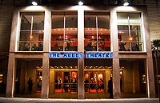
The Abbey Theatre also known as the National Theatre of Ireland , is a theatre
located in Dublin, Ireland
. The Abbey first opened its doors to the public on 27 December 1904. Despite losing its original building to a fire in 1951, it has remained active to the present day. The Abbey was the first state-subsidized theatre in the English-speaking world; from 1925 onwards it received an annual subsidy from the Irish Free State
. Since July 1966, the Abbey has been located at 26 Lower Abbey Street, Dublin 1.
A theatre or circus has stood on this site on Lower Abbey Street since at least the early 19th century. In the mid-19th century, at the urging of Dublin's gentry, John Classon, an upper-class merchant, acquired the buildings then on the site, one of which had housed a circus, in order to establish a joint concert hall and civic institution for the lower classes. The Music Hall, which could seat 4000 persons, in addition to hosting concerts, frequently hosted popular variety entertainments like Pablo Fanque
's Circus Royal. In the late 19th Century the Music Hall was renamed the Mechanics' Theatre
, after the adjacent Mechnanic's Institute. The theatre was also known during this time as the Hibernian Theatre of Varieties
, a name it retained until the building was acquired for Abbey Theatre at the beginning of the 20th Century.
In its early years, the theatre was closely associated with the writers of the Irish Literary Revival
, many of whom were involved in its founding and most of whom had plays staged there. The Abbey served as a nursery for many of the leading Irish playwrights
and actors of the 20th century, including William Butler Yeats
, Augusta, Lady Gregory
, Sean O'Casey
and John Millington Synge
. In addition, through its extensive programme of touring abroad and its high visibility to foreign, particularly American, audiences, it has become an important part of the Irish tourist industry.
 The Abbey arose from three distinct bases, the first of which was the seminal Irish Literary Theatre
. Founded by Lady Gregory, Edward Martyn
and William Butler Yeats
in 1899—with assistance from George Moore
—it presented plays in the Ancient Concert Rooms and the Gaiety Theatre, which brought critical approval but limited public interest.
The second base involved the work of two Irish brothers, William
and Frank Fay
. William worked in the 1890s with a touring company in Ireland, Scotland and Wales, while Frank was heavily involved in amateur dramatics in Dublin. After William returned to Dublin, the Fay brothers staged productions in halls around the city and eventually formed W. G. Fay's Irish National Dramatic Company
, focused on the development of Irish acting talent. In April 1902, the Fays gave three performances of Æ's
play Deirdre and Yeats' Cathleen Ní Houlihan in a hall in St. Theresa's Hall on Clarendon Street. The performances played to a mainly working-class audience rather than the usual middle-class Dublin theatregoers. The run was a great success, thanks in part to Maud Gonne
, who played the lead in Yeats' play. The company continued at the Ancient Concert Rooms, producing works by Seumas O'Cuisin
, Fred Ryan
and Yeats.
The third base was financial support and experience of Annie Elizabeth Fredericka Horniman. Horniman was a middle-class Englishwoman with previous experience of theatre production, having been involved in the presentation of George Bernard Shaw
's Arms and the Man
in London in 1894. She came to Dublin in 1903 to act as Yeats' unpaid secretary and to make costumes for a production of his play The King's Threshold. Her money helped found the Abbey Theatre and, according to the critic Adrian Frazier, would "make the rich feel at home, and the poor—on a first visit—out of place."
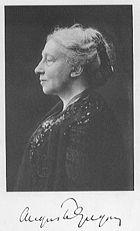 Encouraged by the St Theresa's Hall success, Yeats, Lady Gregory, Æ, Martyn, and John Millington Synge
founded the Irish National Theatre Society in 1903 with funding from Horniman. At first, they staged performances in the Molesworth Hall. When the Hibernian Theatre of Varieties
in Lower Abbey Street and an adjacent building in Marlborough Street became available after fire safety authorities closed the Hibernia, Horniman and William Fay agreed to buy and refit the space to meet the society's needs.
On 11 May 1904, the society formally accepted Horniman's offer of the use of the building. As Horniman did not usually reside in Ireland, the royal letters patent
required were granted in the name of Lady Gregory, although paid for by Horniman. The founders appointed William Fay theatre manager, responsible for training the actors in the newly established repertory company. They commissioned Yeats' brother Jack to paint portraits of all the leading figures in the society for the foyer, and hired Sarah Purser
to design stained glass for the same space.
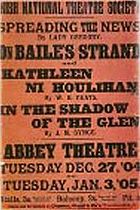
On 27 December, the curtains went up on opening night. The bill consisted of three one-act plays, On Baile's Strand and Cathleen Ní Houlihan by Yeats, and Spreading the News
by Lady Gregory. On the second night, In the Shadow of the Glen by Synge replaced the second Yeats play. These two bills alternated over a five-night run. Frank Fay, playing Cúchulainn
in On Baile's Strand, was the first actor on the Abbey stage. Although Horniman had designed the costumes, neither she nor Lady Gregory was present. Horniman had returned to England. In addition to providing funding, her chief role with the Abbey over the coming years was to organise publicity and bookings for their touring productions in London
and provincial England.
In 1905 without properly consulting Horniman, Yeats, Lady Gregory and Synge decided to turn the theatre into a limited liability company
, the National Theatre Society Ltd. Annoyed by this treatment, she hired Ben Iden Payne
, a former Abbey employee, to help run a new repertory company which she founded in Manchester.
, George Bernard Shaw
, Oliver St John Gogarty, F. R. Higgins
, Thomas MacDonagh
, Lord Dunsany, T. C. Murray
, James Cousins
and Lennox Robinson
. Many of these authors served on the board, and it was during this time that the Abbey gained its reputation as a writers' theatre.
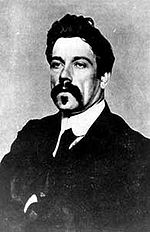 The Abbey's fortunes worsened in January 1907 when the opening of Synge's The Playboy of the Western World
resulted in civil disturbance. The troubles (since known as the Playboy Riots) were encouraged, in part, by nationalists
who believed the theatre was insufficiently political and who took offence at Synge's use of the word 'shift
', as it was known at the time as a symbol representing Kitty O'Shea and adultery, and hence was seen as a slight on the virtue of Irish womanhood. Much of the crowd rioted loudly, and the actors performed the remainder of the play in dumbshow
. The theatre's decision to call in the police further roused anger of the nationalists. Although press opinion soon turned against the rioters and the protests faded, management of the Abbey was shaken. They chose not to stage Synge's next—and last completed—play, The Tinker's Wedding (1908), for fear of further disturbances. That same year, the Fay brothers' association with the theatre ended when they emigrated to the United States; Lennox Robinson took over the Abbey's day-to-day management.
In 1909, Shaw's The Shewing-Up of Blanco Posnet led to further protests. The subsequent discussion occupied a full issue of the theatre's journal The Arrow. Also that year, the proprietors decided to make the Abbey independent of Annie Horniman, who had indicated a preference for this course. Relations with Horniman had been tense, partly because she wished to be involved in choosing which plays were to be performed and when. As a mark of respect for the death of King Edward VII
, an understanding existed that Dublin theatres were to close on the night of 7 May 1910. Robinson, however, kept the Abbey open. When Horniman heard of Robinson's decision, she severed her connections with the company. By her own estimate, she had invested £10,350—worth approximately $1 million in 2007 US dollars—on the project.
With the loss of Horniman, Synge, and the Fays, the Abbey under Robinson tended to drift, suffering from falling public interest and box office returns. This trend was halted for a time by the emergence of Sean O'Casey
as an heir to Synge. O'Casey's career as a dramatist began with The Shadow of a Gunman, staged by the Abbey in 1923. This was followed by Juno and the Paycock in 1924, and The Plough and the Stars in 1926. Theatregoers arose in riots over the last play, in a way reminiscent of those that had greeted the Playboy 19 years earlier. Concerned about public reaction, the Abbey rejected O'Casey's next play. He emigrated to London shortly thereafter.
In 1924, Yeats and Lady Gregory offered the Abbey to the government of the Free State as a gift to the Irish people. Although the government refused, the following year Minister of Finance Ernest Blythe
arranged an annual government subsidy of £850 for the Abbey. This made the company the first state-supported theatre in the English-speaking world. The subsidy allowed the theatre to avoid bankruptcy, but the amount was too small to rescue it from financial difficulty.
The Abbey School of Acting and the Abbey School of Ballet were set up that year. The latter was led by Ninette de Valois
—who had provided choreography for a number of Yeats' plays—and ran until 1933.
and Micheál MacLiammoir
launched the Gate Theatre
, initially using the Peacock to stage works by European and American dramatists. The Gate primarily sought work from new Irish playwrights and, despite the new space, the Abbey entered a period of artistic decline.
This is illustrated by the story of how one new work was said to have come to the Gate Theatre. Denis Johnston
reportedly submitted his first play, Shadowdance, to the Abbey; however, Lady Gregory rejected it, returning it to the author with “The Old Lady says No” written across the title page. Johnston decided to re-title the play. The Gate staged The Old Lady Says 'No' in The Peacock in 1928. (Note: academic critics Joseph Ronsley and Christine St. Peter have questioned the veracity of this story.)
sat on the board from 1935 to 1939, served as managing director from 1937, and had two plays staged during this period. He was alienated from and unable to cope with many of the other board members. They held O'Connor's past adultery against him. Although he fought formidably to retain his position, soon after Yeats died, the board began machinations to remove O'Connor.
During the 1940s and 1950s, the staple fare at the Abbey was comic farce set in the idealised peasant world of playwright Éamon de Valera
. If it had ever existed, it was no longer considered relevant by most Irish citizens. As a result, audience numbers continued to decline. This drift might have been more dramatic but popular actors, including F. J. McCormick
, and dramatists, including George Shiels
, could still draw a crowd. Austin Clarke
staged events for his Dublin Verse Speaking Society—later the Lyric Theatre
—at the Peacock from 1941 to 1944 and the Abbey from 1944 to 1951.
On 17 July 1951, fire destroyed the Abbey Theatre, with only the Peacock surviving intact. The company leased the old Queen's Theatre
in September and continued in residence there until 1966. The Queen's had been home to the Happy Gang, a team of comedians who specialised in popular skits, farces and pantomimes and drew wide audiences. With its continued diet of 'peasant comedies', the new tenants were not far removed from the old.
Neither Brendan Behan
nor Samuel Beckett
, two of the more interesting Irish dramatists to emerge in the 1950s, featured in these productions. In February 1961, the ruins of the Abbey were demolished. The board had plans for rebuilding with a design by the Irish architect Michael Scott
. On 3 September 1963, the President of Ireland
, Éamon de Valera
, laid the foundation stone for the new theatre. The Abbey reopened on 18 July 1966.
, Brian Friel
and Tom Murphy
; and tourism that included the National Theatre as a key cultural attraction, helped revive the theatre. Beginning in 1957, the theatre's participation in the Dublin Theatre Festival
aided its revival. Plays such as Brian Friel
's Philadelphia Here I Come!
(1964), The Faith Healer (1979) and Dancing at Lughnasa
(1990); Tom Murphy
's A Whistle In the Dark
(1961) and The Gigli Concert
(1983); and Hugh Leonard
's Da
(1973) and A Life (1980), helped raise the Abbey's international profile through successful runs in the West End
in London, and on Broadway
in New York City.
In December 2004, the theatre celebrated its centenary with events that included performances of the original programme by amateur dramatic groups and a production of Michael West's Dublin By Lamplight, originally staged by Annie Ryan for The Corn Exchange company at the Project Arts Centre
in November 2004. Despite the centenary, not all was well. Audience numbers were falling; the Peacock was closed for lack of money; the theatre was near bankruptcy, and the staff felt the threat of huge lay-offs.
In September 2004 two members of the theatre's advisory council, playwrights Jimmy Murphy and Ulick O'Connor
, had tabled a motion of no confidence in Artistic Director Ben Barnes. They criticised Barnes for touring with a play in Australia during the deep financial and artistic crisis at home. Barnes returned and temporarily held his position. The debacle put the Abbey under great public scrutiny. On 12 May 2005, Barnes and Managing Director Brian Jackson resigned after it was found that the theatre's deficit of €1.85 million had been underestimated. The new director, Fiach Mac Conghail
, due to start in January 2006, took over in May 2005.
On 20 August 2005, the Abbey Theatre Advisory Council approved a plan to dissolve the Abbey's owner, the National Theatre Society, and replace it with a company limited by guarantee
, the Abbey Theatre Limited. After strong debate, the board accepted the program. Basing its actions on this plan, the Arts Council of Ireland awarded the Abbey €25.7 million in January 2006 to be spread over three years. The grant represented an approximate 43 percent increase in the Abbey's revenues and was the largest grant ever awarded by the Arts Council. The new company was established on 1 February 2006, with the announcement of a new Abbey Board chaired by High Court Judge Bryan McMahon. In March 2007, the larger auditorium in the theatre was radically reconfigured by Jean-Guy Lecat as part of a major upgrade of the theatre.
More than 20 writers have been commissioned by the Abbey since Mac Conghail was appointed director in May 2005. The Abbey is also producing new Irish plays commissioned and developed by London's Royal Court Theatre; Tom Murphy's Alice Trilogy and Marina Carr
's Woman and Scarecrow are examples. The Abbey is also developing a relationship with the Public Theater
in New York, where it has presented two new plays; Terminus by Mark O'Rowe
and Sam Shepard
's Kicking a Dead Horse.
contract for design, construction, financing and maintenance. This building will be in Dublin's "Docklands" area and will comprise three auditorium spaces, including a 700-seat main theatre, a 350-seat secondary performance space and a 150-seat studio theatre, along with rehearsal and education facilities, storage, wardrobe, archive and office space, and one or more bars and restaurants and a bookshop.
The general and artistic operation of the new theatre will continue to be the responsibility of the Abbey Theatre Amharclann na Mainistreach Ltd.
Theatre
Theatre is a collaborative form of fine art that uses live performers to present the experience of a real or imagined event before a live audience in a specific place. The performers may communicate this experience to the audience through combinations of gesture, speech, song, music or dance...
located in Dublin, Ireland
Republic of Ireland
Ireland , described as the Republic of Ireland , is a sovereign state in Europe occupying approximately five-sixths of the island of the same name. Its capital is Dublin. Ireland, which had a population of 4.58 million in 2011, is a constitutional republic governed as a parliamentary democracy,...
. The Abbey first opened its doors to the public on 27 December 1904. Despite losing its original building to a fire in 1951, it has remained active to the present day. The Abbey was the first state-subsidized theatre in the English-speaking world; from 1925 onwards it received an annual subsidy from the Irish Free State
Irish Free State
The Irish Free State was the state established as a Dominion on 6 December 1922 under the Anglo-Irish Treaty, signed by the British government and Irish representatives exactly twelve months beforehand...
. Since July 1966, the Abbey has been located at 26 Lower Abbey Street, Dublin 1.
A theatre or circus has stood on this site on Lower Abbey Street since at least the early 19th century. In the mid-19th century, at the urging of Dublin's gentry, John Classon, an upper-class merchant, acquired the buildings then on the site, one of which had housed a circus, in order to establish a joint concert hall and civic institution for the lower classes. The Music Hall, which could seat 4000 persons, in addition to hosting concerts, frequently hosted popular variety entertainments like Pablo Fanque
Pablo Fanque
Pablo Fanque was the first black circus proprietor in Britain. His circus, in which he himself was a performer, was the most popular circus in Victorian Britain for 30 years, a period that is regarded as the golden age of the circus...
's Circus Royal. In the late 19th Century the Music Hall was renamed the Mechanics' Theatre
Mechanics' Theatre
The Mechanics' Hall, also known as the Hibernian Theatre of Varieties was a theatre and music hall in Lower Abbey Street, Dublin. It stood at the site of the current Abbey Theatre at 26 Lower Abbey Street....
, after the adjacent Mechnanic's Institute. The theatre was also known during this time as the Hibernian Theatre of Varieties
Mechanics' Theatre
The Mechanics' Hall, also known as the Hibernian Theatre of Varieties was a theatre and music hall in Lower Abbey Street, Dublin. It stood at the site of the current Abbey Theatre at 26 Lower Abbey Street....
, a name it retained until the building was acquired for Abbey Theatre at the beginning of the 20th Century.
In its early years, the theatre was closely associated with the writers of the Irish Literary Revival
Irish Literary Revival
The Irish Literary Revival was a flowering of Irish literary talent in the late 19th and early 20th century.-Forerunners:...
, many of whom were involved in its founding and most of whom had plays staged there. The Abbey served as a nursery for many of the leading Irish playwrights
Irish theatre
The history of Irish theatre begins with the Gaelic Irish tradition. Much of the literature in that Celtic language was destroyed by conquest, except for a few manuscripts and fragments, such as the Book of Fermoy...
and actors of the 20th century, including William Butler Yeats
William Butler Yeats
William Butler Yeats was an Irish poet and playwright, and one of the foremost figures of 20th century literature. A pillar of both the Irish and British literary establishments, in his later years he served as an Irish Senator for two terms...
, Augusta, Lady Gregory
Augusta, Lady Gregory
Isabella Augusta, Lady Gregory , born Isabella Augusta Persse, was an Irish dramatist and folklorist. With William Butler Yeats and Edward Martyn, she co-founded the Irish Literary Theatre and the Abbey Theatre, and wrote numerous short works for both companies. Lady Gregory produced a number of...
, Sean O'Casey
Seán O'Casey
Seán O'Casey was an Irish dramatist and memoirist. A committed socialist, he was the first Irish playwright of note to write about the Dublin working classes.- Early life:...
and John Millington Synge
John Millington Synge
Edmund John Millington Synge was an Irish playwright, poet, prose writer, and collector of folklore. He was a key figure in the Irish Literary Revival and was one of the cofounders of the Abbey Theatre...
. In addition, through its extensive programme of touring abroad and its high visibility to foreign, particularly American, audiences, it has become an important part of the Irish tourist industry.
Irish Literary Theatre
Irish Literary Theatre
The Irish Literary Theatre was a precursor to the Abbey Theatre in Dublin, Ireland. Founded by W. B. Yeats, Lady Gregory, George Moore and Edward Martyn in 1899, this theatre presented a number of plays by the founders and other writers, including Padraic Colum....
. Founded by Lady Gregory, Edward Martyn
Edward Martyn
Edward Martyn was an Irish political and cultural activist and playwright.-Early life:Martyn was the eldest son of John Martyn of Tullira and Annie Mary Josephine Smyth of Masonbrook, Loughrea, both in County Galway. He succeeded his father upon John's death in 1860...
and William Butler Yeats
William Butler Yeats
William Butler Yeats was an Irish poet and playwright, and one of the foremost figures of 20th century literature. A pillar of both the Irish and British literary establishments, in his later years he served as an Irish Senator for two terms...
in 1899—with assistance from George Moore
George Moore (novelist)
George Augustus Moore was an Irish novelist, short-story writer, poet, art critic, memoirist and dramatist. Moore came from a Roman Catholic landed family who lived at Moore Hall in Carra, County Mayo. He originally wanted to be a painter, and studied art in Paris during the 1870s...
—it presented plays in the Ancient Concert Rooms and the Gaiety Theatre, which brought critical approval but limited public interest.
The second base involved the work of two Irish brothers, William
William Fay
William George Fay was an actor and theatre producer who was one of the co-founders of the Abbey Theatre....
and Frank Fay
Frank Fay (Irish actor)
Frank Fay , brother of William Fay, was an actor and co-founder of the Abbey Theatre. He worked with his brother, William, staging productions in halls around the city. Finally, they formed W. G...
. William worked in the 1890s with a touring company in Ireland, Scotland and Wales, while Frank was heavily involved in amateur dramatics in Dublin. After William returned to Dublin, the Fay brothers staged productions in halls around the city and eventually formed W. G. Fay's Irish National Dramatic Company
W. G. Fay's Irish National Dramatic Company
W. G. Fay's Irish National Dramatic Company was a precursor to Dublin's Abbey Theatre.It was founded towards the end of the 19th century by two Irish brothers, William and Frank Fay. William had worked for a time in the 1890s with a touring company in Ireland, Scotland and Wales while Frank was...
, focused on the development of Irish acting talent. In April 1902, the Fays gave three performances of Æ's
George William Russell
George William Russell who wrote under the pseudonym Æ , was an Irish nationalist, writer, editor, critic, poet, and painter. He was also a mystical writer, and centre of a group of followers of theosophy in Dublin, for many years.-Organisor:Russell was born in Lurgan, County Armagh...
play Deirdre and Yeats' Cathleen Ní Houlihan in a hall in St. Theresa's Hall on Clarendon Street. The performances played to a mainly working-class audience rather than the usual middle-class Dublin theatregoers. The run was a great success, thanks in part to Maud Gonne
Maud Gonne
Maud Gonne MacBride was an English-born Irish revolutionary, feminist and actress, best remembered for her turbulent relationship with William Butler Yeats. Of Anglo-Irish stock and birth, she was won over to Irish nationalism by the plight of evicted people in the Land Wars...
, who played the lead in Yeats' play. The company continued at the Ancient Concert Rooms, producing works by Seumas O'Cuisin
James Cousins
James Henry Cousins was an Irish writer, playwright, actor, critic, editor, teacher and poet. He used several pseudonyms including Mac Oisín and the Hindu name Jayaram....
, Fred Ryan
Frederick Ryan
Frederick Ryan , was an Irish, Dublin-born playwright, journalist and socialist.-Career:Ryan became secretary of the Irish National Theatre Society in 1902. There he would create realistic satire with the play The Laying of the Foundations...
and Yeats.
The third base was financial support and experience of Annie Elizabeth Fredericka Horniman. Horniman was a middle-class Englishwoman with previous experience of theatre production, having been involved in the presentation of George Bernard Shaw
George Bernard Shaw
George Bernard Shaw was an Irish playwright and a co-founder of the London School of Economics. Although his first profitable writing was music and literary criticism, in which capacity he wrote many highly articulate pieces of journalism, his main talent was for drama, and he wrote more than 60...
's Arms and the Man
Arms and the Man
Arms and the Man is a comedy by George Bernard Shaw, whose title comes from the opening words of Virgil's Aeneid in Latin:"Arma virumque cano" ....
in London in 1894. She came to Dublin in 1903 to act as Yeats' unpaid secretary and to make costumes for a production of his play The King's Threshold. Her money helped found the Abbey Theatre and, according to the critic Adrian Frazier, would "make the rich feel at home, and the poor—on a first visit—out of place."
Foundation
John Millington Synge
Edmund John Millington Synge was an Irish playwright, poet, prose writer, and collector of folklore. He was a key figure in the Irish Literary Revival and was one of the cofounders of the Abbey Theatre...
founded the Irish National Theatre Society in 1903 with funding from Horniman. At first, they staged performances in the Molesworth Hall. When the Hibernian Theatre of Varieties
Mechanics' Theatre
The Mechanics' Hall, also known as the Hibernian Theatre of Varieties was a theatre and music hall in Lower Abbey Street, Dublin. It stood at the site of the current Abbey Theatre at 26 Lower Abbey Street....
in Lower Abbey Street and an adjacent building in Marlborough Street became available after fire safety authorities closed the Hibernia, Horniman and William Fay agreed to buy and refit the space to meet the society's needs.
On 11 May 1904, the society formally accepted Horniman's offer of the use of the building. As Horniman did not usually reside in Ireland, the royal letters patent
Letters patent
Letters patent are a type of legal instrument in the form of a published written order issued by a monarch or president, generally granting an office, right, monopoly, title, or status to a person or corporation...
required were granted in the name of Lady Gregory, although paid for by Horniman. The founders appointed William Fay theatre manager, responsible for training the actors in the newly established repertory company. They commissioned Yeats' brother Jack to paint portraits of all the leading figures in the society for the foyer, and hired Sarah Purser
Sarah Purser
-Early life:She was born in Kingstown in County Dublin, and raised in Dungarvan, County Waterford. She was educated in Switzerland and afterwards studied at the Metropolitan School of Art in Dublin and in Paris at the Académie Julian.-Artist:...
to design stained glass for the same space.
On 27 December, the curtains went up on opening night. The bill consisted of three one-act plays, On Baile's Strand and Cathleen Ní Houlihan by Yeats, and Spreading the News
Spreading the News
Spreading the News is a short one-act comic play by Lady Gregory, which she wrote for the opening night of the Abbey Theatre in Dublin, 27 Dec. 1904. It was on a double bill with William Butler Yeats's Cathleen Ni Houlihan. Audiences may have dozed through Yeats's play , but Spreading the News was...
by Lady Gregory. On the second night, In the Shadow of the Glen by Synge replaced the second Yeats play. These two bills alternated over a five-night run. Frank Fay, playing Cúchulainn
Cúchulainn
Cú Chulainn or Cúchulainn , and sometimes known in English as Cuhullin , is an Irish mythological hero who appears in the stories of the Ulster Cycle, as well as in Scottish and Manx folklore...
in On Baile's Strand, was the first actor on the Abbey stage. Although Horniman had designed the costumes, neither she nor Lady Gregory was present. Horniman had returned to England. In addition to providing funding, her chief role with the Abbey over the coming years was to organise publicity and bookings for their touring productions in London
London
London is the capital city of :England and the :United Kingdom, the largest metropolitan area in the United Kingdom, and the largest urban zone in the European Union by most measures. Located on the River Thames, London has been a major settlement for two millennia, its history going back to its...
and provincial England.
In 1905 without properly consulting Horniman, Yeats, Lady Gregory and Synge decided to turn the theatre into a limited liability company
Limited liability company
A limited liability company is a flexible form of enterprise that blends elements of partnership and corporate structures. It is a legal form of company that provides limited liability to its owners in the vast majority of United States jurisdictions...
, the National Theatre Society Ltd. Annoyed by this treatment, she hired Ben Iden Payne
Ben Iden Payne
Ben Iden Payne was an English actor, director and teacher. Born in Newcastle-on-Tyne, he was raised and educated in Manchester. He started his career as a walk-on actor in 1899. He served as director of the Abbey Theatre for a short time in 1907 and then returned to Manchester to work with Annie...
, a former Abbey employee, to help run a new repertory company which she founded in Manchester.
Early years
The new Abbey Theatre found great popular success, and large crowds attended many of its productions. The Abbey was fortunate in having Synge as a key member, as he was then considered one of the foremost English-language dramatists. The theatre staged many plays by eminent or soon-to-be eminent authors, including Yeats, Lady Gregory, Moore, Martyn, Padraic ColumPadraic Colum
Padraic Colum was an Irish poet, novelist, dramatist, biographer, playwright, children's author and collector of folklore. He was one of the leading figures of the Celtic Revival.-Early life:...
, George Bernard Shaw
George Bernard Shaw
George Bernard Shaw was an Irish playwright and a co-founder of the London School of Economics. Although his first profitable writing was music and literary criticism, in which capacity he wrote many highly articulate pieces of journalism, his main talent was for drama, and he wrote more than 60...
, Oliver St John Gogarty, F. R. Higgins
F. R. Higgins
Frederick Robert Higgins was an Irish poet and theatre director.-Early years:Higgins was born on the west coast of Ireland in Foxford, which is located in County Mayo...
, Thomas MacDonagh
Thomas MacDonagh
Thomas MacDonagh was an Irish nationalist, poet, playwright, and a leader of the 1916 Easter Rising.-Early life:MacDonagh was born in Cloughjordan, County Tipperary...
, Lord Dunsany, T. C. Murray
T. C. Murray
Thomas Cornelius Murray was an Irish dramatist who was closely associated with the Abbey Theatre. He was born in Macroom, County Cork, and educated at St Patrick's Teacher Training College in Drumcondra, Dublin. He worked as a schoolteacher and in 1900 was appointed headmaster of the national...
, James Cousins
James Cousins
James Henry Cousins was an Irish writer, playwright, actor, critic, editor, teacher and poet. He used several pseudonyms including Mac Oisín and the Hindu name Jayaram....
and Lennox Robinson
Lennox Robinson
Esmé Stuart Lennox Robinson was an Irish dramatist, poet and theatre producer and director who was involved with the Abbey Theatre....
. Many of these authors served on the board, and it was during this time that the Abbey gained its reputation as a writers' theatre.
The Playboy of the Western World
The Playboy of the Western World is a three-act play written by Irish playwright John Millington Synge and first performed at the Abbey Theatre, Dublin, on January 26, 1907. It is set in Michael James Flaherty's public house in County Mayo during the early 1900s...
resulted in civil disturbance. The troubles (since known as the Playboy Riots) were encouraged, in part, by nationalists
Irish nationalism
Irish nationalism manifests itself in political and social movements and in sentiment inspired by a love for Irish culture, language and history, and as a sense of pride in Ireland and in the Irish people...
who believed the theatre was insufficiently political and who took offence at Synge's use of the word 'shift
Chemise
The term chemise or shift can refer to the classic smock, or else can refer to certain modern types of women's undergarments and dresses...
', as it was known at the time as a symbol representing Kitty O'Shea and adultery, and hence was seen as a slight on the virtue of Irish womanhood. Much of the crowd rioted loudly, and the actors performed the remainder of the play in dumbshow
Dumbshow
Dumbshow, also dumb show or dumb-show, is a traditional term for pantomime in drama, actions presented by actors onstage without spoken dialogue. It is similar to the masque...
. The theatre's decision to call in the police further roused anger of the nationalists. Although press opinion soon turned against the rioters and the protests faded, management of the Abbey was shaken. They chose not to stage Synge's next—and last completed—play, The Tinker's Wedding (1908), for fear of further disturbances. That same year, the Fay brothers' association with the theatre ended when they emigrated to the United States; Lennox Robinson took over the Abbey's day-to-day management.
In 1909, Shaw's The Shewing-Up of Blanco Posnet led to further protests. The subsequent discussion occupied a full issue of the theatre's journal The Arrow. Also that year, the proprietors decided to make the Abbey independent of Annie Horniman, who had indicated a preference for this course. Relations with Horniman had been tense, partly because she wished to be involved in choosing which plays were to be performed and when. As a mark of respect for the death of King Edward VII
Edward VII of the United Kingdom
Edward VII was King of the United Kingdom and the British Dominions and Emperor of India from 22 January 1901 until his death in 1910...
, an understanding existed that Dublin theatres were to close on the night of 7 May 1910. Robinson, however, kept the Abbey open. When Horniman heard of Robinson's decision, she severed her connections with the company. By her own estimate, she had invested £10,350—worth approximately $1 million in 2007 US dollars—on the project.
With the loss of Horniman, Synge, and the Fays, the Abbey under Robinson tended to drift, suffering from falling public interest and box office returns. This trend was halted for a time by the emergence of Sean O'Casey
Seán O'Casey
Seán O'Casey was an Irish dramatist and memoirist. A committed socialist, he was the first Irish playwright of note to write about the Dublin working classes.- Early life:...
as an heir to Synge. O'Casey's career as a dramatist began with The Shadow of a Gunman, staged by the Abbey in 1923. This was followed by Juno and the Paycock in 1924, and The Plough and the Stars in 1926. Theatregoers arose in riots over the last play, in a way reminiscent of those that had greeted the Playboy 19 years earlier. Concerned about public reaction, the Abbey rejected O'Casey's next play. He emigrated to London shortly thereafter.
In 1924, Yeats and Lady Gregory offered the Abbey to the government of the Free State as a gift to the Irish people. Although the government refused, the following year Minister of Finance Ernest Blythe
Ernest Blythe
Ernest Blythe was an Irish politician.Ernest Blythe was born to a Presbyterian and Unionist family near Lisburn, County Antrim in 1889, the son of a farmer, and was educated locally. At the age of fifteen he started working as a clerk in the Department of Agriculture in Dublin.Blythe joined the...
arranged an annual government subsidy of £850 for the Abbey. This made the company the first state-supported theatre in the English-speaking world. The subsidy allowed the theatre to avoid bankruptcy, but the amount was too small to rescue it from financial difficulty.
The Abbey School of Acting and the Abbey School of Ballet were set up that year. The latter was led by Ninette de Valois
Ninette de Valois
Dame Ninette de Valois, OM, CH, DBE, FRAD, FISTD was an Irish-born British dancer, teacher, choreographer and director of classical ballet...
—who had provided choreography for a number of Yeats' plays—and ran until 1933.
The Peacock and the Gate
Around this time the company acquired additional space, allowing them to create a small experimental theatre, the Peacock, in the ground floor of the main theatre. In 1928, Hilton EdwardsHilton Edwards
Hilton Edwards was an English-born Irish actor and theatrical producer. He was the son of Thomas George Cecil Edwards and Emily Edwards ....
and Micheál MacLiammoir
Micheál MacLiammóir
Micheál Mac Liammóir , born Alfred Willmore, was an English-born Irish actor, dramatist, impresario, writer, poet and painter. Mac Liammóir was born to a Protestant family living in the Kensal Green neighbourhood of London....
launched the Gate Theatre
Gate Theatre
The Gate Theatre, in Dublin, was founded in 1928 by Hilton Edwards and Micheál Mac Liammóir, initially using the Abbey Theatre's Peacock studio theatre space to stage important works by European and American dramatists...
, initially using the Peacock to stage works by European and American dramatists. The Gate primarily sought work from new Irish playwrights and, despite the new space, the Abbey entered a period of artistic decline.
This is illustrated by the story of how one new work was said to have come to the Gate Theatre. Denis Johnston
Denis Johnston
Denis Johnston was an Irish writer. He wrote mostly plays, but also works of literary criticism, a book-length biographical essay of Jonathan Swift, a memoir and an eccentric work of philosophy. He also worked as a war correspondent, and as both a radio and television producer for the BBC...
reportedly submitted his first play, Shadowdance, to the Abbey; however, Lady Gregory rejected it, returning it to the author with “The Old Lady says No” written across the title page. Johnston decided to re-title the play. The Gate staged The Old Lady Says 'No' in The Peacock in 1928. (Note: academic critics Joseph Ronsley and Christine St. Peter have questioned the veracity of this story.)
After Yeats
The tradition of the Abbey as primarily a writers' theatre survived Yeats' withdrawal from day-to-day involvement. Frank O'ConnorFrank O'Connor
Frank O’Connor was an Irish author of over 150 works, best known for his short stories and memoirs.-Early life:...
sat on the board from 1935 to 1939, served as managing director from 1937, and had two plays staged during this period. He was alienated from and unable to cope with many of the other board members. They held O'Connor's past adultery against him. Although he fought formidably to retain his position, soon after Yeats died, the board began machinations to remove O'Connor.
During the 1940s and 1950s, the staple fare at the Abbey was comic farce set in the idealised peasant world of playwright Éamon de Valera
Éamon de Valera
Éamon de Valera was one of the dominant political figures in twentieth century Ireland, serving as head of government of the Irish Free State and head of government and head of state of Ireland...
. If it had ever existed, it was no longer considered relevant by most Irish citizens. As a result, audience numbers continued to decline. This drift might have been more dramatic but popular actors, including F. J. McCormick
F. J. McCormick
F. J. McCormick was an Irish actor who came to fame as part of Dublin's Abbey Theatre. He was also in four films; most famously Carol Reed's Odd Man Out , in which he played the opportunistic Shell. He died in 1947 of a brain tumor.-External links: at the Internet Movie Database...
, and dramatists, including George Shiels
George Shiels
George Shiels was an Irish dramatist whose plays were a success both in his native Ulster and at the Abbey Theatre in Dublin. His most famous plays are The Rugged Path, The Passing Day, and The New Gossoon....
, could still draw a crowd. Austin Clarke
Austin Clarke (poet)
thumb|300px|Austin Clarke Bridge in [[Templeogue]]Austin Clarke was one of the leading Irish poets of the generation after W. B. Yeats. He also wrote plays, novels and memoirs...
staged events for his Dublin Verse Speaking Society—later the Lyric Theatre
Lyric Theatre, Dublin
The Lyric Theatre grew out of Austin Clarke's Dublin Verse Speaking Society. It operated out of the Abbey Theatre's downstairs studio theatre, the Peacock from 1941 to 1944 and the Abbey proper from 1944 to 1951 when it closed as a consequence of the fire that destroyed the building....
—at the Peacock from 1941 to 1944 and the Abbey from 1944 to 1951.
On 17 July 1951, fire destroyed the Abbey Theatre, with only the Peacock surviving intact. The company leased the old Queen's Theatre
Queen's Theatre, Dublin
The Queen's Theatre, Dublin, located in Pearse Street was originally built in 1829 as the Adelphi Theatre. This building was demolished in 1844 and rebuilt. It reopened that same year as the Queens Royal Theatre, the new owner having been granted a Royal Patent to operate as a patent theatre. The...
in September and continued in residence there until 1966. The Queen's had been home to the Happy Gang, a team of comedians who specialised in popular skits, farces and pantomimes and drew wide audiences. With its continued diet of 'peasant comedies', the new tenants were not far removed from the old.
Neither Brendan Behan
Brendan Behan
Brendan Francis Behan was an Irish poet, short story writer, novelist, and playwright who wrote in both Irish and English. He was also an Irish republican and a volunteer in the Irish Republican Army.-Early life:...
nor Samuel Beckett
Samuel Beckett
Samuel Barclay Beckett was an Irish avant-garde novelist, playwright, theatre director, and poet. He wrote both in English and French. His work offers a bleak, tragicomic outlook on human nature, often coupled with black comedy and gallows humour.Beckett is widely regarded as among the most...
, two of the more interesting Irish dramatists to emerge in the 1950s, featured in these productions. In February 1961, the ruins of the Abbey were demolished. The board had plans for rebuilding with a design by the Irish architect Michael Scott
Michael Scott (architect)
Michael Scott was an Irish architect whose buildings included the Busáras building in Dublin, the Abbey Theatre, and Tullamore Hospital....
. On 3 September 1963, the President of Ireland
President of Ireland
The President of Ireland is the head of state of Ireland. The President is usually directly elected by the people for seven years, and can be elected for a maximum of two terms. The presidency is largely a ceremonial office, but the President does exercise certain limited powers with absolute...
, Éamon de Valera
Éamon de Valera
Éamon de Valera was one of the dominant political figures in twentieth century Ireland, serving as head of government of the Irish Free State and head of government and head of state of Ireland...
, laid the foundation stone for the new theatre. The Abbey reopened on 18 July 1966.
New generation
A new building; a new generation of dramatists, including such figures as Hugh LeonardHugh Leonard
Hugh Leonard was an Irish dramatist, television writer and essayist. In a career that spanned 50 years, Leonard wrote more than 18 plays, two volumes of essays and two autobiographies, one novel and numerous screenplays and teleplays, as well as writing a regular newspaper column.-Life and...
, Brian Friel
Brian Friel
Brian Friel is an Irish dramatist, author and director of the Field Day Theatre Company. He is considered to be the greatest living English-language dramatist, hailed by the English-speaking world as an "Irish Chekhov" and "the universally accented voice of Ireland"...
and Tom Murphy
Tom Murphy (playwright)
Tom Murphy is an Irish dramatist who has worked closely with the Abbey Theatre in Dublin and with Druid Theatre, Galway. He was born in Tuam, County Galway, Ireland...
; and tourism that included the National Theatre as a key cultural attraction, helped revive the theatre. Beginning in 1957, the theatre's participation in the Dublin Theatre Festival
Dublin Theatre Festival
The Dublin Theatre Festival is Europe's oldest specialized theatre festival. It was founded by theatre impresario Brendan Smith in 1957 and has, with the exception of two years, produced a season of international and Irish theatre each autumn. It is one of a number of key post-World War II events...
aided its revival. Plays such as Brian Friel
Brian Friel
Brian Friel is an Irish dramatist, author and director of the Field Day Theatre Company. He is considered to be the greatest living English-language dramatist, hailed by the English-speaking world as an "Irish Chekhov" and "the universally accented voice of Ireland"...
's Philadelphia Here I Come!
Philadelphia Here I Come!
Philadelphia, Here I Come! is a 1964 play by Irish dramatist Brian Friel. Set in the fictional town of Ballybeg, Co.Donegal, the play launched Friel onto the international stage.-Plot:...
(1964), The Faith Healer (1979) and Dancing at Lughnasa
Dancing at Lughnasa
Dancing at Lughnasa is a 1990 play by dramatist Brian Friel set in Ireland's County Donegal in August 1936 in the fictional town of Ballybeg. It is a memory play told from the point of view of the adult Michael Evans, the narrator...
(1990); Tom Murphy
Tom Murphy (playwright)
Tom Murphy is an Irish dramatist who has worked closely with the Abbey Theatre in Dublin and with Druid Theatre, Galway. He was born in Tuam, County Galway, Ireland...
's A Whistle In the Dark
A Whistle In the Dark
A Whistle in the Dark is a play by Tom Murphy that premiered in 1961 at the Theatre Royal Stratford East London having been rejected by the Abbey Theatre, Dublin. It then went on to be a West End hit. Murphy was twenty-five years old at the time...
(1961) and The Gigli Concert
The Gigli Concert
The Gigli Concert is a play by Irish playwright Tom Murphy premiered at the Abbey Theatre, Dublin, in 1983 and widely regarded as his masterpiece.-Plot:...
(1983); and Hugh Leonard
Hugh Leonard
Hugh Leonard was an Irish dramatist, television writer and essayist. In a career that spanned 50 years, Leonard wrote more than 18 plays, two volumes of essays and two autobiographies, one novel and numerous screenplays and teleplays, as well as writing a regular newspaper column.-Life and...
's Da
Da (play)
Da is a 1978 comedy play by Irish playwright Hugh Leonard.NOTE: Performed by the Queensland Theatre Company in Brisbane Australia in 1975....
(1973) and A Life (1980), helped raise the Abbey's international profile through successful runs in the West End
West End theatre
West End theatre is a popular term for mainstream professional theatre staged in the large theatres of London's 'Theatreland', the West End. Along with New York's Broadway theatre, West End theatre is usually considered to represent the highest level of commercial theatre in the English speaking...
in London, and on Broadway
Broadway theatre
Broadway theatre, commonly called simply Broadway, refers to theatrical performances presented in one of the 40 professional theatres with 500 or more seats located in the Theatre District centered along Broadway, and in Lincoln Center, in Manhattan in New York City...
in New York City.
In December 2004, the theatre celebrated its centenary with events that included performances of the original programme by amateur dramatic groups and a production of Michael West's Dublin By Lamplight, originally staged by Annie Ryan for The Corn Exchange company at the Project Arts Centre
Project Arts Centre
Project Arts Centre is a multidisciplinary contemporary arts centre located in Dublin's Temple Bar that showcases cutting-edge visual art and performance....
in November 2004. Despite the centenary, not all was well. Audience numbers were falling; the Peacock was closed for lack of money; the theatre was near bankruptcy, and the staff felt the threat of huge lay-offs.
In September 2004 two members of the theatre's advisory council, playwrights Jimmy Murphy and Ulick O'Connor
Ulick O'Connor
Ulick O'Connor is an Irish writer, historian and critic.-Early life:Born in Rathgar, County Dublin in 1928, O'Connor attended St. Mary's College, Rathmines and later University College Dublin, where he studied law and philosophy, becoming known as a keen sporting participant, especially in boxing,...
, had tabled a motion of no confidence in Artistic Director Ben Barnes. They criticised Barnes for touring with a play in Australia during the deep financial and artistic crisis at home. Barnes returned and temporarily held his position. The debacle put the Abbey under great public scrutiny. On 12 May 2005, Barnes and Managing Director Brian Jackson resigned after it was found that the theatre's deficit of €1.85 million had been underestimated. The new director, Fiach Mac Conghail
Fiach Mac Conghail
Fiach Mac Conghail is the Director of the Abbey Theatre. In May 2011, he was appointed as a Senator by the Taoiseach Enda Kenny.-Early life:...
, due to start in January 2006, took over in May 2005.
On 20 August 2005, the Abbey Theatre Advisory Council approved a plan to dissolve the Abbey's owner, the National Theatre Society, and replace it with a company limited by guarantee
Company limited by guarantee
In British and Irish company law, a private company limited by guarantee is an alternative type of corporation used primarily for non-profit organisations that require legal personality. A guarantee company does not usually have a share capital or shareholders, but instead has members who act as...
, the Abbey Theatre Limited. After strong debate, the board accepted the program. Basing its actions on this plan, the Arts Council of Ireland awarded the Abbey €25.7 million in January 2006 to be spread over three years. The grant represented an approximate 43 percent increase in the Abbey's revenues and was the largest grant ever awarded by the Arts Council. The new company was established on 1 February 2006, with the announcement of a new Abbey Board chaired by High Court Judge Bryan McMahon. In March 2007, the larger auditorium in the theatre was radically reconfigured by Jean-Guy Lecat as part of a major upgrade of the theatre.
More than 20 writers have been commissioned by the Abbey since Mac Conghail was appointed director in May 2005. The Abbey is also producing new Irish plays commissioned and developed by London's Royal Court Theatre; Tom Murphy's Alice Trilogy and Marina Carr
Marina Carr
Marina Carr is an Irish playwright.Born in Tullamore, County Offaly, Carr attended University College Dublin before holding posts as writer-in-residence at the Abbey Theatre and Trinity College Dublin. She served as Heimbold Professor of Irish Studies at Villanova University in 2003...
's Woman and Scarecrow are examples. The Abbey is also developing a relationship with the Public Theater
Public Theater
The Public Theater is a New York City arts organization founded as The Shakespeare Workshop in 1954 by Joseph Papp, with the intention of showcasing the works of up-and-coming playwrights and performers. It is headquartered at 425 Lafayette Street in the former Astor Library in the East Village...
in New York, where it has presented two new plays; Terminus by Mark O'Rowe
Mark O'Rowe
- Personal Background :Mark O'Rowe was born in 1970 in Dublin, Ireland, to parents Hugh and Patricia O'Rowe. He grew up in Tallaght, a working class suburb just south of Dublin, and he claims that much of the violence in his work stems from watching and rewatching a tremendous amount of violent,...
and Sam Shepard
Sam Shepard
Sam Shepard is an American playwright, actor, and television and film director. He is the author of several books of short stories, essays, and memoirs, and received the Pulitzer Prize for Drama in 1979 for his play Buried Child...
's Kicking a Dead Horse.
Development
After discussions over many years, the Irish government announced in 2007 that a new theatre building would be procured for the Abbey by way of a public-private partnershipPublic-private partnership
Public–private partnership describes a government service or private business venture which is funded and operated through a partnership of government and one or more private sector companies...
contract for design, construction, financing and maintenance. This building will be in Dublin's "Docklands" area and will comprise three auditorium spaces, including a 700-seat main theatre, a 350-seat secondary performance space and a 150-seat studio theatre, along with rehearsal and education facilities, storage, wardrobe, archive and office space, and one or more bars and restaurants and a bookshop.
The general and artistic operation of the new theatre will continue to be the responsibility of the Abbey Theatre Amharclann na Mainistreach Ltd.
External links
- Abbey Theatre homepage.
- The Abbey and the genius of Irish theatre.
- Denis Johnston and The Old Lady Says 'No'
- Dublin's Abbey in centenary crisis—Guardian Unlimited.
- Barnes to stay on as Abbey Theatre director—RTÉ News
- Arts Council voices concern over Abbey—RTÉ News
- Resignations—RTÉ News.
- Abbey Theatre Collection at Southern Illinois University Carbondale Special Collections Research Center