


Chemise

Encyclopedia

SWEAT
SWEAT is an OLN/TSN show hosted by Julie Zwillich that aired in 2003-2004.Each of the 13 half-hour episodes of SWEAT features a different outdoor sport: kayaking, mountain biking, ice hockey, beach volleyball, soccer, windsurfing, rowing, Ultimate, triathlon, wakeboarding, snowboarding, telemark...
and body oils, the precursor to the modern shirts commonly worn in Western nations.
Etymology
Chemise is a French term (which today simply means shirt). This is a cognateCognate
In linguistics, cognates are words that have a common etymological origin. This learned term derives from the Latin cognatus . Cognates within the same language are called doublets. Strictly speaking, loanwords from another language are usually not meant by the term, e.g...
of the Italian word camicia, and the Spanish / Portuguese language word camisa (subsequently borrowed as kameez by Hindi
Hindi
Standard Hindi, or more precisely Modern Standard Hindi, also known as Manak Hindi , High Hindi, Nagari Hindi, and Literary Hindi, is a standardized and sanskritized register of the Hindustani language derived from the Khariboli dialect of Delhi...
/ Urdu
Urdu
Urdu is a register of the Hindustani language that is identified with Muslims in South Asia. It belongs to the Indo-European family. Urdu is the national language and lingua franca of Pakistan. It is also widely spoken in some regions of India, where it is one of the 22 scheduled languages and an...
/ Hindustani
Hindustani language
Hindi-Urdu is an Indo-Aryan language and the lingua franca of North India and Pakistan. It is also known as Hindustani , and historically, as Hindavi or Rekhta...
), all deriving ultimately from the Latin
Latin
Latin is an Italic language originally spoken in Latium and Ancient Rome. It, along with most European languages, is a descendant of the ancient Proto-Indo-European language. Although it is considered a dead language, a number of scholars and members of the Christian clergy speak it fluently, and...
camisia, itself coming from Celtic. (The Romans avidly imported cloth and clothes from the Celts.) The English called the same shirt a smock and the Irish called it a léine (l̠ʲeːnʲə). For an alternative etymology from Persian via Arabic and ultimately Greek, rather than Latin roots, refer entry under Kameez.
Modern chemise
In modern usage, a chemise is generally a woman's garment that vaguely resembles the older shirts but is typically more delicate, and usually provocative. Most commonly the term refers to a loose-fitting, sleeveless undergarment or type of lingerie which is unfitted at the waist. It can also refer to a short, sleeveless dress that hangs straight from the shoulders and fits loosely at the waist. A chemise typically does not have ny buttons or other fasteners and is put on by either dropping it over the head or stepping into it and lifting it up.As lingerie, a chemise is similar to a babydoll
Babydoll
A babydoll is a short, sometimes sleeveless, loose fitting nightgown or negligee intended as nightwear for women. It sometimes has formed cups called a bralette for cleavage with an attached loose fitting skirt falling in length usually between the upper thigh and the belly button...
, which is also a short, loose-fitting, sleeveless garment. Typically, though, babydolls are more loose-fitting at the hips and are generally designed to more resemble a young girl's nightgown, although many modern styles have added various sexualizing features.
History
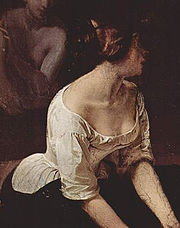
Tunic
A tunic is any of several types of clothing for the body, of various lengths reaching from the shoulders to somewhere between the hips and the ankles...
a and first became popular in Europe in the Middle Ages
Middle Ages
The Middle Ages is a periodization of European history from the 5th century to the 15th century. The Middle Ages follows the fall of the Western Roman Empire in 476 and precedes the Early Modern Era. It is the middle period of a three-period division of Western history: Classic, Medieval and Modern...
. Women wore a shift or chemise under their gown
Gown
A gown is a loose outer garment from knee- to full-length worn by men and women in Europe from the early Middle Ages to the 17th century ; later, gown was applied to any woman's garment consisting of a bodice and attached skirt.A long, loosely-fitted gown called a Banyan was worn by men in the 18th...
or robe
Robe
A robe is a loose-fitting outer garment. A robe is distinguished from a cape or cloak by the fact that it usually has sleeves. The English word robe derives from Middle English robe , borrowed from Old French robe , itself taken from the Frankish word *rouba , and is related to the word rob...
; while men wore a chemise with their trousers or braies, and covered the chemises with garments such as doublet
Doublet (clothing)
A doublet is a man's snug-fitting buttoned jacket that is fitted and shaped to the man's body which was worn in Western Europe from the Middle Ages through to the mid-17th century. The doublet was hip length or waist length and worn over the shirt or drawers. Until the end of the 15th century the...
s, robes, etc.
Until the late 18th century, a chemise referred to an undergarment
Undergarment
Undergarments or underwear are clothes worn under other clothes, often next to the skin. They keep outer garments from being soiled by bodily secretions and discharges, shape the body, and provide support for parts of it. In cold weather, long underwear is sometimes worn to provide additional...
. It was the only underwear worn until the end of Regency period in the 1820s, and was usually the only pieces of clothing that was washed regularly.
In the 1810s, the term came also to be applied to an outergarment. In Western countries, the chemise as an undergarment fell out of fashion in the early 20th century, and was generally replaced by a brassiere
Brassiere
A brassiere is an undergarment that covers, supports, and elevates the breasts. Since the late 19th century, it has replaced the corset as the most widely accepted method for supporting breasts....
, girdle
Girdle
A girdle is a garment that encircles the lower torso, perhaps extending below the hips, and worn often for support. The word girdle originally meant a belt. In modern English, the term girdle is most commonly used for a form of women's foundation wear that replaced the corset in popularity...
, and full slip
Slip (clothing)
Slip is a woman's undergarment worn beneath a dress or skirt to help it hang smoothly and to prevent chafing of the skin from coarse fabrics such as wool...
, and panties
Panties
Panties are a form of underwear, usually light and snug-fitting, designed to be worn by women or girls in the area directly below the waist. Typical components include an elastic waistband, a crotch panel to cover the genital area , and a pair of leg openings which, like the waistband, are often...
first came to be worn.
Men's chemises may be said to have survived as the common T-shirt
T-shirt
A T-shirt is a style of shirt. A T-shirt is buttonless and collarless, with short sleeves and frequently a round neck line....
, which still serves as an undergarment. The chemise also morphed into the smock-frock
Smock-frock
A smock-frock or smock is an outer garment traditionally worn by rural workers, especially shepherds and waggoners, in parts of England and Wales from the early eighteenth century...
, a garment worn by English laborers until the early 20th century. Its loose cut and wide sleeves were well adapted to heavy labor. The name smock is nowadays still used for military combat jackets in the UK, whereas in the Belgian army the term has been corrupted to smoke-vest.
A chemise, shift, or smock was usually sewn at home, by the women of a household. It was assembled from rectangles and triangles cut from one piece of cloth so as to leave no waste. The poor would wear skimpy chemises pieced from a narrow piece of rough cloth; while the rich might have voluminous chemises pieced from thin, smooth fine linen.