


Aaron's rod

Encyclopedia
Aaron's rod refers to any of the staves carried by Moses
' brother, Aaron
, in the Old Testament
of the Bible
. The Bible tells how, along with Moses' rod
, Aaron's rod was endowed with miraculous power during the Plagues of Egypt
which preceded the Exodus
. There are two occasions where the Bible tells of the rod's power even when it was not being held by its owner.
to correct and guide his flock
(Psalm 23
:4). Moses' rod is, in fact, cited in Exodus 4:2 as carried by him while he tended his sheep; and later (Exodus 4:20) becomes his symbol of authority over the Israelites (Psalm 2
:9, Psalm 89
:32, Isaiah
10:24 and 11:4, Ezekiel
20:37). The rods of both Moses and Aaron were endowed with miraculous power during the Plagues of Egypt
(Exodus 7:17, 8:5, 8:16-17, 9:23, and 10:13); God commanded Moses to raise his rod over the Red Sea
when it was to be parted (Exodus 14:16) and in prayer over Israel in battle (Exodus 17:9); Moses brings forth water from a stone using his rod
(Exodus 17, Numbers
20:11).
Aaron's rod, however, is cited twice as exhibiting miraculous power on its own, when not physically in the grasp of its owner. In Exodus 7 (Parshat Va'eira
in the Torah
), God
sends Moses and Aaron to Pharaoh
once more, instructing Aaron that when Pharaoh demands to see a miracle, he is to "cast down his rod" and it will become a serpent
. When he does so, Pharaoh's sorcerers counter by similarly casting down their own rods which also become serpents, but Aaron's rod/serpent swallows them all. "Pharaoh's heart is stubborn" and he chooses to ignore this bit of symbolic warning, and so the Plagues of Egypt
ensue. Notably, this chapter begins with God telling Moses, "Behold, I have made you as God to Pharaoh and your brother Aaron will be your prophet." As God transmits his word through his prophets to his people, so Moses will transmit God's message through Aaron to the pharaoh. The prophet's task was to speak God's word on God's behalf. He was God's "mouth". (Exodus 4:15-16)
In Numbers 17, Korah
's rebellion against Moses' proclamation of the tribe of Levi as the priesthood has been quashed and the entire congregation's ensuing rebellion has resulted in a plague, ended only by the intercession of Moses and Aaron. In order to "stop the complaints" of the Israelites, God commands that each of the Twelve Tribes provide a rod; and only that of the tribe chosen to become priests will miraculously sprout overnight. Aaron provides his rod to represent the tribe of Levi, and "it put forth buds, produced blossoms, and bore ripe almonds" (Numbers 17:8), as an evidence of the exclusive right to the priesthood of the tribe of Levi. In commemoration of this decision it was commanded that the rod be put again "before the testimony" (Numbers 17:10). According to tradition, the rod of Aaron bore sweet almonds on one side and bitter on the other; if the Israelites followed the Lord, the sweet almonds would be ripe and edible, but if they were to forsake the path of the Lord, the bitter almonds would predominate. A later tradition asserts (Hebrews 9:4) that the rod was kept in the Ark of the Covenant
. The main fact, however, is thus confirmed, that a rod was preserved in the Tabernacle
as a relic of the institution of the Aaronic priesthood.
(compare, for example, Exodus 4:2 et seq. and 7:9). The Haggadah goes a step further, and entirely identifies the Rod of Aaron with that of Moses. Thus the Midrash Yelamdenu states that:
That so wonderful a rod should bear external signs of its importance is easily understood. It was made of sapphire
, weighed forty seahs (a seah = 10.70 pounds), and bore this inscription דצכ עדש באחב, which is composed of the initials of the Hebrew
names of the Ten Plagues (Tan., Waëra 8, ed. Buber). Translation of inscription: "To the extent of God let these come to pass".
when the latter was driven from paradise. After it had passed through the hands of Shem
, Enoch
, Abraham
, Isaac
, and Jacob
successively, it came into the possession of Joseph
. On Joseph's death the Egyptian nobles stole some of his belongings, and, among them, Jethro
appropriated the staff. Jethro planted the staff in his garden, when its marvelous virtue was revealed by the fact that nobody could withdraw it from the ground; even to touch it was fraught with danger to life. This was because the Ineffable Name of God was engraved upon it. When Moses entered Jethro's household he read the Name, and by means of it was able to draw up the rod, for which service Zipporah
, Jethro's daughter, was given to him in marriage. Her father had sworn that she should become the wife of the man who should be able to master the miraculous rod and of no other (Pirḳe R. El. 40; Sefer ha-Yashar; Yalḳ. Exodus 168, end). It must, however, be remarked that the Mishnah (Pirkei Avoth v. 9) as yet knew nothing of the miraculous creation of Aaron's Rod, which is first mentioned by the Mekilta (l.c.) and Sifre on Deuteronomy (Berakhot xxxiii. 21; ed. Friedmann, p. 355). This supposed fact of the supernatural origin of the rod explains the statement in the New Testament (Hebrews 9:4) and Tosefta, Yoma, iii. 7 (it is to be interpreted thus according to Bava Batra 14a), that Aaron's Rod, together with its blossoms and fruit, was preserved in the Ark. King Josiah, who foresaw the impending national catastrophe, concealed the Ark and its contents (Tosefta, Sotah, 13a); and their whereabouts will remain unknown until, in the Messianic age, the prophet Elijah shall reveal them (Mekhilta l.c.).
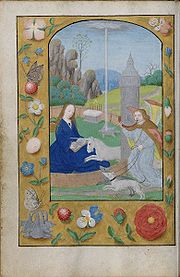 A later Midrash (Numbers R. xviii. end) confuses the legends of the rod that blossomed with those of the rod that worked miracles, thus giving us contradictory statements. There exists a legend that Moses split a tree trunk into twelve portions, and gave one portion to each tribe. When the Rod of Aaron produced blossoms, the Israelites could not but acknowledge the significance of the token. The account of the blossoming of Aaron's Rod contained in Clement's first letter to the Corinthians (ep. 43) is quite in haggadic-midrashic style, and must probably be ascribed to Jewish or, more strictly speaking, Jewish-Hellenistic sources. According to that account, Moses placed upon each of the twelve staffs the corresponding seal of the head of a tribe. The doors of the sanctuary were similarly sealed, to prevent anyone from having access to the rods at night. This legend of the rod as given by the Syrian Solomon in his Book of the Bee
has Christian characteristics. According to it the staff is a fragment of the Tree of Knowledge of Good and Evil
, and was successively in the possession of Shem, of the three Patriarchs, and of Judah, just as in the Jewish legend. From Judah it descended to Pharez, ancestor of David and of the Messiah. After Pharez's death an angel carried it to the mountains of Moab and buried it there, where the pious Jethro found it. When Moses, at Jethro's request, went in search of it, the rod was brought to him by an angel. With this staff Aaron and Moses performed all the miracles related in Scripture, noteworthy among which was the swallowing up of the wonder-working rods of the Egyptian Posdi. Joshua received it from Moses and made use of it in his wars; and Joshua, in turn, delivered it to Phinehas
, who buried it in Jerusalem. There it remained hidden until the birth of Jesus, when the place of its concealment was revealed to Joseph, who took it with him on the journey to Egypt. Judas Iscariot stole it from James, brother of Jesus, who had received it from Joseph. At Jesus' crucifixion the Jews had no wood for the transverse beam of the cross, so Judas produced the staff for that purpose.
This typological
explanation of Moses' rod as the cross is not a novel one. Origen on Exodus (chap. vii.) says: "This rod of Moses, with which he subdued the Egyptians, is the symbol of the cross of Jesus, who conquered the world." Christian legend has preserved the Jewish legend of the rod of the Messiah and made concrete fact of the idea. The miraculous flowering of the rod was also considered a type of the Incarnation of Christ and his Virgin Birth
, and appears in scenes of the Annunciation to Mary.
Other Western legends concerning the connection of the cross and the rod may be found in Seymour, "The Cross," 1898, p. 83.
entitled a novel, Aaron's Rod
, in 1922. This book describes a flautist, Aaron Sissons, and his experiences as he journeys through a Europe exhausted by the First World War. The biblical titular reference, with the flute representing a magic rod, is intended to be ironic
.
Moses
Moses was, according to the Hebrew Bible and Qur'an, a religious leader, lawgiver and prophet, to whom the authorship of the Torah is traditionally attributed...
' brother, Aaron
Aaron
In the Hebrew Bible and the Qur'an, Aaron : Ααρών ), who is often called "'Aaron the Priest"' and once Aaron the Levite , was the older brother of Moses, and a prophet of God. He represented the priestly functions of his tribe, becoming the first High Priest of the Israelites...
, in the Old Testament
Old Testament
The Old Testament, of which Christians hold different views, is a Christian term for the religious writings of ancient Israel held sacred and inspired by Christians which overlaps with the 24-book canon of the Masoretic Text of Judaism...
of the Bible
Bible
The Bible refers to any one of the collections of the primary religious texts of Judaism and Christianity. There is no common version of the Bible, as the individual books , their contents and their order vary among denominations...
. The Bible tells how, along with Moses' rod
Nehushtan
The Nehushtan , in the Hebrew Bible, was a sacred object in the form of a snake of brass upon a pole.The priestly source of the Torah says that Moses used a 'fiery serpent' to cure the Israelites from snakebites...
, Aaron's rod was endowed with miraculous power during the Plagues of Egypt
Plagues of Egypt
The Plagues of Egypt , also called the Ten Plagues or the Biblical Plagues, were ten calamities that, according to the biblical Book of Exodus, Israel's God, Yahweh, inflicted upon Egypt to persuade Pharaoh to release the ill-treated Israelites from slavery. Pharaoh capitulated after the tenth...
which preceded the Exodus
The Exodus
The Exodus is the story of the departure of the Israelites from ancient Egypt described in the Hebrew Bible.Narrowly defined, the term refers only to the departure from Egypt described in the Book of Exodus; more widely, it takes in the subsequent law-givings and wanderings in the wilderness...
. There are two occasions where the Bible tells of the rod's power even when it was not being held by its owner.
Biblical references
In the culture of the Israelites, the rod would be a natural symbol of authority, as the tool used by the shepherdShepherd
A shepherd is a person who tends, feeds or guards flocks of sheep.- Origins :Shepherding is one of the oldest occupations, beginning some 6,000 years ago in Asia Minor. Sheep were kept for their milk, meat and especially their wool...
to correct and guide his flock
Herd
Herd refers to a social grouping of certain animals of the same species, either wild or domestic, and also to the form of collective animal behavior associated with this or as a verb, to herd, to its control by another species such as humans or dogs.The term herd is generally applied to mammals,...
(Psalm 23
Psalm 23
In the 23rd Psalm in the Hebrew Bible/Old Testament, the writer describes God as his Shepherd. The text, beloved by Jews and Christians alike, is often alluded to in popular media and has been set to music....
:4). Moses' rod is, in fact, cited in Exodus 4:2 as carried by him while he tended his sheep; and later (Exodus 4:20) becomes his symbol of authority over the Israelites (Psalm 2
Psalm 2
Psalm 2 is the second Psalm of the Bible. It tells us that we can either defy God and perish, or submit to him and be blessed. Psalm 2 itself does not identify its author, but Acts 4:25-26 clearly attributes it to David.-In the original Hebrew:...
:9, Psalm 89
Psalm 89
Psalm 89 is in the Book of Psalms, part of the Hebrew Bible.The superscription of this Psalm claims that it was written by Ethan, the Ezrahite. Ethan the Ezrahite, along with Heman the Ezrahite , was a wise man from the time of Solomon...
:32, Isaiah
Book of Isaiah
The Book of Isaiah is the first of the Latter Prophets in the Hebrew Bible, preceding the books of Ezekiel, Jeremiah and the Book of the Twelve...
10:24 and 11:4, Ezekiel
Book of Ezekiel
The Book of Ezekiel is the third of the Latter Prophets in the Hebrew Bible, following the books of Isaiah and Jeremiah and preceding the Book of the Twelve....
20:37). The rods of both Moses and Aaron were endowed with miraculous power during the Plagues of Egypt
Plagues of Egypt
The Plagues of Egypt , also called the Ten Plagues or the Biblical Plagues, were ten calamities that, according to the biblical Book of Exodus, Israel's God, Yahweh, inflicted upon Egypt to persuade Pharaoh to release the ill-treated Israelites from slavery. Pharaoh capitulated after the tenth...
(Exodus 7:17, 8:5, 8:16-17, 9:23, and 10:13); God commanded Moses to raise his rod over the Red Sea
Red Sea
The Red Sea is a seawater inlet of the Indian Ocean, lying between Africa and Asia. The connection to the ocean is in the south through the Bab el Mandeb strait and the Gulf of Aden. In the north, there is the Sinai Peninsula, the Gulf of Aqaba, and the Gulf of Suez...
when it was to be parted (Exodus 14:16) and in prayer over Israel in battle (Exodus 17:9); Moses brings forth water from a stone using his rod
Meribah
Meribah is one of the locations which the Torah identifies as having been travelled through by the Israelites, during the Exodus, although the continuous list of visited stations in the Book of Numbers doesn't mention it...
(Exodus 17, Numbers
Book of Numbers
The Book of Numbers is the fourth book of the Hebrew Bible, and the fourth of five books of the Jewish Torah/Pentateuch....
20:11).
Aaron's rod, however, is cited twice as exhibiting miraculous power on its own, when not physically in the grasp of its owner. In Exodus 7 (Parshat Va'eira
Va'eira
Va'eira, Va'era, or Vaera is the fourteenth weekly Torah portion in the annual Jewish cycle of Torah reading and the second in the book of Exodus...
in the Torah
Torah
Torah- A scroll containing the first five books of the BibleThe Torah , is name given by Jews to the first five books of the bible—Genesis , Exodus , Leviticus , Numbers and Deuteronomy Torah- A scroll containing the first five books of the BibleThe Torah , is name given by Jews to the first five...
), God
God
God is the English name given to a singular being in theistic and deistic religions who is either the sole deity in monotheism, or a single deity in polytheism....
sends Moses and Aaron to Pharaoh
Pharaoh
Pharaoh is a title used in many modern discussions of the ancient Egyptian rulers of all periods. The title originates in the term "pr-aa" which means "great house" and describes the royal palace...
once more, instructing Aaron that when Pharaoh demands to see a miracle, he is to "cast down his rod" and it will become a serpent
Serpent (symbolism)
Serpent in Latin means: Rory Collins :&, in turn, from the Biblical Hebrew word of: "saraf" with root letters of: which refers to something burning-as, the pain of poisonous snake's bite was likened to internal burning.This word is commonly used in a specifically mythic or religious context,...
. When he does so, Pharaoh's sorcerers counter by similarly casting down their own rods which also become serpents, but Aaron's rod/serpent swallows them all. "Pharaoh's heart is stubborn" and he chooses to ignore this bit of symbolic warning, and so the Plagues of Egypt
Plagues of Egypt
The Plagues of Egypt , also called the Ten Plagues or the Biblical Plagues, were ten calamities that, according to the biblical Book of Exodus, Israel's God, Yahweh, inflicted upon Egypt to persuade Pharaoh to release the ill-treated Israelites from slavery. Pharaoh capitulated after the tenth...
ensue. Notably, this chapter begins with God telling Moses, "Behold, I have made you as God to Pharaoh and your brother Aaron will be your prophet." As God transmits his word through his prophets to his people, so Moses will transmit God's message through Aaron to the pharaoh. The prophet's task was to speak God's word on God's behalf. He was God's "mouth". (Exodus 4:15-16)
In Numbers 17, Korah
Korah
Korah or Kórach Some older English translations, as well as the Douay Bible), spell the name Core, and many Eastern European translations have Korak...
's rebellion against Moses' proclamation of the tribe of Levi as the priesthood has been quashed and the entire congregation's ensuing rebellion has resulted in a plague, ended only by the intercession of Moses and Aaron. In order to "stop the complaints" of the Israelites, God commands that each of the Twelve Tribes provide a rod; and only that of the tribe chosen to become priests will miraculously sprout overnight. Aaron provides his rod to represent the tribe of Levi, and "it put forth buds, produced blossoms, and bore ripe almonds" (Numbers 17:8), as an evidence of the exclusive right to the priesthood of the tribe of Levi. In commemoration of this decision it was commanded that the rod be put again "before the testimony" (Numbers 17:10). According to tradition, the rod of Aaron bore sweet almonds on one side and bitter on the other; if the Israelites followed the Lord, the sweet almonds would be ripe and edible, but if they were to forsake the path of the Lord, the bitter almonds would predominate. A later tradition asserts (Hebrews 9:4) that the rod was kept in the Ark of the Covenant
Ark of the Covenant
The Ark of the Covenant , also known as the Ark of the Testimony, is a chest described in Book of Exodus as solely containing the Tablets of Stone on which the Ten Commandments were inscribed...
. The main fact, however, is thus confirmed, that a rod was preserved in the Tabernacle
Tabernacle
The Tabernacle , according to the Hebrew Torah/Old Testament, was the portable dwelling place for the divine presence from the time of the Exodus from Egypt through the conquering of the land of Canaan. Built to specifications revealed by God to Moses at Mount Sinai, it accompanied the Israelites...
as a relic of the institution of the Aaronic priesthood.
In Rabbinical literature
The Bible ascribes similar miraculous powers to the Rod of Aaron and to the staff of MosesThe Staff of Moses
According to the Book of Exodus in the Bible, the staff used by Moses was by his side throughout important milestones in the narrative...
(compare, for example, Exodus 4:2 et seq. and 7:9). The Haggadah goes a step further, and entirely identifies the Rod of Aaron with that of Moses. Thus the Midrash Yelamdenu states that:
the staff with which Jacob crossed the Jordan is identical with that which Judah gave to his daughter-in-law, Tamar (Genesis 32:10, 38:18). It is likewise the holy rod with which Moses worked (Exodus 4:20, 21), with which Aaron performed wonders before Pharaoh (Exodus 7:10), and with which, finally, David slew the giant Goliath (I SamuelBooks of SamuelThe Books of Samuel in the Jewish bible are part of the Former Prophets, , a theological history of the Israelites affirming and explaining the Torah under the guidance of the prophets.Samuel begins by telling how the prophet Samuel is chosen by...
17:40). David left it to his descendants, and the Davidic kings used it as a scepter until the destruction of the Temple, when it miraculously disappeared. When the Messiah comes it will be given to him for a scepter in token of his authority over the heathen.
That so wonderful a rod should bear external signs of its importance is easily understood. It was made of sapphire
Sapphire
Sapphire is a gemstone variety of the mineral corundum, an aluminium oxide , when it is a color other than red or dark pink; in which case the gem would instead be called a ruby, considered to be a different gemstone. Trace amounts of other elements such as iron, titanium, or chromium can give...
, weighed forty seahs (a seah = 10.70 pounds), and bore this inscription דצכ עדש באחב, which is composed of the initials of the Hebrew
Hebrew language
Hebrew is a Semitic language of the Afroasiatic language family. Culturally, is it considered by Jews and other religious groups as the language of the Jewish people, though other Jewish languages had originated among diaspora Jews, and the Hebrew language is also used by non-Jewish groups, such...
names of the Ten Plagues (Tan., Waëra 8, ed. Buber). Translation of inscription: "To the extent of God let these come to pass".
Haggadic modification
Legend has still more to say concerning this rod. God created it in the twilight of the sixth day of Creation (Pirkei Avoth 5:9, and Mekhilta, Beshallaḥ, ed. Weiss, iv. 60), and delivered it to AdamAdam and Eve
Adam and Eve were, according to the Genesis creation narratives, the first human couple to inhabit Earth, created by YHWH, the God of the ancient Hebrews...
when the latter was driven from paradise. After it had passed through the hands of Shem
Shem
Shem was one of the sons of Noah in the Hebrew Bible as well as in Islamic literature. He is most popularly regarded as the eldest son, though some traditions regard him as the second son. Genesis 10:21 refers to relative ages of Shem and his brother Japheth, but with sufficient ambiguity in each...
, Enoch
Enoch (ancestor of Noah)
Enoch is a figure in the Generations of Adam. Enoch is described as Adam's greatx4 grandson , the son of Jared, the father of Methuselah, and the great-grandfather of Noah...
, Abraham
Abraham
Abraham , whose birth name was Abram, is the eponym of the Abrahamic religions, among which are Judaism, Christianity and Islam...
, Isaac
Isaac
Isaac as described in the Hebrew Bible, was the only son Abraham had with his wife Sarah, and was the father of Jacob and Esau. Isaac was one of the three patriarchs of the Israelites...
, and Jacob
Jacob
Jacob "heel" or "leg-puller"), also later known as Israel , as described in the Hebrew Bible, the Talmud, the New Testament and the Qur'an was the third patriarch of the Hebrew people with whom God made a covenant, and ancestor of the tribes of Israel, which were named after his descendants.In the...
successively, it came into the possession of Joseph
Joseph (Hebrew Bible)
Joseph is an important character in the Hebrew bible, where he connects the story of Abraham, Isaac and Jacob in Canaan to the subsequent story of the liberation of the Israelites from slavery in Egypt....
. On Joseph's death the Egyptian nobles stole some of his belongings, and, among them, Jethro
Jethro
In the Old Testament or the Hebrew Bible, Jethro |Shu-ayb]]) is Moses' father-in-law, a Kenite shepherd and priest of Midian. He is also revered as a prophet in his own right in the Druze religion, and considered an ancestor of the Druze.-In Exodus:...
appropriated the staff. Jethro planted the staff in his garden, when its marvelous virtue was revealed by the fact that nobody could withdraw it from the ground; even to touch it was fraught with danger to life. This was because the Ineffable Name of God was engraved upon it. When Moses entered Jethro's household he read the Name, and by means of it was able to draw up the rod, for which service Zipporah
Zipporah
Zipporah or Tzipora is mentioned in the Book of Exodus as the wife of Moses, and the daughter of Reuel/Jethro, the priest or prince of Midian...
, Jethro's daughter, was given to him in marriage. Her father had sworn that she should become the wife of the man who should be able to master the miraculous rod and of no other (Pirḳe R. El. 40; Sefer ha-Yashar; Yalḳ. Exodus 168, end). It must, however, be remarked that the Mishnah (Pirkei Avoth v. 9) as yet knew nothing of the miraculous creation of Aaron's Rod, which is first mentioned by the Mekilta (l.c.) and Sifre on Deuteronomy (Berakhot xxxiii. 21; ed. Friedmann, p. 355). This supposed fact of the supernatural origin of the rod explains the statement in the New Testament (Hebrews 9:4) and Tosefta, Yoma, iii. 7 (it is to be interpreted thus according to Bava Batra 14a), that Aaron's Rod, together with its blossoms and fruit, was preserved in the Ark. King Josiah, who foresaw the impending national catastrophe, concealed the Ark and its contents (Tosefta, Sotah, 13a); and their whereabouts will remain unknown until, in the Messianic age, the prophet Elijah shall reveal them (Mekhilta l.c.).
Christian use
Book of the Bee
The Book of the Bee is an historical/theological compilation containing numerous bible legends. It was written by Syrian Nestorian Solomon, Bishop of Bassora . It was written in Syriac.-Book:...
has Christian characteristics. According to it the staff is a fragment of the Tree of Knowledge of Good and Evil
Tree of Knowledge of Good and Evil
In the Book of Genesis, the tree of the knowledge of good and evil or the tree of knowledge was a tree in the middle of the Garden of Eden. . God directly forbade Adam to eat the fruit of this tree...
, and was successively in the possession of Shem, of the three Patriarchs, and of Judah, just as in the Jewish legend. From Judah it descended to Pharez, ancestor of David and of the Messiah. After Pharez's death an angel carried it to the mountains of Moab and buried it there, where the pious Jethro found it. When Moses, at Jethro's request, went in search of it, the rod was brought to him by an angel. With this staff Aaron and Moses performed all the miracles related in Scripture, noteworthy among which was the swallowing up of the wonder-working rods of the Egyptian Posdi. Joshua received it from Moses and made use of it in his wars; and Joshua, in turn, delivered it to Phinehas
Phinehas
-Biblical figures:*Phinehas, son of Eleazar and grandson of Aaron the High Priest*Phinehas, son of the High Priest Eli. He was a priest at Shiloh, and died when the Philistines captured the Ark of the Covenant-Other :*Pinchas, the 41st weekly Torah portion....
, who buried it in Jerusalem. There it remained hidden until the birth of Jesus, when the place of its concealment was revealed to Joseph, who took it with him on the journey to Egypt. Judas Iscariot stole it from James, brother of Jesus, who had received it from Joseph. At Jesus' crucifixion the Jews had no wood for the transverse beam of the cross, so Judas produced the staff for that purpose.
This typological
Typology (theology)
Typology in Christian theology and Biblical exegesis is a doctrine or theory concerning the relationship between the Old and New Testaments...
explanation of Moses' rod as the cross is not a novel one. Origen on Exodus (chap. vii.) says: "This rod of Moses, with which he subdued the Egyptians, is the symbol of the cross of Jesus, who conquered the world." Christian legend has preserved the Jewish legend of the rod of the Messiah and made concrete fact of the idea. The miraculous flowering of the rod was also considered a type of the Incarnation of Christ and his Virgin Birth
Virgin Birth
The virgin birth of Jesus is a tenet of Christianity and Islam which holds that Mary miraculously conceived Jesus while remaining a virgin. The term "virgin birth" is commonly used, rather than "virgin conception", due to the tradition that Joseph "knew her not till she brought forth her firstborn...
, and appears in scenes of the Annunciation to Mary.
Other Western legends concerning the connection of the cross and the rod may be found in Seymour, "The Cross," 1898, p. 83.
In Islam
In modern literature
D. H. LawrenceD. H. Lawrence
David Herbert Richards Lawrence was an English novelist, poet, playwright, essayist, literary critic and painter who published as D. H. Lawrence. His collected works represent an extended reflection upon the dehumanising effects of modernity and industrialisation...
entitled a novel, Aaron's Rod
Aaron's Rod (novel)
Aaron's Rod is a novel by D. H. Lawrence, started in 1917 and published in 1922. The protagonist of this picaresque novel, Aaron Sisson, is a union official in the coal mines of the English Midlands, trapped in a stale marriage. He is also an amateur, but talented, flautist. At the start of the...
, in 1922. This book describes a flautist, Aaron Sissons, and his experiences as he journeys through a Europe exhausted by the First World War. The biblical titular reference, with the flute representing a magic rod, is intended to be ironic
Irony
Irony is a rhetorical device, literary technique, or situation in which there is a sharp incongruity or discordance that goes beyond the simple and evident intention of words or actions...
.
External links
- Jasher 77 A history of the sapphire stick from Adam to Moses is given in the Book of Jasher.