


Deir Yassin massacre

Encyclopedia
The Deir Yassin massacre took place on April 9, 1948, when around 120 fighters from the Irgun Zevai Leumi
and Lohamei Herut Israel
Zionist
paramilitary groups attacked Deir Yassin
near Jerusalem, a Palestinian
-Arab village of roughly 600 people. The assault occurred as Jewish militia sought to relieve the blockade of Jerusalem
during the civil war that preceded the end of British rule in Palestine
.
Around 107 villagers were killed during and after the battle for the village, including women and children—some were shot, while others died when hand grenades were thrown into their homes. Several villagers were taken prisoner and may have been killed after being paraded through the streets of West Jerusalem
, though accounts vary. Four of the attackers died, with around 35 injured. The killings were condemned by the leadership of the Haganah
—the Jewish community's main paramilitary force—and by the area's two chief rabbis
. The Jewish Agency for Israel
sent Jordan's King Abdullah
a letter of apology, which he rebuffed.
The deaths became a pivotal event in the Arab-Israeli conflict for their demographic and military consequences. The narrative was embellished and used by various parties to attack each other—by the Palestinians to besmirch Palestine's Jewish community
and subsequently Israel; by the Haganah to play down their own role in the affair; and later by the Israeli Left to accuse the Irgun and Lehi of violating the Jewish principle of purity of arms
, thus blackening Israel's name around the world. News of the killings sparked terror within the Palestinian community, encouraging them to flee
from their towns and villages in the face of Jewish troop advances, and it strengthened the resolve of Arab governments to intervene, which they did five weeks later.
on November 29, 1947 (UN Resolution 181) that Palestine be divided into an Arab state and a Jewish one. Jerusalem was to belong to neither state, but was to be administered separately; Deir Yassin lay within the boundaries of the proposed plan for Jerusalem. The Arabs rejected the proposal, and civil war broke out. British rule in Palestine ended on May 14, 1948; Israel declared its independence that day, and several Arab armies invaded at midnight on May 15, triggering the 1948 Arab-Israeli war
.
In the months leading up to the end of British rule, in a phase of the civil war known as "The Battle of [the] Roads," the Arab League
-sponsored Arab Liberation Army
(ALA)—composed of Palestinians and other Arabs—attacked Jewish traffic on major roads in an effort to isolate the Jewish communities from each other. The ALA managed to seize several strategic vantage points along the highway between Jerusalem and Tel Aviv
—Jerusalem's sole supply route and link to the western side of the city where 16 percent of all Jews in Palestine lived—and began firing on convoys traveling to the city. By March 1948, the road was cut off and Jerusalem was under siege. In response, the Haganah launched Operation Nachshon
to break the siege. On April 6, in an effort to secure strategic positions, the Haganah and its strike force, the Palmach
, attacked al-Qastal
, a village two kilometers north of Deir Yassin overlooking the Jerusalem-Tel Aviv highway. On April 9, Irgun and Lehi forces attacked nearby Deir Yassin.
writes that there were 610, citing the British mandatory authority figures; and Menachem Begin
's biographer, Eric Silver, 800 to 1,000. It was situated on a hill west of Jerusalem, 800 meters above sea level, overlooking the main highway entering Jerusalem. The village was relatively prosperous, thanks to the excavation of limestone from the village quarries, which allowed the residents to make a good living from stone-cutting. By most accounts, they lived in peace with their Jewish neighbors in nearby villages, particularly those in Givat Shaul
, an Orthodox
community just across the valley, some of whom reportedly tried to help the Deir Yassin villagers during the Irgun-Lehi invasion.
On January 20, 1948, the villagers met with leaders of the Givat Shaul community to form a peace pact. The Deir Yassin villagers agreed to inform Givat Shaul should Palestinian militiamen appear in the village, by hanging out certain types of laundry during the day—two white pieces with a black piece in the middle—and at night signaling three dots with a flashlight and placing three lanterns in a certain place. In return, patrols from Givat Shaul guaranteed safe passage to Deir Yassin residents, in vehicles or on foot, passing through their neighborhood on the way to Jerusalem. Yoma Ben-Sasson, Haganah commander in Givat Shaul, said after the village had been captured that, "there was not even one incident between Deir Yassin and the Jews."
(AHC), the Palestinian-Arab leadership, what the village's relationship was with the Jews: he told them the villagers and the Jews lived in peace. No steps were taken against him, and he was not asked to cancel the peace pact. On February 13, an armed gang of Arabs arrived to attack Givat Shaul, but the Deir Yassin villagers saw them off, the result of which was that the gang killed all the village's sheep. On March 16, the AHC sent a delegation to the village to request that it host a group of Iraqi and Syrian irregulars to guard it. The villagers said no then, and again on April 4, though Irgun fighters said they did encounter at least two foreign militiamen during the April 9 invasion.
The view that the relationship between Deir Yassin and its neighbors was invariably peaceful is disputed by Yehuda Lapidot
(underground name, "Nimrod"), the Irgun's second-in-command of the operation to take the village. He writes that there had been occasional skirmishes between Deir Yassin and Givat Shaul residents, and that on April 3, shots had been fired from Deir Yassin toward the Jewish villages of Bet Hakerem and Yefe Nof. He writes that the village was defended by 100 armed men, that ditches had been dug around it, that Iraqi and Palestinian guerrillas were stationed there, and that there was a guard force stationed by the village entrance. Benny Morris
writes that it is possible some militiamen were stationed in the village, but the evidence is far from definitive, in his view. In Gelber's view, it is unlikely that the peace pact between Deir Yassin and Givat Shaul continued to hold in April, given the intensity of hostilities between the Arab and Jewish communities elsewhere. He writes that shots had been exchanged on April 2 between Deir Yassin and several Jewish communities. Over the next few days, the Jewish community at Motza
and Jewish traffic on the road to Tel Aviv came under fire from the village. On April 8, Deir Yassin youth took part in the defence of the Arab village of al-Qastal
, which the Jews had invaded days earlier: the names of several Deir Yassin residents appeared on a list of wounded compiled by the British Palestine police.

The Jewish forces that entered Deir Yassin belonged in the main to two extremist, underground, paramilitary groups, the Irgun (Etzel) (National Military Organization) and the Lehi (Fighters for the Freedom of Israel), also known as the Stern Gang, both aligned with the right-wing revisionist Zionist
movement. Formed in 1931, Irgun was a militant group that broke away from the mainstream Jewish militia, the Haganah. During the 1936–1939 Arab revolt in Palestine, in which Palestinian Arabs rose up against the British mandate authorities in protest at mass Jewish immigration
into the country, Irgun's tactics had included bus and marketplace bombings, condemned by both the British and the Jewish Agency. Lehi, an Irgun splinter group, was formed in 1940 following Irgun's decision to declare a truce with the British during World War II. Lehi subsequently carried out a series of assassinations designed to force the British out of Palestine. In April 1948, it was estimated that the Irgun had 300 fighters in Jerusalem, and Lehi around 100.
The Palmach, the strike force of the Haganah—whose leadership was aligned with the political Left (see Mapai
)—also took part, though to a lesser extent. Morris writes that two Palmach squads evacuated the wounded, and helped invade and secure some of the villagers' houses. When the Irgun and Lehi fighters ran low on ammunition, they obtained thousands of rounds from the Haganah. Haganah squads also provided covering fire, and fired on villagers fleeing south towards Ayn Karim
.
Eric Silver writes that Irgun and Lehi commanders approached David Shaltiel
, the Haganah commander in Jerusalem, for approval. He was initially reluctant, because the villagers had signed a non-aggression pact, and suggested attacking Ein Karem instead. The Lehi and Irgun commanders complained that this would be too hard for them. Shaltiel ultimately yielded, on condition that the attackers remain in the village rather than leaving it empty, to prevent it becoming an Arab military base. His approval met with resistance. Meir Pa'il
, an intelligence officer with the Palmach, the Haganah's strike force, objected to violating the peace pact with the village, but Shaltiel maintained that he had no power to stop the guerrillas. Pa'il said in 1998 that Yitzchak Levi, head of Haganah intelligence in Jerusalem, had proposed the inhabitants be notified, but Shaltiel had refused to endanger the operation by warning them.
According to Morris, it was agreed during planning meetings that the residents would be expelled. Lehi further proposed that any villagers who failed to flee should be killed to terrify the rest of the country's Arabs. Most of the fighters at the meetings, from both the Irgun and Lehi, favored killing the male villagers, but the Irgun command, including Menachem Begin
, objected. According to Lapidot, the troops were specifically ordered not to kill women, children, or prisoners.
would be left open so they could head there.
Irgun and Lehi commanders had believed the residents would flee, but the fighters encountered resistance. The residents did not realize that the point of the attack was conquest, thinking it just a raid, and failed to run while they had the chance. The villagers' sniper fire from higher positions in the west, especially from the mukhtar's house, effectively contained the attack. Some Lehi units went for help from the Haganah's Camp Schneller
in Jerusalem. The men had no experience of attacking an Arab village in daylight, and lacked support weapons. They resorted to house-to-house attacks, throwing hand grenades through the doors and windows before entering, a couple of grenades per house, following an order from Ben Zion Cohen, the Irgun's commander. Ezra Yachin recalled, "To take a house, you had either to throw a grenade or shoot your way into it. If you were foolish enough to open doors, you got shot down—sometimes by men dressed up as women, shooting out at you in a second of surprise."
The Lehi forces slowly advanced house by house. Weapons failed to work, a few tossed hand grenades without pulling the pin, and a Lehi unit commander, Amos Keynan, was wounded by his own men. Meanwhile, the Irgun guerrillas on the other side of the village were also having a difficult time. By 7:00 a.m., discouraged by the Arab resistance and their own increasing casualties, Irgun commanders relayed a message to the Lehi camp that they were considering retreating. Lehi commanders relayed back that they had already entered the village and expected victory soon. The large number of wounded was a problem. A Magen David Adom
station was called for an ambulance. The fighters took beds out of the houses, and doors off their hinges, laid the wounded on them, and ordered villagers to carry the injured to the ambulance, forcing them to act as human shields. They believed the villagers would not shoot at their own people, but they did, according to Milstein.
The Irgun arranged to receive a supply of explosives from their base in Givat Shaul, and started blasting their way into house after house. In certain instances, the force of the explosions destroyed entire parts of houses, burying Arab fighters and civilians. At least two Haganah members on the scene reported the Lehi repeatedly using a loudspeaker to suggest the residents surrender; over 100 were taken prisoner by the end of the day. At about 10:00 am, a Palmach unit from the Haganah arrived with an armored vehicle and a two-inch mortar. The mortar was fired three times at the mukhtar's house, which stopped the sniper fire. Lehi officer David Gottlieb said the Palmach had accomplished "in one hour what we could not accomplish in several hours."
, a Palmach intelligence officer who said he visited the village on April 9 to observe the operation on behalf of the Haganah:
Pa'il writes that the Haredi people of Givat Shaul came to help the villagers at around 2 p.m., and were able to stop the killing:
Israeli military historian Uri Milstein
wrote in 1998 that Pa'il was not in Deir Yassin on April 9. Milstein argues that there was no organized massacre
, though according to Morris he acknowledges that whole families were gunned down during the fighting. Milstein argues that the Haganah intelligence reports were doctored by the authors or their superiors to discredit the Irgun and Lehi because of in-fighting within the Jewish community.
Pi'al reported to Haganah intelligence on April 10 that he saw five Arab men being paraded through the streets, and later saw their bodies in a quarry near Givat Shaul. Morris writes that this is supported by a report from Dr. Z. Avigdori, the chairman of the Jerusalem branch of the Palestine Physicians Association, and his deputy, Dr. A. Druyan, who were sent by the Jewish Agency to examine the scene on April 12. They walked from house to house, counting and examining corpses. Their report said they found 46 corpses. The cause of death had been injuries from bullets or bombs, and that, "all the bodies were dressed in their own clothes, limbs were whole and we saw no signs of mutilation." They also said they found five male bodies in a house by the village quarry.
 Mordechai Gihon
, a Haganah intelligence (HIS) officer in Jerusalem, reported on April 10 seeing people carry bodies to the quarry east of Deir Yassin: "We entered the village around 3:00 in the afternoon [of April 9] ... In the village there were tens of bodies. The dissidents got them out of the roads. I told them not to throw the bodies into cisterns and caves, because that was the first place that would be checked..." He described beatings, looting, and the stripping of jewelry and money from prisoners. He wrote that the initial orders were to take the men prisoner and send the women and children away, but the order was changed to kill all the prisoners. The mukhtar's son was killed in front of his mother and sisters, he said.
The head of the HIS in Jerusalem, Yitzhak Levy, wrote in reports dated April 12 and 13: "The conquest of the village was carried out with great brutality, whole families [including] women, old people and children were killed and there are piles and piles of dead." He wrote that a mother and child who had been moved from Deir Yassin to Sheikh Badr were killed there by Lehi fighters. Seven old men and women, who had been taken to Jerusalem, were taken back to Deir Yassin and killed in the quarry there, he wrote, and an Arab man, believed to be a sniper, was killed and his corpse burned in front of foreign journalists.
Fifty-five children from the village whose parents had been killed were taken to the Jaffa Gate in Jerusalem's Old City, and left there. They were found by a Palestinian woman, Hind Husseini, a member of the prominent Palestinian Husseini
family. She at first rented two rooms for them, bringing them food every day, before moving them to the Sahyoun convent. In July, she moved them again, this time to her family home, a large house her grandfather had built in Jerusalem in 1891. She renamed the house Dar Al-Tifl Al-Arabi (Arab Children's House), and set up a foundation to finance it. The orphanage continues to this day.
of the British Palestine Police Force
. He wrote one or more reports based on interviews he conducted in Silwan
with some of the Deir Yassin women:
Yoav Gelber writes that Catling was "an old and bitter enemy" of the Irgun and Lehi. The whereabouts of his original report(s) are unknown, and writers refer to it only indirectly, citing Dominique Lapierre and Larry Collins's book O Jerusalem (1972) as their source. Lapierre and Collins write that copies of three of Catling's reports were in their possession when they wrote the book.
After his inspection, the Irgun asked him to sign a document to say he had been received courteously and thanking them for their help. When he refused, they told him he would sign it if he valued his life. "The only course open to me was to convince them that I did not value my life in the least," he wrote.
party and David Ben-Gurion
, who became Israel's first prime minister on May 14, exploited Deir Yassin to stop a power-sharing agreement with the right-wing Revisionists—who were associated with Irgun and Lehi—a proposal that was being debated at the time in Tel Aviv. Mordechai Ra'anan, the Irgun commander in Jerusalem, told reporters on April 10 that 254 Arab bodies had been counted, a figure published by The New York Times on April 13. In 1987, in a study regarded as authoritative, Sharif Kan'ana of Bir Zeit University concluded by interviewing survivors that 107 had died, with 12 wounded.
Hazam Nusseibeh, the news editor of the Palestine Broadcasting Service at the time of the attack, gave an interview to the BBC in 1998. He spoke about a discussion he had with Hussayn Khalidi
, the deputy chairman of the Higher Arab Executive in Jerusalem, shortly after the killings: "I asked Dr. Khalidi how we should cover the story. He said, 'We must make the most of this.' So he wrote a press release, stating that at Deir Yassin, children were murdered, pregnant women were raped, all sorts of atrocities." Gelber writes that Khalidi told journalists on April 11 that the village's dead included 25 pregnant women, 52 mothers of babies, and 60 girls.
The stories of rape angered the villagers, who complained to the Arab emergency committee that their wives and daughters were being exploited in the service of propaganda. Abu Mahmud, who lived in Deir Yassin in 1948, was one of those who complained. He told the BBC: "We said, 'There was no rape.' He [Hussayn Khalidi] said, 'We have to say this so the Arab armies will come to liberate Palestine from the Jews'." "This was our biggest mistake," said Nusseibeh. "We did not realize how our people would react. As soon as they heard that women had been raped at Deir Yassin, Palestinians fled in terror. They ran away from all our villages." He told Larry Collins in 1968: "We committed a fatal error, and set the stage for the refugee problem." Mohammed Radwan, one of the villagers who fought the attackers, said: "There were no rapes. It's all lies. There were no pregnant women who were slit open. It was propaganda that ... Arabs put out so Arab armies would invade. They ended up expelling people from all of Palestine on the rumor of Deir Yassin."
Mapam
's leaders later concluded that the fall of Deir Yassin and Haifa
were the two pivotal events of the Palestinian exodus. On April 14, Irgun radio broadcast that villages around Deir Yassin and elsewhere were being evacuated. HIS intelligence reported that the residents of Beit Iksa
and Al Maliha had fled. The village of Fureidis
appealed for arms. The villages of Fajja
and Mansura reached a peace agreement with their Jewish neighbors. Arabs fled from Haifa and Khirbet Azzun. A Haganah attack on Saris
encountered no resistance, because of the fear of Deir Yassin, in the view of the British. Menachem Begin, leader of the Irgun at the time of the attack, though not present at the village, wrote in 1977:
The Deir Yassin attack, along with attacks on Tiberias, Haifa, and Jaffa
, put pressure on Arab governments to invade Palestine. News of the killings had aroused public anger in the Arab world, which the governments felt unable to ignore. Syria's foreign minister remarked that the Arab public's desire for war was irresistible. The arrival of tens of thousands of refugees further convinced them to act. A consensus favoring invasion began to emerge the day after Deir Yassin, at a meeting on April 10 in Cairo
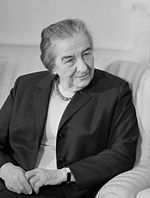
of the Arab League Political Committee. Golda Meir
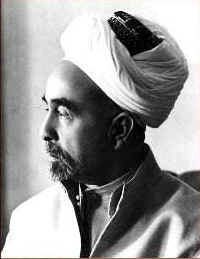
, disguised in an Arab robe, met King Abdullah in Amman
on May 10–11, the second such meeting between them. During their first, Abdullah had agreed to a partition of Palestine to include a Jewish state. Now, he retracted, suggesting instead a Jewish canton within a Hashemite kingdom. Deir Yassin had changed things, he said. Meir reported later that Abdullah was approaching war "as a person who is in a trap and can't get out." The Arab invasion began at midnight on May 14, when Abdullah fired a symbolic shot in the air, and shouted "Forward!"
.jpg) In 1949, despite protests, the Jerusalem neighborhood of Givat Shaul Bet was built on what had been Deir Yassin's land, now considered part of Har Nof
In 1949, despite protests, the Jerusalem neighborhood of Givat Shaul Bet was built on what had been Deir Yassin's land, now considered part of Har Nof
, an Orthodox area. Four Jewish scholars, Martin Buber
, Ernst Simon
, Werner Senator, and Cecil Roth
, wrote to Israel's first prime minister, David Ben-Gurion
, asking that Deir Yassin be left uninhabited, or that its settlement be postponed. They wrote that it had become "infamous throughout the Jewish world, the Arab world and the whole world." Settling the land so soon after the killings would amount to an endorsement of them. Ben-Gurion failed to respond, though the correspondents sent him copy after copy. Eventually his secretary replied that he had been too busy to read their letter.
In 1951, construction of the Kfar Shaul Mental Health Center
began, using some of the village's houses, now hidden behind the hospital's fence, with entry closely restricted. Har HaMenuchot
, a Jewish cemetery, lies to the north. To the south is a valley containing part of the Jerusalem Forest
, and on the other side of the valley, a mile and a half away, lie Mount Herzl
and the Holocaust memorial museum, Yad Vashem
. Palestinian historian Walid Khalidi
wrote in 1992:
Irgun
The Irgun , or Irgun Zevai Leumi to give it its full title , was a Zionist paramilitary group that operated in Mandate Palestine between 1931 and 1948. It was an offshoot of the earlier and larger Jewish paramilitary organization haHaganah...
and Lohamei Herut Israel
Lehi (group)
Lehi , commonly referred to in English as the Stern Group or Stern Gang, was a militant Zionist group founded by Avraham Stern in the British Mandate of Palestine...
Zionist
Zionism
Zionism is a Jewish political movement that, in its broadest sense, has supported the self-determination of the Jewish people in a sovereign Jewish national homeland. Since the establishment of the State of Israel, the Zionist movement continues primarily to advocate on behalf of the Jewish state...
paramilitary groups attacked Deir Yassin
Deir Yassin
Deir Yassin was a Palestinian Arab village of around 600 people near Jerusalem. It had declared its neutrality during the 1947–1948 Civil War in Mandatory Palestine between Arabs and Jews...
near Jerusalem, a Palestinian
Palestinian people
The Palestinian people, also referred to as Palestinians or Palestinian Arabs , are an Arabic-speaking people with origins in Palestine. Despite various wars and exoduses, roughly one third of the world's Palestinian population continues to reside in the area encompassing the West Bank, the Gaza...
-Arab village of roughly 600 people. The assault occurred as Jewish militia sought to relieve the blockade of Jerusalem
Siege of Jerusalem (1948)
The Battle for Jerusalem occurred from 30 November 1947 to 11 June 1948 when Jewish and Arab population of Mandatory Palestine and later Israeli and Jordanian armies fought for the control of the city....
during the civil war that preceded the end of British rule in Palestine
Palestine
Palestine is a conventional name, among others, used to describe the geographic region between the Mediterranean Sea and the Jordan River, and various adjoining lands....
.
Around 107 villagers were killed during and after the battle for the village, including women and children—some were shot, while others died when hand grenades were thrown into their homes. Several villagers were taken prisoner and may have been killed after being paraded through the streets of West Jerusalem
West Jerusalem
West Jerusalem refers to:*The section of Jerusalem captured by Israel following the 1948 Arab-Israeli War.*The western neighborhoods of Jerusalem today.-Division in 1948:...
, though accounts vary. Four of the attackers died, with around 35 injured. The killings were condemned by the leadership of the Haganah
Haganah
Haganah was a Jewish paramilitary organization in what was then the British Mandate of Palestine from 1920 to 1948, which later became the core of the Israel Defense Forces.- Origins :...
—the Jewish community's main paramilitary force—and by the area's two chief rabbis
Chief Rabbinate of Israel
The Chief Rabbinate of Israel is recognized by law as the supreme halakhic and spiritual authority for the Jewish people in Israel. The Chief Rabbinate Council assists the two chief rabbis, who alternate in its presidency. It has legal and administrative authority to organize religious...
. The Jewish Agency for Israel
Jewish Agency for Israel
The Jewish Agency for Israel , also known as the Sochnut or JAFI, served as the organization in charge of immigration and absorption of Jews from the Diaspora into the state of Israel.-History:...
sent Jordan's King Abdullah
Abdullah I of Jordan
Abdullah I bin al-Hussein, King of Jordan [‘Abd Allāh ibn al-Husayn] عبد الله الأول بن الحسين born in Mecca, Second Saudi State, was the second of three sons of Sherif Hussein bin Ali, Sharif and Emir of Mecca and his first wife Abdiyya bint Abdullah...
a letter of apology, which he rebuffed.
The deaths became a pivotal event in the Arab-Israeli conflict for their demographic and military consequences. The narrative was embellished and used by various parties to attack each other—by the Palestinians to besmirch Palestine's Jewish community
Yishuv
The Yishuv or Ha-Yishuv is the term referring to the body of Jewish residents in Palestine before the establishment of the State of Israel...
and subsequently Israel; by the Haganah to play down their own role in the affair; and later by the Israeli Left to accuse the Irgun and Lehi of violating the Jewish principle of purity of arms
Purity of Arms
The code of purity of arms is one of the values stated in the Israel Defense Force's official doctrine of ethics, The Spirit of the IDF....
, thus blackening Israel's name around the world. News of the killings sparked terror within the Palestinian community, encouraging them to flee
1948 Palestinian exodus
The 1948 Palestinian exodus , also known as the Nakba , occurred when approximately 711,000 to 725,000 Palestinian Arabs left, fled or were expelled from their homes, during the 1948 Arab-Israeli War and the Civil War that preceded it. The exact number of refugees is a matter of dispute...
from their towns and villages in the face of Jewish troop advances, and it strengthened the resolve of Arab governments to intervene, which they did five weeks later.
Political and military situation
The invasion of Deir Yassin took place after the United Nations proposed1947 UN Partition Plan
The United Nations Partition Plan for Palestine was created by the United Nations Special Committee on Palestine in 1947 to replace the British Mandate for Palestine with "Independent Arab and Jewish States" and a "Special International Regime for the City of Jerusalem" administered by the United...
on November 29, 1947 (UN Resolution 181) that Palestine be divided into an Arab state and a Jewish one. Jerusalem was to belong to neither state, but was to be administered separately; Deir Yassin lay within the boundaries of the proposed plan for Jerusalem. The Arabs rejected the proposal, and civil war broke out. British rule in Palestine ended on May 14, 1948; Israel declared its independence that day, and several Arab armies invaded at midnight on May 15, triggering the 1948 Arab-Israeli war
1948 Arab-Israeli War
The 1948 Arab–Israeli War, known to Israelis as the War of Independence or War of Liberation The war commenced after the termination of the British Mandate for Palestine and the creation of an independent Israel at midnight on 14 May 1948 when, following a period of civil war, Arab armies invaded...
.
In the months leading up to the end of British rule, in a phase of the civil war known as "The Battle of [the] Roads," the Arab League
Arab League
The Arab League , officially called the League of Arab States , is a regional organisation of Arab states in North and Northeast Africa, and Southwest Asia . It was formed in Cairo on 22 March 1945 with six members: Egypt, Iraq, Transjordan , Lebanon, Saudi Arabia, and Syria. Yemen joined as a...
-sponsored Arab Liberation Army
Arab Liberation Army
The Arab Liberation Army , also translated as Arab Salvation Army, was an army of volunteers from Arab countries led by Fawzi al-Qawuqji...
(ALA)—composed of Palestinians and other Arabs—attacked Jewish traffic on major roads in an effort to isolate the Jewish communities from each other. The ALA managed to seize several strategic vantage points along the highway between Jerusalem and Tel Aviv
Tel Aviv
Tel Aviv , officially Tel Aviv-Yafo , is the second most populous city in Israel, with a population of 404,400 on a land area of . The city is located on the Israeli Mediterranean coastline in west-central Israel. It is the largest and most populous city in the metropolitan area of Gush Dan, with...
—Jerusalem's sole supply route and link to the western side of the city where 16 percent of all Jews in Palestine lived—and began firing on convoys traveling to the city. By March 1948, the road was cut off and Jerusalem was under siege. In response, the Haganah launched Operation Nachshon
Operation Nachshon
Operation Nachshon was an Jewish military operation during the 1948 war. Lasting from 5–20 April 1948, its objective was to break the Siege of Jerusalem by opening the Tel-Aviv - Jerusalem road blockaded by Palestinian Arabs and to supply food and weapons to the isolated Jewish community of...
to break the siege. On April 6, in an effort to secure strategic positions, the Haganah and its strike force, the Palmach
Palmach
The Palmach was the elite fighting force of the Haganah, the underground army of the Yishuv during the period of the British Mandate of Palestine. The Palmach was established on May 15, 1941...
, attacked al-Qastal
Al-Qastal
Al-Qastal was a Palestinian village that was depopulated in the lead up the 1948 Arab-Israeli war.- History :Under the name of Belveer or Beauverium, Qastal belonged to the Hospitalers by c. 1168 and was listed amongst the castles supposedly destroyed by al-Adil in 1191–2...
, a village two kilometers north of Deir Yassin overlooking the Jerusalem-Tel Aviv highway. On April 9, Irgun and Lehi forces attacked nearby Deir Yassin.
Deir Yassin
Deir Yassin was a Palestinian-Arab village of several hundred residents, all Muslim, living in 144 houses. The International Red Cross reported that there were 400 residents; Yoav GelberYoav Gelber
Yoav Gelber is a professor of history at the University of Haifa, and was formerly a visiting professor at The University of Texas at Austin....
writes that there were 610, citing the British mandatory authority figures; and Menachem Begin
Menachem Begin
' was a politician, founder of Likud and the sixth Prime Minister of the State of Israel. Before independence, he was the leader of the Zionist militant group Irgun, the Revisionist breakaway from the larger Jewish paramilitary organization Haganah. He proclaimed a revolt, on 1 February 1944,...
's biographer, Eric Silver, 800 to 1,000. It was situated on a hill west of Jerusalem, 800 meters above sea level, overlooking the main highway entering Jerusalem. The village was relatively prosperous, thanks to the excavation of limestone from the village quarries, which allowed the residents to make a good living from stone-cutting. By most accounts, they lived in peace with their Jewish neighbors in nearby villages, particularly those in Givat Shaul
Givat Shaul
Givat Shaul is a neighborhood in western Jerusalem named after the Rishon Lezion, Rabbi Yaakov Shaul Elyashar, the Sephardi Chief Rabbi of Israel, and not, as commonly believed, for the biblical King Saul, whose capital was probably located on the hill Gibeah of Saul near Pisgat Ze'ev, on the way...
, an Orthodox
Orthodox Judaism
Orthodox Judaism , is the approach to Judaism which adheres to the traditional interpretation and application of the laws and ethics of the Torah as legislated in the Talmudic texts by the Sanhedrin and subsequently developed and applied by the later authorities known as the Gaonim, Rishonim, and...
community just across the valley, some of whom reportedly tried to help the Deir Yassin villagers during the Irgun-Lehi invasion.
On January 20, 1948, the villagers met with leaders of the Givat Shaul community to form a peace pact. The Deir Yassin villagers agreed to inform Givat Shaul should Palestinian militiamen appear in the village, by hanging out certain types of laundry during the day—two white pieces with a black piece in the middle—and at night signaling three dots with a flashlight and placing three lanterns in a certain place. In return, patrols from Givat Shaul guaranteed safe passage to Deir Yassin residents, in vehicles or on foot, passing through their neighborhood on the way to Jerusalem. Yoma Ben-Sasson, Haganah commander in Givat Shaul, said after the village had been captured that, "there was not even one incident between Deir Yassin and the Jews."
Arab militia
Arab militiamen had tried to set up camp in the village, leading to a firefight that saw one villager killed. Just before January 28, Abd al Qadir had arrived with 400 men and tried to recruit some villagers, but the elders voiced their opposition and the men moved on. The leader of the village, the mukhtar, was summoned to Jerusalem to explain to the Arab Higher CommitteeArab Higher Committee
The Arab Higher Committee was the central political organ of the Arab community of Mandate Palestine. It was established on 25 April 1936, on the initiative of Hajj Amin al-Husayni, the Grand Mufti of Jerusalem, and comprised the leaders of Palestinian Arab clans under the mufti's...
(AHC), the Palestinian-Arab leadership, what the village's relationship was with the Jews: he told them the villagers and the Jews lived in peace. No steps were taken against him, and he was not asked to cancel the peace pact. On February 13, an armed gang of Arabs arrived to attack Givat Shaul, but the Deir Yassin villagers saw them off, the result of which was that the gang killed all the village's sheep. On March 16, the AHC sent a delegation to the village to request that it host a group of Iraqi and Syrian irregulars to guard it. The villagers said no then, and again on April 4, though Irgun fighters said they did encounter at least two foreign militiamen during the April 9 invasion.
The view that the relationship between Deir Yassin and its neighbors was invariably peaceful is disputed by Yehuda Lapidot
Yehuda Lapidot
Yehuda "Nimrod" Lapidot is an Israeli historian and former professor of biochemistry. Lapidot was a member of the Irgun and an officer in the Israel Defense Forces. In 1980 he was appointed head of Lishkat Hakesher by former Irgun commander and then Israeli Prime Minister Menachem Begin. Lapidot...
(underground name, "Nimrod"), the Irgun's second-in-command of the operation to take the village. He writes that there had been occasional skirmishes between Deir Yassin and Givat Shaul residents, and that on April 3, shots had been fired from Deir Yassin toward the Jewish villages of Bet Hakerem and Yefe Nof. He writes that the village was defended by 100 armed men, that ditches had been dug around it, that Iraqi and Palestinian guerrillas were stationed there, and that there was a guard force stationed by the village entrance. Benny Morris
Benny Morris
Benny Morris is professor of History in the Middle East Studies department of Ben-Gurion University of the Negev in the city of Be'er Sheva, Israel...
writes that it is possible some militiamen were stationed in the village, but the evidence is far from definitive, in his view. In Gelber's view, it is unlikely that the peace pact between Deir Yassin and Givat Shaul continued to hold in April, given the intensity of hostilities between the Arab and Jewish communities elsewhere. He writes that shots had been exchanged on April 2 between Deir Yassin and several Jewish communities. Over the next few days, the Jewish community at Motza
Motza
Motza ת is a neighbourhood in the western edge of Jerusalem, Israel, located 600 metres above sea level. In the Judean Hills, surrounded by forest, it is a relatively isolated place connected to Jerusalem by the Jerusalem-Tel Aviv highway and the winding mountain road to Har Nof...
and Jewish traffic on the road to Tel Aviv came under fire from the village. On April 8, Deir Yassin youth took part in the defence of the Arab village of al-Qastal
Al-Qastal
Al-Qastal was a Palestinian village that was depopulated in the lead up the 1948 Arab-Israeli war.- History :Under the name of Belveer or Beauverium, Qastal belonged to the Hospitalers by c. 1168 and was listed amongst the castles supposedly destroyed by al-Adil in 1191–2...
, which the Jews had invaded days earlier: the names of several Deir Yassin residents appeared on a list of wounded compiled by the British Palestine police.
Irgun and Lehi militia
The Jewish forces that entered Deir Yassin belonged in the main to two extremist, underground, paramilitary groups, the Irgun (Etzel) (National Military Organization) and the Lehi (Fighters for the Freedom of Israel), also known as the Stern Gang, both aligned with the right-wing revisionist Zionist
Revisionist Zionism
Revisionist Zionism is a nationalist faction within the Zionist movement. It is the founding ideology of the non-religious right in Israel, and was the chief ideological competitor to the dominant socialist Labor Zionism...
movement. Formed in 1931, Irgun was a militant group that broke away from the mainstream Jewish militia, the Haganah. During the 1936–1939 Arab revolt in Palestine, in which Palestinian Arabs rose up against the British mandate authorities in protest at mass Jewish immigration
Aliyah
Aliyah is the immigration of Jews to the Land of Israel . It is a basic tenet of Zionist ideology. The opposite action, emigration from Israel, is referred to as yerida . The return to the Holy Land has been a Jewish aspiration since the Babylonian exile...
into the country, Irgun's tactics had included bus and marketplace bombings, condemned by both the British and the Jewish Agency. Lehi, an Irgun splinter group, was formed in 1940 following Irgun's decision to declare a truce with the British during World War II. Lehi subsequently carried out a series of assassinations designed to force the British out of Palestine. In April 1948, it was estimated that the Irgun had 300 fighters in Jerusalem, and Lehi around 100.
The Palmach, the strike force of the Haganah—whose leadership was aligned with the political Left (see Mapai
Mapai
Mapai was a left-wing political party in Israel, and was the dominant force in Israeli politics until its merger into the Israeli Labor Party in 1968...
)—also took part, though to a lesser extent. Morris writes that two Palmach squads evacuated the wounded, and helped invade and secure some of the villagers' houses. When the Irgun and Lehi fighters ran low on ammunition, they obtained thousands of rounds from the Haganah. Haganah squads also provided covering fire, and fired on villagers fleeing south towards Ayn Karim
Ayn Karim
‘Ayn Karim was a Palestinian town in the British mandate District of JerusalemThe population of 'Ayn Karim in 1931 was 2,637 and in 1944/45 it was 3,180, in each case including the smaller localities of Ayn al-Rawwas and Ayn al-Khandaq....
.
Decision to attack
The attack on the village was important for two reasons, according to Yehuda Lapidot of the Irgun. In the view of Irgun and Lehi, it posed a threat to Jewish neighborhoods and the main road to the coastal plain, and it was the first time Jewish forces had gone on the offensive, as opposed to responding to attacks. An assault on the village would show the Arabs the Jews intended to fight for Jerusalem.Eric Silver writes that Irgun and Lehi commanders approached David Shaltiel
David Shaltiel
David Shaltiel was an Israeli military and intelligence officer, later also diplomat, and was most well known for being the district commander of the Haganah in Jerusalem during the 1948 Arab-Israeli war.He was born in Berlin into a Portuguese orthodox Jewish family settled in Hamburg.At 16,...
, the Haganah commander in Jerusalem, for approval. He was initially reluctant, because the villagers had signed a non-aggression pact, and suggested attacking Ein Karem instead. The Lehi and Irgun commanders complained that this would be too hard for them. Shaltiel ultimately yielded, on condition that the attackers remain in the village rather than leaving it empty, to prevent it becoming an Arab military base. His approval met with resistance. Meir Pa'il
Meir Pa'il
-Biography:Born in Jerusalem during the Mandate era as Meir Pilevsky, Pa'il served in the Palmach between 1943 and 1948, after which he became a Brigade commander in the new Israel Defense Forces. He also headed the Central Officers School and the Department of Military Theory for the General Staff...
, an intelligence officer with the Palmach, the Haganah's strike force, objected to violating the peace pact with the village, but Shaltiel maintained that he had no power to stop the guerrillas. Pa'il said in 1998 that Yitzchak Levi, head of Haganah intelligence in Jerusalem, had proposed the inhabitants be notified, but Shaltiel had refused to endanger the operation by warning them.
According to Morris, it was agreed during planning meetings that the residents would be expelled. Lehi further proposed that any villagers who failed to flee should be killed to terrify the rest of the country's Arabs. Most of the fighters at the meetings, from both the Irgun and Lehi, favored killing the male villagers, but the Irgun command, including Menachem Begin
Menachem Begin
' was a politician, founder of Likud and the sixth Prime Minister of the State of Israel. Before independence, he was the leader of the Zionist militant group Irgun, the Revisionist breakaway from the larger Jewish paramilitary organization Haganah. He proclaimed a revolt, on 1 February 1944,...
, objected. According to Lapidot, the troops were specifically ordered not to kill women, children, or prisoners.
Pre-attack briefing
According to the Haganah, the attack force consisted of about 120 men—80 from the Irgun and 40 from Lehi. They met for briefings on April 8, a few hours before the attack began. Lehi met at the Etz Hayim base, and the Irgun at Givat Shaul. Lapidot writes that the mood at the Irgun meeting was festive. It was the first time a large number of underground fighters had met openly, and the collaboration between the groups increased their sense of solidarity. They chose a password to reflect the mood, "Ahdut Lohemet" ("Fighters' Solidarity"). This was the phrase that would signal the start of the attack. According to Lapidot, Mordechai Raanan, the Irgun commander in Jerusalem, stressed that women, children, and the elderly must not be harmed, and that the villagers were to be warned by loudspeaker to give them a chance to escape. The road to Ayn KarimAyn Karim
‘Ayn Karim was a Palestinian town in the British mandate District of JerusalemThe population of 'Ayn Karim in 1931 was 2,637 and in 1944/45 it was 3,180, in each case including the smaller localities of Ayn al-Rawwas and Ayn al-Khandaq....
would be left open so they could head there.
Invasion
After the briefing, the fighters were driven to their assigned positions. A Lehi unit approached Deir Yassin from the direction of Givat Shaul, while one Irgun unit moved in from the east, and a second from the south. Despite their confidence, the fighters were by all accounts ill-prepared, untrained, and inexperienced. The loudspeaker that was meant to encourage the villagers to leave wasn't working properly, and the truck carrying it got stuck in a ditch outside the village, though Abu Mahmoud, a villager, told the BBC in 1998 that he did hear the warning. At 04:45, a village sentry spotted them moving in, and he called out in Arabic, "Mahmoud." One of the Irgun fighters thought he had said "Ahdut," part of the password. He responded with the second half of the password, "lohemet". According to Uri Milstein, the Arabs shouted "Yahud" (Jews) and opened fire.Irgun and Lehi commanders had believed the residents would flee, but the fighters encountered resistance. The residents did not realize that the point of the attack was conquest, thinking it just a raid, and failed to run while they had the chance. The villagers' sniper fire from higher positions in the west, especially from the mukhtar's house, effectively contained the attack. Some Lehi units went for help from the Haganah's Camp Schneller
Schneller Orphanage
Schneller Orphanage was a Christian orphanage that operated in Jerusalem from 1860 until World War II. The orphanage grounds, located on Malchei Yisrael Street in central Jerusalem, became a British military base known as Camp Schneller. After 1948, the compound housed offices of the Israel...
in Jerusalem. The men had no experience of attacking an Arab village in daylight, and lacked support weapons. They resorted to house-to-house attacks, throwing hand grenades through the doors and windows before entering, a couple of grenades per house, following an order from Ben Zion Cohen, the Irgun's commander. Ezra Yachin recalled, "To take a house, you had either to throw a grenade or shoot your way into it. If you were foolish enough to open doors, you got shot down—sometimes by men dressed up as women, shooting out at you in a second of surprise."
The Lehi forces slowly advanced house by house. Weapons failed to work, a few tossed hand grenades without pulling the pin, and a Lehi unit commander, Amos Keynan, was wounded by his own men. Meanwhile, the Irgun guerrillas on the other side of the village were also having a difficult time. By 7:00 a.m., discouraged by the Arab resistance and their own increasing casualties, Irgun commanders relayed a message to the Lehi camp that they were considering retreating. Lehi commanders relayed back that they had already entered the village and expected victory soon. The large number of wounded was a problem. A Magen David Adom
Magen David Adom
The Magen David Adom is Israel's national emergency medical, disaster, ambulance and blood bank service. The name means "Red Star of David"...
station was called for an ambulance. The fighters took beds out of the houses, and doors off their hinges, laid the wounded on them, and ordered villagers to carry the injured to the ambulance, forcing them to act as human shields. They believed the villagers would not shoot at their own people, but they did, according to Milstein.
The Irgun arranged to receive a supply of explosives from their base in Givat Shaul, and started blasting their way into house after house. In certain instances, the force of the explosions destroyed entire parts of houses, burying Arab fighters and civilians. At least two Haganah members on the scene reported the Lehi repeatedly using a loudspeaker to suggest the residents surrender; over 100 were taken prisoner by the end of the day. At about 10:00 am, a Palmach unit from the Haganah arrived with an armored vehicle and a two-inch mortar. The mortar was fired three times at the mukhtar's house, which stopped the sniper fire. Lehi officer David Gottlieb said the Palmach had accomplished "in one hour what we could not accomplish in several hours."
Numbers killed
The fighting was over by about 11:00 am. Jacques de Reynier, head of the International Red Cross delegation in Palestine, visited Deir Yassin on April 11, 1948 and observed "a total of more than 200 dead, men, women, and children. Sharif Kan'ana of Bir Zeit University interviewed survivors and published figures in 1988: 107 villagers had died, 11 of them armed, with 12 wounded. An Irgun fighter testified years later that Irgun and Lehi men had killed 80 prisoners after the fighting was over. Gelber writes that the figure is inflated and has not been corroborated. Kan'ana writes that 25 villagers were executed and thrown into the quarry after the battle, which Gelber regards as accurate. The only alternative to killing prisoners was to release them, according to Gelber—maintaining underground POW camps was impossible under the noses of the British authorities.Meir Pa'il account
Morris writes that the Irgun and Lehi troops began pillaging the houses and corpses, stealing money and jewelery from the survivors, and burning corpses. Many of the eyewitness accounts come from Haganah officers. Eliahu Arbel, Operations Officer B of the Haganah's Etzioni Brigade, arrived at the scene on April 10. "I have seen a great deal of war," he said years later, "but I never saw a sight like Deir Yassin." Morris writes that the most detailed report comes from Meir Pa'ilMeir Pa'il
-Biography:Born in Jerusalem during the Mandate era as Meir Pilevsky, Pa'il served in the Palmach between 1943 and 1948, after which he became a Brigade commander in the new Israel Defense Forces. He also headed the Central Officers School and the Department of Military Theory for the General Staff...
, a Palmach intelligence officer who said he visited the village on April 9 to observe the operation on behalf of the Haganah:
Pa'il writes that the Haredi people of Givat Shaul came to help the villagers at around 2 p.m., and were able to stop the killing:
Israeli military historian Uri Milstein
Uri Milstein
Uri Milstein is an Israeli military historian and poet.-Biography:Uri Milstein was born in Tel Aviv to Avraham Milstein, a volunteer in the British army in World War II, and Sarah Milstein, a kindergarten teacher. He studied at Hayil school in Tel Aviv's Yad Eliyahu neighborhood, Hadassim youth...
wrote in 1998 that Pa'il was not in Deir Yassin on April 9. Milstein argues that there was no organized massacre
Massacre
A massacre is an event with a heavy death toll.Massacre may also refer to:-Entertainment:*Massacre , a DC Comics villain*Massacre , a 1932 drama film starring Richard Barthelmess*Massacre, a 1956 Western starring Dane Clark...
, though according to Morris he acknowledges that whole families were gunned down during the fighting. Milstein argues that the Haganah intelligence reports were doctored by the authors or their superiors to discredit the Irgun and Lehi because of in-fighting within the Jewish community.
Villagers taken to Jerusalem, possibly killed
Morris writes that the Irgun and Lehi troops loaded some survivors, including women and children, onto trucks, and drove them through the streets of West Jerusalem, where they were jeered, spat at, and stoned. Harry Levin, a Haganah broadcaster, reported seeing "three trucks driving slowly up and down King George V Avenue bearing men, women, and children, their hand above their heads, guarded by Jews armed with sten-guns and rifles." Contrary to Pa'il's account that people from Givat Shaul had helped the prisoners, Mordechai Gichon of the Haganah wrote on April 10 that they had taken part in what he called the "torture" of the prisoners, referring to their being kicked and shoved with rifle butts.Pi'al reported to Haganah intelligence on April 10 that he saw five Arab men being paraded through the streets, and later saw their bodies in a quarry near Givat Shaul. Morris writes that this is supported by a report from Dr. Z. Avigdori, the chairman of the Jerusalem branch of the Palestine Physicians Association, and his deputy, Dr. A. Druyan, who were sent by the Jewish Agency to examine the scene on April 12. They walked from house to house, counting and examining corpses. Their report said they found 46 corpses. The cause of death had been injuries from bullets or bombs, and that, "all the bodies were dressed in their own clothes, limbs were whole and we saw no signs of mutilation." They also said they found five male bodies in a house by the village quarry.
Mordecai Gichon
Mordecai Gichon is a non-fiction author and military historian.He served in the British Army during World War II. He now resides in Israel, near Tel Aviv, and works at Tel Aviv University.- Books :* Battles of the Bible with Chaim Herzog....
, a Haganah intelligence (HIS) officer in Jerusalem, reported on April 10 seeing people carry bodies to the quarry east of Deir Yassin: "We entered the village around 3:00 in the afternoon [of April 9] ... In the village there were tens of bodies. The dissidents got them out of the roads. I told them not to throw the bodies into cisterns and caves, because that was the first place that would be checked..." He described beatings, looting, and the stripping of jewelry and money from prisoners. He wrote that the initial orders were to take the men prisoner and send the women and children away, but the order was changed to kill all the prisoners. The mukhtar's son was killed in front of his mother and sisters, he said.
The head of the HIS in Jerusalem, Yitzhak Levy, wrote in reports dated April 12 and 13: "The conquest of the village was carried out with great brutality, whole families [including] women, old people and children were killed and there are piles and piles of dead." He wrote that a mother and child who had been moved from Deir Yassin to Sheikh Badr were killed there by Lehi fighters. Seven old men and women, who had been taken to Jerusalem, were taken back to Deir Yassin and killed in the quarry there, he wrote, and an Arab man, believed to be a sniper, was killed and his corpse burned in front of foreign journalists.
Fifty-five children from the village whose parents had been killed were taken to the Jaffa Gate in Jerusalem's Old City, and left there. They were found by a Palestinian woman, Hind Husseini, a member of the prominent Palestinian Husseini
Al-Husayni
Husayni is the name of a prominent Palestinian Arab clan formerly based in Jerusalem. Several members of the clan held important political positions such as Mayor and Grand Mufti of Jerusalem and founded and led many Palestinian Arab Islamist groups such as the Holy War Army, the Palestine Arab...
family. She at first rented two rooms for them, bringing them food every day, before moving them to the Sahyoun convent. In July, she moved them again, this time to her family home, a large house her grandfather had built in Jerusalem in 1891. She renamed the house Dar Al-Tifl Al-Arabi (Arab Children's House), and set up a foundation to finance it. The orphanage continues to this day.
Irgun-Lehi press conference
On the evening of April 9, the fighters invited American journalists to a house in Givat Shaul, where they served tea and cookies while explaining the attacks. A spokesman said he regretted the casualties among the women and children, but they were inevitable because every house had to be reduced by force. Ten houses had been blown up entirely, he said, though Yoav Gelber writes that this is untrue; he says the Irgun and Lehi forces had not been carrying explosives. Other houses had had their doors blown off and hand grenades thrown inside. Morris writes that the killing continued after April 9. Several residents who had either hidden or pretended to have died were apparently killed by Lehi men on April 10 or 11.Haganah and Palestine Police Force reports
A number of sources alleged there had been instances of rape (but see the propaganda section below). Yitzhak Levy, head of Haganah Intelligence, wrote on April 13: "LHI [Lehi] members tell of the barbaric behavior of the IZL [Irgun] toward the prisoners and the dead. They also relate that the IZL men raped a number of Arab girls and murdered them afterward (we don't know if this is true)." The main source of the rape allegations was Assistant Inspector-General Richard CatlingRichard Catling
Sir Richard Charles Catling CMG, OBE, KPM was a British police officer who rose to the rank of Commissioner of Police in Kenya from 1954 to 1963....
of the British Palestine Police Force
Palestine Police Force
The Palestine Police Force was a British colonial police service established in the British Mandate for Palestine on 1 July 1920, when High Commissioner Herbert Samuel's civil administration took over responsibility for security from General Allenby's Occupied Enemy Territory Administration...
. He wrote one or more reports based on interviews he conducted in Silwan
Silwan
Silwan or Wadi Hilweh is a predominantly Palestinian village adjacent to the Old City of Jerusalem. In recent years a small Jewish minority of 40 families has settled in the area. The village is located in East Jerusalem, an area occupied by Jordan from 1948 until the 1967 Six-day War and by Israel...
with some of the Deir Yassin women:
Yoav Gelber writes that Catling was "an old and bitter enemy" of the Irgun and Lehi. The whereabouts of his original report(s) are unknown, and writers refer to it only indirectly, citing Dominique Lapierre and Larry Collins's book O Jerusalem (1972) as their source. Lapierre and Collins write that copies of three of Catling's reports were in their possession when they wrote the book.
Red Cross visit
Jacques de Reynier, head of the International Red Cross delegation in Palestine, and his assistant Dr. Alfred Engel, visited Deir Yassin on April 11. In his personal memoirs, published in 1950, Reynier wrote: "a total of more than 200 dead, men, women, and children. About 150 cadavers have not been preserved inside the village in view of the danger represented by the bodies' decomposition. They have been gathered, transported some distance, and placed in a large trough (I have not been able to establish if this is a pit, a grain silo, or a large natural excavation). ... [One body was] a woman who must have been eight months pregnant, hit in the stomach, with powder burns on her dress indicating she'd been shot point-blank." He wrote that he had encountered a "cleaning-up team" when he arrived the village.After his inspection, the Irgun asked him to sign a document to say he had been received courteously and thanking them for their help. When he refused, they told him he would sign it if he valued his life. "The only course open to me was to convince them that I did not value my life in the least," he wrote.
Appeals to the British
The Arab emergency committee in Jerusalem learned of the attack around nine in the morning of April 9, including reports about the killing of women and children. They requested the help of the British, but did nothing further. In the late afternoon, they started to hear reports of women and children being paraded through the streets of Jerusalem. They sent the prisoners food and again appealed to the British army to intervene, to no avail. Gelber writes that the British were not keen to take on the Irgun and Lehi, who would have fought back if attacked, unlike the Haganah. High Commissioner Sir Alan Cunningham urged that troops be sent to Deir Yassin, but General Sir Gordon MacMillan, commander of the Palestine Forces, said he would risk British lives only in British interests. The RAF commanding officer offered to fire rockets on the Jewish forces in the village, but the light bombers had been sent to Egypt and the rockets to Iraq. Cunningham later said the RAF had brought a squadron of Tempest aircraft from Iraq to bomb the village, but he cancelled the operation when he learned the Haganah had arrived there and had garrisoned it.Propaganda
The Jordanian newspaper Al Urdun published a survivor's account in 1955, which said the Palestinians had deliberately exaggerated stories about atrocities in Deir Yassin to encourage others to fight, stories that had caused them to flee instead. Everyone had reason to spread the atrocity narrative. The Irgun and Lehi wanted to frighten Arabs into fleeing; the Arabs wanted to provoke an international response; the Haganah wanted to tarnish the Irgun and Lehi; and the Arabs and the British wanted to malign the Jews. In addition, Milstein writes, the left-wing MapaiMapai
Mapai was a left-wing political party in Israel, and was the dominant force in Israeli politics until its merger into the Israeli Labor Party in 1968...
party and David Ben-Gurion
David Ben-Gurion
' was the first Prime Minister of Israel.Ben-Gurion's passion for Zionism, which began early in life, led him to become a major Zionist leader and Executive Head of the World Zionist Organization in 1946...
, who became Israel's first prime minister on May 14, exploited Deir Yassin to stop a power-sharing agreement with the right-wing Revisionists—who were associated with Irgun and Lehi—a proposal that was being debated at the time in Tel Aviv. Mordechai Ra'anan, the Irgun commander in Jerusalem, told reporters on April 10 that 254 Arab bodies had been counted, a figure published by The New York Times on April 13. In 1987, in a study regarded as authoritative, Sharif Kan'ana of Bir Zeit University concluded by interviewing survivors that 107 had died, with 12 wounded.
Hazam Nusseibeh, the news editor of the Palestine Broadcasting Service at the time of the attack, gave an interview to the BBC in 1998. He spoke about a discussion he had with Hussayn Khalidi
Husayin al-Khalidi
Husayn Fakhri al-Khalidi was born in Jerusalem. He worked as medical doctor for the Department of Public Health in Aleppo. Khalidi was elected mayor of Jerusalem from 1934-1937...
, the deputy chairman of the Higher Arab Executive in Jerusalem, shortly after the killings: "I asked Dr. Khalidi how we should cover the story. He said, 'We must make the most of this.' So he wrote a press release, stating that at Deir Yassin, children were murdered, pregnant women were raped, all sorts of atrocities." Gelber writes that Khalidi told journalists on April 11 that the village's dead included 25 pregnant women, 52 mothers of babies, and 60 girls.
The stories of rape angered the villagers, who complained to the Arab emergency committee that their wives and daughters were being exploited in the service of propaganda. Abu Mahmud, who lived in Deir Yassin in 1948, was one of those who complained. He told the BBC: "We said, 'There was no rape.' He [Hussayn Khalidi] said, 'We have to say this so the Arab armies will come to liberate Palestine from the Jews'." "This was our biggest mistake," said Nusseibeh. "We did not realize how our people would react. As soon as they heard that women had been raped at Deir Yassin, Palestinians fled in terror. They ran away from all our villages." He told Larry Collins in 1968: "We committed a fatal error, and set the stage for the refugee problem." Mohammed Radwan, one of the villagers who fought the attackers, said: "There were no rapes. It's all lies. There were no pregnant women who were slit open. It was propaganda that ... Arabs put out so Arab armies would invade. They ended up expelling people from all of Palestine on the rumor of Deir Yassin."
Exodus and invasion
Mapam
Mapam
Mapam was a political party in Israel and is one of the ancestors of the modern-day Meretz party.-History:Mapam was formed by a January 1948 merger of the Hashomer Hatzair Workers Party and Ahdut HaAvoda Poale Zion Movement. The party was originally Marxist-Zionist in its outlook and represented...
's leaders later concluded that the fall of Deir Yassin and Haifa
Haifa
Haifa is the largest city in northern Israel, and the third-largest city in the country, with a population of over 268,000. Another 300,000 people live in towns directly adjacent to the city including the cities of the Krayot, as well as, Tirat Carmel, Daliyat al-Karmel and Nesher...
were the two pivotal events of the Palestinian exodus. On April 14, Irgun radio broadcast that villages around Deir Yassin and elsewhere were being evacuated. HIS intelligence reported that the residents of Beit Iksa
Beit Iksa
Beit Iksa is a Palestinian village in the Jerusalem Governorate, located 6 kilometers northwest of Jerusalem in the West Bank. Beit Iksa, a village of 1,600 inhabitants, was classified as "Area B" as a result of the Interim Agreement on the West Bank and the Gaza Strip in 1995...
and Al Maliha had fled. The village of Fureidis
Fureidis
Fureidis is an Israeli Arab town in the Haifa District of Israel. It received local council status in 1952.-History:Fureidis was established in the 19th century. The name is believed to come from the Arabic , meaning little Garden of Eden, borrowed from the Persian paradise...
appealed for arms. The villages of Fajja
Fajja
Fajja is a former Palestinian Arab town located 15 kilometers northwest of Jaffa.-History:In the late 19th century, Fajja was described as a small village built of adobe bricks....
and Mansura reached a peace agreement with their Jewish neighbors. Arabs fled from Haifa and Khirbet Azzun. A Haganah attack on Saris
Saris
Saris was a Palestinian Arab village that was depopulated during the major offensive launched by the Haganah on 6 April 1948. Called Operation Nachshon, and launched before the British had left Palestine, its objective was to capture villages between Jerusalem and the coastal plain.-History:During...
encountered no resistance, because of the fear of Deir Yassin, in the view of the British. Menachem Begin, leader of the Irgun at the time of the attack, though not present at the village, wrote in 1977:
The Deir Yassin attack, along with attacks on Tiberias, Haifa, and Jaffa
Jaffa
Jaffa is an ancient port city believed to be one of the oldest in the world. Jaffa was incorporated with Tel Aviv creating the city of Tel Aviv-Yafo, Israel. Jaffa is famous for its association with the biblical story of the prophet Jonah.-Etymology:...
, put pressure on Arab governments to invade Palestine. News of the killings had aroused public anger in the Arab world, which the governments felt unable to ignore. Syria's foreign minister remarked that the Arab public's desire for war was irresistible. The arrival of tens of thousands of refugees further convinced them to act. A consensus favoring invasion began to emerge the day after Deir Yassin, at a meeting on April 10 in Cairo
Cairo
Cairo , is the capital of Egypt and the largest city in the Arab world and Africa, and the 16th largest metropolitan area in the world. Nicknamed "The City of a Thousand Minarets" for its preponderance of Islamic architecture, Cairo has long been a centre of the region's political and cultural life...
of the Arab League Political Committee. Golda Meir
Golda Meir
Golda Meir ; May 3, 1898 – December 8, 1978) was a teacher, kibbutznik and politician who became the fourth Prime Minister of the State of Israel....
, disguised in an Arab robe, met King Abdullah in Amman
Amman
Amman is the capital of Jordan. It is the country's political, cultural and commercial centre and one of the oldest continuously inhabited cities in the world. The Greater Amman area has a population of 2,842,629 as of 2010. The population of Amman is expected to jump from 2.8 million to almost...
on May 10–11, the second such meeting between them. During their first, Abdullah had agreed to a partition of Palestine to include a Jewish state. Now, he retracted, suggesting instead a Jewish canton within a Hashemite kingdom. Deir Yassin had changed things, he said. Meir reported later that Abdullah was approaching war "as a person who is in a trap and can't get out." The Arab invasion began at midnight on May 14, when Abdullah fired a symbolic shot in the air, and shouted "Forward!"
Deir Yassin today
Har Nof
Har Nof is a neighborhood on a hillside on the western boundary of Jerusalem, Israel, with a population of 20,000 residents, primarily Orthodox Jews.-History:...
, an Orthodox area. Four Jewish scholars, Martin Buber
Martin Buber
Martin Buber was an Austrian-born Jewish philosopher best known for his philosophy of dialogue, a form of religious existentialism centered on the distinction between the I-Thou relationship and the I-It relationship....
, Ernst Simon
Ernst Simon
Ernst Akiba/Akiva Simon, or aqibhah Ernst Simon , was a German-Israeli Jewish educator, and religious philosopher. Along with Martin Buber, he founded in the 1920s one of the earliest Israeli peace groups, Brit Shalom, which advocated for a binational state including Jews and Arabs...
, Werner Senator, and Cecil Roth
Cecil Roth
Cecil Roth , was a British Jewish historian.He was educated at Merton College, Oxford and returned to Oxford as reader in Jewish Studies from 1939 to 1964...
, wrote to Israel's first prime minister, David Ben-Gurion
David Ben-Gurion
' was the first Prime Minister of Israel.Ben-Gurion's passion for Zionism, which began early in life, led him to become a major Zionist leader and Executive Head of the World Zionist Organization in 1946...
, asking that Deir Yassin be left uninhabited, or that its settlement be postponed. They wrote that it had become "infamous throughout the Jewish world, the Arab world and the whole world." Settling the land so soon after the killings would amount to an endorsement of them. Ben-Gurion failed to respond, though the correspondents sent him copy after copy. Eventually his secretary replied that he had been too busy to read their letter.
In 1951, construction of the Kfar Shaul Mental Health Center
Kfar Shaul Mental Health Center
Kfar Shaul Mental Health Center , established in 1951, is an Israeli public psychiatric hospital located between Givat Shaul and Har Nof, Jerusalem. It is affiliated with the Hadassah Medical Center and the Hebrew University of Jerusalem...
began, using some of the village's houses, now hidden behind the hospital's fence, with entry closely restricted. Har HaMenuchot
Har HaMenuchot
Har HaMenuchot is the largest cemetery in Jerusalem, Israel. It is located at the western edge of the city adjacent to the neighborhood of Givat Shaul, with commanding views of Mevaseret Zion to the north, Motza to the west, and Har Nof to the south.-History:...
, a Jewish cemetery, lies to the north. To the south is a valley containing part of the Jerusalem Forest
Jerusalem Forest
The Jerusalem Forest is a pine forest located in the Judean Mountains west of Jerusalem. It is surrounded by the Jerusalem neighborhoods Beit HaKerem, Yefe Nof, Ein Kerem, Har Nof, Givat Shaul, and a moshav, Beit Zeit. The forest was planted during the 1950s by the Jewish National Fund, financed by...
, and on the other side of the valley, a mile and a half away, lie Mount Herzl
Mount Herzl
Mount Herzl , also Har HaZikaron , is the national cemetery of Israel on the west side of Jerusalem. It is named for Theodor Herzl, the founder of modern political Zionism. Herzl's tomb lies at the top of the hill. Yad Vashem, which commemorates the Holocaust, lies to the west of Mt. Herzl....
and the Holocaust memorial museum, Yad Vashem
Yad Vashem
Yad Vashem is Israel's official memorial to the Jewish victims of the Holocaust, established in 1953 through the Yad Vashem Law passed by the Knesset, Israel's parliament....
. Palestinian historian Walid Khalidi
Walid Khalidi
Walid Khalidi is an Oxford University-educated Palestinian historian who has written extensively on the Palestinian exodus. He is General Secretary and co-founder of the Institute for Palestine Studies, established in Beirut in December 1963 as an independent research and publishing center...
wrote in 1992:
See also
- Al-Dawayima massacreAl-Dawayima massacreOn October 28, 1948, the Arab town al-Dawayima was conquered by the IDF's 89th Commando Battalion during the Operation Yoav. The Battalion, whose first commander was Moshe Dayan, was composed of former Irgun and Lehi forces...
- Blood Libel at Deir Yassin: The Black Book
- Hadassah medical convoy massacreHadassah medical convoy massacreThe Hadassah medical convoy massacre took place on April 13, 1948, when a convoy, escorted by Haganah militia, bringing medical and fortification supplies and personnel to Hadassah Hospital on Mount Scopus was ambushed by Arab forces....
- Kfar Etzion massacreKfar Etzion massacreThe Kfar Etzion massacre was an act committed by Arab armed forces on May 13, 1948, the day before the Declaration of Independence of the state of Israel.-Background:...
- Killings and massacres during the 1948 Palestine War
- List of Arab towns and villages depopulated during the 1948 Palestine War
Further reading
- Al Hayat, April 1998. Articles to commemorate the 50th anniversary (Arabic): April 9, April 9, April 12, April 13, April 14, April 15, accessed April 15, 2011.
- Al-Arif, Arif (1956). Al-Nakba. Beirut.
- Avner, Yehuda. "The Ghosts of Deir Yassin", The Jerusalem Post, April 7, 2007.
- Deir Yassin Remembered. "Deir Yassin Remembered", video showing scenes of the village remains and its cemetery, accessed April 15, 2011.
- Hasso, Frances S. (2000). "Modernity and Gender in Arab Accounts of the 1948 and 1967 Defeats," International Journal of Middle East Studies, 32:491–510.
- Lapidot, Yehuda. "Deir Yassin", IZL (Irgun) website, accessed April 15, 2011.
- Laurens, Henry (2007). La Question de Palestine, vol.3, Fayard, Paris.
- Masalha, Nur (1988). "On Recent Hebrew and Israeli Sources for the Palestinian Exodus, 1947–49", Journal of Palestine Studies, Vol. 18, No. 1, Special Issue: Palestine 1948 Autumn, 1988), pp. 121–137.
- Milstein, UriUri MilsteinUri Milstein is an Israeli military historian and poet.-Biography:Uri Milstein was born in Tel Aviv to Avraham Milstein, a volunteer in the British army in World War II, and Sarah Milstein, a kindergarten teacher. He studied at Hayil school in Tel Aviv's Yad Eliyahu neighborhood, Hadassim youth...
(2007). Blood Libel at Deir Yassin: The Black Book . National Midrasha Publishers and Survival Institute Publishers. - Milstein, Uri (1989) (History of the War of Independence), Zemorah, Bitan. OCLC 21330115
- Tal, Yerech. "There was no massacre there, Ha'Aretz, September 8, 1991, page B3.
- Rubinstein, Danny. "Indeed there was a massacre there," Ha'Aretz, September 11, 1991.
- Zionist Organization of AmericaZionist Organization of AmericaThe Zionist Organization of America , founded in 1897, was one of the first official Zionist organizations in the United States, and, especially early in the 20th century, the primary representative of Jewish Americans to the World Zionist Organization, espousing primarily Political Zionism.Today,...
. Deir Yassin: History of a Lie, March 9, 1998; also see here, accessed April 15, 2011. - ZochrotZochrotZochrot is an Israeli-Jewish non-profit organization founded in 2002. Based in Tel Aviv, its aim is to promote awareness of the Palestinian Nakba , the 1948 Palestinian exodus. The group's director is Eitan Bronstein...
. "Remembering Deir Yassin", YouTube, 2006, accessed April 15, 2011. - Zogby, JamesJames ZogbyJames J. Zogby is the author of Arab Voices and the founder and president of the Arab American Institute , a Washington, D.C.–based organization which serves as a political and policy research arm of the Arab American community. He is a senior analyst with his brother's polling firm, Zogby...
. "Remembering Deir Yassin", Al-Ahram Weekly, accessed April 15, 2011.