

Yiddish orthography

Encyclopedia
The Yiddish language
is written using Hebrew script
as the basis of a full vocalic alphabet
. This adaptation uses letters that are silent or glottal stop
s in Hebrew, as vowel
s in Yiddish. Other letters that can serve as both vowels and consonants are either read as appropriate to the context in which they appear, or are differentiated by diacritical marks
derived from the Hebrew nikud, and commonly referred to as "points". Additional phonetic distinctions between letters that share the same base character are also indicated by pointing, or by the adjacent placement of otherwise silent base characters. Several Yiddish points are not commonly used in any present-day Hebrew context and others are used in a manner that is specific to Yiddish orthography. There is significant variation in the way this is applied in literary practice. There are also several differing approaches to the disambiguation of characters that can be used as either vowels or consonants.
Words of Aramaic
and Hebrew origin are normally written in the traditional consonant-based orthographies of the source languages. All other Yiddish vocabulary is represented with a phonemic orthography
. Both can appear in a single word, for example, where a Yiddish affix
is applied to a Hebrew stem. Yiddish pointing may also be applied to words that are otherwise written entirely with traditional orthography.
Please note: The correct display of some text in this article requires fonts
with full support for the pointed characters in the Yiddish alphabet, plus the International Phonetic Alphabet
. Additional display issues may be observed and are explained under the heading Computerized Text Production, below.
in a Treatise on Yiddish Reading, Orthography, and Dialectal Variations first published in 1898 together with his Yiddish-English Dictionary (Harkavy 1898), and available online (beginning with the section headed Yiddish reading). Additional illustrations of this variation are provided in source excerpts in Fishman 1981, which also contains a number of texts specifically about the need (pro and con) for a uniform orthography. A detailed chronology of the major events during this normative action, including rosters of conference participants, bibliographic references to the documents they produced, and summaries of their contents, is given in Yiddish in Schaechter 1999. There is a less detailed (but extensive nonetheless) English language review of this process in Estraikh 1999.
 The first action formally undertaken by a government was in the Soviet Union
in 1920, with the abolition of the separate etymological
orthography for words of Semitic
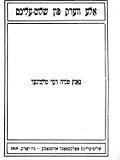
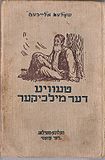
origin. This was extended twelve years later with the elimination of the five separate final-form consonants (as indicated in the table below) which were, however, widely reintroduced in 1961. The changes are both illustrated in the way the name of the author Sholem Aleichem is written. His own work uses the form שלום־עליכם but in Soviet publication this is respelled phonetically to שאָלעמ־אלײכעמ also dispensing with the separate final-form mem and using the initial/medial form instead. This can be seen, together with a respelling of the name of the protagonist of his Tevye der milkhiker
(originally טביה, changed to טעוויע), by comparing the title pages of that work in the U.S. and Soviet editions illustrated next to this paragraph. Note also the germanized מילכיגער (milkhiger) in the former exemplifying another widespread trend, daytshmerish, discussed further below.
The efforts preliminary to the 1920 reform, which took place in several countries — most notably in Poland with focus on a uniform school curriculum — resulted in other devices that were not implemented as a result of any governmental mandate. These were further considered during the 1930s by the Yidisher visnshaftlekher institut, YIVO
, in the development of their תּקנות פֿון ייִדישן אויסלייג (takones fun yidishn oysleyg - "Rules of Yiddish Orthography"), also known as the "SYO" (Standard Yiddish Orthography) or the "YIVO Rules". This has become the most frequently referenced such system in present-day use (SYO 1999). Although it regularly figures in pedagogical contexts, it would be misleading to suggest that it is similarly dominant elsewhere. Other orthographies are frequently encountered in contemporary practice, and are house standards for many publishers.
A useful review of this variation is provided in the Oxford University כלל־תקנות פון יידישן אויסלייג (klal takones fun yidishn oysleyg - "Standard Rules of Yiddish Orthography") (Oxford 1992, and available online), written in and codifying a more conventional orthography than the one put forward by YIVO. Differences in the systems can be seen simply by comparing the titles of the two documents, but they differ more fundamentally in their approaches to the prescription and description of orthographic detail. The former treats orthographic variation as a positive attribute of the Yiddish literature and describes essential elements of that variation. The latter presents a uniform Yiddish orthography, based on observed practice but with proactive prescriptive intent. Strong difference of opinion about the relative merit of the two approaches has been a prominent aspect of the discussion from the outset, and shows little sign of abating. Although the Yiddish alphabet as stated in the SYO is widely accepted as a baseline reference (with a few minor but frequently encountered variations), the spelling rules, and the phonetic aspects of the YIVO system of romanized transliteration
as discussed below, remain subjects of particular contention. The intent of the SYO is not to describe the spectrum of traditional orthographic practice. The bulk of Yiddish literature predates the formulation of those rules, and the discrepancies are significant.
. Whatever impact this may have on the discussion of standardized orthography, it becomes a significant factor when Yiddish is transliterated
into other scripts. It is entirely possible to assign a specific character or sequence of characters in, for example, the Roman alphabet
to a specific character or character sequence in the Yiddish alphabet. The transliterated form will, however, be pronounced in a manner that appears natural to the reader. A choice therefore needs to be made about which of the several possible pronunciations of the Yiddish word is to be conveyed prior to its transliteration, with parallel attention to the phonemic attributes of the target language.
The romanization of Yiddish has been a focus of scholarly attention in Europe since the early 16th century. A detailed review of the various systems presented through the 17th century, including extensive source excerpts, is provided in Frakes 2007. The Harkavy treatise cited above describes a late 19th century system that is based on the pronunciation of the Northeastern Yiddish dialect, Litvish
, for an anglophone
audience. This was also a mainstay of the standardization efforts of YIVO, resulting in the romanization system described in detail below. The Harkavy and YIVO initiatives provide a convenient framework within which intervening developments may be considered. There was significant debate about many aspects of that sequence, including the need for any form of standardized orthography at all (Fishman 1981).
The outright replacement of Hebrew script with Roman script in the native representation of written Yiddish was briefly considered. This had no impact on mainstream orthography but a number of Yiddish books are currently available in romanized editions. These include Yiddish dictionaries, a context in which consistent and phonetically tenable transliteration is essential.
There is no general agreement about the transliteration of Hebrew
into the Roman alphabet. The Hebrew component of a Yiddish text will normally reflect the transliterator's preference without being seen as a component of the methodology applied to the romanization of words presented in the phonemic orthography.
will be required. This is frequently done by using the International Phonetic Alphabet ("IPA"). There are also many contexts in which phonetic distinctions are indicated by the diacritical marking of the base characters, or through the similar use of some alternate script that is familiar to the intended audience. These approaches are all also seen in native Yiddish texts, where distinctions that cannot be directly represented with the basic Yiddish script but do need to be highlighted, are indicated by using additional Hebrew diacritical marks, with Roman letters, or with the IPA.
There is no intrinsic reason why a transcription scheme cannot also be used for transliteration. In general, however, there is no expectation that the representation of a word in the source script can be retrieved from a transcription. Its purpose is to indicate how a word is pronounced, not its native orthography.
The table in the following section indicates two alternatives each for romanized transliteration and phonetic transcription. It is keyed to the Yiddish character repertoire as codified by YIVO. Other transliteration systems are also regularly employed in a variety of contexts but no single one of them represents the full range of variant pronunciation in Yiddish dialects. Nor is the YIVO system equally appropriate phonetically to all languages using Roman script. This issue becomes particularly intricate when dealing with older texts where little is known about pronunciation, and transmitting the fullest possible detail of their notation is historically important. There are several approaches to the romanization of such material. The YIVO transliteration system is solely intended to serve as an English-oriented phonetic counterpart to the modern Standard Yiddish
described (and to some extent prescribed) in the SYO. That work does, however, consider the transcription of variant pronunciation as will be discussed below.
YIVO published a major study of the range of Yiddish phonetic variation in The Language and Cultural Atlas of Ashkenazic Jewry, commonly referred to as the LCAAJ. This uses a detailed system of marked Roman characters and suprasegmental
marks to indicate that variation, and does not apply standard YIVO transliteration at all. Although the full phonetic transcription scheme is not amenable to presentation in the table below, its core elements have been included. This scheme has been used by later authors to indicate "phonetic transcription" and is labelled in that manner here. One recent example of this is provided in Jacobs 2005. Another transcription system frequently cited in academic contexts was devised and presented (in German) by Solomon Birnbaum
in Birnbaum 1918 and used in his later German works, as well as his English publication Birnbaum 1979. This was intended to provide extreme flexibility in the representation of differences between dialects but failed to gain further practical acceptance due to its intricacy and idiosyncratic appearance (illustrated by Birnbaum's own transcription of a passage from Sholem Aleichem's, Shprintse: "Vaaihii haaiym, tréft zex a maasy, éiryv śvjjys iz dus gyvéin, kjm ex cj fuurn mit a bisl milexiks cj ainy fjn maany koinytys, a ijngy almuuny jn a raaxy fjn iékaterinoslav, vus is gykjmyn cj fuurn mit ir ziindl, aronćik haist er, kain boiberik ifn zjmer", which in YIVO transliteration is, "Vayehi hayoym, treft zikh a mayse, erev-shvues iz dos geven, kum ikh tsu forn mit a bisel milkhigs tsu eyner fun mayne kundes, a yunge almone un a raykhe fun katerineslav, vos iz gekumen tsu forn mit ihr zundl, arontshik heyst er, keyn boyberik oyfn zumer").
English-Yiddish-English Dictionary (Weinreich 1968), with a few variants that may be seen in readily available literature. The YIVO romanizations are taken from the same source, where they are presented as "sound equivalents". The romanizations indicated in Harkavy 1898 are included for comparison. The IPA transcriptions correspond to the examples provided by YIVO at http://yivo.org/about/index.php?tid=57&aid=275 (also with a few added variants). The phonetic transcriptions have been extrapolated from the LCAAJ. It is important to note that the elements of the two transcription systems appear in this table as appropriate to the standard pronunciation discussed under the next heading. The same elements, particularly those indicating vowels and diphthong
s, are associated with other Yiddish letters when other pronunciations are being transcribed.
The table also includes several digraphs
and a trigraph
that are standard elements of the Yiddish writing system
. They appear here in normal alphabetic order
but are also commonly collated separately at the end of a listing of the basic single-character alphabet.
A few further romanized equivalents are provided but do not indicate dialectal differences. These are identical to what is contained in the table in the preceding section, with the following exceptions:
YIVO took Litvish as the standard dialect
with only slight modification, to a large extent because of the consistency with which its phonemic attributes could be represented by a standardized orthography similarly requiring only minimal elaboration of traditional practice. The important distinctions between Litvish, Poylish, and Ukrainish are therefore not indicated in either the SYO or Weinreich dictionary. These are, however, discussed in detail in the LCAAJ to which Uriel Weinreich was a major contributor. The Roman characters appearing in the SYO correspond to those used in the LCAAJ, and their marking according to Central European orthographic convention provides greater flexibility in notating dialectal distinction than does an English-oriented approach. Phonetic transcription is therefore common in linguistic discourse about Yiddish, often using a wide range of diacritical marks in clear contrast to the totally undecorated YIVO romanization.
The SYO listing of the Yiddish alphabet (which predates the Weinreich dictionary) explicitly states that the vowels with combining points, and the vov and yud digraphs, are not counted as separate letters, nor are the additional consonant digraphs and trigraphs listed at all:
The order of the letters in the alphabet is as follows:
are not counted as separate letters in the alphabet.
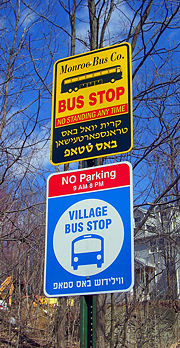 There are several areas in which Yiddish orthographic practice varies. One of them is the extent to which pointing is used to avoid ambiguity in the way a word may be read. This ranges from unpointed text, through a small number of pointed characters, to the redundant use of the full system of Hebraic vowel pointing. Most systems do use a certain amount of pointing. The most frugal application that can be observed is the distinction of pey and fey by enclosing a dot in the former (further details below). Immediately beyond that is the differentiation of the komets alef from the unpointed form, and then the further use of the pasekh alef. Where additional points are applied, there can be significant variation in their number and disposition, and there are often internal inconsistencies in a single system. (The belief that this variation was an impediment to the recognition of Yiddish as a literary peer to the other major European languages was a primary driving force toward the development of orthographic norms.)
A detailed generalized description of the pointing of Yiddish text is given in Harkavy 1898, and the topic is also treated briefly in the SYO (which otherwise simply declares the prescribed characters). A more extensive character repertoire is presented and discussed in Birnbaum 1918.
Although consonants are basically represented in the same manner, the indication of vowels differs more widely. One noteworthy situation that does pertain to the representation of consonants is the indication of phonetic distinctions between each of the four character pairs beys/veys, kof/khof, pey/fey, and tof/sof. The 'hard' (plosive) pronunciation of the first letter in each pair is unequivocally denoted by a dot (dagesh) in the middle of the letter. The 'soft' (fricative) pronunciation is similarly notated with a horizontal bar over the letter (rafe). Most orthographic systems usually only point one of the two characters in a pair but may be inconsistent from pair to pair in indicating the hard or soft alternative. Text that otherwise conforms to the SYO therefore frequently omits the rafe from fey, in harmonization with its unpointed final form, and makes the contrastive distinction from a pey solely with a dagesh in the latter (פ פּ). The similar avoidance of the rafe and preferential use of the dagesh is a common alternative for the contrastive distinction between beys and veys (ב בּ).
The rafe is an attribute of earlier Yiddish orthographic tradition and that the dagesh is an adaptation of what is more generally a Hebrew practice. This also applies to the alternatives for indicating the distinction between yud when used as a consonant or as a vowel. There is a related need for marking the boundary between a yud and tsvey yudn where they appear adjacent to each other and, again, in the corresponding situation with vov and tsvey vovn. A dot under a yud (khirik yud) and to the left of a vov (melupm vov) unambiguously indicates the vocalic form of those letters. In the main table above that Harkavy does not use these pointed forms, which were among the details codified in the early 20th century. In the traditional Yiddish orthographies where these letters are not pointed, the vowel is indicated by preceding it with a shtumer alef (reducing the use of which was a major focus of the normative efforts). The single and digraph forms of, for example, vov can be separated either with a dot or an embedded alef as וווּ or וואו (vu - "where"). Although only the former spelling is consistent with the SYO and appears in Uriel Weinreich's dictionary, he uses the unpointed alternative exclusively in his own "Say it in Yiddish" (ISBN 0-486-20815-X), a phrase book that contains the word in a large number of "Where is...?" queries and was published when the rules had already been well established.
A further graphic example of this distinction is seen in the official announcement, on 14 November 1997, of a change in editorial policy for the prominent Yiddish periodical, פאָרווערטס (forverts - "Yiddish Forward"). It was first during that year that the YIVO orthography was adopted. The previous editorial position overtly opposed any such change and the following is included in the explanation of the shift (quoted in full in Schaechter 1999, p. 109):
"And then we removed the alef in the words ייד [yid] and יידיש [yidish] (previously איד and אידיש) and ייִנגל [yingl] (previously אינגל), and now will spell the words with a khirik under the second yud as: ייִדיש ,ייִד and ייִנגל".
The appearance of three alternate spellings for the name of the Yiddish language in a statement intended to describe its orthographic standardization might not require any comment if it were not for the clear indication that the cardinal representation — יידיש — was neither the older nor the newer editorial preference. Regardless of the intent of that statement, a word-initial yud is consonantal, and an adjacent yud is vocalic, in all Yiddish orthographic systems, as is the constraint on a word initial tsvey yudn diphthong. Pointing the second yud in ייִדיש is therefore, indeed, redundant. The spelling אידיש also illustrates some of the dialectic breadth of the Yiddish language, the name of which is both written and pronounced with and without an initial consonant. It may also be useful to note that in earlier texts, a single vov in word-initial position was often used to indicate an [f].
Finally, letters other than shtumer alef may be used as silent indications of syllable boundaries and in compound consonants, as well as for extending the length of an adjacent vowel. This became particularly common in deliberately germanized orthographies dating from the late 19th century, collectively termed daytshmerish. Its most obvious further attributes are the heavy use of double consonants where traditional orthography uses single ones, and the gratuitous substitution of German vocabulary for established Yiddish words. The desire to reverse that trend was another of the reasons for the effort toward orthographic standardization.
Publishers of Yiddish newspapers have, however, been particularly conservative in their attitude toward that development, and the preceding editorial statement in Forverts provides a useful capsule summary of the details about which opinions differed. Other current Yiddish newspapers and magazines retain the spelling אידיש and many elements of daytshmerish. This is typified in דער איד ("Der Yid
"), which is one of several weekly tabloids — others being דער בּלאט ("Der Blatt
") and די צייטונג (di tsaytung - "News Report" ) — that all adhere to the earlier orthography and are in wider circulation and of substantially greater length than the broadsheet
Forverts. It may also be seen in the online version of the אַלגעמיינער זשורנאַל (algemeyner zhurnal - Algemeiner Journal
), as well as in its printed edition. Extensive additional source material relevant to the stance of the daily press on orthographic reform is provided in Fishman 1981.
Editorial acceptance of varying orthographies is a general characteristic of Hasidic
publication, and a single work written by multiple authors may differ in that regard from section to section depending on the preferences of the individual contributors or the typographic context. One example of the latter situation is the use of the pointed forms of alef only in specific instances where they are deemed necessary to avoid misreading. (As may be noted with the preceding discussion of the spelling of ייִדיש, and the pointing of both fey and pey, the SYO contains some redundant elements.) The online manifestation of such orthographic heterogeneity can readily be seen in the Yiddish Wikipedia. This is an expansive aspect of contemporary Yiddish publication and will require detailed accommodation in future codifications of orthographic practice.
The first edition of the SYO was published in 1937. It was preceded by a collection of essays published by YIVO in 1930, entitled "A Standard of Yiddish Spelling; Discussion No. 1" ( דער איינהייטלעכער יידישער אויסלייג - der eynheytlekher yidisher oysleyg). Neither the title of this work, nor its contents, were written using the conventions that YIVO was subsequently to put forward on its basis. The pivotal essay in the 1930 collection was written by Max Weinreich
:
This "A Projected Uniform Yiddish Orthography" was not written with the pointing that is prescribed in the SYO, and introduces a character that was entirely absent from the previous repertoire. This is the V-shaped grapheme in the second line, replacing the tsvey vovn in Weinreich's name, and in the name of the city where the work was published, Vilna. It appears in two other essays in the same collection but did not appear in any subsequent printed work. It was however, included in the SYO as a recommendation for use in handwritten text, where it is also encountered. Yudl Mark, who authored one of the other 1930 essays in which the typeset
form was used, was later to dub this character the shpitsik maksl ("acute Maxy"), and it remains enshrined in the YIVO logotype.
Further orthographic variation is seen in other YIVO publications from the same period, also using markings that were not included in the SYO, but which did have typographic precedent (for example, אֵ to represent /e/). The way in which the pasekh tsvey yudn are set in the heading of the Weinreich article (in his name) is discussed below.
Yiddish language
Yiddish is a High German language of Ashkenazi Jewish origin, spoken throughout the world. It developed as a fusion of German dialects with Hebrew, Aramaic, Slavic languages and traces of Romance languages...
is written using Hebrew script
Hebrew alphabet
The Hebrew alphabet , known variously by scholars as the Jewish script, square script, block script, or more historically, the Assyrian script, is used in the writing of the Hebrew language, as well as other Jewish languages, most notably Yiddish, Ladino, and Judeo-Arabic. There have been two...
as the basis of a full vocalic alphabet
Alphabet
An alphabet is a standard set of letters—basic written symbols or graphemes—each of which represents a phoneme in a spoken language, either as it exists now or as it was in the past. There are other systems, such as logographies, in which each character represents a word, morpheme, or semantic...
. This adaptation uses letters that are silent or glottal stop
Glottal stop
The glottal stop, or more fully, the voiceless glottal plosive, is a type of consonantal sound used in many spoken languages. In English, the feature is represented, for example, by the hyphen in uh-oh! and by the apostrophe or [[ʻokina]] in Hawaii among those using a preservative pronunciation of...
s in Hebrew, as vowel
Vowel
In phonetics, a vowel is a sound in spoken language, such as English ah! or oh! , pronounced with an open vocal tract so that there is no build-up of air pressure at any point above the glottis. This contrasts with consonants, such as English sh! , where there is a constriction or closure at some...
s in Yiddish. Other letters that can serve as both vowels and consonants are either read as appropriate to the context in which they appear, or are differentiated by diacritical marks
Diacritic
A diacritic is a glyph added to a letter, or basic glyph. The term derives from the Greek διακριτικός . Diacritic is both an adjective and a noun, whereas diacritical is only an adjective. Some diacritical marks, such as the acute and grave are often called accents...
derived from the Hebrew nikud, and commonly referred to as "points". Additional phonetic distinctions between letters that share the same base character are also indicated by pointing, or by the adjacent placement of otherwise silent base characters. Several Yiddish points are not commonly used in any present-day Hebrew context and others are used in a manner that is specific to Yiddish orthography. There is significant variation in the way this is applied in literary practice. There are also several differing approaches to the disambiguation of characters that can be used as either vowels or consonants.
Words of Aramaic
Aramaic language
Aramaic is a group of languages belonging to the Afroasiatic language phylum. The name of the language is based on the name of Aram, an ancient region in central Syria. Within this family, Aramaic belongs to the Semitic family, and more specifically, is a part of the Northwest Semitic subfamily,...
and Hebrew origin are normally written in the traditional consonant-based orthographies of the source languages. All other Yiddish vocabulary is represented with a phonemic orthography
Phonemic orthography
A phonemic orthography is a writing system where the written graphemes correspond to phonemes, the spoken sounds of the language. In terms of orthographic depth, these are termed shallow orthographies, contrasting with deep orthographies...
. Both can appear in a single word, for example, where a Yiddish affix
Affix
An affix is a morpheme that is attached to a word stem to form a new word. Affixes may be derivational, like English -ness and pre-, or inflectional, like English plural -s and past tense -ed. They are bound morphemes by definition; prefixes and suffixes may be separable affixes...
is applied to a Hebrew stem. Yiddish pointing may also be applied to words that are otherwise written entirely with traditional orthography.
Please note: The correct display of some text in this article requires fonts
Typeface
In typography, a typeface is the artistic representation or interpretation of characters; it is the way the type looks. Each type is designed and there are thousands of different typefaces in existence, with new ones being developed constantly....
with full support for the pointed characters in the Yiddish alphabet, plus the International Phonetic Alphabet
International Phonetic Alphabet
The International Phonetic Alphabet "The acronym 'IPA' strictly refers [...] to the 'International Phonetic Association'. But it is now such a common practice to use the acronym also to refer to the alphabet itself that resistance seems pedantic...
. Additional display issues may be observed and are explained under the heading Computerized Text Production, below.
Early 20th century reform
In the early 20th century, for both cultural and political reasons, focused efforts were initiated toward the development of a uniform Yiddish orthography. A specimen initial practice was described in detail by the Yiddish lexicographer Alexander HarkavyAlexander Harkavy
Alexander Harkavy was a Russian-born American writer, lexicographer and linguist.Alexander was educated privately, and at an early age evinced a predilection for philology...
in a Treatise on Yiddish Reading, Orthography, and Dialectal Variations first published in 1898 together with his Yiddish-English Dictionary (Harkavy 1898), and available online (beginning with the section headed Yiddish reading). Additional illustrations of this variation are provided in source excerpts in Fishman 1981, which also contains a number of texts specifically about the need (pro and con) for a uniform orthography. A detailed chronology of the major events during this normative action, including rosters of conference participants, bibliographic references to the documents they produced, and summaries of their contents, is given in Yiddish in Schaechter 1999. There is a less detailed (but extensive nonetheless) English language review of this process in Estraikh 1999.
Soviet Union
The Soviet Union , officially the Union of Soviet Socialist Republics , was a constitutionally socialist state that existed in Eurasia between 1922 and 1991....
in 1920, with the abolition of the separate etymological
Etymology
Etymology is the study of the history of words, their origins, and how their form and meaning have changed over time.For languages with a long written history, etymologists make use of texts in these languages and texts about the languages to gather knowledge about how words were used during...
orthography for words of Semitic
Semitic
In linguistics and ethnology, Semitic was first used to refer to a language family of largely Middle Eastern origin, now called the Semitic languages...
origin. This was extended twelve years later with the elimination of the five separate final-form consonants (as indicated in the table below) which were, however, widely reintroduced in 1961. The changes are both illustrated in the way the name of the author Sholem Aleichem is written. His own work uses the form שלום־עליכם but in Soviet publication this is respelled phonetically to שאָלעמ־אלײכעמ also dispensing with the separate final-form mem and using the initial/medial form instead. This can be seen, together with a respelling of the name of the protagonist of his Tevye der milkhiker
Tevye
Tevye the Dairyman is the protagonist of several of Sholem Aleichem's stories, originally written in Yiddish and first published in 1894. The character became best known from the fictional memoir Tevye and his Daughters , about a pious Jewish milkman in Tsarist Russia, and the troubles he has with...
(originally טביה, changed to טעוויע), by comparing the title pages of that work in the U.S. and Soviet editions illustrated next to this paragraph. Note also the germanized מילכיגער (milkhiger) in the former exemplifying another widespread trend, daytshmerish, discussed further below.
The efforts preliminary to the 1920 reform, which took place in several countries — most notably in Poland with focus on a uniform school curriculum — resulted in other devices that were not implemented as a result of any governmental mandate. These were further considered during the 1930s by the Yidisher visnshaftlekher institut, YIVO
YIVO
YIVO, , established in 1925 in Wilno, Poland as the Yidisher Visnshaftlekher Institut , or Yiddish Scientific Institute, is a source for orthography, lexicography, and other studies related to the Yiddish language...
, in the development of their תּקנות פֿון ייִדישן אויסלייג (takones fun yidishn oysleyg - "Rules of Yiddish Orthography"), also known as the "SYO" (Standard Yiddish Orthography) or the "YIVO Rules". This has become the most frequently referenced such system in present-day use (SYO 1999). Although it regularly figures in pedagogical contexts, it would be misleading to suggest that it is similarly dominant elsewhere. Other orthographies are frequently encountered in contemporary practice, and are house standards for many publishers.
A useful review of this variation is provided in the Oxford University כלל־תקנות פון יידישן אויסלייג (klal takones fun yidishn oysleyg - "Standard Rules of Yiddish Orthography") (Oxford 1992, and available online), written in and codifying a more conventional orthography than the one put forward by YIVO. Differences in the systems can be seen simply by comparing the titles of the two documents, but they differ more fundamentally in their approaches to the prescription and description of orthographic detail. The former treats orthographic variation as a positive attribute of the Yiddish literature and describes essential elements of that variation. The latter presents a uniform Yiddish orthography, based on observed practice but with proactive prescriptive intent. Strong difference of opinion about the relative merit of the two approaches has been a prominent aspect of the discussion from the outset, and shows little sign of abating. Although the Yiddish alphabet as stated in the SYO is widely accepted as a baseline reference (with a few minor but frequently encountered variations), the spelling rules, and the phonetic aspects of the YIVO system of romanized transliteration
Romanization
In linguistics, romanization or latinization is the representation of a written word or spoken speech with the Roman script, or a system for doing so, where the original word or language uses a different writing system . Methods of romanization include transliteration, for representing written...
as discussed below, remain subjects of particular contention. The intent of the SYO is not to describe the spectrum of traditional orthographic practice. The bulk of Yiddish literature predates the formulation of those rules, and the discrepancies are significant.
Transliteration
A few Yiddish letters and letter combinations are pronounced quite differently in the various Yiddish dialectsYiddish dialects
Yiddish dialects are varieties of the Yiddish language. These dialects are divided by originating region in Europe. Northeastern "Litvish" Yiddish was dominant in twentieth-century Yiddish culture and academia, while Southern dialects of Yiddish are now the most commonly spoken, preserved by many...
. Whatever impact this may have on the discussion of standardized orthography, it becomes a significant factor when Yiddish is transliterated
Transliteration
Transliteration is a subset of the science of hermeneutics. It is a form of translation, and is the practice of converting a text from one script into another...
into other scripts. It is entirely possible to assign a specific character or sequence of characters in, for example, the Roman alphabet
Latin alphabet
The Latin alphabet, also called the Roman alphabet, is the most recognized alphabet used in the world today. It evolved from a western variety of the Greek alphabet called the Cumaean alphabet, which was adopted and modified by the Etruscans who ruled early Rome...
to a specific character or character sequence in the Yiddish alphabet. The transliterated form will, however, be pronounced in a manner that appears natural to the reader. A choice therefore needs to be made about which of the several possible pronunciations of the Yiddish word is to be conveyed prior to its transliteration, with parallel attention to the phonemic attributes of the target language.
The romanization of Yiddish has been a focus of scholarly attention in Europe since the early 16th century. A detailed review of the various systems presented through the 17th century, including extensive source excerpts, is provided in Frakes 2007. The Harkavy treatise cited above describes a late 19th century system that is based on the pronunciation of the Northeastern Yiddish dialect, Litvish
Lithuanian Jews
Lithuanian Jews or Litvaks are Jews with roots in the Grand Duchy of Lithuania:...
, for an anglophone
English language
English is a West Germanic language that arose in the Anglo-Saxon kingdoms of England and spread into what was to become south-east Scotland under the influence of the Anglian medieval kingdom of Northumbria...
audience. This was also a mainstay of the standardization efforts of YIVO, resulting in the romanization system described in detail below. The Harkavy and YIVO initiatives provide a convenient framework within which intervening developments may be considered. There was significant debate about many aspects of that sequence, including the need for any form of standardized orthography at all (Fishman 1981).
The outright replacement of Hebrew script with Roman script in the native representation of written Yiddish was briefly considered. This had no impact on mainstream orthography but a number of Yiddish books are currently available in romanized editions. These include Yiddish dictionaries, a context in which consistent and phonetically tenable transliteration is essential.
There is no general agreement about the transliteration of Hebrew
Romanization of Hebrew
Hebrew uses the Hebrew alphabet with optional vowel points. The romanization of Hebrew is the use of the Latin alphabet to transliterate Hebrew words....
into the Roman alphabet. The Hebrew component of a Yiddish text will normally reflect the transliterator's preference without being seen as a component of the methodology applied to the romanization of words presented in the phonemic orthography.
Transcription
A transliteration system uses one script to represent another as closely as possible. It will normally permit unambiguous conversion back and forth between the two scripts. Where the intent is to indicate phonetic variation, some form of transcriptionTranscription (linguistics)
Transcription in the linguistic sense is the systematic representation of language in written form. The source can either be utterances or preexisting text in another writing system, although some linguists only consider the former as transcription.Transcription should not be confused with...
will be required. This is frequently done by using the International Phonetic Alphabet ("IPA"). There are also many contexts in which phonetic distinctions are indicated by the diacritical marking of the base characters, or through the similar use of some alternate script that is familiar to the intended audience. These approaches are all also seen in native Yiddish texts, where distinctions that cannot be directly represented with the basic Yiddish script but do need to be highlighted, are indicated by using additional Hebrew diacritical marks, with Roman letters, or with the IPA.
There is no intrinsic reason why a transcription scheme cannot also be used for transliteration. In general, however, there is no expectation that the representation of a word in the source script can be retrieved from a transcription. Its purpose is to indicate how a word is pronounced, not its native orthography.
The table in the following section indicates two alternatives each for romanized transliteration and phonetic transcription. It is keyed to the Yiddish character repertoire as codified by YIVO. Other transliteration systems are also regularly employed in a variety of contexts but no single one of them represents the full range of variant pronunciation in Yiddish dialects. Nor is the YIVO system equally appropriate phonetically to all languages using Roman script. This issue becomes particularly intricate when dealing with older texts where little is known about pronunciation, and transmitting the fullest possible detail of their notation is historically important. There are several approaches to the romanization of such material. The YIVO transliteration system is solely intended to serve as an English-oriented phonetic counterpart to the modern Standard Yiddish
Yiddish phonology
There is significant phonological variation among the various dialects of the Yiddish language. The description that follows is of a modern Standard Yiddish that was devised during the early 20th century and is frequently encountered in pedagogical contexts...
described (and to some extent prescribed) in the SYO. That work does, however, consider the transcription of variant pronunciation as will be discussed below.
YIVO published a major study of the range of Yiddish phonetic variation in The Language and Cultural Atlas of Ashkenazic Jewry, commonly referred to as the LCAAJ. This uses a detailed system of marked Roman characters and suprasegmental
Prosody (linguistics)
In linguistics, prosody is the rhythm, stress, and intonation of speech. Prosody may reflect various features of the speaker or the utterance: the emotional state of the speaker; the form of the utterance ; the presence of irony or sarcasm; emphasis, contrast, and focus; or other elements of...
marks to indicate that variation, and does not apply standard YIVO transliteration at all. Although the full phonetic transcription scheme is not amenable to presentation in the table below, its core elements have been included. This scheme has been used by later authors to indicate "phonetic transcription" and is labelled in that manner here. One recent example of this is provided in Jacobs 2005. Another transcription system frequently cited in academic contexts was devised and presented (in German) by Solomon Birnbaum
Solomon Birnbaum
Solomon Birnbaum, also Salomo, Solomon A or Solomon Asher, was a Yiddish linguist and Hebrew paleographer.-Career:...
in Birnbaum 1918 and used in his later German works, as well as his English publication Birnbaum 1979. This was intended to provide extreme flexibility in the representation of differences between dialects but failed to gain further practical acceptance due to its intricacy and idiosyncratic appearance (illustrated by Birnbaum's own transcription of a passage from Sholem Aleichem's, Shprintse: "Vaaihii haaiym, tréft zex a maasy, éiryv śvjjys iz dus gyvéin, kjm ex cj fuurn mit a bisl milexiks cj ainy fjn maany koinytys, a ijngy almuuny jn a raaxy fjn iékaterinoslav, vus is gykjmyn cj fuurn mit ir ziindl, aronćik haist er, kain boiberik ifn zjmer", which in YIVO transliteration is, "Vayehi hayoym, treft zikh a mayse, erev-shvues iz dos geven, kum ikh tsu forn mit a bisel milkhigs tsu eyner fun mayne kundes, a yunge almone un a raykhe fun katerineslav, vos iz gekumen tsu forn mit ihr zundl, arontshik heyst er, keyn boyberik oyfn zumer").
The Yiddish alphabet
This table lists the Yiddish alphabet as described in the Uriel WeinreichUriel Weinreich
Uriel Weinreich was a linguist at Columbia University. Born in Vilnius , he earned his Ph.D. from Columbia, and went on to teach there, specializing in Yiddish studies, sociolinguistics, and dialectology...
English-Yiddish-English Dictionary (Weinreich 1968), with a few variants that may be seen in readily available literature. The YIVO romanizations are taken from the same source, where they are presented as "sound equivalents". The romanizations indicated in Harkavy 1898 are included for comparison. The IPA transcriptions correspond to the examples provided by YIVO at http://yivo.org/about/index.php?tid=57&aid=275 (also with a few added variants). The phonetic transcriptions have been extrapolated from the LCAAJ. It is important to note that the elements of the two transcription systems appear in this table as appropriate to the standard pronunciation discussed under the next heading. The same elements, particularly those indicating vowels and diphthong
Diphthong
A diphthong , also known as a gliding vowel, refers to two adjacent vowel sounds occurring within the same syllable. Technically, a diphthong is a vowel with two different targets: That is, the tongue moves during the pronunciation of the vowel...
s, are associated with other Yiddish letters when other pronunciations are being transcribed.
The table also includes several digraphs
Digraph (orthography)
A digraph or digram is a pair of characters used to write one phoneme or a sequence of phonemes that does not correspond to the normal values of the two characters combined...
and a trigraph
Trigraph (orthography)
A trigraph is a group of three letters used to represent a single sound or a combination of sounds that does not correspond to the written letters combined. For example, in the word schilling, the trigraph sch represents the voiceless postalveolar fricative , rather than the consonant cluster...
that are standard elements of the Yiddish writing system
Writing system
A writing system is a symbolic system used to represent elements or statements expressible in language.-General properties:Writing systems are distinguished from other possible symbolic communication systems in that the reader must usually understand something of the associated spoken language to...
. They appear here in normal alphabetic order
Collation
Collation is the assembly of written information into a standard order. One common type of collation is called alphabetization, though collation is not limited to ordering letters of the alphabet...
but are also commonly collated separately at the end of a listing of the basic single-character alphabet.
| Symbol | YIVO Romanization | Harkavy Romanization | IPA Transcription | Phonetic Transcription | Name | Notes |
|---|---|---|---|---|---|---|
| (none) | (none) | (none) | (none) | shtumer alef Aleph (letter) ' is the reconstructed name of the first letter of the Proto-Canaanite alphabet, continued in descended Semitic alphabets as Phoenician ' , Syriac ' , Hebrew Aleph , and Arabic ' .... |
Indicates that a syllable starts with the vocalic form of the following letter. Neither pronounced nor transcribed. | |
| a | a | a | a | pasekh alef | As a non-YIVO equivalent, an [a] may also be indicated by an unpointed alef. | |
| o | o | ɔ | o | komets alef | As a non-YIVO equivalent, an [o] may also be indicated by an unpointed alef. | |
| b | b | b | b | beys | ||
| (none) | (none) | b | (b) | beys | Non-YIVO alternative to ב. | |
| v | v | v | v | veys | Used only in words of Semitic origin. | |
| g | g | ɡ | g | giml Gimel (letter) Gimel is the third letter of many Semitic alphabets, including Phoenician, Aramaic, Hebrew , Syriac and Arabic... |
||
| d | d | d | d | daled | ||
| dzh | (none) | d͡ʒ | dž | daled zayen shin | ||
| h | h | h | h | hey He (letter) He is the fifth letter of many Semitic alphabets, including Phoenician , Aramaic, Hebrew , Syriac and Arabic . Its sound value is a voiceless glottal fricative .... |
||
| u | u | ʊ | u | vov Waw (letter) Waw is the sixth letter of the Northwest Semitic family of scripts, including Phoenician, Aramaic, Hebrew, Syriac, and Arabic .... |
||
| u | (none) | ʊ | u | melupm vov | Used only adjacent to ו or before י. | |
| (none) | (none) | ɔ, ɔj | (o,oj) | khoylem | Non-YIVO alternative to אָ and וי. | |
| v | v | v | v | tsvey vovn | ||
| oy | oi | ɔj | oj | vov yud | ||
| z | z | z | z | zayen Zayin Zayin is the seventh letter of many Semitic abjads, including Phoenician , Aramaic , Hebrew , Syriac and Perso-Arabic alphabet... |
||
| zh | zh | ʒ | ž | zayen shin | ||
| kh | ch | x | x | khes Heth (letter) ' or ' is the reconstructed name of the eighth letter of the Proto-Canaanite alphabet, continued in descended Semitic alphabets as Phoenician , Syriac , Hebrew ḥēth , Arabic , and Berber .Heth originally represented a voiceless fricative, either pharyngeal , or... |
Used only in words of Semitic origin. | |
| t | t | t | t | tes Teth ' is the ninth letter of many Semitic abjads , including Phoenician, Aramaic, Hebrew Tet , Syriac and Arabic ; it is 9th in abjadi order and 16th in modern Arabic order.... |
||
| tsh | tsh | t͡ʃ | č | tes shin | ||
| y, i | y, i | j, i | j, i | yud Yodh Yodh is the tenth letter of many Semitic alphabets, including Phoenician, Aramaic, Hebrew Yud , Syriac and Arabic... |
Consonantal [j] when the first character in a syllable. Vocalic [i] otherwise. | |
| i | (none) | i | i | khirik yud | Used only following a consonantal י or adjacent to another vowel. | |
| ey | ei, ai | ɛj | ej | tsvey yudn | ||
| ay | (none) | aj | aj | pasekh tsvey yudn | ||
| k | k | k | k | kof Kaph Kaph is the eleventh letter of many Semitic abjads, including Phoenician, Aramaic, Hebrew Kaf , Arabic alphabet , Persian alphabet... |
Used only in words of Semitic origin. | |
| kh | ch | x | x | khof | ||
| kh | ch | x | x | lange khof | Final form. Used only at the end of a word. | |
| l | l | l, ʎ | l | lamed | ||
| m | m | m | m | mem Mem Mem is the thirteenth letter of many Semitic abjads, including Phoenician, Aramaic, Hebrew and Arabic... |
||
| m | m | m | m | shlos mem | Final form. Used only at the end of a word. | |
| n | n | n | n | nun Nun (letter) Nun is the fourteenth letter of many Semitic abjads, including Phoenician, Aramaic, Hebrew and Arabic alphabet . It is the third letter in Thaana , pronounced as "noonu"... |
||
| n, m | n, m | n, ŋ, m | n, m | lange nun | Final form. Used only at the end of a word. | |
| s | s | s | s | samekh Samekh Samekh or Simketh is the fifteenth letter in many Semitic alphabets, including Phoenician, Hebrew, and Aramaic, representing . The Arabic alphabet, however, uses a letter based on Phoenician šin to represent ; however, that glyph takes Samekh's place in the traditional Abjadi order of the Arabic... |
||
| e | e | ɛ, ə | e | ayin Ayin ' or ' is the sixteenth letter in many Semitic abjads, including Phoenician, Aramaic, Hebrew and Arabic . It is the twenty-first letter in the new Persian alphabet... |
||
| p | p | p | p | pey Pe (letter) Pe is the seventeenth letter in many Semitic abjads, including Phoenician, Aramaic, Hebrew Pei and Persian, Arabic .... |
Has no separate final form. | |
| f | f | f | f | fey | ||
| (none) | f | f | (f) | fey | Non-YIVO alternative to פֿ. | |
| f | f | f | f | lange fey | Final form. Used only at the end of a word. | |
| ts | tz | ts | c | tsade Tsade ' is the eighteenth letter in many Semitic alphabets, including Phoenician, Aramaic, Hebrew ' and Arabic ' . Its oldest sound value is probably , although there is a variety of pronunciation in different modern Semitic languages and their dialects... k |
||
| ts | tz | ts | c | lange tsadek | Final form. Used only at the end of a word. | |
| k | k | k | k | kuf Qoph Qoph or Qop is the nineteenth letter in many Semitic abjads, including Phoenician, Aramaic, Syriac, Hebrew and Arabic alphabet . Its sound value is an emphatic or . The OHED gives the letter Qoph a transliteration value of Q or a K and a final transliteration value as a ck... |
||
| r | r | ʀ | r | reysh Resh Resh is the twentieth letter of many Semitic alphabets, including Phoenician, Aramaic, Hebrew and Arabic alphabet . Its sound value is one of a number of rhotic consonants: usually or , but also or in Hebrew.... |
||
| sh | sh | ʃ | š | shin Shin (letter) Shin literally means "Sharp" ; It is the twenty-first letter in many Semitic abjads, including Phoenician , Aramaic/Hebrew , and Arabic .... |
||
| s | s | s | s | sin | Used only in words of Semitic origin. | |
| t | t | t | t | tof Taw (letter) Taw, Tav or Taf is the twenty-second and last letter in many Semitic abjads, including Phoenician, Aramaic, Hebrew Taw and Arabic alphabet .Its original sound value is .... |
Used only in words of Semitic origin. | |
| s | s | s | s | sof | Used only in words of Semitic origin. |
Standard Yiddish orthography
The SYO is presented in Yiddish, and a few romanized transcriptions are included only where needed to indicate variant pronunciation. Given that the YIVO standardization initiative has been severely criticized for failing to accommodate such variation, it may be worth noting that the SYO explicitly references the three major branches of Eastern Yiddish — Litvish (Northern), Poylish (Central), and Ukrainish (Southern), as developed in the regions centered on present-day Lithuania/Belarus, Poland, and Ukraine/Moldova. The SYO gives dialect-specific romanized equivalents for the following characters:| Symbol | Litvish | Poylish | Ukrainish | Name |
|---|---|---|---|---|
| u | i | i | vov | |
| ej | aj | ej | tsvey yudn | |
| aj | ā | ā | pasekh tsvey yudn |
A few further romanized equivalents are provided but do not indicate dialectal differences. These are identical to what is contained in the table in the preceding section, with the following exceptions:
| Symbol | Romanization | Name | Note |
|---|---|---|---|
| ch, x, [kh] | khof | kh is not included in earlier SYO editions | |
| š | shin |
YIVO took Litvish as the standard dialect
Standard language
A standard language is a language variety used by a group of people in their public discourse. Alternatively, varieties become standard by undergoing a process of standardization, during which it is organized for description in grammars and dictionaries and encoded in such reference works...
with only slight modification, to a large extent because of the consistency with which its phonemic attributes could be represented by a standardized orthography similarly requiring only minimal elaboration of traditional practice. The important distinctions between Litvish, Poylish, and Ukrainish are therefore not indicated in either the SYO or Weinreich dictionary. These are, however, discussed in detail in the LCAAJ to which Uriel Weinreich was a major contributor. The Roman characters appearing in the SYO correspond to those used in the LCAAJ, and their marking according to Central European orthographic convention provides greater flexibility in notating dialectal distinction than does an English-oriented approach. Phonetic transcription is therefore common in linguistic discourse about Yiddish, often using a wide range of diacritical marks in clear contrast to the totally undecorated YIVO romanization.
The SYO listing of the Yiddish alphabet (which predates the Weinreich dictionary) explicitly states that the vowels with combining points, and the vov and yud digraphs, are not counted as separate letters, nor are the additional consonant digraphs and trigraphs listed at all:
The order of the letters in the alphabet is as follows:
are not counted as separate letters in the alphabet.
Common variation
A detailed generalized description of the pointing of Yiddish text is given in Harkavy 1898, and the topic is also treated briefly in the SYO (which otherwise simply declares the prescribed characters). A more extensive character repertoire is presented and discussed in Birnbaum 1918.
Although consonants are basically represented in the same manner, the indication of vowels differs more widely. One noteworthy situation that does pertain to the representation of consonants is the indication of phonetic distinctions between each of the four character pairs beys/veys, kof/khof, pey/fey, and tof/sof. The 'hard' (plosive) pronunciation of the first letter in each pair is unequivocally denoted by a dot (dagesh) in the middle of the letter. The 'soft' (fricative) pronunciation is similarly notated with a horizontal bar over the letter (rafe). Most orthographic systems usually only point one of the two characters in a pair but may be inconsistent from pair to pair in indicating the hard or soft alternative. Text that otherwise conforms to the SYO therefore frequently omits the rafe from fey, in harmonization with its unpointed final form, and makes the contrastive distinction from a pey solely with a dagesh in the latter (פ פּ). The similar avoidance of the rafe and preferential use of the dagesh is a common alternative for the contrastive distinction between beys and veys (ב בּ).
The rafe is an attribute of earlier Yiddish orthographic tradition and that the dagesh is an adaptation of what is more generally a Hebrew practice. This also applies to the alternatives for indicating the distinction between yud when used as a consonant or as a vowel. There is a related need for marking the boundary between a yud and tsvey yudn where they appear adjacent to each other and, again, in the corresponding situation with vov and tsvey vovn. A dot under a yud (khirik yud) and to the left of a vov (melupm vov) unambiguously indicates the vocalic form of those letters. In the main table above that Harkavy does not use these pointed forms, which were among the details codified in the early 20th century. In the traditional Yiddish orthographies where these letters are not pointed, the vowel is indicated by preceding it with a shtumer alef (reducing the use of which was a major focus of the normative efforts). The single and digraph forms of, for example, vov can be separated either with a dot or an embedded alef as וווּ or וואו (vu - "where"). Although only the former spelling is consistent with the SYO and appears in Uriel Weinreich's dictionary, he uses the unpointed alternative exclusively in his own "Say it in Yiddish" (ISBN 0-486-20815-X), a phrase book that contains the word in a large number of "Where is...?" queries and was published when the rules had already been well established.
A further graphic example of this distinction is seen in the official announcement, on 14 November 1997, of a change in editorial policy for the prominent Yiddish periodical, פאָרווערטס (forverts - "Yiddish Forward"). It was first during that year that the YIVO orthography was adopted. The previous editorial position overtly opposed any such change and the following is included in the explanation of the shift (quoted in full in Schaechter 1999, p. 109):
"And then we removed the alef in the words ייד [yid] and יידיש [yidish] (previously איד and אידיש) and ייִנגל [yingl] (previously אינגל), and now will spell the words with a khirik under the second yud as: ייִדיש ,ייִד and ייִנגל".
The appearance of three alternate spellings for the name of the Yiddish language in a statement intended to describe its orthographic standardization might not require any comment if it were not for the clear indication that the cardinal representation — יידיש — was neither the older nor the newer editorial preference. Regardless of the intent of that statement, a word-initial yud is consonantal, and an adjacent yud is vocalic, in all Yiddish orthographic systems, as is the constraint on a word initial tsvey yudn diphthong. Pointing the second yud in ייִדיש is therefore, indeed, redundant. The spelling אידיש also illustrates some of the dialectic breadth of the Yiddish language, the name of which is both written and pronounced with and without an initial consonant. It may also be useful to note that in earlier texts, a single vov in word-initial position was often used to indicate an [f].
Finally, letters other than shtumer alef may be used as silent indications of syllable boundaries and in compound consonants, as well as for extending the length of an adjacent vowel. This became particularly common in deliberately germanized orthographies dating from the late 19th century, collectively termed daytshmerish. Its most obvious further attributes are the heavy use of double consonants where traditional orthography uses single ones, and the gratuitous substitution of German vocabulary for established Yiddish words. The desire to reverse that trend was another of the reasons for the effort toward orthographic standardization.
Publishers of Yiddish newspapers have, however, been particularly conservative in their attitude toward that development, and the preceding editorial statement in Forverts provides a useful capsule summary of the details about which opinions differed. Other current Yiddish newspapers and magazines retain the spelling אידיש and many elements of daytshmerish. This is typified in דער איד ("Der Yid
Der Yid
Der Yid is a New York based Yiddish language weekly newspaper. The newspaper is published by Satmar Hasidim, but is widely read within the broader Haredi community. It uses a Yiddish dialect common to Satmar Chasidim as opposed to "YIVO Yiddish" which is standard in secular and academic circles.-...
"), which is one of several weekly tabloids — others being דער בּלאט ("Der Blatt
Der Blatt
Der Blatt is a weekly Yiddish newspaper published in New York by Satmar Hasidim.-History:Der Blatt was established in 2000, as a direct result of the Satmar succession feud. Prior to that time there was only one Satmar newspaper, Der Yid. In the dispute over the succession, Der Yid came under the...
") and די צייטונג (di tsaytung - "News Report" ) — that all adhere to the earlier orthography and are in wider circulation and of substantially greater length than the broadsheet
Broadsheet
Broadsheet is the largest of the various newspaper formats and is characterized by long vertical pages . The term derives from types of popular prints usually just of a single sheet, sold on the streets and containing various types of material, from ballads to political satire. The first broadsheet...
Forverts. It may also be seen in the online version of the אַלגעמיינער זשורנאַל (algemeyner zhurnal - Algemeiner Journal
Algemeiner Journal
The Algemeiner Journal is a New York-based Jewish, Yiddish and English weekly newspaper.- History :The Algemeiner Journal was founded in 1972 by Gershon Jacobson . The Algemeiner is currently owned and operated by the Gershon Jacobson Jewish Continuity Foundation...
), as well as in its printed edition. Extensive additional source material relevant to the stance of the daily press on orthographic reform is provided in Fishman 1981.
Editorial acceptance of varying orthographies is a general characteristic of Hasidic
Hasidic Judaism
Hasidic Judaism or Hasidism, from the Hebrew —Ḥasidut in Sephardi, Chasidus in Ashkenazi, meaning "piety" , is a branch of Orthodox Judaism that promotes spirituality and joy through the popularisation and internalisation of Jewish mysticism as the fundamental aspects of the Jewish faith...
publication, and a single work written by multiple authors may differ in that regard from section to section depending on the preferences of the individual contributors or the typographic context. One example of the latter situation is the use of the pointed forms of alef only in specific instances where they are deemed necessary to avoid misreading. (As may be noted with the preceding discussion of the spelling of ייִדיש, and the pointing of both fey and pey, the SYO contains some redundant elements.) The online manifestation of such orthographic heterogeneity can readily be seen in the Yiddish Wikipedia. This is an expansive aspect of contemporary Yiddish publication and will require detailed accommodation in future codifications of orthographic practice.
Graphic innovation
Orthographic reform as considered here, embraces two distinct actions. The first is concerned with the way Yiddish words are spelled, as illustrated in the preceding section with the name of the language, itself. The second relates to the graphic devices used to distinguish, for example, between א when representing what in English is an /a/ and when representing an /o/. The pointed אַ and אָ came into use for that purpose in the mid-18th century and were thus well established by the time the 20th century reforms were initiated, as were several other traditional Yiddish pointings. The most deeply entenched of these was the distinction between פ fey and פּ pey. YIVO proposed the additional use of pointed letters that were not in the Yiddish (or Hebrew) fonts of the day. This is a frequently cited reason for the SYO being slow to gain acceptance, but regardless of any opinion about their utility, most of the graphic elements introduced in that manner are now readily available. (The SYO explicitly states that pointing to disambiguate vowels does not change the identity of the base character; a pointed alef, for example, is not a letter of its own.)The first edition of the SYO was published in 1937. It was preceded by a collection of essays published by YIVO in 1930, entitled "A Standard of Yiddish Spelling; Discussion No. 1" ( דער איינהייטלעכער יידישער אויסלייג - der eynheytlekher yidisher oysleyg). Neither the title of this work, nor its contents, were written using the conventions that YIVO was subsequently to put forward on its basis. The pivotal essay in the 1930 collection was written by Max Weinreich
Max Weinreich
Max Weinreich was a linguist, specializing in the Yiddish language, and the father of the linguist Uriel Weinreich, who edited the Modern Yiddish-English English-Yiddish Dictionary.- Biography :Max Weinreich began his studies in a German school in Kuldiga,...
:
This "A Projected Uniform Yiddish Orthography" was not written with the pointing that is prescribed in the SYO, and introduces a character that was entirely absent from the previous repertoire. This is the V-shaped grapheme in the second line, replacing the tsvey vovn in Weinreich's name, and in the name of the city where the work was published, Vilna. It appears in two other essays in the same collection but did not appear in any subsequent printed work. It was however, included in the SYO as a recommendation for use in handwritten text, where it is also encountered. Yudl Mark, who authored one of the other 1930 essays in which the typeset
Typesetting
Typesetting is the composition of text by means of types.Typesetting requires the prior process of designing a font and storing it in some manner...
form was used, was later to dub this character the shpitsik maksl ("acute Maxy"), and it remains enshrined in the YIVO logotype.
Further orthographic variation is seen in other YIVO publications from the same period, also using markings that were not included in the SYO, but which did have typographic precedent (for example, אֵ to represent /e/). The way in which the pasekh tsvey yudn are set in the heading of the Weinreich article (in his name) is discussed below.
External links
- Ezra SIL - a freely available font designed for heavily marked Hebrew script
- Yiddish Typewriter - online interconversion of Hebrew script and YIVO transliteration