


Yiddish literature

Encyclopedia
Yiddish literature encompasses all belles lettres written in Yiddish
, the language of Ashkenazic Jewry which is related to Middle High German
. The history of Yiddish, with its roots in central Europe
and locus for centuries in Eastern Europe
, is evident in its literature.
It is generally described as having three historical phases: Old Yiddish literature; Haskalah and Hasidic literature; and modern Yiddish literature. While firm dates for these periods are hard to pin down, Old Yiddish can be said to have existed roughly from 1300 to 1780; Haskalah
and Hasidic
literature from 1780 to about 1890; and modern Yiddish literature from 1864 to the present.
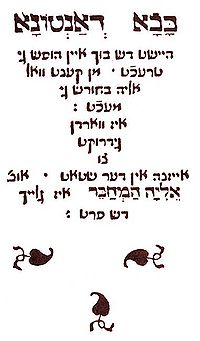 Yiddish literature began with translations of and commentary on religious text
s. (See article on the Yiddish language
for a full description of these texts). The most important writer of old Yiddish literature was Elijah Levita
(known as Elye Bokher) who translated and adapted the chivalric romance of Bevis of Hampton
, via its Italian version, Buovo d’Antona. Levita’s version, called Bovo d'Antona, and later known with the title Bovo-bukh
, was circulated in manuscript from 1507, then published in Isny (Germany) in 1541. This work illustrates the influence of European literary forms on emerging Yiddish literature, not only in its subject but in the form of its stanzas and rhyme scheme
, an adaptation of Italian ottava rima. Nonetheless, Levita altered many features of the story to reflect Judaic elements, though they rest uneasily with the essentially Christian nature of chivalry. (For a discussion of the tension between Christian and Jewish elements in the Bovo-bukh, see chapter two of Michael Wex
’s Born to Kvetch
.)
A number of Yiddish epic poems appeared in the 14-15th centuries. The most important works of this genres are Shmuel-Bukh
and Mlokhim-Bukh
- chivalric romances about king David
and other Biblical heroes. The stanzaic form of these poems resembles that of the Niebelungenlied. Following the example of other European epics, [Shmuel-Bukh] was not simply recited, but sung or chanted to musical accompaniment; its melody was widely known in Jewish communities.
Far from being rhymed adaptations of the Bible, these old Yiddish epic poems fused the Biblical and Midrash
ic material with the European courtly poetry, thus creating an Ashkenazic national epic, comparable to the Niebelungenlied and The Song of Roland
.
Another influential work of old Yiddish literature is the Mayse-bukh (“Story Book”). This work collects ethical tales based on Hebrew and rabbinic sources, as well as folk tales
and legends. Based on the inclusion of a few non-Jewish
stories, scholars have deduced that the compiler lived in the area that is now western Germany during the last third of the 16th century. It was first published in 1602. These instructional stories are still read in highly religious communities, especially among the Hasidim
.
A commentary written for women on the weekly parashot by Rabbi Jacob ben Isaac Ashkenazi
in 1616, the Tseno Ureno
(צאנה וראינה), remains a ubiquitous book in Yiddish homes to this day.
Women wrote old Yiddish literature infrequently, but several collections of tkhines (personal prayers which are not part of liturgy) were written by women such as Sara Bas-Tovim
and Sarah Rebekah Rachel Leah Horowitz, both in the 18th century. The most extensive text by a woman from this era is the memoir of the 17th-18th century Glikl of Hameln
, a family document that was not published until 1896.
were hagiographic stories venerating its leadership
. This gave storytelling a new centrality in Rabbinic Judaism
as a form of worship, and spread the movement's appeal. These anecdotal or miraculous stories personified new Hasidic doctrines of the saintly intermediary, Divine Omnipresence, and the hidden value
of the common folk. As one master related of his visit to Dov Ber of Mezeritch, "I went to see how the Maggid tied up his shoelaces". A story of the Baal Shem Tov, Hasidic founder, represents this:
As Hebrew was reserved for Torah study and prayer, the vernacular Yiddish stories of different masters were compiled in Yiddish or Hebrew writing, beginning with "Shivchei HaBesht"-"In Praise of the Baal Shem Tov" (1815 Yiddish translation from Hebrew compilation of 1814). In the 20th century Martin Buber
publicised Hasidism to the secular world through its stories, mediated through his own Neo-Hasidic philosophy
. Previous Kabbalistic themes, accepted without emphasis in Hasidism, entered Eastern European Jewish folklore
in tales of reincarnation
and possession
, and were commonly adapted by later secular Yiddish writers. Meanwhile, the mysticism of Hasidism as well as the culture of wider
traditional Judaism, were parodied by Haskalah Yiddish literature.
 Within the works of Hasidic philosophy
, another storytelling form was used - insightful parables to illustrate its new mystical interpretations. The Baal Shem Tov used short, soulful analogies, alluded teachings and encouraging anecdotes in first reaching out to revive the common folk, while parables of other masters were integrated within their classic works of Hasidic thought. The distinct parables of Nachman of Breslov
comprise a complete literary form that stand alone with their own commentary, in Yiddish original and Hebrew translation. In one example of former Hasidic parable, the Baal Shem Tov explained the mystical meaning of blowing the ram's horn
on the New Year:
Rabbi Nachman’s 13 Sippurei Ma'asiyot Wonder-Tales of 1816 take mystical parable to a self contained literary purpose and art. Where the analogies of other masters have direct messages, Rabbi Nachman's imaginative, intricate tales, that can involve stories within stories, offer layered mystical
and devotional commentaries
, or literary readings. Rabbi Nachman alluded to some meanings when he orally told each tale in Yiddish. He saw their roots in ancient Aggadic
mystical articulation, by saying that this concealed form was how Kabbalah was taught orally before Shimon bar Yochai explained it, though the Tales are unique in Rabbinic literature
. He took to storytelling as redemptive activity once other paths had been blocked, such as the death of his son in whom he saw Messianic potential; "the time has come to tell stories", he said. Rabbi Nachman saw his role as innovative, and his teachings focus on the redemptive scheme of rectification
:
The thirteenth tale, "The Seven Beggars", is the most intricate. The story told on the seventh day is missing and Rabbi Nachman said that it would only be known when the Messiah
comes. The Tales, documented in Yiddish with Hebrew translation by Nathan of Breslov
, amongst other Hasidic storytelling have had the strongest effect on the development of Yiddish literature.
. This movement was influenced by the Enlightenment
and opposed superstition in religious life and the antiquated education given to most Jews. They proposed better integration into European culture and society, and were strong opponents of Hasidism. Writers who used their craft to expound this view were Israel Aksenfeld
, Solomon (or Shloyme) Ettinger
and Isaac Meir Dik. Aksenfeld was at first a follower of Reb Nachman of Bratslav, but later abandoned Hasidism and became a strong opponent of it. His novel Dos shterntikhl (“The head-scarf”), published in 1861, portrays the Hasidic world as intolerant and small-minded. Only five of his works were published because of opposition from Hasidic leaders. His work is realist and shows the influence of 19th century Russian literature
. Ettinger was a physician who wrote plays, including what is considered the most important of the Haskalah era, “Serkele.” His satiric style shows the influence of European drama: one scholar speculates that he read Molière
. Dik (1808–1893) wrote short stories
which sold tens of thousands of copies in book form. His role in literary development is as significant for creating a readership for Yiddish as for the content of his work, which tends to the didactic. He also wrote in Hebrew, including the outstanding Talmud
ic parody, “Masseket Aniyyut” (“Tractate Poverty”).
’s novel Dos kleyne mentshele ("The Little Person"). Abramovitsh had previously written in Hebrew, the language in which many proponents of the Haskalah communicated with each other, until this publication. With this novel, originally published serially in a Yiddish newspaper, Abramovitsh introduced his alter ego
, the character of Mendele Moykher Sforim ("Mendel the Book Peddler"), the character who narrates this and many succeeding stories. Abramovitsh himself is often known by this name, and it appears as the "author" on several of his books, producing a complex set of relations between the author, the persona and the readership which has been explored most thoroughly by Dan Miron. Abramovitsh’s work is ironic and sharp, while maintaining the voice of a folksy narrator. His work critiques corruption inside the Jewish community and that imposed on it from Russian and Polish governing institutions. He also continues the tradition of Haskalah literature with his attack on superstition and outmoded traditions such as arranged marriage
. His extraordinary parody of the picaresque
, Kitser masoes Binyomen hashlishi ("The Brief Travels of Benjamin the Third"), published in 1878, was his last great work and provides one of his strongest critiques of Jewish life in the Pale of Settlement
.
Abramovitsh’s influence lay in two factors. First, he wrote in Yiddish at a time when most Jewish thinkers tended to Hebrew or a non-Jewish language such as German. Secondly, as Dan Miron demonstrates, Abramovitsh brought Yiddish belles lettres firmly into the modern era through the use of rhetorical strategies that allowed his social reform agenda to be expressed at the highest level of literary and artistic achievement. The outpouring of Yiddish literature in modernist forms that followed Abramovitsh demonstrates how important this development was in giving voice to Jewish aspirations, both social and literary. The most important of the early writers to follow Abramovitsh were Sholem Rabinovitsh, popularly known by his alter-ego, Sholem Aleichem, and I. L. Peretz. Rabinovitsh’s best-known works are the stories centering on the character Tevye the Dairyman
. Written over many years and in response to the variety of Jewish catastrophes of the late 19th and early 20th centuries, the stories epitomize Rabinovitsh's style, including his signature style of "laughter through tears". I. L. Peretz brought into Yiddish a wide array of modernist techniques he encountered in his reading of European fiction. While himself politically radical, particularly during the 1890s, his fiction is enormously nuanced and allows multiple readings. His work is both simple and caustic, more psychological and more individualistic than Abramovitsh or Rabinovitsh’s. For these reasons, he is considered the first true modernist in Yiddish literature. He wrote primarily stories of which "Bontshe shvayg" (Bontshe the Silent) is one of his best known. As with much of his work, it manages to convey two apparently opposing messages: sympathy for the oppressed with critique of passivity as a response to oppression.
Together, Abramovitsh, Rabinovitsh and I. L. Peretz are usually referred to as the three "classic" Yiddish writers ("di klasiker" in Yiddish). They are also nickednamed respectively the "grandfather", the "father" and the "son" of Yiddish literature. This formulation erases the fact that they were all roughly contemporaneous and are best understood as a single phenomenon rather than as distinct generational manifestations of a tradition. Nonetheless, this formulation was propounded by the classic writers themselves, perhaps as a means of investing their fledgling literary culture with a lineage that could stand up to other world literatures they admired.
, and Jacob Gordin
. Much of what was presented on the Yiddish stage were translations from European repertoire, and as a result much of the earliest original writing in Yiddish owes as much to German theatre as to the classic Yiddish writers.
While the three classic writers were still at their height, the first true movement in modern Yiddish literature sprang up in New York. The “Sweatshop Poets,” as this school has come to be called, were all immigrant workers who experienced first hand
the inhumane working conditions in the factories of their day. The leading members of this group were Morris Rosenfeld
, Morris Winchevsky
, David Edelstadt
and Joseph Bovshover. Their work centers on the subject of proletarian oppression and struggle, and uses the styles of Victorian verse, producing a rhetoric that is highly stylized. As a result it is little read or understood today. Simultaneously in Warsaw
a group of writers centered around I. L. Peretz took Yiddish to another level of modern experimentation; they included David Pinski
, S. Ansky
, Sholem Asch
and I.M. Weissenberg. A later Warsaw group, “Di Khalyastre” (“The Gang”) included notables such as Israel Joshua Singer, Peretz Hirshbein
, Melech Ravitch and Uri Zvi Grinberg (who went on to write most of his work in Hebrew). Like their New York counterpart, the group called “Di Yunge” (“The Young Ones”), they broke with earlier Yiddish writers and attempted to free Yiddish writing, particularly verse, from its preoccupation with politics and the fate of the Jews. Prominent members of Di Yunge included Mani Leib
, Moyshe-Leyb Halpern
, H.Leivick, Zishe Landau and the prose writers David Ignatoff, Lamed Shapiro
and Isaac Raboy. Just a few years after Di Yunge came into prominence, a group called “In Zikh” (“Introspection”) declared itself the true avant garde, rejecting metered verse and declaring that non-Jewish themes were a valid topic for Yiddish poetry. The most important member of this group was Yankev Glatshteyn
. Glatshteyn was interested in exotic themes, in poems that emphasized the sound of words, and later, as the Holocaust loomed and then took place, in reappropriations of Jewish tradition. His poem, “A gute nakht, velt” (“Good Night, World,” 1938) seems to foresee the tragedy on the horizon in Eastern Europe. In Vilnius, Lithuania (called Vilna or Vilne by its Jewish inhabitants, and one of the most historically significant centers of Yiddish cultural activity), the group “Yung Vilne” (“Young Vilna”) included Chaim Grade
, Abraham Sutzkever
and Szmerke Kaczerginski. Grade’s short story “Mayn krig mit Hersh Raseyner” (“My Quarrel With Hershl Rasseyner”) is one of the classic post-Holocaust Yiddish stories, encapsulating the philosophical dilemma faced by many survivors. Sutzkever went on to be one of major poets of the 20th century.
During the radical turn of the 1930s, a group of writers clustered around the U. S. Communist Party came to be known as “Di Linke” (“The Left Wing”). This group included Moishe Nadir, Malke Lee and Ber Grin. In Canada, a similar group was known as the Proletariat school of writers, exemplified by Yudica. In the Soviet Union
, Yiddish literature underwent a dramatic flowering, with such greats as David Bergelson
, Der Nister
, Peretz Markish
and Moyshe Kulbak
. Several of these writers were murdered during a Stalinist purge known as the Night of the Murdered Poets
(August 12–13, 1952), including Itzik Fefer and Leib Kvitko
. Bergelson is considered by many an underrated genius whose work in the modernist novel may be among the most interesting examples of the form. Important Soviet writers who escaped persecution include Moyshe Altman
, Ikhil Shraybman, Note Lurie, Elye Shekhtman, Shike Driz, Rivke Rubin, Shira Gorshman
, and others. There appears to have been no rhyme or reason to explain why certain writers were not persecuted, as all these writers pursued similar themes in their writing and participated in similar groupings of Jewish intellectuals.
An interesting feature of Yiddish literature in its most active years (1900–1940) is the presence of numerous women writers who were less involved in specific movements or tied to a particular artistic ideology. Writers such as Celia Dropkin
, Anna Margolin
, Kadya Molodowsky, Esther Kreitman
and Esther Shumiatcher Hirschbein created bodies of work that do not fit easily into a particular category and which are often experimental in form or subject matter. Margolin’s work pioneered the use of assonance
and consonance
in Yiddish verse. She preferred off-rhymes to true rhymes. Dropkin introduced a highly charged erotic vocabulary and shows the influence of 19th century Russian poetry. Kreitman, the sister of I. J.
and I. B. Singer
, wrote novels and short stories, many of which were sharply critical of gender inequality
in traditional Jewish life.
Certain male writers also did not associate with a particular literary group, or did so for a short time before moving on to other creative ethics. Among these were Itzik Manger
, whose clever re-imaginings of Biblical and other Jewish stories are accessible and playful but deeply intellectual. Other writers in this category are Joseph Opatoshu
, I. B. Singer
(who is always called “Bashevis” in Yiddish to distinguish him from his older brother), I. J. Singer
and Aaron Zeitlin
.
Many of the writers mentioned above who wrote during and after the 1940s responded to the Holocaust in their literary works—some wrote poetry and stories while in ghettos, concentration camps, and partisan groups, and many continued to address the Holocaust and its aftereffects in their subsequent writing. Yiddish writers known best for their writings about the Holocaust include Yitzhak Katzenelson
, Y. Shpigl, and Katsetnik
.
to Isaac Bashevis Singer
in 1978
helped cement his reputation as one of the great writers of world literature. Many readers of Yiddish, however, are convinced that there are many finer writers among Yiddish literature, including his brother. Chaim Grade
believed himself overlooked by the English-speaking world. Cynthia Ozick
’s short story “Envy; or, Yiddish in America” implies a similar emotion on the part of a Yiddish poet, generally taken to be based on Yankev Glatshteyn. Some Yiddish critics complained of the excessive sex and superstition in Singer’s work, which they felt brought Yiddish literature in general into disrepute. In addition, Singer’s habit of presenting himself to the American press as the last or only Yiddish writer was irksome to the dozens of writers still living and working at the time. But in spite of these squabbles (some of which continue to be perpetrated years after the death of the protagonists), most scholars of Yiddish today would agree that the awarding of the Nobel Prize to Singer brought an unprecedented amount of attention to Yiddish literature, and has served to heighten interest in the field generally. Many scholars believe it to be a justified prize on the basis of the part of Singer’s oeuvre that is available in translation, which represents his most accomplished works.
, Simcha Simchovitch, and Grunia Slutzky-Kohn; the Israeli writers including Tzvi Ayznman, Aleksander Shpiglblat, Rivke Basman Ben-Hayim, Yitzkhok Luden, Mishe Lev
, Yente Mash, Tzvi Kanar, Elisheva Kohen-Tsedek and Lev Berinsky; and American poet-songwriter Beyle Schaechter-Gottesman
and poets and prose masters Yonia Fain and Moyshe Szklar (editor of the Los Angeles Yiddish literary periodical Khezhbn) as well as the prolific feuilletonist and playwright Miriam Hoffman
. Writers of the "younger" postwar born generation comprising those born in the late 1940s, 1950s, 1960s (many hailing from the former Soviet Union) include Alexander Belousov (1948–2004), Mikhoel Felsenbaum
, Daniel Galay, Moyshe Lemster, Boris Sandler (current editor of the Yiddish "Forverts" edition of The Forward
), Velvl Chernin, Zisye Veytsman, Heershadovid Menkes (pen name of Dovid Katz
), and Boris Karloff (pen name of Dov-Ber Kerler, editor of "Yerusholaymer Almanakh"). A younger generation of writers who began to come to the fore in the 21st century includes poets Gitl Schaechter-Viswanath
, Yermiyahu Ahron Taub and Yoel Matveyev in the US, Yisroel Nekrasov in Saint Petersburg, Haike Beruriah Wiegand in London, Thomas Soxberger in Vienna, and the prose writers Boris Kotlerman in Israel and Gilles Rozier (editor of "Gilgulim") in Paris. The earlier works of some of the younger generation authors were collected in the anthology "Vidervuks" (regrowth), published in 1989. Recent works of many of contemporary authors appeared in 2008 in Paris (Gilgulim: naye shafungen) and Jerusalem (Yerusholaymer Almanakh). The poet Irena Klepfisz
hails from Poland; she now teaches at Barnard
.
A new generation of Yiddish writers has emerged from the Hasidic and Haredi movements of contemporary Orthodoxy. The author known only by the pseudonym Katle Kanye writes blistering satire of current halakhic literature as well as poetry and thoughtful commentary on Hasidic life. Another example of a Haredi Yiddish blog-writer is Naturlich. Spy thrillers in Yiddish have become a popular genre within Hasidic communities.
European literatures have had a strong influence on Yiddish literature, but until the late 20th century there was little return flow into English, except through bilingual writers who chose to write in English, such as Anzia Yezierska
and Ab Cahan
. Currently, many young writers with little knowledge of Yiddish have been influenced by Yiddish literature in translation, such as Nathan Englander
and Jonathan Safran Foer
. An exception is Dara Horn
, who has studied both Yiddish and Hebrew and draws on both of these traditions in her English-language novels.
The last Yiddish language writers in the former Soviet Union are Aleksandr Bejderman in Odessa and Yoysef Burg in Chernivtsi.
2. Zeitgenössische jiddische Lyrik Odessaer Autoren
Steinhoff, Thorsten. - [Regensburg] : [Lehrstuhl für Neuere Dt. Literaturwiss. I der Univ.], [1996], Als Ms. gedr.
Yiddish language
Yiddish is a High German language of Ashkenazi Jewish origin, spoken throughout the world. It developed as a fusion of German dialects with Hebrew, Aramaic, Slavic languages and traces of Romance languages...
, the language of Ashkenazic Jewry which is related to Middle High German
Middle High German
Middle High German , abbreviated MHG , is the term used for the period in the history of the German language between 1050 and 1350. It is preceded by Old High German and followed by Early New High German...
. The history of Yiddish, with its roots in central Europe
Central Europe
Central Europe or alternatively Middle Europe is a region of the European continent lying between the variously defined areas of Eastern and Western Europe...
and locus for centuries in Eastern Europe
Eastern Europe
Eastern Europe is the eastern part of Europe. The term has widely disparate geopolitical, geographical, cultural and socioeconomic readings, which makes it highly context-dependent and even volatile, and there are "almost as many definitions of Eastern Europe as there are scholars of the region"...
, is evident in its literature.
It is generally described as having three historical phases: Old Yiddish literature; Haskalah and Hasidic literature; and modern Yiddish literature. While firm dates for these periods are hard to pin down, Old Yiddish can be said to have existed roughly from 1300 to 1780; Haskalah
Haskalah
Haskalah , the Jewish Enlightenment, was a movement among European Jews in the 18th–19th centuries that advocated adopting enlightenment values, pressing for better integration into European society, and increasing education in secular studies, Hebrew language, and Jewish history...
and Hasidic
Hasidic Judaism
Hasidic Judaism or Hasidism, from the Hebrew —Ḥasidut in Sephardi, Chasidus in Ashkenazi, meaning "piety" , is a branch of Orthodox Judaism that promotes spirituality and joy through the popularisation and internalisation of Jewish mysticism as the fundamental aspects of the Jewish faith...
literature from 1780 to about 1890; and modern Yiddish literature from 1864 to the present.
Old Yiddish literature
Religious text
Religious texts, also known as scripture, scriptures, holy writ, or holy books, are the texts which various religious traditions consider to be sacred, or of central importance to their religious tradition...
s. (See article on the Yiddish language
Yiddish language
Yiddish is a High German language of Ashkenazi Jewish origin, spoken throughout the world. It developed as a fusion of German dialects with Hebrew, Aramaic, Slavic languages and traces of Romance languages...
for a full description of these texts). The most important writer of old Yiddish literature was Elijah Levita
Elia Levita
Elia Levita , also known as Elijah Levita, Elias Levita, Élie Lévita, Eliahu Bakhur was a Renaissance Hebrew grammarian, scholar and poet. He was influential in helping to create the Yiddish language...
(known as Elye Bokher) who translated and adapted the chivalric romance of Bevis of Hampton
Bevis of Hampton
Bevis of Hampton is a legendary English hero and the subject of Anglo-Norman, French, English, Venetian and other medieval metrical romances that bear his name...
, via its Italian version, Buovo d’Antona. Levita’s version, called Bovo d'Antona, and later known with the title Bovo-bukh
Bovo-Bukh
The Bovo-Bukh , written in 1507–1508 by Elia Levita, was the most popular chivalric romance in the Yiddish language. It was first printed in 1541, being the first non-religious book to be printed in Yiddish. For five centuries, it endured at least 40 editions...
, was circulated in manuscript from 1507, then published in Isny (Germany) in 1541. This work illustrates the influence of European literary forms on emerging Yiddish literature, not only in its subject but in the form of its stanzas and rhyme scheme
Rhyme scheme
A rhyme scheme is the pattern of rhyme between lines of a poem or song. It is usually referred to by using letters to indicate which lines rhyme. In other words, it is the pattern of end rhymes or lines...
, an adaptation of Italian ottava rima. Nonetheless, Levita altered many features of the story to reflect Judaic elements, though they rest uneasily with the essentially Christian nature of chivalry. (For a discussion of the tension between Christian and Jewish elements in the Bovo-bukh, see chapter two of Michael Wex
Michael Wex
Michael Wex is a Canadian novelist, playwright, translator, lecturer, performer, and author of books on language and literature. His specialty is Yiddish and his book Born to Kvetch was a surprise bestseller in 2005...
’s Born to Kvetch
Born to Kvetch
Born to Kvetch: Yiddish Language and Culture in All Its Moods is a 2005 book by Michael Wex devoted to Yiddish. In this book, "Wex is a rare combination of Jewish comic and scholarly cultural analyst"....
.)
A number of Yiddish epic poems appeared in the 14-15th centuries. The most important works of this genres are Shmuel-Bukh
Shmuel-Bukh
The Shmuel-Bukh is a religious verse epic written in Yiddish. Composed no later than the second half of the 15th century and widely circulated in manuscript, it was first printed in Augsburg in 1544. Its stanzaic form resembles that of the Nibelungenlied, and its hero is the biblical David...
and Mlokhim-Bukh
Mlokhim-Bukh
The Mlokhim-Bukh is a Yiddish religious verse epic by an unknown author, which recounts the monarchy of Solomon and the ancient history of the Hebrews up to the Babylonian Captivity. The oldest surviving fragment is dated to 1519-1525, though the poem is probably older...
- chivalric romances about king David
David
David was the second king of the united Kingdom of Israel according to the Hebrew Bible and, according to the Gospels of Matthew and Luke, an ancestor of Jesus Christ through both Saint Joseph and Mary...
and other Biblical heroes. The stanzaic form of these poems resembles that of the Niebelungenlied. Following the example of other European epics, [Shmuel-Bukh] was not simply recited, but sung or chanted to musical accompaniment; its melody was widely known in Jewish communities.
Far from being rhymed adaptations of the Bible, these old Yiddish epic poems fused the Biblical and Midrash
Midrash
The Hebrew term Midrash is a homiletic method of biblical exegesis. The term also refers to the whole compilation of homiletic teachings on the Bible....
ic material with the European courtly poetry, thus creating an Ashkenazic national epic, comparable to the Niebelungenlied and The Song of Roland
The Song of Roland
The Song of Roland is the oldest surviving major work of French literature. It exists in various manuscript versions which testify to its enormous and enduring popularity in the 12th to 14th centuries...
.
Another influential work of old Yiddish literature is the Mayse-bukh (“Story Book”). This work collects ethical tales based on Hebrew and rabbinic sources, as well as folk tales
Folklore
Folklore consists of legends, music, oral history, proverbs, jokes, popular beliefs, fairy tales and customs that are the traditions of a culture, subculture, or group. It is also the set of practices through which those expressive genres are shared. The study of folklore is sometimes called...
and legends. Based on the inclusion of a few non-Jewish
Gentile
The term Gentile refers to non-Israelite peoples or nations in English translations of the Bible....
stories, scholars have deduced that the compiler lived in the area that is now western Germany during the last third of the 16th century. It was first published in 1602. These instructional stories are still read in highly religious communities, especially among the Hasidim
Hasidic Judaism
Hasidic Judaism or Hasidism, from the Hebrew —Ḥasidut in Sephardi, Chasidus in Ashkenazi, meaning "piety" , is a branch of Orthodox Judaism that promotes spirituality and joy through the popularisation and internalisation of Jewish mysticism as the fundamental aspects of the Jewish faith...
.
A commentary written for women on the weekly parashot by Rabbi Jacob ben Isaac Ashkenazi
Jacob ben Isaac Ashkenazi
Rabbi Jacob ben Isaac Ashkenazi , of Janów , was the author of the Tseno Ureno, sometimes called the "Women's Bible", a 1616 Yiddish-language prose work whose structure parallels the weekly portions of the Pentateuch and Haftorahs used in Shabbat services.He also authored a supplement, the Melitz...
in 1616, the Tseno Ureno
Tseno Ureno
The Tseno Ureno , sometimes called the Women's Bible, was a 1616 Yiddish-language prose work whose structure parallels the weekly portions of the Pentateuch and Haftorahs used in Jewish worship services...
(צאנה וראינה), remains a ubiquitous book in Yiddish homes to this day.
Women wrote old Yiddish literature infrequently, but several collections of tkhines (personal prayers which are not part of liturgy) were written by women such as Sara Bas-Tovim
Sarah Bas Tovim
Sarah Bas Tovim was a Ukrainian Jew, author of Shloshe Shearim the most widely circulated of the tkhines, Yiddish-language prayer booklets intended mainly for Jewish women. [Liptzin, 1972, 16]Born in the small town of Satanov in the Podolia region of Ukraine, she claimed descent from Rabbi...
and Sarah Rebekah Rachel Leah Horowitz, both in the 18th century. The most extensive text by a woman from this era is the memoir of the 17th-18th century Glikl of Hameln
Glückel of Hameln
Glückel of Hameln was a Jewish businesswoman and diarist, whose account of life provides scholars with an intimate picture of German Jewish communal life in the late-17th-early eighteenth century Jewish ghetto...
, a family document that was not published until 1896.
Hasidic Stories
The rise of Hasidic popular mysticism in the 18th century gave rise to a specific kind of literary work. Alongside its scholarly thoughtHasidic philosophy
Hasidic philosophy or Hasidus , alternatively transliterated as Hassidism, Chassidism, Chassidut etc. is the teachings, interpretations of Judaism, and mysticism articulated by the modern Hasidic movement...
were hagiographic stories venerating its leadership
Rebbe
Rebbe , which means master, teacher, or mentor, is a Yiddish word derived from the Hebrew word Rabbi. It often refers to the leader of a Hasidic Jewish movement...
. This gave storytelling a new centrality in Rabbinic Judaism
Rabbinic Judaism
Rabbinic Judaism or Rabbinism has been the mainstream form of Judaism since the 6th century CE, after the codification of the Talmud...
as a form of worship, and spread the movement's appeal. These anecdotal or miraculous stories personified new Hasidic doctrines of the saintly intermediary, Divine Omnipresence, and the hidden value
Jewish meditation
Jewish meditation can refer to several traditional practices of contemplation, ranging from visualization and intuitive methods, or forms of emotional insight in communitive prayer, to intellectual analysis of philosophical, ethical or mystical concepts...
of the common folk. As one master related of his visit to Dov Ber of Mezeritch, "I went to see how the Maggid tied up his shoelaces". A story of the Baal Shem Tov, Hasidic founder, represents this:
The saintly prayers of the Baal Shem Tov and his close circle were unable to lift a harsh Heavenly decree they perceived one New YearRosh HashanahRosh Hashanah , , is the Jewish New Year. It is the first of the High Holy Days or Yamim Nora'im which occur in the autumn...
. After extending the prayers beyond time, the danger remained. An unlettered shephard boy entered and was deeply envious of those who could read the holy day's prayers. He said to God "I don't know how to pray, but I can make the noises of the animals of the field." With great feeling he cried out, "Cock-a-doodle-do, God have mercy!" Immediately, joy overcame the Baal Shem Tov and he hurried to finish the prayers. Afterwards, he explained that the heartfelt words of the shephard boy opened the Gates of Heaven, and the decree was lifted.
As Hebrew was reserved for Torah study and prayer, the vernacular Yiddish stories of different masters were compiled in Yiddish or Hebrew writing, beginning with "Shivchei HaBesht"-"In Praise of the Baal Shem Tov" (1815 Yiddish translation from Hebrew compilation of 1814). In the 20th century Martin Buber
Martin Buber
Martin Buber was an Austrian-born Jewish philosopher best known for his philosophy of dialogue, a form of religious existentialism centered on the distinction between the I-Thou relationship and the I-It relationship....
publicised Hasidism to the secular world through its stories, mediated through his own Neo-Hasidic philosophy
Jewish existentialism
Jewish existentialism is a category of work by Jewish authors dealing with existentialist themes and concepts , and intended to answer theological questions that are important in Judaism. The existential angst of Job is an example from the Hebrew Bible of the existentialist theme...
. Previous Kabbalistic themes, accepted without emphasis in Hasidism, entered Eastern European Jewish folklore
Folklore
Folklore consists of legends, music, oral history, proverbs, jokes, popular beliefs, fairy tales and customs that are the traditions of a culture, subculture, or group. It is also the set of practices through which those expressive genres are shared. The study of folklore is sometimes called...
in tales of reincarnation
Gilgul
Gilgul/Gilgul neshamot/Gilgulei Ha Neshamot describes a Kabbalistic concept of reincarnation. In Hebrew, the word gilgul means "cycle" and neshamot is the plural for "souls." Souls are seen to "cycle" through "lives" or "incarnations", being attached to different human bodies over time...
and possession
Dybbuk
In Jewish folklore, a dybbuk is a malicious or malevolent possessing spirit believed to be the dislocated soul of a dead person.Dybbuks are said to have escaped from Sheol or to have been turned away for serious transgressions, such as suicide, for which the soul is denied entry...
, and were commonly adapted by later secular Yiddish writers. Meanwhile, the mysticism of Hasidism as well as the culture of wider
Misnagdim
Misnagdim or Mitnagdim is a Hebrew word meaning "opponents". It is the plural of misnaged or mitnaged. Most prominent among the Misnagdim was Rabbi Elijah ben Shlomo Zalman , commonly known as the Vilna Gaon or the Gra...
traditional Judaism, were parodied by Haskalah Yiddish literature.
Hasidic Parables
Hasidic philosophy
Hasidic philosophy or Hasidus , alternatively transliterated as Hassidism, Chassidism, Chassidut etc. is the teachings, interpretations of Judaism, and mysticism articulated by the modern Hasidic movement...
, another storytelling form was used - insightful parables to illustrate its new mystical interpretations. The Baal Shem Tov used short, soulful analogies, alluded teachings and encouraging anecdotes in first reaching out to revive the common folk, while parables of other masters were integrated within their classic works of Hasidic thought. The distinct parables of Nachman of Breslov
Nachman of Breslov
Nachman of Breslov , also known as Reb Nachman of Bratslav, Reb Nachman Breslover , Nachman from Uman , was the founder of the Breslov Hasidic movement....
comprise a complete literary form that stand alone with their own commentary, in Yiddish original and Hebrew translation. In one example of former Hasidic parable, the Baal Shem Tov explained the mystical meaning of blowing the ram's horn
Shofar
A shofar is a horn, traditionally that of a ram, used for Jewish religious purposes. Shofar-blowing is incorporated in synagogue services on Rosh Hashanah and Yom Kippur.Shofar come in a variety of sizes.- Bible and rabbinic literature :...
on the New Year:
A King sent his son away from the palace to learn new skills. Regretably, the son lost his royal ways, and forgot his home tongue. After years in exile he remembered his true calling, and desired to return to the palace. Upon approaching the gates, the guards no longer recognised the King's son and refused him entry. At that moment the King appeared on the balcony and saw the commotion of the son at the gates, but also did not recognise his son who now appeared in peasant clothing. In distress, as the son could no longer remember the royal language, he cried out a heartfelt wordless call from his soul. Immediately, the King recognised his voice and delighted in being reunited with his son.
Rabbi Nachman’s 13 Sippurei Ma'asiyot Wonder-Tales of 1816 take mystical parable to a self contained literary purpose and art. Where the analogies of other masters have direct messages, Rabbi Nachman's imaginative, intricate tales, that can involve stories within stories, offer layered mystical
Kabbalah
Kabbalah/Kabala is a discipline and school of thought concerned with the esoteric aspect of Rabbinic Judaism. It was systematized in 11th-13th century Hachmei Provence and Spain, and again after the Expulsion from Spain, in 16th century Ottoman Palestine...
and devotional commentaries
Pardes (Jewish exegesis)
Pardes refers to approaches to biblical exegesis in rabbinic Judaism . The term, sometimes also spelled PaRDeS, is an acronym formed from the name initials of the following four approaches:...
, or literary readings. Rabbi Nachman alluded to some meanings when he orally told each tale in Yiddish. He saw their roots in ancient Aggadic
Aggadah
Aggadah refers to the homiletic and non-legalistic exegetical texts in the classical rabbinic literature of Judaism, particularly as recorded in the Talmud and Midrash...
mystical articulation, by saying that this concealed form was how Kabbalah was taught orally before Shimon bar Yochai explained it, though the Tales are unique in Rabbinic literature
Rabbinic literature
Rabbinic literature, in its broadest sense, can mean the entire spectrum of rabbinic writings throughout Jewish history. However, the term often refers specifically to literature from the Talmudic era, as opposed to medieval and modern rabbinic writing, and thus corresponds with the Hebrew term...
. He took to storytelling as redemptive activity once other paths had been blocked, such as the death of his son in whom he saw Messianic potential; "the time has come to tell stories", he said. Rabbi Nachman saw his role as innovative, and his teachings focus on the redemptive scheme of rectification
Tikkun
Tikkun/Tikun is a Hebrew word meaning "Fixing/Rectification". It has several connotations in Judaism:Traditional:*Tikkun , a book of Torah scroll text, used when learning to chant Torah portions or for correct-fixed scribal calligraphy...
:
"In the tales told by the Nations of the World are hidden sparks of holiness, but the tales are confused and spiritually out of order, so that the sparks remain hidden."
The thirteenth tale, "The Seven Beggars", is the most intricate. The story told on the seventh day is missing and Rabbi Nachman said that it would only be known when the Messiah
Jewish Messiah
Messiah, ; mashiah, moshiah, mashiach, or moshiach, is a term used in the Hebrew Bible to describe priests and kings, who were traditionally anointed with holy anointing oil as described in Exodus 30:22-25...
comes. The Tales, documented in Yiddish with Hebrew translation by Nathan of Breslov
Nathan of Breslov
Nathan of Breslov , also known as Reb Noson, born Nathan Sternhartz, was the chief disciple and scribe of Rebbe Nachman of Breslov, founder of the Breslov Hasidic dynasty. Reb Noson is credited with preserving, promoting and expanding the Breslov movement after the Rebbe's death...
, amongst other Hasidic storytelling have had the strongest effect on the development of Yiddish literature.
Haskalah
During the same years as the emergence of Hasidism, the most influential secular movement of Jews also appeared in the form of the HaskalahHaskalah
Haskalah , the Jewish Enlightenment, was a movement among European Jews in the 18th–19th centuries that advocated adopting enlightenment values, pressing for better integration into European society, and increasing education in secular studies, Hebrew language, and Jewish history...
. This movement was influenced by the Enlightenment
Age of Enlightenment
The Age of Enlightenment was an elite cultural movement of intellectuals in 18th century Europe that sought to mobilize the power of reason in order to reform society and advance knowledge. It promoted intellectual interchange and opposed intolerance and abuses in church and state...
and opposed superstition in religious life and the antiquated education given to most Jews. They proposed better integration into European culture and society, and were strong opponents of Hasidism. Writers who used their craft to expound this view were Israel Aksenfeld
Israel Aksenfeld
Israel Aksenfeld was a Judæo-German writer. Although he spoke other languages perfectly , he chose to write in Yiddish...
, Solomon (or Shloyme) Ettinger
Solomon Ettinger
Solomon Ettinger was a 19th century Yiddish- and Hebrew-language playwright, poet and writer of songs and fables whose emblematic play Serkele has remained a classic of the Yiddish theatre. His given name has appeared variously as Salomon or Shlomo or Shloyme and his family name has also been...
and Isaac Meir Dik. Aksenfeld was at first a follower of Reb Nachman of Bratslav, but later abandoned Hasidism and became a strong opponent of it. His novel Dos shterntikhl (“The head-scarf”), published in 1861, portrays the Hasidic world as intolerant and small-minded. Only five of his works were published because of opposition from Hasidic leaders. His work is realist and shows the influence of 19th century Russian literature
Russian literature
Russian literature refers to the literature of Russia or its émigrés, and to the Russian-language literature of several independent nations once a part of what was historically Russia or the Soviet Union...
. Ettinger was a physician who wrote plays, including what is considered the most important of the Haskalah era, “Serkele.” His satiric style shows the influence of European drama: one scholar speculates that he read Molière
Molière
Jean-Baptiste Poquelin, known by his stage name Molière, was a French playwright and actor who is considered to be one of the greatest masters of comedy in Western literature...
. Dik (1808–1893) wrote short stories
Short story
A short story is a work of fiction that is usually written in prose, often in narrative format. This format tends to be more pointed than longer works of fiction, such as novellas and novels. Short story definitions based on length differ somewhat, even among professional writers, in part because...
which sold tens of thousands of copies in book form. His role in literary development is as significant for creating a readership for Yiddish as for the content of his work, which tends to the didactic. He also wrote in Hebrew, including the outstanding Talmud
Talmud
The Talmud is a central text of mainstream Judaism. It takes the form of a record of rabbinic discussions pertaining to Jewish law, ethics, philosophy, customs and history....
ic parody, “Masseket Aniyyut” (“Tractate Poverty”).
The classic Yiddish writers
Modern Yiddish literature is generally dated to the publication in 1864 of Sholem Yankev AbramovitshMendele Mocher Sforim
Mendele Mocher Sforim , December 21, 1835 = January 2, 1836 , Kapyl — November 25, 1917 = December 8, 1917...
’s novel Dos kleyne mentshele ("The Little Person"). Abramovitsh had previously written in Hebrew, the language in which many proponents of the Haskalah communicated with each other, until this publication. With this novel, originally published serially in a Yiddish newspaper, Abramovitsh introduced his alter ego
Alter ego
An alter ego is a second self, which is believe to be distinct from a person's normal or original personality. The term was coined in the early nineteenth century when dissociative identity disorder was first described by psychologists...
, the character of Mendele Moykher Sforim ("Mendel the Book Peddler"), the character who narrates this and many succeeding stories. Abramovitsh himself is often known by this name, and it appears as the "author" on several of his books, producing a complex set of relations between the author, the persona and the readership which has been explored most thoroughly by Dan Miron. Abramovitsh’s work is ironic and sharp, while maintaining the voice of a folksy narrator. His work critiques corruption inside the Jewish community and that imposed on it from Russian and Polish governing institutions. He also continues the tradition of Haskalah literature with his attack on superstition and outmoded traditions such as arranged marriage
Arranged marriage
An arranged marriage is a practice in which someone other than the couple getting married makes the selection of the persons to be wed, meanwhile curtailing or avoiding the process of courtship. Such marriages had deep roots in royal and aristocratic families around the world...
. His extraordinary parody of the picaresque
Picaresque novel
The picaresque novel is a popular sub-genre of prose fiction which is usually satirical and depicts, in realistic and often humorous detail, the adventures of a roguish hero of low social class who lives by his wits in a corrupt society...
, Kitser masoes Binyomen hashlishi ("The Brief Travels of Benjamin the Third"), published in 1878, was his last great work and provides one of his strongest critiques of Jewish life in the Pale of Settlement
Pale of Settlement
The Pale of Settlement was the term given to a region of Imperial Russia, in which permanent residency by Jews was allowed, and beyond which Jewish permanent residency was generally prohibited...
.
Abramovitsh’s influence lay in two factors. First, he wrote in Yiddish at a time when most Jewish thinkers tended to Hebrew or a non-Jewish language such as German. Secondly, as Dan Miron demonstrates, Abramovitsh brought Yiddish belles lettres firmly into the modern era through the use of rhetorical strategies that allowed his social reform agenda to be expressed at the highest level of literary and artistic achievement. The outpouring of Yiddish literature in modernist forms that followed Abramovitsh demonstrates how important this development was in giving voice to Jewish aspirations, both social and literary. The most important of the early writers to follow Abramovitsh were Sholem Rabinovitsh, popularly known by his alter-ego, Sholem Aleichem, and I. L. Peretz. Rabinovitsh’s best-known works are the stories centering on the character Tevye the Dairyman
Tevye
Tevye the Dairyman is the protagonist of several of Sholem Aleichem's stories, originally written in Yiddish and first published in 1894. The character became best known from the fictional memoir Tevye and his Daughters , about a pious Jewish milkman in Tsarist Russia, and the troubles he has with...
. Written over many years and in response to the variety of Jewish catastrophes of the late 19th and early 20th centuries, the stories epitomize Rabinovitsh's style, including his signature style of "laughter through tears". I. L. Peretz brought into Yiddish a wide array of modernist techniques he encountered in his reading of European fiction. While himself politically radical, particularly during the 1890s, his fiction is enormously nuanced and allows multiple readings. His work is both simple and caustic, more psychological and more individualistic than Abramovitsh or Rabinovitsh’s. For these reasons, he is considered the first true modernist in Yiddish literature. He wrote primarily stories of which "Bontshe shvayg" (Bontshe the Silent) is one of his best known. As with much of his work, it manages to convey two apparently opposing messages: sympathy for the oppressed with critique of passivity as a response to oppression.
Together, Abramovitsh, Rabinovitsh and I. L. Peretz are usually referred to as the three "classic" Yiddish writers ("di klasiker" in Yiddish). They are also nickednamed respectively the "grandfather", the "father" and the "son" of Yiddish literature. This formulation erases the fact that they were all roughly contemporaneous and are best understood as a single phenomenon rather than as distinct generational manifestations of a tradition. Nonetheless, this formulation was propounded by the classic writers themselves, perhaps as a means of investing their fledgling literary culture with a lineage that could stand up to other world literatures they admired.
Literary movements and figures
Dramatic works in Yiddish grew up at first separately, and later intertwined with other Yiddish movements. Early drama, following Ettinger’s example, was written by Abraham GoldfadenAbraham Goldfaden
Abraham Goldfaden ; was an Russian-born Jewish poet, playwright, stage director and actor in the languages Yiddish and Hebrew, author of some 40 plays.Goldfaden is considered the father of the Jewish modern theatre.In 1876 he founded in...
, and Jacob Gordin
Jacob Michailovitch Gordin
Jacob Michailovitch Gordin was a Russian-born American playwright active in the early years of Yiddish theater. He is known for introducing realism and naturalism into Yiddish theater....
. Much of what was presented on the Yiddish stage were translations from European repertoire, and as a result much of the earliest original writing in Yiddish owes as much to German theatre as to the classic Yiddish writers.
While the three classic writers were still at their height, the first true movement in modern Yiddish literature sprang up in New York. The “Sweatshop Poets,” as this school has come to be called, were all immigrant workers who experienced first hand
First hand
Firsthand is obtained directly from the original source. The phrase may also refer to:* First Hand , the debut album released by Steven Curtis Chapman* First Hand Foundation, a non-profit organisation...
the inhumane working conditions in the factories of their day. The leading members of this group were Morris Rosenfeld
Morris Rosenfeld
Morris Rosenfeld was a Yiddish poet....
, Morris Winchevsky
Morris Winchevsky
Morris Winchevsky Morris Winchevsky Morris Winchevsky (Leopold Benzion Novokhovitch; Pseudonym: Ben Netz (Hebrew: 'Son of Hawk'; 1856–1932) was a prominent Jewish socialist leader in London and the United States in the late 19th century....
, David Edelstadt
David Edelstadt
David Edelstadt was a Jewish-Russian-American anarchist poet of Yiddish language.- Biography :...
and Joseph Bovshover. Their work centers on the subject of proletarian oppression and struggle, and uses the styles of Victorian verse, producing a rhetoric that is highly stylized. As a result it is little read or understood today. Simultaneously in Warsaw
Warsaw
Warsaw is the capital and largest city of Poland. It is located on the Vistula River, roughly from the Baltic Sea and from the Carpathian Mountains. Its population in 2010 was estimated at 1,716,855 residents with a greater metropolitan area of 2,631,902 residents, making Warsaw the 10th most...
a group of writers centered around I. L. Peretz took Yiddish to another level of modern experimentation; they included David Pinski
David Pinski
David Pinski was a Yiddish language writer, probably best known as a playwright. At a time when Eastern Europe was only beginning to experience the industrial revolution, Pinski was the first to introduce to its stage a drama about urban Jewish workers; a dramatist of ideas, he was notable also...
, S. Ansky
S. Ansky
Shloyme Zanvl Rappoport , known by his pseudonym S. Ansky , was a Russian Jewish author, playwright, and researcher of Jewish folklore....
, Sholem Asch
Sholem Asch
Sholem Asch, born Szalom Asz , also written Shalom Asch was a Polish-born American Jewish novelist, dramatist, and essayist in the Yiddish language.-Life and work:...
and I.M. Weissenberg. A later Warsaw group, “Di Khalyastre” (“The Gang”) included notables such as Israel Joshua Singer, Peretz Hirshbein
Peretz Hirshbein
Peretz Hirshbein was a Yiddish-language playwright, instrumental in the revival of Yiddish theater in Russia shortly after the 1904 lifting of the 1883 ban on theatrical performances in that language...
, Melech Ravitch and Uri Zvi Grinberg (who went on to write most of his work in Hebrew). Like their New York counterpart, the group called “Di Yunge” (“The Young Ones”), they broke with earlier Yiddish writers and attempted to free Yiddish writing, particularly verse, from its preoccupation with politics and the fate of the Jews. Prominent members of Di Yunge included Mani Leib
Mani Leib
Mani Leib Yiddish poet, born in Nizhyn, . He was one of eight children; his father sold furs, hides, and animals at regional fairs. His mother supported the family selling hens, geese and eggs...
, Moyshe-Leyb Halpern
Moyshe-Leyb Halpern
Moyshe-Leyb Halpern was a Yiddish-language modernist poet. He was born and raised in a traditional Jewish household in Zlotshev, Galicia and brought to Vienna at the age of 12 in 1898 to study commercial art. He then began writing modernist poetry in German...
, H.Leivick, Zishe Landau and the prose writers David Ignatoff, Lamed Shapiro
Lamed Shapiro
Levi Yehoshua Shapiro , better known as "Lamed Shapiro", , was an American Yiddish-language writer.-Biography:...
and Isaac Raboy. Just a few years after Di Yunge came into prominence, a group called “In Zikh” (“Introspection”) declared itself the true avant garde, rejecting metered verse and declaring that non-Jewish themes were a valid topic for Yiddish poetry. The most important member of this group was Yankev Glatshteyn
Jacob Glatstein
Jacob Glatstein was a Polish-born American poet and literary critic who wrote in the Yiddish language. He was born 1896 August 20 in Lublin, Poland and died 1971 November 19 in New York City, New York, U.S.A. He is also known as Yankev Glatshteyn and as Jacob Glatshteyn...
. Glatshteyn was interested in exotic themes, in poems that emphasized the sound of words, and later, as the Holocaust loomed and then took place, in reappropriations of Jewish tradition. His poem, “A gute nakht, velt” (“Good Night, World,” 1938) seems to foresee the tragedy on the horizon in Eastern Europe. In Vilnius, Lithuania (called Vilna or Vilne by its Jewish inhabitants, and one of the most historically significant centers of Yiddish cultural activity), the group “Yung Vilne” (“Young Vilna”) included Chaim Grade
Chaim Grade
Chaim Grade was one of the leading Yiddish writers of the twentieth century....
, Abraham Sutzkever
Abraham Sutzkever
Abraham Sutzkever was an acclaimed Yiddish poet. The New York Times wrote that Sutzkever was "the greatest poet of the Holocaust."-Biography:...
and Szmerke Kaczerginski. Grade’s short story “Mayn krig mit Hersh Raseyner” (“My Quarrel With Hershl Rasseyner”) is one of the classic post-Holocaust Yiddish stories, encapsulating the philosophical dilemma faced by many survivors. Sutzkever went on to be one of major poets of the 20th century.
During the radical turn of the 1930s, a group of writers clustered around the U. S. Communist Party came to be known as “Di Linke” (“The Left Wing”). This group included Moishe Nadir, Malke Lee and Ber Grin. In Canada, a similar group was known as the Proletariat school of writers, exemplified by Yudica. In the Soviet Union
Soviet Union
The Soviet Union , officially the Union of Soviet Socialist Republics , was a constitutionally socialist state that existed in Eurasia between 1922 and 1991....
, Yiddish literature underwent a dramatic flowering, with such greats as David Bergelson
David Bergelson
David Bergelson was a Yiddish language writer. Ukrainian-born, he lived for a time in Berlin, Germany. He moved back to the Soviet Union when Adolf Hitler came to power in Germany...
, Der Nister
Der Nister
thumb|250px|Der Nister sitting behind [[Marc Chagall]] at the [[Malakhovka, Moscow Oblast|Malakhovka]] Jewish boys refuge.Der Nister was the penname of Pinchus Kahanovich , a Yiddish author, philosopher, translator, and critic...
, Peretz Markish
Peretz Markish
Peretz Davidovich Markish was a Soviet/Russian Jewish poet and playwright who wrote in Yiddish.Peretz Markish was born in Polonnoye in 1895. His distant ancestors lived in Spain. As a child he attended a cheder and sang in the choir of the local synagogue. He served as a private in the Russian...
and Moyshe Kulbak
Moyshe Kulbak
Moyshe Kulbak was a Yiddish-language writer, born in Smarhon to a Jewish family. He studied at the Volozhin Yeshiva in Lithuania.-Overview:...
. Several of these writers were murdered during a Stalinist purge known as the Night of the Murdered Poets
Night of the Murdered Poets
On August 12, 1952, thirteen Soviet Jews were executed in the Lubyanka Prison in Moscow, Russia as a result of charges of espionage based on forced, false confessions resulting from coercion and torture. This massacre is known as the Night of the Murdered Poets....
(August 12–13, 1952), including Itzik Fefer and Leib Kvitko
Leib Kvitko
Leib Kvitko was a prominent Yiddish poet, an author of well-known children's poems and a member of the Jewish Anti-Fascist Committee . He was one of the editors of Eynikayt and of the Heymland, a literary magazine...
. Bergelson is considered by many an underrated genius whose work in the modernist novel may be among the most interesting examples of the form. Important Soviet writers who escaped persecution include Moyshe Altman
Moyshe Altman
Moyshe Altman was a Yiddish writer.-Works:* בלענדעניש , Култур: Черновцы, 1926....
, Ikhil Shraybman, Note Lurie, Elye Shekhtman, Shike Driz, Rivke Rubin, Shira Gorshman
Shira Gorshman
Shira Gorshman was a Yiddish language short story writer and memoirist. She was born in the small town of Krakės, Lithuania to an extremely poor family and began working at a young age. She was able to achieve a basic education, and like many Eastern European Jews was multi-lingual...
, and others. There appears to have been no rhyme or reason to explain why certain writers were not persecuted, as all these writers pursued similar themes in their writing and participated in similar groupings of Jewish intellectuals.
An interesting feature of Yiddish literature in its most active years (1900–1940) is the presence of numerous women writers who were less involved in specific movements or tied to a particular artistic ideology. Writers such as Celia Dropkin
Celia Dropkin
Celia Dropkin was a Yiddish poet. . She was born in Bobruysk, Belarus to an assimilated Russian-Jewish family. Her father, a forester, died of tuberculosis when Dropkin was young...
, Anna Margolin
Anna Margolin
Anna Margolin is the pen name of Rosa Harning Lebensboym a twentieth century Jewish Russian-American, Yiddish language poet....
, Kadya Molodowsky, Esther Kreitman
Esther Kreitman
Hinde Ester Singer Kreytman , known in English as Esther Kreitman, was a Yiddish-language novelist and short story writer. She was born in Biłgoraj, Poland to a rabbinic Jewish family. Her younger brothers Israel Joshua Singer and Isaac Bashevis Singer also became writers.Kreitman had an unhappy...
and Esther Shumiatcher Hirschbein created bodies of work that do not fit easily into a particular category and which are often experimental in form or subject matter. Margolin’s work pioneered the use of assonance
Assonance
Assonance is the repetition of vowel sounds to create internal rhyming within phrases or sentences, and together with alliteration and consonance serves as one of the building blocks of verse. For example, in the phrase "Do you like blue?", the is repeated within the sentence and is...
and consonance
Consonance
Consonance is a stylistic device, most commonly used in poetry and songs, characterized by the repetition of the same consonant two or more times in short succession, as in "pitter patter" or in "all mammals named Sam are clammy".Consonance should not be confused with assonance, which is the...
in Yiddish verse. She preferred off-rhymes to true rhymes. Dropkin introduced a highly charged erotic vocabulary and shows the influence of 19th century Russian poetry. Kreitman, the sister of I. J.
Israel Joshua Singer
Israel Joshua Singer was a Yiddish novelist. He was born Yisroel Yehoyshue Zinger, the son of Pinchas Mendl Zinger, a rabbi and author of rabbinic commentaries, and Basheva Zylberman...
and I. B. Singer
Isaac Bashevis Singer
Isaac Bashevis Singer – July 24, 1991) was a Polish Jewish American author noted for his short stories. He was one of the leading figures in the Yiddish literary movement, and received the Nobel Prize in Literature in 1978...
, wrote novels and short stories, many of which were sharply critical of gender inequality
Gender gap
Gender gap may refer to:*Gender differences in a general psycho-social context*Gender pay gap*Income disparity by gender in a purely economic context*The Global Gender Gap Report*Father's rights in child custody determinations of family courts...
in traditional Jewish life.
Certain male writers also did not associate with a particular literary group, or did so for a short time before moving on to other creative ethics. Among these were Itzik Manger
Itzik Manger
Itzik Manger was a prominent Yiddish poet and playwright, a self-proclaimed folk bard, visionary, and ‘master tailor’ of the written word...
, whose clever re-imaginings of Biblical and other Jewish stories are accessible and playful but deeply intellectual. Other writers in this category are Joseph Opatoshu
Joseph Opatoshu
]Joseph Opatoshu , was a Polish-born Yiddish novelist and short story writer.-Biography:Opatoshu was born in 1886 as Yosef Meir Opatowski to a Hasidic family, in Mława, Poland, Russian Empire....
, I. B. Singer
Isaac Bashevis Singer
Isaac Bashevis Singer – July 24, 1991) was a Polish Jewish American author noted for his short stories. He was one of the leading figures in the Yiddish literary movement, and received the Nobel Prize in Literature in 1978...
(who is always called “Bashevis” in Yiddish to distinguish him from his older brother), I. J. Singer
Israel Joshua Singer
Israel Joshua Singer was a Yiddish novelist. He was born Yisroel Yehoyshue Zinger, the son of Pinchas Mendl Zinger, a rabbi and author of rabbinic commentaries, and Basheva Zylberman...
and Aaron Zeitlin
Aaron Zeitlin
Aaron Zeitlin , the son of the famous Jewish writer Hillel Zeitlin and Esther Kunin, authored several books on Yiddish literature, Poetry and Parapsychology.-Biography:...
.
Many of the writers mentioned above who wrote during and after the 1940s responded to the Holocaust in their literary works—some wrote poetry and stories while in ghettos, concentration camps, and partisan groups, and many continued to address the Holocaust and its aftereffects in their subsequent writing. Yiddish writers known best for their writings about the Holocaust include Yitzhak Katzenelson
Yitzhak Katzenelson
Itzhak Katzenelson נעלסאָן was a Jewish teacher, poet and dramatist. He was born in 1886 in Karelichy near Minsk, and was murdered May 1, 1944 in Auschwitz.Soon after his birth Katzenelson's family moved to Łódź, Poland, where he grew up...
, Y. Shpigl, and Katsetnik
Yehiel De-Nur
Yehiel De-Nur or Dinur, , born Yehiel Feiner was a Jewish writer and Holocaust survivor, whose books were inspired by his time as a prisoner in the Auschwitz concentration camp....
.
Isaac Bashevis Singer and the Nobel Prize
The awarding of the Nobel Prize in LiteratureNobel Prize in Literature
Since 1901, the Nobel Prize in Literature has been awarded annually to an author from any country who has, in the words from the will of Alfred Nobel, produced "in the field of literature the most outstanding work in an ideal direction"...
to Isaac Bashevis Singer
Isaac Bashevis Singer
Isaac Bashevis Singer – July 24, 1991) was a Polish Jewish American author noted for his short stories. He was one of the leading figures in the Yiddish literary movement, and received the Nobel Prize in Literature in 1978...
in 1978
1978 in literature
The year 1978 in literature involved some significant events and new books.-Events:*The Bookseller/Diagram Prize for Oddest Title of the Year, a humorous award given annually to books with unusual titles is created. The first winner was Proceedings of the Second International Workshop on Nude...
helped cement his reputation as one of the great writers of world literature. Many readers of Yiddish, however, are convinced that there are many finer writers among Yiddish literature, including his brother. Chaim Grade
Chaim Grade
Chaim Grade was one of the leading Yiddish writers of the twentieth century....
believed himself overlooked by the English-speaking world. Cynthia Ozick
Cynthia Ozick
Cynthia Ozick is an American short story writer, novelist, and essayist. She is the niece of the Hebraist Abraham Regelson.-Background:Cynthia Shoshana Ozick was born in New York City, the second of two children...
’s short story “Envy; or, Yiddish in America” implies a similar emotion on the part of a Yiddish poet, generally taken to be based on Yankev Glatshteyn. Some Yiddish critics complained of the excessive sex and superstition in Singer’s work, which they felt brought Yiddish literature in general into disrepute. In addition, Singer’s habit of presenting himself to the American press as the last or only Yiddish writer was irksome to the dozens of writers still living and working at the time. But in spite of these squabbles (some of which continue to be perpetrated years after the death of the protagonists), most scholars of Yiddish today would agree that the awarding of the Nobel Prize to Singer brought an unprecedented amount of attention to Yiddish literature, and has served to heighten interest in the field generally. Many scholars believe it to be a justified prize on the basis of the part of Singer’s oeuvre that is available in translation, which represents his most accomplished works.
Contemporary writing in Yiddish and influenced by Yiddish literature
The last prewar European-born writers who are still publishing include the Canadian authors Chava RosenfarbChava Rosenfarb
Chava Rosenfarb was a Holocaust survivor and Jewish-Canadian author of Yiddish poetry and novels, a major contributor to post-World War II Yiddish Literature. Rosenfarb began writing poetry as young as eight...
, Simcha Simchovitch, and Grunia Slutzky-Kohn; the Israeli writers including Tzvi Ayznman, Aleksander Shpiglblat, Rivke Basman Ben-Hayim, Yitzkhok Luden, Mishe Lev
Michael Lev
Michael Lev was born in 1917 in the Ukraine, in Pohrebysche. He studied Yiddish language and literature in Moscow, and worked at a Yiddish publishing house, where his first publications appeared. During World War II Lev fought in the Russian army, was taken prisoner, escaped, and joined the...
, Yente Mash, Tzvi Kanar, Elisheva Kohen-Tsedek and Lev Berinsky; and American poet-songwriter Beyle Schaechter-Gottesman
Beyle Schaechter-Gottesman
Beyle Schaechter-Gottesman is a Yiddish poet and songwriter.-Biography:She was born in Vienna into an Eastern-European, Yiddish-speaking family; her family left for Czernowitz, Ukraine and settled there when Schaechter-Gottesman was a young child...
and poets and prose masters Yonia Fain and Moyshe Szklar (editor of the Los Angeles Yiddish literary periodical Khezhbn) as well as the prolific feuilletonist and playwright Miriam Hoffman
Miriam Hoffman
Miriam Hoffman , has been a lecturer of Yiddish language at Columbia University since 1993.Hoffman was born in Lodz, Poland to a Yiddish-speaking family. While she was a child, her father was sent to a forced labor camp in Siberia, accompanied by Hoffman and her mother...
. Writers of the "younger" postwar born generation comprising those born in the late 1940s, 1950s, 1960s (many hailing from the former Soviet Union) include Alexander Belousov (1948–2004), Mikhoel Felsenbaum
Mikhoel Felsenbaum
Mikhoel Felzenbaum ; is a postmodernist Yiddish novelist, poet and playwright....
, Daniel Galay, Moyshe Lemster, Boris Sandler (current editor of the Yiddish "Forverts" edition of The Forward
The Forward
The Forward , commonly known as The Jewish Daily Forward, is a Jewish-American newspaper published in New York City. The publication began in 1897 as a Yiddish-language daily issued by dissidents from the Socialist Labor Party of Daniel DeLeon...
), Velvl Chernin, Zisye Veytsman, Heershadovid Menkes (pen name of Dovid Katz
Dovid Katz
Dovid Katz is an American-born, Vilnius-based Judaic studies professor, Yiddish specialist, and political activist, currently living in Lithuania.-Biography:...
), and Boris Karloff (pen name of Dov-Ber Kerler, editor of "Yerusholaymer Almanakh"). A younger generation of writers who began to come to the fore in the 21st century includes poets Gitl Schaechter-Viswanath
Gitl Schaechter-Viswanath
Gitl Schaechter-Viswanath is a Yiddish-language poet who was born in The Bronx, New York, USA. She grew up in a Yiddish-speaking home and attended Yiddish schools as a child. She began writing poetry, much of which was published in the journals Yugntruf and Afn Shvel, in 1980...
, Yermiyahu Ahron Taub and Yoel Matveyev in the US, Yisroel Nekrasov in Saint Petersburg, Haike Beruriah Wiegand in London, Thomas Soxberger in Vienna, and the prose writers Boris Kotlerman in Israel and Gilles Rozier (editor of "Gilgulim") in Paris. The earlier works of some of the younger generation authors were collected in the anthology "Vidervuks" (regrowth), published in 1989. Recent works of many of contemporary authors appeared in 2008 in Paris (Gilgulim: naye shafungen) and Jerusalem (Yerusholaymer Almanakh). The poet Irena Klepfisz
Irena Klepfisz
Irena Klepfisz is a Jewish Lesbian author, academic and activist.-Early life:Klepfisz was born in the Warsaw Ghetto on April 17, 1941 and was 2 years old during the "varshever geto oyfshtand",...
hails from Poland; she now teaches at Barnard
Barnard
- People :Some of the Barnard family are believed to have been Huguenots who fled from the Atlantic coast region of France to England, Ireland, Holland and the New World circa 1685 or earlier than that date. See,...
.
A new generation of Yiddish writers has emerged from the Hasidic and Haredi movements of contemporary Orthodoxy. The author known only by the pseudonym Katle Kanye writes blistering satire of current halakhic literature as well as poetry and thoughtful commentary on Hasidic life. Another example of a Haredi Yiddish blog-writer is Naturlich. Spy thrillers in Yiddish have become a popular genre within Hasidic communities.
European literatures have had a strong influence on Yiddish literature, but until the late 20th century there was little return flow into English, except through bilingual writers who chose to write in English, such as Anzia Yezierska
Anzia Yezierska
Anzia Yezierska was a Polish-American novelist born in Maly Plock, Poland.- Personal life :Anzia Yezierska was born in the 1880s in Maly Plock to Bernard and Pearl Yezierski. Her family immigrated to America around 1890, following in the footsteps of her eldest brother Meyer, who arrived to the...
and Ab Cahan
Abraham Cahan
Abraham "Abe" Cahan was a Lithuanian-born American socialist newspaper editor, novelist, and politician.-Early years:...
. Currently, many young writers with little knowledge of Yiddish have been influenced by Yiddish literature in translation, such as Nathan Englander
Nathan Englander
Nathan Englander is a Jewish-American author born in Long Island, NY in 1970. He wrote the short story collection, For the Relief of Unbearable Urges, published by Alfred A. Knopf, Inc., in 1999...
and Jonathan Safran Foer
Jonathan Safran Foer
Jonathan Safran Foer is an American author best known for his novels Everything Is Illuminated and Extremely Loud and Incredibly Close...
. An exception is Dara Horn
Dara Horn
Dara Horn is an American novelist and professor of literature.-Education and career:Dara Horn was born in New Jersey in 1977 and received her Ph.D. in comparative literature from Harvard University in 2006. In 2007 Dara Horn was chosen by Granta magazine as one of the Best Young American...
, who has studied both Yiddish and Hebrew and draws on both of these traditions in her English-language novels.
The last Yiddish language writers in the former Soviet Union are Aleksandr Bejderman in Odessa and Yoysef Burg in Chernivtsi.
See also
- Yiddish RenaissanceYiddish RenaissanceThe Yiddish Renaissance was a cultural and artistic movement which began among Jews in Eastern Europe during the latter part of the 19th Century. Some of the leading founders of this movement were Mendele Moykher-Sforim , I.L...
- Jewish political movementsJewish political movementsJewish political movements refer to the organized efforts of Jews to build their own political parties or otherwise represent their interest in politics outside of the Jewish community...
- List of Yiddish language poets
- Yiddish theatreYiddish theatreYiddish theatre consists of plays written and performed primarily by Jews in Yiddish, the language of the Central European Ashkenazi Jewish community. The range of Yiddish theatre is broad: operetta, musical comedy, and satiric or nostalgic revues; melodrama; naturalist drama; expressionist and...
- Hebrew literatureHebrew literatureHebrew literature consists of ancient, medieval, and modern writings in the Hebrew language. It is one of the primary forms of Jewish literature, though there have been cases of literature written in Hebrew by non-Jews...
- ShtetlShtetlA shtetl was typically a small town with a large Jewish population in Central and Eastern Europe until The Holocaust. Shtetls were mainly found in the areas which constituted the 19th century Pale of Settlement in the Russian Empire, the Congress Kingdom of Poland, Galicia and Romania...
Further reading
- Estraikh, Gennady. In Harness: Yiddish Writers’ Romance with Communism (Syracuse: Syracuse University Press, 2005) ISBN 0-8156-3052-2
- Frieden, Ken. Classic Yiddish Fiction: Abramovitsh, Sholem Aleichem, and Peretz (Albany: State University of New York Press, 1995). ISBN 0-7914-2602-5
- Glasser, Amelia (trans.) Proletpen: America’s Rebel Yiddish Poets (Madison: University of Wisconsin Press, 2005) ISBN 0-299-20800-1
- “Ma’aseh books,” “Aksenfed, Israel,” “Ettinger (Oetinger),” “Dick, Isaac Mayer”. Jewish Encyclopedia (1904–11). 11 August 2006 http://www.jewishencyclopedia.com/
- Miron, Dan. A Traveler Disguised: A Study in the Rise of Modern Yiddish Fiction in the Nineteenth Century. (New York: Schocken, 1973; reprint edition Syracuse University Press, 1996). ISBN 0-8156-0330-4
- Norich, Anita. The Homeless Imagination in the Fiction of Israel Joshua Singer (Bloomington: IUP, 1991) ISBN 0-253-34109-4
- Riemer, Nathanael: Some parallels of stories in Glikls of Hameln "Zikhroynes". In: PaRDeS. Zeitschrift der Vereinigung für Jüdische Studien e.V. (2008) Nr. 14 , S. 125-148.
- Roskies, David G. A Bridge of Longing: The Lost Art of Yiddish Storytelling (Harvard University Press, 1996) ISBN 0-674-08140-4, ISBN 978-0-674-08140-6
- Seidman, Naomi. A Marriage Made in Heaven: the Sexual Politics of Hebrew and Yiddish (Los Angeles: University of California Press, 1997) ISBN 0-520-20193-0
- Sokoloff, Naomi, Anne Lapidus Lerner and Anita Norich, eds. Gender and Text in Modern Hebrew and Yiddish Literature. New York: JTSA, 1992. ISBN 0-674-34198-8
- Wex, Michael. Born to Kvetch: Yiddish Language And Culture in All Its Moods. (New York: St. Martin's Press, 2005). ISBN 0-312-30741-1
- Wisse, Ruth. A Little Love in Big Manhattan: Two Yiddish Poets (Cambridge, MA: Harvard University Press, 1988) ISBN 0-674-53659-2
- “Yiddish literature.” Written by Ken Frieden. Encyclopædia Britannica. 2006. Encyclopædia Britannica Online. 31 July 2006
- “Yiddish literature,” “Glikl of Hameln” and “Nahman of Bratslav”. Reader’s Guide to Judaism, ed. Michael Terry (Chicago, New York: Fitzroy Dearborn: 2000). ISBN 1-57958-139-0
2. Zeitgenössische jiddische Lyrik Odessaer Autoren
Steinhoff, Thorsten. - [Regensburg] : [Lehrstuhl für Neuere Dt. Literaturwiss. I der Univ.], [1996], Als Ms. gedr.
External links
- Yiddish Book Collection of the Russian Avant-Garde at the Beinecke Rare Book and Manuscript Library at Yale University
- Bibliotheca Iiddica (Bibliotheca Augustana)
- Gilgulim, a literary Yiddish Magazine published in Paris
- Yerusholaimer Almanakh, periodic collections for Yiddish literature and culture, published in Jerusalem
- A Yiddish poem read in Yiddish and English
- A literary blog with news on Yiddish literature and culture
- English selections from the Stories of Nachman of Breslov
- Yiddish in the USSR, by SL Shneiderman
- Yiddish Tales יידיש מעשה Stories in English translated by Helena Frank. Free mp3 recording from LibriVox.org.