


Bovo-Bukh

Encyclopedia
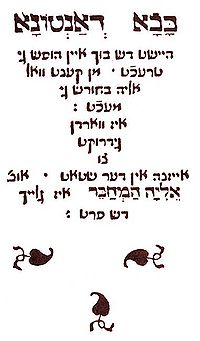
Elia Levita
Elia Levita , also known as Elijah Levita, Elias Levita, Élie Lévita, Eliahu Bakhur was a Renaissance Hebrew grammarian, scholar and poet. He was influential in helping to create the Yiddish language...
, was the most popular chivalric
Chivalry
Chivalry is a term related to the medieval institution of knighthood which has an aristocratic military origin of individual training and service to others. Chivalry was also the term used to refer to a group of mounted men-at-arms as well as to martial valour...
romance
Romance (genre)
As a literary genre of high culture, romance or chivalric romance is a style of heroic prose and verse narrative that was popular in the aristocratic circles of High Medieval and Early Modern Europe. They were fantastic stories about marvel-filled adventures, often of a knight errant portrayed as...
in the Yiddish language
Yiddish language
Yiddish is a High German language of Ashkenazi Jewish origin, spoken throughout the world. It developed as a fusion of German dialects with Hebrew, Aramaic, Slavic languages and traces of Romance languages...
. It was first printed in 1541, being the first non-religious book to be printed in Yiddish. For five centuries, it endured at least 40 editions. It is written in ottava rima
Ottava rima
Ottava rima is a rhyming stanza form of Italian origin. Originally used for long poems on heroic themes, it later came to be popular in the writing of mock-heroic works. Its earliest known use is in the writings of Giovanni Boccaccio....
and, according to Sol Liptzin
Sol Liptzin
Sol Liptzin was a scholar, author, and educator in Yiddish and German literature.- Life :Liptzin was born in Sataniv, Ukraine, and moved to New York at the age of nine. He graduated from City College of New York and did postgraduate work at the University of Berlin. He earned a master's degree and...
, is "generally regarded as the most outstanding poetic work in Old Yiddish". [Liptzin, 1972, 5, 7]
The theme derives from the Anglo-Norman
Anglo-Norman
The Anglo-Normans were mainly the descendants of the Normans who ruled England following the Norman conquest by William the Conqueror in 1066. A small number of Normans were already settled in England prior to the conquest...
romance of Sir Bevis of Hampton
Bevis of Hampton
Bevis of Hampton is a legendary English hero and the subject of Anglo-Norman, French, English, Venetian and other medieval metrical romances that bear his name...
, by way of an Italian
Italian language
Italian is a Romance language spoken mainly in Europe: Italy, Switzerland, San Marino, Vatican City, by minorities in Malta, Monaco, Croatia, Slovenia, France, Libya, Eritrea, and Somalia, and by immigrant communities in the Americas and Australia...
poem that had modified the name Bevis of Hampton to Buovo d'Antona and had, itself, been through at least thirty editions at the time of translation and adaptation into Yiddish. The central theme is the love of Bovo and Druziane. [Liptzin, 1972, 6], [Gottheil] The story "had no basis in Jewish reality", but compared to other chivalric romances it "tone[s] down the Christian
Christian
A Christian is a person who adheres to Christianity, an Abrahamic, monotheistic religion based on the life and teachings of Jesus of Nazareth as recorded in the Canonical gospels and the letters of the New Testament...
symbols of his original" and "substitute[s] Jewish customs, Jewish values and Jewish traits of character here and there..." [Liptzin, 1972, 8]
The character was also popular in Russian folk culture as Prince Bova.
The Bovo-Bukh later became known in the late 18th century as the Bove-mayse or "Bovo's tale". This name, in turn, was corrupted and passed into the Yiddish language as bubbe meise, literally "grandmother's tale", meaning "old wives' tale". [Liptzin, 1972, 7]
Plot summary
- Based on Sol Liptzin, A History of Yiddish Literature, pp. 6–7.
Bovo's young mother conspires to have her husband, an aged king, killed during a hunt, then marries the murderer. They try and fail to poison the child Bovo, whom they are afraid will avenge his father. The handsome youth runs away from Antona, is kidnapped and taken to Flanders
Flanders
Flanders is the community of the Flemings but also one of the institutions in Belgium, and a geographical region located in parts of present-day Belgium, France and the Netherlands. "Flanders" can also refer to the northern part of Belgium that contains Brussels, Bruges, Ghent and Antwerp...
to be stable boy to a king, whose daughter Druzane falls in love with him.
The heathen sultan of Babylonia
Babylonia
Babylonia was an ancient cultural region in central-southern Mesopotamia , with Babylon as its capital. Babylonia emerged as a major power when Hammurabi Babylonia was an ancient cultural region in central-southern Mesopotamia (present-day Iraq), with Babylon as its capital. Babylonia emerged as...
arrives, backed by ten thousand warriors, to demand Druzane in marriage for his ugly son, Lucifer. He is refused; in the ensuing war the king of Flanders is captured. Bovo, riding a magic horse Rundele, defeats the sultan's army, slays Lucifer, frees the king, and is promised the hand of Druzane, but is enticed to Babylonia, where he is horribly imprisoned for a year before escaping. Meanwhile, Druzane has presumed him dead and consented to marry the knight Macabron.
On the wedding day of Druzane and Macabron, Bovo arrives disguised as a beggar; he and Druzane flee, first to a palace but later to the forest, pursued by Macabron. Deep in the forest, Druzane gives birth to twins.
Bovo sets off to try to find a route back to Flanders. Druzane comes to the conclusion that Bovo has fallen prey to a lion, sets off on her own with the twins, and successfully reaches Flanders. Bovo returns to their forest abode; failing to find her or the twins, he now also presumes her to have fallen prey. Despairing, he joins an army ranged against his native Antona. He kills his stepfather, dispatches his mother to a nunnery, and takes his rightful crown. He is eventually reunited with Druzane, who becomes his queen.
Modern editions
- Elia Levita Bachur's Bovo-Buch: A Translation of the Old Yiddish Edition of 1541 with Introduction and Notes by Elia Levita Bachur, translated and notes by Jerry C. Smith, Fenestra Books, 2003, ISBN 1-58736-160-4.