

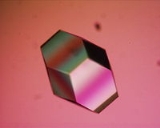
Lysozyme

Overview
Enzyme
Enzymes are proteins that catalyze chemical reactions. In enzymatic reactions, the molecules at the beginning of the process, called substrates, are converted into different molecules, called products. Almost all chemical reactions in a biological cell need enzymes in order to occur at rates...
s that damage bacterial cell walls by catalyzing hydrolysis
Hydrolysis
Hydrolysis is a chemical reaction during which molecules of water are split into hydrogen cations and hydroxide anions in the process of a chemical mechanism. It is the type of reaction that is used to break down certain polymers, especially those made by condensation polymerization...
of 1,4-beta-linkages between N-acetylmuramic acid
N-Acetylmuramic acid
N-Acetylmuramic acid, or MurNAc, is the ether of lactic acid and N-acetylglucosamine with a chemical formula of C11H19NO8. It is part of a biopolymer in the bacterial cell wall, built from alternating units of N-acetylglucosamine and N-acetylmuramic acid , cross-linked with oligopeptides at the...
and N-acetyl-D-glucosamine residues in a peptidoglycan
Peptidoglycan
Peptidoglycan, also known as murein, is a polymer consisting of sugars and amino acids that forms a mesh-like layer outside the plasma membrane of bacteria , forming the cell wall. The sugar component consists of alternating residues of β- linked N-acetylglucosamine and N-acetylmuramic acid...
and between N-acetyl-D-glucosamine residues in chitodextrins
Chitobiose
Chitobiose is a dimer of β-1,4-linked glucosamine units. There is ambiguity as to which structure the name refers, owing to the method by which it was first isolated....
. Lysozyme is abundant in a number of secretion
Secretion
Secretion is the process of elaborating, releasing, and oozing chemicals, or a secreted chemical substance from a cell or gland. In contrast to excretion, the substance may have a certain function, rather than being a waste product...
s, such as tears
Tears
Tears are secretions that clean and lubricate the eyes. Lacrimation or lachrymation is the production or shedding of tears....
, saliva
Saliva
Saliva , referred to in various contexts as spit, spittle, drivel, drool, or slobber, is the watery substance produced in the mouths of humans and most other animals. Saliva is a component of oral fluid. In mammals, saliva is produced in and secreted from the three pairs of major salivary glands,...
, human milk, and mucus
Mucus
In vertebrates, mucus is a slippery secretion produced by, and covering, mucous membranes. Mucous fluid is typically produced from mucous cells found in mucous glands. Mucous cells secrete products that are rich in glycoproteins and water. Mucous fluid may also originate from mixed glands, which...
. It is also present in cytoplasmic granules of the polymorphonuclear neutrophils (PMN).
Unanswered Questions

Discussions