


West Virginia State Board of Education v. Barnette

Encyclopedia
West Virginia State Board of Education v. Barnette, 319 U.S. 624
(1943), is a decision by the Supreme Court of the United States
that held that the Free Speech Clause of the First Amendment to the United States Constitution protected students from being forced to salute the American flag
and say the Pledge of Allegiance
in school.
It was a significant court victory won by Jehovah's Witnesses
, whose religion forbade them from saluting or pledging to symbols, including symbols of political institutions. However, the Court did not address the effect the compelled salutation and recital ruling had upon their particular religious beliefs, but instead ruled that the state did not have the power to compel speech in that manner for anyone.
Barnette overruled a 1940 decision on the same issue, Minersville School District v. Gobitis
(also involving the children of Jehovah's Witnesses), in which the Court stated that the proper recourse for dissent was to try to change the school policy democratically.
However, in overruling Gobitis the Court primarily relied on the Free Speech Clause of the First Amendment rather than the Free Exercise Clause
.
decision, the West Virginia Legislature
amended its statutes to require all schools in the state to conduct courses of instruction in history, civics, and in the Constitutions of the United States and of the State "for the purpose of teaching, fostering and perpetuating the ideals, principles and spirit of Americanism, and increasing the knowledge of the organization and machinery of the government." The West Virginia State Board of Education was directed to "prescribe the courses of study covering these subjects" for public schools.
The Board of Education on January 9, 1942, adopted a resolution containing recitals taken largely from the Court's Gobitis opinion and ordering that the salute to the flag become "a regular part of the program of activities in the public schools," that all teachers and pupils "shall be required to participate in the salute honoring the Nation represented by the Flag; provided, however, that refusal to salute the Flag be regarded as an Act of insubordination, and shall be dealt with accordingly." The resolution originally required the "commonly accepted salute to the Flag" which it defined. Objections to the salute as "being too much like Hitler's
" were raised by the Parent and Teachers Association
, the Boy
and Girl Scouts
, the Red Cross, and the General Federation of Women's Clubs
. Some modification appears to have been made in deference to these objections, but no concession was made to Jehovah's Witnesses. What was required after the modification was a "stiff-arm" salute
, the saluter to keep the right hand raised with palm turned up while the following is repeated: "I pledge allegiance to the Flag of the United States of America and to the Republic for which it stands; one Nation, indivisible, with liberty and justice for all."
Failure to comply was considered "insubordination" and dealt with by expulsion. Readmission was denied by statute until the student complied. This expulsion, in turn, automatically exposed the child and their parents to criminal prosecution; the expelled child was considered "unlawfully absent" and could be proceeded against as a delinquent, and their parents or guardians could be fined as much as $50 and jailed up to thirty days. On the advice of an early attorney, the Barnettes had avoided the further complications by having their expelled girls return to school each day, though the school would send them home.
The Barnettes brought suit in the United States District Court
for themselves and others similarly situated asking its injunction to restrain enforcement of these laws and regulations against Jehovah's Witnesses. The Witnesses taught and still teach that the obligation imposed by law of God is superior to that of laws enacted by temporal government. Their religious beliefs include a literal version of Exodus, Chapter 20, verses 4 and 5, which says: 'Thou shalt not make unto thee any graven image, or any likeness of anything that is in heaven above, or that is in the earth beneath, or that is in the water under the earth; thou shalt not bow down thyself to them nor serve them.' They consider that the flag is an 'image' within this command. For this reason they refused to salute the flag. Children of Jehovah's Witnesses had been expelled from school and were threatened with exclusion for no other cause. Officials threatened to send them to reformatories maintained for criminally inclined juveniles. Parents of such children had been prosecuted and were being threatened with prosecutions for causing delinquency.
Gobitis settled the constitutional questions raised by the flag-salute expulsions. The state's brief
quoted extensively from Justice Frankfurter's Gobitis opinion. Given the clear indications that at least
five justices were ready to lay aside the Gobitis precedent, there was little else the state's lawyers
could do. The American Legion
's amicus curiae brief filed in support of the state's appeal did little
more than duplicate the West Virginia argument.
Hayden Covington answered the state's appeal in a brief that was a mixture of Jehovah's Witnesses Bible
teachings and Constitutional arguments. He included a fiery attack on the Court's Gobitis opinion,
especially rejecting Justice Frankfurter's deference to legislative policymaking authority. Such deference, he
argued, allowed the legislature to define its own powers. He emphasized the nationwide persecution
of Jehovah's Witnesses that had followed Gobitis and concluded with a long list of law journal and
newspaper articles that criticized the decision. The American Bar Association
's Committee on the Bill of Rights and the American Civil Liberties Union
filed amicus curiae briefs that argued Gobitis was bad law and should be overruled.
and held that compelling public schoolchildren to salute the flag was unconstitutional. The Court found that salutes of the type mandated by the West Virginia State Board of Education were forms of utterance and thus were a means of communicating ideas. "Compulsory unification of opinion," the Court held, was doomed to failure and was antithetical to the values set forth in the First Amendment
. Writing for the majority, Justice Jackson argued: "If there is any fixed star in our constitutional constellation, it is that no official, high or petty, can prescribe what shall be orthodox in politics, nationalism, religion, or other matters of opinion or force citizens to confess by word or act their faith therein." To underscore its decision, the Supreme Court announced it on Flag Day
.
, who had joined the court only two years earlier, wrote the decision, echoing the free-expression sentiments of Stromberg v. California
.
The opinion that Justice Felix Frankfurter
had authored three years earlier in Gobitis
rested on four arguments. In Barnette Justice Jackson addressed each element of Frankfurter’s Gobitis decision. Jackson began with Frankfurter’s designation of the flag as a national symbol. He did not question Frankfurter’s designation of the flag as a national symbol; instead, he criticized the pedestal on which Frankfurter put such national symbols. Jackson called symbols a “primitive but effective way of communicating ideas,” and explained that “a person gets from a symbol the meaning he puts into it, and what is one man’s comfort and inspiration is another’s jest and scorn.”
Next Jackson denied Frankfurter’s argument that flag-saluting ceremonies were an appropriate way to build the “cohesive sentiment” that Frankfurter believed national unity depended on. Jackson rejected Frankfurter’s argument, citing the Roman
effort to drive out Christianity
, the Spanish Inquisition
of the Jews
and the Siberian exile
of Soviet dissidents
as evidence of the “ultimate futility” of efforts to coerce unanimous sentiment out of a populace. Jackson warned that “[t]hose who begin coercive elimination of dissent soon find themselves exterminating dissenters. Compulsory unification of opinion achieves only the unanimity of the graveyard.”
Then Jackson dealt with Frankfurter’s assertion that forcing students to salute the flag, and threatening them with expulsion if they chose not to, was a permissible way to foster national unity. Jackson’s rejection of this section of Frankfurter’s argument has proved the most quoted section of his opinion. In his Gobitis opinion Frankfurter’s solution was for the dissenters to seek out solutions to their problems at the ballot box
. Jackson responded that the conflict in this case was between authority and the individual and that the founders intended the Bill of Rights
to put some rights out of reach from majorities, ensuring that some liberties would endure beyond political majorities. Jackson wrote:
The last leg of Frankfurter’s Gobitis opinion reasoned that matters like saluting the flag were issues of “school discipline” that are better left to local officials rather than federal judges. Justice Jackson rejected this argument as well:
and William O. Douglas
— would become the most ardent supporters of the First Amendment.
"Words uttered under coercion are proof of loyalty to nothing but self-interest," wrote Black and Douglas in a concurring opinion. "Love of country must spring from willing hearts and free minds, inspired by a fair administration of wise laws enacted by the people's elected representatives within the bounds of express constitutional prohibitions."
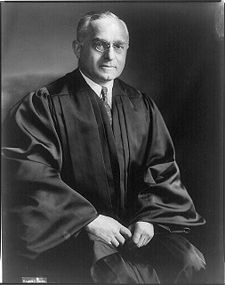 Three years earlier seven justices had followed Frankfurter’s reasoning and joined his majority opinion in Gobitis. In Barnette however, only Frankfurter filed a written dissent, while Justices Owen Roberts and Stanley Reed
dissented in silence.
Frankfurter said that the court was overstepping its bounds in striking down the West Virginia law. He said, too, that freedom of religion did not allow individuals to break laws simply because of religious conscience. Frankfurter argued that, "Otherwise each individual could set up his own censor against obedience to laws conscientiously deemed for the public good by those whose business it is to make laws."
Frankfurter’s response to Jackson’s systematic destruction of his Gobitis decision was one of anger, and Justices Roberts and Murphy
tried to get him to revise his opinion, arguing that the first two lines were “much too personal”. However, Frankfurter ignored the advice of his fellow justices, taking the overruling of his Gobitis decision as a personal affront and insisting on speaking his mind.
Frankfurter began with a reference to his Jewish roots: “One who belongs to the most vilified and persecuted minority in history is not likely to be insensible to the freedoms guaranteed by our Constitution.” This was the passage Justices Roberts and Frank Murphy
felt was out of place. Frankfurter, however, insisted that the passage was necessary since he claimed he was “literally flooded with letters” following the Court’s decision in Gobitis that said he should be more sensitive to the protection of minorities due to his Jewish heritage. Frankfurter's dissent continued, “Were my purely personal attitudes relevant I should wholeheartedly associate myself with the generally libertarian views in the Court’s opinion . . . But as judges we are neither Jew nor Gentile
, neither Catholic
nor agnostic.”
Having responded to his critics and the Court’s reversal on a personal level, he now responded on a judicial one, with the remainder of his opinion focusing on judicial restraint. “As a member of this Court I am not justified in writing my private notions of policy into the Constitution.... It can never be emphasized too much that one’s own opinion about the wisdom or evil of a law should be excluded altogether when one is doing one’s duty on the bench.”
Frankfurter continued, arguing that if the Court is frequently striking down laws it is circumventing the democratic process, since the Court cannot work to reach a compromise. It either strikes down a law or lets it stand; it cannot simply modify or qualify a law as a legislature can.
Finally Frankfurter rejected Justice Stone’s rational basis test that Stone laid out in United States v. Carolene Products Co.
. Instead Frankfurter focused on his belief that there were no provisions within the constitution that occupied a “preferred position” over others.
(1963), for example, the Court upheld a Seventh-day Adventist
's claim to unemployment benefits even though she declined to make herself available to work on Saturday (her Sabbath) as the law required. In Wisconsin v. Yoder
(1972), the Court upheld the right of Amish
parents not to send their children to public schools past the eighth grade.
At 2006 proceedings cosponsored by the Justice Robert H. Jackson Center and the Supreme Court Historical Society
, Supreme Court law clerks from that Court were on a panel with the two eponymous Barnettes. Just as she and her sister had in 1942, Gathie Barnette Edmonds noted that her own son was also sent to the principal's office for not saluting the flag.
"What We Owe Jehovah's Witnesses," by Sarah Barringer Gordon, April/May 2011 American History magazine; article on Barnettes affects on Constitutional Law.
Case citation
Case citation is the system used in many countries to identify the decisions in past court cases, either in special series of books called reporters or law reports, or in a 'neutral' form which will identify a decision wherever it was reported...
(1943), is a decision by the Supreme Court of the United States
Supreme Court of the United States
The Supreme Court of the United States is the highest court in the United States. It has ultimate appellate jurisdiction over all state and federal courts, and original jurisdiction over a small range of cases...
that held that the Free Speech Clause of the First Amendment to the United States Constitution protected students from being forced to salute the American flag
Flag of the United States
The national flag of the United States of America consists of thirteen equal horizontal stripes of red alternating with white, with a blue rectangle in the canton bearing fifty small, white, five-pointed stars arranged in nine offset horizontal rows of six stars alternating with rows...
and say the Pledge of Allegiance
Pledge of Allegiance
The Pledge of Allegiance of the United States is an expression of loyalty to the federal flag and the republic of the United States of America, originally composed by Christian Socialist Francis Bellamy in 1892 and formally adopted by Congress as the pledge in 1942...
in school.
It was a significant court victory won by Jehovah's Witnesses
Jehovah's Witnesses
Jehovah's Witnesses is a millenarian restorationist Christian denomination with nontrinitarian beliefs distinct from mainstream Christianity. The religion reports worldwide membership of over 7 million adherents involved in evangelism, convention attendance of over 12 million, and annual...
, whose religion forbade them from saluting or pledging to symbols, including symbols of political institutions. However, the Court did not address the effect the compelled salutation and recital ruling had upon their particular religious beliefs, but instead ruled that the state did not have the power to compel speech in that manner for anyone.
Barnette overruled a 1940 decision on the same issue, Minersville School District v. Gobitis
Minersville School District v. Gobitis
Minersville School District v. Gobitis, , was a decision by the Supreme Court of the United States involving the religious rights of public school students under the First Amendment to the United States Constitution...
(also involving the children of Jehovah's Witnesses), in which the Court stated that the proper recourse for dissent was to try to change the school policy democratically.
However, in overruling Gobitis the Court primarily relied on the Free Speech Clause of the First Amendment rather than the Free Exercise Clause
Free Exercise Clause of the First Amendment
The Free Exercise Clause is the accompanying clause with the Establishment Clause of the First Amendment to the United States Constitution. The Establishment Clause and the Free Exercise Clause together read:...
.
Facts of the case
Following the Minersville School District v. GobitisMinersville School District v. Gobitis
Minersville School District v. Gobitis, , was a decision by the Supreme Court of the United States involving the religious rights of public school students under the First Amendment to the United States Constitution...
decision, the West Virginia Legislature
West Virginia Legislature
The West Virginia Legislature is the state legislature of the U.S. state of West Virginia. A bicameral legislative body, the Legislature is split between the upper Senate and the lower House of Delegates. It was established under Article VI of the West Virginia Constitution following the state's...
amended its statutes to require all schools in the state to conduct courses of instruction in history, civics, and in the Constitutions of the United States and of the State "for the purpose of teaching, fostering and perpetuating the ideals, principles and spirit of Americanism, and increasing the knowledge of the organization and machinery of the government." The West Virginia State Board of Education was directed to "prescribe the courses of study covering these subjects" for public schools.
The Board of Education on January 9, 1942, adopted a resolution containing recitals taken largely from the Court's Gobitis opinion and ordering that the salute to the flag become "a regular part of the program of activities in the public schools," that all teachers and pupils "shall be required to participate in the salute honoring the Nation represented by the Flag; provided, however, that refusal to salute the Flag be regarded as an Act of insubordination, and shall be dealt with accordingly." The resolution originally required the "commonly accepted salute to the Flag" which it defined. Objections to the salute as "being too much like Hitler's
Nazi salute
The Nazi salute, or Hitler salute , was a gesture of greeting in Nazi Germany usually accompanied by saying, Heil Hitler! ["Hail Hitler!"], Heil, mein Führer ["Hail, my leader!"], or Sieg Heil! ["Hail victory!"]...
" were raised by the Parent and Teachers Association
Parent-Teacher Association
In the U.S. a parent-teacher association or Parent-Teacher-Student Association is a formal organization composed of parents, teachers and staff that is intended to facilitate parental participation in a public or private school. Most public and private K-8 schools in the U.S. have a PTA, a...
, the Boy
Boy Scouts of America
The Boy Scouts of America is one of the largest youth organizations in the United States, with over 4.5 million youth members in its age-related divisions...
and Girl Scouts
Girl Scouts of the USA
The Girl Scouts of the United States of America is a youth organization for girls in the United States and American girls living abroad. It describes itself as "the world's preeminent organization dedicated solely to girls". It was founded by Juliette Gordon Low in 1912 and was organized after Low...
, the Red Cross, and the General Federation of Women's Clubs
General Federation of Women's Clubs
The General Federation of Women's Clubs , founded in 1890, is an international women's organization dedicated to community improvement by enhancing the lives of others through volunteer service...
. Some modification appears to have been made in deference to these objections, but no concession was made to Jehovah's Witnesses. What was required after the modification was a "stiff-arm" salute
Roman salute
The Roman salute is a gesture in which the arm is held out forward straight, with palm down, and fingers touching. In some versions, the arm is raised upward at an angle; in others, it is held out parallel to the ground. The former is a well known symbol of fascism that is commonly perceived to be...
, the saluter to keep the right hand raised with palm turned up while the following is repeated: "I pledge allegiance to the Flag of the United States of America and to the Republic for which it stands; one Nation, indivisible, with liberty and justice for all."
Failure to comply was considered "insubordination" and dealt with by expulsion. Readmission was denied by statute until the student complied. This expulsion, in turn, automatically exposed the child and their parents to criminal prosecution; the expelled child was considered "unlawfully absent" and could be proceeded against as a delinquent, and their parents or guardians could be fined as much as $50 and jailed up to thirty days. On the advice of an early attorney, the Barnettes had avoided the further complications by having their expelled girls return to school each day, though the school would send them home.
The Barnettes brought suit in the United States District Court
United States district court
The United States district courts are the general trial courts of the United States federal court system. Both civil and criminal cases are filed in the district court, which is a court of law, equity, and admiralty. There is a United States bankruptcy court associated with each United States...
for themselves and others similarly situated asking its injunction to restrain enforcement of these laws and regulations against Jehovah's Witnesses. The Witnesses taught and still teach that the obligation imposed by law of God is superior to that of laws enacted by temporal government. Their religious beliefs include a literal version of Exodus, Chapter 20, verses 4 and 5, which says: 'Thou shalt not make unto thee any graven image, or any likeness of anything that is in heaven above, or that is in the earth beneath, or that is in the water under the earth; thou shalt not bow down thyself to them nor serve them.' They consider that the flag is an 'image' within this command. For this reason they refused to salute the flag. Children of Jehovah's Witnesses had been expelled from school and were threatened with exclusion for no other cause. Officials threatened to send them to reformatories maintained for criminally inclined juveniles. Parents of such children had been prosecuted and were being threatened with prosecutions for causing delinquency.
Arguments
The state's principal argument was that Barnette raised no substantial federal question becauseGobitis settled the constitutional questions raised by the flag-salute expulsions. The state's brief
quoted extensively from Justice Frankfurter's Gobitis opinion. Given the clear indications that at least
five justices were ready to lay aside the Gobitis precedent, there was little else the state's lawyers
could do. The American Legion
American Legion
The American Legion is a mutual-aid organization of veterans of the United States armed forces chartered by the United States Congress. It was founded to benefit those veterans who served during a wartime period as defined by Congress...
's amicus curiae brief filed in support of the state's appeal did little
more than duplicate the West Virginia argument.
Hayden Covington answered the state's appeal in a brief that was a mixture of Jehovah's Witnesses Bible
Bible
The Bible refers to any one of the collections of the primary religious texts of Judaism and Christianity. There is no common version of the Bible, as the individual books , their contents and their order vary among denominations...
teachings and Constitutional arguments. He included a fiery attack on the Court's Gobitis opinion,
especially rejecting Justice Frankfurter's deference to legislative policymaking authority. Such deference, he
argued, allowed the legislature to define its own powers. He emphasized the nationwide persecution
of Jehovah's Witnesses that had followed Gobitis and concluded with a long list of law journal and
newspaper articles that criticized the decision. The American Bar Association
American Bar Association
The American Bar Association , founded August 21, 1878, is a voluntary bar association of lawyers and law students, which is not specific to any jurisdiction in the United States. The ABA's most important stated activities are the setting of academic standards for law schools, and the formulation...
's Committee on the Bill of Rights and the American Civil Liberties Union
American Civil Liberties Union
The American Civil Liberties Union is a U.S. non-profit organization whose stated mission is "to defend and preserve the individual rights and liberties guaranteed to every person in this country by the Constitution and laws of the United States." It works through litigation, legislation, and...
filed amicus curiae briefs that argued Gobitis was bad law and should be overruled.
Decision of the Court
In a 6-to-3 decision, the Court overruled its decision in Minersville School District v. GobitisMinersville School District v. Gobitis
Minersville School District v. Gobitis, , was a decision by the Supreme Court of the United States involving the religious rights of public school students under the First Amendment to the United States Constitution...
and held that compelling public schoolchildren to salute the flag was unconstitutional. The Court found that salutes of the type mandated by the West Virginia State Board of Education were forms of utterance and thus were a means of communicating ideas. "Compulsory unification of opinion," the Court held, was doomed to failure and was antithetical to the values set forth in the First Amendment
First Amendment to the United States Constitution
The First Amendment to the United States Constitution is part of the Bill of Rights. The amendment prohibits the making of any law respecting an establishment of religion, impeding the free exercise of religion, abridging the freedom of speech, infringing on the freedom of the press, interfering...
. Writing for the majority, Justice Jackson argued: "If there is any fixed star in our constitutional constellation, it is that no official, high or petty, can prescribe what shall be orthodox in politics, nationalism, religion, or other matters of opinion or force citizens to confess by word or act their faith therein." To underscore its decision, the Supreme Court announced it on Flag Day
Flag Day in the United States
In the United States Flag Day is celebrated on June 14. It commemorates the adoption of the flag of the United States, which happened that day by resolution of the Second Continental Congress in 1777...
.
Majority opinion
Justice Robert JacksonRobert H. Jackson
Robert Houghwout Jackson was United States Attorney General and an Associate Justice of the United States Supreme Court . He was also the chief United States prosecutor at the Nuremberg Trials...
, who had joined the court only two years earlier, wrote the decision, echoing the free-expression sentiments of Stromberg v. California
Stromberg v. California
Stromberg v. California, 283 U.S. 359 was a United States Supreme Court case in which the Court ruled 7-2 that a 1919 California statute banning red flags was unconstitutional because it violated the Fourteenth Amendment...
.
The opinion that Justice Felix Frankfurter
Felix Frankfurter
Felix Frankfurter was an Associate Justice of the United States Supreme Court.-Early life:Frankfurter was born into a Jewish family on November 15, 1882, in Vienna, Austria, then part of the Austro-Hungarian Empire in Europe. He was the third of six children of Leopold and Emma Frankfurter...
had authored three years earlier in Gobitis
Minersville School District v. Gobitis
Minersville School District v. Gobitis, , was a decision by the Supreme Court of the United States involving the religious rights of public school students under the First Amendment to the United States Constitution...
rested on four arguments. In Barnette Justice Jackson addressed each element of Frankfurter’s Gobitis decision. Jackson began with Frankfurter’s designation of the flag as a national symbol. He did not question Frankfurter’s designation of the flag as a national symbol; instead, he criticized the pedestal on which Frankfurter put such national symbols. Jackson called symbols a “primitive but effective way of communicating ideas,” and explained that “a person gets from a symbol the meaning he puts into it, and what is one man’s comfort and inspiration is another’s jest and scorn.”
Next Jackson denied Frankfurter’s argument that flag-saluting ceremonies were an appropriate way to build the “cohesive sentiment” that Frankfurter believed national unity depended on. Jackson rejected Frankfurter’s argument, citing the Roman
Roman Empire
The Roman Empire was the post-Republican period of the ancient Roman civilization, characterised by an autocratic form of government and large territorial holdings in Europe and around the Mediterranean....
effort to drive out Christianity
Christianity
Christianity is a monotheistic religion based on the life and teachings of Jesus as presented in canonical gospels and other New Testament writings...
, the Spanish Inquisition
Spanish Inquisition
The Tribunal of the Holy Office of the Inquisition , commonly known as the Spanish Inquisition , was a tribunal established in 1480 by Catholic Monarchs Ferdinand II of Aragon and Isabella I of Castile. It was intended to maintain Catholic orthodoxy in their kingdoms, and to replace the Medieval...
of the Jews
Jews
The Jews , also known as the Jewish people, are a nation and ethnoreligious group originating in the Israelites or Hebrews of the Ancient Near East. The Jewish ethnicity, nationality, and religion are strongly interrelated, as Judaism is the traditional faith of the Jewish nation...
and the Siberian exile
Exile
Exile means to be away from one's home , while either being explicitly refused permission to return and/or being threatened with imprisonment or death upon return...
of Soviet dissidents
Soviet dissidents
Soviet dissidents were citizens of the Soviet Union who disagreed with the policies and actions of their government and actively protested against these actions through either violent or non-violent means...
as evidence of the “ultimate futility” of efforts to coerce unanimous sentiment out of a populace. Jackson warned that “[t]hose who begin coercive elimination of dissent soon find themselves exterminating dissenters. Compulsory unification of opinion achieves only the unanimity of the graveyard.”
Then Jackson dealt with Frankfurter’s assertion that forcing students to salute the flag, and threatening them with expulsion if they chose not to, was a permissible way to foster national unity. Jackson’s rejection of this section of Frankfurter’s argument has proved the most quoted section of his opinion. In his Gobitis opinion Frankfurter’s solution was for the dissenters to seek out solutions to their problems at the ballot box
Ballot box
A ballot box is a temporarily sealed container, usually square box though sometimes a tamper resistant bag, with a narrow slot in the top sufficient to accept a ballot paper in an election but which prevents anyone from accessing the votes cast until the close of the voting period...
. Jackson responded that the conflict in this case was between authority and the individual and that the founders intended the Bill of Rights
United States Bill of Rights
The Bill of Rights is the collective name for the first ten amendments to the United States Constitution. These limitations serve to protect the natural rights of liberty and property. They guarantee a number of personal freedoms, limit the government's power in judicial and other proceedings, and...
to put some rights out of reach from majorities, ensuring that some liberties would endure beyond political majorities. Jackson wrote:
The last leg of Frankfurter’s Gobitis opinion reasoned that matters like saluting the flag were issues of “school discipline” that are better left to local officials rather than federal judges. Justice Jackson rejected this argument as well:
Concurring opinion
Two of the justices who changed their minds between Minersville and West Virginia v. Barnette — Hugo BlackHugo Black
Hugo Lafayette Black was an American politician and jurist. A member of the Democratic Party, Black represented Alabama in the United States Senate from 1927 to 1937, and served as an Associate Justice of the Supreme Court of the United States from 1937 to 1971. Black was nominated to the Supreme...
and William O. Douglas
William O. Douglas
William Orville Douglas was an Associate Justice of the United States Supreme Court. With a term lasting 36 years and 209 days, he is the longest-serving justice in the history of the Supreme Court...
— would become the most ardent supporters of the First Amendment.
"Words uttered under coercion are proof of loyalty to nothing but self-interest," wrote Black and Douglas in a concurring opinion. "Love of country must spring from willing hearts and free minds, inspired by a fair administration of wise laws enacted by the people's elected representatives within the bounds of express constitutional prohibitions."
Dissenting opinion
Stanley Forman Reed
Stanley Forman Reed was a noted American attorney who served as United States Solicitor General from 1935 to 1938 and as an Associate Justice of the U.S. Supreme Court from 1938 to 1957. He was the last Supreme Court Justice who did not graduate from law school Stanley Forman Reed (December 31,...
dissented in silence.
Frankfurter said that the court was overstepping its bounds in striking down the West Virginia law. He said, too, that freedom of religion did not allow individuals to break laws simply because of religious conscience. Frankfurter argued that, "Otherwise each individual could set up his own censor against obedience to laws conscientiously deemed for the public good by those whose business it is to make laws."
Frankfurter’s response to Jackson’s systematic destruction of his Gobitis decision was one of anger, and Justices Roberts and Murphy
Frank Murphy
William Francis Murphy was a politician and jurist from Michigan. He served as First Assistant U.S. District Attorney, Eastern Michigan District , Recorder's Court Judge, Detroit . Mayor of Detroit , the last Governor-General of the Philippines , U.S...
tried to get him to revise his opinion, arguing that the first two lines were “much too personal”. However, Frankfurter ignored the advice of his fellow justices, taking the overruling of his Gobitis decision as a personal affront and insisting on speaking his mind.
Frankfurter began with a reference to his Jewish roots: “One who belongs to the most vilified and persecuted minority in history is not likely to be insensible to the freedoms guaranteed by our Constitution.” This was the passage Justices Roberts and Frank Murphy
Frank Murphy
William Francis Murphy was a politician and jurist from Michigan. He served as First Assistant U.S. District Attorney, Eastern Michigan District , Recorder's Court Judge, Detroit . Mayor of Detroit , the last Governor-General of the Philippines , U.S...
felt was out of place. Frankfurter, however, insisted that the passage was necessary since he claimed he was “literally flooded with letters” following the Court’s decision in Gobitis that said he should be more sensitive to the protection of minorities due to his Jewish heritage. Frankfurter's dissent continued, “Were my purely personal attitudes relevant I should wholeheartedly associate myself with the generally libertarian views in the Court’s opinion . . . But as judges we are neither Jew nor Gentile
Gentile
The term Gentile refers to non-Israelite peoples or nations in English translations of the Bible....
, neither Catholic
Catholic
The word catholic comes from the Greek phrase , meaning "on the whole," "according to the whole" or "in general", and is a combination of the Greek words meaning "about" and meaning "whole"...
nor agnostic.”
Having responded to his critics and the Court’s reversal on a personal level, he now responded on a judicial one, with the remainder of his opinion focusing on judicial restraint. “As a member of this Court I am not justified in writing my private notions of policy into the Constitution.... It can never be emphasized too much that one’s own opinion about the wisdom or evil of a law should be excluded altogether when one is doing one’s duty on the bench.”
Frankfurter continued, arguing that if the Court is frequently striking down laws it is circumventing the democratic process, since the Court cannot work to reach a compromise. It either strikes down a law or lets it stand; it cannot simply modify or qualify a law as a legislature can.
Finally Frankfurter rejected Justice Stone’s rational basis test that Stone laid out in United States v. Carolene Products Co.
United States v. Carolene Products Co.
United States v. Carolene Products Company, 304 U.S. 144 , was an April 25, 1938 decision by the United States Supreme Court. The case dealt with a federal law that prohibited filled milk from being shipped in interstate commerce...
. Instead Frankfurter focused on his belief that there were no provisions within the constitution that occupied a “preferred position” over others.
Subsequent history
The majority opinion in Barnette is considered one of the Court's greatest and most sweeping statements about the fundamental freedoms established by the Bill of Rights. After Barnette, the Court began to turn away from the belief-action doctrine altogether, creating religious exemption for believers of different creeds. In Sherbert v. VernerSherbert v. Verner
Sherbert v. Verner, 374 U.S. 398 , was a case in which the Supreme Court of the United States held that the Free Exercise Clause of the First Amendment required that government demonstrate a compelling government interest before denying unemployment compensation to someone who was fired because her...
(1963), for example, the Court upheld a Seventh-day Adventist
Seventh-day Adventist Church
The Seventh-day Adventist Church is a Protestant Christian denomination distinguished by its observance of Saturday, the original seventh day of the Judeo-Christian week, as the Sabbath, and by its emphasis on the imminent second coming of Jesus Christ...
's claim to unemployment benefits even though she declined to make herself available to work on Saturday (her Sabbath) as the law required. In Wisconsin v. Yoder
Wisconsin v. Yoder
Wisconsin v. Yoder, 406 U.S. 205 , is the case in which the United States Supreme Court found that Amish children could not be placed under compulsory education past 8th grade, as it violated their parents' fundamental right to freedom of religion....
(1972), the Court upheld the right of Amish
Amish
The Amish , sometimes referred to as Amish Mennonites, are a group of Christian church fellowships that form a subgroup of the Mennonite churches...
parents not to send their children to public schools past the eighth grade.
At 2006 proceedings cosponsored by the Justice Robert H. Jackson Center and the Supreme Court Historical Society
Supreme Court Historical Society
The Supreme Court Historical Society is a private, non-profit organization dedicated to preserving and communicating the history of the U.S. Supreme Court.-History:...
, Supreme Court law clerks from that Court were on a panel with the two eponymous Barnettes. Just as she and her sister had in 1942, Gathie Barnette Edmonds noted that her own son was also sent to the principal's office for not saluting the flag.
See also
- Minersville School District v. GobitisMinersville School District v. GobitisMinersville School District v. Gobitis, , was a decision by the Supreme Court of the United States involving the religious rights of public school students under the First Amendment to the United States Constitution...
- Wooley v. MaynardWooley v. MaynardWooley v. Maynard, 430 U.S. 705 , was a case in which the Supreme Court of the United States held that New Hampshire could not constitutionally require citizens to display the state motto upon their vehicle license plates when the state motto was offensive to their moral...
- List of United States Supreme Court cases, volume 319
External links
"What We Owe Jehovah's Witnesses," by Sarah Barringer Gordon, April/May 2011 American History magazine; article on Barnettes affects on Constitutional Law.