

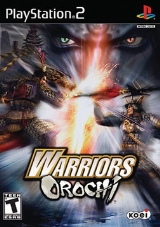
Warriors Orochi

Encyclopedia
, is a PlayStation 2
and Xbox 360
hack and slash
video game developed by Koei and Omega Force. It is a crossover
of two of Koei's popular video game series, Dynasty Warriors
and Samurai Warriors
(Specifically Dynasty Warriors 5
and Samurai Warriors 2
). The game was released on March 21, 2007 in Japan, September 18 in the United States, September 21 in Europe, September 27 in Australia and September 28 in New Zealand. The game came out for the Xbox 360 in Japan on September 13, and the UK version came out on the same date as the PlayStation 2 version in the United States.
The game was ported to the PSP
. It was released in Japan
February 2008, March 25 in the US, and March 28 in the UK. A PC
version was released in the US on March 25, 2008.
A direct sequel
was released in Japan on April 3, 2008 and was released in Europe and North America in September 2008.
A compilation
was released on March 12, 2009 in Japan for the PlayStation 3 and on November 27, 2009 for Microsoft Windows; it is only available in Japan and will not receive a Western release.
of China
and the Warring States period
of Japan
(more than 1,000 years apart in history), Orochi wished to test the might of the warriors of these two eras.
The story is told in four separate but related subplots. Each subplot starts the player with three characters. More characters are unlocked as the player progresses through the story or satisfies certain conditions in certain stages. Each subplot is named after one of the Three Kingdoms, and one from the perspective of the Samurai Warriors characters. Characters from different factions band together in each subplot to confront Orochi. Because of the storyline, most of the characters have split from their respective factions in the original games and have been forced into other scenarios. However, the character selection screen still places all the characters in their original positions.
A total of 79 characters encompasses the roster of Warriors Orochi: 48 from Dynasty Warriors, 29 from Samurai Warriors (including Yoshimoto Imagawa, Kunoichi and Goemon Ishikawa from the first Samurai Warriors, left out in its sequel), and two new characters: the titular character and primary villain, Orochi (远吕智/八歧大蛇) the Serpent King and the mythological beast of Yamato
; and Da Ji
(妲己), the villainous concubine of King Zhou of Shang
from Fengshen Yanyi
. Orochi wields a very large scythe
, named "Eternal Agony", while Da Ji fights with two floating orbs
, called "the Orbs of Ruin".
There are many generic, non-playable officers who are also part of the game, all taken from the Samurai Warriors and Dynasty Warriors games. There are also exclusive non-playable officers that are in Orochi's forces.
was captured by Orochi's forces and held prisoner in Ueda Castle
. He is later rescued by Zuo Ci
, Yoshihiro Shimazu
and Xing Cai. Zuo Ci revealed startling news to Zhao Yun, which led him to embark upon a quest with help from unexpected allies.
had disappeared in his battle against Orochi's forces. His son, Cao Pi
, took up leadership of the Wei clan and allied himself with Orochi, under the offer sent by his strategist, Da Ji. There were a few Wei officers who refused to surrender, or ended up joining other forces opposing Orochi. Under the new alliance, Orochi orders Cao Pi to suppress all those who oppose him. Though Cao Pi obediently obeys Orochi's every command, he has an ulterior motive that he is planning as the story progresses.
and other Wu officers to blackmail the Sun family into servitude. Orochi demanded that rebel leaders and officers be turned over in exchange for the release of the captives. Sun Ce
is the first to rebel against Orochi, under the guidance of Sakon Shima, and much to the disapproval of his siblings, Quan
and Shang Xiang.
s refuse to work together against Orochi. Each of them were focused on assimilating smaller resistance forces spread throughout the land into their own forces.
In the English language version of Warriors Orochi, the Orochi officers are all named after various species of snakes (using their common names) as a pun to Orochi being the Serpent King. The Orochi officers all share the same character model
, and are unplayable enemy characters. The names of the Orochi officers in the English language version:
In the original Japanese version, they are named after various legendary monsters (youkai) in both Chinese and Japanese folklores.
Character selection screen: Dynasty Warriors characters are divided by their respective kingdoms. Samurai Warriors characters are divided by which game they made their first appearance.
Correct pronunciation of names: Unlike the Dynasty Warriors games, the English language version of Warriors Orochi utilizes the correct pronunciations of certain Three Kingdoms officers. The best example is Cao Cao, who in Dynasty Warriors is pronounced as "cow cow". Cao Cao is now "ts'au ts'au" following traditional Chinese pronunciation. This new pronunciation method also applies for Cao Pi, Cao Ren, and Xing Cai.
Art gallery: Showcases CG art and trailers from past Warriors games. Trailers are removed from the US PlayStation 2, Xbox 360, PSP and PC versions.
Chaos difficulty: This highest difficulty level is available in Warriors Orochi at the start. Dynasty Warriors 5 and Samurai Warriors 2, in comparison, offered the Chaos difficulty only after completing special requirements.
Game soundtrack: Composed of the original music from both Dynasty Warriors' rock
-based soundtrack and Samurai Warriors' techno
-based soundtrack. A few new songs were created exclusively for Warriors Orochi. Lu Bu's theme song is given a rearrangement combining both rock and techno music styles.
Multiplayer: Player 2 uses same team as Player 1, albeit with a swapped palette.
Game stages: Recycles stages from both games, some of which are modified by Orochi's supernatural influence. Such stages have burnt ground and 16th century Japanese buildings placed on some Dynasty Warriors stages. Koshi Castle, a stage made exclusively for this game, is the location of the final battle against Orochi for all stories.
Equipment: Abilities acquired by characters during the game are equipped, as seen in Samurai Warriors 2. Using an element from the first Samurai Warriors game, a limit is placed on the number of Abilities equipped at one time.
Camera control: Players are given complete control over the game camera, similar to Samurai Warriors 2.
Special attacks: Following Samurai Warriors 2 to an extent, characters perform their own Enhanced Strikes, varied by characters and their classes.
Weapon deadlocks: No indication as to which character holds the advantage during a deadlock, following Dynasty Warriors 5. In Samurai Warriors 2, a tug-of-war-style bar is displayed during a deadlock, indicating which character holds the advantage.
Double jumps: Expands on the concept of Samurai Warriors 2. All Speed-class characters in Warriors Orochi can perform an Aerial Thrust, which keeps them in the air but propels them forward (or in a given direction as per player control); this can be used for example to avoid certain attacks or to reposition on the fly.
Additional attacks: This is the ability for characters to perform hits beyond the standard six. Characters in Warriors Orochi gain this ability with experience, following Samurai Warriors. Dynasty Warriors characters also gain an additional three attacks after their regular combo once they reach a high proficiency; the attacks are the same as the "Evolution" attacks from the Dynasty Warriors PSP series.
Fourth weapons: These are the most powerful weapons a character can possess. They are obtained in Hard mode on a stage rated 3-stars or higher, or any stage in Chaos mode. Fourth weapons contain random elements. Lu Bu and Tadakatsu Honda possess the strongest of those weapons, both with Strength values up to 100.
Calling horses: An ability exclusive to Yukimura Sanada and Keiji Maeda in Samurai Warriors 2, any character can perform this ability in Warriors Orochi. If the player character(s) did not start the game on horseback, however, s/he will be only able to call a low-level steed.
Special mounts: Only the Red Hare
from Dynasty Warriors 5 and Matsukaze from Samurai Warriors 2 are present when a player acquires a Level 10 Cavalier ability in the game. They can also be found mid-game by defeating either a mounted Lu Bu
or Maeda Keiji.
Facial expressions: All characters, including the Dynasty Warriors characters, display different facial expressions in their in-game avatar when speaking, following Samurai Warriors 2.
Base captains: Following Samurai Warriors 2, base captains carry shields, allowing them to withstand several hits before taking damage.
Objectives: Following Dynasty Warriors 5, some stages have certain objectives that, if completed successfully, greatly help the player in winning the stage. Not implemented is a feature from Samurai Warriors 2, which awards the player additional gold if objectives are completed successfully.
PlayStation 2
The PlayStation 2 is a sixth-generation video game console manufactured by Sony as part of the PlayStation series. Its development was announced in March 1999 and it was first released on March 4, 2000, in Japan...
and Xbox 360
Xbox 360
The Xbox 360 is the second video game console produced by Microsoft and the successor to the Xbox. The Xbox 360 competes with Sony's PlayStation 3 and Nintendo's Wii as part of the seventh generation of video game consoles...
hack and slash
Hack and slash
Hack and slash or hack and slay, abbreviated H&S or HnS, refers to a type of gameplay that emphasizes combat. "Hack and slash" was originally used to describe an aspect of pen-and-paper role-playing games , carrying over from there to MUDs, MMORPGs, and video games in general...
video game developed by Koei and Omega Force. It is a crossover
Fictional crossover
A fictional crossover is the placement of two or more otherwise discrete fictional characters, settings, or universes into the context of a single story. They can arise from legal agreements between the relevant copyright holders, or because of unauthorized efforts by fans, or even amid common...
of two of Koei's popular video game series, Dynasty Warriors
Dynasty Warriors
is a series of tactical action video games created by Omega Force and Koei. The award-winning series is a spin-off of Koei's turn-based strategy Romance of the Three Kingdoms series, based loosely around the Chinese classical novel of the same name. The first game titled Dynasty Warriors,...
and Samurai Warriors
Samurai Warriors
is the first title in the series of video games created by Koei's Omega Force team based loosely around the Sengoku period of Japanese history and it is a spinoff of the Dynasty Warriors series...
(Specifically Dynasty Warriors 5
Dynasty Warriors 5
is a Hack and slash video game set in China and the fifth installment in the Dynasty Warriors series, developed by Omega Force and published by Koei. The game was released on the PlayStation 2 and Xbox. It is based on the Chinese novel Romance of the Three Kingdoms by Luo Guanzhong.-Gameplay:The...
and Samurai Warriors 2
Samurai Warriors 2
is a sequel to the original Samurai Warriors, created by Koei and Omega Force. The game was released in 2006 for the PlayStation 2 and Xbox 360, and received a port to Microsoft Windows in 2008....
). The game was released on March 21, 2007 in Japan, September 18 in the United States, September 21 in Europe, September 27 in Australia and September 28 in New Zealand. The game came out for the Xbox 360 in Japan on September 13, and the UK version came out on the same date as the PlayStation 2 version in the United States.
The game was ported to the PSP
PlayStation Portable
The is a handheld game console manufactured and marketed by Sony Corporation Development of the console was announced during E3 2003, and it was unveiled on , 2004, at a Sony press conference before E3 2004...
. It was released in Japan
Japan
Japan is an island nation in East Asia. Located in the Pacific Ocean, it lies to the east of the Sea of Japan, China, North Korea, South Korea and Russia, stretching from the Sea of Okhotsk in the north to the East China Sea and Taiwan in the south...
February 2008, March 25 in the US, and March 28 in the UK. A PC
Personal computer
A personal computer is any general-purpose computer whose size, capabilities, and original sales price make it useful for individuals, and which is intended to be operated directly by an end-user with no intervening computer operator...
version was released in the US on March 25, 2008.
A direct sequel
Warriors Orochi 2
is a video game developed by Koei and Omega Force for the Sony PlayStation 2. It is the sequel to Warriors Orochi, a crossover video game of the Dynasty Warriors and Samurai Warriors series. The game was released on September 23 in North America and September 19 in Europe...
was released in Japan on April 3, 2008 and was released in Europe and North America in September 2008.
A compilation
Warriors Orochi Z
, is a hack and slash video game developed by Koei and Omega Force for the Sony PlayStation 3 and Microsoft Windows. Z' is the third installment of the Warriors Orochi series, a crossover video game of the Dynasty Warriors and Samurai Warriors series...
was released on March 12, 2009 in Japan for the PlayStation 3 and on November 27, 2009 for Microsoft Windows; it is only available in Japan and will not receive a Western release.
Plot and characters
The fictional events of the game begin when the Serpent King Orochi created a rift in time and space. By creating a twisted new world and bringing together warriors from the Three Kingdoms eraThree Kingdoms
The Three Kingdoms period was a period in Chinese history, part of an era of disunity called the "Six Dynasties" following immediately the loss of de facto power of the Han Dynasty rulers. In a strict academic sense it refers to the period between the foundation of the state of Wei in 220 and the...
of China
China
Chinese civilization may refer to:* China for more general discussion of the country.* Chinese culture* Greater China, the transnational community of ethnic Chinese.* History of China* Sinosphere, the area historically affected by Chinese culture...
and the Warring States period
Sengoku period
The or Warring States period in Japanese history was a time of social upheaval, political intrigue, and nearly constant military conflict that lasted roughly from the middle of the 15th century to the beginning of the 17th century. The name "Sengoku" was adopted by Japanese historians in reference...
of Japan
Japan
Japan is an island nation in East Asia. Located in the Pacific Ocean, it lies to the east of the Sea of Japan, China, North Korea, South Korea and Russia, stretching from the Sea of Okhotsk in the north to the East China Sea and Taiwan in the south...
(more than 1,000 years apart in history), Orochi wished to test the might of the warriors of these two eras.
The story is told in four separate but related subplots. Each subplot starts the player with three characters. More characters are unlocked as the player progresses through the story or satisfies certain conditions in certain stages. Each subplot is named after one of the Three Kingdoms, and one from the perspective of the Samurai Warriors characters. Characters from different factions band together in each subplot to confront Orochi. Because of the storyline, most of the characters have split from their respective factions in the original games and have been forced into other scenarios. However, the character selection screen still places all the characters in their original positions.
A total of 79 characters encompasses the roster of Warriors Orochi: 48 from Dynasty Warriors, 29 from Samurai Warriors (including Yoshimoto Imagawa, Kunoichi and Goemon Ishikawa from the first Samurai Warriors, left out in its sequel), and two new characters: the titular character and primary villain, Orochi (远吕智/八歧大蛇) the Serpent King and the mythological beast of Yamato
Yamato
Yamato was originally the area around today's Sakurai City in Nara Prefecture of Japan. Later the term was used as the name of the province and also as an ancient name of Japan...
; and Da Ji
Daji
Daji was a favorite concubine of King Zhou of Shang, the last king of the Shang Dynasty in ancient China. She is a classic example of how a beauty causes the downfall of an empire/dynasty in Chinese culture...
(妲己), the villainous concubine of King Zhou of Shang
King Zhou of Shang
Emperor Xin of Shang was the last king of the Shang Dynasty. He was later given the pejorative posthumous name Zhòu . He is also called Zhou Xin or King Zhou . He may also be referred to by adding "Shang" in front of any of his names...
from Fengshen Yanyi
Fengshen Yanyi
Fengshen Bang, also known as Fengshen Yanyi in Chinese, and translated as The Investiture of the Gods or The Creation of the Gods, is one of the major vernacular Chinese epic novels written during the Ming Dynasty...
. Orochi wields a very large scythe
Scythe
A scythe is an agricultural hand tool for mowing grass, or reaping crops. It was largely replaced by horse-drawn and then tractor machinery, but is still used in some areas of Europe and Asia. The Grim Reaper is often depicted carrying or wielding a scythe...
, named "Eternal Agony", while Da Ji fights with two floating orbs
Sphere
A sphere is a perfectly round geometrical object in three-dimensional space, such as the shape of a round ball. Like a circle in two dimensions, a perfect sphere is completely symmetrical around its center, with all points on the surface lying the same distance r from the center point...
, called "the Orbs of Ruin".
There are many generic, non-playable officers who are also part of the game, all taken from the Samurai Warriors and Dynasty Warriors games. There are also exclusive non-playable officers that are in Orochi's forces.
Shu story
In the Kingdom of Shu story, the Shu forces were in shambles after their battle with Orochi. Many Shu officers were captured by Orochi, went missing, or joined other forces. Zhao YunZhao Yun
Zhao Yun was a military general who lived during the late Han Dynasty and early Three Kingdoms era of Chinese history. For most of his career, Zhao served the warlord Liu Bei, playing a part in the establishment of state of Shu Han...
was captured by Orochi's forces and held prisoner in Ueda Castle
Ueda Castle
Ueda Castle was the original home of the Sanada clan, built by Sanada Masayuki.It was this castle that the Sanada defended twice from the Tokugawa, first in 1583 and again in 1600, putting up a very impressive defense both of those times....
. He is later rescued by Zuo Ci
Zuo Ci
Zuo Ci is a legendary personage of the late Han Dynasty and Three Kingdoms periods of Chinese history. Though he is known as a local of Lujiang, the years of his birth and death are unknown. It is believed that he had existed before the collapse of the Han Dynasty, and it is claimed that he lived...
, Yoshihiro Shimazu
Shimazu Yoshihiro
was the second son of Shimazu Takahisa and younger brother of Shimazu Yoshihisa. It had traditionally been believed that he became the seventeenth head of the Shimazu clan after Yoshihisa, but it is currently believed that he let Yoshihisa keep his position....
and Xing Cai. Zuo Ci revealed startling news to Zhao Yun, which led him to embark upon a quest with help from unexpected allies.
- Starting characters: Zhao YunZhao YunZhao Yun was a military general who lived during the late Han Dynasty and early Three Kingdoms era of Chinese history. For most of his career, Zhao served the warlord Liu Bei, playing a part in the establishment of state of Shu Han...
, Xing Cai, Yoshihiro Shimazu - Affiliates: Ginchiyo TachibanaTachibana Ginchiyowas the head of the Japanese clan of Tachibana during the Sengoku Period of the 16th century. Ginchiyo was the daughter of Tachibana Dōsetsu, retainer of the Ōtomo . Because Dosetsu had no sons, he requested that Ginchiyo be made family head after his death...
, Yue YingHuang YueyingHuang Yueying is the fictional name of the wife of Zhuge Liang, the chancellor of Shu Han during the Three Kingdoms period of Chinese history. Her personal name was not recorded in history.-In folklore:...
, Magoichi SaikaSaika Magoichi, better known as , was the name given to the leader of the Saika Ikki. He is famous for arming his troops with arquebuses and donning the yatagarasu as his family crest....
, Jiang WeiJiang WeiJiang Wei was a military general and regent of the state of Shu Han during the Three Kingdoms era of Chinese history. He originally served Shu's rival state, Cao Wei, as a middle-level military officer, but defected to the Shu strategist Zhuge Liang, leaving his mother in Wei. After that, Jiang...
, Wei YanWei YanWei Yan was a military general of Shu Han during the Three Kingdoms era of Chinese history. He became a soldier of Liu Bei when the latter fled Jing Province and seek protection from the eastern warlord, Sun Quan, in 208. In 211, Wei had climbed up the ranks and become a general in Liu Bei's...
, Yukimura SanadaSanada Yukimurawas a Japanese samurai, second son of the Sengoku period daimyo Sanada Masayuki . His proper name was Sanada Nobushige , named after Takeda Shingen's younger brother Takeda Nobushige, who was a brave and respected warrior. He and his father were known as being excellent military tacticians...
, Pang DePang DePang De was a military general during the late Han Dynasty period of Chinese history. He served different warlords during his life-span, including the Han Dynasty imperial court under Emperor Ling; the Liang Province forces led by Han Sui and Ma Teng; the Hanzhong warlord, Zhang Lu; and the...
, Meng HuoMeng HuoMeng Huo was popularly regarded as a local leader representing the gentries of the Nanzhong region during the Three Kingdoms era of Chinese history...
, Zhu RongLady ZhurongLady Zhurong, sometimes known as Madam Zhurong, is a fictional character in Luo Guanzhong's historical novel Romance of the Three Kingdoms. She was the wife of the Nanman chieftain Meng Huo, who controlled the lands in southern Shu Han. She claimed to be descended from the fire deity Zhu Rong, from...
, Goemon IshikawaIshikawa Goemonwas a semi-legendary Japanese outlaw hero who stole gold and valuables and gave them to the poor. Goemon is notable for being boiled alive along with his son in public after a failed assassination attempt on the civil war-era warlord Toyotomi Hideyoshi. A large iron kettle-shaped bathtub is now...
, Yuan ShaoYuan ShaoYuan Shao was a warlord during the late Han Dynasty period of Chinese history. He occupied the northern territories of China during the civil war that occurred towards the end of the Han Dynasty and the beginning of the Three Kingdoms era...
, Masamune Date, Musashi MiyamotoMiyamoto Musashi, also known as Shinmen Takezō, Miyamoto Bennosuke or, by his Buddhist name, Niten Dōraku, was a Japanese swordsman and rōnin. Musashi, as he was often simply known, became renowned through stories of his excellent swordsmanship in numerous duels, even from a very young age...
, Guan YuGuan YuGuan Yu was a general serving under the warlord Liu Bei during the late Eastern Han Dynasty of China. He played a significant role in the civil war that led to the collapse of the Han Dynasty and the establishment of the state of Shu Han during the Three Kingdoms period, of which Liu Bei was the...
, Zhang Fei, Zhuge LiangZhuge LiangZhuge Liang was a chancellor of the state of Shu Han during the Three Kingdoms period of Chinese history. He is often recognised as the greatest and most accomplished strategist of his era....
, Liu BeiLiu BeiLiu Bei , also known as Liu Xuande, was a warlord, military general and later the founding emperor of the state of Shu Han during the Three Kingdoms era of Chinese history... - Stages: Ueda CastleSiege of UedaThe siege of Ueda was staged in 1600 by Tokugawa Hidetada, son of the warlord Tokugawa Ieyasu, against Ueda castle in Shinano province, which was controlled by the Sanada family....
, HasedōSiege of HasedoThe siege of Hasedō was one of a series of battles fought in the far north of Japan's main island of Honshū contemporaneous with the famous and decisive campaigns between Tokugawa Ieyasu and Ishida Mitsunari further south...
, NanzhongZhuge Liang's Southern CampaignZhuge Liang's Southern Campaign, also known as the War of Pacification in Nanzhong, refers to a military campaign led by Shu Han chancellor Zhuge Liang to suppress opposing forces in the south in 225 during the Three Kingdoms period of Chinese history...
(2 times), Cheng Du, ShizugatakeBattle of ShizugatakeThe was a battle in Sengoku period Japan between supporters of Toyotomi Hideyoshi and Oda Nobutaka.In May, 1583, a former general of Nobunaga's named Shibata Katsuie coordinated a number of simultaneous attacks on Shizugatake, a series of forts held by Hideyoshi's generals among whom was Nakagawa...
, Huarong Pass, Jiangdong, Jie TingBattle of JietingThe Battle of Jieting was fought between the states of Cao Wei and Shu Han in 228 during the Three Kingdoms period of Chinese history. The battle was part of the first Northern Expedition led by Shu's chancellor Zhuge Liang to attack Wei...
, Hu Lao GateBattle of Hulao PassThe Battle of Hulao Pass is a fictional battle described in Luo Guanzhong's historical novel Romance of the Three Kingdoms. The battle was fought between Dong Zhuo and a coalition of regional warlords and officials as part of the Campaign against Dong Zhuo in 190 during the prelude to the Three...
, TedorigawaBattle of TedorigawaThe took place near the Tedori River in Japan's Kaga Province in 1577. The battle site is in the modern-day Ishikawa Prefecture.- Background :The Tedorigawa Campaign was precipitated by Uesugi intervention inside the domain of the Hatakeyama clan, an Oda Client state...
, Edo Castle, Xi Liang, MikatagaharaBattle of MikatagaharaThe ' was one of the most famous battles of Takeda Shingen's campaigns, and one of the best demonstrations of his cavalry-based tactics.-Background:...
Wei story
In the Kingdom of Wei story, Cao CaoCao Cao
Cao Cao was a warlord and the penultimate chancellor of the Eastern Han Dynasty who rose to great power during the dynasty's final years. As one of the central figures of the Three Kingdoms period, he laid the foundations for what was to become the state of Cao Wei and was posthumously titled...
had disappeared in his battle against Orochi's forces. His son, Cao Pi
Cao Pi
Cao Pi , formally known as Emperor Wen of Wei, was the first emperor of the state of Cao Wei during the Three Kingdoms period of Chinese history. Born in Qiao County, Pei Commandery , he was the second son of the late Han Dynasty warlord Cao Cao.Cao Pi, like his father, was a poet...
, took up leadership of the Wei clan and allied himself with Orochi, under the offer sent by his strategist, Da Ji. There were a few Wei officers who refused to surrender, or ended up joining other forces opposing Orochi. Under the new alliance, Orochi orders Cao Pi to suppress all those who oppose him. Though Cao Pi obediently obeys Orochi's every command, he has an ulterior motive that he is planning as the story progresses.
- Starting characters: Cao PiCao PiCao Pi , formally known as Emperor Wen of Wei, was the first emperor of the state of Cao Wei during the Three Kingdoms period of Chinese history. Born in Qiao County, Pei Commandery , he was the second son of the late Han Dynasty warlord Cao Cao.Cao Pi, like his father, was a poet...
, Zhang LiaoZhang LiaoZhang Liao was a military general serving under the warlord Cao Cao during the late Han Dynasty and early Three Kingdoms era of Chinese history. He participated in many campaigns, including those against Yuan Shao's clan and the Wuhuan tribes...
, Xu HuangXu HuangXu Huang was a military general serving under the warlord Cao Cao during the late Han Dynasty era of Chinese history. He served the state of Cao Wei, founded by Cao Cao's successor Cao Pi, during the Three Kingdoms period... - Affiliates: Xu ZhuXu ChuXu Chu was a warrior who lived during the late Han Dynasty and Three Kingdoms era of Chinese history. He served as a bodyguard to the warlord Cao Cao. Gigantic and strong, yet simple-minded and honest, Xu Chu was referred to as "Dumb Tiger" by his fellow men...
, Mitsunari IshidaIshida MitsunariIshida Mitsunari was a samurai who led the Western army in the Battle of Sekigahara following the Azuchi-Momoyama period of the 17th century. Also known by his court title, Jibunoshō...
, Zhang HeZhang HeZhang He was a military general serving under the warlord Cao Cao during the late Han Dynasty era of Chinese history. He continued serving the state of Cao Wei during the Three Kingdoms period until his death....
, NeneNene (person)or One was an aristocratic lady during the Sengoku and Edo periods of Japanese history known for her intelligence and marriage to Toyotomi Hideyoshi...
, Xiahou DunXiahou DunXiahou Dun was a military general serving under the warlord Cao Cao during the late Han Dynasty period of Chinese history. Cao Cao's original family name was Xiahou, but his father Cao Song was the adopted son of the eunuch Cao Teng, so Xiahou Dun and Cao Cao share blood relations...
, Xiahou YuanXiahou YuanXiahou Yuan was a military general serving under the warlord Cao Cao during the late Han Dynasty period of Chinese history. He was killed in the Battle of Mount Dingjun against Liu Bei's general Huang Zhong in 219, and was given the posthumous title of Marquis Min , literally meaning "sympathetic...
, Pang TongPang TongPang Tong was an advisor to Liu Bei during the late Han Dynasty period of Chinese history. He was nicknamed "Young Phoenix" by his uncle Pang Degong due to his ugly appearance but great capabilities and talent...
, Huang GaiHuang GaiHuang Gai was a military general who served the warlord Sun family of Eastern Wu for three generations during the late Han Dynasty and Three Kingdoms period of Chinese history...
, Diao ChanDiaochanDiaochan was one of the Four Beauties of ancient China. She was said to have been born in 161 or 169 or 176, depending on the source. However, unlike the other three beauties, there is no known evidence that suggests her existence, therefore she is likely to be a fictional character.Diaochan...
, OichiOichior a female historical figure in the late Sengoku period. She is known primarily as the mother of three daughters who married well -- Yodo-dono, Ohatsu and Oeyo....
, Nagamasa Azai, Yoshimoto Imagawa, Gan NingGan NingGan Ning was a military general serving under the warlord Sun Quan during the late Han Dynasty period of Chinese history. He was born in Linjiang, Ba Commandery .-Early life as a pirate:...
, Zhen Ji, Dian WeiDian WeiDian Wei was a military general serving under the warlord Cao Cao during the late Han Dynasty period of Chinese history. Famed for his enormous strength, Dian Wei excelled in wielding dual halberds, each of which was said to weigh 40 jin...
, Cao CaoCao CaoCao Cao was a warlord and the penultimate chancellor of the Eastern Han Dynasty who rose to great power during the dynasty's final years. As one of the central figures of the Three Kingdoms period, he laid the foundations for what was to become the state of Cao Wei and was posthumously titled... - Stages: Kuzegawa, Tian Shui, NanzhongZhuge Liang's Southern CampaignZhuge Liang's Southern Campaign, also known as the War of Pacification in Nanzhong, refers to a military campaign led by Shu Han chancellor Zhuge Liang to suppress opposing forces in the south in 225 during the Three Kingdoms period of Chinese history...
(2 times), Xia KouBattle of XiakouThe Battle of Xiakou was a battle fought between the warlords Sun Quan and Liu Biao in 203 during the prelude to the Three Kingdoms period of Chinese history. Sun Quan's forces attempted to conquer Jiangxia Commandery , which was defended by Liu Biao's general Huang Zu...
, Ji Province, Yiling, Saika Village, Odawara CastleOdawara Castleis a landmark in the city of Odawara in Kanagawa Prefecture, Japan.-History:Odawara was a stronghold of the Doi clan during the Kamakura period, and a fortified residence was built by their collateral branch, the Kobayakawa clan stood on the approximate site of the present castle...
, The Five Gates, Chen Cang, Liang Province, YamazakiYamazakiThe are descendants of a samurai clan from Kawagoe in the Kantō region. The Yamazaki line dates from the 18th century, and their land was awarded by Tokugawa Ieyasu, the first shogun of the Edo Period.- Descendants :...
, He Fei Castle
Wu story
In the Kingdom of Wu story, Orochi uses the captive Sun JianSun Jian
Sun Jian was a military general and warlord during the late Han Dynasty period of Chinese history. He allied himself with Yuan Shu in 190 when warlords from eastern China formed a coalition to oust Dong Zhuo, a tyrannical warlord who held the puppet Emperor Xian in his power...
and other Wu officers to blackmail the Sun family into servitude. Orochi demanded that rebel leaders and officers be turned over in exchange for the release of the captives. Sun Ce
Sun Ce
Sun Ce was a military general and warlord during the late Han Dynasty period of Chinese history. He was the oldest of the children of Sun Jian who was killed during the Battle of Xiangyang when Sun Ce was only 16. Sun Ce then broke away from his father's overlord, Yuan Shu, and headed to...
is the first to rebel against Orochi, under the guidance of Sakon Shima, and much to the disapproval of his siblings, Quan
Sun Quan
Sun Quan , son of Sun Jian, formally Emperor Da of Wu, was the founder of Eastern Wu during the Three Kingdoms period of Chinese history. He ruled from 222 to 229 as King of Wu and from 229 to 252 as Emperor of Wu....
and Shang Xiang.
- Starting characters: Sun Ce, Ieyasu Tokugawa, Hanzo Hattori
- Affiliates: Zhou YuZhou YuZhou Yu was a military general and strategist who served his close friend, the warlord Sun Ce, during the late Han Dynasty period of Chinese history...
, Ranmaru Mori, Taishi CiTaishi CiTaishi Ci was a military general during the late Han Dynasty period of Chinese history. He served several warlords, including Kong Rong, Liu Yao, and Sun Ce.-Early life:...
, Kotaro Fuma, Lu MengLü MengLü Meng was a military general serving under the warlord Sun Quan during the late Han Dynasty period of Chinese history. He served as the commanding general in the invasion of Jing Province that led to the death of Guan Yu.-Early life:Lü Meng was born in Fupo, Runan Commandery in 178...
, Sakon Shima, NōNohimealso Kichō or Lady Noh, was the wife of Oda Nobunaga, a major daimyo during the Sengoku period of Japanese history. Her proper name was Kichō, but since she came from Mino Province, she is most commonly referred to as Nōhime . She was renowned for her beauty and cleverness.Nōhime's father was the...
, Kunoichi, Sun Shang Xiang, InahimeInahime' was a Japanese woman of the late Azuchi-Momoyama through early Edo periods. Born the daughter of Honda Tadakatsu, she was adopted by Tokugawa Ieyasu, before marrying Sanada Nobuyuki. She is described as having been very beautiful and highly intelligent.-Biography:Komatsuhime was known in her...
(Ina), Da QiaoTwo QiaosThe Two Qiaos refer to two sisters who lived during the late Han Dynasty period of Chinese history. Their names were not recorded, so in later times they are referred to simply as Da Qiao and Xiao Qiao . They were from Wan County, Lujiang Commandery...
, Zhou TaiZhou TaiZhou Tai , style name Youping , was a military general serving under the warlord Sun Quan during the late Han Dynasty and Three Kingdoms era of Chinese history.-Early life and career:...
, Keiji Maeda, Sun QuanSun QuanSun Quan , son of Sun Jian, formally Emperor Da of Wu, was the founder of Eastern Wu during the Three Kingdoms period of Chinese history. He ruled from 222 to 229 as King of Wu and from 229 to 252 as Emperor of Wu....
, Sun JianSun JianSun Jian was a military general and warlord during the late Han Dynasty period of Chinese history. He allied himself with Yuan Shu in 190 when warlords from eastern China formed a coalition to oust Dong Zhuo, a tyrannical warlord who held the puppet Emperor Xian in his power... - Stages: Mt. Ding JunBattle of Mount DingjunThe Battle of Mount Dingjun was fought between the warlords Liu Bei and Cao Cao in 219 during the prelude to the Three Kingdoms period of Chinese history. Liu Bei's victory in the battle marked a major milestone in his Hanzhong Campaign.-The battle:...
, Chang BanBattle of ChangbanThe Battle of Changban was a battle fought between the warlords Cao Cao and Liu Bei in 208 during the prelude to the Three Kingdoms period of Chinese history...
, Chang Shan, Odani CastleOdani Castlewas a Sengoku period mountain-top castle located in the present day town of Kohoku in Higashiazai District, Shiga Prefecture, Japan. Only the ruins remain today. It was the home castle of the Azai clan and the mountain it was built upon was considered to be impregnable...
, Jian Ye, Osaka CastleOsaka Castleis a Japanese castle in Chūō-ku, Osaka, Japan.Originally called Ozakajō, it is one of Japan's most famous castles, and played a major role in the unification of Japan during the sixteenth century of the Azuchi-Momoyama period.-Description:...
, Wan CastleBattle of WanchengThe Battle of Wancheng or Battle of Wan City was a battle fought between the warlords Cao Cao and Zhang Xiu in 197 during the prelude to the Three Kingdoms period of Chinese history...
, Sekigahara, Anegawa, He FeiBattle of Xiaoyao FordThe Battle of Xiaoyao Ford, also known as the Battle of Leisure Ford, Battle of Hefei, and Hefei Campaign, was fought between the warlords Cao Cao and Sun Quan between 215 and 217 during the prelude to the Three Kingdoms period of Chinese history over the control of Hefei...
, Osaka BayOsaka BayOsaka Bay is a bay in western Japan. As an eastern part of the Inland Sea, it is separated from the Pacific Ocean by the Kii Channel and from the neighbor western part of the Inland Sea by the Akashi Strait...
, Komaki-Nagakute, Ji Province, Chi BiBattle of Red CliffsThe Battle of Red Cliffs, otherwise known as the Battle of Chibi, was a decisive battle at the end of the Han Dynasty, immediately prior to the Three Kingdoms period of Chinese history. It was fought in the winter of 208/9 AD between the allied forces of the southern warlords Liu Bei and Sun Quan...
Samurai Warriors story
In this story, Nobunaga Oda, Shingen Takeda, and Kenshin Uesugi each maintained a resistance force against Orochi's army. Even in this most dire of circumstances, the three daimyoDaimyo
is a generic term referring to the powerful territorial lords in pre-modern Japan who ruled most of the country from their vast, hereditary land holdings...
s refuse to work together against Orochi. Each of them were focused on assimilating smaller resistance forces spread throughout the land into their own forces.
- Starting characters: Nobunaga Oda, Mitsuhide Akechi, Hideyoshi Toyotomi
- Affiliates: Guan PingGuan PingGuan Ping was the oldest son of the military general Guan Yu and older brother of Guan Xing. He served under the warlord Liu Bei during the late Han Dynasty period of Chinese history...
, Huang ZhongHuang ZhongHuang Zhong was a military general serving under the warlord Liu Bei during the late Han Dynasty period of Chinese history. He was most noted for his victory in the Battle of Mount Dingjun, in which his force routed that of Xiahou Yuan, who was slain during battle...
, Ma ChaoMa ChaoMa Chao was the oldest son of Ma Teng and a military general during the late Han Dynasty and early Three Kingdoms era of Chinese history. In Luo Guanzhong's historical novel Romance of the Three Kingdoms, he received the nickname "Ma Chao the Splendid" due to his elaborate armour and grand skill...
, OkuniIzumo no Okuniwas the originator of kabuki theater. She was believed to be a miko at the Grand Shrine of Izumo who began performing this new style of dancing, singing, and acting in the dry riverbeds of Kyoto.-Early years:...
, Xiao QiaoTwo QiaosThe Two Qiaos refer to two sisters who lived during the late Han Dynasty period of Chinese history. Their names were not recorded, so in later times they are referred to simply as Da Qiao and Xiao Qiao . They were from Wan County, Lujiang Commandery...
, Zhang JiaoZhang JiaoZhang Jue was the leader of the Yellow Turban rebels during the late Han Dynasty period of Chinese history. He was said to be a follower of Taoism and a sorcerer. His name is sometimes read as Zhang Jiao, since the Chinese character of Zhang's given name can be read as either "Jiao" or "Jue"...
, Lu XunLu Xun (Three Kingdoms)Lu Xun was a military general and politician of the state of Eastern Wu during the Three Kingdoms era of Chinese history. He is best known for defeating Liu Bei's forces at the Battle of Xiaoting in 222.-Early life:...
, Dong ZhuoDong ZhuoDong Zhuo was a politician and warlord during the late Han Dynasty period of Chinese history. He seized control of the capital city Luoyang in 189 when it was in a state of turmoil following the death of Emperor Ling and a clash between the eunuch faction and some court officials led by...
, Ling TongLing TongLing Tong was a military general of the state of Eastern Wu during the late Han Dynasty and Three Kingdoms era of Chinese history. He started his service to the Sun family since his childhood, and throughout his entire life, he had been contributing to the foundation and solidification of Eastern Wu...
, Cao RenCao RenCao Ren was a military general serving under the warlord Cao Cao during the late Han Dynasty and Three Kingdoms era of Chinese history. He played a significant part in assisting Cao Cao in the civil wars leading to the end of the Han Dynasty...
, Sima YiSima YiSima Yi was a general and politician of the state of Cao Wei during the Three Kingdoms era of Chinese history. He is perhaps best known for defending Wei from Zhuge Liang's Northern Expeditions...
, Kanetsugu Naoe, Shingen Takeda, Kenshin Uesugi - Stages: Jing ProvinceBattle of Xiangyang (191)The Battle of Xiangyang in 191 was a battle fought between Sun Jian and Liu Biao during the prelude to the Three Kingdoms period of Chinese history. Liu Biao emerged victorious against Sun Jian's forces...
, Honno-ji, KawanakajimaBattles of KawanakajimaThe ' were fought in the Sengoku Period of Japan between Takeda Shingen of Kai Province and Uesugi Kenshin of Echigo Province in the plain of Kawanakajima, in the north of Shinano Province. The location is in the southern part of the present-day city of Nagano.The five major battles took place in...
, KyūshūKyushuis the third largest island of Japan and most southwesterly of its four main islands. Its alternate ancient names include , , and . The historical regional name is referred to Kyushu and its surrounding islands....
, Xia PiBattle of XiapiThe Battle of Xiapi was a battle fought by the forces of Lü Bu against the allied armies of Cao Cao and Liu Bei in 198 during the prelude to the Three Kingdoms period of Chinese history...
, Tong Gate, Si Shui GateBattle of Sishui PassThe Battle of Sishui Pass is a fictional battle described in Luo Guanzhong's historical novel Romance of the Three Kingdoms. The battle was fought between Dong Zhuo and a coalition of regional warlords and officials as part of the Campaign against Dong Zhuo in 190 during the prelude to the Three...
, Guan DuBattle of GuanduThe Battle of Guandu was a military conflict between the warlords Cao Cao and Yuan Shao in 200 during the prelude to the Three Kingdoms period of Chinese history. The battle, which concluded with victory for Cao Cao, was a turning point in the war between the two warlords...
, NagashinoNagashino Castlewas a Sengoku period Japanese castle located in what is now Shinshiro, eastern Aichi Prefecture, Japan. It is noteworthy as the site of the crucial Battle of Nagashino between the combined forces of Tokugawa Ieyasu and Oda Nobunaga against Takeda Katsuyori in 1575....
, Fan CastleBattle of FanchengThe Battle of Fancheng was fought between the forces of warlords Liu Bei and Cao Cao in 219 during the prelude to the Three Kingdoms period of Chinese history...
, Odawara CastleOdawara Castleis a landmark in the city of Odawara in Kanagawa Prefecture, Japan.-History:Odawara was a stronghold of the Doi clan during the Kamakura period, and a fortified residence was built by their collateral branch, the Kobayakawa clan stood on the approximate site of the present castle...
, Wu Zhang PlainsBattle of Wuzhang PlainsThe Battle of Wuzhang Plains was a standoff between the contending states of Cao Wei and Shu Han in 234 during the Three Kingdoms period of Chinese history...
, Kanegasaki, Bai Di Castle
Orochi Army
The Orochi Army consists of pale-skinned troops that behave similarly to regular troops of the protagonist forces. Several major characters from both Dynasty Warriors and Samurai Warriors either aligned themselves or were subverted by Orochi, fighting in his name. Orochi's main headquarters is at Koshi Castle, where the final confrontation takes place for all four stories in the game.- Orochi, the Serpent King: Commander of the Orochi Army. (Unlocked when all other characters are unlocked)
- Da JiDajiDaji was a favorite concubine of King Zhou of Shang, the last king of the Shang Dynasty in ancient China. She is a classic example of how a beauty causes the downfall of an empire/dynasty in Chinese culture...
: Orochi's Chief Lady Advisor and his second-in-command. (Unlocked when all other characters are unlocked) - Major characters aligned with Orochi:
- Lu BuLü BuLü Bu was a military general and later a minor warlord during the late Han Dynasty period of Chinese history. According to the Records of Three Kingdoms, Lü Bu was highly-skilled in horse-riding and archery, and was thus nicknamed "Flying General"...
: Orochi's personal elite guardian. Follows Orochi so that he can find and battle the greatest warrior. (Unlocked when impressed in 4 stories of 8-X) - Mitsunari Ishida: Orochi's second strategist and Da Ji's helper. Serves Orochi for reasons unknown. (Unlocked in Wei story)
- Dong ZhuoDong ZhuoDong Zhuo was a politician and warlord during the late Han Dynasty period of Chinese history. He seized control of the capital city Luoyang in 189 when it was in a state of turmoil following the death of Emperor Ling and a clash between the eunuch faction and some court officials led by...
: Orochi's field commander. Serves Orochi only because the Serpent King is paying him a mountain of gold. (Unlocked in Samurai Warriors story) - Pang DePang DePang De was a military general during the late Han Dynasty period of Chinese history. He served different warlords during his life-span, including the Han Dynasty imperial court under Emperor Ling; the Liang Province forces led by Han Sui and Ma Teng; the Hanzhong warlord, Zhang Lu; and the...
: Orochi's rebellion suppressor. Follows the Serpent King because he doesn't know what should he do. (Unlocked in Shu story) - Masamune Date: Orochi's field general and "the closest ally". Believes that Orochi is the path of progress. (Unlocked in Shu story)
- Keiji Maeda: Orochi's training officer. Fights for the Serpent King so that he can fight strong opponents. (Unlocked in Wu story)
- Cao RenCao RenCao Ren was a military general serving under the warlord Cao Cao during the late Han Dynasty and Three Kingdoms era of Chinese history. He played a significant part in assisting Cao Cao in the civil wars leading to the end of the Han Dynasty...
: Orochi's warden. Serves Orochi because he follows Cao Pi. (Unlocked in Samurai Warriors story) - Sima YiSima YiSima Yi was a general and politician of the state of Cao Wei during the Three Kingdoms era of Chinese history. He is perhaps best known for defending Wei from Zhuge Liang's Northern Expeditions...
: Orochi's field strategist. (Unlocked in Samurai Warriors story) - Diao Chan: Serving as the faction's lady of the court (though she only wanted to be with Lu Bu), but is quickly regretting serving Orochi. (Unlocked in Wei story)
- Lu Bu
In the English language version of Warriors Orochi, the Orochi officers are all named after various species of snakes (using their common names) as a pun to Orochi being the Serpent King. The Orochi officers all share the same character model
3D modeling
In 3D computer graphics, 3D modeling is the process of developing a mathematical representation of any three-dimensional surface of object via specialized software. The product is called a 3D model...
, and are unplayable enemy characters. The names of the Orochi officers in the English language version:
- HognoseHognoseThe hognose snake is a type of colubrid snake characterized by an upturned snout. They are notorious for playing dead when threatened. The hognose snakes consist of three distantly related genera that are artificially grouped together by the "hognose" common name: Heterodon which are predominantly...
, Yellowbelly, SidewinderCrotalus cerastesCrotalus cerastes is a venomous pitviper species found in the desert regions of the southwestern United States and northwestern Mexico. Three subspecies are currently recognized, including the nominate subspecies described here.-Description:...
, Lancehead, UrutuBothrops alternatusBothrops alternatus is a venomous pitviper species found in Brazil, Paraguay, Uruguay and Argentina. Within its range, it is an important cause of snakebite. The specific name, which is Latin for "alternating", is apparently a reference to the staggered markings along the body...
, CottonmouthAgkistrodon piscivorusAgkistrodon piscivorus is a venomous snake, a species of pit viper, found in the southeastern United States. Adults are large and capable of delivering a painful and potentially fatal bite. When antagonized they will stand their ground by coiling their bodies and displaying their fangs...
, DiamondbackCrotalus atroxCrotalus atrox, the "western diamondback rattlesnake", is a venomous rattlesnake species found in the United States and Mexico. It is likely responsible for the majority of snakebite fatalities in northern Mexico and the second greatest number in the USA after C. adamanteus. No subspecies are...
, BushmasterLachesis (genus)Lachesis is a genus of venomous pitvipers found in remote forested areas of Central and South America. The generic name refers to one of the Three Fates in Greek mythology who determined the length of the thread of life...
, MamushiGloydius blomhoffiiGloydius blomhoffii, commonly known as the mamushi, or Japanese mamushi, is a venomous pitviper species found in China, Japan, and Korea. There are four subspecies including the nominate subspecies described here....
, Coachwhip, CopperheadAgkistrodon contortrixAgkistrodon contortrix is a species of venomous snake found in North America, a member of the Crotalinae subfamily. The more common name for the species is "copperhead". The behavior of Agkistrodon contortrix may lead to accidental encounters with humans...
, KeelbackKeelbackThe Keelback is a non-venomous snake found throughout Northern Australia; it is also known as the freshwater snake. It resembles two venomous snakes, the Taipan and the Rough-scaled snake, and this has obviously assisted its evolution. It rarely grows over one metre and feeds mainly on...
, Hooknose, Patchnose, and BoomslangBoomslangThe boomslang is a large venomous colubrid snake.-Taxonomy & etymology:It is currently the only species in its genus, although several species and subspecies have been described in the past...
.
In the original Japanese version, they are named after various legendary monsters (youkai) in both Chinese and Japanese folklores.
New elements
The following are some new game play mechanics added exclusively to Warriors Orochi:- Players can take any three characters from the Dynasty and Samurai Warriors lineup into battle, forming a party, as seen in Marvel vs. Capcom. Players can switch between the characters in their party any time during battle. Those that are inactive are invisible, during which their health and Musou energy regenerate. If one character is defeated, the game ends in defeat, even if the player's other two characters are still intact.
- All characters are grouped into one of the following character classes: Power, Technique and Speed. The first type hits hard and relatively (but not completely) slow; the second type demonstrates more "fancy" fighting moves with moderate strength and speed, and is able to perform a "counter-strike"; the third type usually attacks and moves faster than the previous two types, and is the only type that can double jump (see below).
- All characters have a new move called an Enhanced Strike. This move consumes Musou energy with all Power characters and sometimes with characters of other classes, and varies by character and their class.
- All characters have specific personal items that can be acquired by completing character-specific objectives. This also unlocks special features. These replace the final weapons of previous games, which had similar requirements, but are only another more powerful weapon in the game.
- Weapon improvements are performed with the new Weapon Fusion system. Players can combine attributes of multiple weapons of one character into one more powerful weapon.
Revised gameplay elements
The core game play combines elements from Dynasty Warriors 5 and Samurai Warriors 2. Many of these elements have been revised for Warriors Orochi:Character selection screen: Dynasty Warriors characters are divided by their respective kingdoms. Samurai Warriors characters are divided by which game they made their first appearance.
Correct pronunciation of names: Unlike the Dynasty Warriors games, the English language version of Warriors Orochi utilizes the correct pronunciations of certain Three Kingdoms officers. The best example is Cao Cao, who in Dynasty Warriors is pronounced as "cow cow". Cao Cao is now "ts'au ts'au" following traditional Chinese pronunciation. This new pronunciation method also applies for Cao Pi, Cao Ren, and Xing Cai.
Art gallery: Showcases CG art and trailers from past Warriors games. Trailers are removed from the US PlayStation 2, Xbox 360, PSP and PC versions.
Chaos difficulty: This highest difficulty level is available in Warriors Orochi at the start. Dynasty Warriors 5 and Samurai Warriors 2, in comparison, offered the Chaos difficulty only after completing special requirements.
Game soundtrack: Composed of the original music from both Dynasty Warriors' rock
Rock music
Rock music is a genre of popular music that developed during and after the 1960s, particularly in the United Kingdom and the United States. It has its roots in 1940s and 1950s rock and roll, itself heavily influenced by rhythm and blues and country music...
-based soundtrack and Samurai Warriors' techno
Techno
Techno is a form of electronic dance music that emerged in Detroit, Michigan in the United States during the mid to late 1980s. The first recorded use of the word techno, in reference to a genre of music, was in 1988...
-based soundtrack. A few new songs were created exclusively for Warriors Orochi. Lu Bu's theme song is given a rearrangement combining both rock and techno music styles.
Multiplayer: Player 2 uses same team as Player 1, albeit with a swapped palette.
Game stages: Recycles stages from both games, some of which are modified by Orochi's supernatural influence. Such stages have burnt ground and 16th century Japanese buildings placed on some Dynasty Warriors stages. Koshi Castle, a stage made exclusively for this game, is the location of the final battle against Orochi for all stories.
Equipment: Abilities acquired by characters during the game are equipped, as seen in Samurai Warriors 2. Using an element from the first Samurai Warriors game, a limit is placed on the number of Abilities equipped at one time.
Camera control: Players are given complete control over the game camera, similar to Samurai Warriors 2.
Special attacks: Following Samurai Warriors 2 to an extent, characters perform their own Enhanced Strikes, varied by characters and their classes.
Weapon deadlocks: No indication as to which character holds the advantage during a deadlock, following Dynasty Warriors 5. In Samurai Warriors 2, a tug-of-war-style bar is displayed during a deadlock, indicating which character holds the advantage.
Double jumps: Expands on the concept of Samurai Warriors 2. All Speed-class characters in Warriors Orochi can perform an Aerial Thrust, which keeps them in the air but propels them forward (or in a given direction as per player control); this can be used for example to avoid certain attacks or to reposition on the fly.
Additional attacks: This is the ability for characters to perform hits beyond the standard six. Characters in Warriors Orochi gain this ability with experience, following Samurai Warriors. Dynasty Warriors characters also gain an additional three attacks after their regular combo once they reach a high proficiency; the attacks are the same as the "Evolution" attacks from the Dynasty Warriors PSP series.
Fourth weapons: These are the most powerful weapons a character can possess. They are obtained in Hard mode on a stage rated 3-stars or higher, or any stage in Chaos mode. Fourth weapons contain random elements. Lu Bu and Tadakatsu Honda possess the strongest of those weapons, both with Strength values up to 100.
Calling horses: An ability exclusive to Yukimura Sanada and Keiji Maeda in Samurai Warriors 2, any character can perform this ability in Warriors Orochi. If the player character(s) did not start the game on horseback, however, s/he will be only able to call a low-level steed.
Special mounts: Only the Red Hare
Red Hare
Red Hare was Lü Bu's horse during the Three Kingdoms period of China. Historical records only mention the horse when Lü Bu temporarily became a subordinate of Yuan Shao, where he charged and defeated the armies of Zhang Yan while riding the Red Hare...
from Dynasty Warriors 5 and Matsukaze from Samurai Warriors 2 are present when a player acquires a Level 10 Cavalier ability in the game. They can also be found mid-game by defeating either a mounted Lu Bu
Lü Bu
Lü Bu was a military general and later a minor warlord during the late Han Dynasty period of Chinese history. According to the Records of Three Kingdoms, Lü Bu was highly-skilled in horse-riding and archery, and was thus nicknamed "Flying General"...
or Maeda Keiji.
Facial expressions: All characters, including the Dynasty Warriors characters, display different facial expressions in their in-game avatar when speaking, following Samurai Warriors 2.
Base captains: Following Samurai Warriors 2, base captains carry shields, allowing them to withstand several hits before taking damage.
Objectives: Following Dynasty Warriors 5, some stages have certain objectives that, if completed successfully, greatly help the player in winning the stage. Not implemented is a feature from Samurai Warriors 2, which awards the player additional gold if objectives are completed successfully.
Gameplay elements not included
The following elements were not incorporated into Warriors Orochi:- Musou Rage from Dynasty Warriors 5.
- Musou refill from attacking or being attacked from Dynasty Warriors 5.
- Use of bow and arrow from Dynasty Warriors 5 (except the character that already had bow as weapon).
- Bodyguards from Dynasty Warriors 5.
- Dodge Roll from Samurai Warriors 2.
- Special Stances from Samurai Warriors 2. They are included in Warriors Orochi as Enhanced Strikes.
- Multi-tiered Musou Gauges from Samurai Warriors 2.
- Counter Attack (performed on the PlayStation 2 version by holding the guard button and pressing the charge button) from Dynasty Warriors 5. Only Technique-type characters can counter attack by pressing the R1 button (PlayStation 2 version) when attacked.
- The Create-A-Warrior system from Dynasty Warriors 5: XL/Empires and Samurai Warriors 2:Empires
- The Double Jump ability of the ninjas from Samurai Warriors 2, although characters with the speed abilities can jump forward after the first normal jump.