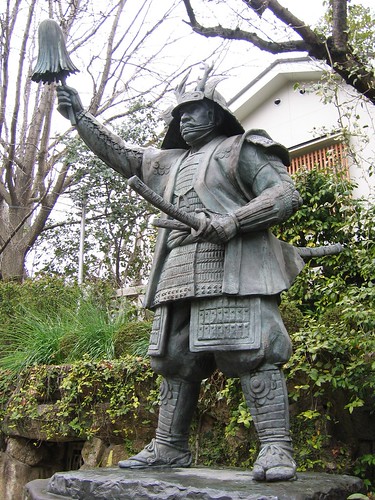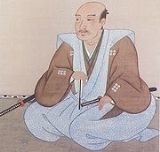
Sanada Yukimura

Encyclopedia
Japanese people
The are an ethnic group originating in the Japanese archipelago and are the predominant ethnic group of Japan. Worldwide, approximately 130 million people are of Japanese descent; of these, approximately 127 million are residents of Japan. People of Japanese ancestry who live in other countries...
samurai
Samurai
is the term for the military nobility of pre-industrial Japan. According to translator William Scott Wilson: "In Chinese, the character 侍 was originally a verb meaning to wait upon or accompany a person in the upper ranks of society, and this is also true of the original term in Japanese, saburau...
, second son of the Sengoku period
Sengoku period
The or Warring States period in Japanese history was a time of social upheaval, political intrigue, and nearly constant military conflict that lasted roughly from the middle of the 15th century to the beginning of the 17th century. The name "Sengoku" was adopted by Japanese historians in reference...
daimyo
Daimyo
is a generic term referring to the powerful territorial lords in pre-modern Japan who ruled most of the country from their vast, hereditary land holdings...
Sanada Masayuki
Sanada Masayuki
was a Japanese Sengoku period daimyo. He was the third son of Sanada Yukitaka, a vassal daimyo to the Takeda family in Shinano province. He is known as a master strategist. Sanada Nobuyuki and Sanada Yukimura were his sons.-Biography:...
(1544–1611). His proper name was Sanada Nobushige (真田 信繁), named after Takeda Shingen
Takeda Shingen
, of Kai Province, was a preeminent daimyo in feudal Japan with exceptional military prestige in the late stage of the Sengoku period.-Name:Shingen was called "Tarō" or "Katsuchiyo" during his childhood...
's younger brother Takeda Nobushige
Takeda Nobushige
was a samurai of Japan's Sengoku period, and younger brother of Takeda Shingen. Takeda Nobushige held the favor of their father, and was meant to inherit the Takeda lands, wealth and power, becoming head of the clan. However, Shingen rebelled against their father and seized the lands and power for...
, who was a brave and respected warrior. He and his father were known as being excellent military tacticians. Though their army was very small, they won many battles in which they were outnumbered. Sanada Yukimura was called "A Hero who may appear once in hundred years" and "crimson demon of war", and the famed veteran of the invasion of Korea Shimazu Tadatsune
Shimazu Tadatsune
was a tozama daimyo of Satsuma, the first to hold it as a formal fief under the Tokugawa shogunate, and the first Japanese to rule over the Ryūkyū Kingdom...
called him the .
Life
He was the second son of Sanada Masayuki, his elder brother being Sanada NobuyukiSanada Nobuyuki
was a Japanese samurai of the Sengoku period. He was the son of daimyo Sanada Masayuki and the older brother of Sanada Yukimura.-Biography:At an early age, Nobuyuki's father served under the daimyo Takeda Shingen and sent Nobuyuki as a hostage to prove the Sanada clan's loyalty to the Takeda clan...
. He was married to Akihime, (Chikurinin) a foster-daughter of Ōtani Yoshitsugu
Otani Yoshitsugu
was a Japanese samurai of the Sengoku period though Azuchi-Momoyama Period. He was also known by his court title, . He was born in 1559 to a father who was said to be a retainer of either Ōtomo Sōrin or of Rokkaku Yoshikata. He become one of Toyotomi Hideyoshi's followers...
. They had two sons, Daisuke (Yukimasa) and Daihachi (Morinobu).
In 1575, the Battle of Nagashino
Battle of Nagashino
The ' took place in 1575 near Nagashino Castle on the plain of Shitaragahara in the Mikawa province of Japan. Forces under Takeda Katsuyori had besieged the castle since the 17th of June; Okudaira Sadamasa , a Tokugawa vassal, commanded the defending force...
claimed the lives of two of Sanada Masayuki's elder brothers. Masayuki, previously serving Takeda Shingen and Takeda Katsuyori
Takeda Katsuyori
was a Japanese daimyo of the Sengoku Period, who was famed as the head of the Takeda clan and the successor to the legendary warlord Takeda Shingen. He was the son of Shingen by the , the daughter of Suwa Yorishige...
as a retainer, inherited the Sanada clan and left for Ueda Castle
Ueda Castle
Ueda Castle was the original home of the Sanada clan, built by Sanada Masayuki.It was this castle that the Sanada defended twice from the Tokugawa, first in 1583 and again in 1600, putting up a very impressive defense both of those times....
. Yukimura also went, taking the Sanada name as well.
By 1582, the Oda
Oda clan
The was a family of Japanese daimyo who were to become an important political force in the unification of Japan in the mid-16th century. Though they had the climax of their fame under Oda Nobunaga and fell from the spotlight soon after, several branches of the family would continue on as daimyo...
-Tokugawa
Tokugawa clan
The was a powerful daimyo family of Japan. They nominally descended from Emperor Seiwa and were a branch of the Minamoto clan by the Nitta clan. However, the early history of this clan remains a mystery.-History:...
forces had destroyed the Takeda clan. The Sanada initially surrendered to Oda Nobunaga
Oda Nobunaga
was the initiator of the unification of Japan under the shogunate in the late 16th century, which ruled Japan until the Meiji Restoration in 1868. He was also a major daimyo during the Sengoku period of Japanese history. His opus was continued, completed and finalized by his successors Toyotomi...
, but, after the Incident at Honnōji
Incident at Honnoji
The ' refers to the forced suicide on June 21, 1582 of Japanese daimyo Oda Nobunaga at the hands of his samurai general Akechi Mitsuhide. This occurred in Honnō-ji, a temple in Kyoto, ending Nobunaga's quest to consolidate centralized power in Japan under his authority.-Context:Oda Nobunaga was at...
, it became independent again, drifting between stronger daimyo such as the Uesugi clan
Uesugi clan
The was a Japanese samurai clan, descended from the Fujiwara clan and particularly notable for their power in the Muromachi and Sengoku periods ....
, the Late Hōjō clan
Late Hojo clan
The ' was one of the most powerful warrior clans in Japan in the Sengoku period and held domains primarily in the Kantō region.The clan is traditionally reckoned to be started by Ise Shinkurō, who came from a branch of the prestigious Ise clan, a family in the direct employment of the Ashikaga...
, and the Tokugawa clan. Eventually, the Sanada clan became a vassal of Toyotomi Hideyoshi
Toyotomi Hideyoshi
was a daimyo warrior, general and politician of the Sengoku period. He unified the political factions of Japan. He succeeded his former liege lord, Oda Nobunaga, and brought an end to the Sengoku period. The period of his rule is often called the Momoyama period, named after Hideyoshi's castle...
. During this period, Hideyoshi treated Yukimura with extreme care and hospitality. Hideyoshi's fondness is shown by the fact that Yukimura was given the right to use the surname of Toyotomi, which was the clan of the Kanpaku during that period. Thus, he is sometimes referred to (even by Yukimura himself) as Toyotomi Saemon-no-suke Nobushige (豊臣 左衛門佐 信繁).
In 1600, before the Battle of Sekigahara
Battle of Sekigahara
The , popularly known as the , was a decisive battle on October 21, 1600 which cleared the path to the Shogunate for Tokugawa Ieyasu...
, Tokugawa Ieyasu
Tokugawa Ieyasu
was the founder and first shogun of the Tokugawa shogunate of Japan , which ruled from the Battle of Sekigahara in 1600 until the Meiji Restoration in 1868. Ieyasu seized power in 1600, received appointment as shogun in 1603, abdicated from office in 1605, but...
rallied various daimyo to attack Uesugi Kagekatsu
Uesugi Kagekatsu
was a daimyo during the Sengoku and Edo periods of Japanese history. The son of Nagao Masakage and husband of Uesugi Kenshin's elder sister, Aya-Gozen. After his father died, he was adopted by Kenshin....
. The Sanada clan complied as well, but when Ishida Mitsunari
Ishida Mitsunari
Ishida Mitsunari was a samurai who led the Western army in the Battle of Sekigahara following the Azuchi-Momoyama period of the 17th century. Also known by his court title, Jibunoshō...
decided to challenge Ieyasu, Masayuki and Yukimura joined the western forces, parting ways with Masayuki's eldest son and Yukimura's brother, Nobuyuki (真田 信之, originally 真田 信幸), who joined the eastern forces. It has been said at first Yukimura followed Ieyasu but, after Ieyasu tried to seize his territory he betrayed Ieyasu. The true motive of Masayuki and Yukimura's decision is disputed with many theories, but there are two main schools of thought: In one, Masayuki made the decision (and Yukimura agreed); he expressed the willingness to take a gamble, so that if he were to join the weak side and win the battle, the Sanada would gain much more power. The other theory is the opposite where they planned a safety net; Masayuki, Yukimura, and Nobuyuki discussed the situation when Ieyasu asked them to state their allegiance clearly, and they decided to join both sides separately, so that, regardless of the outcome of the battle, the Sanada clan would survive.
The Sanada retreated and fortified Ueda Castle. When Tokugawa Hidetada
Tokugawa Hidetada
was the second shogun of the Tokugawa dynasty, who ruled from 1605 until his abdication in 1623. He was the third son of Tokugawa Ieyasu, the first shogun of the Tokugawa shogunate.-Early life :...
marched a sizeable army on the Nakasendō
Nakasendo
The , also called the , was one of the five routes of the Edo period, and one of the two that connected Edo to Kyoto in Japan. There were 69 stations between Edo and Kyoto, crossing through Musashi, Kōzuke, Shinano, Mino and Ōmi provinces...
, the Sanada resisted and were able to fight back Hidetada's 40,000 men with only 2,000. However, as it took much longer to take the castle than was expected, Hidetada lost focus and never showed up on the battlefield during the Battle of Sekigahara
Battle of Sekigahara
The , popularly known as the , was a decisive battle on October 21, 1600 which cleared the path to the Shogunate for Tokugawa Ieyasu...
where the main force was awaiting the arrival of his crucial army, a mistake that put the Tokugawa clan in jeopardy. After the battle, his territory was seized but he gathered an army in secret and rose when the Winter Battle of Castle Osaka broke out in 1615.
Siege of Osaka Castle

Siege of Osaka
The was a series of battles undertaken by the Tokugawa shogunate against the Toyotomi clan, and ending in that clan's destruction. Divided into two stages , and lasting from 1614 to 1615, the siege put an end to the last major armed opposition to the shogunate's establishment...
was a series of battles undertaken by the Tokugawa shougunate against the Toyotomi clan, and ending in that clan’s destruction. Divided into two stages (Winter Campaign and Summer Campaign), lasting from 1614 to 1615, the siege put an end to the last major armed opposition to the shogunate’s establishment. The end of the conflict is sometimes referred to as the Genna Armistice (Genna Enbu), because the era name was changed from Keicho to Genna immediately following the siege.
Winter siege of Osaka Castle
The siege began on November 19, 1614 and lasted until January 22, 1615, when Ieyasu led three thousand men across the Kizu River, destroying the fort there. A week later, he attacked the village of Imafuku with 1,500 men against a defending force of 600. With the aid of a squad of arquebuses, the Tokugawa claimed victory once again. Several more small forts and villages were attacked before the siege on Osaka Castle itself began on December 4, 1614. Yukimura built a small fortress called Sanada-maru in the southwest of the Osaka Castle. The Sanada-maru was an earthwork barbician defended by 7000 men under Yukimura's command. From there, he defeated the Tokugawa forces (approximately 30,000 men) with groups of 6000 arquebusiers. The Shogun's forces were repeatedly repelled, and the Sanada troops launched a number of attacks against the siege lines, breaking through three times. Ieyasu then resorted to artillery (including 17 imported European cannons and domestic wrought iron cannons) as well as men employed to dig under the walls of the fortress. The fortress was impregnable; the Tokugawa suffered many losses.Ieyasu gave up trying to destroy the castle during this battle, and sued for peace with Toyotomi Hideyori. He proposed a condition for the reconciliation, i.e. to destroy the outer moat of the castle. When his envoy came into the castle, they destroyed not only the outer moat but the inner moat as well.
Summer siege of Osaka Castle
In the next year April 1615, Ieyasu received information that Toyotomi HideyoriToyotomi Hideyori
was the son and designated successor of Toyotomi Hideyoshi, the general who first united all of Japan. His mother, Yodo-dono, was the niece of Oda Nobunaga....
was gathering forces to rebuild the castle moat. Toyotomi forces (often referred to as the western army) began to attack contingents of the Shogun's forces (often referred to as the eastern army) near Osaka. On April 29, 1615 Commanded by Ban Danemon they raided Wakayama Castle, a coastal fortress belonging to Asano Nagakira, an ally of the Shogun. Asano's men came forth from the castle and drove off the invaders. Ieyasu gathered his vast armies, and attack the castle again. Yukimura fought the army of Date Masamune
Date Masamune
was a regional strongman of Japan's Azuchi-Momoyama period through early Edo period. Heir to a long line of powerful daimyo in the Tōhoku region, he went on to found the modern-day city of Sendai...
on May 6, 1615. Yukimura's army was out numbered and he was defeated by Masamune's army. The next day he and a few soldiers assaulted the camp of Ieyasu directly. He closed in on Ieyasu only to have his assault stopped at the last minute. By early June, the Eastern army had arrived, before Hideyori managed to secure any land to use against them. On June 2, 1615, at the Battle of Domyoji
Battle of Domyoji
On June 3, 1615 the Eastern Army of Tokugawa Ieyasu and the Osaka Army of Toyotomi Hideyori clashed in battle at Dōmyōji , Osaka. This battle was one of Japan's major historical battles between samurai forces...
2,600 men from the western army ecountered 23,000 of the eastern army. Hideyori's commander at the castle, Gotō Matabei attempted to retreat into the fog, but the battle was lost and he was killed. After this, Tokugawa forces intercepted those of Sanada Yukimura at Honta-Ryo. Sanada tried to force a battle with Date Masamune
Date Masamune
was a regional strongman of Japan's Azuchi-Momoyama period through early Edo period. Heir to a long line of powerful daimyo in the Tōhoku region, he went on to found the modern-day city of Sendai...
, but Date's retainer Katakura Shigenaga
Katakura Shigenaga
was a Japanese samurai of the Azuchi-Momoyama period through early Edo period. The son of Katakura Kagetsuna, Shigenaga was the 2nd man to bear the common name Kojūrō. His name was originally Shigetsuna; however, to avoid conflict with the 4th shogun Ietsuna's name, he changed it to Shigenaga...
retreated since his troops were exhausted; Sanada's forces followed suit. On June 3, 1615, at the Battle of Domyoji
Battle of Domyoji
On June 3, 1615 the Eastern Army of Tokugawa Ieyasu and the Osaka Army of Toyotomi Hideyori clashed in battle at Dōmyōji , Osaka. This battle was one of Japan's major historical battles between samurai forces...
(also known as the battle of the tombs) Sanada Yukimura was in command of the Western army on the right side of Susukida Kanesuke and was taken on by Date Masamune
Date Masamune
was a regional strongman of Japan's Azuchi-Momoyama period through early Edo period. Heir to a long line of powerful daimyo in the Tōhoku region, he went on to found the modern-day city of Sendai...
in the area of Emperor Ojin's Tomb and Konda Hachiman Shrine. Later into the fight Sanada Yukimura made the decision to begin a retreat towards Osaka Castle having already lost a powerful commander earlier in the day. Tokugawa Tadateru the sixth son of Tokugawa Ieyasu was given the order to pursue Sanada but, he refused. This action would later lead to his exile at Koyasan. After being allowed to return to the Eastern army, he would die later during another assault on Osaka Castle
Osaka Castle
is a Japanese castle in Chūō-ku, Osaka, Japan.Originally called Ozakajō, it is one of Japan's most famous castles, and played a major role in the unification of Japan during the sixteenth century of the Azuchi-Momoyama period.-Description:...
. Given the time he needed Sanada's forces were able to successfully retreat from the Eastern army.
Battle of Tennoji-guchi
The Battle of Tennoji(guchi) was fought on June 4, 1615. This would be the last battle of the Siege of OsakaSiege of Osaka
The was a series of battles undertaken by the Tokugawa shogunate against the Toyotomi clan, and ending in that clan's destruction. Divided into two stages , and lasting from 1614 to 1615, the siege put an end to the last major armed opposition to the shogunate's establishment...
and the final battle for Sanada Yukimura. Greatly outnumbered by Tokugawa forces, Yukimura's forces were eventually defeated. According to "The Life of Shogun Tokugawa Ieyasu" by A.L. Sadler, in his intense fight against the wavering Echizen troops, Yukimura was badly wounded, leaving him exhausted. Soldiers from the Echizen army quickly went to Sanada. Now too tired to fight back, Yukimura allowed the men to kill him, reportedly saying, "I am Sanada Nobushige, no doubt an adversary quite worthy of you, but I am exhausted and can fight no longer. Go on, take my head as your trophy". A man by the name of Nishio Nizaemon chopped off Sanada’s head. His grave is now located in Osaka, marked by the Yasui Shrine located to the west of Shitennoji Temple.
Legend and popular depiction
A fact about Sanada Yukimura is that, in primary historical sources and personal letters penned by himself, he was never referred to as Yukimura. That name surfaced in a military novel written during the Edo periodEdo period
The , or , is a division of Japanese history which was ruled by the shoguns of the Tokugawa family, running from 1603 to 1868. The political entity of this period was the Tokugawa shogunate....
and has since been popularized in modern plays, books, novels, and different media of entertainment. The historical documents use his historical name "Nobushige", but his pen name "Yukimura" was never mentioned. One theory is that the name Yukimura is a portmanteau of Masayuki (his father) and Date Tsunamura
Date Tsunamura
was a daimyo in mid-17th century Tokugawa Japan whose life was at the center of the Date Sōdō or "Date Disturbance", a very famous noble conflict of the period....
.
A legend says that Yukimura had ten heroes who took an active role at the battles of Osaka Castle. They were called the Sanada Ten Braves
Sanada Ten Braves
The are a legendary group of ninja that assisted the warlord Sanada Yukimura during the Warring States era of Japan ....
, a group of ninja, and consisted of the following members:
- Sarutobi SasukeSarutobi Sasukewas a famous ninja in Japanese folklore. He is generally believed to be a Meiji period fictional creation based on the historical ninja ', although some argue for his actual existence.- In folklore :...
- Kirigakure SaizoKirigakure Saizo' was a legendary ninja of the final phase of the Japanese civil war. In the folklore he is one of the Sanada Ten Braves, and next to Sarutobi Sasuke, he is the most recognized of the Ten....
- Miyoshi SeikaiSanada Ten BravesThe are a legendary group of ninja that assisted the warlord Sanada Yukimura during the Warring States era of Japan ....
- Miyoshi IsaSanada Ten BravesThe are a legendary group of ninja that assisted the warlord Sanada Yukimura during the Warring States era of Japan ....
- Anayama KosukeSanada Ten BravesThe are a legendary group of ninja that assisted the warlord Sanada Yukimura during the Warring States era of Japan ....
- Unno RokuroSanada Ten BravesThe are a legendary group of ninja that assisted the warlord Sanada Yukimura during the Warring States era of Japan ....
- Kakei JuzoSanada Ten BravesThe are a legendary group of ninja that assisted the warlord Sanada Yukimura during the Warring States era of Japan ....
- Nezu JinpachiSanada Ten BravesThe are a legendary group of ninja that assisted the warlord Sanada Yukimura during the Warring States era of Japan ....
- Mochizuki RokuroSanada Ten BravesThe are a legendary group of ninja that assisted the warlord Sanada Yukimura during the Warring States era of Japan ....
- Yuri KamanosukeSanada Ten BravesThe are a legendary group of ninja that assisted the warlord Sanada Yukimura during the Warring States era of Japan ....