


Hard disk

Encyclopedia
A hard disk drive is a non-volatile, random access
digital magnetic
data storage device
. It features rotating rigid platters on a motor-driven spindle within a protective enclosure. Data is magnetically read from and written to the platter by read/write heads
that float on a film of air above the platters. Introduced by IBM
in 1956, hard disk drives have decreased in cost and physical size over the years while dramatically increasing in capacity.
Hard disk drives have been the dominant device for secondary storage of data in general purpose computers
since the early 1960s. They have maintained this position because advances in their recording density have kept pace with the requirements for secondary storage. Today's HDDs operate on high-speed serial interfaces; i.e., serial ATA
(SATA) or serial attached SCSI
(SAS).
and mini
computers.
As the 1980s began, hard disk drives were a rare and very expensive additional feature on personal computers (PCs); however by the late '80s, hard disk drives were standard on all but the cheapest PC.
Most hard disk drives in the early 1980s were sold to PC end users as an add on subsystem, not under the drive manufacturer's name but by systems integrators such as the Corvus Disk System or the systems manufacturer such as the Apple ProFile. The IBM PC/XT in 1983 included an internal standard 10MB hard disk drive, and soon thereafter internal hard disk drives proliferated on personal computers.
External hard disk drives remained popular for much longer on the Apple Macintosh. Every Mac made between 1986 and 1998 has a SCSI port on the back, making external expansion easy; also, "toaster" Compact Macs did not have easily accessible hard drive bays (or, in the case of the Mac Plus, any hard drive bay at all), so on those models, external SCSI disks were the only reasonable option.
Driven by areal density doubling every two to four years since their invention, HDDs have changed in many ways. A few highlights include:
material directionally. Sequential changes in the direction of magnetization represent patterns of binary data bits
. The data are read from the disk by detecting the transitions in magnetization and decoding the originally written data. Different encoding schemes, such as modified frequency modulation
, group code recording
, run-length limited encoding, and others are used.
A typical HDD design consists of a spindle that holds flat circular disks, also called platters
, which hold the recorded data. The platters are made from a non-magnetic material, usually aluminum alloy, glass, or ceramic, and are coated with a shallow layer of magnetic material typically 10–20 nm in depth, with an outer layer of carbon for protection. For reference, a standard piece of copy paper is 0.07–0.18 mm (70,000–180,000 nm).
 The platters in contemporary HDDs are spun at speeds varying from 4200 rpm in energy-efficient portable devices, to 15,000 rpm for high performance servers. The first hard drives spun at 1200 rpm , and for many years, 3600 rpm was the norm. Information is written to, and read from a platter as it rotates past devices called read-and-write head
s that operate very close (tens of nanometers in new drives) over the magnetic surface. The read-and-write head is used to detect and modify the magnetization of the material immediately under it. In modern drives there is one head for each magnetic platter surface on the spindle, mounted on a common arm. An actuator arm (or access arm) moves the heads on an arc (roughly radially) across the platters as they spin, allowing each head to access almost the entire surface of the platter as it spins. The arm is moved using a voice coil
actuator or in some older designs a stepper motor
.
The magnetic surface of each platter is conceptually divided into many small sub-micrometer
-sized magnetic regions referred to as magnetic domains
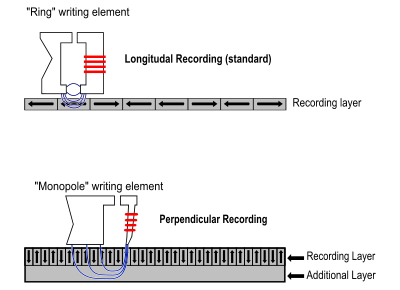
. In older disk designs the regions were oriented horizontally and parallel to the disk surface, but beginning about 2005, the orientation was changed to perpendicular
to allow for closer magnetic domain spacing. Due to the polycrystalline nature of the magnetic material each of these magnetic regions is composed of a few hundred magnetic grains
. Magnetic grains are typically 10 nm in size and each form a single magnetic domain
. Each magnetic region in total forms a magnetic dipole
which generates a magnetic field
.
For reliable storage of data, the recording material needs to resist self-demagnetization, which occurs when the magnetic domains repel each other. Magnetic domains written too densely together to a weakly magnetizable material will degrade over time due to physical rotation of one or more domains to cancel out these forces. The domains rotate sideways to a halfway position that weakens the readability of the domain and relieves the magnetic stresses. Older hard disks used iron(III) oxide
as the magnetic material, but current disks use a cobalt
-based alloy.
A write head magnetizes a region by generating a strong local magnetic field. Early HDDs used an electromagnet
both to magnetize the region and to then read its magnetic field by using electromagnetic induction
. Later versions of inductive heads included metal in Gap (MIG) heads and thin film
heads. As data density increased, read heads using magnetoresistance
(MR) came into use; the electrical resistance of the head changed according to the strength of the magnetism from the platter. Later development made use of spintronics
; in these heads, the magnetoresistive effect was much greater than in earlier types, and was dubbed "giant" magnetoresistance (GMR). In today's heads, the read and write elements are separate, but in close proximity, on the head portion of an actuator arm. The read element is typically magneto-resistive while the write element is typically thin-film inductive.
The heads are kept from contacting the platter surface by the air that is extremely close to the platter; that air moves at or near the platter speed. The record and playback head are mounted on a block called a slider, and the surface next to the platter is shaped to keep it just barely out of contact. This forms a type of air bearing.
In modern drives, the small size of the magnetic regions creates the danger that their magnetic state might be lost because of thermal effects. To counter this, the platters are coated with two parallel magnetic layers, separated by a 3-atom layer of the non-magnetic element ruthenium
, and the two layers are magnetized in opposite orientation, thus reinforcing each other. Another technology used to overcome thermal effects to allow greater recording densities is perpendicular recording
, first shipped in 2005, and as of 2007 the technology was used in many HDDs.
The disk motor has an external rotor attached to the disks; the stator windings are fixed in place.
Opposite the actuator at the end of the head support arm is the read-write head (near center in photo); thin printed-circuit cables connect the read-write heads to amplifier electronics mounted at the pivot of the actuator. A flexible, somewhat U-shaped, ribbon cable, seen edge-on below and to the left of the actuator arm continues the connection to the controller board on the opposite side.
The head support arm is very light, but also stiff; in modern drives, acceleration at the head reaches 550 g
.
The silver-colored structure at the upper left of the first image is the top plate of the actuator, a permanent-magnet and moving coil motor that swings the heads to the desired position (it is shown removed in the second image). The plate supports a squat neodymium-iron-boron
(NIB) high-flux magnet
. Beneath this plate is the moving coil, often referred to as the voice coil
by analogy to the coil in loudspeaker
s, which is attached to the actuator hub, and beneath that is a second NIB magnet, mounted on the bottom plate of the motor (some drives only have one magnet).
The voice coil itself is shaped rather like an arrowhead, and made of doubly coated copper magnet wire
. The inner layer is insulation, and the outer is thermoplastic, which bonds the coil together after it is wound on a form, making it self-supporting. The portions of the coil along the two sides of the arrowhead (which point to the actuator bearing center) interact with the magnetic field
, developing a tangential force that rotates the actuator. Current flowing radially outward along one side of the arrowhead and radially inward on the other produces the tangential force. If the magnetic field were uniform, each side would generate opposing forces that would cancel each other out. Therefore the surface of the magnet is half N pole, half S pole, with the radial dividing line in the middle, causing the two sides of the coil to see opposite magnetic fields and produce forces that add instead of canceling. Currents along the top and bottom of the coil produce radial forces that do not rotate the head.
. These techniques store extra bits for each block of data that are determined by mathematical formulas. The extra bits allow many errors to be fixed. While these extra bits take up space on the hard drive, they allow higher recording densities to be employed, resulting in much larger storage capacity for user data. In 2009, in the newest drives, low-density parity-check code
s (LDPC) are supplanting Reed-Solomon. LDPC codes enable performance close to the Shannon Limit and thus allow for the highest storage density available.
Typical hard drives attempt to "remap" the data in a physical sector that is going bad to a spare physical sector—hopefully while the errors in that bad sector are still few enough that the ECC can recover the data without loss. The S.M.A.R.T. system counts the total number of errors in the entire hard drive fixed by ECC, and the total number of remappings, in an attempt to predict hard drive failure.
October 2011: TDK
has developed a special laser that heats up a hard's disk's surface with a precision of a few dozen nanometers. TDK also used the new material in the magnetic head and redesigned its structure to expand the recording density. This new technology apparently makes it possible to store one terabyte
on one platter and for the initial hard drive TDK plans to include two platters.
The capacity of hard disk drives is given by manufacturers in megabyte
s (1 MB = 1,000,000 bytes), gigabyte
s (1 GB = 1,000,000,000 bytes) or terabyte
s (1 TB = 1,000,000,000,000 bytes). This numbering convention, where prefixes like mega- and giga- denote powers of 1000, is also used for data transmission rates and DVD capacities. However, the convention is different from that used by manufacturers of memory (RAM
, ROM
) and CDs, where prefixes like kilo- and mega- mean powers of 1024.
When the unit prefixes
like kilo- denote powers of 1024 in the measure of memory capacities, the 1024n progression (for n = 1, 2, …) is as follows:
and so forth.
The practice of using prefixes assigned to powers of 1000 within the hard drive and computer industries dates back to the early days of computing. By the 1970s million, mega and M were consistently being used in the powers of 1000 sense to describe HDD capacity. As HDD sizes grew the industry adopted the prefixes “G” for giga and “T” for tera denoting 1,000,000,000 and 1,000,000,000,000 bytes of HDD capacity respectively.
Likewise, the practice of using prefixes assigned to powers of 1024 within the computer industry also traces its roots to the early days of computing By the early 1970s using the prefix “K” in a powers of 1024 sense to describe memory was common within the industry. As memory sizes grew the industry adopted the prefixes “M” for mega and “G” for giga denoting 1,048,576 and 1,073,741,824 bytes of memory respectively.
Computers do not internally represent HDD or memory capacity in powers of 1024; reporting it in this manner is just a convention. Creating confusion, operating systems report HDD capacity in different ways. Most operating systems, including the Microsoft Windows
operating systems use the powers of 1024 convention when reporting HDD capacity, thus an HDD offered by its manufacturer as a 1 TB drive is reported by these OSes as a 931 GB HDD. Apple's current OSes, beginning with Mac OS X 10.6 (“Snow Leopard”), use powers of 1000 when reporting HDD capacity, thereby avoiding any discrepancy between what it reports and what the manufacturer advertises.
In the case of “mega-,” there is a nearly 5% difference between the powers of 1000 definition and the powers of 1024 definition. Furthermore, the difference is compounded by 2.4% with each incrementally larger prefix (gigabyte, terabyte, etc.) The discrepancy between the two conventions for measuring capacity was the subject of several class action suits against HDD manufacturers. The plaintiffs argued that the use of decimal measurements effectively misled consumers while the defendants denied any wrongdoing or liability, asserting that their marketing and advertising complied in all respects with the law and that no Class Member sustained any damages or injuries.
In December 1998, an international standards organization
attempted to address these dual definitions of the conventional prefixes by proposing unique binary prefixes and prefix symbols to denote multiples of 1024, such as “mebibyte
(MiB)”, which exclusively denotes 220 or 1,048,576 bytes. In the over that have since elapsed, the proposal has seen little adoption by the computer industry and the conventionally prefixed forms of “byte” continue to denote slightly different values depending on context.
. This may differ substantially from the drive's native interface particularly in mainframes
or servers.
Modern HDDs, such as SAS
and SATA
drives, appear at their interfaces as a contiguous set of logical blocks; typically 512 bytes long but the industry is in the process of changing to 4,096 byte logical blocks; see Advanced Format
.
The process of initializing these logical blocks on the physical disk platters is called low level formatting which is usually performed at the factory and is not normally changed in the field.
High level formatting then writes the file system
structures into selected logical blocks to make the remaining logical blocks available to the host OS
and its applications. The operating system file system
uses some of the disk space to organize files on the disk, recording their file names and the sequence of disk areas that represent the file. Examples of data structures stored on disk to retrieve files include the MS DOS file allocation table
(FAT), and UNIX
inodes, as well as other operating system data structures. As a consequence not all the space on a hard drive is available for user files. This file system overhead is usually less than 1% on drives larger than 100 MB.
In some systems, there may be hidden partitions
used for system recovery that reduce the capacity available to the end user.
For RAID
drives, data integrity and fault-tolerance requirements also reduce the realized capacity. For example, a RAID1 drive will be about half the total capacity as a result of data mirroring. For RAID5 drives with x drives you would lose 1/x of your space to parity. RAID drives are multiple drives that appear to be one drive to the user, but provides some fault-tolerance. Most RAID vendors use some form of checksum
s to improve data integrity at the block level. For many vendors, this involves using HDDs with sectors of 520 bytes per sector to contain 512 bytes of user data and 8 checksum bytes or using separate 512 byte sectors for the checksum data.
 Because modern disk drives appear to their interface as a contiguous set of logical blocks their gross capacity can be calculated by multiplying the number of blocks by the size of the block. This information is available from the manufacturers specification and from the drive itself through use of special utilities invoking low level commands
The gross capacity of older HDDs can be calculated by multiplying for each zone
of the drive the number of cylinders
by the number of heads by the number of sectors/zone
by the number of bytes/sector (most commonly 512) and then summing the totals for all zones. Some modern ATA
drives will also report cylinder, head, sector
(C/H/S) values to the CPU but they are no longer actual physical parameters since the reported numbers are constrained by historic operating-system interfaces.
The old C/H/S scheme has been replaced by logical block addressing
. In some cases, to try to "force-fit" the C/H/S scheme to large-capacity drives, the number of heads was given as 64, although no modern drive has anywhere near 32 platters.

Mainframe and minicomputer hard disks were of widely varying dimensions, typically in free standing cabinets the size of washing machines (e.g. HP 7935
and DEC RP06 Disk Drives) or designed so that dimensions enabled placement in a 19" rack (e.g. Diablo Model 31). In 1962, IBM
introduced its model 1311 disk, which used 14 inch (nominal size) platters. This became a standard size for mainframe and minicomputer drives for many years, but such large platters were never used with microprocessor-based systems.
With increasing sales of microcomputers having built in floppy-disk drives (FDDs)
, HDDs that would fit to the FDD mountings became desirable, and this led to the evolution of the market towards drives with certain Form factors, initially derived from the sizes of 8-inch, 5.25-inch, and 3.5-inch floppy disk drives. Smaller sizes than 3.5 inches have emerged as popular in the marketplace and/or been decided by various industry groups.
3.5-inch and 2.5-inch hard disks currently dominate the market.
By 2009 all manufacturers had discontinued the development of new products for the 1.3-inch, 1-inch and 0.85-inch form factors due to falling prices of flash memory
, which is slightly more stable and resistant to damage from impact and/or dropping.
The inch-based nickname of all these form factors usually do not indicate any actual product dimension (which are specified in millimeters for more recent form factors), but just roughly indicate a size relative to disk diameters, in the interest of historic continuity.
) are mostly related to the mechanical nature of the rotating disks and moving heads. Seek time is a measure of how long it takes the head assembly to travel to the track of the disk that contains data. Rotational latency is incurred because the desired disk sector may not be directly under the head when data transfer is requested. These two delays are on the order of milliseconds each. The bit rate
or data transfer rate once the head is in the right position creates delay which is a function of the number of blocks transferred; typically relatively small, but can be quite long with the transfer of large contiguous files. Delay may also occur if the drive disks are stopped to save energy, see Power management.
An HDD's Average Access Time is its average Seek time which technically is the time to do all possible seeks divided by the number of all possible seeks, but in practice is determined by statistical methods or simply approximated as the time of a seek over one-third of the number of tracks
Defragmentation
is a procedure used to minimize delay in retrieving data by moving related items to physically proximate areas on the disk. Some computer operating systems perform defragmentation automatically. Although automatic defragmentation is intended to reduce access delays, the procedure can slow response when performed while the computer is in use.
Access time
can be improved by increasing rotational speed, thus reducing latency and/or by decreasing seek time. Increasing areal density increases throughput
by increasing data rate and by increasing the amount of data under a set of heads, thereby potentially reducing seek activity for a given amount of data. Based on historic trends, analysts predict a future growth in HDD areal density (and therefore capacity) of about 40% per year. Access times have not kept up with throughput increases, which themselves have not kept up with growth in storage capacity.
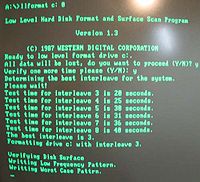 Sector interleave is a mostly obsolete device characteristic related to access time, dating back to when computers were too slow to be able to read large continuous streams of data. Interleaving introduced gaps between data sectors to allow time for slow equipment to get ready to read the next block of data. Without interleaving, the next logical sector would arrive at the read/write head before the equipment was ready, requiring the system to wait for another complete disk revolution before reading could be performed.
However, because interleaving introduces intentional physical delays into the drive mechanism, setting the interleave to a ratio higher than required causes unnecessary delays for equipment that has the performance needed to read sectors more quickly. The interleaving ratio was therefore usually chosen by the end-user to suit their particular computer system's performance capabilities when the drive was first installed in their system.
Modern technology is capable of reading data as fast as it can be obtained from the spinning platters, so hard drives usually have a fixed sector interleave ratio of 1:1, which is effectively no interleaving being used.
for high-end server drives, to 15 ms for mobile drives, with the most common mobile drives at about 12 ms
and the most common desktop type typically being around 9 ms.
The first HDD had an average seek time of about 600 ms and by the middle 1970s HDDs were available with seek times of about 25 ms. Some early PC drives used a stepper motor
to move the heads, and as a result had seek times as slow as 80–120 ms, but this was quickly improved by voice coil
type actuation in the 1980s, reducing seek times to around 20 ms. Seek time has continued to improve slowly over time.
Some desktop and laptop computer systems allow the user to make a tradeoff between seek performance and drive noise. Faster seek rates typically require more energy usage to quickly move the heads across the platter, causing loud noises from the pivot bearing and greater device vibrations as the heads are rapidly accelerated during the start of the seek motion and decelerated at the end of the seek motion. Quiet operation reduces movement speed and acceleration rates, but at a cost of reduced seek performance.
Latency is the delay for the rotation of the disk to bring the required disk sector
under the read-write mechanism. It depends on rotational speed of a disk, measured in revolutions per minute
(rpm). Average rotational latency is shown in the table below, based on the empirical relation that the average latency in milliseconds for such a drive is one-half the rotational period.
" data transfer rate up to 1030
Mbits/sec.
This rate depends on the track location, so it will be higher for data on the outer tracks (where there are more data sectors) and lower toward the inner tracks (where there are fewer data sectors); and is generally somewhat higher for 10,000 rpm drives. A current widely used standard for the "buffer-to-computer" interface is 3.0 Gbit/s SATA, which can send about 300 megabyte/s (10 bit encoding) from the buffer to the computer, and thus is still comfortably ahead of today's disk-to-buffer transfer rates. Data transfer rate (read/write) can be measured by writing a large file to disk using special file generator tools, then reading back the file. Transfer rate can be influenced by file system fragmentation
and the layout of the files.
HDD data transfer rate depends upon the rotational speed of the platters and the data recording density. Because heat and vibration limit rotational speed, advancing density becomes the main method to improve sequential transfer rates. While areal density advances by increasing both the number of tracks across the disk and the number of sectors per track, only the latter will increase the data transfer rate for a given rpm. Since data transfer rate performance only tracks one of the two components of areal density, its performance improves at a lower rate.
). Heat dissipation is tied directly to power consumption, and as drives age, disk failure rate
s increase at higher drive temperatures. Similar issues exist for large companies with thousands of desktop PCs. Smaller form factor drives often use less power than larger drives. One interesting development in this area is actively controlling the seek speed so that the head arrives at its destination only just in time to read the sector, rather than arriving as quickly as possible and then having to wait for the sector to come around (i.e. the rotational latency). Many of the hard drive companies are now producing Green Drives that require much less power and cooling. Many of these Green Drives spin slower (<5400 rpm compared to 7200, 10,000 or 15,000 rpm) thereby generating less heat. Power consumption can also be reduced by parking the drive heads when the disk is not in use reducing friction, adjusting spin speeds, and disabling internal components when not in use.
Also in systems where there might be multiple hard disk drives, there are various ways of controlling when the hard drives spin up since the highest current is drawn at that time.
, audible noise is significant for certain applications, such as DVR
s, digital audio recording and quiet computers
. Low noise disks typically use fluid bearing
s, slower rotational speeds (usually 5400 rpm) and reduce the seek speed under load (AAM
) to reduce audible clicks and crunching sounds. Drives in smaller form factors (e.g. 2.5 inch) are often quieter than larger drives.
that parks the disk heads if the machine is dropped, hopefully before impact, to offer the greatest possible chance of survival in such an event. Maximum shock tolerance to date is 350 g
for operating and 1000 g for non-operating.
(SATA), SCSI
, Serial Attached SCSI
(SAS), and Fibre Channel
. Bridge circuitry is sometimes used to connect hard disk drives to buses with which they cannot communicate natively, such as IEEE 1394
, USB
and SCSI.
For the ST-506
interface, the data encoding
scheme as written to the disk surface was also important. The first ST-506 disks used Modified Frequency Modulation
(MFM) encoding, and transferred data at a rate of 5 megabit
s per second. Later controllers using 2,7 RLL
(or just "RLL") encoding caused 50% more data to appear under the heads compared to one rotation of an MFM drive, increasing data storage and data transfer rate by 50%, to 7.5 megabits per second.
Many ST-506 interface disk drives were only specified by the manufacturer to run at the 1/3 lower MFM data transfer rate compared to RLL, while other drive models (usually more expensive versions of the same drive) were specified to run at the higher RLL data transfer rate. In some cases, a drive had sufficient margin to allow the MFM specified model to run at the denser/faster RLL data transfer rate (not recommended nor guaranteed by manufacturers). Also, any RLL-certified drive could run on any MFM controller, but with 1/3 less data capacity and as much as 1/3 less data transfer rate compared to its RLL specifications.
Enhanced Small Disk Interface
(ESDI) also supported multiple data rates (ESDI disks always used 2,7 RLL, but at 10, 15 or 20 megabits per second), but this was usually negotiated automatically by the disk drive and controller; most of the time, however, 15 or 20 megabit ESDI disk drives were not downward compatible (i.e. a 15 or 20 megabit disk drive would not run on a 10 megabit controller). ESDI disk drives typically also had jumpers to set the number of sectors per track and (in some cases) sector size.
Modern hard drives present a consistent interface to the rest of the computer, no matter what data encoding scheme is used internally. Typically a DSP
in the electronics inside the hard drive takes the raw analog voltages from the read head and uses PRML and Reed–Solomon error correction
to decode the sector boundaries and sector data, then sends that data out the standard interface. That DSP also watches the error rate detected by error detection and correction
, and performs bad sector
remapping, data collection for Self-Monitoring, Analysis, and Reporting Technology
, and other internal tasks.
SCSI
originally had just one signaling frequency of 5 MHz
for a maximum data rate of 5 megabyte
s/second over 8 parallel conductors, but later this was increased dramatically. The SCSI bus speed had no bearing on the disk's internal speed because of buffering between the SCSI bus and the disk drive's internal data bus; however, many early disk drives had very small buffers, and thus had to be reformatted to a different interleave (just like ST-506 disks) when used on slow computers, such as early Commodore Amiga, IBM PC compatible
s and Apple Macintoshes.
ATA disks have typically had no problems with interleave or data rate, due to their controller design, but many early models were incompatible with each other and could not run with two devices on the same physical cable in a master/slave setup. This was mostly remedied by the mid-1990s, when ATA's specification was standardized and the details began to be cleaned up, but still causes problems occasionally (especially with CD-ROM and DVD-ROM disks, and when mixing Ultra DMA and non-UDMA devices).
Serial ATA does away with master/slave setups entirely, placing each disk on its own channel (with its own set of I/O ports) instead.
FireWire/IEEE 1394 and USB(1.0/2.0/3.0) hard drives consist of enclosures containing generally ATA or Serial ATA disks with built-in adapters to these external buses.
Modern bit serial interfaces connect a hard disk drive to a host bus interface adapter (today typically integrated into the "south bridge
") with one data/control cable. (As for historical bit serial interfaces above, each drive also has an additional power cable, usually direct to the power supply unit.)
Word serial interfaces connect a hard disk drive to a host bus adapter (today typically integrated into the "south bridge
") with one cable for combined data/control. (As for all bit serial interfaces above, each drive also has an additional power cable, usually direct to the power supply unit.) The earliest versions of these interfaces typically had a 8 bit parallel data transfer to/from the drive, but 16-bit versions became much more common, and there are 32 bit versions. Modern variants have serial data transfer. The word nature of data transfer makes the design of a host bus adapter significantly simpler than that of the precursor HDD controller.
—a failure
of the disk in which the head scrapes across the platter surface, often grinding away the thin magnetic film and causing data loss. Head crashes can be caused by electronic failure, a sudden power failure, physical shock, contamination of the drive's internal enclosure, wear and tear, corrosion
, or poorly manufactured platters and heads.
The HDD's spindle system relies on air pressure inside the disk enclosure
to support the heads at their proper flying height while the disk rotates. Hard disk drives require a certain range of air pressures in order to operate properly. The connection to the external environment and pressure occurs through a small hole in the enclosure (about 0.5 mm in breadth), usually with a filter on the inside (the breather filter). If the air pressure is too low, then there is not enough lift for the flying head, so the head gets too close to the disk, and there is a risk of head crashes and data loss. Specially manufactured sealed and pressurized disks are needed for reliable high-altitude operation, above about 3,000 m (10,000 feet). Modern disks include temperature sensors and adjust their operation to the operating environment.
Breather holes can be seen on all disk drives—they usually have a sticker next to them, warning the user not to cover the holes. The air inside the operating drive is constantly moving too, being swept in motion by friction with the spinning platters. This air passes through an internal recirculation (or "recirc") filter to remove any leftover contaminants from manufacture, any particles or chemicals that may have somehow entered the enclosure, and any particles or outgassing generated internally in normal operation.
Very high humidity for extended periods can corrode the heads and platters.
For giant magnetoresistive
(GMR) heads in particular, a minor head crash from contamination (that does not remove the magnetic surface of the disk) still results in the head temporarily overheating, due to friction with the disk surface, and can render the data unreadable for a short period until the head temperature stabilizes (so called "thermal asperity", a problem which can partially be dealt with by proper electronic filtering of the read signal).
. Feedback of the drive electronics is accomplished by means of special segments of the disk dedicated to servo feedback. These are either complete concentric circles (in the case of dedicated servo technology), or segments interspersed with real data (in the case of embedded servo technology). The servo feedback optimizes the signal to noise ratio of the GMR sensors by adjusting the voice-coil of the actuated arm. The spinning of the disk also uses a servo motor. Modern disk firmware is capable of scheduling reads and writes efficiently on the platter surfaces and remapping sectors of the media which have failed.
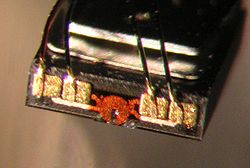 During normal operation heads in HDDs fly above the data recorded on the disks. Modern HDDs prevent power interruptions or other malfunctions from landing its heads in the data zone by either physically moving (parking) the heads to a special landing zone on the platters that is not used for data storage, or by physically locking the heads in a suspended (unloaded) position raised off the platters.
Some early PC HDDs did not park the heads automatically when power was prematurely disconnected and the heads would land on data. In some other early units the user manually parked the heads by running a program to park the HDD's heads.
or, more recently, rotational inertia
in the platters is used to park the heads in the case of unexpected power loss. In this case, the spindle motor
temporarily acts as a generator
, providing power to the actuator.
Spring tension from the head mounting constantly pushes the heads towards the platter. While the disk is spinning, the heads are supported by an air bearing and experience no physical contact or wear. In CSS drives the sliders carrying the head sensors (often also just called heads) are designed to survive a number of landings and takeoffs from the media surface, though wear and tear on these microscopic components eventually takes its toll. Most manufacturers design the sliders to survive 50,000 contact cycles before the chance of damage on startup rises above 50%. However, the decay rate is not linear: when a disk is younger and has had fewer start-stop cycles, it has a better chance of surviving the next startup than an older, higher-mileage disk (as the head literally drags along the disk's surface until the air bearing is established). For example, the Seagate Barracuda 7200.10 series of desktop hard disks are rated to 50,000 start-stop cycles, in other words no failures attributed to the head-platter interface were seen before at least 50,000 start-stop cycles during testing.
Around 1995 IBM pioneered a technology where a landing zone on the disk is made by a precision laser process (Laser Zone Texture = LZT) producing an array of smooth nanometer-scale "bumps" in a landing zone, thus vastly improving stiction
and wear performance. This technology is still largely in use today (2011), predominantly in desktop and enterprise (3.5 inch) drives. In general, CSS technology can be prone to increased stiction (the tendency for the heads to stick to the platter surface), e.g. as a consequence of increased humidity. Excessive stiction can cause physical damage to the platter and slider or spindle motor.
in 1967, to load/unload onto plastic "ramps" near the outer disk edge.
All HDDs today still use one of these two technologies listed above. Each has a list of advantages and drawbacks in terms of loss of storage area on the disk, relative difficulty of mechanical tolerance control, non-operating shock robustness, cost of implementation, etc.
Addressing shock robustness, IBM also created a technology for their ThinkPad
line of laptop computers called the Active Protection System. When a sudden, sharp movement is detected by the built-in accelerometer
in the Thinkpad, internal hard disk heads automatically unload themselves to reduce the risk of any potential data loss or scratch defects. Apple later also utilized this technology in their PowerBook
, iBook
, MacBook Pro
, and MacBook
line, known as the Sudden Motion Sensor
. Sony
, HP with their HP 3D DriveGuard and Toshiba
have released similar technology in their notebook computers.
Most major hard disk and motherboard vendors now support S.M.A.R.T. (Self-Monitoring, Analysis, and Reporting Technology), which measures drive characteristics such as operating temperature
, spin-up time, data error rates, etc. Certain trends and sudden changes in these parameters are thought to be associated with increased likelihood of drive failure and data loss.
However, not all failures are predictable. Normal use eventually can lead to a breakdown in the inherently fragile device, which makes it essential for the user to periodically back up the data onto a separate storage device. Failure to do so can lead to the loss of data. While it may sometimes be possible to recover lost information, it is normally an extremely costly procedure, and it is not possible to guarantee success. A 2007 study published by Google
suggested very little correlation between failure rates and either high temperature or activity level; however, the correlation between manufacturer/model and failure rate was relatively strong. Statistics in this matter is kept highly secret by most entities. Google did not publish the manufacturer's names along with their respective failure rates, though they have since revealed that they use Hitachi Deskstar drives in some of their servers. While several S.M.A.R.T. parameters have an impact on failure probability, a large fraction of failed drives do not produce predictive S.M.A.R.T. parameters. S.M.A.R.T. parameters alone may not be useful for predicting individual drive failures.
A common misconception is that a colder hard drive will last longer than a hotter hard drive.
The Google study seems to imply the reverse—"lower temperatures are associated with higher failure rates". Hard drives with S.M.A.R.T.-reported average temperatures below 27 °C (80.6 °F) had higher failure rates than hard drives with the highest reported average temperature of 50 °C (122 °F), failure rates at least twice as high as the optimum S.M.A.R.T.-reported temperature range of 36 °C (96.8 °F) to 47 °C (116.6 °F).
SCSI, SAS
, and FC
drives are typically more expensive and are traditionally used in server
s and disk array
s, whereas inexpensive ATA and SATA drives evolved in the home computer
market and were perceived to be less reliable. This distinction is now becoming blurred.
The mean time between failures (MTBF) of SATA drives is usually about 600,000 hours (some drives such as Western Digital Raptor have rated 1.4 million hours MTBF), while SCSI drives are rated for upwards of 1.5 million hours. However, independent research indicates that MTBF is not a reliable estimate of a drive's longevity. MTBF is conducted in laboratory environments in test chambers and is an important metric to determine the quality of a disk drive before it enters high volume production. Once the drive product is in production, the more valid metric is annualized failure rate
(AFR). AFR is the percentage of real-world drive failures after shipping.
SAS drives are comparable to SCSI drives, with high MTBF and high reliability.
Enterprise S-ATA drives designed and produced for enterprise markets, unlike standard S-ATA drives, have reliability comparable to other enterprise class drives.
Typically enterprise drives (all enterprise drives, including SCSI, SAS, enterprise SATA, and FC) experience between 0.70%–0.78% annual failure rates from the total installed drives.
Eventually all mechanical hard disk drives fail, so to mitigate loss of data, some form of redundancy is needed, such as RAID or a regular backup
system.
, establishing communication via connectivity options, such as USB.
Plug and play drive functionality offers system compatibility, and features large volume data storage options, but maintains a portable design.
These drives with an ability to function and be removed simplistically, have had further applications due their flexibility. These include:
External hard disk drives are available in two main sizes (physical size), 2.5" and 3.5".
Features such as biometric security or multiple interfaces are available at a higher cost.
.
The exponential
increases in disk space and data access speeds of HDDs have enabled the commercial viability of consumer products that require large storage capacities, such as digital video recorder
s and digital audio players. In addition, the availability of vast amounts of cheap storage has made viable a variety of web-based services with extraordinary capacity requirements, such as free-of-charge web search, web archiving
, and video sharing (Google
, Internet Archive
, YouTube, etc.).
In most modern operating systems, hard drives are represented by an illustration or photograph of the drive enclosure, as shown in the examples below.
Random access
In computer science, random access is the ability to access an element at an arbitrary position in a sequence in equal time, independent of sequence size. The position is arbitrary in the sense that it is unpredictable, thus the use of the term "random" in "random access"...
digital magnetic
Magnetic storage
Magnetic storage and magnetic recording are terms from engineering referring to the storage of data on a magnetized medium. Magnetic storage uses different patterns of magnetization in a magnetizable material to store data and is a form of non-volatile memory. The information is accessed using...
data storage device
Data storage device
thumb|200px|right|A reel-to-reel tape recorder .The magnetic tape is a data storage medium. The recorder is data storage equipment using a portable medium to store the data....
. It features rotating rigid platters on a motor-driven spindle within a protective enclosure. Data is magnetically read from and written to the platter by read/write heads
Disk read-and-write head
Disk read/write heads are the small parts of a disk drive, that move above the disk platter and transform platter's magnetic field into electrical current or vice versa – transform electrical current into magnetic field...
that float on a film of air above the platters. Introduced by IBM
IBM
International Business Machines Corporation or IBM is an American multinational technology and consulting corporation headquartered in Armonk, New York, United States. IBM manufactures and sells computer hardware and software, and it offers infrastructure, hosting and consulting services in areas...
in 1956, hard disk drives have decreased in cost and physical size over the years while dramatically increasing in capacity.
Hard disk drives have been the dominant device for secondary storage of data in general purpose computers
History of general purpose CPUs
The history of general purpose CPUs is a continuation of the earlier history of computing hardware.- 1950s: early designs :Each of the computer designs of the early 1950s was a unique design; there were no upward-compatible machines or computer architectures with multiple, differing implementations...
since the early 1960s. They have maintained this position because advances in their recording density have kept pace with the requirements for secondary storage. Today's HDDs operate on high-speed serial interfaces; i.e., serial ATA
Serial ATA
Serial ATA is a computer bus interface for connecting host bus adapters to mass storage devices such as hard disk drives and optical drives...
(SATA) or serial attached SCSI
Serial Attached SCSI
Serial Attached SCSI is a computer bus used to move data to and from computer storage devices such as hard drives and tape drives. SAS depends on a point-to-point serial protocol that replaces the parallel SCSI bus technology that first appeared in the mid 1980s in data centers and workstations,...
(SAS).
History
Hard disk drives were introduced in 1956 as data storage for an IBM real time transaction processing computer and were developed for use with general purpose mainframeMainframe computer
Mainframes are powerful computers used primarily by corporate and governmental organizations for critical applications, bulk data processing such as census, industry and consumer statistics, enterprise resource planning, and financial transaction processing.The term originally referred to the...
and mini
Minicomputer
A minicomputer is a class of multi-user computers that lies in the middle range of the computing spectrum, in between the largest multi-user systems and the smallest single-user systems...
computers.
As the 1980s began, hard disk drives were a rare and very expensive additional feature on personal computers (PCs); however by the late '80s, hard disk drives were standard on all but the cheapest PC.
Most hard disk drives in the early 1980s were sold to PC end users as an add on subsystem, not under the drive manufacturer's name but by systems integrators such as the Corvus Disk System or the systems manufacturer such as the Apple ProFile. The IBM PC/XT in 1983 included an internal standard 10MB hard disk drive, and soon thereafter internal hard disk drives proliferated on personal computers.
External hard disk drives remained popular for much longer on the Apple Macintosh. Every Mac made between 1986 and 1998 has a SCSI port on the back, making external expansion easy; also, "toaster" Compact Macs did not have easily accessible hard drive bays (or, in the case of the Mac Plus, any hard drive bay at all), so on those models, external SCSI disks were the only reasonable option.
Driven by areal density doubling every two to four years since their invention, HDDs have changed in many ways. A few highlights include:
- Capacity per HDD increasing from 3.75 megabytes to greater than 1 terabyte, a greater than 270-thousand-to-1 improvement.
- Size of HDD decreasing from 87.9 cubic feet (a double wide refrigerator) to 0.002 cubic feet (2½-inch form factor, a pack of cards), a greater than 44-thousand-to-1 improvement.
- Price decreasing from about $15,000 per megabyte to less than $0.0001 per megabyte ($100/1 terabyte), a greater than 150-million-to-1 improvement.
- Average access time decreasing from greater than 0.1 second to a few thousandths of a second, a greater than 40-to-1 improvement.
- Market application expanding from general purpose computers to most computing applications including consumer applications.
Magnetic recording
HDDs record data by magnetizing ferromagneticFerromagnetism
Ferromagnetism is the basic mechanism by which certain materials form permanent magnets, or are attracted to magnets. In physics, several different types of magnetism are distinguished...
material directionally. Sequential changes in the direction of magnetization represent patterns of binary data bits
Bit
A bit is the basic unit of information in computing and telecommunications; it is the amount of information stored by a digital device or other physical system that exists in one of two possible distinct states...
. The data are read from the disk by detecting the transitions in magnetization and decoding the originally written data. Different encoding schemes, such as modified frequency modulation
Modified Frequency Modulation
Modified Frequency Modulation, commonly MFM, is a line coding scheme used to encode the actual data-bits on most floppy disk formats, hardware examples include Amiga, most CP/M machines as well as IBM PC compatibles. Early hard disk drives also used this coding.MFM is a modification to the original...
, group code recording
Group Code Recording
In computer science, group code recording refers to several distinct but related encoding methods for magnetic media. The first, used in 6250 cpi magnetic tape, is an error-correcting code combined with a run length limited encoding scheme...
, run-length limited encoding, and others are used.
A typical HDD design consists of a spindle that holds flat circular disks, also called platters
Hard disk platter
A hard-disk platter is a component of a hard-disk drive: it is the circular disk on which the magnetic data is stored. The rigid nature of the platters in a hard drive is what gives them their name . Hard drives typically have several platters which are mounted on the same spindle...
, which hold the recorded data. The platters are made from a non-magnetic material, usually aluminum alloy, glass, or ceramic, and are coated with a shallow layer of magnetic material typically 10–20 nm in depth, with an outer layer of carbon for protection. For reference, a standard piece of copy paper is 0.07–0.18 mm (70,000–180,000 nm).
Disk read-and-write head
Disk read/write heads are the small parts of a disk drive, that move above the disk platter and transform platter's magnetic field into electrical current or vice versa – transform electrical current into magnetic field...
s that operate very close (tens of nanometers in new drives) over the magnetic surface. The read-and-write head is used to detect and modify the magnetization of the material immediately under it. In modern drives there is one head for each magnetic platter surface on the spindle, mounted on a common arm. An actuator arm (or access arm) moves the heads on an arc (roughly radially) across the platters as they spin, allowing each head to access almost the entire surface of the platter as it spins. The arm is moved using a voice coil
Voice coil
A voice coil is the coil of wire attached to the apex of a loudspeaker cone. It provides the motive force to the cone by the reaction of a magnetic field to the current passing through it...
actuator or in some older designs a stepper motor
Stepper motor
A stepper motor is a brushless, electric motor that can divide a full rotation into a large number of steps. The motor's position can be controlled precisely without any feedback mechanism , as long as the motor is carefully sized to the application...
.
The magnetic surface of each platter is conceptually divided into many small sub-micrometer
Micrometer
A micrometer , sometimes known as a micrometer screw gauge, is a device incorporating a calibrated screw used widely for precise measurement of small distances in mechanical engineering and machining as well as most mechanical trades, along with other metrological instruments such as dial, vernier,...
-sized magnetic regions referred to as magnetic domains
Magnetic domains
A magnetic domain describes a region within a magnetic material which has uniform magnetization. This means that the individual magnetic moments of the atoms are aligned with one another and they point in the same direction...
. In older disk designs the regions were oriented horizontally and parallel to the disk surface, but beginning about 2005, the orientation was changed to perpendicular
Perpendicular recording
Perpendicular recording is a technology for data recording on hard disks. It was first proven advantageous in 1976 by Shun-ichi Iwasaki, then professor of the Tohoku University in Japan, and first commercially implemented in 2005.-Advantages:Perpendicular recording can deliver more than three...
to allow for closer magnetic domain spacing. Due to the polycrystalline nature of the magnetic material each of these magnetic regions is composed of a few hundred magnetic grains
Crystallite
Crystallites are small, often microscopic crystals that, held together through highly defective boundaries, constitute a polycrystalline solid. Metallurgists often refer to crystallites as grains.- Details :...
. Magnetic grains are typically 10 nm in size and each form a single magnetic domain
Magnetic domains
A magnetic domain describes a region within a magnetic material which has uniform magnetization. This means that the individual magnetic moments of the atoms are aligned with one another and they point in the same direction...
. Each magnetic region in total forms a magnetic dipole
Magnetic dipole
A magnetic dipole is the limit of either a closed loop of electric current or a pair of poles as the dimensions of the source are reduced to zero while keeping the magnetic moment constant. It is a magnetic analogue of the electric dipole, but the analogy is not complete. In particular, a magnetic...
which generates a magnetic field
Magnetic field
A magnetic field is a mathematical description of the magnetic influence of electric currents and magnetic materials. The magnetic field at any given point is specified by both a direction and a magnitude ; as such it is a vector field.Technically, a magnetic field is a pseudo vector;...
.
For reliable storage of data, the recording material needs to resist self-demagnetization, which occurs when the magnetic domains repel each other. Magnetic domains written too densely together to a weakly magnetizable material will degrade over time due to physical rotation of one or more domains to cancel out these forces. The domains rotate sideways to a halfway position that weakens the readability of the domain and relieves the magnetic stresses. Older hard disks used iron(III) oxide
Iron(III) oxide
Iron oxide or ferric oxide is the inorganic compound with the formula Fe2O3. It is one of the three main oxides of iron, the other two being iron oxide , which is rare, and iron oxide , which also occurs naturally as the mineral magnetite. As the mineral known as hematite, Fe2O3 is the main...
as the magnetic material, but current disks use a cobalt
Cobalt
Cobalt is a chemical element with symbol Co and atomic number 27. It is found naturally only in chemically combined form. The free element, produced by reductive smelting, is a hard, lustrous, silver-gray metal....
-based alloy.
A write head magnetizes a region by generating a strong local magnetic field. Early HDDs used an electromagnet
Electromagnet
An electromagnet is a type of magnet in which the magnetic field is produced by the flow of electric current. The magnetic field disappears when the current is turned off...
both to magnetize the region and to then read its magnetic field by using electromagnetic induction
Electromagnetic induction
Electromagnetic induction is the production of an electric current across a conductor moving through a magnetic field. It underlies the operation of generators, transformers, induction motors, electric motors, synchronous motors, and solenoids....
. Later versions of inductive heads included metal in Gap (MIG) heads and thin film
Thin film
A thin film is a layer of material ranging from fractions of a nanometer to several micrometers in thickness. Electronic semiconductor devices and optical coatings are the main applications benefiting from thin film construction....
heads. As data density increased, read heads using magnetoresistance
Magnetoresistance
Magnetoresistance is the property of a material to change the value of its electrical resistance when an external magnetic field is applied to it. The effect was first discovered by William Thomson in 1856, but he was unable to lower the electrical resistance of anything by more than 5%. This...
(MR) came into use; the electrical resistance of the head changed according to the strength of the magnetism from the platter. Later development made use of spintronics
Spintronics
Spintronics , also known as magnetoelectronics, is an emerging technology that exploits both the intrinsic spin of the electron and its associated magnetic moment, in addition to its fundamental electronic charge, in solid-state devices.An additional effect occurs when a spin-polarized current is...
; in these heads, the magnetoresistive effect was much greater than in earlier types, and was dubbed "giant" magnetoresistance (GMR). In today's heads, the read and write elements are separate, but in close proximity, on the head portion of an actuator arm. The read element is typically magneto-resistive while the write element is typically thin-film inductive.
The heads are kept from contacting the platter surface by the air that is extremely close to the platter; that air moves at or near the platter speed. The record and playback head are mounted on a block called a slider, and the surface next to the platter is shaped to keep it just barely out of contact. This forms a type of air bearing.
In modern drives, the small size of the magnetic regions creates the danger that their magnetic state might be lost because of thermal effects. To counter this, the platters are coated with two parallel magnetic layers, separated by a 3-atom layer of the non-magnetic element ruthenium
Ruthenium
Ruthenium is a chemical element with symbol Ru and atomic number 44. It is a rare transition metal belonging to the platinum group of the periodic table. Like the other metals of the platinum group, ruthenium is inert to most chemicals. The Russian scientist Karl Ernst Claus discovered the element...
, and the two layers are magnetized in opposite orientation, thus reinforcing each other. Another technology used to overcome thermal effects to allow greater recording densities is perpendicular recording
Perpendicular recording
Perpendicular recording is a technology for data recording on hard disks. It was first proven advantageous in 1976 by Shun-ichi Iwasaki, then professor of the Tohoku University in Japan, and first commercially implemented in 2005.-Advantages:Perpendicular recording can deliver more than three...
, first shipped in 2005, and as of 2007 the technology was used in many HDDs.
Components
A typical hard disk drive has two electric motors; a disk motor that spins the disks and an actuator (motor) that positions the read/write head assembly across the spinning disks.The disk motor has an external rotor attached to the disks; the stator windings are fixed in place.
Opposite the actuator at the end of the head support arm is the read-write head (near center in photo); thin printed-circuit cables connect the read-write heads to amplifier electronics mounted at the pivot of the actuator. A flexible, somewhat U-shaped, ribbon cable, seen edge-on below and to the left of the actuator arm continues the connection to the controller board on the opposite side.
The head support arm is very light, but also stiff; in modern drives, acceleration at the head reaches 550 g
G-force
The g-force associated with an object is its acceleration relative to free-fall. This acceleration experienced by an object is due to the vector sum of non-gravitational forces acting on an object free to move. The accelerations that are not produced by gravity are termed proper accelerations, and...
.
The silver-colored structure at the upper left of the first image is the top plate of the actuator, a permanent-magnet and moving coil motor that swings the heads to the desired position (it is shown removed in the second image). The plate supports a squat neodymium-iron-boron
Neodymium magnet
A neodymium magnet , the most widely-used type of rare-earth magnet, is a permanent magnet made from an alloy of neodymium, iron, and boron to form the Nd2Fe14B tetragonal crystalline structure. Developed in 1982 by General Motors and Sumitomo Special Metals, neodymium magnets are the strongest...
(NIB) high-flux magnet
Magnet
A magnet is a material or object that produces a magnetic field. This magnetic field is invisible but is responsible for the most notable property of a magnet: a force that pulls on other ferromagnetic materials, such as iron, and attracts or repels other magnets.A permanent magnet is an object...
. Beneath this plate is the moving coil, often referred to as the voice coil
Voice coil
A voice coil is the coil of wire attached to the apex of a loudspeaker cone. It provides the motive force to the cone by the reaction of a magnetic field to the current passing through it...
by analogy to the coil in loudspeaker
Loudspeaker
A loudspeaker is an electroacoustic transducer that produces sound in response to an electrical audio signal input. Non-electrical loudspeakers were developed as accessories to telephone systems, but electronic amplification by vacuum tube made loudspeakers more generally useful...
s, which is attached to the actuator hub, and beneath that is a second NIB magnet, mounted on the bottom plate of the motor (some drives only have one magnet).
The voice coil itself is shaped rather like an arrowhead, and made of doubly coated copper magnet wire
Magnet wire
Magnet wire or enameled copper wire is a copper or aluminum wire covered with thin insulation. It is used in the construction of transformers, inductors, motors, headphones, loudspeakers, hard drive head positioners, potentiometers, and electromagnets, among other applications...
. The inner layer is insulation, and the outer is thermoplastic, which bonds the coil together after it is wound on a form, making it self-supporting. The portions of the coil along the two sides of the arrowhead (which point to the actuator bearing center) interact with the magnetic field
Magnetic field
A magnetic field is a mathematical description of the magnetic influence of electric currents and magnetic materials. The magnetic field at any given point is specified by both a direction and a magnitude ; as such it is a vector field.Technically, a magnetic field is a pseudo vector;...
, developing a tangential force that rotates the actuator. Current flowing radially outward along one side of the arrowhead and radially inward on the other produces the tangential force. If the magnetic field were uniform, each side would generate opposing forces that would cancel each other out. Therefore the surface of the magnet is half N pole, half S pole, with the radial dividing line in the middle, causing the two sides of the coil to see opposite magnetic fields and produce forces that add instead of canceling. Currents along the top and bottom of the coil produce radial forces that do not rotate the head.
Error handling
Modern drives also make extensive use of Error Correcting Codes (ECCs), particularly Reed–Solomon error correctionReed–Solomon error correction
In coding theory, Reed–Solomon codes are non-binary cyclic error-correcting codes invented by Irving S. Reed and Gustave Solomon. They described a systematic way of building codes that could detect and correct multiple random symbol errors...
. These techniques store extra bits for each block of data that are determined by mathematical formulas. The extra bits allow many errors to be fixed. While these extra bits take up space on the hard drive, they allow higher recording densities to be employed, resulting in much larger storage capacity for user data. In 2009, in the newest drives, low-density parity-check code
Low-density parity-check code
In information theory, a low-density parity-check code is a linear error correcting code, a method of transmitting a message over a noisy transmission channel, and is constructed using a sparse bipartite graph...
s (LDPC) are supplanting Reed-Solomon. LDPC codes enable performance close to the Shannon Limit and thus allow for the highest storage density available.
Typical hard drives attempt to "remap" the data in a physical sector that is going bad to a spare physical sector—hopefully while the errors in that bad sector are still few enough that the ECC can recover the data without loss. The S.M.A.R.T. system counts the total number of errors in the entire hard drive fixed by ECC, and the total number of remappings, in an attempt to predict hard drive failure.
Future development
Due to bit-flipping errors and other issues, perpendicular recording densities may be supplanted by other magnetic recording technologies. Toshiba is promoting bit-patterned recording (BPR), while Xyratex are developing heat-assisted magnetic recording (HAMR).October 2011: TDK
TDK
, formerly , is a Japanese company which manufactures electronic materials, electronic components, and recording and data-storage media, and markets them globally. Their motto is "Contribute to culture and industry through creativity"...
has developed a special laser that heats up a hard's disk's surface with a precision of a few dozen nanometers. TDK also used the new material in the magnetic head and redesigned its structure to expand the recording density. This new technology apparently makes it possible to store one terabyte
Terabyte
The terabyte is a multiple of the unit byte for digital information. The prefix tera means 1012 in the International System of Units , and therefore 1 terabyte is , or 1 trillion bytes, or 1000 gigabytes. 1 terabyte in binary prefixes is 0.9095 tebibytes, or 931.32 gibibytes...
on one platter and for the initial hard drive TDK plans to include two platters.
Capacity
The capacity of an HDD may appear to the end user to be a different amount than the amount stated by a drive or system manufacturer due to amongst other things, different units of measuring capacity, capacity consumed in formatting the drive for use by an operating system and/or redundancy.Units of storage capacity
| Advertised capacity by manufacturer (using decimal multiples) |
Expected capacity by consumers in class action (using binary multiples Binary prefix In computing, a binary prefix is a specifier or mnemonic that is prepended to the units of digital information, the bit and the byte, to indicate multiplication by a power of 2... ) |
Reported capacity | |||
|---|---|---|---|---|---|
| Windows (using binary multiples) |
Mac OS X 10.6+ (using decimal multiples) |
||||
| With prefix | Bytes | Bytes | Diff. | ||
| 100 MB Megabyte The megabyte is a multiple of the unit byte for digital information storage or transmission with two different values depending on context: bytes generally for computer memory; and one million bytes generally for computer storage. The IEEE Standards Board has decided that "Mega will mean 1 000... |
100,000,000 | 104,857,600 | 4.86% | 95.4 MB | 100.0 MB |
| 100 GB Gigabyte The gigabyte is a multiple of the unit byte for digital information storage. The prefix giga means 109 in the International System of Units , therefore 1 gigabyte is... |
100,000,000,000 | 107,374,182,400 | 7.37% | 93.1 GB, 95,367 MB | 100.00 GB |
| 1 TB Terabyte The terabyte is a multiple of the unit byte for digital information. The prefix tera means 1012 in the International System of Units , and therefore 1 terabyte is , or 1 trillion bytes, or 1000 gigabytes. 1 terabyte in binary prefixes is 0.9095 tebibytes, or 931.32 gibibytes... |
1,000,000,000,000 | 1,099,511,627,776 | 9.95% | 931 GB, 953,674 MB | 1000.00 GB, 1000,000 MB |
The capacity of hard disk drives is given by manufacturers in megabyte
Megabyte
The megabyte is a multiple of the unit byte for digital information storage or transmission with two different values depending on context: bytes generally for computer memory; and one million bytes generally for computer storage. The IEEE Standards Board has decided that "Mega will mean 1 000...
s (1 MB = 1,000,000 bytes), gigabyte
Gigabyte
The gigabyte is a multiple of the unit byte for digital information storage. The prefix giga means 109 in the International System of Units , therefore 1 gigabyte is...
s (1 GB = 1,000,000,000 bytes) or terabyte
Terabyte
The terabyte is a multiple of the unit byte for digital information. The prefix tera means 1012 in the International System of Units , and therefore 1 terabyte is , or 1 trillion bytes, or 1000 gigabytes. 1 terabyte in binary prefixes is 0.9095 tebibytes, or 931.32 gibibytes...
s (1 TB = 1,000,000,000,000 bytes). This numbering convention, where prefixes like mega- and giga- denote powers of 1000, is also used for data transmission rates and DVD capacities. However, the convention is different from that used by manufacturers of memory (RAM
Random-access memory
Random access memory is a form of computer data storage. Today, it takes the form of integrated circuits that allow stored data to be accessed in any order with a worst case performance of constant time. Strictly speaking, modern types of DRAM are therefore not random access, as data is read in...
, ROM
Read-only memory
Read-only memory is a class of storage medium used in computers and other electronic devices. Data stored in ROM cannot be modified, or can be modified only slowly or with difficulty, so it is mainly used to distribute firmware .In its strictest sense, ROM refers only...
) and CDs, where prefixes like kilo- and mega- mean powers of 1024.
When the unit prefixes
SI prefix
The International System of Units specifies a set of unit prefixes known as SI prefixes or metric prefixes. An SI prefix is a name that precedes a basic unit of measure to indicate a decadic multiple or fraction of the unit. Each prefix has a unique symbol that is prepended to the unit symbol...
like kilo- denote powers of 1024 in the measure of memory capacities, the 1024n progression (for n = 1, 2, …) is as follows:
- kilo = 210 = 10241 = 1024,
- mega = 220 = 10242 = 1,048,576,
- giga = 230 = 10243 = 1,073,741,824,
- tera = 240 = 10244 = 1,099,511,627,776,
and so forth.
The practice of using prefixes assigned to powers of 1000 within the hard drive and computer industries dates back to the early days of computing. By the 1970s million, mega and M were consistently being used in the powers of 1000 sense to describe HDD capacity. As HDD sizes grew the industry adopted the prefixes “G” for giga and “T” for tera denoting 1,000,000,000 and 1,000,000,000,000 bytes of HDD capacity respectively.
Likewise, the practice of using prefixes assigned to powers of 1024 within the computer industry also traces its roots to the early days of computing By the early 1970s using the prefix “K” in a powers of 1024 sense to describe memory was common within the industry. As memory sizes grew the industry adopted the prefixes “M” for mega and “G” for giga denoting 1,048,576 and 1,073,741,824 bytes of memory respectively.
Computers do not internally represent HDD or memory capacity in powers of 1024; reporting it in this manner is just a convention. Creating confusion, operating systems report HDD capacity in different ways. Most operating systems, including the Microsoft Windows
Microsoft Windows
Microsoft Windows is a series of operating systems produced by Microsoft.Microsoft introduced an operating environment named Windows on November 20, 1985 as an add-on to MS-DOS in response to the growing interest in graphical user interfaces . Microsoft Windows came to dominate the world's personal...
operating systems use the powers of 1024 convention when reporting HDD capacity, thus an HDD offered by its manufacturer as a 1 TB drive is reported by these OSes as a 931 GB HDD. Apple's current OSes, beginning with Mac OS X 10.6 (“Snow Leopard”), use powers of 1000 when reporting HDD capacity, thereby avoiding any discrepancy between what it reports and what the manufacturer advertises.
In the case of “mega-,” there is a nearly 5% difference between the powers of 1000 definition and the powers of 1024 definition. Furthermore, the difference is compounded by 2.4% with each incrementally larger prefix (gigabyte, terabyte, etc.) The discrepancy between the two conventions for measuring capacity was the subject of several class action suits against HDD manufacturers. The plaintiffs argued that the use of decimal measurements effectively misled consumers while the defendants denied any wrongdoing or liability, asserting that their marketing and advertising complied in all respects with the law and that no Class Member sustained any damages or injuries.
In December 1998, an international standards organization
Standards organization
A standards organization, standards body, standards developing organization , or standards setting organization is any organization whose primary activities are developing, coordinating, promulgating, revising, amending, reissuing, interpreting, or otherwise producing technical standards that are...
attempted to address these dual definitions of the conventional prefixes by proposing unique binary prefixes and prefix symbols to denote multiples of 1024, such as “mebibyte
Mebibyte
The mebibyte is a multiple of the unit byte for digital information. The binary prefix mebi means 220, therefore 1 mebibyte is . The unit symbol for the mebibyte is MiB. The unit was established by the International Electrotechnical Commission in 2000 and has been accepted for use by all major...
(MiB)”, which exclusively denotes 220 or 1,048,576 bytes. In the over that have since elapsed, the proposal has seen little adoption by the computer industry and the conventionally prefixed forms of “byte” continue to denote slightly different values depending on context.
HDD formatting
The presentation of an HDD to its host is determined by its controllerDisk controller
The disk controller is the circuit which enables the CPU to communicate with a hard disk, floppy disk or other kind of disk drive.Early disk controllers were identified by their storage methods and data encoding. They were typically implemented on a separate controller card...
. This may differ substantially from the drive's native interface particularly in mainframes
Mainframe computer
Mainframes are powerful computers used primarily by corporate and governmental organizations for critical applications, bulk data processing such as census, industry and consumer statistics, enterprise resource planning, and financial transaction processing.The term originally referred to the...
or servers.
Modern HDDs, such as SAS
and SATA
drives, appear at their interfaces as a contiguous set of logical blocks; typically 512 bytes long but the industry is in the process of changing to 4,096 byte logical blocks; see Advanced Format
Advanced Format
Advanced Format is a generic term pertaining to any sector format used to store data on the magnetic disks in hard disk drives that exceeds 512 to 520 bytes per sector. Advanced Format is also considered a milestone technology in the history of hard-drive storage, where data has been processed in...
.
The process of initializing these logical blocks on the physical disk platters is called low level formatting which is usually performed at the factory and is not normally changed in the field.
High level formatting then writes the file system
File system
A file system is a means to organize data expected to be retained after a program terminates by providing procedures to store, retrieve and update data, as well as manage the available space on the device which contain it. A file system organizes data in an efficient manner and is tuned to the...
structures into selected logical blocks to make the remaining logical blocks available to the host OS
Operating system
An operating system is a set of programs that manage computer hardware resources and provide common services for application software. The operating system is the most important type of system software in a computer system...
and its applications. The operating system file system
File system
A file system is a means to organize data expected to be retained after a program terminates by providing procedures to store, retrieve and update data, as well as manage the available space on the device which contain it. A file system organizes data in an efficient manner and is tuned to the...
uses some of the disk space to organize files on the disk, recording their file names and the sequence of disk areas that represent the file. Examples of data structures stored on disk to retrieve files include the MS DOS file allocation table
File Allocation Table
File Allocation Table is a computer file system architecture now widely used on many computer systems and most memory cards, such as those used with digital cameras. FAT file systems are commonly found on floppy disks, flash memory cards, digital cameras, and many other portable devices because of...
(FAT), and UNIX
Unix
Unix is a multitasking, multi-user computer operating system originally developed in 1969 by a group of AT&T employees at Bell Labs, including Ken Thompson, Dennis Ritchie, Brian Kernighan, Douglas McIlroy, and Joe Ossanna...
inodes, as well as other operating system data structures. As a consequence not all the space on a hard drive is available for user files. This file system overhead is usually less than 1% on drives larger than 100 MB.
Redundancy
In modern HDDs spare capacity for defect management is not included in the published capacity; however in many early HDDs a certain number of sectors were reserved for spares, thereby reducing capacity available to end users.In some systems, there may be hidden partitions
Disk partitioning
Disk partitioning is the act of dividing a hard disk drive into multiple logical storage units referred to as partitions, to treat one physical disk drive as if it were multiple disks. Partitions are also termed "slices" for operating systems based on BSD, Solaris or GNU Hurd...
used for system recovery that reduce the capacity available to the end user.
For RAID
RAID
RAID is a storage technology that combines multiple disk drive components into a logical unit...
drives, data integrity and fault-tolerance requirements also reduce the realized capacity. For example, a RAID1 drive will be about half the total capacity as a result of data mirroring. For RAID5 drives with x drives you would lose 1/x of your space to parity. RAID drives are multiple drives that appear to be one drive to the user, but provides some fault-tolerance. Most RAID vendors use some form of checksum
Checksum
A checksum or hash sum is a fixed-size datum computed from an arbitrary block of digital data for the purpose of detecting accidental errors that may have been introduced during its transmission or storage. The integrity of the data can be checked at any later time by recomputing the checksum and...
s to improve data integrity at the block level. For many vendors, this involves using HDDs with sectors of 520 bytes per sector to contain 512 bytes of user data and 8 checksum bytes or using separate 512 byte sectors for the checksum data.
HDD parameters to calculate capacity
The gross capacity of older HDDs can be calculated by multiplying for each zone
Zone bit recording
Zone Bit Recording is used by disk drives to store more sectors per track on outer tracks than on inner tracks. It is also called Zone Constant Angular Velocity ....
of the drive the number of cylinders
Cylinder (disk drive)
A disk drive cylinder is a division of data in a disk drive, as used in the CHS addressing mode of a Fixed Block Architecture disk or the cylinder–head–record addressing mode of a CKD disk. The concept is concentric, hollow, cylindrical slices through the physical disks , collecting the respective...
by the number of heads by the number of sectors/zone
Disk sector
In computer disk storage, a sector is a subdivision of a track on a magnetic disk or optical disc. Each sector stores a fixed amount of user data. Traditional formatting of these storage media provides space for 512 bytes or 2048 bytes of user-accessible data per sector...
by the number of bytes/sector (most commonly 512) and then summing the totals for all zones. Some modern ATA
Serial ATA
Serial ATA is a computer bus interface for connecting host bus adapters to mass storage devices such as hard disk drives and optical drives...
drives will also report cylinder, head, sector
Cylinder-head-sector
Cylinder-head-sector, also known as CHS, was an early method for giving addresses to each physical block of data on a hard disk drive. In the case of floppy drives, for which the same exact diskette medium can be truly low-level formatted to different capacities, this is still true.Though CHS...
(C/H/S) values to the CPU but they are no longer actual physical parameters since the reported numbers are constrained by historic operating-system interfaces.
The old C/H/S scheme has been replaced by logical block addressing
Logical block addressing
Logical block addressing is a common scheme used for specifying the location of blocks of data stored on computer storage devices, generally secondary storage systems such as hard disks....
. In some cases, to try to "force-fit" the C/H/S scheme to large-capacity drives, the number of heads was given as 64, although no modern drive has anywhere near 32 platters.
Form factors
Mainframe and minicomputer hard disks were of widely varying dimensions, typically in free standing cabinets the size of washing machines (e.g. HP 7935
HP 7935
The HP 7935 was a business computer hard disc drive system manufactured by Hewlett Packard. It was produced by the Disc Memory Division in Boise, Idaho USA beginning in 1982 at a cost of about $27,000...
and DEC RP06 Disk Drives) or designed so that dimensions enabled placement in a 19" rack (e.g. Diablo Model 31). In 1962, IBM
IBM
International Business Machines Corporation or IBM is an American multinational technology and consulting corporation headquartered in Armonk, New York, United States. IBM manufactures and sells computer hardware and software, and it offers infrastructure, hosting and consulting services in areas...
introduced its model 1311 disk, which used 14 inch (nominal size) platters. This became a standard size for mainframe and minicomputer drives for many years, but such large platters were never used with microprocessor-based systems.
With increasing sales of microcomputers having built in floppy-disk drives (FDDs)
Floppy disk
A floppy disk is a disk storage medium composed of a disk of thin and flexible magnetic storage medium, sealed in a rectangular plastic carrier lined with fabric that removes dust particles...
, HDDs that would fit to the FDD mountings became desirable, and this led to the evolution of the market towards drives with certain Form factors, initially derived from the sizes of 8-inch, 5.25-inch, and 3.5-inch floppy disk drives. Smaller sizes than 3.5 inches have emerged as popular in the marketplace and/or been decided by various industry groups.
- 8 inch: × × ( × × )
In 1979, Shugart AssociatesShugart AssociatesShugart Associates was a computer peripheral manufacturer that dominated the floppy disk drive market in the late 1970s and is famous for introducing the 5¼-inch minifloppy disk drive....
' SA1000 was the first form factor compatible HDD, having the same dimensions and a compatible interface to the 8″ FDD. - 5.25 inch: 5.75 in × 3.25 in × 8 in (146.1 mm × 82.55 mm × 203 mm)
This smaller form factor, first used in an HDD by Seagate in 1980, was the same size as full-height 5+1/4 in FDD, 3.25-inches high. This is twice as high as "half height"; i.e., 1.63 in (41.4 mm). Most desktop models of drives for optical 120 mm disks (DVD, CD) use the half height 5¼″ dimension, but it fell out of fashion for HDDs. The Quantum Bigfoot HDD was the last to use it in the late 1990s, with "low-profile" (≈25 mm) and "ultra-low-profile" (≈20 mm) high versions. - 3.5 inch: 4 in × 1 in × 5.75 in (101.6 mm × 25.4 mm × 146 mm) = 376.77344 cm³
This smaller form factor is similar to that used in an HDD by RodimeRodimeRodime was an electronics company specialising in hard disks, based in Glenrothes, Scotland. It was founded in 1979 by several Scottish and American former employees of Burroughs Corporation and listed on the London Stock Exchange in 1986, becoming Rodime PLC....
in 1983,, which was the same size as the "half height" 3½″ FDD, i.e., 1.63 inches high. Today, the 1-inch high ("slimline" or "low-profile") version of this form factor is the most popular form used in most desktops. - 2.5 inch: × 0.275– × ( × 7– × ) = 48.895–
This smaller form factor was introduced by PrairieTek in 1988; there is no corresponding FDD. It is widely used today for solid-state drivesSSD-Computing:* Solid-state drive, a type of data storage device which uses memory rather than rotating media* Seven-segment display, a display which uses 7 segments to display mostly numbers* System sequence diagram, a type of UML software engineering diagram...
and for hard disk drives in mobile devices (laptops, music players, etc.) and as of 2008 replacing 3.5 inch enterprise-class drives. It is also used in the Playstation 3PlayStation 3The is the third home video game console produced by Sony Computer Entertainment and the successor to the PlayStation 2 as part of the PlayStation series. The PlayStation 3 competes with Microsoft's Xbox 360 and Nintendo's Wii as part of the seventh generation of video game consoles...
and Xbox 360Xbox 360The Xbox 360 is the second video game console produced by Microsoft and the successor to the Xbox. The Xbox 360 competes with Sony's PlayStation 3 and Nintendo's Wii as part of the seventh generation of video game consoles...
video game consoles. Today, the dominant height of this form factor is 9.5 mm for laptop drives (usually having two platters inside), but higher capacity drives have a height of 12.5 mm (usually having three platters). Enterprise-class drives can have a height up to 15 mm. Seagate released a 7mm drive aimed at entry level laptops and high end netbooks in December 2009. - 1.8 inch: 54 mm × 8 mm × 71 mm = 30.672 cm³
This form factor, originally introduced by Integral Peripherals in 1993, has evolved into the ATA-7 LIF with dimensions as stated. It was increasingly used in digital audio players and subnotebookSubnotebookA subnotebook is a class of laptop computers that are smaller and lighter than a typical laptop....
s, but is rarely used today. An original variant exists for 2–5GB sized HDDs that fit directly into a PC cardPC cardIn computing, PC Card is the form factor of a peripheral interface designed for laptop computers. The PC Card standard was defined and developed by the Personal Computer Memory Card International Association which itself was created by a number of computer industry companies in the United States...
expansion slot. These became popular for their use in iPods and other HDD based MP3 players. - 1 inch: 42.8 mm × 5 mm × 36.4 mm
This form factor was introduced in 1999 as IBMIBMInternational Business Machines Corporation or IBM is an American multinational technology and consulting corporation headquartered in Armonk, New York, United States. IBM manufactures and sells computer hardware and software, and it offers infrastructure, hosting and consulting services in areas...
's MicrodriveMicrodriveMicrodrive is a brand name for a miniature, 1-inch hard disk designed to fit in a CompactFlash Type II slot. The release of similar drives by other makers has led to them often being referred to as 'microdrives'...
to fit inside a CF Type II slot. Samsung calls the same form factor "1.3 inch" drive in its product literature. - 0.85 inch: 24 mm × 5 mm × 32 mm
ToshibaToshibais a multinational electronics and electrical equipment corporation headquartered in Tokyo, Japan. It is a diversified manufacturer and marketer of electrical products, spanning information & communications equipment and systems, Internet-based solutions and services, electronic components and...
announced this form factor in January 2004 for use in mobile phones and similar applications, including SDSecure Digital cardSecure Digital is a non-volatile memory card format developed by the SD Card Association for use in portable devices. The SD technology is used by more than 400 brands across dozens of product categories and more than 8,000 models, and is considered the de-facto industry standard.Secure Digital...
/MMCMultiMediaCardThe MultiMediaCard is a flash memory memory card standard. Unveiled in 1997 by Siemens AG and SanDisk, it is based on Toshiba's NAND-based flash memory, and is therefore much smaller than earlier systems based on Intel NOR-based memory such as CompactFlash. MMC is about the size of a postage...
slot compatible HDDs optimized for video storage on 4G4GIn telecommunications, 4G is the fourth generation of cellular wireless standards. It is a successor to the 3G and 2G families of standards. In 2009, the ITU-R organization specified the IMT-Advanced requirements for 4G standards, setting peak speed requirements for 4G service at 100 Mbit/s...
handsets. Toshiba currently sells a 4 GB (MK4001MTD) and 8 GB (MK8003MTD) version http://www3.toshiba.co.jp/storage/english/spec/hdd/mk4001.htm and holds the Guinness World Record for the smallest hard disk drive.
3.5-inch and 2.5-inch hard disks currently dominate the market.
By 2009 all manufacturers had discontinued the development of new products for the 1.3-inch, 1-inch and 0.85-inch form factors due to falling prices of flash memory
Flash memory
Flash memory is a non-volatile computer storage chip that can be electrically erased and reprogrammed. It was developed from EEPROM and must be erased in fairly large blocks before these can be rewritten with new data...
, which is slightly more stable and resistant to damage from impact and/or dropping.
The inch-based nickname of all these form factors usually do not indicate any actual product dimension (which are specified in millimeters for more recent form factors), but just roughly indicate a size relative to disk diameters, in the interest of historic continuity.
Current hard disk form factors
| Form factor | Width (mm) | Height (mm) | Largest capacity | Platters (Max) |
|---|---|---|---|---|
| 3.5″ | 102 | 19 or 25.4 | 4 TB Terabyte The terabyte is a multiple of the unit byte for digital information. The prefix tera means 1012 in the International System of Units , and therefore 1 terabyte is , or 1 trillion bytes, or 1000 gigabytes. 1 terabyte in binary prefixes is 0.9095 tebibytes, or 931.32 gibibytes... (2011) |
5 |
| 2.5″ | 69.9 | 7, 9.5, 11.5, or 15 | 1.5 TB (2010) | 4 |
| 1.8″ | 54 | 5 or 8 | 320 GB (2009) | 3 |
Obsolete hard disk form factors
| Form factor | Width (mm) | Largest capacity | Platters (Max) |
|---|---|---|---|
| 5.25″ FH | 146 | 47 GB Gigabyte The gigabyte is a multiple of the unit byte for digital information storage. The prefix giga means 109 in the International System of Units , therefore 1 gigabyte is... (1998) |
14 |
| 5.25″ HH | 146 | 19.3 GB (1998) | 4 |
| 1.3″ | 43 | 40 GB (2007) | 1 |
| 1″ (CFII/ZIF/IDE-Flex) | 42 | 20 GB (2006) | 1 |
| 0.85″ | 24 | 8 GB (2004) | 1 |
Access time
The factors that limit the time to access the data on a hard disk drive (Access timeAccess time
Access time is the time delay or latency between a request to an electronic system, and the access being completed or the requested data returned....
) are mostly related to the mechanical nature of the rotating disks and moving heads. Seek time is a measure of how long it takes the head assembly to travel to the track of the disk that contains data. Rotational latency is incurred because the desired disk sector may not be directly under the head when data transfer is requested. These two delays are on the order of milliseconds each. The bit rate
Bit rate
In telecommunications and computing, bit rate is the number of bits that are conveyed or processed per unit of time....
or data transfer rate once the head is in the right position creates delay which is a function of the number of blocks transferred; typically relatively small, but can be quite long with the transfer of large contiguous files. Delay may also occur if the drive disks are stopped to save energy, see Power management.
An HDD's Average Access Time is its average Seek time which technically is the time to do all possible seeks divided by the number of all possible seeks, but in practice is determined by statistical methods or simply approximated as the time of a seek over one-third of the number of tracks
Defragmentation
Defragmentation
In the maintenance of file systems, defragmentation is a process that reduces the amount of fragmentation. It does this by physically organizing the contents of the mass storage device used to store files into the smallest number of contiguous regions . It also attempts to create larger regions of...
is a procedure used to minimize delay in retrieving data by moving related items to physically proximate areas on the disk. Some computer operating systems perform defragmentation automatically. Although automatic defragmentation is intended to reduce access delays, the procedure can slow response when performed while the computer is in use.
Access time
Access time
Access time is the time delay or latency between a request to an electronic system, and the access being completed or the requested data returned....
can be improved by increasing rotational speed, thus reducing latency and/or by decreasing seek time. Increasing areal density increases throughput
Throughput
In communication networks, such as Ethernet or packet radio, throughput or network throughput is the average rate of successful message delivery over a communication channel. This data may be delivered over a physical or logical link, or pass through a certain network node...
by increasing data rate and by increasing the amount of data under a set of heads, thereby potentially reducing seek activity for a given amount of data. Based on historic trends, analysts predict a future growth in HDD areal density (and therefore capacity) of about 40% per year. Access times have not kept up with throughput increases, which themselves have not kept up with growth in storage capacity.
Interleave
However, because interleaving introduces intentional physical delays into the drive mechanism, setting the interleave to a ratio higher than required causes unnecessary delays for equipment that has the performance needed to read sectors more quickly. The interleaving ratio was therefore usually chosen by the end-user to suit their particular computer system's performance capabilities when the drive was first installed in their system.
Modern technology is capable of reading data as fast as it can be obtained from the spinning platters, so hard drives usually have a fixed sector interleave ratio of 1:1, which is effectively no interleaving being used.
Seek time
Average seek time ranges from 3 msMillisecond
A millisecond is a thousandth of a second.10 milliseconds are called a centisecond....
for high-end server drives, to 15 ms for mobile drives, with the most common mobile drives at about 12 ms
Millisecond
A millisecond is a thousandth of a second.10 milliseconds are called a centisecond....
and the most common desktop type typically being around 9 ms.
The first HDD had an average seek time of about 600 ms and by the middle 1970s HDDs were available with seek times of about 25 ms. Some early PC drives used a stepper motor
Stepper motor
A stepper motor is a brushless, electric motor that can divide a full rotation into a large number of steps. The motor's position can be controlled precisely without any feedback mechanism , as long as the motor is carefully sized to the application...
to move the heads, and as a result had seek times as slow as 80–120 ms, but this was quickly improved by voice coil
Voice coil
A voice coil is the coil of wire attached to the apex of a loudspeaker cone. It provides the motive force to the cone by the reaction of a magnetic field to the current passing through it...
type actuation in the 1980s, reducing seek times to around 20 ms. Seek time has continued to improve slowly over time.
Some desktop and laptop computer systems allow the user to make a tradeoff between seek performance and drive noise. Faster seek rates typically require more energy usage to quickly move the heads across the platter, causing loud noises from the pivot bearing and greater device vibrations as the heads are rapidly accelerated during the start of the seek motion and decelerated at the end of the seek motion. Quiet operation reduces movement speed and acceleration rates, but at a cost of reduced seek performance.
Rotational latency
| Rotational speed [rpm] | Average latency [ms] |
|---|---|
| 15000 | 2 |
| 10000 | 3 |
| 7200 | 4.16 |
| 5400 | 5.55 |
| 4800 | 6.25 |
Latency is the delay for the rotation of the disk to bring the required disk sector
Disk sector
In computer disk storage, a sector is a subdivision of a track on a magnetic disk or optical disc. Each sector stores a fixed amount of user data. Traditional formatting of these storage media provides space for 512 bytes or 2048 bytes of user-accessible data per sector...
under the read-write mechanism. It depends on rotational speed of a disk, measured in revolutions per minute
Revolutions per minute
Revolutions per minute is a measure of the frequency of a rotation. It annotates the number of full rotations completed in one minute around a fixed axis...
(rpm). Average rotational latency is shown in the table below, based on the empirical relation that the average latency in milliseconds for such a drive is one-half the rotational period.
Data transfer rate
As of 2010, a typical 7200 rpm desktop hard drive has a sustained "disk-to-bufferDisk buffer
In computer storage, disk buffer is the embedded memory in a hard drive acting as a buffer between the rest of the computer and the physical hard disk platter that is used for storage...
" data transfer rate up to 1030
Mbits/sec.
This rate depends on the track location, so it will be higher for data on the outer tracks (where there are more data sectors) and lower toward the inner tracks (where there are fewer data sectors); and is generally somewhat higher for 10,000 rpm drives. A current widely used standard for the "buffer-to-computer" interface is 3.0 Gbit/s SATA, which can send about 300 megabyte/s (10 bit encoding) from the buffer to the computer, and thus is still comfortably ahead of today's disk-to-buffer transfer rates. Data transfer rate (read/write) can be measured by writing a large file to disk using special file generator tools, then reading back the file. Transfer rate can be influenced by file system fragmentation
File system fragmentation
In computing, file system fragmentation, sometimes called file system aging, is the inability of a file system to lay out related data sequentially , an inherent phenomenon in storage-backed file systems that allow in-place modification of their contents. It is a special case of data fragmentation...
and the layout of the files.
HDD data transfer rate depends upon the rotational speed of the platters and the data recording density. Because heat and vibration limit rotational speed, advancing density becomes the main method to improve sequential transfer rates. While areal density advances by increasing both the number of tracks across the disk and the number of sectors per track, only the latter will increase the data transfer rate for a given rpm. Since data transfer rate performance only tracks one of the two components of areal density, its performance improves at a lower rate.
Power consumption
Power consumption has become increasingly important, not only in mobile devices such as laptops but also in server and desktop markets. Increasing data center machine density has led to problems delivering sufficient power to devices (especially for spin up), and getting rid of the waste heat subsequently produced, as well as environmental and electrical cost concerns (see green computingGreen computing
Green computing or green IT, refers to environmentally sustainable computing or IT. In the article Harnessing Green IT: Principles and Practices, San Murugesan defines the field of green computing as "the study and practice of designing, manufacturing, using, and disposing of computers, servers,...
). Heat dissipation is tied directly to power consumption, and as drives age, disk failure rate
Failure rate
Failure rate is the frequency with which an engineered system or component fails, expressed for example in failures per hour. It is often denoted by the Greek letter λ and is important in reliability engineering....
s increase at higher drive temperatures. Similar issues exist for large companies with thousands of desktop PCs. Smaller form factor drives often use less power than larger drives. One interesting development in this area is actively controlling the seek speed so that the head arrives at its destination only just in time to read the sector, rather than arriving as quickly as possible and then having to wait for the sector to come around (i.e. the rotational latency). Many of the hard drive companies are now producing Green Drives that require much less power and cooling. Many of these Green Drives spin slower (<5400 rpm compared to 7200, 10,000 or 15,000 rpm) thereby generating less heat. Power consumption can also be reduced by parking the drive heads when the disk is not in use reducing friction, adjusting spin speeds, and disabling internal components when not in use.
Also in systems where there might be multiple hard disk drives, there are various ways of controlling when the hard drives spin up since the highest current is drawn at that time.
- On SCSI hard disk drives, the SCSI controller can directly control spin up and spin down of the drives.
- On Parallel ATA (PATA) and Serial ATASerial ATASerial ATA is a computer bus interface for connecting host bus adapters to mass storage devices such as hard disk drives and optical drives...
(SATA) hard disk drives, some support power-up in standbyPower-up in standbyPower-up in standby or power management 2 mode is a SATA or Parallel ATA hard disk configuration which prevents the drive from automatic spinup when power is applied. The spinup occurs later by an ATA command, only when the disk is needed, to conserve electric power.PUIS requires corresponding...
or PUIS. The hard disk drive will not spin up until the controller or system BIOS issues a specific command to do so. This limits the power draw or consumption upon power on.
- Some SATA II hard disk drives support Spin-up#Staggered spin-up, allowing the computer to spin up the drives in sequence to reduce load on the power supply when booting.
Power management
Most hard disk drives today support some form of power management which uses a number of specific power modes that save energy by reducing performance. When implemented an HDD will change between a full power mode to one or more power saving modes as a function of drive usage. Recovery from the deepest mode, typically called Sleep, may take as long as several seconds.Audible noise
Measured in dBAA-weighting
A Weighting curve is a graph of a set of factors, that are used to 'weight' measured values of a variable according to their importance in relation to some outcome. The most commonly known example is frequency weighting in sound level measurement where a specific set of weighting curves known as A,...
, audible noise is significant for certain applications, such as DVR
Digital video recorder
A digital video recorder , sometimes referred to by the merchandising term personal video recorder , is a consumer electronics device or application software that records video in a digital format to a disk drive, USB flash drive, SD memory card or other local or networked mass storage device...
s, digital audio recording and quiet computers
Quiet PC
A quiet PC is a personal computer that makes little noise. Common uses for quiet PCs include video editing, sound mixing, home servers, and home theater PCs. A typical quiet PC uses quiet cooling and storage devices and energy-efficient parts....
. Low noise disks typically use fluid bearing
Fluid bearing
Fluid bearings are bearings which support the bearing's loads solely on a thin layer of liquid or gas.They can be broadly classified as fluid dynamic bearings or hydrostatic bearings. Hydrostatic bearings are externally pressurized fluid bearings, where the fluid is usually oil, water or air, and...
s, slower rotational speeds (usually 5400 rpm) and reduce the seek speed under load (AAM
Automatic Acoustic Management
Automatic acoustic management is a method for reducing acoustic emanations in AT Attachment mass storage devices, such as ATA hard disk drives and ATAPI optical disc drives...
) to reduce audible clicks and crunching sounds. Drives in smaller form factors (e.g. 2.5 inch) are often quieter than larger drives.
Shock resistance
Shock resistance is especially important for mobile devices. Some laptops now include active hard drive protectionActive hard drive protection
In computer hardware, active hard-drive protection refers to technology that attempts to avoid or reduce mechanical damage to hard disk drives by preparing the disk prior to impact...
that parks the disk heads if the machine is dropped, hopefully before impact, to offer the greatest possible chance of survival in such an event. Maximum shock tolerance to date is 350 g
Gravitational acceleration
In physics, gravitational acceleration is the acceleration on an object caused by gravity. Neglecting friction such as air resistance, all small bodies accelerate in a gravitational field at the same rate relative to the center of mass....
for operating and 1000 g for non-operating.
Access and interfaces
Hard disk drives are accessed over one of a number of bus types, including parallel ATA (PATA, also called IDE or EIDE), Serial ATASerial ATA
Serial ATA is a computer bus interface for connecting host bus adapters to mass storage devices such as hard disk drives and optical drives...
(SATA), SCSI
SCSI
Small Computer System Interface is a set of standards for physically connecting and transferring data between computers and peripheral devices. The SCSI standards define commands, protocols, and electrical and optical interfaces. SCSI is most commonly used for hard disks and tape drives, but it...
, Serial Attached SCSI
Serial Attached SCSI
Serial Attached SCSI is a computer bus used to move data to and from computer storage devices such as hard drives and tape drives. SAS depends on a point-to-point serial protocol that replaces the parallel SCSI bus technology that first appeared in the mid 1980s in data centers and workstations,...
(SAS), and Fibre Channel
Fibre Channel
Fibre Channel, or FC, is a gigabit-speed network technology primarily used for storage networking. Fibre Channel is standardized in the T11 Technical Committee of the InterNational Committee for Information Technology Standards , an American National Standards Institute –accredited standards...
. Bridge circuitry is sometimes used to connect hard disk drives to buses with which they cannot communicate natively, such as IEEE 1394
IEEE 1394 interface
The IEEE 1394 interface is a serial bus interface standard for high-speed communications and isochronous real-time data transfer, frequently used by personal computers, as well as in digital audio, digital video, automotive, and aeronautics applications. The interface is also known by the brand...
, USB
Universal Serial Bus
USB is an industry standard developed in the mid-1990s that defines the cables, connectors and protocols used in a bus for connection, communication and power supply between computers and electronic devices....
and SCSI.
For the ST-506
ST-506
The ST-506 was the first 5.25 inch hard disk drive. Introduced in 1980 by Seagate Technology , it stored up to 5 megabytes after formatting and cost $1500. The similar 10 MB ST-412 was introduced in late 1981. Both used MFM encoding...
interface, the data encoding
Encoder
An encoder is a device, circuit, transducer, software program, algorithm or person that converts information from one format or code to another, for the purposes of standardization, speed, secrecy, security, or saving space by shrinking size.-Media:...
scheme as written to the disk surface was also important. The first ST-506 disks used Modified Frequency Modulation
Modified Frequency Modulation
Modified Frequency Modulation, commonly MFM, is a line coding scheme used to encode the actual data-bits on most floppy disk formats, hardware examples include Amiga, most CP/M machines as well as IBM PC compatibles. Early hard disk drives also used this coding.MFM is a modification to the original...
(MFM) encoding, and transferred data at a rate of 5 megabit
Megabit
The megabit is a multiple of the unit bit for digital information or computer storage. The prefix mega is defined in the International System of Units as a multiplier of 106 , and therefore...
s per second. Later controllers using 2,7 RLL
Run Length Limited
Run length limited or RLL coding is a line coding technique that is used to send arbitrary data over a communications channel with bandwidth limits. This is used in both telecommunication and storage systems which move a medium past a fixed head. Specifically, RLL bounds the length of stretches ...
(or just "RLL") encoding caused 50% more data to appear under the heads compared to one rotation of an MFM drive, increasing data storage and data transfer rate by 50%, to 7.5 megabits per second.
Many ST-506 interface disk drives were only specified by the manufacturer to run at the 1/3 lower MFM data transfer rate compared to RLL, while other drive models (usually more expensive versions of the same drive) were specified to run at the higher RLL data transfer rate. In some cases, a drive had sufficient margin to allow the MFM specified model to run at the denser/faster RLL data transfer rate (not recommended nor guaranteed by manufacturers). Also, any RLL-certified drive could run on any MFM controller, but with 1/3 less data capacity and as much as 1/3 less data transfer rate compared to its RLL specifications.
Enhanced Small Disk Interface
Enhanced Small Disk Interface
Enhanced Small Disk Interface was a disk interface designed by Maxtor Corporation in the early 1980s to be a follow-on to the ST-506 interface...
(ESDI) also supported multiple data rates (ESDI disks always used 2,7 RLL, but at 10, 15 or 20 megabits per second), but this was usually negotiated automatically by the disk drive and controller; most of the time, however, 15 or 20 megabit ESDI disk drives were not downward compatible (i.e. a 15 or 20 megabit disk drive would not run on a 10 megabit controller). ESDI disk drives typically also had jumpers to set the number of sectors per track and (in some cases) sector size.
Modern hard drives present a consistent interface to the rest of the computer, no matter what data encoding scheme is used internally. Typically a DSP
Digital signal processor
A digital signal processor is a specialized microprocessor with an architecture optimized for the fast operational needs of digital signal processing.-Typical characteristics:...
in the electronics inside the hard drive takes the raw analog voltages from the read head and uses PRML and Reed–Solomon error correction
Reed–Solomon error correction
In coding theory, Reed–Solomon codes are non-binary cyclic error-correcting codes invented by Irving S. Reed and Gustave Solomon. They described a systematic way of building codes that could detect and correct multiple random symbol errors...
to decode the sector boundaries and sector data, then sends that data out the standard interface. That DSP also watches the error rate detected by error detection and correction
Error detection and correction
In information theory and coding theory with applications in computer science and telecommunication, error detection and correction or error control are techniques that enable reliable delivery of digital data over unreliable communication channels...
, and performs bad sector
Bad Sector
Bad Sector is an ambient/noise project formed in 1992 in Tuscany, Italy by Massimo Magrini. While working at the Computer Art Lab of ISTI in Pisa , he developed original gesture interfaces that he uses in live performances: 'Aerial Painting Hand' , 'UV-Stick' Bad Sector is an ambient/noise...
remapping, data collection for Self-Monitoring, Analysis, and Reporting Technology
Self-Monitoring, Analysis, and Reporting Technology
S.M.A.R.T. is a monitoring system for computer hard disk drives to detect and report on various indicators of reliability, in the hope of anticipating failures....
, and other internal tasks.
SCSI
SCSI
Small Computer System Interface is a set of standards for physically connecting and transferring data between computers and peripheral devices. The SCSI standards define commands, protocols, and electrical and optical interfaces. SCSI is most commonly used for hard disks and tape drives, but it...
originally had just one signaling frequency of 5 MHz
Hertz
The hertz is the SI unit of frequency defined as the number of cycles per second of a periodic phenomenon. One of its most common uses is the description of the sine wave, particularly those used in radio and audio applications....
for a maximum data rate of 5 megabyte
Megabyte
The megabyte is a multiple of the unit byte for digital information storage or transmission with two different values depending on context: bytes generally for computer memory; and one million bytes generally for computer storage. The IEEE Standards Board has decided that "Mega will mean 1 000...
s/second over 8 parallel conductors, but later this was increased dramatically. The SCSI bus speed had no bearing on the disk's internal speed because of buffering between the SCSI bus and the disk drive's internal data bus; however, many early disk drives had very small buffers, and thus had to be reformatted to a different interleave (just like ST-506 disks) when used on slow computers, such as early Commodore Amiga, IBM PC compatible
IBM PC compatible
IBM PC compatible computers are those generally similar to the original IBM PC, XT, and AT. Such computers used to be referred to as PC clones, or IBM clones since they almost exactly duplicated all the significant features of the PC architecture, facilitated by various manufacturers' ability to...
s and Apple Macintoshes.
ATA disks have typically had no problems with interleave or data rate, due to their controller design, but many early models were incompatible with each other and could not run with two devices on the same physical cable in a master/slave setup. This was mostly remedied by the mid-1990s, when ATA's specification was standardized and the details began to be cleaned up, but still causes problems occasionally (especially with CD-ROM and DVD-ROM disks, and when mixing Ultra DMA and non-UDMA devices).
Serial ATA does away with master/slave setups entirely, placing each disk on its own channel (with its own set of I/O ports) instead.
FireWire/IEEE 1394 and USB(1.0/2.0/3.0) hard drives consist of enclosures containing generally ATA or Serial ATA disks with built-in adapters to these external buses.
Disk interface families used in personal computers
Historical bit serial interfaces connect a hard disk drive (HDD) to a hard disk controller (HDC) with two cables, one for control and one for data. (Each drive also has an additional cable for power, usually connecting it directly to the power supply unit). The HDC provided significant functions such as serial/parallel conversion, data separation, and track formatting, and required matching to the drive (after formatting) in order to assure reliability. Each control cable could serve two or more drives, while a dedicated (and smaller) data cable served each drive.- ST506 used MFMModified Frequency ModulationModified Frequency Modulation, commonly MFM, is a line coding scheme used to encode the actual data-bits on most floppy disk formats, hardware examples include Amiga, most CP/M machines as well as IBM PC compatibles. Early hard disk drives also used this coding.MFM is a modification to the original...
(Modified Frequency Modulation) for the data encoding method. - ST412 was available in either MFM or RLLRun Length LimitedRun length limited or RLL coding is a line coding technique that is used to send arbitrary data over a communications channel with bandwidth limits. This is used in both telecommunication and storage systems which move a medium past a fixed head. Specifically, RLL bounds the length of stretches ...
(Run Length Limited) encoding variants. - Enhanced Small Disk InterfaceEnhanced Small Disk InterfaceEnhanced Small Disk Interface was a disk interface designed by Maxtor Corporation in the early 1980s to be a follow-on to the ST-506 interface...
(ESDI) was an industry standard interface similar to ST412 supporting higher data rates between the processor and the disk drive.
Modern bit serial interfaces connect a hard disk drive to a host bus interface adapter (today typically integrated into the "south bridge
Southbridge (computing)
The southbridge is one of the two chips in the core logic chipset on a personal computer motherboard, the other being the northbridge. The southbridge typically implements the slower capabilities of the motherboard in a northbridge/southbridge chipset computer architecture. In Intel chipset...
") with one data/control cable. (As for historical bit serial interfaces above, each drive also has an additional power cable, usually direct to the power supply unit.)
- Fibre ChannelFibre ChannelFibre Channel, or FC, is a gigabit-speed network technology primarily used for storage networking. Fibre Channel is standardized in the T11 Technical Committee of the InterNational Committee for Information Technology Standards , an American National Standards Institute –accredited standards...
(FC) is a successor to parallel SCSI interface on enterprise market. It is a serial protocol. In disk drives usually the Fibre Channel Arbitrated Loop (FC-AL) connection topology is used. FC has much broader usage than mere disk interfaces, and it is the cornerstone of storage area networkStorage area networkA storage area network is a dedicated network that provides access to consolidated, block level data storage. SANs are primarily used to make storage devices, such as disk arrays, tape libraries, and optical jukeboxes, accessible to servers so that the devices appear like locally attached devices...
s (SANs). Recently other protocols for this field, like iSCSIISCSIIn computing, iSCSI , is an abbreviation of Internet Small Computer System Interface, an Internet Protocol -based storage networking standard for linking data storage facilities. By carrying SCSI commands over IP networks, iSCSI is used to facilitate data transfers over intranets and to manage...
and ATA over EthernetATA over EthernetATA over Ethernet is a network protocol developed by the Brantley Coile Company, designed for simple, high-performance access of SATA storage devices over Ethernet networks. It is used to build storage area networks with low-cost, standard technologies.- Protocol description :AoE runs on layer 2...
have been developed as well. Confusingly, drives usually use copper twisted-pair cables for Fibre Channel, not fibre optics. The latter are traditionally reserved for larger devices, such as servers or disk array controllerDisk array controllerA disk array controller is a device which manages the physical disk drives and presents them to the computer as logical units. It almost always implements hardware RAID, thus it is sometimes referred to as RAID controller. It also often provides additional disk cache.A disk array controller name is...
s. - Serial ATASerial ATASerial ATA is a computer bus interface for connecting host bus adapters to mass storage devices such as hard disk drives and optical drives...
(SATA). The SATA data cable has one data pair for differential transmission of data to the device, and one pair for differential receiving from the device, just like EIA-422EIA-422RS-422 is a technical standard that specifies electrical characteristics of a digital signalling circuit. Differential-mode signals can be sent at rates as high as 10 million bits per second, or may be sent on cables as long as 1200 metres. Some systems directly interconnect using RS 422 signals,...
. That requires that data be transmitted serially. A similar differential signalingDifferential signalingDifferential signaling is a method of transmitting information electrically by means of two complementary signals sent on two separate wires. The technique can be used for both analog signaling, as in some audio systems, and digital signaling, as in RS-422, RS-485, Ethernet , PCI Express and USB...
system is used in RS485, LocalTalkLocalTalkLocalTalk is a particular implementation of the physical layer of the AppleTalk networking system from Apple Computer. LocalTalk specifies a system of shielded twisted pair cabling, plugged into self-terminating transceivers, running at a rate of 230.4 kbit/s...
, USB, Firewire, and differential SCSISCSISmall Computer System Interface is a set of standards for physically connecting and transferring data between computers and peripheral devices. The SCSI standards define commands, protocols, and electrical and optical interfaces. SCSI is most commonly used for hard disks and tape drives, but it...
. - Serial Attached SCSISerial Attached SCSISerial Attached SCSI is a computer bus used to move data to and from computer storage devices such as hard drives and tape drives. SAS depends on a point-to-point serial protocol that replaces the parallel SCSI bus technology that first appeared in the mid 1980s in data centers and workstations,...
(SAS). The SAS is a new generation serial communication protocol for devices designed to allow for much higher speed data transfers and is compatible with SATA. SAS uses a mechanically identical data and power connector to standard 3.5-inch SATA1/SATA2 HDDs, and many server-oriented SAS RAID controllers are also capable of addressing SATA hard drives. SAS uses serial communication instead of the parallel method found in traditional SCSI devices but still uses SCSI commands.
Word serial interfaces connect a hard disk drive to a host bus adapter (today typically integrated into the "south bridge
Southbridge (computing)
The southbridge is one of the two chips in the core logic chipset on a personal computer motherboard, the other being the northbridge. The southbridge typically implements the slower capabilities of the motherboard in a northbridge/southbridge chipset computer architecture. In Intel chipset...
") with one cable for combined data/control. (As for all bit serial interfaces above, each drive also has an additional power cable, usually direct to the power supply unit.) The earliest versions of these interfaces typically had a 8 bit parallel data transfer to/from the drive, but 16-bit versions became much more common, and there are 32 bit versions. Modern variants have serial data transfer. The word nature of data transfer makes the design of a host bus adapter significantly simpler than that of the precursor HDD controller.
- Integrated Drive Electronics (IDE), later renamed to ATA, with the alias P-ATA or PATA ("parallel ATA") retroactively added upon introduction of the new variant Serial ATASerial ATASerial ATA is a computer bus interface for connecting host bus adapters to mass storage devices such as hard disk drives and optical drives...
. The original name reflected the innovative integration of HDD controller with HDD itself, which was not found in earlier disks. Moving the HDD controller from the interface card to the disk drive helped to standardize interfaces, and to reduce the cost and complexity. The 40-pin IDE/ATA connection transfers 16 bits of data at a time on the data cable. The data cable was originally 40-conductor, but later higher speed requirements for data transfer to and from the hard drive led to an "ultra DMA" mode, known as UDMA. Progressively swifter versions of this standard ultimately added the requirement for a 80-conductor variant of the same cable, where half of the conductors provides groundingGround (electricity)In electrical engineering, ground or earth may be the reference point in an electrical circuit from which other voltages are measured, or a common return path for electric current, or a direct physical connection to the Earth....
necessary for enhanced high-speed signal quality by reducing cross talkCrosstalk (electronics)In electronics, crosstalk is any phenomenon by which a signal transmitted on one circuit or channel of a transmission system creates an undesired effect in another circuit or channel...
. The interface for 80-conductor only has 39 pins, the missing pin acting as a key to prevent incorrect insertion of the connector to an incompatible socket, a common cause of disk and controller damage. - EIDE was an unofficial update (by Western Digital) to the original IDE standard, with the key improvement being the use of direct memory accessDirect memory accessDirect memory access is a feature of modern computers that allows certain hardware subsystems within the computer to access system memory independently of the central processing unit ....
(DMA) to transfer data between the disk and the computer without the involvement of the CPUCentral processing unitThe central processing unit is the portion of a computer system that carries out the instructions of a computer program, to perform the basic arithmetical, logical, and input/output operations of the system. The CPU plays a role somewhat analogous to the brain in the computer. The term has been in...
, an improvement later adopted by the official ATA standards. By directly transferring data between memory and disk, DMA eliminates the need for the CPU to copy byte per byte, therefore allowing it to process other tasks while the data transfer occurs. - Small Computer System Interface (SCSI), originally named SASI for Shugart Associates System Interface, was an early competitor of ESDI. SCSI disks were standard on servers, workstations, Commodore Amiga, and Apple Macintosh computers through the mid-1990s, by which time most models had been transitioned to IDE (and later, SATA) family disks. Only in 2005 did the capacity of SCSI disks fall behind IDE disk technology, though the highest-performance disks are still available in SCSI, SAS and Fibre Channel only. The range limitations of the data cable allows for external SCSI devices. Originally SCSI data cables used single ended (common mode) data transmission, but server class SCSI could use differential transmission, either low voltage differential (LVD) or high voltage differential (HVD). ("Low" and "High" voltages for differential SCSI are relative to SCSI standards and do not meet the meaning of low voltage and high voltage as used in general electrical engineering contexts, as apply e.g. to statutory electrical codes; both LVD and HVD use low voltage signals (3.3 V and 5 V respectively) in general terminology.)
| Acronym or abbreviation | Meaning | Description |
|---|---|---|
| SASI | Shugart Associates System Interface | Historical predecessor to SCSI. |
| SCSI SCSI Small Computer System Interface is a set of standards for physically connecting and transferring data between computers and peripheral devices. The SCSI standards define commands, protocols, and electrical and optical interfaces. SCSI is most commonly used for hard disks and tape drives, but it... |
Small Computer System Interface | Bus Computer bus In computer architecture, a bus is a subsystem that transfers data between components inside a computer, or between computers.Early computer buses were literally parallel electrical wires with multiple connections, but the term is now used for any physical arrangement that provides the same... oriented that handles concurrent Concurrency (computer science) In computer science, concurrency is a property of systems in which several computations are executing simultaneously, and potentially interacting with each other... operations. |
| SAS Serial Attached SCSI Serial Attached SCSI is a computer bus used to move data to and from computer storage devices such as hard drives and tape drives. SAS depends on a point-to-point serial protocol that replaces the parallel SCSI bus technology that first appeared in the mid 1980s in data centers and workstations,... |
Serial Attached SCSI | Improvement of SCSI, uses serial communication instead of parallel. |
| ST-506 ST-506 The ST-506 was the first 5.25 inch hard disk drive. Introduced in 1980 by Seagate Technology , it stored up to 5 megabytes after formatting and cost $1500. The similar 10 MB ST-412 was introduced in late 1981. Both used MFM encoding... |
Seagate Technology | Historical Seagate interface. |
| ST-412 | Seagate Technology | Historical Seagate interface (minor improvement over ST-506). |
| ESDI Enhanced Small Disk Interface Enhanced Small Disk Interface was a disk interface designed by Maxtor Corporation in the early 1980s to be a follow-on to the ST-506 interface... |
Enhanced Small Disk Interface | Historical; backwards compatible with ST-412/506, but faster and more integrated. |
| ATA (PATA) | Advanced Technology Attachment | Successor to ST-412/506/ESDI by integrating the disk controller completely onto the device. Incapable of concurrent operations. |
| SATA Serial ATA Serial ATA is a computer bus interface for connecting host bus adapters to mass storage devices such as hard disk drives and optical drives... |
Serial ATA | Modification of ATA, uses serial communication instead of parallel. |
Integrity
Due to the extremely close spacing between the heads and the disk surface, hard disk drives are vulnerable to being damaged by a head crashHead crash
A head crash is a hard-disk failure that occurs when a read–write head of a hard disk drive comes in contact with its rotating platter, resulting in permanent and usually irreparable damage to the magnetic media on the platter surface....
—a failure
Hard disk failure
In computing, a hard-disk failure occurs when a hard disk drive malfunctions and the stored information cannot be accessed with a properly configured computer...
of the disk in which the head scrapes across the platter surface, often grinding away the thin magnetic film and causing data loss. Head crashes can be caused by electronic failure, a sudden power failure, physical shock, contamination of the drive's internal enclosure, wear and tear, corrosion
Corrosion
Corrosion is the disintegration of an engineered material into its constituent atoms due to chemical reactions with its surroundings. In the most common use of the word, this means electrochemical oxidation of metals in reaction with an oxidant such as oxygen...
, or poorly manufactured platters and heads.
The HDD's spindle system relies on air pressure inside the disk enclosure
Disk enclosure
A disk enclosure is essentially a specialized chassis designed to hold and power disk drives while providing a mechanism to allow them to communicate to one or more separate computers. Drive enclosures provide power to the drives therein and convert the data sent across their native data bus into a...
to support the heads at their proper flying height while the disk rotates. Hard disk drives require a certain range of air pressures in order to operate properly. The connection to the external environment and pressure occurs through a small hole in the enclosure (about 0.5 mm in breadth), usually with a filter on the inside (the breather filter). If the air pressure is too low, then there is not enough lift for the flying head, so the head gets too close to the disk, and there is a risk of head crashes and data loss. Specially manufactured sealed and pressurized disks are needed for reliable high-altitude operation, above about 3,000 m (10,000 feet). Modern disks include temperature sensors and adjust their operation to the operating environment.
Breather holes can be seen on all disk drives—they usually have a sticker next to them, warning the user not to cover the holes. The air inside the operating drive is constantly moving too, being swept in motion by friction with the spinning platters. This air passes through an internal recirculation (or "recirc") filter to remove any leftover contaminants from manufacture, any particles or chemicals that may have somehow entered the enclosure, and any particles or outgassing generated internally in normal operation.
Very high humidity for extended periods can corrode the heads and platters.
For giant magnetoresistive
Giant magnetoresistive effect
Giant magnetoresistance is a quantum mechanical magnetoresistance effect observed in thin-film structures composed of alternating ferromagnetic and non-magnetic layers...
(GMR) heads in particular, a minor head crash from contamination (that does not remove the magnetic surface of the disk) still results in the head temporarily overheating, due to friction with the disk surface, and can render the data unreadable for a short period until the head temperature stabilizes (so called "thermal asperity", a problem which can partially be dealt with by proper electronic filtering of the read signal).
Actuation of moving arm
The hard drive's electronics control the movement of the actuator and the rotation of the disk, and perform reads and writes on demand from the disk controllerDisk controller
The disk controller is the circuit which enables the CPU to communicate with a hard disk, floppy disk or other kind of disk drive.Early disk controllers were identified by their storage methods and data encoding. They were typically implemented on a separate controller card...
. Feedback of the drive electronics is accomplished by means of special segments of the disk dedicated to servo feedback. These are either complete concentric circles (in the case of dedicated servo technology), or segments interspersed with real data (in the case of embedded servo technology). The servo feedback optimizes the signal to noise ratio of the GMR sensors by adjusting the voice-coil of the actuated arm. The spinning of the disk also uses a servo motor. Modern disk firmware is capable of scheduling reads and writes efficiently on the platter surfaces and remapping sectors of the media which have failed.
Landing zones and load/unload technology
Some early PC HDDs did not park the heads automatically when power was prematurely disconnected and the heads would land on data. In some other early units the user manually parked the heads by running a program to park the HDD's heads.
Landing zones
A landing zone is an area of the platter usually near its inner diameter (ID), where no data are stored. This area is called the Contact Start/Stop (CSS) zone. Disks are designed such that either a springSpring (device)
A spring is an elastic object used to store mechanical energy. Springs are usually made out of spring steel. Small springs can be wound from pre-hardened stock, while larger ones are made from annealed steel and hardened after fabrication...
or, more recently, rotational inertia
Inertia
Inertia is the resistance of any physical object to a change in its state of motion or rest, or the tendency of an object to resist any change in its motion. It is proportional to an object's mass. The principle of inertia is one of the fundamental principles of classical physics which are used to...
in the platters is used to park the heads in the case of unexpected power loss. In this case, the spindle motor
Brushless DC electric motor
Brushless DC motors also known as electronically commutated motors are electric motors powered by direct-current electricity and having electronic commutation systems, rather than mechanical commutators and brushes...
temporarily acts as a generator
Electrical generator
In electricity generation, an electric generator is a device that converts mechanical energy to electrical energy. A generator forces electric charge to flow through an external electrical circuit. It is analogous to a water pump, which causes water to flow...
, providing power to the actuator.
Spring tension from the head mounting constantly pushes the heads towards the platter. While the disk is spinning, the heads are supported by an air bearing and experience no physical contact or wear. In CSS drives the sliders carrying the head sensors (often also just called heads) are designed to survive a number of landings and takeoffs from the media surface, though wear and tear on these microscopic components eventually takes its toll. Most manufacturers design the sliders to survive 50,000 contact cycles before the chance of damage on startup rises above 50%. However, the decay rate is not linear: when a disk is younger and has had fewer start-stop cycles, it has a better chance of surviving the next startup than an older, higher-mileage disk (as the head literally drags along the disk's surface until the air bearing is established). For example, the Seagate Barracuda 7200.10 series of desktop hard disks are rated to 50,000 start-stop cycles, in other words no failures attributed to the head-platter interface were seen before at least 50,000 start-stop cycles during testing.
Around 1995 IBM pioneered a technology where a landing zone on the disk is made by a precision laser process (Laser Zone Texture = LZT) producing an array of smooth nanometer-scale "bumps" in a landing zone, thus vastly improving stiction
Stiction
Stiction is the static friction that needs to be overcome to enable relative motion of stationary objects in contact. The term is a portmanteau of the term "static friction", perhaps also influenced by the verb "stick"....
and wear performance. This technology is still largely in use today (2011), predominantly in desktop and enterprise (3.5 inch) drives. In general, CSS technology can be prone to increased stiction (the tendency for the heads to stick to the platter surface), e.g. as a consequence of increased humidity. Excessive stiction can cause physical damage to the platter and slider or spindle motor.
Unloading
Load/Unload technology relies on the heads being lifted off the platters into a safe location, thus eliminating the risks of wear and stiction altogether. The first HDD RAMAC and most early disk drives used complex mechanisms to load and unload the heads. Modern HDDs use ramp loading, first introduced by MemorexMemorex
Memorex began as a computer tape producer and expanded to become a major IBM plug compatible peripheral supplier. It is now a consumer electronics brand of Imation specializing in disk recordable media for CD and DVD drives, flash memory, computer accessories and other electronics.Established in...
in 1967, to load/unload onto plastic "ramps" near the outer disk edge.
All HDDs today still use one of these two technologies listed above. Each has a list of advantages and drawbacks in terms of loss of storage area on the disk, relative difficulty of mechanical tolerance control, non-operating shock robustness, cost of implementation, etc.
Addressing shock robustness, IBM also created a technology for their ThinkPad
ThinkPad
ThinkPad is line of laptop computers originally sold by IBM but now produced by Lenovo. They are known for their boxy black design, which was modeled after a traditional Japanese lunchbox...
line of laptop computers called the Active Protection System. When a sudden, sharp movement is detected by the built-in accelerometer
Accelerometer
An accelerometer is a device that measures proper acceleration, also called the four-acceleration. This is not necessarily the same as the coordinate acceleration , but is rather the type of acceleration associated with the phenomenon of weight experienced by a test mass that resides in the frame...
in the Thinkpad, internal hard disk heads automatically unload themselves to reduce the risk of any potential data loss or scratch defects. Apple later also utilized this technology in their PowerBook
PowerBook
The PowerBook was a line of Macintosh laptop computers that was designed, manufactured and sold by Apple Computer, Inc. from 1991 to 2006. During its lifetime, the PowerBook went through several major revisions and redesigns, often being the first to incorporate features that would later become...
, iBook
IBook
The iBook was a line of laptop computers sold by Apple Computer from 1999 to 2006. The line targeted the consumer and education markets, with lower specifications and prices than the PowerBook, Apple's higher-end line of laptop computers....
, MacBook Pro
MacBook Pro
The MacBook Pro is a line of Macintosh portable computers introduced in January 2006 by Apple. It replaced the PowerBook G4 and was the second model, after the iMac, to be announced in the Apple–Intel transition...
, and MacBook
MacBook
The MacBook was a brand of Macintosh notebook computers built by Apple Inc. First introduced in May 2006, it replaced the iBook and 12-inch PowerBook series of notebooks as a part of the Apple–Intel transition. Positioned as the low end of the MacBook family, the Apple MacBook was aimed at the...
line, known as the Sudden Motion Sensor
Sudden Motion Sensor
The Sudden Motion Sensor is Apple's patent-pending motion-based hardware and data-protection system used in their notebook computer systems. Apple introduced the system January 1, 2005 in its refreshed PowerBook line, and included it in the iBook line July 26, 2005...
. Sony
VAIO
VAIO is a sub-brand used for many of Sony's computer products. Originally an acronym of Video Audio Integrated Operation, this was amended to Visual Audio Intelligent Organizer in 2008 to celebrate the brand's 10th anniversary...
, HP with their HP 3D DriveGuard and Toshiba
Toshiba
is a multinational electronics and electrical equipment corporation headquartered in Tokyo, Japan. It is a diversified manufacturer and marketer of electrical products, spanning information & communications equipment and systems, Internet-based solutions and services, electronic components and...
have released similar technology in their notebook computers.
Failures and metrics
Most major hard disk and motherboard vendors now support S.M.A.R.T. (Self-Monitoring, Analysis, and Reporting Technology), which measures drive characteristics such as operating temperature
Operating temperature
An operating temperature is the temperature at which an electrical or mechanical device operates. The device will operate effectively within a specified temperature range which varies based on the device function and application context, and ranges from the minimum operating temperature to the...
, spin-up time, data error rates, etc. Certain trends and sudden changes in these parameters are thought to be associated with increased likelihood of drive failure and data loss.
However, not all failures are predictable. Normal use eventually can lead to a breakdown in the inherently fragile device, which makes it essential for the user to periodically back up the data onto a separate storage device. Failure to do so can lead to the loss of data. While it may sometimes be possible to recover lost information, it is normally an extremely costly procedure, and it is not possible to guarantee success. A 2007 study published by Google
Google
Google Inc. is an American multinational public corporation invested in Internet search, cloud computing, and advertising technologies. Google hosts and develops a number of Internet-based services and products, and generates profit primarily from advertising through its AdWords program...
suggested very little correlation between failure rates and either high temperature or activity level; however, the correlation between manufacturer/model and failure rate was relatively strong. Statistics in this matter is kept highly secret by most entities. Google did not publish the manufacturer's names along with their respective failure rates, though they have since revealed that they use Hitachi Deskstar drives in some of their servers. While several S.M.A.R.T. parameters have an impact on failure probability, a large fraction of failed drives do not produce predictive S.M.A.R.T. parameters. S.M.A.R.T. parameters alone may not be useful for predicting individual drive failures.
A common misconception is that a colder hard drive will last longer than a hotter hard drive.
The Google study seems to imply the reverse—"lower temperatures are associated with higher failure rates". Hard drives with S.M.A.R.T.-reported average temperatures below 27 °C (80.6 °F) had higher failure rates than hard drives with the highest reported average temperature of 50 °C (122 °F), failure rates at least twice as high as the optimum S.M.A.R.T.-reported temperature range of 36 °C (96.8 °F) to 47 °C (116.6 °F).
SCSI, SAS
Serial Attached SCSI
Serial Attached SCSI is a computer bus used to move data to and from computer storage devices such as hard drives and tape drives. SAS depends on a point-to-point serial protocol that replaces the parallel SCSI bus technology that first appeared in the mid 1980s in data centers and workstations,...
, and FC
Fibre Channel
Fibre Channel, or FC, is a gigabit-speed network technology primarily used for storage networking. Fibre Channel is standardized in the T11 Technical Committee of the InterNational Committee for Information Technology Standards , an American National Standards Institute –accredited standards...
drives are typically more expensive and are traditionally used in server
Server (computing)
In the context of client-server architecture, a server is a computer program running to serve the requests of other programs, the "clients". Thus, the "server" performs some computational task on behalf of "clients"...
s and disk array
Disk array
A disk array is a disk storage system which contains multiple disk drives. It is differentiated from a disk enclosure, in that an array has cache memory and advanced functionality, like RAID and virtualization.Components of a typical disk array include:...
s, whereas inexpensive ATA and SATA drives evolved in the home computer
Home computer
Home computers were a class of microcomputers entering the market in 1977, and becoming increasingly common during the 1980s. They were marketed to consumers as affordable and accessible computers that, for the first time, were intended for the use of a single nontechnical user...
market and were perceived to be less reliable. This distinction is now becoming blurred.
The mean time between failures (MTBF) of SATA drives is usually about 600,000 hours (some drives such as Western Digital Raptor have rated 1.4 million hours MTBF), while SCSI drives are rated for upwards of 1.5 million hours. However, independent research indicates that MTBF is not a reliable estimate of a drive's longevity. MTBF is conducted in laboratory environments in test chambers and is an important metric to determine the quality of a disk drive before it enters high volume production. Once the drive product is in production, the more valid metric is annualized failure rate
Annualized failure rate
Annualized failure rate is the relation between the mean time between failure and the hours that a number of devices are run per year, expressed in percent. AFR does not specifically apply to a single component, but rather to a population of like components...
(AFR). AFR is the percentage of real-world drive failures after shipping.
SAS drives are comparable to SCSI drives, with high MTBF and high reliability.
Enterprise S-ATA drives designed and produced for enterprise markets, unlike standard S-ATA drives, have reliability comparable to other enterprise class drives.
Typically enterprise drives (all enterprise drives, including SCSI, SAS, enterprise SATA, and FC) experience between 0.70%–0.78% annual failure rates from the total installed drives.
Eventually all mechanical hard disk drives fail, so to mitigate loss of data, some form of redundancy is needed, such as RAID or a regular backup
Backup
In information technology, a backup or the process of backing up is making copies of data which may be used to restore the original after a data loss event. The verb form is back up in two words, whereas the noun is backup....
system.
External removable drives
External removable hard disk drives offer independence from system integrationSystem integration
In engineering, system integration is the bringing together of the component subsystems into one system and ensuring that the subsystems function together as a system...
, establishing communication via connectivity options, such as USB.
Plug and play drive functionality offers system compatibility, and features large volume data storage options, but maintains a portable design.
These drives with an ability to function and be removed simplistically, have had further applications due their flexibility. These include:
- Disk cloningDisk cloningDisk cloning is the process of copying the contents of one computer hard disk to another disk or to an "image" file. Often, the contents of the first disk are written to an image file as an intermediate step, and the second disk is loaded with the contents of the image...
- Data storageData storageData storage can refer to:* Computer data storage; memory, components, devices and media that retain digital computer data used for computing for some interval of time....
- Data recoveryData recoveryData recovery is the process of salvaging data from damaged, failed, corrupted, or inaccessible secondary storage media when it cannot be accessed normally. Often the data are being salvaged from storage media such as internal or external hard disk drives, solid-state drives , USB flash drive,...
- BackupBackupIn information technology, a backup or the process of backing up is making copies of data which may be used to restore the original after a data loss event. The verb form is back up in two words, whereas the noun is backup....
of files and information
- Storing and running virtual machines
- Scratch disk for video editingVideo editingThe term video editing can refer to:* Linear video editing, using video tape* Non-linear editing system , using computers with video editing software* Offline editing* Online editing...
applications and video recording
- Booting operating systems (e.g. LinuxLinuxLinux is a Unix-like computer operating system assembled under the model of free and open source software development and distribution. The defining component of any Linux system is the Linux kernel, an operating system kernel first released October 5, 1991 by Linus Torvalds...
, WindowsMicrosoft WindowsMicrosoft Windows is a series of operating systems produced by Microsoft.Microsoft introduced an operating environment named Windows on November 20, 1985 as an add-on to MS-DOS in response to the growing interest in graphical user interfaces . Microsoft Windows came to dominate the world's personal...
, Windows To GoWindows To GoWindows To Go is a feature in Windows 8 that allows the entire system to run from USB mass storage devices such as flash drives and external hard drives....
– a.k.a. Live USBLive USBA live USB is a USB flash drive or a USB external hard disk drive containing a full operating system that can be booted. Live USBs are closely related to live CDs, but sometimes have the ability to persistently save settings and permanently install software packages back onto the USB device...
)
External hard disk drives are available in two main sizes (physical size), 2.5" and 3.5".
Features such as biometric security or multiple interfaces are available at a higher cost.
Market segments
, the highest capacity consumer HDDs is 4 TBTerabyte
The terabyte is a multiple of the unit byte for digital information. The prefix tera means 1012 in the International System of Units , and therefore 1 terabyte is , or 1 trillion bytes, or 1000 gigabytes. 1 terabyte in binary prefixes is 0.9095 tebibytes, or 931.32 gibibytes...
.
- "DesktopDesktop computerA desktop computer is a personal computer in a form intended for regular use at a single location, as opposed to a mobile laptop or portable computer. Early desktop computers are designed to lay flat on the desk, while modern towers stand upright...
HDDs" typically store between 250 GBGigabyteThe gigabyte is a multiple of the unit byte for digital information storage. The prefix giga means 109 in the International System of Units , therefore 1 gigabyte is...
and 2 TB and rotate at 5400 to 10,000 rpmRevolutions per minuteRevolutions per minute is a measure of the frequency of a rotation. It annotates the number of full rotations completed in one minute around a fixed axis...
, and have a media transfer rate of 0.5 Gbit/s or higher. (1 GB = 109 bytes; 1 Gbit/s = 109 bit/s) - Enterprise HDDs are typically used with multiple-user computers running enterprise softwareEnterprise softwareEnterprise software, also known as enterprise application software , is software used in organizations, such as in a business or government, contrary to software chosen by individuals...
. Examples are- transaction processing databases;
- internet infrastructure (email, webserver, e-commerce);
- scientific computing software;
- nearline storage management software.
- The fastest enterprise HDDs spin at 10,000 or 15,000 rpm, and can achieve sequential media transfer speeds above 1.6 Gbit/s. and a sustained transfer rate up to 1 Gbit/s. Drives running at 10,000 or 15,000 rpm use smaller platters to mitigate increased power requirements (as they have less air drag) and therefore generally have lower capacity than the highest capacity desktop drives.
- Enterprise drives commonly operate continuously ("24/7") in demanding environments while delivering the highest possible performance without sacrificing reliability. Maximum capacity is not the primary goal, and as a result the drives are often offered in capacities that are relatively low in relation to their cost.
- Mobile HDDs or laptop HDDs, smaller than their desktop and enterprise counterparts, tend to be slower and have lower capacity. A typical mobile HDD spins at either 4200 rpm, 5200 rpm, 5400 rpm, or 7200 rpm, with 5400 rpm being the most prominent. 7200 rpm drives tend to be more expensive and have smaller capacities, while 4200 rpm models usually have very high storage capacities. Because of smaller platter(s), mobile HDDs generally have lower capacity than their greater desktop counterparts.
The exponential
Exponential growth
Exponential growth occurs when the growth rate of a mathematical function is proportional to the function's current value...
increases in disk space and data access speeds of HDDs have enabled the commercial viability of consumer products that require large storage capacities, such as digital video recorder
Digital video recorder
A digital video recorder , sometimes referred to by the merchandising term personal video recorder , is a consumer electronics device or application software that records video in a digital format to a disk drive, USB flash drive, SD memory card or other local or networked mass storage device...
s and digital audio players. In addition, the availability of vast amounts of cheap storage has made viable a variety of web-based services with extraordinary capacity requirements, such as free-of-charge web search, web archiving
Web archiving
Web archiving is the process of collecting portions of the World Wide Web and ensuring the collection is preserved in an archive, such as an archive site, for future researchers, historians, and the public. Due to the massive size of the Web, web archivists typically employ web crawlers for...
, and video sharing (Google
Google
Google Inc. is an American multinational public corporation invested in Internet search, cloud computing, and advertising technologies. Google hosts and develops a number of Internet-based services and products, and generates profit primarily from advertising through its AdWords program...
, Internet Archive
Internet Archive
The Internet Archive is a non-profit digital library with the stated mission of "universal access to all knowledge". It offers permanent storage and access to collections of digitized materials, including websites, music, moving images, and nearly 3 million public domain books. The Internet Archive...
, YouTube, etc.).
Sales
Worldwide revenue from shipments of HDDs is expected to reach $27.7 billion in 2010, up 18.4% from $23.4 billion in 2009 corresponding to a 2010 unit shipment forecast of 674.6 million compared to 549.5 million units in 2009.Icons
HDDs are traditionally symbolized as a stylized stack of platters or as a cylinder and are found in diagrams or on lights to indicate hard drive access.In most modern operating systems, hard drives are represented by an illustration or photograph of the drive enclosure, as shown in the examples below.
Manufacturers
More than 200 companies have manufactured hard disk drives over time. , most hard drives are made by:- Western DigitalWestern DigitalWestern Digital Corporation is one of the largest computer hard disk drive manufacturers in the world. It has a long history in the electronics industry as an integrated circuit maker and a storage products company. Western Digital was founded on April 23, 1970 by Alvin B...
(31.2%) - SeagateSeagate TechnologySeagate Technology is one of the world's largest manufacturers of hard disk drives. Incorporated in 1978 as Shugart Technology, Seagate is currently incorporated in Dublin, Ireland and has its principal executive offices in Scotts Valley, California, United States.-1970s:On November 1, 1979...
(29.2%) - Hitachi GST (18.1%) (Western Digital is acquiring their HDD business)
- ToshibaToshibais a multinational electronics and electrical equipment corporation headquartered in Tokyo, Japan. It is a diversified manufacturer and marketer of electrical products, spanning information & communications equipment and systems, Internet-based solutions and services, electronic components and...
(10.8%) - SamsungSamsungThe Samsung Group is a South Korean multinational conglomerate corporation headquartered in Samsung Town, Seoul, South Korea...
(10.7%) (Seagate is acquiring their HDD business)
See also
- Automatic acoustic managementAutomatic Acoustic ManagementAutomatic acoustic management is a method for reducing acoustic emanations in AT Attachment mass storage devices, such as ATA hard disk drives and ATAPI optical disc drives...
- CleanroomCleanroomA cleanroom is an environment, typically used in manufacturing or scientific research, that has a low level of environmental pollutants such as dust, airborne microbes, aerosol particles and chemical vapors. More accurately, a cleanroom has a controlled level of contamination that is specified by...
- Click of deathClick of deathClick of death is a term that became common in the late 1990s referring to the clicking sound in disk storage systems that signals the disk drive has failed, often catastrophically.- Origin of the term :...
- Data erasureData erasureData erasure is a software-based method of overwriting data that completely destroys all electronic data residing on a hard disk drive or other digital media. Permanent data erasure goes beyond basic file deletion commands, which only remove direct pointers to data disk sectors and make data...
- Drive mapping
- Hybrid driveHybrid driveA Hybrid Drive, Hybrid Hard Drive , or Hybrid Hard Disk Drive is a type of large-buffer computer hard disk drive. It is different from standard hard drives in that it integrates a cache using non-volatile memory or even a small solid-state drive...
- S.M.A.R.T.
- Solid-state driveSolid-state driveA solid-state drive , sometimes called a solid-state disk or electronic disk, is a data storage device that uses solid-state memory to store persistent data with the intention of providing access in the same manner of a traditional block i/o hard disk drive...
- Write precompensationWrite precompensationWrite precompensation is a technical aspect of hard disk design. It is the use of a stronger magnetic field to write data in sectors that are closer to the center of the disk...