

Videotape format war

Encyclopedia
Format war
A format war describes competition between mutually incompatible proprietary formats that compete for the same market, typically for data storage devices and recording formats for electronic media. It is often characterized by political and financial influence on content publishers by the...
" of incompatible models of consumer-level analog video
Analog video
Analog video is a video signal transferred by an analog signal. An analog color video signal contains luminance, brightness and chrominance of an analog television image...
videocassette and video cassette recorders (VCR) in the late 1970s and the 1980s.
Overview
The first video cassette recorder (VCR) to become available was the U-maticU-matic
U-matic is an analog recording videocassette format first shown by Sony in prototype in October 1969, and introduced to the market in September 1971. It was among the first video formats to contain the videotape inside a cassette, as opposed to the various Reel-to-Reel or open-reel formats of the...
system, released in September 1971. U-matic was designed for commercial or professional television production use, and was not affordable or user-friendly for home video
Home video
Home video is a blanket term used for pre-recorded media that is either sold or rented/hired for home cinema entertainment. The term originates from the VHS/Betamax era but has carried over into current optical disc formats like DVD and Blu-ray Disc and, to a lesser extent, into methods of digital...
s or home movies
Home movies
A home movie is part of the motion picture filmmaking process made by amateurs, often for viewing by family and friends. When the hobby began, home movies were produced on photographic film, but accessibility of video production with video cameras and low cost data storage devices has made the...
. The first consumer-grade VCR to be released was the Philips
Philips
Koninklijke Philips Electronics N.V. , more commonly known as Philips, is a multinational Dutch electronics company....
N1500 VCR format in 1972, followed in 1975 by Sony
Sony
, commonly referred to as Sony, is a Japanese multinational conglomerate corporation headquartered in Minato, Tokyo, Japan and the world's fifth largest media conglomerate measured by revenues....
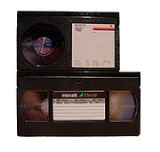
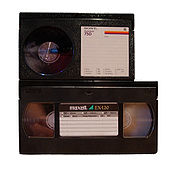
's Betamax
Betamax
Betamax was a consumer-level analog videocassette magnetic tape recording format developed by Sony, released on May 10, 1975. The cassettes contain -wide videotape in a design similar to the earlier, professional wide, U-matic format...
. This was quickly followed by the competing VHS
VHS
The Video Home System is a consumer-level analog recording videocassette standard developed by Victor Company of Japan ....
(Video Home System) format from JVC
JVC
, usually referred to as JVC, is a Japanese international consumer and professional electronics corporation based in Yokohama, Japan which was founded in 1927...
, and later by Video 2000
Video 2000
Video 2000 was a consumer videocassette recorder system and analog recording videocassette standard developed by Philips and Grundig to compete with JVC's VHS and Sony's Betamax video technologies...
from Philips
Philips
Koninklijke Philips Electronics N.V. , more commonly known as Philips, is a multinational Dutch electronics company....
. Subsequently, the Betamax–VHS format war began in earnest. Other competitors, such as Sanyo's V-Cord
V-Cord
V-Cord was a analog recording videocassette format developed and released by Sanyo in 1974. V-Cord was released in two versions: V-Cord I , which could record a maximum of 60 minutes on one V-Cord cassette, and the later V-Cord II, released in 1976, which could record a maximum of 120 minutes on a...
and Quasar's "Great Time Machine
VX (videocassette format)
VX was a short-lived and unsuccessful consumer analog recording videocassette format developed by Panasonic and launched in 1975 in Japan. In the US it was sold using the Quasar brand and marketed under the name "The Great Time Machine" to exhibit its time-shifting capabilities, since VX machines...
" quickly disappeared.
Sony
Sony
, commonly referred to as Sony, is a Japanese multinational conglomerate corporation headquartered in Minato, Tokyo, Japan and the world's fifth largest media conglomerate measured by revenues....
had demonstrated a prototype videotape recording system they called "Beta" to the other electronics manufacturers in 1974, and expected that they would back a single format for the good of all. But JVC in particular decided to go with its own format (despite Sony's appeal to the Japanese Ministry of Trade and Industry
Ministry of Economy, Trade and Industry (Japan)
The or METI, is a ministry of the Government of Japan. It was created by the 2001 Central Government Reform when the Ministry of International Trade and Industry merged with agencies from other ministries related to economic activities, such as the Economic Planning Agency.METI, which used to be...
), thus beginning the format war.
Manufacturers also introduced other systems such as needle-based, record-style discs (RCA's Capacitance Electronic Disc, JVC's Video High Density disc) and Philips' LaserDisc
Laserdisc
LaserDisc was a home video format and the first commercial optical disc storage medium. Initially licensed, sold, and marketed as MCA DiscoVision in North America in 1978, the technology was previously referred to interally as Optical Videodisc System, Reflective Optical Videodisc, Laser Optical...
. None of these disc formats gained much ground as none were capable of home recording; however, they did hold small niche markets. CED's inexpensive record-like format (using a fine keel-shaped stylus to read an electronic signal rather than mechanical vibrations) made it attractive to low-income families during the 1980s, and LaserDisc's 5 megahertz/420 line resolution made it popular with discerning videophiles until circa 1997 (when DVD-Video
DVD-Video
DVD-Video is a consumer video format used to store digital video on DVD discs, and is currently the dominant consumer video format in Asia, North America, Europe, and Australia. Discs using the DVD-Video specification require a DVD drive and a MPEG-2 decoder...
became the new standard for high-quality).
Competing technologies
According to James Lardner's 1987 book Fast Forward: Hollywood, the Japanese, and the VCR Wars, Sony had met with MatsushitaMatsushita Electric Industrial Co.
, formerly known as , is a Japanese multinational consumer electronics corporation headquartered in Kadoma, Osaka, Japan. Its main business is in electronics manufacturing....
executives sometime in late 1974/early 1975 to discuss the forthcoming home video market. Both had previously cooperated in the development and marketing of the U-Matic
U-matic
U-matic is an analog recording videocassette format first shown by Sony in prototype in October 1969, and introduced to the market in September 1971. It was among the first video formats to contain the videotape inside a cassette, as opposed to the various Reel-to-Reel or open-reel formats of the...
video cassette format. Sony brought along a Betamax prototype for Matsushita's engineers to evaluate. Sony at the time was unaware of JVC's work. At a later meeting, Matsushita, with JVC
JVC
, usually referred to as JVC, is a Japanese international consumer and professional electronics corporation based in Yokohama, Japan which was founded in 1927...
management in attendance, showed Sony a VHS prototype, and advised them it was not too late to embrace VHS "for the good of the industry" but Sony management felt they were too close to production to compromise.
U.S. market
While VHS machines' lower retail price was a major factor, the principal battleground proved to be recording time. The original Sony Betamax video recorder for the NTSCNTSC
NTSC, named for the National Television System Committee, is the analog television system that is used in most of North America, most of South America , Burma, South Korea, Taiwan, Japan, the Philippines, and some Pacific island nations and territories .Most countries using the NTSC standard, as...
television system could only record for 60 minutes, identical to the previous U-matic
U-matic
U-matic is an analog recording videocassette format first shown by Sony in prototype in October 1969, and introduced to the market in September 1971. It was among the first video formats to contain the videotape inside a cassette, as opposed to the various Reel-to-Reel or open-reel formats of the...
format, which had been sufficient for use in television studios. JVC's VHS could manage 120 minutes, followed by RCA
RCA
RCA Corporation, founded as the Radio Corporation of America, was an American electronics company in existence from 1919 to 1986. The RCA trademark is currently owned by the French conglomerate Technicolor SA through RCA Trademark Management S.A., a company owned by Technicolor...
's entrance into the market with a 240 minute recorder. These challenges sparked a mini-war to see who could achieve the longest recording time.
RCA had initially planned a home video format around 1974, to be called "SelectaVision MagTape," but canceled it after hearing rumors about Sony's Betamax format, and was considering Sony as an OEM
Original Equipment Manufacturer
An original equipment manufacturer, or OEM, manufactures products or components that are purchased by a company and retailed under that purchasing company's brand name. OEM refers to the company that originally manufactured the product. When referring to automotive parts, OEM designates a...
for an RCA-branded VCR. RCA had discussions with Sony, but RCA felt the recording time was too short, insisting that they needed at least a 4-hour recording time (reportedly because that was the length of an average televised U.S. football
American football
American football is a sport played between two teams of eleven with the objective of scoring points by advancing the ball into the opposing team's end zone. Known in the United States simply as football, it may also be referred to informally as gridiron football. The ball can be advanced by...
game). Sony engineers knew that the technology available to manufacture video heads wasn't up to the task yet, but halving the tape speed and track width was a possibility. Unfortunately, the picture quality would be degraded severely, and at that time Sony engineers felt the compromise was not worthwhile.
Soon after, RCA met with execs with the Victor Corporation of Japan (JVC), who had created their own video format christened "VHS" (which stood for "Video Home System"). But JVC also refused to compromise the picture quality of their format by allowing a 4-hour mode. Ironically, their parent corporation, Matsushita, later met with RCA, and agreed to manufacture a 4-hour-capable VHS machine for RCA, much to JVC's chagrin.
RCA would go on to market "4 hours, $999", forcing a price war and also a "tape length" war. Betamax eventually achieved 5 hours at Beta-III speed on an ultra-thin L-830 cassette, and VHS eventually squeezed 10.6 hours with SLP/EP speed on a T-210 cassette. Slower tape speeds meant a degradation in picture quality, but the consumer didn't seem to mind. From the consumer perspective, buying a single 10-hour VHS tape was cheaper than buying two 5-hour Betamax tapes.
Picture quality
When Betamax was introduced in Japan and the United States in 1975 its Beta-I speed (1.5"/second) offered a slightly higher horizontal resolution (250 lines vs 240 lines horizontal NTSC), lower video noise, and less luma/chroma crosstalkCrosstalk (electronics)
In electronics, crosstalk is any phenomenon by which a signal transmitted on one circuit or channel of a transmission system creates an undesired effect in another circuit or channel...
than VHS, and was later marketed as providing pictures superior to VHS's playback. However the introduction of B-II speed, 0.8"/sec (2-hour mode), to compete with VHS's 2-hour Standard Play mode (1.3"/sec) reduced Betamax's horizontal resolution to 240 lines. The extension of VHS to VHS HQ increased the apparent resolution to 250 lines so that overall a Betamax/VHS user could expect virtually identical luma resolution and chroma resolution (≈30 lines) wherein the actual picture performance depended on other factors including the condition and quality of the videotape and the specific video recorder machine model. For most consumers the difference as seen on the average television was negligible.
Another improvement would be SuperBeta (sometimes called High Band Beta) in 1985. SuperBeta allowed for a gain of 20% to 290 lines in horizontal resolution and some mechanical changes to reduce video noise but Betamax's American and European share had already dropped to less than 10% of the market.
Europe
For PALPAL
PAL, short for Phase Alternating Line, is an analogue television colour encoding system used in broadcast television systems in many countries. Other common analogue television systems are NTSC and SECAM. This page primarily discusses the PAL colour encoding system...
versions time was less of an issue. Betamax's longest tape (L-830) could record for 3 hours and 35 minutes, compared to VHS's 4 hours. For the European markets the issue was one of cost, since VHS had already gained dominance in the United States (70% of the market), and the large economy of scale allowed VHS units to be sold at a far lower cost than the rarer Betamax units. (See market share below.)
In the mid-to-late 80s, both formats were extended to Super Betamax and Super VHS. Super Betamax offered a slight improvement from 250 to 290 lines horizontally, which could make near-identical copies of broadcast or cable television. Super VHS offered up to 420 lines horizontal (in modern digital terms, 560 pixels edge-to-edge) that surpassed broadcast-quality and matched the quality of laserdiscs. However, the "super" standards remained expensive niche products for a small minority of videophiles and camcorder hobbyists.
Market share
When home VCRs started to become popular in the UKUnited Kingdom
The United Kingdom of Great Britain and Northern IrelandIn the United Kingdom and Dependencies, other languages have been officially recognised as legitimate autochthonous languages under the European Charter for Regional or Minority Languages...
, the main issue was one of availability and price. VHS machines were available through the high street
High Street
High Street, or the High Street, is a metonym for the generic name of the primary business street of towns or cities, especially in the United Kingdom. It is usually a focal point for shops and retailers in city centres, and is most often used in reference to retailing...
rental
Renting
Renting is an agreement where a payment is made for the temporary use of a good, service or property owned by another. A gross lease is when the tenant pays a flat rental amount and the landlord pays for all property charges regularly incurred by the ownership from landowners...
chains such as Radio Rentals
Radio Rentals
Radio Rentals was formed in 1932 to rent out radio sets by Percy Perring-Thoms with a turnover in the first year of £780. It later moved into televisions and ultimately video recorders. In 1965 it merged with RentaSet, Joseph Robinson's similarly formed company...
and DER (most of whom were owned by Ferguson Electronics
Ferguson Electronics
Ferguson Electronics is an electronics company specializing in small electronics items such as radios and set top boxes.- History :...
, who were part-owned by JVC
JVC
, usually referred to as JVC, is a Japanese international consumer and professional electronics corporation based in Yokohama, Japan which was founded in 1927...
, the inventors of VHS), while Beta was seen as the more upmarket choice for people who wanted quality and were prepared to pay for it. By 1980, out of an estimated 100,000 homes with VCRs, 70% were rented, and the presence of three competing formats (the third being Video 2000
Video 2000
Video 2000 was a consumer videocassette recorder system and analog recording videocassette standard developed by Philips and Grundig to compete with JVC's VHS and Sony's Betamax video technologies...
) meant that renting was an even more attractive choice, since a small fortune (about £2000 or $3900 in today's prices) could be spent on a system which might become obsolete
Obsolescence
Obsolescence is the state of being which occurs when an object, service or practice is no longer wanted even though it may still be in good working order. Obsolescence frequently occurs because a replacement has become available that is superior in one or more aspects. Obsolete refers to something...
. By the time Betamax machines became easier to rent, VHS had already claimed 70% of the market.
Within continental Europe there were three choices by 1980, with the arrival of the Video 2000
Video 2000
Video 2000 was a consumer videocassette recorder system and analog recording videocassette standard developed by Philips and Grundig to compete with JVC's VHS and Sony's Betamax video technologies...
format from Philips and Grundig
Grundig
Grundig AG is a German manufacturer of consumer electronics for home entertainment which transferred to Turkish control in 2004-2007. Established in 1945 in Nuremberg by Max Grundig, the company changed hands several times before becoming part of the Turkish Koç Holding group...
, which replaced Philips' outdated "VCR
Video Cassette Recording
Video Cassette Recording was an early domestic analog recording format designed by Philips. It was the first successful consumer-level home videocassette recorder system. Later variants included the VCR-LP and Super Video formats.The VCR format was introduced in 1972, just after the Sony...
" format. Although it featured many capabilities formerly only available on expensive broadcast video recorders, V2000 had too long a development cycle and arrived late to the market. Apart from this, to keep costs down many of its unique features, such as Dynamic Track Following, were only implemented on the most expensive models, meaning mainstream models suffered from indifferent video quality. Also, many features that came standard on VHS and Betamax machines (such as direct AV in and out connectors), were only available as expensive "optional extras" on V2000. The machines were also found to be less reliable than their VHS and Beta counterparts and for all these reasons the format never gained substantial market share
Market share
Market share is the percentage of a market accounted for by a specific entity. In a survey of nearly 200 senior marketing managers, 67 percent responded that they found the "dollar market share" metric very useful, while 61% found "unit market share" very useful.Marketers need to be able to...
. V2000 was cancelled in 1985, the first casualty of the format war.
Sony refused to allow pornography on their Betamax system. This is believed by some to have driven a significant amount of sales to VHS machines.
The outcome was decided by other more important factors such as longer home-recording time (up to 10.6 hours on a T-210). Although Betamax initially owned 100% of the market in 1975, the perceived value of longer recording times eventually tipped the balance in favor of VHS. By 1981, U.S. Beta sales had sunk to only 25% of all sales. As movie and video studios turned away from Beta, the combination of lower market share and a lack of available titles strengthened VHS's hand. In the UK, Beta held a 25% market share, but by 1986 it was down to 7.5%, and continued to decline further. In Japan, Betamax had more success and eventually evolved into Enhanced Definition Betamax with 500+ lines resolution (DVD quality), but eventually both Betamax and VHS were supplanted by laser-based technology. The last Sony Betamax was produced in 2002. Although VHS is still available in VHS/DVD combination units, the last dedicated JVC VHS unit was produced in 2007.
End of Beta
Beta sales dwindled away and VHS emerged as the winner of the format war. The video format war is now a highly scrutinized event in business and marketing history, leading to a plethora of market investigations into why Betamax failed. Sony seemed to have misjudged the home video market. JVC quickly licensed its VHS technology and just about every major consumer electronics company of the era (JVC, Panasonic, RCA, Magnavox, Quasar, Zenith, et al.) had their own brand of VCR and at a significantly lower retail price, due in part to high competition among the brands, than the Betamax. Sony believed that the one-hour length of their current U-matic format would be sufficient for Betamax. However, U-matic was primarily a professional standard with constant surveillance by television technicians and which did not need more than one hour length per tape. For home usage, one hour would not be enough to record lengthy programming, such as a baseballBaseball
Baseball is a bat-and-ball sport played between two teams of nine players each. The aim is to score runs by hitting a thrown ball with a bat and touching a series of four bases arranged at the corners of a ninety-foot diamond...
game or a movie. Therefore, consumers naturally flocked to tape formats that could record two hours or more.
Further driving the VHS format was its inherent two-hour playback time (SP speed) - a much better fit for Hollywood movies than Betamax's one-hour limitation. This event spawned the video rental business that flourished in the 1970s and 80s. Being able to watch Hollywood movies at home was a major innovation that transformed consumer habits and allowed people to see older "classic" films that had been buried in the vaults for years.
What Sony did not take into account was what the consumers wanted. While Betamax was believed to be the superior format in the minds of the public and press (due to excellent marketing by Sony), consumers really wanted an affordable VCR (a VHS often cost hundreds of dollars less than a Betamax); Sony believed that having better quality recordings was the key to success, and that consumers would be willing to pay a higher retail price for this, whereas it soon became clear that consumer desire was focused more intently on recording time, lower retail price, compatibility with other machines for sharing (as VHS was becoming the format in the majority of homes), brand loyalty to companies who licensed VHS (RCA, Magnavox, Zenith, Quasar, Mitsubishi, Panasonic, even JVC itself, et al.), and compatibility for easy transfer of information. In addition, Sony, being the first producer to offer their technology, also thought it would establish Betamax as the leading format. This kind of lock-in and path dependence
Path dependence
Path dependence explains how the set of decisions one faces for any given circumstance is limited by the decisions one has made in the past, even though past circumstances may no longer be relevant....
failed for Sony, but succeeded for JVC. For thirty years JVC dominated the home market with their VHS, Super VHS and VHS-C
VHS-C
VHS-C is the compact VHS videocassette format introduced in 1982 and used primarily for consumer-grade compact analog recording camcorders. The format is based on the same video tape as is used in VHS, and can be played back in a standard VHS VCR with an adapter...
ompact formats, and collected billions in royalty payments.
The video recording market was an unknown when VCRs first came on the market; as such, Sony and JVC were both developing technologies that were unproven. As a result of the desire to get into the marketplace faster, the firms both spent less time on research and development and tried to save money by picking a version of the technology they thought would do best without really exploring all the options. This is why there was more than one format on the market and why they continued to reinvent them with longer playing times and better quality.
In 1988, Sony began to market their own VHS machines, and, despite claims that they were still backing Beta, it was clear that the format was dead - at least in Europe
Europe
Europe is, by convention, one of the world's seven continents. Comprising the westernmost peninsula of Eurasia, Europe is generally 'divided' from Asia to its east by the watershed divides of the Ural and Caucasus Mountains, the Ural River, the Caspian and Black Seas, and the waterways connecting...
and North America
North America
North America is a continent wholly within the Northern Hemisphere and almost wholly within the Western Hemisphere. It is also considered a northern subcontinent of the Americas...
. In parts of South America
South America
South America is a continent situated in the Western Hemisphere, mostly in the Southern Hemisphere, with a relatively small portion in the Northern Hemisphere. The continent is also considered a subcontinent of the Americas. It is bordered on the west by the Pacific Ocean and on the north and east...
and in Japan
Japan
Japan is an island nation in East Asia. Located in the Pacific Ocean, it lies to the east of the Sea of Japan, China, North Korea, South Korea and Russia, stretching from the Sea of Okhotsk in the north to the East China Sea and Taiwan in the south...
Beta continued to be popular and was still in production up to the end of 2002. Today, the only remaining aspect of the Betamax
Betamax
Betamax was a consumer-level analog videocassette magnetic tape recording format developed by Sony, released on May 10, 1975. The cassettes contain -wide videotape in a design similar to the earlier, professional wide, U-matic format...
system is the slang term 'betamaxed', used to describe something that had a brief shelf life and was quickly replaced by the competition. Despite the failure of Betamax, its technological successor the Betacam
Betacam
Betacam is family of half-inch professional videocassette products developed by Sony in 1982. In colloquial use, "Betacam" singly is often used to refer to a Betacam camcorder, a Betacam tape, a Betacam video recorder or the format itself....
tape would become an industry standard for video recording, production and presentation, and continues to be used to this day, only now beginning to be supplanted by digital or high-definition tape recordings.
Similar video format wars
After the videotape format war, VHS was dominant until the creation of DVD technology. The major electronics corporations agreed on a single standard for playback of pre-recorded material on DVDs. A minor skirmish arose over DIVXDIVX
DIVX was an unsuccessful attempt by Circuit City and the entertainment law firm Ziffren, Brittenham, Branca and Fischer to create an alternative to video rental in the United States.-Format:...
, but it died a quick death. A later format war resulted from a failure to agree on a single standard for DVD's high-definition successor
High definition optical disc format war
A format war took place between the Blu-ray Disc and HD DVD optical disc standards for storing high definition video and audio.These standards emerged between 2000 and 2002 and attracted both the mutual and exclusive support of major consumer electronics manufacturers, personal computer...
(HD DVD
HD DVD
HD DVD is a discontinued high-density optical disc format for storing data and high-definition video.Supported principally by Toshiba, HD DVD was envisioned to be the successor to the standard DVD format...
) in May 2005. This format war ended in victory for Sony's Blu-ray in February 2008.
See also
- BetacamBetacamBetacam is family of half-inch professional videocassette products developed by Sony in 1982. In colloquial use, "Betacam" singly is often used to refer to a Betacam camcorder, a Betacam tape, a Betacam video recorder or the format itself....
- Comparison of high definition optical disc formatsComparison of high definition optical disc formatsThis article compares the technical specifications of multiple high definition formats, including HD DVD and Blu-ray Disc; two mutually incompatible, high definition optical disc formats that, beginning in 2006, attempted to improve upon and eventually replace the DVD standard...
- De facto standardDe facto standardA de facto standard is a custom, convention, product, or system that has achieved a dominant position by public acceptance or market forces...
- Dominant DesignDominant DesignDominant design is a technology management concept identifying key technological designs that become a de-facto standard in their market place....
- High definition optical disc format warHigh definition optical disc format warA format war took place between the Blu-ray Disc and HD DVD optical disc standards for storing high definition video and audio.These standards emerged between 2000 and 2002 and attracted both the mutual and exclusive support of major consumer electronics manufacturers, personal computer...
- Peep searchPeep searchPeep Search is feature available on many videocassette recorders and most camcorders, whereby the unit can show you what is on the tape during rewind and fast forward operations...
A picture search system pioneered with Betamax and available on most video formats since. - Videocassette recorderVideocassette recorderThe videocassette recorder , is a type of electro-mechanical device that uses removable videocassettes that contain magnetic tape for recording analog audio and analog video from broadcast television so that the images and sound can be played back at a more convenient time...
External links
- Why VHS was better than Betamax - Guardian UnlimitedGuardian Unlimitedguardian.co.uk, formerly known as Guardian Unlimited, is a British website owned by the Guardian Media Group. Georgina Henry is the editor...