

Betamax

Encyclopedia
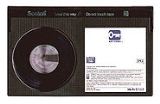
Betamax was a consumer-level analog videocassette magnetic tape
recording format developed by Sony
, released on May 10, 1975. The cassettes contain 0.5 in (12.7 mm)-wide videotape
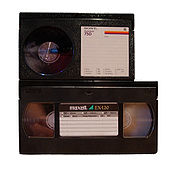
in a design similar to the earlier, professional 0.75 in (19.1 mm) wide, U-matic
format. The format is considered obsolete, though it is still used in specialist applications by a small minority of people.
Like the rival videotape format VHS (introduced in Japan by JVC in October 1976 and in the U.S. by RCA in August 1977), Betamax had no guard band and used azimuth recording
to reduce crosstalk
. According to Sony's own history webpages, the name came from a double meaning: beta being the Japanese word used to describe the way signals were recorded onto the tape, and from the fact that when the tape ran through the transport, it looked like the Greek letter beta
(β). The suffix -max came from "maximum", to suggest greatness.
Sanyo
marketed a version as Betacord, but this was also referred to casually as "Beta". In addition to Sony and Sanyo, Beta-format video recorders were also sold by Toshiba
, Pioneer
, Murphy
, Aiwa
, and NEC; the Zenith Electronics Corporation and WEGA
Corporations contracted with Sony
to produce VCRs for their product lines. Department stores like Sears (in the U.S. and Canada) and Quelle (Germany) sold Beta-format VCRs under their house brands, as did the RadioShack
chain of electronic stores. Betamax and VHS competed in a fierce format war
, which saw VHS come out on top in most markets.
as the medium of choice for shooting home movies and amateur films. These units included a portable VCR, which the videographer would carry by a shoulder strap, and a separate camera, which was connected to the VCR by a special cable. At this point, Beta had several advantages over VHS systems. The smaller Beta cassette made for smaller and lighter VCRs. Beta's superior picture was important for home movies, whereas the longer recording times of VHS were seen as superfluous.
However, consumers wanted a one-piece solution. The first one-piece consumer camcorder, the Betamovie, came from Sony. A major requirement for a one-piece camcorder was miniaturizing the record head drum, and Sony's solution to this involved a nonstandard video signal which would become standard only when played back on full-sized VCRs. A side effect of this was that Beta camcorders were record-only: consumers saw this as a major limitation.
VHS manufacturers found a better solution to drum miniaturization (it involved four heads doing the work of two). Because it used standard video signals, VHS camcorders could review footage in the camcorder and copy to another VCR for editing. This shifted the home movie advantage dramatically away from Beta, and was a primary reason for the loss of Beta market share: owners of Beta VCRs found that a VHS camcorder would allow them to copy and edit footage to their Beta deck – something that Betamovie could not do. And if rental movies were not available in Beta, they could rent them in VHS and use their camcorder to play them. Owners of VHS VCRs could also choose a variant camcorder format called VHS-C
. This used a miniaturized cassette to make a camcorder smaller and lighter than any Betamovie.
Sony could not duplicate the functionality of VHS-C camcorders, and seeing the rapid loss of market share, eventually introduced the Video8 format. Their hope was that Video8 could replace both Beta and VHS for all uses. For more information, see the article on camcorders.
case study. Sony's attempt to dictate an industry standard backfired when JVC
made the tactical decision to forgo Sony's offer of Betamax in favor of developing their own technology. They felt that it would end up like the U-Matic
deal, with Sony dominating.
By 1980, JVC's VHS format controlled 70% of the North American market. The large economy of scale allowed VHS units to be introduced to the European market at a far lower cost than the rarer Betamax units. In the UK, Betamax held a 25% market share in 1981, but by 1986, it was down to 7.5% and continued to decline further. By 1984, forty companies utilized the VHS format in comparison with Beta's twelve. Sony finally conceded defeat in 1988 when it, too, began producing VHS recorders (under license from Hitachi
), though it still continued to produce Betamax recorders.
In Japan, Betamax had more success and eventually evolved into Extended Definition Betamax, with 500+ lines of resolution, but eventually both Betamax and VHS were supplanted by laser-based technology. The last Sony Betamax VCR was produced in 2002.
The second series of The Mighty Boosh
features a villain called The Betamax Bandit.
determining home videotaping to be legal in the United States, wherein home videotape cassette recorders were a legal technology since they had substantial noninfringing uses. This precedent was later invoked in MGM v. Grokster (2005), where the high court agreed that the same "substantial noninfringing uses" standard applies to authors and vendors of peer-to-peer
file sharing software (notably excepting those who "actively induce" copyright infringement through "purposeful, culpable expression and conduct").
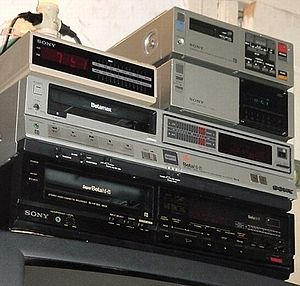
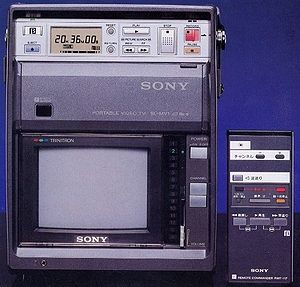
 In the professional and broadcast video industry, Sony's Betacam
, derived from Betamax as a professional format, became one of several standard formats; production houses exchange footage on Betacam videocassettes, and the Betacam system became the most widely used videotape format in the ENG
(Electronic News Gathering) industry, replacing the 0.75 in (19.1 mm) U-matic tape format (which was the first practical and cost-effective portable videotape format for broadcast television, signaling the end of 16 mm film — and the phrase "film at 11
" often heard on the six-o-clock newscast, before the film had been developed). The professional derivative of VHS, MII
(aka Recam) manufactured by Panasonic
, faced off against Betacam and lost. Once Betacam became the de facto
standard of the broadcast industry, its position in the professional market mirrored VHS's dominance in the home video market. On a technical level, Betacam and Betamax are similar in that both share the same videocassette shape, use the same oxide tape formulation with the same coercivity
, and both record linear audio tracks on the same location of the videotape. But in the key area of video recording, Betacam and Betamax are completely different. Betacam tapes are mechanically interchangeable with Betamax, but not electronically. Betacam moves the tape at 12 cm (4.7 in)/s, with different recording/encoding techniques. Betamax is a color-under system, with linear tape speeds ranging from 4 cm (1.6 in)/s to 1.33 cm (0.523622047244095 in)/s.
Sony also offered a range of industrial Betamax products, a Beta I-only format for industrial and institutional users. This was basically cheaper and smaller than U-Matic. The arrival of the Betacam system reduced the demand for both Industrial Beta and U-Matic equipment.
Betamax also had a significant part to play in the music recording industry, when Sony introduced its PCM
(Pulse Code Modulation) digital recording system as an encoding box/PCM adaptor
that connected to a Betamax recorder. The Sony PCM-F1 adaptor was sold with a companion Betamax VCR SL-2000 as a portable digital audio
recording system. Many recording engineers used this system in the 1980s and 1990s to make their first digital master recordings.
Initially, Sony was able to tout several Betamax-only features, such as BetaScan—a high speed picture search in either direction—and BetaSkipScan, a technique that allowed the operator to see where he was on the tape by pressing the FF key (or REW, if in that mode): the transport would switch into the BetaScan mode until the key was released. This feature is discussed in more detail on Peep Search
. Sony believed that the M-Load transports used by VHS machines made copying these trick modes impossible. BetaSkipScan (Peep Search) is now available on miniature M-load formats, but even Sony was unable to fully replicate this on VHS. BetaScan was originally called "Videola" until the company that made the Moviola
threatened legal action.
Sony would also sell a BetaPak, a small deck designed to be used with a camera. Concerned with the need for several pieces and cables to connect them, an integrated camera/recorder was designed, which Sony dubbed a "Camcorder"; the result was Betamovie. Betamovie used the standard-size cassette, but with a modified transport. The tape was wrapped 300°
around a smaller, 4.4671 mm (0.175870078740158 in)-diameter head drum, with a single dual-azimuth head to write the video tracks. For playback, the tape would be inserted into a Beta-format deck. Due to the different geometry and writing techniques employed, playback within the camcorder was not feasible. SuperBeta and industrial Betamovie camcorders would also be sold by Sony.
, Beta HiFi worked by placing a pair of FM carriers between the chroma (C) and luminance (Y) carriers, a process known as frequency multiplexing. Each head had a specific pair of carriers; in total, four individual channels were employed. Head A recorded its hi-fi carriers at 1.38(L) and 1.68(R) MHz, and the B head employed 1.53 and 1.83 MHz. The result was audio with an 80 dB dynamic range, with less than 0.005% wow and flutter.
Prior to the introduction of Beta Hi-Fi, Sony shifted the Y carrier up by 400 kHz to make room for the four FM carriers that would be needed for Beta Hi-Fi. All Beta machines incorporated this change, plus the ability to hunt for a lower frequency pre-AFM Y carrier. Sony incorporated an "antihunt" circuit, to stop the machine hunting for a Y carrier that wasn't there.
Some Sony NTSC models were marketed as "Hi-Fi Ready" (with an SL-HFR prefix to the model's number instead of the usual SL or SL-HF). These Betamax decks looked like a regular Betamax model, except for a special 28-pin connector on the rear. If the user desired a Beta Hi-Fi model but lacked the funds at the time, he could purchase an "SL-HFRxx" and at a later date purchase the separate Hi-Fi Processor. Sony offered two outboard Beta Hi-Fi processors, the HFP-100 and HFP-200. They were identical except that the HFP-200 was capable of multi-channel TV sound, with the word "stereocast" printed after the Beta Hi-Fi logo. This was possible because unlike a VHS Hi-Fi deck, an NTSC Betamax didn't need an extra pair of heads. The HFP-x00 would generate the needed carriers which would be recorded by the attached deck, and during playback the AFM carriers would be passed to the HFP-x00. They also had a small "fine tracking" control on the rear panel for difficult tapes.
For PAL
, however, the bandwidth between the chroma and luminance carriers was not sufficient to allow additional FM carriers, so depth multiplexing was employed, wherein the audio track would be recorded in the same way that the video track was. The lower-frequency audio track was written first by a dedicated head, and the video track recorded on top by the video head. The head disk had an extra pair of audio-only heads with a different azimuth, positioned slightly ahead of the regular video heads, for this purpose.
Sony was confident that VHS could not achieve the same audio performance feat as Beta Hi-Fi. However, to the chagrin of Sony, JVC did develop a VHS hi-fi system on the principle of depth multiplexing approximately a year after the first Beta Hi-Fi VCR, the SL-5200, was introduced by Sony. Despite initial praise as providing "CD sound quality", both Beta Hi-Fi and VHS HiFi suffered from "carrier buzz", where high frequency information bled into the audio carriers, creating momentary "buzzing" and other audio flaws. Both systems also used companding noise-reduction systems, which could create "pumping" artifacts under some conditions. Both formats also suffered from interchange problems, where tapes made on one machine did not always play back well on other machines. When this happened and if the artifacts became too distracting, users were forced to revert to the old linear soundtrack.
resolution was over 100 lines. The heads were also narrowed to 29 μm
to reduce crosstalk, with a narrower head gap to play back the higher carrier frequency at 5.6 MHz. Later, some models would feature further improvement, in the form of Beta-Is, a high band version of the Beta-I recording mode. There were some incompatibilities between the older Beta decks and SuperBeta, but most could play back a high band tape without major problems. SuperBeta decks had a switch to disable the SuperBeta mode for compatibility purposes. (SuperBeta was only marginally supported outside of Sony, as many licensees had already discontinued their Betamax line.)
In 1988, Sony would again push the envelope with ED Beta, or "Extended Definition" Betamax, capable of up to 500 lines of resolution, that equaled DVD quality (480 typical). In order to store the ~6.5 MHz-wide luma signal, with the peak frequency at 9.3 MHz, Sony used a metal formulation tape borrowed from the Betacam SP format (branded "ED-Metal") and incorporated some improvements to the transport to reduce mechanically induced aberrations in the picture. Beta ED also featured a luminance carrier deviation of 2.5 MHz, as opposed to the 1.2 MHz used in SuperBeta, improving contrast with reduced luminance noise.
Sony introduced two ED decks and a camcorder in the late 1980s. The top end EDV-9500 (EDV-9300 in Canada) deck was a very capable editing deck, rivaling much more expensive U-Matic set-ups for its accuracy and features, but did not have commercial success due to lack of timecode and other pro features. Sony did market Beta ED to "semiprofessional" users, or "prosumers". One complaint about the EDC-55 ED CAM was that it needed a lot of light (at least 25 lux), due to the use of two CCDs instead of the typical single-CCD imaging device. The Beta ED lineup only recorded in BII/BIII modes, with the ability to play back BI/BIs.
Despite the sharp decline in sales of Betamax recorders in the late 1980s and subsequent halt in production of new recorders by Sony in 2002, both Betamax and SuperBetamax are still being used by a small number of people. New cassettes are still available for purchase at online shop
s and used recorders are often found at flea market
s, thrift stores or on Internet
auction
sites. Early format BetaCam
cassettes—which are physically based on the Betamax cassette—continue to be available for use in the professional media.
 Below is a list of modern, digital-style resolutions (and traditional analog "TV lines per picture height" measurements) for various media. The list only includes popular formats. All values are approximate NTSC resolutions. For PAL systems, replace "480" with "576". Note that listed resolution applies to luminance only, with chroma resolution usually half of that for digital formats, and significantly lower for analog formats.
Resolution based on the quality with a standard Kell factor
of 0.7:
Digital formats
Quality based on the resolution with a standard Kell factor
of 0.7:
Magnetic tape
Magnetic tape is a medium for magnetic recording, made of a thin magnetizable coating on a long, narrow strip of plastic. It was developed in Germany, based on magnetic wire recording. Devices that record and play back audio and video using magnetic tape are tape recorders and video tape recorders...
recording format developed by Sony
Sony
, commonly referred to as Sony, is a Japanese multinational conglomerate corporation headquartered in Minato, Tokyo, Japan and the world's fifth largest media conglomerate measured by revenues....
, released on May 10, 1975. The cassettes contain 0.5 in (12.7 mm)-wide videotape
Videotape
A videotape is a recording of images and sounds on to magnetic tape as opposed to film stock or random access digital media. Videotapes are also used for storing scientific or medical data, such as the data produced by an electrocardiogram...
in a design similar to the earlier, professional 0.75 in (19.1 mm) wide, U-matic
U-matic
U-matic is an analog recording videocassette format first shown by Sony in prototype in October 1969, and introduced to the market in September 1971. It was among the first video formats to contain the videotape inside a cassette, as opposed to the various Reel-to-Reel or open-reel formats of the...
format. The format is considered obsolete, though it is still used in specialist applications by a small minority of people.
Like the rival videotape format VHS (introduced in Japan by JVC in October 1976 and in the U.S. by RCA in August 1977), Betamax had no guard band and used azimuth recording
Azimuth recording
Azimuth recording is the use of a variation in angle between two recording heads that are recording data so close together on magnetic tape that crosstalk would otherwise likely occur. Normally, the head is perpendicular to the movement of the tape, and this is considered zero degrees...
to reduce crosstalk
Crosstalk (electronics)
In electronics, crosstalk is any phenomenon by which a signal transmitted on one circuit or channel of a transmission system creates an undesired effect in another circuit or channel...
. According to Sony's own history webpages, the name came from a double meaning: beta being the Japanese word used to describe the way signals were recorded onto the tape, and from the fact that when the tape ran through the transport, it looked like the Greek letter beta
Beta (letter)
Beta is the second letter of the Greek alphabet. In Ancient Greek, beta represented the voiced bilabial plosive . In Modern Greek, it represents the voiced labiodental fricative ....
(β). The suffix -max came from "maximum", to suggest greatness.
Sanyo
Sanyo
is a major electronics company and member of the Fortune 500 whose headquarters is located in Moriguchi, Osaka prefecture, Japan. Sanyo targets the middle of the market and has over 230 Subsidiaries and Affiliates....
marketed a version as Betacord, but this was also referred to casually as "Beta". In addition to Sony and Sanyo, Beta-format video recorders were also sold by Toshiba
Toshiba
is a multinational electronics and electrical equipment corporation headquartered in Tokyo, Japan. It is a diversified manufacturer and marketer of electrical products, spanning information & communications equipment and systems, Internet-based solutions and services, electronic components and...
, Pioneer
Pioneer Corporation
is a multinational corporation that specializes in digital entertainment products, based in Kawasaki, Kanagawa, Japan. The company was founded in 1938 in Tokyo as a radio and speaker repair shop...
, Murphy
Murphy Radio
Murphy Radio was a British manufacturer of radios and televisions based in Welwyn Garden City, England.Murphy Radio was founded in 1929 by Frank Murphy and E.J. Power as a volume manufacturer of home radio sets...
, Aiwa
Aiwa
was a Japanese consumer electronics company, founded in 1951.It produced audio and video equipment from the 1970s until the early 2000s.-History:The Aiwa Corporation slid towards bankruptcy until it was purchased by competitor Sony Corporation. As of October 1, 2002, Aiwa ceased to be a separate...
, and NEC; the Zenith Electronics Corporation and WEGA
WEGA
WEGA was a pioneering German audio and video manufacturer, manufacturing some of Germany's earliest radio sets.- History :WEGA was founded as Wuerttembergische Radio-Gesellschaft mbh in Stuttgart, Germany in the year 1923. In 1975, it was acquired by Sony Corporation...
Corporations contracted with Sony
Sony
, commonly referred to as Sony, is a Japanese multinational conglomerate corporation headquartered in Minato, Tokyo, Japan and the world's fifth largest media conglomerate measured by revenues....
to produce VCRs for their product lines. Department stores like Sears (in the U.S. and Canada) and Quelle (Germany) sold Beta-format VCRs under their house brands, as did the RadioShack
RadioShack
RadioShack Corporation is an American franchise of electronics retail stores in the United States, as well as parts of Europe, South America and Africa. As of 2008, RadioShack reported net sales and operating revenues of $4.81 billion. The headquarters of RadioShack is located in Downtown...
chain of electronic stores. Betamax and VHS competed in a fierce format war
Videotape format war
The videotape format war was a period of intense competition or "format war" of incompatible models of consumer-level analog video videocassette and video cassette recorders in the late 1970s and the 1980s.- Overview :...
, which saw VHS come out on top in most markets.
Home movies
Two-piece camera/VCR systems rapidly displaced Super 8 mm film8 mm film
8 mm film is a motion picture film format in which the filmstrip is eight millimeters wide. It exists in two main versions: the original standard 8mm film, also known as regular 8 mm or Double 8 mm, and Super 8...
as the medium of choice for shooting home movies and amateur films. These units included a portable VCR, which the videographer would carry by a shoulder strap, and a separate camera, which was connected to the VCR by a special cable. At this point, Beta had several advantages over VHS systems. The smaller Beta cassette made for smaller and lighter VCRs. Beta's superior picture was important for home movies, whereas the longer recording times of VHS were seen as superfluous.
However, consumers wanted a one-piece solution. The first one-piece consumer camcorder, the Betamovie, came from Sony. A major requirement for a one-piece camcorder was miniaturizing the record head drum, and Sony's solution to this involved a nonstandard video signal which would become standard only when played back on full-sized VCRs. A side effect of this was that Beta camcorders were record-only: consumers saw this as a major limitation.
VHS manufacturers found a better solution to drum miniaturization (it involved four heads doing the work of two). Because it used standard video signals, VHS camcorders could review footage in the camcorder and copy to another VCR for editing. This shifted the home movie advantage dramatically away from Beta, and was a primary reason for the loss of Beta market share: owners of Beta VCRs found that a VHS camcorder would allow them to copy and edit footage to their Beta deck – something that Betamovie could not do. And if rental movies were not available in Beta, they could rent them in VHS and use their camcorder to play them. Owners of VHS VCRs could also choose a variant camcorder format called VHS-C
VHS-C
VHS-C is the compact VHS videocassette format introduced in 1982 and used primarily for consumer-grade compact analog recording camcorders. The format is based on the same video tape as is used in VHS, and can be played back in a standard VHS VCR with an adapter...
. This used a miniaturized cassette to make a camcorder smaller and lighter than any Betamovie.
Sony could not duplicate the functionality of VHS-C camcorders, and seeing the rapid loss of market share, eventually introduced the Video8 format. Their hope was that Video8 could replace both Beta and VHS for all uses. For more information, see the article on camcorders.
The legacy of Betamax
The VHS format's defeat of the Betamax format became a classic marketingMarketing
Marketing is the process used to determine what products or services may be of interest to customers, and the strategy to use in sales, communications and business development. It generates the strategy that underlies sales techniques, business communication, and business developments...
case study. Sony's attempt to dictate an industry standard backfired when JVC
JVC
, usually referred to as JVC, is a Japanese international consumer and professional electronics corporation based in Yokohama, Japan which was founded in 1927...
made the tactical decision to forgo Sony's offer of Betamax in favor of developing their own technology. They felt that it would end up like the U-Matic
U-matic
U-matic is an analog recording videocassette format first shown by Sony in prototype in October 1969, and introduced to the market in September 1971. It was among the first video formats to contain the videotape inside a cassette, as opposed to the various Reel-to-Reel or open-reel formats of the...
deal, with Sony dominating.
By 1980, JVC's VHS format controlled 70% of the North American market. The large economy of scale allowed VHS units to be introduced to the European market at a far lower cost than the rarer Betamax units. In the UK, Betamax held a 25% market share in 1981, but by 1986, it was down to 7.5% and continued to decline further. By 1984, forty companies utilized the VHS format in comparison with Beta's twelve. Sony finally conceded defeat in 1988 when it, too, began producing VHS recorders (under license from Hitachi
Hitachi
Hitachi is a multinational corporation specializing in high-technology.Hitachi may also refer to:*Hitachi, Ibaraki, Japan*Hitachi province, former province of Japan*Prince Hitachi and Princess Hitachi, members of the Japanese imperial family...
), though it still continued to produce Betamax recorders.
In Japan, Betamax had more success and eventually evolved into Extended Definition Betamax, with 500+ lines of resolution, but eventually both Betamax and VHS were supplanted by laser-based technology. The last Sony Betamax VCR was produced in 2002.
The second series of The Mighty Boosh
The Mighty Boosh
The Mighty Boosh is a British comedy troupe featuring comedians Julian Barratt and Noel Fielding. Developed from three stage shows and a six episode radio series, it has since spawned a total of twenty television episodes for BBC Three and two live tours of the UK, as well as two live shows in the...
features a villain called The Betamax Bandit.
Home and professional recording
One other major consequence of the Betamax technology's introduction to the U.S. was the lawsuit Sony Corp. v. Universal City Studios (1984, the "Betamax case"), with the U.S. Supreme CourtSupreme Court of the United States
The Supreme Court of the United States is the highest court in the United States. It has ultimate appellate jurisdiction over all state and federal courts, and original jurisdiction over a small range of cases...
determining home videotaping to be legal in the United States, wherein home videotape cassette recorders were a legal technology since they had substantial noninfringing uses. This precedent was later invoked in MGM v. Grokster (2005), where the high court agreed that the same "substantial noninfringing uses" standard applies to authors and vendors of peer-to-peer
Peer-to-peer
Peer-to-peer computing or networking is a distributed application architecture that partitions tasks or workloads among peers. Peers are equally privileged, equipotent participants in the application...
file sharing software (notably excepting those who "actively induce" copyright infringement through "purposeful, culpable expression and conduct").
Betacam
Betacam is family of half-inch professional videocassette products developed by Sony in 1982. In colloquial use, "Betacam" singly is often used to refer to a Betacam camcorder, a Betacam tape, a Betacam video recorder or the format itself....
, derived from Betamax as a professional format, became one of several standard formats; production houses exchange footage on Betacam videocassettes, and the Betacam system became the most widely used videotape format in the ENG
Electronic news gathering
ENG is a broadcasting industry acronym which stands for electronic news gathering. It can mean anything from a lone broadcast journalist reporter taking a single professional video camera out to shoot a story, to an entire television crew taking a production truck or satellite truck on location...
(Electronic News Gathering) industry, replacing the 0.75 in (19.1 mm) U-matic tape format (which was the first practical and cost-effective portable videotape format for broadcast television, signaling the end of 16 mm film — and the phrase "film at 11
Film at 11
The idiom "Film at 11" originates from television news broadcasting. Traditionally, it follows a promotion aired earlier in the evening for a particular story to be detailed on a later local news broadcast at 11 p.m., a traditional timeslot for local news broadcasts in the Eastern and Pacific time...
" often heard on the six-o-clock newscast, before the film had been developed). The professional derivative of VHS, MII
MII (videocassette format)
MII is a professional analog recording videocassette format developed by Panasonic in 1986 as their answer and competitive product to Sony's Betacam SP format...
(aka Recam) manufactured by Panasonic
Panasonic
Panasonic is an international brand name for Japanese electric products manufacturer Panasonic Corporation, which was formerly known as Matsushita Electric Industrial Co., Ltd...
, faced off against Betacam and lost. Once Betacam became the de facto
De facto
De facto is a Latin expression that means "concerning fact." In law, it often means "in practice but not necessarily ordained by law" or "in practice or actuality, but not officially established." It is commonly used in contrast to de jure when referring to matters of law, governance, or...
standard of the broadcast industry, its position in the professional market mirrored VHS's dominance in the home video market. On a technical level, Betacam and Betamax are similar in that both share the same videocassette shape, use the same oxide tape formulation with the same coercivity
Coercivity
In materials science, the coercivity, also called the coercive field or coercive force, of a ferromagnetic material is the intensity of the applied magnetic field required to reduce the magnetization of that material to zero after the magnetization of the sample has been driven to saturation...
, and both record linear audio tracks on the same location of the videotape. But in the key area of video recording, Betacam and Betamax are completely different. Betacam tapes are mechanically interchangeable with Betamax, but not electronically. Betacam moves the tape at 12 cm (4.7 in)/s, with different recording/encoding techniques. Betamax is a color-under system, with linear tape speeds ranging from 4 cm (1.6 in)/s to 1.33 cm (0.523622047244095 in)/s.
Sony also offered a range of industrial Betamax products, a Beta I-only format for industrial and institutional users. This was basically cheaper and smaller than U-Matic. The arrival of the Betacam system reduced the demand for both Industrial Beta and U-Matic equipment.
Betamax also had a significant part to play in the music recording industry, when Sony introduced its PCM
Pulse-code modulation
Pulse-code modulation is a method used to digitally represent sampled analog signals. It is the standard form for digital audio in computers and various Blu-ray, Compact Disc and DVD formats, as well as other uses such as digital telephone systems...
(Pulse Code Modulation) digital recording system as an encoding box/PCM adaptor
PCM adaptor
A PCM adaptor is a device used for recording digital audio in the PCM format, which in turn connects to a video cassette recorder for storage and playback of the digital audio information.-How a PCM adaptor works:...
that connected to a Betamax recorder. The Sony PCM-F1 adaptor was sold with a companion Betamax VCR SL-2000 as a portable digital audio
Digital audio
Digital audio is sound reproduction using pulse-code modulation and digital signals. Digital audio systems include analog-to-digital conversion , digital-to-analog conversion , digital storage, processing and transmission components...
recording system. Many recording engineers used this system in the 1980s and 1990s to make their first digital master recordings.
Initially, Sony was able to tout several Betamax-only features, such as BetaScan—a high speed picture search in either direction—and BetaSkipScan, a technique that allowed the operator to see where he was on the tape by pressing the FF key (or REW, if in that mode): the transport would switch into the BetaScan mode until the key was released. This feature is discussed in more detail on Peep Search
Peep search
Peep Search is feature available on many videocassette recorders and most camcorders, whereby the unit can show you what is on the tape during rewind and fast forward operations...
. Sony believed that the M-Load transports used by VHS machines made copying these trick modes impossible. BetaSkipScan (Peep Search) is now available on miniature M-load formats, but even Sony was unable to fully replicate this on VHS. BetaScan was originally called "Videola" until the company that made the Moviola
Moviola
A Moviola is a device that allows a film editor to view film while editing. It was the first machine for motion picture editing when it was invented by Iwan Serrurier in 1924.-History:...
threatened legal action.
Sony would also sell a BetaPak, a small deck designed to be used with a camera. Concerned with the need for several pieces and cables to connect them, an integrated camera/recorder was designed, which Sony dubbed a "Camcorder"; the result was Betamovie. Betamovie used the standard-size cassette, but with a modified transport. The tape was wrapped 300°
Degree (angle)
A degree , usually denoted by ° , is a measurement of plane angle, representing 1⁄360 of a full rotation; one degree is equivalent to π/180 radians...
around a smaller, 4.4671 mm (0.175870078740158 in)-diameter head drum, with a single dual-azimuth head to write the video tracks. For playback, the tape would be inserted into a Beta-format deck. Due to the different geometry and writing techniques employed, playback within the camcorder was not feasible. SuperBeta and industrial Betamovie camcorders would also be sold by Sony.
HiFi audio upgrade
In June of 1983, Sony introduced high fidelity audio to videotape as Beta Hi-Fi. For NTSCNTSC
NTSC, named for the National Television System Committee, is the analog television system that is used in most of North America, most of South America , Burma, South Korea, Taiwan, Japan, the Philippines, and some Pacific island nations and territories .Most countries using the NTSC standard, as...
, Beta HiFi worked by placing a pair of FM carriers between the chroma (C) and luminance (Y) carriers, a process known as frequency multiplexing. Each head had a specific pair of carriers; in total, four individual channels were employed. Head A recorded its hi-fi carriers at 1.38(L) and 1.68(R) MHz, and the B head employed 1.53 and 1.83 MHz. The result was audio with an 80 dB dynamic range, with less than 0.005% wow and flutter.
Prior to the introduction of Beta Hi-Fi, Sony shifted the Y carrier up by 400 kHz to make room for the four FM carriers that would be needed for Beta Hi-Fi. All Beta machines incorporated this change, plus the ability to hunt for a lower frequency pre-AFM Y carrier. Sony incorporated an "antihunt" circuit, to stop the machine hunting for a Y carrier that wasn't there.
Some Sony NTSC models were marketed as "Hi-Fi Ready" (with an SL-HFR prefix to the model's number instead of the usual SL or SL-HF). These Betamax decks looked like a regular Betamax model, except for a special 28-pin connector on the rear. If the user desired a Beta Hi-Fi model but lacked the funds at the time, he could purchase an "SL-HFRxx" and at a later date purchase the separate Hi-Fi Processor. Sony offered two outboard Beta Hi-Fi processors, the HFP-100 and HFP-200. They were identical except that the HFP-200 was capable of multi-channel TV sound, with the word "stereocast" printed after the Beta Hi-Fi logo. This was possible because unlike a VHS Hi-Fi deck, an NTSC Betamax didn't need an extra pair of heads. The HFP-x00 would generate the needed carriers which would be recorded by the attached deck, and during playback the AFM carriers would be passed to the HFP-x00. They also had a small "fine tracking" control on the rear panel for difficult tapes.
For PAL
PAL
PAL, short for Phase Alternating Line, is an analogue television colour encoding system used in broadcast television systems in many countries. Other common analogue television systems are NTSC and SECAM. This page primarily discusses the PAL colour encoding system...
, however, the bandwidth between the chroma and luminance carriers was not sufficient to allow additional FM carriers, so depth multiplexing was employed, wherein the audio track would be recorded in the same way that the video track was. The lower-frequency audio track was written first by a dedicated head, and the video track recorded on top by the video head. The head disk had an extra pair of audio-only heads with a different azimuth, positioned slightly ahead of the regular video heads, for this purpose.
Sony was confident that VHS could not achieve the same audio performance feat as Beta Hi-Fi. However, to the chagrin of Sony, JVC did develop a VHS hi-fi system on the principle of depth multiplexing approximately a year after the first Beta Hi-Fi VCR, the SL-5200, was introduced by Sony. Despite initial praise as providing "CD sound quality", both Beta Hi-Fi and VHS HiFi suffered from "carrier buzz", where high frequency information bled into the audio carriers, creating momentary "buzzing" and other audio flaws. Both systems also used companding noise-reduction systems, which could create "pumping" artifacts under some conditions. Both formats also suffered from interchange problems, where tapes made on one machine did not always play back well on other machines. When this happened and if the artifacts became too distracting, users were forced to revert to the old linear soundtrack.
New standards: SuperBetamax and Extended Definition Betamax
In early 1985, Sony would introduce a new feature, High Band or SuperBeta, by again shifting the Y carrier—this time by 800 kHz. This improved the bandwidth available to the Y sideband and increased the horizontal resolution from 240 to 290 lines on a regular-grade Betamax cassette. Since over-the-antenna and cable signals were only 300–330 lines resolution, SuperBeta could make a nearly identical copy of live television. However, the chroma resolution still remained relatively poor, limited to just under 0.4 MHz or approximately 30 lines resolution, whereas live broadcast chrominanceChrominance
Chrominance is the signal used in video systems to convey the color information of the picture, separately from the accompanying luma signal . Chrominance is usually represented as two color-difference components: U = B' − Y' and V = R' − Y'...
resolution was over 100 lines. The heads were also narrowed to 29 μm
Micrometre
A micrometer , is by definition 1×10⁻⁶ of a meter .In plain English, it means one-millionth of a meter . Its unit symbol in the International System of Units is μm...
to reduce crosstalk, with a narrower head gap to play back the higher carrier frequency at 5.6 MHz. Later, some models would feature further improvement, in the form of Beta-Is, a high band version of the Beta-I recording mode. There were some incompatibilities between the older Beta decks and SuperBeta, but most could play back a high band tape without major problems. SuperBeta decks had a switch to disable the SuperBeta mode for compatibility purposes. (SuperBeta was only marginally supported outside of Sony, as many licensees had already discontinued their Betamax line.)
In 1988, Sony would again push the envelope with ED Beta, or "Extended Definition" Betamax, capable of up to 500 lines of resolution, that equaled DVD quality (480 typical). In order to store the ~6.5 MHz-wide luma signal, with the peak frequency at 9.3 MHz, Sony used a metal formulation tape borrowed from the Betacam SP format (branded "ED-Metal") and incorporated some improvements to the transport to reduce mechanically induced aberrations in the picture. Beta ED also featured a luminance carrier deviation of 2.5 MHz, as opposed to the 1.2 MHz used in SuperBeta, improving contrast with reduced luminance noise.
Sony introduced two ED decks and a camcorder in the late 1980s. The top end EDV-9500 (EDV-9300 in Canada) deck was a very capable editing deck, rivaling much more expensive U-Matic set-ups for its accuracy and features, but did not have commercial success due to lack of timecode and other pro features. Sony did market Beta ED to "semiprofessional" users, or "prosumers". One complaint about the EDC-55 ED CAM was that it needed a lot of light (at least 25 lux), due to the use of two CCDs instead of the typical single-CCD imaging device. The Beta ED lineup only recorded in BII/BIII modes, with the ability to play back BI/BIs.
Despite the sharp decline in sales of Betamax recorders in the late 1980s and subsequent halt in production of new recorders by Sony in 2002, both Betamax and SuperBetamax are still being used by a small number of people. New cassettes are still available for purchase at online shop
Online shop
Online shopping is the process whereby consumers directly buy goods or services from a seller in real-time, without an intermediary service, over the Internet. It is a form of electronic commerce...
s and used recorders are often found at flea market
Flea market
A flea market or swap meet is a type of bazaar where inexpensive or secondhand goods are sold or bartered. It may be indoors, such as in a warehouse or school gymnasium; or it may be outdoors, such as in a field or under a tent...
s, thrift stores or on Internet
Internet
The Internet is a global system of interconnected computer networks that use the standard Internet protocol suite to serve billions of users worldwide...
auction
Auction
An auction is a process of buying and selling goods or services by offering them up for bid, taking bids, and then selling the item to the highest bidder...
sites. Early format BetaCam
Betacam
Betacam is family of half-inch professional videocassette products developed by Sony in 1982. In colloquial use, "Betacam" singly is often used to refer to a Betacam camcorder, a Betacam tape, a Betacam video recorder or the format itself....
cassettes—which are physically based on the Betamax cassette—continue to be available for use in the professional media.
Comparison to other video formats
Resolution based on the quality with a standard Kell factor
Kell factor
The Kell factor, named after RCA engineer Raymond D. Kell, is a parameter used to limit the bandwidth of a sampled image signal to avoid the appearance of beat frequency patterns when displaying the image in a discrete display devices, usually taken to be 0.7. The number was first measured in 1934...
of 0.7:
- 350×480 (250 lines per picture height): Umatic, Betamax, VHS, Video8
- 420×480 (300 lines per picture height): Super Betamax, Betacam (professional)
- 460×480 (330 lines per picture height): Analog Broadcast
- 590×480 (420 lines per picture height): LaserDisc, Super VHS, Hi8
- 700×480 (500 lines per picture height): Extended Definition Betamax
Digital formats
Quality based on the resolution with a standard Kell factor
Kell factor
The Kell factor, named after RCA engineer Raymond D. Kell, is a parameter used to limit the bandwidth of a sampled image signal to avoid the appearance of beat frequency patterns when displaying the image in a discrete display devices, usually taken to be 0.7. The number was first measured in 1934...
of 0.7:
- 352×240 (240 lines per picture height): Video CD
- 480×480 (330 lines per picture height): SVCD
- 720×480 (504 lines per picture height): 4:3 DVD, Anamorphic Widescreen DVD, miniDV, Digital8
- 720×360 (504 lines per picture height): LetterboxLetterboxLetterboxing is the practice of transferring film shot in a widescreen aspect ratio to standard-width video formats while preserving the film's original aspect ratio. The resulting videographic image has mattes above and below it; these mattes are part of the image...
Widescreen DVD - 1280×720 (896 lines per picture height): AVCHD-lite (720p)
- 1440×1080 (1008 lines per picture height): miniDV (high-def variant)
- 1920×1080 (1344 lines per picture height): (1080i/p) AVCHD, Blu-ray, HD DVDHD DVDHD DVD is a discontinued high-density optical disc format for storing data and high-definition video.Supported principally by Toshiba, HD DVD was envisioned to be the successor to the standard DVD format...
See also
- Videotape format warVideotape format warThe videotape format war was a period of intense competition or "format war" of incompatible models of consumer-level analog video videocassette and video cassette recorders in the late 1970s and the 1980s.- Overview :...
- Peep searchPeep searchPeep Search is feature available on many videocassette recorders and most camcorders, whereby the unit can show you what is on the tape during rewind and fast forward operations...
– A picture search system pioneered with Betamax and available on most video formats since. - U-maticU-maticU-matic is an analog recording videocassette format first shown by Sony in prototype in October 1969, and introduced to the market in September 1971. It was among the first video formats to contain the videotape inside a cassette, as opposed to the various Reel-to-Reel or open-reel formats of the...
- The predecessor to Betamax, using 3/4-inch tape instead of 1/2-inch. - Compact Video CassetteCompact Video CassetteCompact Video Cassette was one of the first analog recording videocassette formats to use a tape smaller than its earlier predecessors of VHS and Betamax, and was developed by Funai Electronics of Japan. The first model of VCR for the format was the Model 212, introduced in 1980 by both Funai and...
- Competitor product developed by FunaiFunaiFunai Electric is a Japanese consumer electronics company headquartered in Daitō, Osaka. The company was founded in 1961. It owns the subsidiary Funai Corporation, Inc., established in the United States since 1991, to market and maintain Funai-licensed brands such as Sylvania, Emerson Radio,...
and TechnicolorTechnicolorTechnicolor is a color motion picture process invented in 1916 and improved over several decades.It was the second major process, after Britain's Kinemacolor, and the most widely used color process in Hollywood from 1922 to 1952...
using 1/4" tape format. - BetacamBetacamBetacam is family of half-inch professional videocassette products developed by Sony in 1982. In colloquial use, "Betacam" singly is often used to refer to a Betacam camcorder, a Betacam tape, a Betacam video recorder or the format itself....
- Umatic's replacement. A non-compatible, high-quality standard used by television studios and other professionals. - Video8 - A small form factor tape based upon Betamax technology, using 8 mm tape.
External links
- The Ultimate Betamax Info Guide – covering the Betamax format in the North American market
- Mister Betamax – extensive Beta supply site
- Betamax PALsite – over 350 pages of Betamax information, running since 1997
- The 'Total Rewind' VCR museum – covering Betamax and other vintage formats
- The Betamax format in the UK, including technical information on servicing Sanyo Beta machines
- "Daily Giz Wiz" Podcast discussing the Betamax
- The Rise and Fall of Beta by Marc Wielage and Rod Woodcock