


U-matic

Encyclopedia
Analog recording
Analog recording is a technique used for the recording of analog signals which among many possibilities include audio frequency, analog audio and analog video information for later playback.Analog recording methods store signals as a continual wave in or on the media...
videocassette format first shown by Sony
Sony
, commonly referred to as Sony, is a Japanese multinational conglomerate corporation headquartered in Minato, Tokyo, Japan and the world's fifth largest media conglomerate measured by revenues....
in prototype in October 1969, and introduced to the market in September 1971. It was among the first video formats to contain the videotape
Videotape
A videotape is a recording of images and sounds on to magnetic tape as opposed to film stock or random access digital media. Videotapes are also used for storing scientific or medical data, such as the data produced by an electrocardiogram...
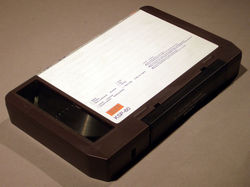
inside a cassette, as opposed to the various Reel-to-Reel or open-reel formats of the time. Unlike most other cassette-based tape formats, the supply and take-up reels in the cassette turn in opposite directions during playback, fast-forward, and rewind: one reel would run clockwise while the other would run counter-clockwise. A locking mechanism integral to each cassette secures the tape hubs during transportation to keep the tape wound tightly on the hubs. When the cassette is loaded into the videocassette recorder (VCR) or player, the mechanism releases the hubs, permitting the hubs to spin. A spring-loaded tape cover door protects the tape from damage; when the cassette is inserted into the VCR, the door is released and is opened, enabling the VCR mechanism to spool the tape around the spinning video drum. Accidental recording is prevented by the presence of a red plastic button fitted to a hole on the bottom surface of the tape; removal of the button disabled recording.
U-Matic VCRs and cassettes may be seen as props in the television program Lost (TV series)
Lost (TV series)
Lost is an American television series that originally aired on ABC from September 22, 2004 to May 23, 2010, consisting of six seasons. Lost is a drama series that follows the survivors of the crash of a commercial passenger jet flying between Sydney and Los Angeles, on a mysterious tropical island...
and movies Broadcast News (film)
Broadcast News (film)
Broadcast News is a 1987 romantic comedy-drama film written, produced and directed by James L. Brooks. The film concerns a virtuoso television news producer , who has daily emotional breakdowns, a brilliant yet prickly reporter and his charismatic but far less seasoned rival...
, Blue Thunder
Blue Thunder
Blue Thunder is a 1983 feature film that features a high-tech helicopter of the same name. The movie was directed by John Badham and stars Roy Scheider...
, and Electric Horseman.
Development
As part of its development, in March 1970, Sony, Matsushita Electric Industrial Co.Matsushita Electric Industrial Co.
, formerly known as , is a Japanese multinational consumer electronics corporation headquartered in Kadoma, Osaka, Japan. Its main business is in electronics manufacturing....
(Panasonic), Victor Co. of Japan
JVC
, usually referred to as JVC, is a Japanese international consumer and professional electronics corporation based in Yokohama, Japan which was founded in 1927...
(JVC), and five non-Japanese companies reached agreement on unified standards.
The videotape was ¾ inches (1.9 cm) wide, so the format is often known as 'three-quarter-inch' or simply 'three-quarter', comparing to other open reel videotape formats of the same vintage, such as 1-inch type C videotape and 2" quadruplex videotape.
The first generation of U-matic VCRs were large devices approximately 30 inches wide and 24" deep, and 12" high, requiring special shelving, and had mechanical controls limited to Record, Play, Rewind, Fast-Forward, Stop and Pause. Later models sported improvements such as chassis sized for 19-inch EIA rack mounting, with sliding rack rails for compressed storage in broadcast environments, solenoid control mechanics, jog-shuttle knob, remote controls, Vertical Interval Time Code (VITC), longitudinal time code, internal cuts-only editing controls, "Slo-Mo" slow-motion playback, and Dolby audio noise reduction.
U-matic was named after the shape of the tape path when it was threaded around the helical scan
Helical scan
Helical scan is a method of recording high bandwidth signals onto magnetic tape. It is used in reel-to-reel video tape recorders, video cassette recorders, digital audio tape recorders, and some computer tape drives....
video head drum, which resembled the letter U. Betamax
Betamax
Betamax was a consumer-level analog videocassette magnetic tape recording format developed by Sony, released on May 10, 1975. The cassettes contain -wide videotape in a design similar to the earlier, professional wide, U-matic format...
used this same type of "U-load" as well.
The total potential lines of horizontal resolution for standard U-matic is 280 lines per picture height. Vertical resolution is the NTSC
NTSC
NTSC, named for the National Television System Committee, is the analog television system that is used in most of North America, most of South America , Burma, South Korea, Taiwan, Japan, the Philippines, and some Pacific island nations and territories .Most countries using the NTSC standard, as...
standard of 486 visible scan lines, and recording time was limited to one hour.
Introduction
At the 1971 introduction of U-Matic, Sony originally intended it to be a videocassette format oriented at the consumer market. This proved to be somewhat of a failure, due to the high manufacturing cost and resulting retail price of the format's first VCRs. But the cost was affordable enough for industrial and institutional customers, where the format was very successful for such applications as business communication and educational television. As a result, Sony shifted U-Matic's marketing to the industrial, professional, and educational sectors.U-Matic even saw more success from the television broadcast industry in the mid-1970s, when a number of local TV stations and national TV networks utilized the format when its first portable model, the Sony VO-3800, was released in 1974. This model ushered in the era of ENG, or Electronic News Gathering
Electronic news gathering
ENG is a broadcasting industry acronym which stands for electronic news gathering. It can mean anything from a lone broadcast journalist reporter taking a single professional video camera out to shoot a story, to an entire television crew taking a production truck or satellite truck on location...
, which made obsolete the previous 16mm film cameras normally used for on-location television news gathering. Film required developing which took time, compared to the instantly available playback of videotape, making faster breaking news possible.
Models
U-matic is also available in a smaller cassette size, officially known as U-Matic S. Much like VHS-CVHS-C
VHS-C is the compact VHS videocassette format introduced in 1982 and used primarily for consumer-grade compact analog recording camcorders. The format is based on the same video tape as is used in VHS, and can be played back in a standard VHS VCR with an adapter...
, U-Matic S was developed as a more portable version of U-Matic, to be used in smaller-sized S-format recorders such as the aforementioned Sony VO-3800, as well as the later VO-4800, VO-6800, VO-8800, BVU-50, BVU-100 and BVU-150 models from Sony, among others from Sony, Panasonic, JVC and other manufacturers. To minimize weight and bulk in the field, portable recorders had an external AC power supply, or could be operated from Ni-cad rechargeable batteries. The price point of the VO series was oriented toward educational, corporate and industrial fields, featured unbalanced audio connectors, and did not typically include SMPTE time code
SMPTE time code
SMPTE timecode is a set of cooperating standards to label individual frames of video or film with a time code defined by the Society of Motion Picture and Television Engineers in the SMPTE 12M specification...
(although one or two companies offered after-market modification services to install longitudinal time code). The VO-3800 was largely metal, which made the unit heavy, but still technically portable. The VO-4800 had the same functionality as the VO-3800, but at a greatly reduced weight and size, by replacing many components with plastic. The VO-6800 added the improvement of a long, thin battery standard ("candy bars") that permitted storage of the batteries in a trouser pocket. Common model numbers for these batteries were NP-1, NP-1A and NP-1B. The VO-8800 was the last of the portable VO series to be produced by Sony, and featured solenoid-controlled transport.
The Sony BVU series added longitudinal and vertical interval SMPTE time code
SMPTE time code
SMPTE timecode is a set of cooperating standards to label individual frames of video or film with a time code defined by the Society of Motion Picture and Television Engineers in the SMPTE 12M specification...
, balanced audio XLR connector
XLR connector
The XLR connector is a style of electrical connector, primarily found on professional audio, video, and stage lighting equipment. The connectors are circular in design and have between 3 and 7 pins...
s, and heavier-duty transport features. The BVU-50 enabled recording in the field but not playback, and the BVU-100 permitted both recording and playback in the field. Portable recorders were connected to the camera with a multi-conductor cable terminated with multi-pin connectors on each end. The cable carried bi-directional audio, video, synchronization, record on/off control, and power. Early studio and all portable U-Matic VCRs had a drawer-type mechanism which required the tape to be inserted, followed by manual closure of the drawer (a "top-loading" mechanism). Later studio VCRs accepted the cassette from a port opening and the cassette was pulled into and seated in the transport (a "front-loading" mechanism).
S-format tapes can be played back in older top-loading standard U-Matic decks with the aid of an adapter (the KCA-1 from Sony) which fitted around an S-sized tape; newer front-loading machines can accept S-format tapes directly, as the tapes have a slot on the underside that rides along a tab. U-Matic S tapes had a maximum recording time of 20 minutes, although some tape manufacturers such as 3M
3M
3M Company , formerly known as the Minnesota Mining and Manufacturing Company, is an American multinational conglomerate corporation based in Maplewood, Minnesota, United States....
came out with 30-minute tapes by loading the cassette with a thinner tape. It was the U-Matic S-format decks that ushered in the beginning of ENG, or Electronic News Gathering
Electronic news gathering
ENG is a broadcasting industry acronym which stands for electronic news gathering. It can mean anything from a lone broadcast journalist reporter taking a single professional video camera out to shoot a story, to an entire television crew taking a production truck or satellite truck on location...
.
Some U-Matic VCRs could be controlled by external video editing
Video editing
The term video editing can refer to:* Linear video editing, using video tape* Non-linear editing system , using computers with video editing software* Offline editing* Online editing...
controllers, such as the cuts-only Sony RM-440 for linear video editing
Linear video editing
Linear video editing is a video editing post-production process of selecting, arranging and modifying images and sound in a predetermined, ordered sequence. Regardless whether captured by a video camera, tapeless camcorder, recorded in a television studio on a video tape recorder the content must...
systems. Sony and other manufacturers such as Convergence, Calaway, and CMX Systems
CMX Systems
CMX Editing Systems was a company founded jointly by CBS and Memorex, that developed some of the very first computerized systems for linear and non-linear editing of videotape for post production...
produced A/B roll systems, which permitted two or more VCRs to be controlled and synchronized for video dissolves and other motion effects, integration of the character generator
Character generator
A character generator, often abbreviated as CG, is a device or software that produces static or animated text for keying into a video stream. Modern character generators are computer-based, and can generate graphics as well as text...
, audio controllers and digital video effects (DVE).
In the early 1980s, Sony introduced the semi backwards-compatible high-band or BVU (Broadcast Video U-matic) format, and the 'original' U-matic format became known as low-band. This high-band format had an improved colour recording system and lower noise levels. BVU gained immense popularity in ENG and location programme-making, spelling the end of 16 mm film
16 mm film
16 mm film refers to a popular, economical gauge of film used for motion pictures and non-theatrical film making. 16 mm refers to the width of the film...
in everyday production. By the early 1990s, Sony's ½-inch Betacam
Betacam
Betacam is family of half-inch professional videocassette products developed by Sony in 1982. In colloquial use, "Betacam" singly is often used to refer to a Betacam camcorder, a Betacam tape, a Betacam video recorder or the format itself....
SP format had all but replaced BVU outside of corporate and 'budget' programme making. Sony made a final improvement to BVU by further improving the recording system and giving it the same 'SP' suffix as Betacam. SP had a horizontal resolution of 330 lines. First-generation BVU-SP and Beta-SP recordings were hard to tell apart, but despite this the writing was on the wall for the U-matic family, due to intrinsic problems with the format.
Problems
A recurring problem with the format was damage to the videotape caused by prolonged friction of the spinning video drum heads against a paused videotape. The drum would rub oxide off the tape or the tape would wrinkle; when the damaged tape was played back, a horizontal line of distorted visual image would ascend in the frame, and audio would drop out. Manufacturers attempted to minimize this issue with schemes in which the tape would loosen around the spinning head or the head would stop spinning after resting in pause mode for a pre-determined period of time.The format video image also suffered from head-switching noise, a distortion of the image in which a section of video at the bottom of the video frame would be horizontally askew from the larger portion.
The format also had difficulty reproducing the color red
Red
Red is any of a number of similar colors evoked by light consisting predominantly of the longest wavelengths of light discernible by the human eye, in the wavelength range of roughly 630–740 nm. Longer wavelengths than this are called infrared , and cannot be seen by the naked eye...
, and red images would be noisier than other colors in the spectrum. For this reason, on-camera talent was discouraged from wearing red clothing that would call attention to the technical shortcoming.
Copying video from one VCR to another VCR displayed compromised playback reliability, and exponential levels of head-switching noise, chroma smearing and noise, compounded with every generation. These technical challenges motivated videotape editors and engineers to plan work around minimizing generational degradation. Use of a time-base corrector (TBC) or "dub" cable were methods of minimizing multi-generational quality loss. The TBC regenerates the sync tip portion of the video signal, improving playback reliability. The dub, demodulated (or "demod") cable was a multi-conductor cable that circumvented a portion of video circuitry, minimizing amplification noise.
Broadcast use
For synchronization to broadcast or post-productionPost-production
Post-production is part of filmmaking and the video production process. It occurs in the making of motion pictures, television programs, radio programs, advertising, audio recordings, photography, and digital art...
editing house genlock
Genlock
Genlock is a common technique where the video output of one source, or a specific reference signal from a signal generator, is used to synchronize other television picture sources together. The aim in video and digital audio applications is to ensure the coincidence of signals in time at a...
systems, U-Matic VCRs required a Time Base Corrector (TBC). Some TBCs had a drop-out compensation (DOC) circuit which would hold lines of video in temporary digital memory to compensate for oxide drop-out or wrinkle flaws in the videotape, however the DOC circuits required several cables and expert calibration for use.
U-matic tapes were also used for easy transport of filmed scenes for dailies
Dailies
Dailies, in filmmaking, are the raw, unedited footage shot during the making of a motion picture. They are so called because usually at the end of each day, that day's footage is developed, synched to sound, and printed on film in a batch for viewing the next day by the director and some members...
in the days before VHS, DVD, and portable hard drives. Several movies have surviving copies in this form. The first rough cut
Rough cut
In filmmaking, the rough cut is the second of three stages of offline editing. The rough cut is the first stage in which the film begins to resemble its final product...
of Apocalypse Now
Apocalypse Now
Apocalypse Now is a 1979 American war film set during the Vietnam War, produced and directed by Francis Ford Coppola. The central character is US Army special operations officer Captain Benjamin L. Willard , of MACV-SOG, an assassin sent to kill the renegade and presumed insane Special Forces...
, for example (the raw version of what became Apocalypse Now Redux), survived on three U-Matic cassettes.
Audio quality was compromised due the use of longitudinal audio tape heads in combination with slow tape speed. Sony eventually implemented Dolby noise reduction circuitry to improve audio fidelity.
U-matic would also see use for the storage of digital audio
Digital audio
Digital audio is sound reproduction using pulse-code modulation and digital signals. Digital audio systems include analog-to-digital conversion , digital-to-analog conversion , digital storage, processing and transmission components...
data. Most digital audio recordings from the 1980s were digitally mastered to U-matic tape. The Sony PCM-1600 PCM adaptor
PCM adaptor
A PCM adaptor is a device used for recording digital audio in the PCM format, which in turn connects to a video cassette recorder for storage and playback of the digital audio information.-How a PCM adaptor works:...
used a U-matic recorder as a transport
Transport (recording)
A transport is a device that handles a particular physical storage medium itself, and extracts or records the information to and from the medium, to an outboard set of processing electronics that the transport is connected to.A transport houses no electronics itself for encoding and decoding the...
. The PCM-1600 output standard "pseudo video" in 525/60 format, which appeared to be a video image of vibrating checkerboard patterns that could be recorded on a video recorder. The PCM-1600 was the first system used for mastering audio compact disc
Compact Disc
The Compact Disc is an optical disc used to store digital data. It was originally developed to store and playback sound recordings exclusively, but later expanded to encompass data storage , write-once audio and data storage , rewritable media , Video Compact Discs , Super Video Compact Discs ,...
s in the early 1980s, with the famous Compact Disc
Compact Disc
The Compact Disc is an optical disc used to store digital data. It was originally developed to store and playback sound recordings exclusively, but later expanded to encompass data storage , write-once audio and data storage , rewritable media , Video Compact Discs , Super Video Compact Discs ,...
44.1 kHz sampling rate
Sampling rate
The sampling rate, sample rate, or sampling frequency defines the number of samples per unit of time taken from a continuous signal to make a discrete signal. For time-domain signals, the unit for sampling rate is hertz , sometimes noted as Sa/s...
based on a best-fit calculation for the U-matic's video horizontal-sync rate. The later PCM-1610 and 1630 units also used U-matic cassettes as a storage medium.
Decline of use
U-matic is no longer used as a mainstream television production format, but it has found lasting appeal as a cheap, well specified, and hard-wearing format. The format permitted many broadcast and non-broadcast institutions to produce television programTelevision program
A television program , also called television show, is a segment of content which is intended to be broadcast on television. It may be a one-time production or part of a periodically recurring series...
ming on an accessible budget, spawning programming distribution, classroom playback, etc. At its peak popularity, U-matic recording and playback equipment was manufactured by Sony, Panasonic, JVC and Sharp, with many spin-off product manufacturers, such as video edit controllers, time base correctors, video production furniture, playback monitors and carts, etc.
Many television facilities the world over still have a U-matic recorder for archive playback of material recorded in the 1980s. For example, the Library of Congress facility in Culpeper, VA, holds thousands of its titles on U-matic video, as a means of providing access copies and proof for copyright deposit of old television broadcasts and films.
Four decades after it was developed, the format is still used for the menial tasks of the industry, being more highly specialized and suited to the needs of production staff than the domestic VHS
VHS
The Video Home System is a consumer-level analog recording videocassette standard developed by Victor Company of Japan ....
, although as time passes it has been replaced at the bottom of the tree of tape-based production formats by Betacam
Betacam
Betacam is family of half-inch professional videocassette products developed by Sony in 1982. In colloquial use, "Betacam" singly is often used to refer to a Betacam camcorder, a Betacam tape, a Betacam video recorder or the format itself....
and Betacam SP as these in turn are replaced by Digital Betacam and HDCAM
HDCAM
HDCAM, introduced in 1997, is an High-definition video digital recording videocassette version of Digital Betacam, using an 8-bit DCT compressed 3:1:1 recording, in 1080i-compatible downsampled resolution of 1440×1080, and adding 24p and 23.976 PsF modes to later models...
.