


South Shields

Encyclopedia
South Shields is a coastal town in Tyne and Wear
, England
, located at the mouth of the River Tyne
to Tyne Dock, and about 4.84 miles (7.8 km) downstream from Newcastle upon Tyne
. The town has a population of 82,854, and is part of the metropolitan borough
of South Tyneside
, which includes the riverside towns of Jarrow
and Hebburn
and the villages of Boldon, Cleadon
and Whitburn
. South Shields is represented in parliament
by Labour MP David Miliband
.
, although there is no evidence they built a settlement within the town of South Shields. Earlier Celtic inscriptions were found as evident in CAER URFA, the original name for south Shields. The Romans built a fort here around AD 160, and expanded it around AD 208 to help supply their soldiers along Hadrian's Wall
. Divisions living at the fort included Tigris bargemen (from Persia/modern day Iraq), Spanish/French soldiers, and Syrian archers/spearmen. The fort was abandoned as the Roman Empire
declined in the fourth century AD. Many ruins still exist today, and some stuctures have been rebuilt as part of a modern museum.
In the sixth century, northeast England was famed for its centre of religious enlightenment and education, with the holy isle of Lindisfarne, close to Bamburgh and important religious clergy: St Aidan, St Bede, St Cuthbert. This region was known as 'Bernicia' with Bamburgh its capital and forming the Kingdom of Northumbria
, with Deira (Yorkshire) forming the southern boundary.
The Vikings raided the area in the ninth century, establishing settlements and controlling most of northern England (and East Anglia) from York (Yorvik) to South Shields. It is said in local folklore that a Viking ship ran aground at herdsands in its attempts to disembark at a cove nearby.
The current town was founded in 1245 and developed as a fishing port. Salt-panning expanded as an industry in 1499. During the Civil War, parliament's Scottish allies captured the town and caused the royalists to flee south, leading to the Boldon Hill battle.
In the Victorian era, coal mining led to a boom in the town. Population increased from 12,000 in 1801 to 75,000 by the 1860s, as the coal industry played a part in creating wealth both regionally and nationally. Due to an ancient Royal Charter, Newcastle administrated the sale of coal on the river Tyne. In 1832, with the Great Reform Act, South Shields and Gateshead got their own MP and became boroughs, resulting in coal mining taxes being paid to the Government instead of the Bishops of Durham. The rapid growth of coal made sanitation a problem as evident in the creation of the Cleadon water tower, still used to this day. In the 1850s, shipbuilding became a prominent industry, but this industry declined over time due to cheaper labour and raw materials in South East Asia.
Zeppelin airships attacked the town in World War I
, and Nazi air raids caused damage and death in World War II
. Throughout the 20th century, the coal and shipbuilding industries ceased. In the 21st century, most of the town's populace work in the cities of Sunderland and Newcastle upon Tyne in the public sector/service sector; with a small minority working in service industries/retail and the ever increasing role of tourism in the local economy.
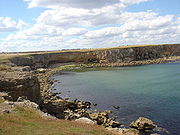
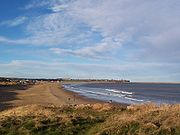 South Shields is situated in a peninsula setting, where the River Tyne
meets the North Sea
. It has six miles of coastline and three miles of river frontage, dominated by the massive piers at the mouth of the Tyne. These are best viewed from the Lawe Top, which also houses two replicas of cannon captured from the Russians
during the Crimean War
(the originals having been melted during World War II).
The town slopes gently from the Cleadon
Hills down to the river. The Cleadon Hills are made conspicuous by the Victorian
water pumping station (opened in 1860 to improve sanitation) and a now derelict windmill
which can be seen from many miles away and also out at sea.
The town has extensive beaches including sand dunes as well as dramatic Magnesian Limestone cliffs with grassy areas above known as The Leas
, which cover three miles of this coastline and are a National Trust
protected area. Marsden Bay, with its famous Marsden Rock
, is home to one of the largest seabird colonies in Britain.
One of the most historic parts of the town is the quaint & beautiful Westoe
village, which consists of a quiet street of 1st grade and 2nd gradeGeorgian
and Victorian houses, many of which had been built by Victorian business leaders from the coal or ship industries in town. Given its beautiful setting, parks and trees, this street was often the setting for a number of books by the novelist Catherine Cookson
.
Westoe village was once a separate village about a mile from South Shields but urban sprawl has now consumed it along with the village of Harton slightly further along the road to Sunderland.
and Village
based rural economy with some small-scale shipbuilding, glass making and salt processing along the riverside. Beyond 1820 and into the Industrial Revolution
, South Shields expanded into an urban
settlement built around shipbuilding and coal mining. Migration came from up the River Tyne
, with other migrants from rural County Durham
, Northumberland
, Scotland
and Ireland
. The majority of the people living in South Shields are descendants of those who migrated and settled in the area during the Industrial Revolution in order to work in expanding coalmines and shipyards. Towards the end of the 19th century, with the British Navy needing seamen, Yemeni British
sailors settled in the town, this resulted in the first roots of the Yemeni British
community in the town.
community since the 1890s. The main reason for the Yemen
i arrival was the supply of seamen, such as engine room firemen, to British merchant vessels. Similar communities were founded in Hull
, Liverpool
and Cardiff
. In 1909, the first Arab
Seamen's Boarding House opened in the Holborn
riverside district of the town. At the time of the First World War
there was a shortage of crews due to the demands of the fighting and many Yemenis were recruited to serve on British ships at the port of Aden
, then under British protection. At the end of the war, the Yemeni population of South Shields had swelled to well over 3,000. Shields lost one of the largest proportions of Merchant Navy
sailors. Approximately 1 in 4 of these men was of Yemeni background.
Disputes over jobs led to riots - also called the Arab
Riots - in 1919. Often incorrectly reported as 'race riots', these were in fact trades union disputes involving equal pay protests championed by Communist union activists. In fact, the Yemeni had already become a successfully integrated into the wider community. In 1930 a further dispute broke out over working practices, which the Yemeni seamen felt to be discriminatory, and led to more rioting. However, over time, attitudes to Yemenis in the town were softened and there was no significant recurrence of this violence.
After World War II
, the Yemeni population declined, partly due to migrations to other industrial areas such as Birmingham
, Liverpool
and Sheffield
. However, the main reason for the reduction in numbers was the end of the shipping industry and the need for sailors as coal burning ships decreased in numbers. Today, the Yemeni population of South Shields numbers around 1,000. Many Yemeni sailors married local women and became integrated with the wider community, resulting with a migrant population less distinct than in other mixed communities across the UK. The Yemeni are the first, settled Muslim
community in Britain and have been used to justify multi-culturalism.
There is a mosque
at Laygate, including the Yemeni School, which was visited by American boxer Muhammed Ali in 1977. He had his marriage blessed at the Al-Ahzar Mosque, the first purpose-built in the UK. This story is covered in a documentary film, The King of South Shields film website. Throughout April and early May 2008, the BALTIC Arts Centre in Gateshead chronicled the Yemeni community of South Shields, including interviews with the last remaining survivors of the first Yemeni generation. The exhibition depicted the Yemeni story as an example of early successful multi-cultural integration in Britain, as well as showcasing the high-profile 1977 visit by Muhammed Ali.
In 2008, South Shields resident and filmmaker Tina Gharavi
unveiled plans for a plaque to mark Ali's visit.
In 2009, the detective series George Gently
, based on the novels by Alan Hunter
, portrayed the Yemeni integration in a 1960s setting.
, closed in 1984 and the last pit, Westoe
Colliery, in 1993. Today, the town relies largely on service industries, whilst many residents commute to work in nearby Newcastle
, Gateshead
, North Tyneside
and Sunderland.
Despite a skilled local workforce, for many years South Tyneside
had the highest unemployment rate in mainland Britain, although between December 2002 and December 2008 unemployment in South Shields fell by 17.8%, and that of South Tyneside
by 17.7%, the best performance in the North East region over that time period. However, latest figures from the Guardian in January 2011, show a marked improvement with unemployment at: 6.5%.
The Port of Tyne
is one of the UK's most important and is further developing its freight and passenger activities. In 2007, it imported two million tonnes of coal. Manufacturing and ship repair/engineering are other significant sectors.
South Shields benefits from significant public and private sector investment. More recently this has included primarily the town centre, riverside and foreshore areas, given the decline of once-traditional heavy industries with the town's growing importance as a major commercial centre and tourist destination.
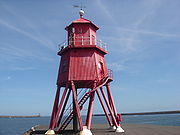 As well as being the oldest and largest town in South Tyneside, South Shields is also one of the region's most popular seaside resorts. The area markets itself as Catherine Cookson
Country, which attracts many visitors. Further improvements and developments to the seafront are planned.
The town and region include:
There is a good choice of restaurants, cafes, public houses and nightlife as well as hotels, guest houses and caravan parks. South Shields plays host to an annual free summer festival and each autumn the town is the seaside finish to the world-famous Great North Run
.
It is also home to the legendary Colman's of South Shields Fish and Chip Restaurant and Takeaway, winners of countless regional and national food awards. Colman's also provided their famous Fish and Chips for the Queens birthday party at the British Embassies in Guatemala and Rome. http://www.colmansfishandchips.com
, one of the two leading maritime training centres in the UK, with facilities including a marine safety training centre and a simulated ship's bridge for the training of deck officers. The college
was also home to the only planetarium
in the region, as well as an observatory
; and in its time was a popular visitor attraction for local schools and visitors in general. The observatory was used for 20 years and in 2008 it was deemed redundant to the future curriculum needs of the college. The college provides a wide range of other flexible vocational and training courses.
Local schooling is generally regarded as being very good, which is reflected in continuing improvements to school results and independent inspections.
In 2007, Brinkburn
Comprehensive and King George V Comprehensive merged forming South Shields Community School
. The new school will be built at a cost of £19 million on the King George V School site and is due to open in September 2011.
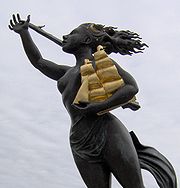 Residents of South Shields are identified as Geordie
, a term commonly associated with all residents of Tyneside
.
A less commonly used colloquial term is Sandancer
. It is presumed to originate from the town's beach and history with the Arabic peoples, as the Arbeian fort was Arabic for: "place of the arabs."

A number of notable people have been associated with South Shields. They include Ridley Scott
, William Wouldhave
(creator of the lifeboat), Eric Idle
, David Cunningham
(Leading Games Designer), John N. Gray (Philosopher), Sir
Frank Williams (founder and manager of Williams F1 Formula 1 team), Phil Brown (current manager of Preston North End F.C.
), Elinor Brent-Dyer
, Catherine Cookson
, Dame Flora Robson
(Oscar-nominated Actress), Claire Rutter
(leading operatic soprano), Jack Brymer
, Dorfy, Ginger
(Wildhearts singer and guitar), Craig Conway
(Actor), Steve Furst
(comedian), Sarah Millican
(comedian), Tom Curry
former Newcastle United player and Munich air disaster
victim, Joe McElderry
winner of X Factor 2009, Professor David Phillips
(chemist), John Simpson Kirkpatrick
(ANZAC war hero) and Professor
John Erickson
(world-renowned historian and UN
advisor).
RFC and South Tyneside College
RUFC.
South Tyneside College RUFC have been playing at Grosvenor Road since they were formed.
Westoe RFC
, formed in 1875, still play at their original ground, Wood Terrace. In 2005 they had an Intermediate Cup run and got to Twickenham
but were beaten by Morley R.F.C. from Yorkshire
.
is a safe Labour Party
Parliamentary seat, currently held by David Miliband
, who was Foreign Secretary under Gordon Brown.
The local authority (South Tyneside Metropolitan Borough Council
) is also controlled by Labour.
The town also has a local independent political party, the Progressive Party. This broadly centre-right party was formed in the 1950s to address hostility towards the Conservative Party. The Progressives have no representation beyond South Shields. Having controlled the old County Borough
of South Shields council until 1974, they still hold several seats on the borough council and have experienced a resurgence in recent years, sitting in alliance with independent members of the council.
trunk road to the West and situated close to the Tyne Tunnel
at Jarrow. The town is well connected to other areas of Tyne & Wear and to the strategic road network - the A194(M)
motorway provides a direct link between the Borough and the A1/A1(M).
The Tyne and Wear Metro
light rail system was introduced in the 1980s and replaced British Rail
services over the same route. The Metro network serves South Tyneside, Gateshead, Newcastle, North Tyneside, Sunderland and Newcastle Airport
. The platform at South Shields Metro Station
is situated on a bridge directly above King Street - the town's main shopping area. When Metro services were introduced, the railway line at the former High Shields LNER station at Laygate was re-routed eastwards to the then-new Chichester Metro and bus interchange. The former South Shields LNER station was also closed and the Victorian buildings survived as a secondary entrance to the Metro station until they were demolished in 1998. There are other Metro stations at Tyne Dock
and Brockley Whins
, while a new station at Simonside
opened in early 2008. Long-term plans by Nexus to re-open the former Sunderland to South Shields line between Tyne Dock, Brockley Whins and East Boldon would create a direct rail service between South Shields and Sunderland, without the need for passengers to change trains at Pelaw in Gateshead.
There is a frequent pedestrian ferry
service to North Shields
on the opposite bank of the Tyne. The Shields Ferry
carries tens of thousands of commuters and pleasure trippers each year. There has been a cross-river ferry service between the two towns since 1377.
The Port of Tyne headquarters and international freight terminal are located at Tyne Dock
in South Shields. The Port has a freight rail connection.
Local bus routes are operated by Stagecoach North East
and Go North East
, which are planned to integrate with Metro services.
There is a National Express coach service direct to London
.
The town's extensive network of strategic footpaths and cycle routes includes the Sea to Sea Cycle Route
and National Cycle Route 1.
Key - Route serves a bus/coach station. - Route serves a Tyne & Wear Metro station. - Route serves a railway station.
Tyne and Wear
Tyne and Wear is a metropolitan county in north east England around the mouths of the Rivers Tyne and Wear. It came into existence as a metropolitan county in 1974 after the passage of the Local Government Act 1972...
, England
England
England is a country that is part of the United Kingdom. It shares land borders with Scotland to the north and Wales to the west; the Irish Sea is to the north west, the Celtic Sea to the south west, with the North Sea to the east and the English Channel to the south separating it from continental...
, located at the mouth of the River Tyne
River Tyne
The River Tyne is a river in North East England in Great Britain. It is formed by the confluence of two rivers: the North Tyne and the South Tyne. These two rivers converge at Warden Rock near Hexham in Northumberland at a place dubbed 'The Meeting of the Waters'.The North Tyne rises on the...
to Tyne Dock, and about 4.84 miles (7.8 km) downstream from Newcastle upon Tyne
Newcastle upon Tyne
Newcastle upon Tyne is a city and metropolitan borough of Tyne and Wear, in North East England. Historically a part of Northumberland, it is situated on the north bank of the River Tyne...
. The town has a population of 82,854, and is part of the metropolitan borough
Metropolitan borough
A metropolitan borough is a type of local government district in England, and is a subdivision of a metropolitan county. Created in 1974 by the Local Government Act 1972, metropolitan boroughs are defined in English law as metropolitan districts, however all of them have been granted or regranted...
of South Tyneside
South Tyneside
South Tyneside is a metropolitan borough in Tyne and Wear in North East England.It is bordered by four other boroughs - Newcastle upon Tyne and Gateshead to the west, Sunderland in the south, and North Tyneside to the north. The border county of Northumberland lies further north...
, which includes the riverside towns of Jarrow
Jarrow
Jarrow is a town in Tyne and Wear, England, located on the River Tyne, with a population of 27,526. From the middle of the 19th century until 1935, Jarrow was a centre for shipbuilding, and was the starting point of the Jarrow March against unemployment in 1936.-Foundation:The Angles re-occupied...
and Hebburn
Hebburn
Hebburn is a small town situated on the south bank of the River Tyne in North East England, sandwiched between the towns of Jarrow and Bill Quay...
and the villages of Boldon, Cleadon
Cleadon
Cleadon is a suburban village in South Tyneside, North East England in the county of Tyne and Wear. The population of Cleadon is 4,795, and there are a few shops including Bon Appetit Deli, Boutiques store and a Post Office. Cleadon is a short walk from the local East Boldon Metro Station. Nearby...
and Whitburn
Whitburn, South Tyneside
Whitburn is a village in South Tyneside, on the coast of North East England. It lies just to the north of the City of Sunderland in the ceremonial county of Tyne and Wear. Until 1974, when the Local Government Act 1972 came into being, it was part of County Durham...
. South Shields is represented in parliament
Parliament
A parliament is a legislature, especially in those countries whose system of government is based on the Westminster system modeled after that of the United Kingdom. The name is derived from the French , the action of parler : a parlement is a discussion. The term came to mean a meeting at which...
by Labour MP David Miliband
David Miliband
David Wright Miliband is a British Labour Party politician who has been the Member of Parliament for South Shields since 2001, and was the Secretary of State for Foreign and Commonwealth Affairs from 2007 to 2010. He is the elder son of the late Marxist theorist Ralph Miliband...
.
History
The first settlers of the area were the BrigantesBrigantes
The Brigantes were a Celtic tribe who in pre-Roman times controlled the largest section of what would become Northern England, and a significant part of the Midlands. Their kingdom is sometimes called Brigantia, and it was centred in what was later known as Yorkshire...
, although there is no evidence they built a settlement within the town of South Shields. Earlier Celtic inscriptions were found as evident in CAER URFA, the original name for south Shields. The Romans built a fort here around AD 160, and expanded it around AD 208 to help supply their soldiers along Hadrian's Wall
Hadrian's Wall
Hadrian's Wall was a defensive fortification in Roman Britain. Begun in AD 122, during the rule of emperor Hadrian, it was the first of two fortifications built across Great Britain, the second being the Antonine Wall, lesser known of the two because its physical remains are less evident today.The...
. Divisions living at the fort included Tigris bargemen (from Persia/modern day Iraq), Spanish/French soldiers, and Syrian archers/spearmen. The fort was abandoned as the Roman Empire
Roman Empire
The Roman Empire was the post-Republican period of the ancient Roman civilization, characterised by an autocratic form of government and large territorial holdings in Europe and around the Mediterranean....
declined in the fourth century AD. Many ruins still exist today, and some stuctures have been rebuilt as part of a modern museum.
In the sixth century, northeast England was famed for its centre of religious enlightenment and education, with the holy isle of Lindisfarne, close to Bamburgh and important religious clergy: St Aidan, St Bede, St Cuthbert. This region was known as 'Bernicia' with Bamburgh its capital and forming the Kingdom of Northumbria
Northumbria
Northumbria was a medieval kingdom of the Angles, in what is now Northern England and South-East Scotland, becoming subsequently an earldom in a united Anglo-Saxon kingdom of England. The name reflects the approximate southern limit to the kingdom's territory, the Humber Estuary.Northumbria was...
, with Deira (Yorkshire) forming the southern boundary.
The Vikings raided the area in the ninth century, establishing settlements and controlling most of northern England (and East Anglia) from York (Yorvik) to South Shields. It is said in local folklore that a Viking ship ran aground at herdsands in its attempts to disembark at a cove nearby.
The current town was founded in 1245 and developed as a fishing port. Salt-panning expanded as an industry in 1499. During the Civil War, parliament's Scottish allies captured the town and caused the royalists to flee south, leading to the Boldon Hill battle.
In the Victorian era, coal mining led to a boom in the town. Population increased from 12,000 in 1801 to 75,000 by the 1860s, as the coal industry played a part in creating wealth both regionally and nationally. Due to an ancient Royal Charter, Newcastle administrated the sale of coal on the river Tyne. In 1832, with the Great Reform Act, South Shields and Gateshead got their own MP and became boroughs, resulting in coal mining taxes being paid to the Government instead of the Bishops of Durham. The rapid growth of coal made sanitation a problem as evident in the creation of the Cleadon water tower, still used to this day. In the 1850s, shipbuilding became a prominent industry, but this industry declined over time due to cheaper labour and raw materials in South East Asia.
Zeppelin airships attacked the town in World War I
World War I
World War I , which was predominantly called the World War or the Great War from its occurrence until 1939, and the First World War or World War I thereafter, was a major war centred in Europe that began on 28 July 1914 and lasted until 11 November 1918...
, and Nazi air raids caused damage and death in World War II
World War II
World War II, or the Second World War , was a global conflict lasting from 1939 to 1945, involving most of the world's nations—including all of the great powers—eventually forming two opposing military alliances: the Allies and the Axis...
. Throughout the 20th century, the coal and shipbuilding industries ceased. In the 21st century, most of the town's populace work in the cities of Sunderland and Newcastle upon Tyne in the public sector/service sector; with a small minority working in service industries/retail and the ever increasing role of tourism in the local economy.
Geography
River Tyne
The River Tyne is a river in North East England in Great Britain. It is formed by the confluence of two rivers: the North Tyne and the South Tyne. These two rivers converge at Warden Rock near Hexham in Northumberland at a place dubbed 'The Meeting of the Waters'.The North Tyne rises on the...
meets the North Sea
North Sea
In the southwest, beyond the Straits of Dover, the North Sea becomes the English Channel connecting to the Atlantic Ocean. In the east, it connects to the Baltic Sea via the Skagerrak and Kattegat, narrow straits that separate Denmark from Norway and Sweden respectively...
. It has six miles of coastline and three miles of river frontage, dominated by the massive piers at the mouth of the Tyne. These are best viewed from the Lawe Top, which also houses two replicas of cannon captured from the Russians
Russian Empire
The Russian Empire was a state that existed from 1721 until the Russian Revolution of 1917. It was the successor to the Tsardom of Russia and the predecessor of the Soviet Union...
during the Crimean War
Crimean War
The Crimean War was a conflict fought between the Russian Empire and an alliance of the French Empire, the British Empire, the Ottoman Empire, and the Kingdom of Sardinia. The war was part of a long-running contest between the major European powers for influence over territories of the declining...
(the originals having been melted during World War II).
The town slopes gently from the Cleadon
Cleadon
Cleadon is a suburban village in South Tyneside, North East England in the county of Tyne and Wear. The population of Cleadon is 4,795, and there are a few shops including Bon Appetit Deli, Boutiques store and a Post Office. Cleadon is a short walk from the local East Boldon Metro Station. Nearby...
Hills down to the river. The Cleadon Hills are made conspicuous by the Victorian
Victorian era
The Victorian era of British history was the period of Queen Victoria's reign from 20 June 1837 until her death on 22 January 1901. It was a long period of peace, prosperity, refined sensibilities and national self-confidence...
water pumping station (opened in 1860 to improve sanitation) and a now derelict windmill
Windmill
A windmill is a machine which converts the energy of wind into rotational energy by means of vanes called sails or blades. Originally windmills were developed for milling grain for food production. In the course of history the windmill was adapted to many other industrial uses. An important...
which can be seen from many miles away and also out at sea.
The town has extensive beaches including sand dunes as well as dramatic Magnesian Limestone cliffs with grassy areas above known as The Leas
The Leas
The Leas is a large area of land owned and maintained by the National Trust along the coastal cliffs of South Shields, England.It is popular with dog walkers, joggers, kite flyers, horse riders, cyclists and other activities...
, which cover three miles of this coastline and are a National Trust
National Trust for Places of Historic Interest or Natural Beauty
The National Trust for Places of Historic Interest or Natural Beauty, usually known as the National Trust, is a conservation organisation in England, Wales and Northern Ireland...
protected area. Marsden Bay, with its famous Marsden Rock
Marsden Rock
Marsden Rock is a rock formation in Tyne and Wear, North East England, situated in Marsden, South Shields. It is owned by the National Trust. The face of the rock was changed forever when tidal erosion caused the arch to collapse in 1996. Prior to this it was the feature included on most postcards...
, is home to one of the largest seabird colonies in Britain.
One of the most historic parts of the town is the quaint & beautiful Westoe
Westoe
Westoe is a suburb of South Shields, Tyne & Wear, United Kingdom.- History :Westoe was originally a village a mile south of South Shields, and was gradually absorbed into the urban sprawl extending from the centre of Shields at the end of the niineteenth century.In contemporary usage the term...
village, which consists of a quiet street of 1st grade and 2nd gradeGeorgian
Georgian era
The Georgian era is a period of British history which takes its name from, and is normally defined as spanning the reigns of, the first four Hanoverian kings of Great Britain : George I, George II, George III and George IV...
and Victorian houses, many of which had been built by Victorian business leaders from the coal or ship industries in town. Given its beautiful setting, parks and trees, this street was often the setting for a number of books by the novelist Catherine Cookson
Catherine Cookson
Dame Catherine Cookson DBE was a British author. She became the United Kingdom's most widely read novelist, with sales topping 100 million, while retaining a relatively low profile in the world of celebrity writers...
.
Westoe village was once a separate village about a mile from South Shields but urban sprawl has now consumed it along with the village of Harton slightly further along the road to Sunderland.
Demography
Before 1820, South Shields was a predominantly sparse hamletHamlet (place)
A hamlet is usually a rural settlement which is too small to be considered a village, though sometimes the word is used for a different sort of community. Historically, when a hamlet became large enough to justify building a church, it was then classified as a village...
and Village
Village
A village is a clustered human settlement or community, larger than a hamlet with the population ranging from a few hundred to a few thousand , Though often located in rural areas, the term urban village is also applied to certain urban neighbourhoods, such as the West Village in Manhattan, New...
based rural economy with some small-scale shipbuilding, glass making and salt processing along the riverside. Beyond 1820 and into the Industrial Revolution
Industrial Revolution
The Industrial Revolution was a period from the 18th to the 19th century where major changes in agriculture, manufacturing, mining, transportation, and technology had a profound effect on the social, economic and cultural conditions of the times...
, South Shields expanded into an urban
Urban area
An urban area is characterized by higher population density and vast human features in comparison to areas surrounding it. Urban areas may be cities, towns or conurbations, but the term is not commonly extended to rural settlements such as villages and hamlets.Urban areas are created and further...
settlement built around shipbuilding and coal mining. Migration came from up the River Tyne
River Tyne
The River Tyne is a river in North East England in Great Britain. It is formed by the confluence of two rivers: the North Tyne and the South Tyne. These two rivers converge at Warden Rock near Hexham in Northumberland at a place dubbed 'The Meeting of the Waters'.The North Tyne rises on the...
, with other migrants from rural County Durham
County Durham
County Durham is a ceremonial county and unitary district in north east England. The county town is Durham. The largest settlement in the ceremonial county is the town of Darlington...
, Northumberland
Northumberland
Northumberland is the northernmost ceremonial county and a unitary district in North East England. For Eurostat purposes Northumberland is a NUTS 3 region and is one of three boroughs or unitary districts that comprise the "Northumberland and Tyne and Wear" NUTS 2 region...
, Scotland
Scotland
Scotland is a country that is part of the United Kingdom. Occupying the northern third of the island of Great Britain, it shares a border with England to the south and is bounded by the North Sea to the east, the Atlantic Ocean to the north and west, and the North Channel and Irish Sea to the...
and Ireland
Ireland
Ireland is an island to the northwest of continental Europe. It is the third-largest island in Europe and the twentieth-largest island on Earth...
. The majority of the people living in South Shields are descendants of those who migrated and settled in the area during the Industrial Revolution in order to work in expanding coalmines and shipyards. Towards the end of the 19th century, with the British Navy needing seamen, Yemeni British
Yemeni British
Yemenis in the United Kingdom include citizens and non-citizen immigrants in the United Kingdom of Yemeni ancestry, as well as their descendants...
sailors settled in the town, this resulted in the first roots of the Yemeni British
Yemeni British
Yemenis in the United Kingdom include citizens and non-citizen immigrants in the United Kingdom of Yemeni ancestry, as well as their descendants...
community in the town.
Irish and Scottish community
The influence of these communities is evident today in the number of Anglian, Baptist, Catholic, Presbyterian and Methodist churches in South Shields. The local boys' brigades often take part in parades in the town during the festival of Easter.Yemeni community
South Shields has been home to a Yemeni BritishYemeni British
Yemenis in the United Kingdom include citizens and non-citizen immigrants in the United Kingdom of Yemeni ancestry, as well as their descendants...
community since the 1890s. The main reason for the Yemen
Yemen
The Republic of Yemen , commonly known as Yemen , is a country located in the Middle East, occupying the southwestern to southern end of the Arabian Peninsula. It is bordered by Saudi Arabia to the north, the Red Sea to the west, and Oman to the east....
i arrival was the supply of seamen, such as engine room firemen, to British merchant vessels. Similar communities were founded in Hull
Kingston upon Hull
Kingston upon Hull , usually referred to as Hull, is a city and unitary authority area in the ceremonial county of the East Riding of Yorkshire, England. It stands on the River Hull at its junction with the Humber estuary, 25 miles inland from the North Sea. Hull has a resident population of...
, Liverpool
Liverpool
Liverpool is a city and metropolitan borough of Merseyside, England, along the eastern side of the Mersey Estuary. It was founded as a borough in 1207 and was granted city status in 1880...
and Cardiff
Cardiff
Cardiff is the capital, largest city and most populous county of Wales and the 10th largest city in the United Kingdom. The city is Wales' chief commercial centre, the base for most national cultural and sporting institutions, the Welsh national media, and the seat of the National Assembly for...
. In 1909, the first Arab
Arab
Arab people, also known as Arabs , are a panethnicity primarily living in the Arab world, which is located in Western Asia and North Africa. They are identified as such on one or more of genealogical, linguistic, or cultural grounds, with tribal affiliations, and intra-tribal relationships playing...
Seamen's Boarding House opened in the Holborn
Holborn
Holborn is an area of Central London. Holborn is also the name of the area's principal east-west street, running as High Holborn from St Giles's High Street to Gray's Inn Road and then on to Holborn Viaduct...
riverside district of the town. At the time of the First World War
World War I
World War I , which was predominantly called the World War or the Great War from its occurrence until 1939, and the First World War or World War I thereafter, was a major war centred in Europe that began on 28 July 1914 and lasted until 11 November 1918...
there was a shortage of crews due to the demands of the fighting and many Yemenis were recruited to serve on British ships at the port of Aden
Aden
Aden is a seaport city in Yemen, located by the eastern approach to the Red Sea , some 170 kilometres east of Bab-el-Mandeb. Its population is approximately 800,000. Aden's ancient, natural harbour lies in the crater of an extinct volcano which now forms a peninsula, joined to the mainland by a...
, then under British protection. At the end of the war, the Yemeni population of South Shields had swelled to well over 3,000. Shields lost one of the largest proportions of Merchant Navy
Merchant Navy
The Merchant Navy is the maritime register of the United Kingdom, and describes the seagoing commercial interests of UK-registered ships and their crews. Merchant Navy vessels fly the Red Ensign and are regulated by the Maritime and Coastguard Agency...
sailors. Approximately 1 in 4 of these men was of Yemeni background.
Disputes over jobs led to riots - also called the Arab
Arab
Arab people, also known as Arabs , are a panethnicity primarily living in the Arab world, which is located in Western Asia and North Africa. They are identified as such on one or more of genealogical, linguistic, or cultural grounds, with tribal affiliations, and intra-tribal relationships playing...
Riots - in 1919. Often incorrectly reported as 'race riots', these were in fact trades union disputes involving equal pay protests championed by Communist union activists. In fact, the Yemeni had already become a successfully integrated into the wider community. In 1930 a further dispute broke out over working practices, which the Yemeni seamen felt to be discriminatory, and led to more rioting. However, over time, attitudes to Yemenis in the town were softened and there was no significant recurrence of this violence.
After World War II
World War II
World War II, or the Second World War , was a global conflict lasting from 1939 to 1945, involving most of the world's nations—including all of the great powers—eventually forming two opposing military alliances: the Allies and the Axis...
, the Yemeni population declined, partly due to migrations to other industrial areas such as Birmingham
Birmingham
Birmingham is a city and metropolitan borough in the West Midlands of England. It is the most populous British city outside the capital London, with a population of 1,036,900 , and lies at the heart of the West Midlands conurbation, the second most populous urban area in the United Kingdom with a...
, Liverpool
Liverpool
Liverpool is a city and metropolitan borough of Merseyside, England, along the eastern side of the Mersey Estuary. It was founded as a borough in 1207 and was granted city status in 1880...
and Sheffield
Sheffield
Sheffield is a city and metropolitan borough of South Yorkshire, England. Its name derives from the River Sheaf, which runs through the city. Historically a part of the West Riding of Yorkshire, and with some of its southern suburbs annexed from Derbyshire, the city has grown from its largely...
. However, the main reason for the reduction in numbers was the end of the shipping industry and the need for sailors as coal burning ships decreased in numbers. Today, the Yemeni population of South Shields numbers around 1,000. Many Yemeni sailors married local women and became integrated with the wider community, resulting with a migrant population less distinct than in other mixed communities across the UK. The Yemeni are the first, settled Muslim
Muslim
A Muslim, also spelled Moslem, is an adherent of Islam, a monotheistic, Abrahamic religion based on the Quran, which Muslims consider the verbatim word of God as revealed to prophet Muhammad. "Muslim" is the Arabic term for "submitter" .Muslims believe that God is one and incomparable...
community in Britain and have been used to justify multi-culturalism.
There is a mosque
Mosque
A mosque is a place of worship for followers of Islam. The word is likely to have entered the English language through French , from Portuguese , from Spanish , and from Berber , ultimately originating in — . The Arabic word masjid literally means a place of prostration...
at Laygate, including the Yemeni School, which was visited by American boxer Muhammed Ali in 1977. He had his marriage blessed at the Al-Ahzar Mosque, the first purpose-built in the UK. This story is covered in a documentary film, The King of South Shields film website. Throughout April and early May 2008, the BALTIC Arts Centre in Gateshead chronicled the Yemeni community of South Shields, including interviews with the last remaining survivors of the first Yemeni generation. The exhibition depicted the Yemeni story as an example of early successful multi-cultural integration in Britain, as well as showcasing the high-profile 1977 visit by Muhammed Ali.
In 2008, South Shields resident and filmmaker Tina Gharavi
Tina Gharavi
Tina Gharavi is an Iranian/American filmmaker and screenwriter. Gharavi, is known for making innovative films about outsiders, outcasts and marginalised people in extraordinary situations. Best known for her work on diversity, her subjects include migration, terrorism-related discrimination,...
unveiled plans for a plaque to mark Ali's visit.
In 2009, the detective series George Gently
George Gently
Inspector George Gently is a British television series produced by Company Pictures for BBC One, set in the 1960s and based on the Inspector Gently novels by Alan Hunter and featuring Martin Shaw as the eponymous inspector, Lee Ingleby as Detective Sergeant John Bacchus and Simon Hubbard as PC...
, based on the novels by Alan Hunter
Alan Hunter (author)
Alan Hunter was an English author of crime fiction. All of his 46 novels feature Inspector George Gently and are mainly set in East Anglia....
, portrayed the Yemeni integration in a 1960s setting.
Economy
The last shipbuilder, John Readhead & SonsJohn Readhead & Sons
John Readhead & Sons was a shipyard located in South Shields, Tyne and Wear in England, by the River Tyne.-History:The business was founded John Readhead in 1865 trading in South Shields under the name of Readhead & Softley. The Company's first ship was a small collier named Unus. In 1909 the...
, closed in 1984 and the last pit, Westoe
Westoe
Westoe is a suburb of South Shields, Tyne & Wear, United Kingdom.- History :Westoe was originally a village a mile south of South Shields, and was gradually absorbed into the urban sprawl extending from the centre of Shields at the end of the niineteenth century.In contemporary usage the term...
Colliery, in 1993. Today, the town relies largely on service industries, whilst many residents commute to work in nearby Newcastle
Newcastle upon Tyne
Newcastle upon Tyne is a city and metropolitan borough of Tyne and Wear, in North East England. Historically a part of Northumberland, it is situated on the north bank of the River Tyne...
, Gateshead
Gateshead
Gateshead is a town in Tyne and Wear, England and is the main settlement in the Metropolitan Borough of Gateshead. Historically a part of County Durham, it lies on the southern bank of the River Tyne opposite Newcastle upon Tyne and together they form the urban core of Tyneside...
, North Tyneside
North Tyneside
The Metropolitan Borough of North Tyneside is a metropolitan borough of Tyne and Wear, in North East England and is part of the Tyneside conurbation. Its seat is Wallsend Town Hall....
and Sunderland.
Despite a skilled local workforce, for many years South Tyneside
South Tyneside
South Tyneside is a metropolitan borough in Tyne and Wear in North East England.It is bordered by four other boroughs - Newcastle upon Tyne and Gateshead to the west, Sunderland in the south, and North Tyneside to the north. The border county of Northumberland lies further north...
had the highest unemployment rate in mainland Britain, although between December 2002 and December 2008 unemployment in South Shields fell by 17.8%, and that of South Tyneside
South Tyneside
South Tyneside is a metropolitan borough in Tyne and Wear in North East England.It is bordered by four other boroughs - Newcastle upon Tyne and Gateshead to the west, Sunderland in the south, and North Tyneside to the north. The border county of Northumberland lies further north...
by 17.7%, the best performance in the North East region over that time period. However, latest figures from the Guardian in January 2011, show a marked improvement with unemployment at: 6.5%.
The Port of Tyne
Port of Tyne
The Port of Tyne comprises the commercial docks in and around the River Tyne in Tyne and Wear in the north east of England.- History :There has been a port on the Tyne at least since the Romans used their settlement of Arbeia to supply the garrison of Hadrian's Wall...
is one of the UK's most important and is further developing its freight and passenger activities. In 2007, it imported two million tonnes of coal. Manufacturing and ship repair/engineering are other significant sectors.
South Shields benefits from significant public and private sector investment. More recently this has included primarily the town centre, riverside and foreshore areas, given the decline of once-traditional heavy industries with the town's growing importance as a major commercial centre and tourist destination.
Landmarks and tourism
Catherine Cookson
Dame Catherine Cookson DBE was a British author. She became the United Kingdom's most widely read novelist, with sales topping 100 million, while retaining a relatively low profile in the world of celebrity writers...
Country, which attracts many visitors. Further improvements and developments to the seafront are planned.
The town and region include:
- the reconstructed Roman Fort and excavations at ArbeiaArbeiaArbeia was a large Roman fort in South Shields, Tyne & Wear, England, now ruined, and which has been partially reconstructed. It was first excavated in the 1870s and all modern building on the site were cleared in the 1970s. It is managed by Tyne and Wear Museums as Arbeia Roman Fort and Museum.-...
, which form part of the Hadrian's Wall World Heritage Site - the town's museum & art gallery, including a permanent exhibition dedicated to the life and times of Catherine Cookson
- the home to the BarbourJ. Barbour & SonsJ. Barbour & Sons Ltd is a British clothing manufacturer and importer, founded in South Shields, best known for making waterproof and outdoor clothing...
headquarters, warehouse and factory - the Customs House theatre and arts venue and the historic Mill Dam riverside
- traditional, continental and farmers' markets and high street shopping
- seafront complete with promenade, parks, fairground and amusement arcades, crazy golf, skate complex, quasar laser, miniature steam railway and boating lake and live entertainment
- coastal scenery, beaches and dunes at Littlehaven, Sandhaven and MarsdenMarsden, Tyne and WearMarsden is a suburb in South Shields, North East England, located on the North Sea coast.The original village of Marsden, was demolished in the 1960s due to the risk of erosion from the encroaching shoreline. What remains are five rows of Victorian terraced houses, which were originally built to...
Bay - the National TrustNational Trust for Places of Historic Interest or Natural BeautyThe National Trust for Places of Historic Interest or Natural Beauty, usually known as the National Trust, is a conservation organisation in England, Wales and Northern Ireland...
-owned Souter Lighthouse and The Leas cliff tops - Temple Park Leisure Centre
- an extensive network of cycle paths and trails, and
- a newly refurbished multi-purpose family friendly complex at the seafront called Dunes Adventure Island, including a bowling alley, a soft play area, a fully licensed bar, Italian restaurant and an arcade.
There is a good choice of restaurants, cafes, public houses and nightlife as well as hotels, guest houses and caravan parks. South Shields plays host to an annual free summer festival and each autumn the town is the seaside finish to the world-famous Great North Run
Great North Run
The Bupa Great North Run is the world's largest half marathon, taking place annually each September. Participants run between Newcastle upon Tyne and South Shields in England. The run was devised by former Olympic 10,000 m bronze medallist and BBC Sport commentator Brendan Foster.The first Great...
.
It is also home to the legendary Colman's of South Shields Fish and Chip Restaurant and Takeaway, winners of countless regional and national food awards. Colman's also provided their famous Fish and Chips for the Queens birthday party at the British Embassies in Guatemala and Rome. http://www.colmansfishandchips.com
Education
South Shields is home to South Tyneside CollegeSouth Tyneside College
South Tyneside College is a large further education college in South Tyneside in North East England, with its main sites in the towns of South Shields and Hebburn. The college offers part-time and full-time courses for both young students and adults alike...
, one of the two leading maritime training centres in the UK, with facilities including a marine safety training centre and a simulated ship's bridge for the training of deck officers. The college
South Tyneside College
South Tyneside College is a large further education college in South Tyneside in North East England, with its main sites in the towns of South Shields and Hebburn. The college offers part-time and full-time courses for both young students and adults alike...
was also home to the only planetarium
Planetarium
A planetarium is a theatre built primarily for presenting educational and entertaining shows about astronomy and the night sky, or for training in celestial navigation...
in the region, as well as an observatory
Observatory
An observatory is a location used for observing terrestrial or celestial events. Astronomy, climatology/meteorology, geology, oceanography and volcanology are examples of disciplines for which observatories have been constructed...
; and in its time was a popular visitor attraction for local schools and visitors in general. The observatory was used for 20 years and in 2008 it was deemed redundant to the future curriculum needs of the college. The college provides a wide range of other flexible vocational and training courses.
Local schooling is generally regarded as being very good, which is reflected in continuing improvements to school results and independent inspections.
In 2007, Brinkburn
Brinkburn
Brinkburn is a parish in Northumberland, England. It is divided by the River Coquet.-External links:* *...
Comprehensive and King George V Comprehensive merged forming South Shields Community School
South Shields Community School
South Shields Community School is located in South Shields, Tyne and Wear, England, with pupils aged from 11-16.The school opened in its present buildings in McAnany Avenue in South Shields in April 2007, is part of the South Tyneside and Gateshead Building Schools for the Future Programme and will...
. The new school will be built at a cost of £19 million on the King George V School site and is due to open in September 2011.
Regional identity
Geordie
Geordie is a regional nickname for a person from the Tyneside region of the north east of England, or the name of the English-language dialect spoken by its inhabitants...
, a term commonly associated with all residents of Tyneside
Tyneside
Tyneside is a conurbation in North East England, defined by the Office of National Statistics, which is home to over 80% of the population of Tyne and Wear. It includes the city of Newcastle upon Tyne and the Metropolitan Boroughs of Gateshead, North Tyneside and South Tyneside — all settlements on...
.
A less commonly used colloquial term is Sandancer
Sandancer
Sandancer is a colloquialism used to describe those who come from the town of South Shields, Tyne and Wear, England. Residents of South Shields are often referred to as Geordies or Mackems though 'Sandancer' is unique to town....
. It is presumed to originate from the town's beach and history with the Arabic peoples, as the Arbeian fort was Arabic for: "place of the arabs."
Notable people
A number of notable people have been associated with South Shields. They include Ridley Scott
Ridley Scott
Sir Ridley Scott is an English film director and producer. His most famous films include The Duellists , Alien , Blade Runner , Legend , Thelma & Louise , G. I...
, William Wouldhave
William Wouldhave
William Wouldhave is a rival of Lionel Lukin for recognition as inventor of the lifeboat. His tombstone, erected thirteen years before Lukin’s, describes William Wouldhave as;-Personal History:...
(creator of the lifeboat), Eric Idle
Eric Idle
Eric Idle is an English comedian, actor, author, singer, writer, and comedic composer. He was as a member of the British comedy group Monty Python, a member of the The Rutles on Saturday Night Live and author of the play, Spamalot....
, David Cunningham
David Cunningham
David Cunningham lives and works in London. Cunningham's work has ranged from pop music to gallery installations, including work for television, film, contemporary dance, and a number of collaborations with visual artists...
(Leading Games Designer), John N. Gray (Philosopher), Sir
Sir
Sir is an honorific used as a title , or as a courtesy title to address a man without using his given or family name in many English speaking cultures...
Frank Williams (founder and manager of Williams F1 Formula 1 team), Phil Brown (current manager of Preston North End F.C.
Preston North End F.C.
Preston North End Football Club is an English professional football club located in the Deepdale area of the city of Preston, Lancashire, currently playing in the third tier of English league football, League One...
), Elinor Brent-Dyer
Elinor Brent-Dyer
Elinor M. Brent-Dyer was a children’s author who wrote over 100 books during her lifetime, the most famous being the Chalet School series.-Short Biography :...
, Catherine Cookson
Catherine Cookson
Dame Catherine Cookson DBE was a British author. She became the United Kingdom's most widely read novelist, with sales topping 100 million, while retaining a relatively low profile in the world of celebrity writers...
, Dame Flora Robson
Flora Robson
Dame Flora McKenzie Robson DBE was an English actress, renowned as a character actress, who played roles ranging from queens to villainesses.-Early life:...
(Oscar-nominated Actress), Claire Rutter
Claire Rutter
Claire Rutter is an English operatic soprano.-Biography:Claire Rutter studied at the Guildhall School of Music and Drama and at the National Opera Studio. Her title role performances have included those in Tosca, La Traviata and Aida at English National Opera...
(leading operatic soprano), Jack Brymer
Jack Brymer
John Alexander Brymer OBE , was a British clarinettist, born in South Shields.-Biography:The son of a builder, Jack Brymer started his working life as a teacher, being at Heath Clark School, Thornton Heath, Surrey in the late 1940s...
, Dorfy, Ginger
Ginger (singer)
Ginger is a rock guitarist, singer and songwriter, best known for his band The Wildhearts.-Early career:...
(Wildhearts singer and guitar), Craig Conway
Craig Conway (actor)
Craig Conway is a British actor. Conway has appeared in a number of stage plays and British television series in addition to his film work.Conway is the husband of actress Jill Halfpenny, with whom he has a son.-Filmography:...
(Actor), Steve Furst
Steve Furst
Steven Larry Furst is a comedian, actor and writer. Furst says his father told him that he arrived as an immigrant from Hungary with "nothing but a violin under my arm"...
(comedian), Sarah Millican
Sarah Millican
Sarah Millican is an English stand-up comedian. Millican won the if.comedy award for Best Newcomer at the 2008 Edinburgh Festival Fringe.-Career:...
(comedian), Tom Curry
Tom Curry
Tom Curry was an English footballer who played as a half back for Newcastle United and Stockport County in the 1920s...
former Newcastle United player and Munich air disaster
Munich air disaster
The Munich air disaster occurred on 6 February 1958, when British European Airways Flight 609 crashed on its third attempt to take off from a slush-covered runway at Munich-Riem Airport in Munich, West Germany. On board the plane was the Manchester United football team, nicknamed the "Busby Babes",...
victim, Joe McElderry
Joe McElderry
Joseph "Joe" McElderry is an English singer and model. He won the sixth series of the ITV show The X Factor in 2009. His first single "The Climb" reached number one on the UK Singles Chart and Irish Singles Charts. He was also crowned the winner of the second series of Popstar to Operastar, two...
winner of X Factor 2009, Professor David Phillips
David Phillips (chemist)
Professor David Phillips OBE is a British Chemist specializing in photochemistry and lasers, and President of the Royal Society of Chemistry 2010–12.Phillips was born 3 December 1939 in South Shields, where he attended the Grammar School...
(chemist), John Simpson Kirkpatrick
John Simpson Kirkpatrick
John 'Jack' Simpson Kirkpatrick , who served under the name John Simpson, was a stretcher bearer with the Australian and New Zealand Army Corps during the Gallipoli Campaign in World War I...
(ANZAC war hero) and Professor
Professor
A professor is a scholarly teacher; the precise meaning of the term varies by country. Literally, professor derives from Latin as a "person who professes" being usually an expert in arts or sciences; a teacher of high rank...
John Erickson
John Erickson (historian)
John Erickson was a British historian who wrote extensively on the Second World War...
(world-renowned historian and UN
United Nations
The United Nations is an international organization whose stated aims are facilitating cooperation in international law, international security, economic development, social progress, human rights, and achievement of world peace...
advisor).
Football
South Shields FC is the town's main football team. Originally formed during the first decade of the 20th century, the team played in the Football League during the 1920s. As of 2008, the club plays in the Northern League's first division.Rugby
South Shields is the home of two rugby clubs, WestoeWestoe
Westoe is a suburb of South Shields, Tyne & Wear, United Kingdom.- History :Westoe was originally a village a mile south of South Shields, and was gradually absorbed into the urban sprawl extending from the centre of Shields at the end of the niineteenth century.In contemporary usage the term...
RFC and South Tyneside College
South Tyneside College
South Tyneside College is a large further education college in South Tyneside in North East England, with its main sites in the towns of South Shields and Hebburn. The college offers part-time and full-time courses for both young students and adults alike...
RUFC.
South Tyneside College RUFC have been playing at Grosvenor Road since they were formed.
Westoe RFC
Westoe RFC
Westoe RFC is a Rugby Union Football Club which currently plays in National 2 North at Wood Terrace, South Shields.-History:A family club where sons follow fathers and a traditional club, with a historical seafaring influence through the marine faculty at the college nearby Westoe RFC is South...
, formed in 1875, still play at their original ground, Wood Terrace. In 2005 they had an Intermediate Cup run and got to Twickenham
Twickenham
Twickenham is a large suburban town southwest of central London. It is the administrative headquarters of the London Borough of Richmond upon Thames and one of the locally important district centres identified in the London Plan...
but were beaten by Morley R.F.C. from Yorkshire
Yorkshire
Yorkshire is a historic county of northern England and the largest in the United Kingdom. Because of its great size in comparison to other English counties, functions have been increasingly undertaken over time by its subdivisions, which have also been subject to periodic reform...
.
Politics
South ShieldsSouth Shields (UK Parliament constituency)
South Shields is a borough constituency represented in the House of Commons of the Parliament of the United Kingdom. It elects one Member of Parliament by the first past the post system of election.-Boundaries:...
is a safe Labour Party
Labour Party (UK)
The Labour Party is a centre-left democratic socialist party in the United Kingdom. It surpassed the Liberal Party in general elections during the early 1920s, forming minority governments under Ramsay MacDonald in 1924 and 1929-1931. The party was in a wartime coalition from 1940 to 1945, after...
Parliamentary seat, currently held by David Miliband
David Miliband
David Wright Miliband is a British Labour Party politician who has been the Member of Parliament for South Shields since 2001, and was the Secretary of State for Foreign and Commonwealth Affairs from 2007 to 2010. He is the elder son of the late Marxist theorist Ralph Miliband...
, who was Foreign Secretary under Gordon Brown.
The local authority (South Tyneside Metropolitan Borough Council
South Tyneside
South Tyneside is a metropolitan borough in Tyne and Wear in North East England.It is bordered by four other boroughs - Newcastle upon Tyne and Gateshead to the west, Sunderland in the south, and North Tyneside to the north. The border county of Northumberland lies further north...
) is also controlled by Labour.
The town also has a local independent political party, the Progressive Party. This broadly centre-right party was formed in the 1950s to address hostility towards the Conservative Party. The Progressives have no representation beyond South Shields. Having controlled the old County Borough
County borough
County borough is a term introduced in 1889 in the United Kingdom of Great Britain and Ireland , to refer to a borough or a city independent of county council control. They were abolished by the Local Government Act 1972 in England and Wales, but continue in use for lieutenancy and shrievalty in...
of South Shields council until 1974, they still hold several seats on the borough council and have experienced a resurgence in recent years, sitting in alliance with independent members of the council.
Public transport
South Shields is bounded by the A19A19 road
The A19 is a major road in England running approximately parallel to and east of the A1 road, although the two roads meet at the northern end of the A19, the two roads originally met at the southern end of the A19 in Doncaster but the old route of the A1 was changed to the A638. From Sunderland...
trunk road to the West and situated close to the Tyne Tunnel
Tyne Tunnel
The Tyne Tunnel is a the name given to two two-lane toll vehicular tunnels under the River Tyne in North East England. Completed in 1967 and 2011 respectively, they connect the town of Jarrow on the south bank of the river with North Shields and Howdon on the north...
at Jarrow. The town is well connected to other areas of Tyne & Wear and to the strategic road network - the A194(M)
A194 road
The A194 road is a road in Tyne and Wear, England. It runs northeast from its start at junction 65 of the A1/A1 near Washington, and the first are motorway standard, designated the A194...
motorway provides a direct link between the Borough and the A1/A1(M).
The Tyne and Wear Metro
Tyne and Wear Metro
The Tyne and Wear Metro, also known as the Metro, is a light rail system in North East England, serving Newcastle upon Tyne, Gateshead, South Tyneside, North Tyneside and Sunderland. It opened in 1980 and in 2007–2008 provided 40 million public journeys on its network of nearly...
light rail system was introduced in the 1980s and replaced British Rail
British Rail
British Railways , which from 1965 traded as British Rail, was the operator of most of the rail transport in Great Britain between 1948 and 1997. It was formed from the nationalisation of the "Big Four" British railway companies and lasted until the gradual privatisation of British Rail, in stages...
services over the same route. The Metro network serves South Tyneside, Gateshead, Newcastle, North Tyneside, Sunderland and Newcastle Airport
Newcastle Airport
Newcastle International Airport is located in Woolsington in the City of Newcastle upon Tyne, England, north-west of the city centre. In 2010 it was the 11th busiest airport in the United Kingdom....
. The platform at South Shields Metro Station
South Shields Metro station
South Shields Metro station is the main Tyne and Wear Metro station for South Shields, England. In 2008-9 the station was used by over 1 million passengers. The station is located on a bridge above King Street, the main shopping street in South Shields Town Centre...
is situated on a bridge directly above King Street - the town's main shopping area. When Metro services were introduced, the railway line at the former High Shields LNER station at Laygate was re-routed eastwards to the then-new Chichester Metro and bus interchange. The former South Shields LNER station was also closed and the Victorian buildings survived as a secondary entrance to the Metro station until they were demolished in 1998. There are other Metro stations at Tyne Dock
Tyne Dock Metro station
Tyne Dock Metro station is situated on the Yellow line of the Tyne and Wear Metro system, in South Shields, Tyne and Wear, England. It takes its name from the Tyne Dock locality to the north of the station, although in primarily serves the residential area of West Harton to the south.The original...
and Brockley Whins
Brockley Whins Metro station
Brockley Whins Metro station is on the Tyne and Wear Metro Green Line. It serves the Brockley Whins area of South Tyneside, England.The station was formerly served by mainline services between Sunderland and Newcastle Central station but was taken over by the Metro as part of the extension to...
, while a new station at Simonside
Simonside Metro station
Simonside Metro station is the name of a Tyne and Wear Metro station in South Tyneside, England, which opened on 17 March 2008. Costing GB£3 million it is the 60th station on the network....
opened in early 2008. Long-term plans by Nexus to re-open the former Sunderland to South Shields line between Tyne Dock, Brockley Whins and East Boldon would create a direct rail service between South Shields and Sunderland, without the need for passengers to change trains at Pelaw in Gateshead.
There is a frequent pedestrian ferry
Shields Ferry
The Shields Ferry operates across the River Tyne, England, between North Shields and South Shields. The service is operated by Nexus and is part of the Tyne and Wear Metro System...
service to North Shields
North Shields
North Shields is a town on the north bank of the River Tyne, in the metropolitan borough of North Tyneside, in North East England...
on the opposite bank of the Tyne. The Shields Ferry
Shields Ferry
The Shields Ferry operates across the River Tyne, England, between North Shields and South Shields. The service is operated by Nexus and is part of the Tyne and Wear Metro System...
carries tens of thousands of commuters and pleasure trippers each year. There has been a cross-river ferry service between the two towns since 1377.
The Port of Tyne headquarters and international freight terminal are located at Tyne Dock
Tyne Dock
Tyne Dock is a neighbourhood within the town of South Shields, North East England, on the south bank of the River Tyne. It takes its name from the large dock on the river which was opened in 1859 by the Tyne Improvement Commission to handle Tyneside's coal exports...
in South Shields. The Port has a freight rail connection.
Local bus routes are operated by Stagecoach North East
Stagecoach North East
Stagecoach North East is a major operator of bus services in North East England. It is a subsidiary of the Stagecoach Group. The company is made up of two formerly municipal operations; Busways and Transit...
and Go North East
Go North East
Go North East is the largest operator of bus services in North East England, United Kingdom. Go North East operates services in the counties of Tyne and Wear, County Durham and Northumberland...
, which are planned to integrate with Metro services.
There is a National Express coach service direct to London
London
London is the capital city of :England and the :United Kingdom, the largest metropolitan area in the United Kingdom, and the largest urban zone in the European Union by most measures. Located on the River Thames, London has been a major settlement for two millennia, its history going back to its...
.
The town's extensive network of strategic footpaths and cycle routes includes the Sea to Sea Cycle Route
Sea to Sea Cycle Route
The Coast to Coast or Sea to Sea Cycle Route is Great Britain's most popular long-distance cycle route and is based on minor roads, disused railway lines, off-road tracks and specially constructed cycle paths...
and National Cycle Route 1.
List of bus services
The following are the bus services currently using South Shields Interchange, correct to 5 September 2011.Key - Route serves a bus/coach station. - Route serves a Tyne & Wear Metro station. - Route serves a railway station.
| Route | To | Via | Operator | Days of operation (if not 7 days) |
|---|---|---|---|---|
| 1 | Circular Service | Westoe, Biddick Hall & Laygate | Stagecoach in South Shields | Sat/Sun morning. |
| 2 | Circular Service | Laygate, Biddick Hall & Westoe | Stagecoach in South Shields | Sat/Sun morning. |
| 3 | Circular Service | Chichester , Biddick Hall & Westoe | Stagecoach in South Shields | |
| 4 | Circular Service | Westoe, Biddick Hall & Chichester | Stagecoach in South Shields Stagecoach North East Stagecoach North East is a major operator of bus services in North East England. It is a subsidiary of the Stagecoach Group. The company is made up of two formerly municipal operations; Busways and Transit... |
|
| 5 | Jarrow Bus Station | Chichester , Whiteleas & Fellgate | Go North East Go North East Go North East is the largest operator of bus services in North East England, United Kingdom. Go North East operates services in the counties of Tyne and Wear, County Durham and Northumberland... |
|
| 7 | Circular Service | Chichester , Marsden & Westoe | Stagecoach in South Shields Stagecoach North East Stagecoach North East is a major operator of bus services in North East England. It is a subsidiary of the Stagecoach Group. The company is made up of two formerly municipal operations; Busways and Transit... |
|
| 8 | Circular Service | Westoe, Marsden & Chichester | Stagecoach in South Shields Stagecoach North East Stagecoach North East is a major operator of bus services in North East England. It is a subsidiary of the Stagecoach Group. The company is made up of two formerly municipal operations; Busways and Transit... |
|
| 10 | Jarrow Bus Station | Horsley Hill, Whiteleas & Simonside | Stagecoach in South Shields Stagecoach North East Stagecoach North East is a major operator of bus services in North East England. It is a subsidiary of the Stagecoach Group. The company is made up of two formerly municipal operations; Busways and Transit... |
One-Way. |
| 12 | The Lonnen | Laygate, West Harton & Harton Nook | Stagecoach in South Shields Stagecoach North East Stagecoach North East is a major operator of bus services in North East England. It is a subsidiary of the Stagecoach Group. The company is made up of two formerly municipal operations; Busways and Transit... |
|
| South Shields Mile End Road | ||||
| 12A | The Lonnen Watson Avenue | Laygate, West Harton & Harton Nook | Stagecoach in South Shields Stagecoach North East Stagecoach North East is a major operator of bus services in North East England. It is a subsidiary of the Stagecoach Group. The company is made up of two formerly municipal operations; Busways and Transit... |
Mon-Sat daytime. |
| South Shields Mile End Road | ||||
| Note - Sat service terminates at Harton Nook. | ||||
| 17 | Circular Service | Laygate, Whiteleas & West Harton | Stagecoach in South Shields Stagecoach North East Stagecoach North East is a major operator of bus services in North East England. It is a subsidiary of the Stagecoach Group. The company is made up of two formerly municipal operations; Busways and Transit... |
|
| 18 | Circular Service | Chichester , West Harton & Brockley Whins | Stagecoach in South Shields Stagecoach North East Stagecoach North East is a major operator of bus services in North East England. It is a subsidiary of the Stagecoach Group. The company is made up of two formerly municipal operations; Busways and Transit... |
Daytime |
| 18A | Jarrow Bus Station Jarrow Metro station Jarrow Metro station is a station on the Tyne and Wear Metro, in the centre of the town of Jarrow in South Tyneside, England. It is on the system's Yellow line, but was originally on the Green line prior to the South Shields and South Hylton services being swapped over... |
Chichester , West Harton & Brockley Whins | Stagecoach in South Shields Stagecoach North East Stagecoach North East is a major operator of bus services in North East England. It is a subsidiary of the Stagecoach Group. The company is made up of two formerly municipal operations; Busways and Transit... |
Evenings |
| 27 | Newcastle Market Street | Jarrow , Heworth & Gateshead | Go North East Go North East Go North East is the largest operator of bus services in North East England, United Kingdom. Go North East operates services in the counties of Tyne and Wear, County Durham and Northumberland... |
"The Crusader". |
| 30 | Boldon Colliery | Westoe, Cleadon & East Boldon | Stagecoach in South Shields Stagecoach North East Stagecoach North East is a major operator of bus services in North East England. It is a subsidiary of the Stagecoach Group. The company is made up of two formerly municipal operations; Busways and Transit... |
|
| 35 | Rainton Bridge Industrial Estate (Mon-Sat) Low Moorsley (Sun) |
Sunderland , Silksworth & Herrington Burn | Go North East Go North East Go North East is the largest operator of bus services in North East England, United Kingdom. Go North East operates services in the counties of Tyne and Wear, County Durham and Northumberland... |
"The Laser". |
| Note - Alternate Mon-Sat evening journeys extended to Low Moorsley or South Hetton, also 1 Sun journey/hour extended to South Hetton. | ||||
| 50 | Durham Bus Station Durham bus station Durham bus station serves the city of Durham, in County Durham, England. The bus station is managed by Durham County Council.This bus station is situated on North Road in the city centre... |
West Boldon, Washington & Chester-le-Street | Go North East Go North East Go North East is the largest operator of bus services in North East England, United Kingdom. Go North East operates services in the counties of Tyne and Wear, County Durham and Northumberland... |
Mon-Sat daytime. |
| 50A | Chester-le-Street | Whiteleas, Sulgrave & Washington | Go North East Go North East Go North East is the largest operator of bus services in North East England, United Kingdom. Go North East operates services in the counties of Tyne and Wear, County Durham and Northumberland... |
Mon-Sat evenings & all-day Sun. |
| Note - Sun daytime service extended to Durham Bus Station Durham bus station Durham bus station serves the city of Durham, in County Durham, England. The bus station is managed by Durham County Council.This bus station is situated on North Road in the city centre... . |
||||
| 88 | Lukes Lane Estate | Chichester , South Leam & Jarrow | Go North East Go North East Go North East is the largest operator of bus services in North East England, United Kingdom. Go North East operates services in the counties of Tyne and Wear, County Durham and Northumberland... |
"South Tyne", daytime. |
| 88A | Lukes Lane Estate | Chichester , South Leam & Jarrow | Go North East Go North East Go North East is the largest operator of bus services in North East England, United Kingdom. Go North East operates services in the counties of Tyne and Wear, County Durham and Northumberland... |
"South Tyne", Mon-Sat daytime. |
| 516 | South Tyneside General Hospital | Pier Head, Marsden & Harton Nook | Go North East Go North East Go North East is the largest operator of bus services in North East England, United Kingdom. Go North East operates services in the counties of Tyne and Wear, County Durham and Northumberland... |
Mon-Sat daytime. |
| 961 | DSS Waterview Park | Chichester , Simonside & Fellgate | Arriva Northumbria Arriva Northumbria Arriva Northumbria operates in Northumbria, using the "Arriva serving Northumbria" name. They are considered now to have merged with Arriva North East,-Brief history:*1986: United Automobile Services split into two parts, ready for privatisation.... |
1 journey, Mon-Fri daytime. |
| E1 | Sunderland Interchange Park Lane Interchange Park Lane Interchange is a busy transport interchange on the south-western fringe of the city centre of Sunderland, North East England. It offers Tyne and Wear Metro services, long distance coach services and also local bus services. It is on the site of the Park Lane Bus Station that was built in... |
Bents Park, Marsden & Roker | Stagecoach in South Shields Stagecoach North East Stagecoach North East is a major operator of bus services in North East England. It is a subsidiary of the Stagecoach Group. The company is made up of two formerly municipal operations; Busways and Transit... |
|
| E2 | Sunderland Interchange Park Lane Interchange Park Lane Interchange is a busy transport interchange on the south-western fringe of the city centre of Sunderland, North East England. It offers Tyne and Wear Metro services, long distance coach services and also local bus services. It is on the site of the Park Lane Bus Station that was built in... |
Chichester , Marsden & Fulwell Grange | Stagecoach in South Shields Stagecoach North East Stagecoach North East is a major operator of bus services in North East England. It is a subsidiary of the Stagecoach Group. The company is made up of two formerly municipal operations; Busways and Transit... |
|
| E6 | Sunderland Interchange Park Lane Interchange Park Lane Interchange is a busy transport interchange on the south-western fringe of the city centre of Sunderland, North East England. It offers Tyne and Wear Metro services, long distance coach services and also local bus services. It is on the site of the Park Lane Bus Station that was built in... |
Chichester , Marsden & Roker | Stagecoach in South Shields Stagecoach North East Stagecoach North East is a major operator of bus services in North East England. It is a subsidiary of the Stagecoach Group. The company is made up of two formerly municipal operations; Busways and Transit... |
|
| TB503 | Low Simonside | Laygate, Chichester & Simonside | Eurocab Minibuses | Taxibus, Mon-Sat daytime. |
| TB504 | Horsley Hill Square | Chichester , Tyne Dock & S.Tyneside Gen.Hosp. | Eurocab Minibuses | Taxibus, Mon-Sat evening & all-day Sun. |
| X20 | Fellgate | Chichester , Simonside & Primrose | Stagecoach in South Shields Stagecoach North East Stagecoach North East is a major operator of bus services in North East England. It is a subsidiary of the Stagecoach Group. The company is made up of two formerly municipal operations; Busways and Transit... |
|
See also
- South Shields (UK Parliament constituency)South Shields (UK Parliament constituency)South Shields is a borough constituency represented in the House of Commons of the Parliament of the United Kingdom. It elects one Member of Parliament by the first past the post system of election.-Boundaries:...
- North ShieldsNorth ShieldsNorth Shields is a town on the north bank of the River Tyne, in the metropolitan borough of North Tyneside, in North East England...
- Trolleybuses in South ShieldsTrolleybuses in South ShieldsThe South Shields trolleybus system once served the town of South Shields, then in County Durham, but now in Tyne and Wear, England. Opened on , it gradually replaced the South Shields Corporation Tramways....
External links
- South Tyneside Council & Community website - Local council website
- South Shields Roman Fort - English Heritage information about Roman Fort
- http://website.lineone.net/~d.ord/aspsosh.htm History website of South Shields
- http://www.roman-britain.org/places/arbeia.htm - Arbeia information website
- http://www.communigate.co.uk/ne/sthildassouthshields/ St. Hilda's Parish website
- South Shields Sanddancers - Local Information website
- Curly's Corner Shop, the blog! Local commentary
- Photos of South Shields
- South Shields Daily Photo A South Shields or North of England picture every day, comments invited
- Boarding House, a 2009 short documentary film about the Yemeni community in South Shields, by Peter Fryer and David CampbellDavid Campbell (academic)David Campbell , Professor of Cultural and Political Geography in the Department of Geography at Durham University in the UK. He also serves as Associate Director for the Durham Centre for Advanced Photography Studies...