
All Topics  
Seismic wave

 
Seismic Wave

   Email Print
   Bookmark   Link


Seismic wave


Seismic waves are wave
Wave

A wave is a disturbance that propagates through space and time, usually with transference of energy. While a mechanical wave exists in a medium , waves of electromagnetic radiation can travel through vacuum, that is, without a medium....
s that travel through the Earth
Earth

Earth is the third planet from the Sun. Earth is the largest of the terrestrial planets in the Solar System in diameter, mass and density. It is also referred to as the World and Wiktionary:Terra.Note that by International Astronomical Union convention, the term "Terra" is used for naming extensive land masses, rather...
 or other elastic body, for example as the result of an earthquake
Earthquake

An earthquake is the result of a sudden release of energy in the Earth's crust that creates seismic waves. Earthquakes are recorded with a seismometer, also known as a seismograph....
, explosion
Explosion

An explosion is a sudden increase in volume and release of energy in an extreme manner, usually with the generation of high temperatures and the release of gases....
, or some other process that imparts forces to the body.


Discussion
Ask a question about 'Seismic wave'
Start a new discussion about 'Seismic wave'
Answer questions from other users
Full Discussion Forum


Recent Posts


Encyclopedia


Pswaves
Earthquake Wave Paths
Seismogram
Seismic waves are wave
Wave

A wave is a disturbance that propagates through space and time, usually with transference of energy. While a mechanical wave exists in a medium , waves of electromagnetic radiation can travel through vacuum, that is, without a medium....
s that travel through the Earth
Earth

Earth is the third planet from the Sun. Earth is the largest of the terrestrial planets in the Solar System in diameter, mass and density. It is also referred to as the World and Wiktionary:Terra.Note that by International Astronomical Union convention, the term "Terra" is used for naming extensive land masses, rather...
 or other elastic body, for example as the result of an earthquake
Earthquake

An earthquake is the result of a sudden release of energy in the Earth's crust that creates seismic waves. Earthquakes are recorded with a seismometer, also known as a seismograph....
, explosion
Explosion

An explosion is a sudden increase in volume and release of energy in an extreme manner, usually with the generation of high temperatures and the release of gases....
, or some other process that imparts forces to the body. Seismic waves are also continually excited on Earth by the incessant pounding of ocean waves
Ocean Waves

, also known as Ocean Waves, is a TV anime movie made by Studio Ghibli. It was directed by Tomomi Mochizuki and was based on the novel of the same title by Saeko Himuro....
 (referred to as the microseism
Microseism

A microseism is defined as a faint earth tremor caused by natural phenomena, such as winds and ocean waves. Thus a microseism is a small and long-continuing oscillation of the ground....
) and the wind
WIND

The Global Geospace Science WIND satellite is a NASA science spacecraft launched at 04:31:00 EST on November 1, 1994 from launch pad 17B at Cape Canaveral Air Force Station in Merritt_Island%2C_Florida, Florida aboard a McDonnell Douglas Delta II 7925-10 rocket....
. Seismic waves are studied by seismologist
Seismology

Seismology is the scientific study of earthquakes and the propagation of Linear elasticity#Elastic waves through the Earth. The field also includes studies of earthquake effects, such as tsunamis as well as diverse seismic sources such as volcanic, tectonic, oceanic, atmospheric, and artificial processes ....
s, and measured by a seismograph, which records the output of a seismometer
Seismometer

Seismometers are instruments that measure and record motions of the ground, including those of seismic waves generated by earthquakes, nuclear explosions, and other seismic sources....
, or geophone
Geophone

The term geophone derives from the Greek word "geo" meaning "classical element" and "phone" meaning "sound".A geophone is a device which converts ground movement into voltage, which may be recorded at a recording station....
. For seismic studies of oil reservoirs, hydrophones may give additional information.

Types of seismic waves

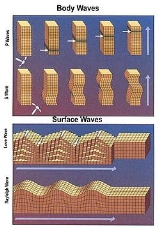
There are two types of seismic waves, body waves and surface waves. Other modes of wave propagation exist than those described in this article, but they are of comparatively minor importance. An excellent audience demonstration for seismic waves is shown in slinky seismology.

Body waves

Body waves travel through the interior of the Earth. They follow raypaths bent by the varying density
Density

The density of a material is defined as its mass per unit volume. The symbol of density is ....
 and modulus (stiffness) of the Earth's interior. The density and modulus, in turn, vary according to temperature, composition, and phase. This effect is similar to the refraction
Refraction

Refraction is the change in direction of a wave due to a change in its speed. This is most commonly observed when a wave passes from one optical medium to another....
 of light waves.
P-waves
P waves (primary waves) are longitudinal
Longitudinal wave

Longitudinal waves are waves that have vibrations along or parallel to their direction of travel; that is, waves in which the motion of the medium is in the same direction as the motion of the wave....
 or compressional waves, which means that the ground is alternately compressed and dilated in the direction of propagation. In solids, these waves generally travel almost twice as fast as S waves and can travel through any type of material. In air, these pressure waves take the form of sound waves, hence they travel at the speed of sound
Speed of sound

Sound is a vibration that travels through an elasticity medium as a wave. The speed of sound describes how much distance such a wave travels in a certain amount of time....
. Typical speeds are 330 m/s in air, 1450 m/s in water and about 5000 m/s in granite. When generated by an earthquake they are less destructive than the S waves and surface waves that follow them, due to their bigger amplitudes.

S-waves
S waves (secondary waves) are transverse
Transverse wave

A transverse wave is a moving wave that consists of oscillations occurring perpendicular to the direction of energy transfer. If a transverse wave is moving in the positive x-direction, its oscillations are in up and down directions that lie in the y-z plane....
 or shear waves, which means that the ground is displaced perpendicularly to the direction of propagation. In the case of horizontally polarized S waves, the ground moves alternately to one side and then the other. S waves can travel only through solids, as fluids (liquids and gases) do not support shear stresses. Their speed is about 60% of that of P waves in a given material. S waves are several times larger in amplitude than P waves for earthquake sources.

Surface waves

Surface waves are analogous to water waves and travel just under the Earth's surface. They travel more slowly than body waves. Because of their low frequency, long duration, and large amplitude, they can be the most destructive type of seismic wave. There are two types of surface waves: Rayleigh wave
Rayleigh wave

Rayleigh waves are a type of elastic surface wave that travel on solids. They are produced on the Earth by earthquakes, in which case they are also known as "ground roll", or by other sources of seismic energy such as an explosion or even a sledgehammer impact....
s and Love wave
Love wave

In elastodynamics, Love waves are essentially horizontally polarized shear waves guided by an elastic layer, which is "welded" to an elastic half space on one side while bordering a vacuum on the other side....
s. Theoretically, surface waves can be understood as systems of interacting Primary and Secondary waves, which are also known as P waves and S waves which you can read in the few paragraphs below.

Rayleigh waves
Rayleigh waves, also called ground roll, are surface waves that travel as ripples with motions that are similar to those of waves on the surface of water (note, however, that the associated particle motion at shallow depths is retrograde, and that the restoring force in Rayleigh and in other seismic waves is elastic, not gravitational as for water waves). The existence of these waves was predicted by John William Strutt, Lord Rayleigh, in 1885. They are slower than body waves, roughly 90% of the velocity of S waves for typical homogeneous elastic media.

Rayleigh waves have been asserted to be visible during an earthquake in an open space like a parking lot where the cars move up and down with the waves, however, reports among seismologists suggest that the apparent motion may be due to distortion of the human eye during shaking. Anecdotally, placing people on "shake tables" causes the room to appear to ripple. In any case, waves of the reported amplitude, wavelength, and velocity of the "visible waves" have never been recorded instrumentally.

Love waves
Love waves are surface waves that cause horizontal shearing of the ground. They are named after A.E.H. Love, a British mathematician who created a mathematical model of the waves in 1911. They usually travel slightly faster than Rayleigh waves, about 90% of the S wave velocity.

P and S waves in Earth's mantle and core

When an earthquake occurs, seismographs near the epicenter
Epicenter

The epicenter or epicentre is the point on the Earth's surface that is directly above the hypocenter or focus, the point where an earthquake or underground explosion originates....
, out to about 90 km distance, are able to record both P and S waves, but those at a greater distance no longer detect the high frequencies of the first S wave. Since shear waves cannot pass through liquids, this phenomenon was original evidence for the now well-established observation that the Earth has a liquid outer core, as demonstrated by Richard Dixon Oldham
Richard Dixon Oldham

Richard Dixon Oldham was an United Kingdom geology who, in 1906, argued that the Earth must have a molten interior as seismic wave were not able to travel as quickly through liquids nor through the Earth's interior as through less dense matter....
. This kind of observation has also been used to argue, by seismic testing, that the Moon has a solid core, although recent geodetic studies suggest the core is still molten.

Usefulness of P and S waves in locating an event


In the case of local or nearby earthquakes, the difference in the arrival times of the P and S waves can be used to determine the distance to the event. In the case of earthquakes that have occurred at global distances, four or more geographically diverse observing stations (using a common clock
Clock

A clock is an instrument used for indicating and maintaining the time and passage thereof. The word clock is derived ultimately from the Celtic languages words clagan and clocca meaning "bell"....
) recording P-wave arrivals permits the computation of a unique time and location on the planet for the event. Typically, dozens or even hundreds of P-wave arrivals are used to calculate hypocenter
Hypocenter

The hypocenter or hypocentre , refers to the site of an earthquake or to that of a nuclear explosion. In the former, it is a synonym of the focus; in the latter, of ground zero....
s. The misfit generated by a hypocenter calculation is known as "the residual". Residuals of 0.5 second or less are typical for distant events, residuals of 0.1-0.2 s typical for local events, meaning most reported P arrivals fit the computed hypocenter that well. Typically a location program will start by assuming the event occurred at a depth of about 33 km; then it minimizes the residual by adjusting depth. Most events occur at depths shallower than about 40 km, but some occur as deep as 700 km.

A quick way to determine the distance from a location to the origin of a seismic wave less than 200 km away is to take the difference in arrival time of the P wave and the S wave in second
Second

The second , sometimes abbreviated sec., is the name of a units of measurement of time, and is the International System of Units SI base unit of time....
s and multiply by 8 kilometers per second. Modern seismic arrays use more complicated earthquake location
Earthquake location

The primary purpose of a seismometer is to locate the initiating points of earthquake hypocenters. The secondary purpose, of determining the 'size' or Moment magnitude scale must be calculated after the precise location is known....
 techniques.

At teleseismic distances, the first arriving P waves have necessarily travelled deep into the mantle, and perhaps have even refracted into the outer core of the planet, before travelling back up to the Earth's surface where the seismographic stations are located. The waves travel more quickly than if they had traveled in a straight line from the earthquake. This is due to the appreciably increased velocities within the planet, and is termed Huygens' Principle. Density
Density

The density of a material is defined as its mass per unit volume. The symbol of density is ....
 in the planet increases with depth, which would slow the waves, but the modulus
Modulus

Modulus may refer to:*Modulus , a formal product of places of a number field*Modulus of continuity, a way to measure the smoothness of a function...
 of the rock increases much more, so deeper means faster. Therefore, a longer route can take a shorter time.

The travel time must be calculated very accurately in order to compute a precise hypocenter. Since P waves move at many kilometers per second, being off on travel-time calculation by even a half second can mean an error of many kilometers in terms of distance. In practice, P arrivals from many stations are used and the errors cancel out, so the computed epicenter likely to be quite accurate, on the order of 10-50 km or so around the world. Dense arrays of nearby sensors such as those that exist in California can provide accuracy of roughly a kilometer, and much greater accuracy is possible when timing is measured directly by cross-correlation
Cross-correlation

In signal processing, cross-correlation is a measure of similarity of two waveforms as a function of a time-lag applied to one of them. This is also known as a sliding dot product or inner-product....
 of seismogram
Seismogram

A seismogram is a graph output by a seismograph. It is a record of the ground motion at a measuring station. The energy measured in a seismogram may result from an earthquake or from some other source, such as an explosion.A recording of earth motion as a function of time is called a seismogram....
 waveforms.

External links