

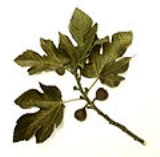
The Fig Tree

Encyclopedia
- For the plant genus, see FicusFicusFicus is a genus of about 850 species of woody trees, shrubs, vines, epiphytes, and hemiepiphyte in the family Moraceae. Collectively known as fig trees or figs, they are native throughout the tropics with a few species extending into the semi-warm temperate zone. The Common Fig Ficus is a genus of...
.
Ficus
Ficus is a genus of about 850 species of woody trees, shrubs, vines, epiphytes, and hemiepiphyte in the family Moraceae. Collectively known as fig trees or figs, they are native throughout the tropics with a few species extending into the semi-warm temperate zone. The Common Fig Ficus is a genus of...
, are mentioned several times in the New Testament
New Testament
The New Testament is the second major division of the Christian biblical canon, the first such division being the much longer Old Testament....
as well as the Old Testament
Old Testament
The Old Testament, of which Christians hold different views, is a Christian term for the religious writings of ancient Israel held sacred and inspired by Christians which overlaps with the 24-book canon of the Masoretic Text of Judaism...
. Biblical references to figs are often symbolic and refer to more than just the common Mediterranean fruit tree and the Common Fig
Common fig
The Common fig is a deciduous tree growing to heights of up to 6 m in the genus Ficus from the family Moraceae known as Common fig tree. It is a temperate species native to the Middle East.-Description:...
. In the Bible, figs are a symbol or type
Typology (theology)
Typology in Christian theology and Biblical exegesis is a doctrine or theory concerning the relationship between the Old and New Testaments...
, subject to various interpretations.
Hebrew Bible (Old Testament)
In the Old Testament the fig tree is the third tree to be mentioned by name. The first is the Tree of Life and the second is the Tree of the Knowledge of Good and Evil. Adam and Eve used the leaves of the fig tree to sew garments for themselves when they realized that they were naked. Figs were one of the foods produced in the promised landIn fig production was listed as a great accomplishment during King Solomon's reign. During Solomon's lifetime Judah and Israel, from Dan to Beersheba, lived in safety, each man under his own vine and fig tree; this is an indicator of national wealth and prosperity.
This situation was apparently reversed by the time of the reign of Hezekiah (which should not be surprising, considering the political and martial upheavals in the intervening time). states that Hezekiah rebelled against the King of Assyria, of whom he had become a vassal. In response, the Assyrian commander attempted to sway the army of Jerusalem by offering deserters each his own vine and fig tree. In the following chapter Jehovah protected Hezekiah and his people and the Assyrian invasion was not successful this time.
likens tending a fig tree to looking after one's master.
Of course there was a fig tree in the garden of the Song of Solomon. In the year of love the tree formed its fruit early.
The Fig Tree and figs are featured in the Book of Jeremiah
Book of Jeremiah
The Book of Jeremiah is the second of the Latter Prophets in the Hebrew Bible, following the book of Isaiah and preceding Ezekiel and the Book of the Twelve....
.
Another species of ficus, the Egyptian Sycamore Fig is occasionally mentioned as well, for example (and in the New Testament).
Parable of the budding fig tree
The Parable of the budding fig tree is found in , , as part of the Olivet discourseOlivet discourse
The Olivet discourse or Olivet prophecy is a biblical passage found in the Synoptic Gospels of Mark 13, Matthew 24, Luke 21. It is known as the "Little Apocalypse" because it includes Jesus' descriptions of the end times, the use of apocalyptic language, and Jesus' warning to his followers that...
.
The term fig tree could be understood to refer to Israel ,
Parable of the barren fig tree
The Parable of the barren fig tree is a parable of JesusParables of Jesus
The parables of Jesus can be found in all the Canonical gospels as well as in some of the non-canonical gospels but are located mainly within the three synoptic gospels. They represent a key part of the teachings of Jesus, forming approximately one third of his recorded teachings...
recorded in the Gospel of Luke
Gospel of Luke
The Gospel According to Luke , commonly shortened to the Gospel of Luke or simply Luke, is the third and longest of the four canonical Gospels. This synoptic gospel is an account of the life and ministry of Jesus of Nazareth. It details his story from the events of his birth to his Ascension.The...
. A vinekeeper holds out hope that a barren fig tree will bear fruit next year.
Jesus and the withered fig tree / clearing the temple
MarkGospel of Mark
The Gospel According to Mark , commonly shortened to the Gospel of Mark or simply Mark, is the second book of the New Testament. This canonical account of the life of Jesus of Nazareth is one of the three synoptic gospels. It was thought to be an epitome, which accounts for its place as the second...
includes an account of Jesus withering a fig tree / clearing the temple:
A parallel is found in Matthew
Gospel of Matthew
The Gospel According to Matthew is one of the four canonical gospels, one of the three synoptic gospels, and the first book of the New Testament. It tells of the life, ministry, death, and resurrection of Jesus of Nazareth...
. In , the next day, Simon Peter notices that the cursed fig tree has withered. In Matthew, the fig tree withers immediately and is noticed at that time by the disciples.
Interpretations
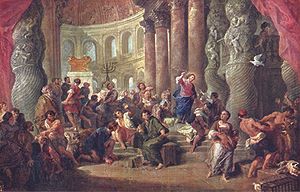
Mark 11
Mark 11 is the eleventh chapter of the Gospel of Mark in the New Testament of the Christian Bible, beginning Jesus' final week before his death as he arrives in Jerusalem for the coming Passover...
immediately before and then after the incident at the Temple
Jesus and the Money Changers
The narrative of Jesus and the money changers, commonly referred to as the cleansing of the Temple, occurs in all four canonical gospels of the New Testament....
. The cursing of the tree displays Jesus' power and the power of prayer coupled with full belief in God. Mark, placing the fig tree before and after the incident at the Temple, may be using the fig tree as a metaphor, as Jesus himself might have, for what he sees as the barrenness of the priests (technically, the Temple priests were the Sadducees
Sadducees
The Sadducees were a sect or group of Jews that were active in Ancient Israel during the Second Temple period, starting from the second century BC through the destruction of the Temple in 70 AD. The sect was identified by Josephus with the upper social and economic echelon of Judean society...
) and the withering of their teaching and authority due to their lack of true faith. As Jesus hoped to find fruit on the fig tree, Jesus hoped to find "fruit", the fruit of true worship of God, at the Temple. The Temple, Herod's Temple, like the fig tree, is cursed. See also .
Simon Peter observes that the tree withered. Jesus responds that anyone can make a mountain
Mountain
Image:Himalaya_annotated.jpg|thumb|right|The Himalayan mountain range with Mount Everestrect 58 14 160 49 Chomo Lonzorect 200 28 335 52 Makalurect 378 24 566 45 Mount Everestrect 188 581 920 656 Tibetan Plateaurect 250 406 340 427 Rong River...
throw itself in the sea
Sea
A sea generally refers to a large body of salt water, but the term is used in other contexts as well. Most commonly, it means a large expanse of saline water connected with an ocean, and is commonly used as a synonym for ocean...
, if he truly believes his command will be obeyed. A similar statement is also mentioned in the much earlier Pauline Epistles
Pauline epistles
The Pauline epistles, Epistles of Paul, or Letters of Paul, are the thirteen New Testament books which have the name Paul as the first word, hence claiming authorship by Paul the Apostle. Among these letters are some of the earliest extant Christian documents...
, where the First Epistle to the Corinthians
First Epistle to the Corinthians
The first epistle of Paul the apostle to the Corinthians, often referred to as First Corinthians , is the seventh book of the New Testament of the Bible...
argues that faith can move mountains.
A different statement is found in the Gospel of Thomas
Gospel of Thomas
The Gospel According to Thomas, commonly shortened to the Gospel of Thomas, is a well preserved early Christian, non-canonical sayings-gospel discovered near Nag Hammadi, Egypt, in December 1945, in one of a group of books known as the Nag Hammadi library...
. Instead of referring to a lack of doubt, Jesus advises that mountains can be moved if two people make peace with each other in a "single house." The early Gnostics
Gnosticism
Gnosticism is a scholarly term for a set of religious beliefs and spiritual practices common to early Christianity, Hellenistic Judaism, Greco-Roman mystery religions, Zoroastrianism , and Neoplatonism.A common characteristic of some of these groups was the teaching that the realisation of Gnosis...
interpreted this statement
Gnosticism and the New Testament
Gnosticism and the New Testament is the connection between the Christian sects described by Irenaeus , and other writers, as gnostikos, and the New Testament, and also the use of the New Testament in the Nag Hammadi texts ....
as referring to the paths that lead to gnosis
Gnosis
Gnosis is the common Greek noun for knowledge . In the context of the English language gnosis generally refers to the word's meaning within the spheres of Christian mysticism, Mystery religions and Gnosticism where it signifies 'spiritual knowledge' in the sense of mystical enlightenment.-Related...
.
In the Synoptic Gospels
Synoptic Gospels
The gospels of Matthew, Mark, and Luke are known as the Synoptic Gospels because they include many of the same stories, often in the same sequence, and sometimes exactly the same wording. This degree of parallelism in content, narrative arrangement, language, and sentence structures can only be...
, the fig tree is revisited as a parable
Parable
A parable is a succinct story, in prose or verse, which illustrates one or more instructive principles, or lessons, or a normative principle. It differs from a fable in that fables use animals, plants, inanimate objects, and forces of nature as characters, while parables generally feature human...
within the Olivet discourse
Olivet discourse
The Olivet discourse or Olivet prophecy is a biblical passage found in the Synoptic Gospels of Mark 13, Matthew 24, Luke 21. It is known as the "Little Apocalypse" because it includes Jesus' descriptions of the end times, the use of apocalyptic language, and Jesus' warning to his followers that...
. Jesus says that when the fig tree puts forth leaves one can tell that summer has arrived. Jesus continues that when this has happened the kingdom of God
Kingdom of God
The Kingdom of God or Kingdom of Heaven is a foundational concept in the Abrahamic religions: Judaism, Christianity and Islam.The term "Kingdom of God" is found in all four canonical gospels and in the Pauline epistles...
will be at hand. This is almost always interpreted metaphorically, and is usually considered in contrast to the earlier tree withering.
Most modern Christians interpret the parable to suggest that the tree's withering meant the teachings of the Sadducees and Pharisees were far from the truth, and that this poverty of teaching was the source of Jesus' anger at the lack of fruit. At some point the fruits of Christianity will come forth and then an eschatological
Christian eschatology
Christian eschatology is a major branch of study within Christian theology. Eschatology, from two Greek words meaning last and study , is the study of the end of things, whether the end of an individual life, the end of the age, or the end of the world...
kingdom of God arrive. Another Christian interpretation of this event suggests that the fig tree represents God's people and the fruit reperesents the good works or virtue that they are supposed to produce. If Jesus comes and does not find his people bearing their intended fruit then they have lost their purpose, they might as well whither. This interpretation is similar to Jesus' parable of the talents where a master gives three servants each a number of talents, to one servant he gives only one talent. When the master returns to those servants and finds that the one servant did not produce anything with his talent, he refers to him as a wicked servant and takes away his one and only talent and then punishes him severely.
The Jewish Encyclopedia
Jewish Encyclopedia
The Jewish Encyclopedia is an encyclopedia originally published in New York between 1901 and 1906 by Funk and Wagnalls. It contained over 15,000 articles in 12 volumes on the history and then-current state of Judaism and the Jews as of 1901...
states that the fig tree is a symbol of the coming of the Mashiach:
- The simple meaning of these parables, however, was lost later on, and they were taken to be allegories and mysteries, especially when they alluded to the Messianic expectationsJewish MessiahMessiah, ; mashiah, moshiah, mashiach, or moshiach, is a term used in the Hebrew Bible to describe priests and kings, who were traditionally anointed with holy anointing oil as described in Exodus 30:22-25...
, about which it was not safe to speak in public, as they assumed the end of the kingdom of SatanSatanSatan , "the opposer", is the title of various entities, both human and divine, who challenge the faith of humans in the Hebrew Bible...
(RomeRomeRome is the capital of Italy and the country's largest and most populated city and comune, with over 2.7 million residents in . The city is located in the central-western portion of the Italian Peninsula, on the Tiber River within the Lazio region of Italy.Rome's history spans two and a half...
; comp. , ; , especially and ). Thus "the parable of the fig-tree" is actually a "symbol" of the Messianic advent, according to the MidrashMidrashThe Hebrew term Midrash is a homiletic method of biblical exegesis. The term also refers to the whole compilation of homiletic teachings on the Bible....
(Cant. R. ii. 13), but was no longer understood by the evangelists, either as an allegoryAllegoryAllegory is a demonstrative form of representation explaining meaning other than the words that are spoken. Allegory communicates its message by means of symbolic figures, actions or symbolic representation...
or as a sign of Messianic success or failure, in the story of the blasted fig-tree .
In the noncanonical Apocalypse of Peter
Apocalypse of Peter
The recovered Apocalypse of Peter or Revelation of Peter is an example of a simple, popular early Christian text of the 2nd century; it is an example of Apocalyptic literature with Hellenistic overtones. The text is extant in two incomplete versions of a lost Greek original, one Koine Greek, and an...
, Peter discusses the significance of the fig tree with Jesus, who says the fig tree represents "the house of Israel."
In his 1927 essay Why I Am Not a Christian
Why I Am Not a Christian
Why I Am Not a Christian is a 1927 essay by the British philosopher Bertrand Russell hailed by The Independent as "devastating in its use of cold logic", and listed in the New York Public Library's list of the most influential books of the 20th century....
, Bertrand Russell
Bertrand Russell
Bertrand Arthur William Russell, 3rd Earl Russell, OM, FRS was a British philosopher, logician, mathematician, historian, and social critic. At various points in his life he considered himself a liberal, a socialist, and a pacifist, but he also admitted that he had never been any of these things...
argued that a divine
Divinity
Divinity and divine are broadly applied but loosely defined terms, used variously within different faiths and belief systems — and even by different individuals within a given faith — to refer to some transcendent or transcendental power or deity, or its attributes or manifestations in...
figure would either know that the tree would not have figs or could have simply produced the figs by a miracle
Miracle
A miracle often denotes an event attributed to divine intervention. Alternatively, it may be an event attributed to a miracle worker, saint, or religious leader. A miracle is sometimes thought of as a perceptible interruption of the laws of nature. Others suggest that a god may work with the laws...
and thus finds the story illogical from a literal sense:
- Then there is the curious story of the fig tree, which always rather puzzled me. You remember what happened about the fig tree. “He was hungry; and seeing a fig tree afar off having leaves, He came if haply He might find anything thereon; and when He came to it He found nothing but leaves, for the time of figs was not yet. And Jesus answered and said unto it: ‘No man eat fruit of thee hereafter for ever’ . . . and Peter . . . saith unto Him: ‘Master, behold the fig tree which thou cursedst is withered away.’” This is a very curious story, because it was not the right time of year for figs, and you really could not blame the tree. I cannot myself feel that either in the matter of wisdom or in the matter of virtue Christ stands quite as high as some other people known to history.
Russell, however, was neither a biblical scholar nor a botanist. On the other hand, an article by F. F. Bruce
F. F. Bruce
Frederick Fyvie Bruce was a Biblical scholar and one of the founders of the modern evangelical understanding of the Bible...
in the book Hard Sayings in the Bible sheds some light on the passage:
- Was it not unreasonable to curse the tree for being fruitless when, as Mark expressly says, "it was not the season for figs"? The problem is most satisfactorily cleared up in a discussion called "The Barren Fig Tree" published many years ago by W. M. Christie, a Church of ScotlandChurch of ScotlandThe Church of Scotland, known informally by its Scots language name, the Kirk, is a Presbyterian church, decisively shaped by the Scottish Reformation....
minister in Palestine under the British mandatory regime. He pointed out first the time of year at which the incident is said to have occurred (if, as is probable, Jesus was crucified on April 6th, A.D. 30, the incident occurred during the first days of April). "Now," wrote Christie, "the facts connected with the fig tree are these. Towards the end of March the leaves begin to appear, and in about a week the foliage coating is complete. Coincident with [this], and sometimes even before, there appears quite a crop of small knobs, not the real figs, but a kind of early forerunner. They grow to the size of green almonds, in which condition they are eaten by peasants and others when hungry. When they come to their own indefinite maturity they drop off." These precursors of the true fig are called taqsh in Palestinian ArabicPalestinian ArabicPalestinian Arabic is a Levantine Arabic dialect subgroup spoken by Palestinians and the majority of Arab-Israelis. Rural varieties of this dialect exhibit several distinctive features; particularly the pronunciation of qaf as kaf, which distinguish them from other Arabic varieties...
. Their appearance is a harbinger of the fully formed appearance of the true fig some six weeks later. So, as Mark says, the time for figs had not yet come. But if the leaves appear without any taqsh, that is a sign that there will be no figs. Since Jesus found "nothing but leaves" — leaves without any taqsh — he knew that "it was an absolutely hopeless, fruitless fig tree" and said as much.
Christian teaching on the 'Withering of the Fig Tree'
There are approximately 30 references to The Fig tree in the Bible (depending on the translation) and approximately 50 references to a vine. Some are literal and some metaphorical. These are in the Gospels:- The cursing of the barren fig tree by Jesus (Matthew 21:18-22), (Mark 11)
- The parable of the barren fig tree (Luke 13:6-9)
- The parable of the budding fig tree (Mar 13:28-29), (Mat 24:32-33), (Luke 21:29-31)
- In chapter 15 of the gospel of John, Jesus says he is 'the vine'.
- There are also references to 'the vineyard' in the Old Testament, believed to be related to Israel in the prophesies of Isaiah.
To understand in context the 'withering of the fig tree' it is important to see if Jesus' teaching elsewhere follows similar themes. We read in John 15 that Jesus says he is the true vine. John 15:6 (English Standard Version) says "If anyone does not abide in me he is thrown away like a branch and withers; and the branches are gathered, thrown into the fire, and burned.". The mainstream Christian view on Jesus' miracle was that Jesus was teaching the disciples that although Israel was God's chosen people (Israel was commonly represented by the fig tree ), if Israel or any other claim to be of Christ (or have spiritual life) yet do not keep his commandments (as Christ says this is the sign of his followers), then they shall not have salvation. Many Christians believe that this miracle of Jesus echoes the words of the prophet Isaiah
Isaiah
Isaiah ; Greek: ', Ēsaïās ; "Yahu is salvation") was a prophet in the 8th-century BC Kingdom of Judah.Jews and Christians consider the Book of Isaiah a part of their Biblical canon; he is the first listed of the neviim akharonim, the later prophets. Many of the New Testament teachings of Jesus...
who prophesied the rejection of Israel as having special spiritual significance. Isaiah says the reason for this withering or rejection is Israel's continual disobedience. The prophet Jeremiah
Jeremiah
Jeremiah Hebrew:יִרְמְיָה , Modern Hebrew:Yirməyāhū, IPA: jirməˈjaːhu, Tiberian:Yirmĭyahu, Greek:Ἰερεμίας), meaning "Yahweh exalts", or called the "Weeping prophet" was one of the main prophets of the Hebrew Bible...
refers to Israel as a choice vine planted by God which has turned against her creator to become a 'corrupt wild vine'. Jeremiah also describes a vision of good and bad figs representing people of Judah
Kingdom of Judah
The Kingdom of Judah was a Jewish state established in the Southern Levant during the Iron Age. It is often referred to as the "Southern Kingdom" to distinguish it from the northern Kingdom of Israel....
conquered by Babylon, those good eventually returning to Jerusalem, those bad being exiled and punished in nations of the earth.
Some say that Jesus responded harshly in such action (as the above mentioned Bertrand Russell
Bertrand Russell
Bertrand Arthur William Russell, 3rd Earl Russell, OM, FRS was a British philosopher, logician, mathematician, historian, and social critic. At various points in his life he considered himself a liberal, a socialist, and a pacifist, but he also admitted that he had never been any of these things...
). The significance of not bearing spiritual fruit means that a branch or plant is spiritually dead and must be cut off. This may be considered in a context of the Biblical definition of spiritual fruit as love, joy, peace, patience, kindness, goodness, faithfulness, gentleness, and self-control. As understood here, to have such fruit we must be grafted onto Christ, the true vine.
The apostle Paul seeks to clarify the issue in Romans 11, correcting those who believed that Israel was rejected forever. There is difference of opinion about what Paul is actually referring to when he says 'all Israel will be saved'. Dispensationalist theology
Dispensationalist theology
Dispensational theology refers to the unified teachings of Dispensationalism that address what other views teach as divergent theologies in the Old Testament and New Testament...
maintains that Israel will be restored politically and spiritually as the people of God. Reformed theology teaches that Israel is representative of all of God's children in Christ and includes those whom Paul referred to as having been 'grafted in'. These differences of interpretation reflect differing views of eschatology
Eschatology
Eschatology is a part of theology, philosophy, and futurology concerned with what are believed to be the final events in history, or the ultimate destiny of humanity, commonly referred to as the end of the world or the World to Come...
. A example of a popular dispensationalist theologian is Cyrus Scofield
Cyrus Scofield
Cyrus Ingerson Scofield was an American theologian, minister, and writer whose best-selling annotated Bible popularized dispensationalism among fundamentalist Christians.-Youth:...
, while the views of Matthew Henry
Matthew Henry
Matthew Henry was an English commentator on the Bible and Presbyterian minister.-Life:He was born at Broad Oak, a farmhouse on the borders of Flintshire and Shropshire. His father, Philip Henry, had just been ejected under the Act of Uniformity 1662...
are those of a reformed theologian.
Matthew Henry
Matthew Henry
Matthew Henry was an English commentator on the Bible and Presbyterian minister.-Life:He was born at Broad Oak, a farmhouse on the borders of Flintshire and Shropshire. His father, Philip Henry, had just been ejected under the Act of Uniformity 1662...
comments on the Matthew 21 and Mark 11 passages but does not refer one to another, suggesting he thought they were two separate events