

The Bacchae

Encyclopedia
The Bacchae is an ancient Greek
tragedy
by the Athenian
playwright
Euripides
, during his final years in Macedon
, at the court of Archelaus I of Macedon
. It premiered posthumously at the Theatre of Dionysus
in 405 BC
as part of a tetralogy
that also included Iphigeneia at Aulis
, and which Euripides' son or nephew probably directed. It won first prize in the City Dionysia festival competition
.
The tragedy is based on the mythological
story of King Pentheus
of Thebes and his mother Agauë, and their punishment by the god Dionysus
(who is Pentheus' cousin) for refusing to worship him.
in Euripides' tale is a young god, angry that his mortal family, the royal house of Cadmus
, has denied him a place of honor as a deity. His mortal mother, Semele
, was a mistress of Zeus
, and while pregnant, she was killed because her sisters accused her of lying about her son's paternity and their father Cadmus
using Zeus as a cover up. Most of Semele's family, including her sisters Ino, Autonoe, and Agauë, refused to believe that Dionysus was the son of Zeus, and the young god is spurned in his home. He has traveled throughout Asia
and other foreign lands, gathering a cult of female worshipers (Bacchantes), and at the start of the play has returned to take revenge on the house of Cadmus, disguised as a stranger. He has driven the women of Thebes, including his aunts, into an ecstatic frenzy, sending them dancing and hunting on Mount Kithaeron, much to the horror of their families. Complicating matters, his cousin, the young king Pentheus
, has declared a ban on the worship of Dionysus throughout Thebes.
, angry at her husband Zeus' betrayal, convinces Semele to ask Zeus to appear to her in his true form. Zeus appears to Semele as a lightning bolt and kills her instantly. At the moment of her death however, Hermes
swoops down and saves the unborn Dionysus. To hide the baby from Hera, Zeus has the fetus
sewn up in his thigh until the baby is ready to be born. However, Semele's family—her sisters Agave, Autonoe
, and Ino
, and her father, Cadmus—still believe that Semele blasphemously lied about the identity of the baby's father and that she died as a result. Dionysus comes to Thebes to vindicate his mother Semele.
The old men Cadmus and Tiresias
, though not under the same spell as the Theban women (who include Cadmus' daughters Ino, Autonoe and Agave, Pentheus' mother), have become enamored of the Bacchic rituals and are about to go out celebrating when Pentheus returns to the city and finds them dressed in festive garb. He scolds them harshly and orders his soldiers to arrest anyone else engaging in Dionysian worship.
The guards return with Dionysus himself, disguised as his priest and the leader of the Asian maenads. Pentheus questions him, still not believing that Dionysus is a god. However, his questions reveal that he is deeply interested in the Dionysiac rites, which the stranger refuses to reveal fully to him. This greatly angers Pentheus, who has Dionysus locked up. However, being a god, he is quickly able to break free and creates more havoc, razing the palace of Pentheus to the ground in a giant earthquake and fire. Word arrives via a herdsman that the Bacchae on Cithaeron are behaving especially strangely and performing incredible feats, putting snakes in their hair in reverie of their god, suckling wild wolves and gazelle, and making wine, milk, honey and water spring up from the ground. He tells that when they tried to capture the women, the women descended on a herd of cows, ripping them to shreds with their bare hands (Sparagmos
). Those guards who attacked the women were unable to harm them with their weapons, while the women could defeat them with only sticks. Dionysus wishes to punish Pentheus for not worshipping him or paying him libations. He uses Pentheus' clear desire to see the ecstatic women to convince the king to dress as a female Maenad to avoid detection and go to the rites:
Dionysus dresses Pentheus as a woman and gives him a thyrsus
and fawn skins, then leads him out of the house. Pentheus begins to see double, perceiving two Thebes and two bulls (Dionysus often took the form of a bull) leading him.
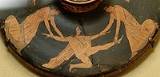
A messenger arrives at the palace to report that once they reached Cithaeron, Pentheus wanted to climb up an evergreen tree to get a better view of the Bacchants. The blond stranger used his divine power to bend the tall tree and place the king at its highest branches. However, once he was safely at the top, Dionysus called out to his followers and showed the man sitting atop the tree. This, of course, drove the Bacchants wild, and they tore the trapped Pentheus down and ripped his body apart piece by piece.
After the messenger has relayed this news, Pentheus' mother, Agave, arrives carrying the head of her son. In her possessed state she believed it was the head of a mountain lion, and she killed him with her bare hands and pulled his head off. She proudly displays her son's head to her father, believing it to be a hunting trophy. She is confused when Cadmus does not delight in her trophy, his face contorting in horror. By that time, however, Dionysus' possession is beginning to wear off, and as Cadmus reels from the horror of his grandson's death, Agave slowly realizes what she has done. The family is destroyed, with Agave and her sisters sent into exile. Cadmus and his wife Harmonia
were actually honored by Dionysus when he turns them into snakes. Tiresias, the old, blind Theban prophet, is the only one not to suffer.
.
At the start of the play, Dionysus gives us the exposition and from which we can highlight the play's central conflict; the invasion of Greece by an Asian religion.
's "Birth of Tragedy
" in 1872 that reposed the question of Dionysus's relation with the theatre that elevated interest in The Bacchae. In the twentieth century performances of The Bacchae had become quite fashionable, particularly so in the opera due to the dramatic choruses found throughout the story. R.P Winnington-Ingram's review in 1948 praises the work of Euripides, he writes: "On its poetical and dramatic beauties he writes with charm and insight; on more complex themes he shows equal mastery."
Classical Greece
Classical Greece was a 200 year period in Greek culture lasting from the 5th through 4th centuries BC. This classical period had a powerful influence on the Roman Empire and greatly influenced the foundation of Western civilizations. Much of modern Western politics, artistic thought, such as...
tragedy
Tragedy
Tragedy is a form of art based on human suffering that offers its audience pleasure. While most cultures have developed forms that provoke this paradoxical response, tragedy refers to a specific tradition of drama that has played a unique and important role historically in the self-definition of...
by the Athenian
Classical Athens
The city of Athens during the classical period of Ancient Greece was a notable polis of Attica, Greece, leading the Delian League in the Peloponnesian War against Sparta and the Peloponnesian League. Athenian democracy was established in 508 BC under Cleisthenes following the tyranny of Hippias...
playwright
Playwright
A playwright, also called a dramatist, is a person who writes plays.The term is not a variant spelling of "playwrite", but something quite distinct: the word wright is an archaic English term for a craftsman or builder...
Euripides
Euripides
Euripides was one of the three great tragedians of classical Athens, the other two being Aeschylus and Sophocles. Some ancient scholars attributed ninety-five plays to him but according to the Suda it was ninety-two at most...
, during his final years in Macedon
Macedon
Macedonia or Macedon was an ancient kingdom, centered in the northeastern part of the Greek peninsula, bordered by Epirus to the west, Paeonia to the north, the region of Thrace to the east and Thessaly to the south....
, at the court of Archelaus I of Macedon
Archelaus I of Macedon
Archelaus I was a king of Macedon from 413 to 399 BC. He was a capable and beneficent ruler, known for the sweeping changes he made in state administration, the military, and commerce. By the time that he died, Archelaus had succeeded in converting Macedon into a significantly stronger power...
. It premiered posthumously at the Theatre of Dionysus
Theatre of Dionysus
The Theatre of Dionysus is a major open-air theatre and one of the earliest preserved in Athens. It was used for festivals in honor of the god Dionysus...
in 405 BC
405 BC
Year 405 BC was a year of the pre-Julian Roman calendar. At the time, it was known as the Year of the Tribunate of Barbatus, Capitolinus, Cincinnatus, Medullinus, Iullus and Mamercinus...
as part of a tetralogy
Tetralogy
A tetralogy is a compound work that is made up of four distinct works, just as a trilogy is made up of three works....
that also included Iphigeneia at Aulis
Iphigeneia at Aulis
Iphigenia in Aulis is the last extant work of the playwright Euripides. Written between 408, after the Orestes, and 406 BC, the year of Euripides's death, the play was first produced the following year by his son or nephew, Euripides the Younger, and won the first place at the Athenian city...
, and which Euripides' son or nephew probably directed. It won first prize in the City Dionysia festival competition
Dionysia
The Dionysia[p] was a large festival in ancient Athens in honor of the god Dionysus, the central events of which were the theatrical performances of dramatic tragedies and, from 487 BC, comedies. It was the second-most important festival after the Panathenaia...
.
The tragedy is based on the mythological
Greek mythology
Greek mythology is the body of myths and legends belonging to the ancient Greeks, concerning their gods and heroes, the nature of the world, and the origins and significance of their own cult and ritual practices. They were a part of religion in ancient Greece...
story of King Pentheus
Pentheus
In Greek mythology, Pentheus was a king of Thebes, son of the strongest of the Spartes, Echion, and of Agave, daughter of Cadmus, the founder of Thebes, and the goddess Harmonia....
of Thebes and his mother Agauë, and their punishment by the god Dionysus
Dionysus
Dionysus was the god of the grape harvest, winemaking and wine, of ritual madness and ecstasy in Greek mythology. His name in Linear B tablets shows he was worshipped from c. 1500—1100 BC by Mycenean Greeks: other traces of Dionysian-type cult have been found in ancient Minoan Crete...
(who is Pentheus' cousin) for refusing to worship him.
Background
The DionysusDionysus
Dionysus was the god of the grape harvest, winemaking and wine, of ritual madness and ecstasy in Greek mythology. His name in Linear B tablets shows he was worshipped from c. 1500—1100 BC by Mycenean Greeks: other traces of Dionysian-type cult have been found in ancient Minoan Crete...
in Euripides' tale is a young god, angry that his mortal family, the royal house of Cadmus
Cadmus
Cadmus or Kadmos , in Greek mythology was a Phoenician prince, the son of king Agenor and queen Telephassa of Tyre and the brother of Phoenix, Cilix and Europa. He was originally sent by his royal parents to seek out and escort his sister Europa back to Tyre after she was abducted from the shores...
, has denied him a place of honor as a deity. His mortal mother, Semele
Semele
Semele , in Greek mythology, daughter of the Boeotian hero Cadmus and Harmonia, was the mortal mother of Dionysus by Zeus in one of his many origin myths. In another version of his mythic origin, he is the son of Persephone...
, was a mistress of Zeus
Zeus
In the ancient Greek religion, Zeus was the "Father of Gods and men" who ruled the Olympians of Mount Olympus as a father ruled the family. He was the god of sky and thunder in Greek mythology. His Roman counterpart is Jupiter and his Etruscan counterpart is Tinia.Zeus was the child of Cronus...
, and while pregnant, she was killed because her sisters accused her of lying about her son's paternity and their father Cadmus
Cadmus
Cadmus or Kadmos , in Greek mythology was a Phoenician prince, the son of king Agenor and queen Telephassa of Tyre and the brother of Phoenix, Cilix and Europa. He was originally sent by his royal parents to seek out and escort his sister Europa back to Tyre after she was abducted from the shores...
using Zeus as a cover up. Most of Semele's family, including her sisters Ino, Autonoe, and Agauë, refused to believe that Dionysus was the son of Zeus, and the young god is spurned in his home. He has traveled throughout Asia
Asia
Asia is the world's largest and most populous continent, located primarily in the eastern and northern hemispheres. It covers 8.7% of the Earth's total surface area and with approximately 3.879 billion people, it hosts 60% of the world's current human population...
and other foreign lands, gathering a cult of female worshipers (Bacchantes), and at the start of the play has returned to take revenge on the house of Cadmus, disguised as a stranger. He has driven the women of Thebes, including his aunts, into an ecstatic frenzy, sending them dancing and hunting on Mount Kithaeron, much to the horror of their families. Complicating matters, his cousin, the young king Pentheus
Pentheus
In Greek mythology, Pentheus was a king of Thebes, son of the strongest of the Spartes, Echion, and of Agave, daughter of Cadmus, the founder of Thebes, and the goddess Harmonia....
, has declared a ban on the worship of Dionysus throughout Thebes.
Plot
Dionysus first comes on stage to tell the audience who he is and why he decided to come to Thebes. He explains the story of his birth, how his mother Semele had enamoured the god Zeus, who had come down from Mount Olympus to lie with her. She becomes pregnant with a divine son; however none of her family believe her, thinking the illicit pregnancy of the more usual sort. HeraHera
Hera was the wife and one of three sisters of Zeus in the Olympian pantheon of Greek mythology and religion. Her chief function was as the goddess of women and marriage. Her counterpart in the religion of ancient Rome was Juno. The cow and the peacock were sacred to her...
, angry at her husband Zeus' betrayal, convinces Semele to ask Zeus to appear to her in his true form. Zeus appears to Semele as a lightning bolt and kills her instantly. At the moment of her death however, Hermes
Hermes
Hermes is the great messenger of the gods in Greek mythology and a guide to the Underworld. Hermes was born on Mount Kyllini in Arcadia. An Olympian god, he is also the patron of boundaries and of the travelers who cross them, of shepherds and cowherds, of the cunning of thieves, of orators and...
swoops down and saves the unborn Dionysus. To hide the baby from Hera, Zeus has the fetus
Fetus
A fetus is a developing mammal or other viviparous vertebrate after the embryonic stage and before birth.In humans, the fetal stage of prenatal development starts at the beginning of the 11th week in gestational age, which is the 9th week after fertilization.-Etymology and spelling variations:The...
sewn up in his thigh until the baby is ready to be born. However, Semele's family—her sisters Agave, Autonoe
Autonoe
In Greek mythology, Autonoë was a daughter of Cadmus, founder of Thebes, Greece, and the goddess Harmonia. She was the wife of Aristaeus and mother of Actaeon and possibly Macris...
, and Ino
Ino (Greek mythology)
In Greek mythology Ino was a mortal queen of Thebes, who after her death and transfiguration was worshiped as a goddess under her epithet Leucothea, the "white goddess." Alcman called her "Queen of the Sea" , which, if not hyperbole, would make her a doublet of Amphitrite.In her mortal self, Ino,...
, and her father, Cadmus—still believe that Semele blasphemously lied about the identity of the baby's father and that she died as a result. Dionysus comes to Thebes to vindicate his mother Semele.
The old men Cadmus and Tiresias
Tiresias
In Greek mythology, Tiresias was a blind prophet of Thebes, famous for clairvoyance and for being transformed into a woman for seven years. He was the son of the shepherd Everes and the nymph Chariclo; Tiresias participated fully in seven generations at Thebes, beginning as advisor to Cadmus...
, though not under the same spell as the Theban women (who include Cadmus' daughters Ino, Autonoe and Agave, Pentheus' mother), have become enamored of the Bacchic rituals and are about to go out celebrating when Pentheus returns to the city and finds them dressed in festive garb. He scolds them harshly and orders his soldiers to arrest anyone else engaging in Dionysian worship.
The guards return with Dionysus himself, disguised as his priest and the leader of the Asian maenads. Pentheus questions him, still not believing that Dionysus is a god. However, his questions reveal that he is deeply interested in the Dionysiac rites, which the stranger refuses to reveal fully to him. This greatly angers Pentheus, who has Dionysus locked up. However, being a god, he is quickly able to break free and creates more havoc, razing the palace of Pentheus to the ground in a giant earthquake and fire. Word arrives via a herdsman that the Bacchae on Cithaeron are behaving especially strangely and performing incredible feats, putting snakes in their hair in reverie of their god, suckling wild wolves and gazelle, and making wine, milk, honey and water spring up from the ground. He tells that when they tried to capture the women, the women descended on a herd of cows, ripping them to shreds with their bare hands (Sparagmos
Sparagmos
Sparagmos refers to an ancient Dionysian ritual in which a living animal, or sometimes even a human being, would be sacrificed by being dismembered, by the tearing apart of limbs from the body. Sparagmos was frequently followed by omophagia...
). Those guards who attacked the women were unable to harm them with their weapons, while the women could defeat them with only sticks. Dionysus wishes to punish Pentheus for not worshipping him or paying him libations. He uses Pentheus' clear desire to see the ecstatic women to convince the king to dress as a female Maenad to avoid detection and go to the rites:
- Stranger: Ah! Would you like to see them in their gatherings upon the mountain?
- Pentheus: Very much. Ay, and pay uncounted gold for the pleasure.
- Stranger: Why have you conceived so strong a desire?
- Pentheus: Though it would pain me to see them drunk with wine-
- Stranger: Yet you would like to see them, pain and all.
Dionysus dresses Pentheus as a woman and gives him a thyrsus
Thyrsus
In Greek mythology, a thyrsus or thyrsos was a staff of giant fennel covered with ivy vines and leaves, sometimes wound with taeniae and always topped with a pine cone. These staffs were carried by Dionysus and his followers. Euripides wrote that honey dripped from the thyrsos staves that the...
and fawn skins, then leads him out of the house. Pentheus begins to see double, perceiving two Thebes and two bulls (Dionysus often took the form of a bull) leading him.
A messenger arrives at the palace to report that once they reached Cithaeron, Pentheus wanted to climb up an evergreen tree to get a better view of the Bacchants. The blond stranger used his divine power to bend the tall tree and place the king at its highest branches. However, once he was safely at the top, Dionysus called out to his followers and showed the man sitting atop the tree. This, of course, drove the Bacchants wild, and they tore the trapped Pentheus down and ripped his body apart piece by piece.
After the messenger has relayed this news, Pentheus' mother, Agave, arrives carrying the head of her son. In her possessed state she believed it was the head of a mountain lion, and she killed him with her bare hands and pulled his head off. She proudly displays her son's head to her father, believing it to be a hunting trophy. She is confused when Cadmus does not delight in her trophy, his face contorting in horror. By that time, however, Dionysus' possession is beginning to wear off, and as Cadmus reels from the horror of his grandson's death, Agave slowly realizes what she has done. The family is destroyed, with Agave and her sisters sent into exile. Cadmus and his wife Harmonia
Harmonia (mythology)
In Greek mythology, Harmonia is the immortal goddess of harmony and concord. Her Roman counterpart is Concordia, and her Greek opposite is Eris, whose Roman counterpart is Discordia.-Origins:...
were actually honored by Dionysus when he turns them into snakes. Tiresias, the old, blind Theban prophet, is the only one not to suffer.
Dramatic versions
- Joe OrtonJoe OrtonJohn Kingsley Orton was an English playwright.In a short but prolific career lasting from 1964 until his death, he shocked, outraged and amused audiences with his scandalous black comedies...
's play The Erpingham Camp (television broadcast 27 June 1966; opened at the Royal Court TheatreRoyal Court TheatreThe Royal Court Theatre is a non-commercial theatre on Sloane Square, in the Royal Borough of Kensington and Chelsea. It is noted for its contributions to modern theatre...
on 6 June 1967) relocates The Bacchae to a British Butlin'sButlinsButlins is a chain of large holiday camps in the United Kingdom. Butlins was founded by Billy Butlin to provide affordable holidays for ordinary British families....
-style holiday campHoliday campHoliday camp, in Britain, generally refers to a resort with a boundary that includes accommodation, entertainment and other facilities.As distinct from camping, accommodation typically consisted of chalets – small buildings arranged either individually or in blocks. Some had three or four storeys,...
. An author's note at the beginning of the text of the play states that: "[n]o attempt must be made to reproduce the various locales in a naturalistic manner. A small, permanent set of Erpingham's office is set on a high level. The rest of the stage is an unlocalised area. Changes of scene are suggested by lighting and banners after the manner of the Royal Shakespeare CompanyRoyal Shakespeare CompanyThe Royal Shakespeare Company is a major British theatre company, based in Stratford-upon-Avon, Warwickshire, England. The company employs 700 staff and produces around 20 productions a year from its home in Stratford-upon-Avon and plays regularly in London, Newcastle-upon-Tyne and on tour across...
's productions of ShakespeareWilliam ShakespeareWilliam Shakespeare was an English poet and playwright, widely regarded as the greatest writer in the English language and the world's pre-eminent dramatist. He is often called England's national poet and the "Bard of Avon"...
's historiesShakespearean historyIn the First Folio, the plays of William Shakespeare were grouped into three categories: comedies, histories, and tragedies. This categorisation has become established, although some critics have argued for other categories such as romances and problem plays. The histories were those plays based on...
."
- In 1970, Brian De PalmaBrian De PalmaBrian Russell De Palma is an American film director and writer. In a career spanning over 40 years, he is probably best known for his suspense and crime thriller films, including such box office successes as the horror film Carrie, Dressed to Kill, Scarface, The Untouchables, and Mission:...
filmed Richard SchechnerRichard SchechnerRichard Schechner is Professor of Performance Studies at the Tisch School of the Arts, New York University , editor of TDR: The Drama Review, and artistic director of East Coast Artists. His BA is from Cornell University , MA from the University of Iowa , and PhD from Tulane University...
's dramatic re-envisioning of the work, Dionysus in 69, in a converted garage.
- Wole SoyinkaWole SoyinkaAkinwande Oluwole "Wole" Soyinka is a Nigerian writer, poet and playwright. He was awarded the 1986 Nobel Prize in Literature, where he was recognised as a man "who in a wide cultural perspective and with poetic overtones fashions the drama of existence", and became the first African in Africa and...
adapted the play as The Bacchae of Euripides: A Communion Rite with the British Royal National TheatreRoyal National TheatreThe Royal National Theatre in London is one of the United Kingdom's two most prominent publicly funded theatre companies, alongside the Royal Shakespeare Company...
in London in 1973, incorporating a second chorus of slaves to mirror the civil unrest in his native NigeriaNigeriaNigeria , officially the Federal Republic of Nigeria, is a federal constitutional republic comprising 36 states and its Federal Capital Territory, Abuja. The country is located in West Africa and shares land borders with the Republic of Benin in the west, Chad and Cameroon in the east, and Niger in...
.
- Caryl ChurchillCaryl ChurchillCaryl Churchill is an English dramatist known for her use of non-naturalistic techniques and feminist themes, the abuses of power, and sexual politics. She is acknowledged as a major playwright in the English language and a leading female writer...
and David LanDavid LanDavid Lan is an English playwright, filmmaker and theatre director.Born in Cape Town, South Africa in 1952, he emigrated to London in 1972. Since 2000 he has been artistic director of the Young Vic theatre in London's South Bank.-Career:...
used the play as the basis of their 1986 dance-theatre hybrid A Mouthful of BirdsA Mouthful of BirdsA Mouthful of Birds is a 1986 play with dance by Caryl Churchill and David Lan, with choreography by Ian Spink. Drawing its themes from The Bacchae of Euripides, it is a meditation on possession, madness and female violence.-Synopsis:...
.
- Famed Swedish director Ingmar BergmanIngmar BergmanErnst Ingmar Bergman was a Swedish director, writer and producer for film, stage and television. Described by Woody Allen as "probably the greatest film artist, all things considered, since the invention of the motion picture camera", he is recognized as one of the most accomplished and...
directed the Bacchae three times: as an opera (1991) for the Royal Swedish Opera, as a TV-film (1993) for Sveriges Television and as a staged play (1996) for the Royal Dramatic Theatre in Stockholm. These three versions received great acclaim amidst some mixed reviews.
- Brad MaysBrad MaysBrad Mays is an independent filmmaker and stage director, living and working in Los Angeles, California.-Background and education:...
directed his own adaptation of the play at the Complex in Los AngelesLos ÁngelesLos Ángeles is the capital of the province of Biobío, in the commune of the same name, in Region VIII , in the center-south of Chile. It is located between the Laja and Biobío rivers. The population is 123,445 inhabitants...
in 1997, where it broke all box office records and was nominated for three LA Weekly Theater AwardLA Weekly Theater AwardLA Weekly Theater Award is an annual critics' award established in 1979, given by the LA Weekly for outstanding achievements in small theatre productions in Southern California...
s: for Best Direction, Best Musical Score and Best Production Design. Because the production featured several scenes with levels of violence and nudity rare for even the most experimental of theater pieces, it was widely discussed in print, and even videotaped for the Lincoln Center's Billy Rose Theatre Collection in NYC. The production was eventually fashioned into an independent feature filmFeature filmIn the film industry, a feature film is a film production made for initial distribution in theaters and being the main attraction of the screening, rather than a short film screened before it; a full length movie...
which, interestingly, featured Will Shepherd — the Pentheus of Richard SchechnerRichard SchechnerRichard Schechner is Professor of Performance Studies at the Tisch School of the Arts, New York University , editor of TDR: The Drama Review, and artistic director of East Coast Artists. His BA is from Cornell University , MA from the University of Iowa , and PhD from Tulane University...
's Dionysus in '69 — in the role of Cadmus. Both productions were produced by Mays' wife, Lorenda StarfeltLorenda StarfeltLorenda Starfelt was an award-winning independent film producer, as well as a committed political activist and blogger who famously dug up president Barack Obama's in an August 1961 edition of The Honolulu Advertiser while researching her documentary on the 2008 presidential election...
.
- The Bacchae 2.1, a theatrical adaptation set in modern times, was written by Charles MeeCharles L. MeeCharles L. Mee is an American playwright, historian and author known for his collage-like style of playwriting, which makes use of radical reconstructions of found texts.-Early Life and Early Career:...
and first performed in 1993.
- In 2007, David GreigDavid Greig (dramatist)David Greig is a Scottish playwright and theatre director.Greig was born in Edinburgh in 1969 and was brought up in Nigeria. He studied drama at Bristol University. He has been commissioned by the Royal Court Theatre, the Royal National Theatre and the Royal Shakespeare Company amongst others.His...
wrote an adaptation of The Bacchae for the National theatre of scotlandNational Theatre of ScotlandThe National Theatre of Scotland is a theatre company established in February 2006. The company performs in a wide range of venues including theatres, halls and found spaces across Scotland....
starring Alan CummingAlan CummingAlan Cumming, OBE is a Scottish stage, television and film actor, singer, writer, director, producer and author. His roles have included the Emcee in Cabaret, Boris Grishenko in GoldenEye, Kurt Wagner/Nightcrawler in X2: X-Men United, Mr. Elton in Emma, and Fegan Floop in the Spy Kids trilogy...
as DionysusDionysusDionysus was the god of the grape harvest, winemaking and wine, of ritual madness and ecstasy in Greek mythology. His name in Linear B tablets shows he was worshipped from c. 1500—1100 BC by Mycenean Greeks: other traces of Dionysian-type cult have been found in ancient Minoan Crete...
, with ten soul-singing followers in place of the traditional Greek chorusGreek chorusA Greek chorus is a homogenous, non-individualised group of performers in the plays of classical Greece, who comment with a collective voice on the dramatic action....
. A critically praised run at New YorkNew YorkNew York is a state in the Northeastern region of the United States. It is the nation's third most populous state. New York is bordered by New Jersey and Pennsylvania to the south, and by Connecticut, Massachusetts and Vermont to the east...
's Lincoln Center Rose Theater followed the show's premiere in ScotlandScotlandScotland is a country that is part of the United Kingdom. Occupying the northern third of the island of Great Britain, it shares a border with England to the south and is bounded by the North Sea to the east, the Atlantic Ocean to the north and west, and the North Channel and Irish Sea to the...
.
- Luigi Lo CascioLuigi Lo CascioLuigi Lo Cascio is an Italian actor born 20 October 1967 in Palermo.He won David di Donatello for Best actor for his starring role in I cento passi.-Filmography:*2000: I cento passi*2001: Luce dei miei occhi...
's multimedia adaptation La Caccia (The Hunt) won the Biglietto d' Oro del Teatro prize in 2008. The free adaptation combines live theater with animations by Nicola Console and Desideria Rayner's video projections. A revised 2009 version is currently on tour and features original music by Andrea RoccaAndrea RoccaAndrea Rocca is an Italian musician and film composer. He first began scoring feature-length films in 1995, with Kaprice Kea's The Hurting .Rocca is involved with several bands in London's avant-garde music scene....
.
- In May 2008, BBC Radio 7 broadcast Dionysos, a ninety-minute drama based on The Bacchae written by Andrew Rissik and starring Paul ScofieldPaul ScofieldDavid Paul Scofield, CH, CBE , better known as Paul Scofield, was an English actor of stage and screen...
as "Cadmus" and Diana RiggDiana RiggDame Enid Diana Elizabeth Rigg, DBE is an English actress. She is probably best known for her portrayals of Emma Peel in The Avengers and Countess Teresa di Vicenzo in the 1969 James Bond film On Her Majesty's Secret Service....
as "Agave".
- In 2010 The Bacchae was performed at The Royal Exchange TheatreRoyal Exchange, ManchesterThe Royal Exchange is a grade II listed Victorian building in Manchester, England. It is located in the city centre on the land bounded by St Ann’s Square, Exchange Street, Market Street, Cross Street and Old Bank Street...
, Manchester. The play was performed from the 10th of November till the 4th of December. This performance of The Bacchae was a different version by Mike Poulton.
- In March 2011 a liberal adaption of The Bacchae, written by Aaron Caleb, was performed by Trinity Western University's School of the Arts, Media and Culture.
Operatic versions
- Harry PartchHarry PartchHarry Partch was an American composer and instrument creator. He was one of the first twentieth-century composers to work extensively and systematically with microtonal scales, writing much of his music for custom-made instruments that he built himself, tuned in 11-limit just intonation.-Early...
composed an opera based on The Bacchae titled Revelation in the Courthouse Park. It was first performed in 1960, and a recording was released in 1987.
- Another opera based on The Bacchae, called The BassaridsThe BassaridsThe Bassarids is an opera in one act and an intermezzo, with music Hans Werner Henze to an English libretto by W. H...
, was composed in 1965 by Hans Werner HenzeHans Werner HenzeHans Werner Henze is a German composer of prodigious output best known for "his consistent cultivation of music for the theatre throughout his life"...
. The libretto was by W. H. AudenW. H. AudenWystan Hugh Auden , who published as W. H. Auden, was an Anglo-American poet,The first definition of "Anglo-American" in the OED is: "Of, belonging to, or involving both England and America." See also the definition "English in origin or birth, American by settlement or citizenship" in See also...
and Chester KallmanChester KallmanChester Simon Kallman was an American poet, librettist, and translator, best known for his collaborations with W. H. Auden and Igor Stravinsky.-Life:...
.
- Giorgio Federico GhediniGiorgio Federico GhediniGiorgio Federico Ghedini was an Italian composer.-Life:Ghedini was born in Cuneo in 1892. He studied organ, piano and composition in Turin, then graduated in composition in Bologna under Marco Enrico Bossi in 1911...
composed an opera in Italian based on The Bacchae and called Le Baccanti. The libretto was by playwright and screenwriter Tullio PinelliTullio PinelliTullio Pinelli was an Italian screenwriter best known for his work on the Federico Fellini classics I Vitelloni, La strada, La Dolce Vita and 8½.-Biography:...
. The opera was composed in 1941–1944 and first performed at La ScalaLa ScalaLa Scala , is a world renowned opera house in Milan, Italy. The theatre was inaugurated on 3 August 1778 and was originally known as the New Royal-Ducal Theatre at La Scala...
opera house in Milan on February 22, 1948. It was revived in Milan in 1972.
Musical versions
In Summer 2009, the Public Theater (of New York City) produced a version of The Bacchae' with music by Philip GlassPhilip Glass
Philip Glass is an American composer. He is considered to be one of the most influential composers of the late 20th century and is widely acknowledged as a composer who has brought art music to the public .His music is often described as minimalist, along with...
.
- Gustav HolstGustav HolstGustav Theodore Holst was an English composer. He is most famous for his orchestral suite The Planets....
's "Hymn to Dionysus" (Op. 31, No.2) is a setting for female voices and orchestra of the parodosParodosParodos is a term used in Ancient Greek comedy and tragedy. A parodos is both the first entrance of the chorus into the orchestra and the choral ode that they sing and dance as they enter...
from The Bacchae in the translation by Gilbert MurrayGilbert MurrayGeorge Gilbert Aimé Murray, OM was an Australian born British classical scholar and public intellectual, with connections in many spheres. He was an outstanding scholar of the language and culture of Ancient Greece, perhaps the leading authority in the first half of the twentieth century...
. It was composed in 1913 and premiered in 1914.
Significant quotations
- Dionysus: "It's a wise man's part to practise a smooth-tempered self-control."
- Dionysus: "Your [Pentheus'] name points to calamity. It fits you well." (The name "Pentheus" derives from πένθος, pénthos, grief)
- Messenger: "Dionysus' powers are manifold; he gave to men the vine to cure their sorrows."
- Dionysus: "Can you, a mortal, measure your strength against a god?"
Religious Significance
Plays such as The Bacchae existed primarily for the purpose of religious practice and worship. Religion was connected closely with everyday life, and cities and local communities would come together to celebrate the worship of different deities. Through plays, gods such as Dionysus could be celebrated. The Bacchae re-enacts how Dionysus had come to be a god and in ancient Greek theatre, "role-playing is a well-known feature of ritual liminality." The Bacchae is a tribute to Dionysus and it is written in a way that favours him. It is a common understanding that worship is the play's main function. Deities were found in every locality of everyday life. The play also highlights what Dionysus represents; he is the god of wine, ritual madness and ecstasy. With this in mind, the play incorporates these aspects to depict how Dionysus is present in ancient Greek life. As an actor, religious worship is a direct experience. The actor would have experienced a "stepping out" of himself to become a representation of Dionysus. As a spectator, the experience comes from what is acted onstage, arousing emotions that sympathize with Dionysus. Collectively, through Dionysiac acting, there is a reintegration of the "other" into the "self," that is to say that Dionysus has been accepted and will be worshipped by the Greek people.Dramatic structure
In a play that follows a climatic plot construction, Dionysus the Protagonist, instigates the unfolding action by simultaneously emulating the play's author, costume designer, choreographer and artistic director. Helen P. Foley wrote of the links between the importance of Dionysus as the central character and his effect on the play's structure, she writes: "the poet uses the ritual crisis to explore simultaneously god, man, society, and his own tragic art. In this protodrama Dionysus, the god of the theatre, stage-directs the play."At the start of the play, Dionysus gives us the exposition and from which we can highlight the play's central conflict; the invasion of Greece by an Asian religion.
Critical review
Up until the late nineteenth century the play's themes were considered far too gruesome to be studied and appreciated. It was NietzscheFriedrich Nietzsche
Friedrich Wilhelm Nietzsche was a 19th-century German philosopher, poet, composer and classical philologist...
's "Birth of Tragedy
The Birth of Tragedy
The Birth of Tragedy from the Spirit of Music is a 19th-century work of dramatic theory by the German philosopher Friedrich Nietzsche. It was reissued in 1886 as The Birth of Tragedy, Or: Hellenism and Pessimism ...
" in 1872 that reposed the question of Dionysus's relation with the theatre that elevated interest in The Bacchae. In the twentieth century performances of The Bacchae had become quite fashionable, particularly so in the opera due to the dramatic choruses found throughout the story. R.P Winnington-Ingram's review in 1948 praises the work of Euripides, he writes: "On its poetical and dramatic beauties he writes with charm and insight; on more complex themes he shows equal mastery."
Translations
- Theodore Alois BuckleyTheodore Alois BuckleyTheodore Alois William Buckley was a translator of Homer's and other classical works. In 1873 he published a literal prose translation of the complete text of The Iliad, in which he included explanatory notes....
, 1850: prose: full text - Henry Hart MilmanHenry Hart MilmanThe Very Reverend Henry Hart Milman was an English historian and ecclesiastic.He was born in London, the third son of Sir Francis Milman, 1st Baronet, physician to King George III . Educated at Eton and at Brasenose College, Oxford, his university career was brilliant...
, 1865: verse - Edward P. Coleridge, 1891: prose: full text
- Gilbert MurrayGilbert MurrayGeorge Gilbert Aimé Murray, OM was an Australian born British classical scholar and public intellectual, with connections in many spheres. He was an outstanding scholar of the language and culture of Ancient Greece, perhaps the leading authority in the first half of the twentieth century...
, 1911: verse: full text - Arthur S. Way, 1912: verse
- D. W. Lucas, 1930: prose
- Philip Vellacott, 1954: prose and verse
- Henry BirkheadHenry BirkheadHenry Birkhead was an English academic, lawyer and Latin poet. He is now known as the founder of the Oxford Chair of Poetry.-Life:He was born in the parish of St. Gregory, near St. Paul's Cathedral, London...
, 1957: verse - William ArrowsmithWilliam ArrowsmithWilliam Ayres Arrowsmith was an American classicist, academic, and translator.-Life:Born in Orange, New Jersey, the son of Walter Weed Arrowsmith and Dorothy Arrowsmith, William grew up in Wellesley, Massachusetts...
, 1958: verse - Moses HadasMoses HadasMoses Hadas was an American teacher, one of the leading classical scholars of the twentieth century, and a translator of numerous works....
and John McLeanJohn McLean (disambiguation)John McLean was an Associate Justice of the United States Supreme Court.John McLean may also refer to:* John McLean , American Olympic athlete and head football coach at Missouri, 1903–1905...
, 1960: prose - Geoffrey KirkGeoffrey KirkGeoffrey Stephen Kirk DSC, FBA was a British classical scholar, known for his books on Ancient Greek literature and mythology.-Life:...
, 1970: prose and verse - Robert BaggRobert BaggRobert Bagg is an American poet and translator. He has published several volumes of poetry and has authored critical studies of Sappho and Catallus....
, 1978: verse (as The Bakkhai) - Michael Cacoyannis, 1982: verse
- Matt Neuberg, 1988: verse: full text as PDF
- Arthur EvansArthur Evans (author)Arthur Scott Evans was an early gay rights advocate and author, most well known for his 1978 book Witchcraft and the Gay Counterculture.-Early life:...
, 1988, prose and verse, as The God of Ecstacy (St. Martin's PressSt. Martin's PressSt. Martin's Press is a book publisher headquartered in the Flatiron Building in New York City. Currently, St. Martin's Press is one of the United States' largest publishers, bringing to the public some 700 titles a year under eight imprints, which include St. Martin's Press , St...
) - Nicholas RudallNicholas RudallD. Nicholas Rudall is Professor of Classical Languages and Literatures, a member of on General Studies in the Humanities and Ancient Mediterranean World, and the College at the University of Chicago, where he has taught since 1966. He specializes in Greek drama, and has translated numerous works...
, 1996 - Daniel Mark EpsteinDaniel Mark EpsteinDaniel Mark Epstein is an American poet, dramatist and biographer.Epstein earned his B.A. from Kenyon College...
, 1998;verse - Paul WoodruffPaul WoodruffPaul Woodruff is a classicist, professor of philosophy, and dean at the University of Texas at Austin, where he once chaired the department of philosophy and has more recently held the Hayden Head Regents Chair as director of Plan II Honors program, which he resigned in 2006 after 15 years of...
, 1999: verse - Reginald GibbonsReginald GibbonsReginald Gibbons is an American poet, fiction writer, translator, literary critic, artist, and Professor of English, Classics, and Spanish and Portuguese at Northwestern University...
, 2000: verse ISBN 0195125983 - David Franklin, 2000: prose
- Ian Johnston, 2003: verse: full text
- Colin TeevanColin TeevanColin Teevan is an Irish playwright, radio dramatist, translator and academic.Teevan has premiered works in the National Theatres of Ireland, Scotland and the Royal National Theatre in London, He has been a regular collaborator of directors Hideki Noda, Sir Peter Hall, and actors Greg Hicks, Clare...
, 2003,: verse (as "Bacchai") - George Theodoridis, 2005: prose, full text
- Michael Valerie, 2005: verse: full text
- Michael Scanlan, 2006: verse (La Salle Academy: Providence, RI)
- Graham Kirby, 2009: verse (The ScoopThe ScoopThe Scoop is an outdoor amphitheatre situated on the south side of the River Thames near Tower Bridge in London, located underneath City Hall, providing seating for approximately 800 people...
)