

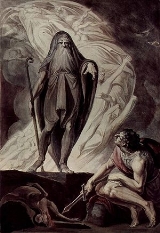
Tiresias

Encyclopedia
- Everes redirects here. For the butterflyButterflyA butterfly is a mainly day-flying insect of the order Lepidoptera, which includes the butterflies and moths. Like other holometabolous insects, the butterfly's life cycle consists of four parts: egg, larva, pupa and adult. Most species are diurnal. Butterflies have large, often brightly coloured...
genusGenusIn biology, a genus is a low-level taxonomic rank used in the biological classification of living and fossil organisms, which is an example of definition by genus and differentia...
, see Everes (genus).

Greek mythology
Greek mythology is the body of myths and legends belonging to the ancient Greeks, concerning their gods and heroes, the nature of the world, and the origins and significance of their own cult and ritual practices. They were a part of religion in ancient Greece...
, Tiresias was a blind prophet
Prophet
In religion, a prophet, from the Greek word προφήτης profitis meaning "foreteller", is an individual who is claimed to have been contacted by the supernatural or the divine, and serves as an intermediary with humanity, delivering this newfound knowledge from the supernatural entity to other people...
of Thebes, famous for clairvoyance
Clairvoyance
The term clairvoyance is used to refer to the ability to gain information about an object, person, location or physical event through means other than the known human senses, a form of extra-sensory perception...
and for being transformed into a woman for seven years. He was the son of the shepherd Everes and the nymph
Nymph
A nymph in Greek mythology is a female minor nature deity typically associated with a particular location or landform. Different from gods, nymphs are generally regarded as divine spirits who animate nature, and are usually depicted as beautiful, young nubile maidens who love to dance and sing;...
Chariclo
Chariclo
Chariclo is the name of two nymphs in Greek mythology.Chariclo, daughter of Cychreus and Stilbe married Chiron and became the mother of Hippe, Endeis, Ocyrhoe, and Carystus....
; Tiresias participated fully in seven generations at Thebes, beginning as advisor to Cadmus
Cadmus
Cadmus or Kadmos , in Greek mythology was a Phoenician prince, the son of king Agenor and queen Telephassa of Tyre and the brother of Phoenix, Cilix and Europa. He was originally sent by his royal parents to seek out and escort his sister Europa back to Tyre after she was abducted from the shores...
himself.
Overview
Eighteen allusions to mythic Tiresias, noted by Luc Brisson, fall into three groups: one, in two episodes, recounts Tiresias' sex-change and his encounter with Zeus and Hera; a second group recounts his blinding by Athena; a third, all but lost, seems to have recounted the misadventures of Tiresias.Tiresias was a prophet of Apollo
Apollo
Apollo is one of the most important and complex of the Olympian deities in Greek and Roman mythology...
. According to the mythographic compendium Bibliotheke, different stories were told of the cause of his blindness, the most direct being that he was simply blinded by the gods for revealing their secrets. An alternate story told by the poet Pherecydes
Pherecydes
Pherecydes was the name of:*Pherecydes of Syros, a pre-Socratic philosopher and author from the island of Syros, by some believed to have influenced Pythagoras...
was followed in Callimachus
Callimachus
Callimachus was a native of the Greek colony of Cyrene, Libya. He was a noted poet, critic and scholar at the Library of Alexandria and enjoyed the patronage of the Egyptian–Greek Pharaohs Ptolemy II Philadelphus and Ptolemy III Euergetes...
' poem "The Bathing of Pallas"; in it, Tiresias was blinded by Athena
Athena
In Greek mythology, Athena, Athenê, or Athene , also referred to as Pallas Athena/Athene , is the goddess of wisdom, courage, inspiration, civilization, warfare, strength, strategy, the arts, crafts, justice, and skill. Minerva, Athena's Roman incarnation, embodies similar attributes. Athena is...
after he stumbled onto her bathing naked. His mother, Chariclo, a nymph of Athena, begged Athena to undo her curse, but the goddess could not; instead, she cleaned his ears, giving him the ability to understand birdsong, thus the gift of augury.
On Mount Cyllene in the Peloponnese
Peloponnese
The Peloponnese, Peloponnesos or Peloponnesus , is a large peninsula , located in a region of southern Greece, forming the part of the country south of the Gulf of Corinth...
, as Tiresias came upon a pair of copulating snakes, he hit the pair a smart blow with his stick. Hera
Hera
Hera was the wife and one of three sisters of Zeus in the Olympian pantheon of Greek mythology and religion. Her chief function was as the goddess of women and marriage. Her counterpart in the religion of ancient Rome was Juno. The cow and the peacock were sacred to her...
was not pleased, and she punished Tiresias by transforming him into a woman. As a woman, Tiresias became a priestess of Hera, married and had children, including Manto
Manto (mythology)
There are several distinct figures in Greek mythology named Manto, the most prominent being the daughter of Tiresias. The name Manto derives from Ancient Greek Mantis, "seer, prophet" .-Daughter of Tiresias:...
, who also possessed the gift of prophecy. According to some versions of the tale, Lady Tiresias was a prostitute of great renown. After seven years as a woman, Tiresias again found mating snakes; depending on the myth, either she made sure to leave the snakes alone this time, or, according to Hyginus, trampled on them. As a result, Tiresias was released from his sentence and permitted to regain his masculinity. This ancient story is recorded in lost lines of Hesiod
Hesiod
Hesiod was a Greek oral poet generally thought by scholars to have been active between 750 and 650 BC, around the same time as Homer. His is the first European poetry in which the poet regards himself as a topic, an individual with a distinctive role to play. Ancient authors credited him and...
.
In a separate episode, Tiresias was drawn into an argument between Hera and her husband Zeus
Zeus
In the ancient Greek religion, Zeus was the "Father of Gods and men" who ruled the Olympians of Mount Olympus as a father ruled the family. He was the god of sky and thunder in Greek mythology. His Roman counterpart is Jupiter and his Etruscan counterpart is Tinia.Zeus was the child of Cronus...
, on the theme of who has more pleasure in sex: the man, as Hera claimed; or, as Zeus claimed, the woman, as Tiresias had experienced both. Tiresias replied "Of ten parts a man enjoys one only." Hera instantly struck him blind for his impiety
Impiety
Impiety is classically a lack of proper concern for the obligations owed to public religious observation or cult. Impiety was a main Pagan objection to Christianity, for unlike other initiates into mystery religions, early Christians refused to cast a pinch of incense before the images of the gods,...
. Zeus could do nothing to stop her, but he did give Tiresias the gift of foresight
Second sight
Second sight is a form of extrasensory perception, the supposed power to perceive things that are not present to the senses, whereby a person perceives information, in the form of a vision, about future events before they happen , or about things or events at remote locations...
and a lifespan of seven lives.
Stripped of its narrative, anecdotal and causal connections, the mythic figure of Tiresias combines several archaic elements: the blind seer; the impious interruption of a natural rite (whether of a bathing goddess or coupling serpents
Serpent (symbolism)
Serpent in Latin means: Rory Collins :&, in turn, from the Biblical Hebrew word of: "saraf" with root letters of: which refers to something burning-as, the pain of poisonous snake's bite was likened to internal burning.This word is commonly used in a specifically mythic or religious context,...
); serpents and staff (Caduceus
Caduceus
The caduceus is the staff carried by Hermes in Greek mythology. The same staff was also borne by heralds in general, for example by Iris, the messenger of Hera. It is a short staff entwined by two serpents, sometimes surmounted by wings...
); a holy man's double gender (shaman); and competition between deities.
Tiresias's background, fully male and then fully female, was important, both for his prophecy and his experiences. Also, prophecy was a gift given only to the priests and priestesses. Therefore, Tiresias offered Zeus and Hera evidence and gained the gift of male and female priestly prophecy. How he obtained his information varied: sometimes, like the oracle
Oracle
In Classical Antiquity, an oracle was a person or agency considered to be a source of wise counsel or prophetic predictions or precognition of the future, inspired by the gods. As such it is a form of divination....
s, he would receive visions; other times he would listen for the songs of birds, or ask for a description of visions and pictures appearing within the smoke of burnt offerings, and so interpret them.
Tiresias makes a dramatic appearance in the Odyssey
Odyssey
The Odyssey is one of two major ancient Greek epic poems attributed to Homer. It is, in part, a sequel to the Iliad, the other work ascribed to Homer. The poem is fundamental to the modern Western canon, and is the second—the Iliad being the first—extant work of Western literature...
, book XI, in which Odysseus calls up the spirits of the dead (the nekyia
Nekyia
In ancient Greek cult-practice and literature, a nekyia is a "rite by which ghosts were called up and questioned about the future," i.e., necromancy. A nekyia is not necessarily the same thing as a katabasis...
). "So sentient is Tiresias, even in death," observes Marina Warner "that he comes up to Odysseus and recognizes him and calls him by name before he has drunk the black blood of the sacrifice; even Odysseus' own mother
Anticlea
In Greek mythology, Anticlea was the daughter of Autolycus and Amphithea and mother of Odysseus by Laërtes . She was also the granddaughter of the trickster god Hermes Tiresias. In the underworld, he encounters many spirits, including that of his mother, Anticlea...
cannot accomplish this, but must drink deep before her ghost can see her son for himself."
As a seer, "Tiresias" was "a common title for soothsayers throughout Greek legendary history" (Graves 1960, 105.5). In Greek literature
Greek literature
Greek literature refers to writings composed in areas of Greek influence, typically though not necessarily in one of the Greek dialects, throughout the whole period in which the Greek-speaking people have existed.-Ancient Greek literature :...
, Tiresias's pronouncements are always gnomic
Gnome (rhetoric)
A gnome is a type of saying, especially an aphorism or a maxim designed to provide instruction in a compact form....
but never wrong. Often when his name is attached to a mythic prophecy, it is introduced simply to supply a personality to the generic example of a seer, not by any inherent connection of Tiresias with the myth: thus it is Tiresias who tells Amphytrion of Zeus and Alcmena and warns the mother of Narcissus
Narcissus (mythology)
Narcissus or Narkissos , possibly derived from ναρκη meaning "sleep, numbness," in Greek mythology was a hunter from the territory of Thespiae in Boeotia who was renowned for his beauty. He was exceptionally proud, in that he disdained those who loved him...
that the boy will thrive as long as he never knows himself
Know thyself
The Ancient Greek aphorism "Know thyself", Greek: ', English phonetics pronunciation: , was inscribed in the pronaos of the Temple of Apollo at Delphi according to the Greek periegetic writer Pausanias .The maxim, or aphorism, "Know Thyself" has had a variety of meanings attributed to it in...
. This is his emblematic role in tragedy (see below). Like most oracle
Oracle
In Classical Antiquity, an oracle was a person or agency considered to be a source of wise counsel or prophetic predictions or precognition of the future, inspired by the gods. As such it is a form of divination....
s, he is generally extremely reluctant to offer the whole of what he sees in his visions.
In Hellenistic and Roman times Tiresias' sex-change was embroidered upon and expanded into seven episodes, with appropriate amours in each, probably written by the Alexandrian Ptolemaeus Chennus
Ptolemaeus Chennus
Ptolemaeus Chennus or Chennos , of Alexandria, was a Greek grammarian during the reigns of Trajan and Hadrian.According to the Suda, he was the author of an historical drama named Sphinx, of an epic, Anthomeros, in 24 books and a Strange History...
, but attributed by Eustathius
Eustathius
Eustathius or Eustathios may refer to:* Eustathius of Antioch, Patriarch of Antioch * Eustathius of Sebaste * Eustathius of Cappadocia Neoplatonist, orator, and diplomat...
to Sostratus
Sostratus
Sostratus may refer to:*Sostratus of Cnidus, designer of the Lighthouse of Alexandria*Sostratus of Dyme, Greek mythological hero and friend of Hercules*Sostratus of Pellene, runner and Olympic winner...
. Tiresias is presented as a complexly liminal figure, with a foot in each of many oppositions, mediating between the gods and mankind, male and female, blind and seeing, present and future, and this world and the Underworld
Underworld
The Underworld is a region which is thought to be under the surface of the earth in some religions and in mythologies. It could be a place where the souls of the recently departed go, and in some traditions it is identified with Hell or the realm of death...
.
Tiresias and Thebes
Tiresias appears as the name of a recurring character in several stories and Greek tragedies concerning the legendary history of Thebes. In The BacchaeThe Bacchae
The Bacchae is an ancient Greek tragedy by the Athenian playwright Euripides, during his final years in Macedon, at the court of Archelaus I of Macedon. It premiered posthumously at the Theatre of Dionysus in 405 BC as part of a tetralogy that also included Iphigeneia at Aulis, and which...
, by Euripides
Euripides
Euripides was one of the three great tragedians of classical Athens, the other two being Aeschylus and Sophocles. Some ancient scholars attributed ninety-five plays to him but according to the Suda it was ninety-two at most...
, Tiresias appears with Cadmus
Cadmus
Cadmus or Kadmos , in Greek mythology was a Phoenician prince, the son of king Agenor and queen Telephassa of Tyre and the brother of Phoenix, Cilix and Europa. He was originally sent by his royal parents to seek out and escort his sister Europa back to Tyre after she was abducted from the shores...
, the founder and first king of Thebes, to warn the current king Pentheus
Pentheus
In Greek mythology, Pentheus was a king of Thebes, son of the strongest of the Spartes, Echion, and of Agave, daughter of Cadmus, the founder of Thebes, and the goddess Harmonia....
against denouncing Dionysus
Dionysus
Dionysus was the god of the grape harvest, winemaking and wine, of ritual madness and ecstasy in Greek mythology. His name in Linear B tablets shows he was worshipped from c. 1500—1100 BC by Mycenean Greeks: other traces of Dionysian-type cult have been found in ancient Minoan Crete...
as a god. Along with Cadmus, he dresses in women's clothing to go up the mountain to worship Dionysus with the Theban women.
In Sophocles
Sophocles
Sophocles is one of three ancient Greek tragedians whose plays have survived. His first plays were written later than those of Aeschylus, and earlier than or contemporary with those of Euripides...
' Oedipus the King
Oedipus the King
Oedipus the King , also known by the Latin title Oedipus Rex, is an Athenian tragedy by Sophocles that was first performed c. 429 BCE. It was the second of Sophocles's three Theban plays to be produced, but it comes first in the internal chronology, followed by Oedipus at Colonus and then Antigone...
, Oedipus, the king of Thebes, calls upon Tiresias to aid in the investigation of the killing of the previous king Laius
Laius
In Greek mythology, King Laius, or Laios of Thebes was a divine hero and key personage in the Theban founding myth. Son of Labdacus, he was raised by the regent Lycus after the death of his father.-Abduction of Chrysippus:...
. At first, Tiresias refuses to give a direct answer and instead hints that the killer is someone Oedipus really does not wish to find. However, after being provoked to anger by Oedipus' accusation first that he has no foresight and then that Tiresias had had a hand in the murder, he reveals that in fact it was Oedipus himself who had (unwittingly) committed the crime. Outraged, Oedipus throws him out of the palace, but then afterwards realizes the truth.
Oedipus had handed over the rule of Thebes to his sons Eteocles
Eteocles
In Greek mythology, Eteocles was a king of Thebes, the son of Oedipus and either Jocasta or Euryganeia. The name is from earlier *Etewoklewes , meaning "truly glorious". Tawaglawas is thought to be the Hittite rendition of the name. Oedipus killed his father Laius and married his mother without...
and Polynices
Polynices
In Greek mythology, Polynices or Polyneices was the son of Oedipus and Jocasta. His wife was Argea. His father, Oedipus, was discovered to have killed his father and married his mother, and was expelled from Thebes, leaving his sons Eteocles and Polynices to rule...
but Eteocles refused to share the throne with his brother. Aeschylus
Aeschylus
Aeschylus was the first of the three ancient Greek tragedians whose work has survived, the others being Sophocles and Euripides, and is often described as the father of tragedy. His name derives from the Greek word aiskhos , meaning "shame"...
' Seven Against Thebes
Seven Against Thebes
The Seven against Thebes is the third play in an Oedipus-themed trilogy produced by Aeschylus in 467 BC. The trilogy is sometimes referred to as the Oedipodea. It concerns the battle between an Argive army led by Polynices and the army of Thebes led by Eteocles and his supporters. The trilogy won...
recounts the story of the war which followed. In it, Eteocles and Polynices kill each other, and Megareus
Megareus
In Greek mythology, Megareus may refer to:*Megareus of Onchestus, King of Onchestus, Boeotia, father of Hippomenes*Megareus of Thebes, son of Eurydice of Thebes; defended Thebes against the Seven Against Thebes, committed suicide to save it...
kills himself because of Tiresias' prophecy that a voluntary death from a Theban would save the city.
Tiresias also appears in Sophocles' Antigone
Antigone (Sophocles)
Antigone is a tragedy by Sophocles written in or before 442 BC. Chronologically, it is the third of the three Theban plays but was written first...
. Creon
Creon
Creon is a figure in Greek mythology best known as the ruler of Thebes in the legend of Oedipus. He had two children with his wife, Eurydice: Megareus and Haemon...
, now king of Thebes, refuses to allow Polynices to be buried. His niece, Antigone
Antigone
In Greek mythology, Antigone is the daughter of Oedipus and Jocasta, Oedipus' mother. The name may be taken to mean "unbending", coming from "anti-" and "-gon / -gony" , but has also been suggested to mean "opposed to motherhood", "in place of a mother", or "anti-generative", based from the root...
, defies the order and is caught; Creon decrees that she is to be buried alive. The gods express their disapproval of Creon's decision through Tiresias, who tells Creon 'the city is sick through your fault.' However, Antigone has already hanged herself rather than be buried alive. When Creon arrives at the tomb where she is to be interred, his son, Haemon
Haemon
According to Sophocles' play Antigone, Haemon or Haimon , was the son of Creon and Eurydice.When Oedipus stepped down as King of Thebes, he gave the kingdom to his two sons, Eteocles and Polynices, who both agreed to alternate the throne every year. However, they showed no concern for their...
who was betrothed to Antigone, attacks Creon and then kills himself. When Creon's wife, Eurydice
Eurydice of Thebes
In Greek mythology, Eurydice was the wife of Creon, a king of Thebes. She appears briefly in Sophocles' Antigone, to kill herself after learning that her son Haemon and his betrothed, Antigone, had both committed suicide, from a messenger. She thrusts a sword into her heart and curses Creon for...
, is informed of her son and Antigone's deaths, she too takes her own life.
Tiresias and his prophecy are also involved in the story of the Epigoni
Epigoni
In Greek mythology, Epigoni are the sons of the Argive heroes who had fought and been killed in the first Theban war, the subject of the Greek Thebaid, in which Polynices and six allies attacked Thebes because Polynices' brother, Eteocles, refused to give up the throne as promised...
.
Death
Tiresias died after drinking water from the tainted spring TilphussaTilphussa
In Greek mythology, Tilphussa is a spring in Boetia. Tiresias died after he drank water from this spring. Strabo locates the deadly spring below the slopes of Mount Telphosion, near Haliartos and Alalkomenai; he mentions the sanctuary of Tiresias and the temple of Telphousian Apollo, unique to...
, where he was struck by an arrow of Apollo. Later, he descended to the fields of Asphodel, the first level of Hades. After his death he was visited in the underworld by Odysseus
Odysseus
Odysseus or Ulysses was a legendary Greek king of Ithaca and the hero of Homer's epic poem the Odyssey. Odysseus also plays a key role in Homer's Iliad and other works in the Epic Cycle....
, to whom he gave valuable advice concerning the rest of his voyage
Odyssey
The Odyssey is one of two major ancient Greek epic poems attributed to Homer. It is, in part, a sequel to the Iliad, the other work ascribed to Homer. The poem is fundamental to the modern Western canon, and is the second—the Iliad being the first—extant work of Western literature...
, specifically concerning the cattle of Helios
Helios
Helios was the personification of the Sun in Greek mythology. Homer often calls him simply Titan or Hyperion, while Hesiod and the Homeric Hymn separate him as a son of the Titans Hyperion and Theia or Euryphaessa and brother of the goddesses Selene, the moon, and Eos, the dawn...
, advice which Odysseus' men did not follow, to their peril.
Qe-Ra-Si-Ja
At KnossosKnossos
Knossos , also known as Labyrinth, or Knossos Palace, is the largest Bronze Age archaeological site on Crete and probably the ceremonial and political centre of the Minoan civilization and culture. The palace appears as a maze of workrooms, living spaces, and store rooms close to a central square...
, in a Late Minoan IIIA context (fourteenth century BC), seven Linear B
Linear B
Linear B is a syllabic script that was used for writing Mycenaean Greek, an early form of Greek. It pre-dated the Greek alphabet by several centuries and seems to have died out with the fall of Mycenaean civilization...
texts mention an entity, unattested elsewhere as yet, called qe-ra-si-ja and, once, qe-ra-si-jo. If this title had survived the fall of LMIII Crete, then it could have evolved into *Terasias in Doric Greek and, possibly, *Te[i]resias in Ionic.
The caduceus
Connections with the paired serpents on the caduceusCaduceus
The caduceus is the staff carried by Hermes in Greek mythology. The same staff was also borne by heralds in general, for example by Iris, the messenger of Hera. It is a short staff entwined by two serpents, sometimes surmounted by wings...
are often made (Brisson 1976:55-57).
In popular culture
- Tiresias' impressive apparition in Odyssey xi kept his image a lively one, and the figure of Tiresias has been much-invoked by fiction writers and poets. Since Tiresias is both the greatest seer of the Classical mythos, a figure cursed by the gods, and both man and woman, he has been very useful to authors. At the climax of Lucian's Necyomantia, Tiresias in HadesHadesHades , Hadēs, originally , Haidēs or , Aidēs , meaning "the unseen") was the ancient Greek god of the underworld. The genitive , Haidou, was an elision to denote locality: "[the house/dominion] of Hades". Eventually, the nominative came to designate the abode of the dead.In Greek mythology, Hades...
is asked "what is the best way of life?" and his disconcertingly modern response, couched in high-flown diction, is "the life of the ordinary guy: forget philosophers and their metaphysics." This advice is pragmatic and moderate and represents the moral message of the short story. - In Divine Comedy (InfernoInferno (Dante)Inferno is the first part of Dante Alighieri's 14th-century epic poem Divine Comedy. It is followed by Purgatorio and Paradiso. It is an allegory telling of the journey of Dante through what is largely the medieval concept of Hell, guided by the Roman poet Virgil. In the poem, Hell is depicted as...
, Canto XX), DanteDANTEDelivery of Advanced Network Technology to Europe is a not-for-profit organisation that plans, builds and operates the international networks that interconnect the various national research and education networks in Europe and surrounding regions...
sees Tiresias in the fourth pit of the eighth circle of Hell (the circle is for perpetrators of fraudFraudIn criminal law, a fraud is an intentional deception made for personal gain or to damage another individual; the related adjective is fraudulent. The specific legal definition varies by legal jurisdiction. Fraud is a crime, and also a civil law violation...
and the fourth pit being the location for astrologers, sorcerers, soothsayerFortune-tellingFortune-telling is the practice of predicting information about a person's life. The scope of fortune-telling is in principle identical with the practice of divination...
s, divinerDivinerDiviner is an infrared sensing instrument aboard NASA's Lunar Reconnaissance Orbiter, part of the Lunar Precursor Robotic Program which is studying the moon...
s, and false prophetFalse prophetIn religion, a false prophet is one who falsely claims the gift of prophecy, or who uses that gift for evil ends. Often, someone who is considered a "true prophet" by some people is simultaneously considered a "false prophet" by others....
s who claim to see the future when they couldn't) He was condemned to walk for eternity with his head twisted toward his back; while in life he strove to look forward to the future, in Hell he must only look backward. Tiresias' daughter Manto is also assigned her punishment here. - More recently, "Tiresias" was the title of a poem by Alfred, Lord Tennyson.
- T. S. EliotT. S. EliotThomas Stearns "T. S." Eliot OM was a playwright, literary critic, and arguably the most important English-language poet of the 20th century. Although he was born an American he moved to the United Kingdom in 1914 and was naturalised as a British subject in 1927 at age 39.The poem that made his...
used Tiresias as an integral voice in his modernistModernismModernism, in its broadest definition, is modern thought, character, or practice. More specifically, the term describes the modernist movement, its set of cultural tendencies and array of associated cultural movements, originally arising from wide-scale and far-reaching changes to Western society...
poem, "The Waste LandThe Waste LandThe Waste Land[A] is a 434-line[B] modernist poem by T. S. Eliot published in 1922. It has been called "one of the most important poems of the 20th century." Despite the poem's obscurity—its shifts between satire and prophecy, its abrupt and unannounced changes of speaker, location and time, its...
". - The French composer Francis PoulencFrancis PoulencFrancis Jean Marcel Poulenc was a French composer and a member of the French group Les six. He composed solo piano music, chamber music, oratorio, choral music, opera, ballet music, and orchestral music...
also wrote an operaOperaOpera is an art form in which singers and musicians perform a dramatic work combining text and musical score, usually in a theatrical setting. Opera incorporates many of the elements of spoken theatre, such as acting, scenery, and costumes and sometimes includes dance...
called Les Mamelles de TirésiasLes mamelles de TirésiasLes mamelles de Tirésias is a surrealist two-act opéra bouffe by Francis Poulenc, based on the play of the same title by Guillaume Apollinaire, which was written in 1903 but first performed in 1917...
("The Breasts of Tiresias") based on Guillaume ApollinaireGuillaume ApollinaireWilhelm Albert Włodzimierz Apolinary Kostrowicki, known as Guillaume Apollinaire was a French poet, playwright, short story writer, novelist, and art critic born in Italy to a Polish mother....
's surrealist text of 1917. - Frank HerbertFrank HerbertFranklin Patrick Herbert, Jr. was a critically acclaimed and commercially successful American science fiction author. Although a short story author, he is best known for his novels, most notably Dune and its five sequels...
also uses the mythic characteristics of Tiresias in his second DuneDune (novel)Dune is a science fiction novel written by Frank Herbert, published in 1965. It won the Hugo Award in 1966, and the inaugural Nebula Award for Best Novel...
novel, Dune MessiahDune MessiahDune Messiah is a science fiction novel by Frank Herbert, the second in a series of six novels. It was originally serialized in Galaxy magazine in 1969. The American and British editions have different prologues summarizing events in the previous novel...
, where the protagonist Paul AtreidesPaul AtreidesPaul Atreides is a fictional character in the Dune universe created by Frank Herbert. Paul is a prominent character in the first two novels in the series, Dune and Dune Messiah , and returns in Children of Dune . The character is brought back as two different gholas in the Brian Herbert/Kevin J...
loses his sight but has prophetic powers to counter this stemming from insights into both the male and female part of the psyche. - Amy Seham, drama professor at Gustavus Adolphus CollegeGustavus Adolphus CollegeGustavus Adolphus College is a private liberal arts college affiliated with the Evangelical Lutheran Church in America located in St. Peter, Minnesota, United States. A coeducational, four-year, residential institution, it was founded in 1862 by Swedish Americans. To this day the school is firmly...
, wrote a musical entitled "Tiresias" in 1999, with music by Chanda Walker and Kira Theimer. - Tiresias as a motif of doubleness (male/female) also occurs in the writing of Rohinton MistryRohinton MistryRohinton Mistry is an Indian-born Canadian writer in English. Residing in Brampton, Ontario, Canada, Mistry is of Indian origin, originally from Mumbai, Zoroastrian and belongs to the Parsi community. Mistry is a Neustadt International Prize for Literature laureate .-Biography:Rohinton Mistry was...
. There it serves as a comparison to the protagonist of the short story "Lend me your Light", who is torn between his childhood home in Bombay and his new existence in Toronto: "I, Tiresias,/ Blind and throbbing between two lives..." (Tales from Firozsha Baag: 180). - In Lawrence DurrellLawrence DurrellLawrence George Durrell was an expatriate British novelist, poet, dramatist, and travel writer, though he resisted affiliation with Britain and preferred to be considered cosmopolitan...
's novel BalthazarBalthazar (novel)Balthazar, published in 1958, is the second volume in the The Alexandria Quartet series by British author Lawrence Durrell. Set in Alexandria, Egypt around WWII, the four novels tell essentially the same story from different points of view and come to a conclusion in Clea...
, the second part of his Alexandria Quartet, Melissa, Scobie and Balthazar are each seen as having moments of prophetic sight. Scobie also cross-dresses, thus implying the androgyny of Tiresias. The novel also features the sing-song rhyme:
- Old Tiresias
- No-one half so breezy as,
- Half so free and easy as
- Old Tiresias
- Tiresias also shows up in Jeffrey EugenidesJeffrey EugenidesJeffrey Kent Eugenides is an American Pulitzer Prize-winning novelist and short story writer. Eugenides is most known for his first two novels, The Virgin Suicides and Middlesex . His novel The Marriage Plot was published in October, 2011.-Life and career:Eugenides was born in Detroit, Michigan,...
' MiddlesexMiddlesex (novel)Middlesex is a Pulitzer Prize-winning novel by Jeffrey Eugenides published in 2002. The book is a bestseller, with more than three million copies sold as of May 2011. Its characters and events are loosely based on aspects of Eugenides' life and observations of his Greek heritage. It is...
. Cal, the protagonistProtagonistA protagonist is the main character of a literary, theatrical, cinematic, or musical narrative, around whom the events of the narrative's plot revolve and with whom the audience is intended to most identify...
, compares himself to the seer, and has even played him in a production of Antigone. - The blind beggar of Gustave FlaubertGustave FlaubertGustave Flaubert was a French writer who is counted among the greatest Western novelists. He is known especially for his first published novel, Madame Bovary , and for his scrupulous devotion to his art and style.-Early life and education:Flaubert was born on December 12, 1821, in Rouen,...
's Madame Bovary echoes Tiresias. Emma looking in her mirror, contemplating her death and hearing the song of the blind beggar, reflects her vacillatiing struggle between the masculine and feminine identity. - Dennis DeYoung uses Tiresias in the song "Castle Walls" on the 1977 StyxStyx (band)Styx is an American rock band that became famous for its albums from the late 1970s and early 1980s. The Chicago band is known for melding the style of prog-rock with the power of hard rock guitar, strong ballads, and elements of American musical theater....
album The Grand Illusion. - Carol Ann DuffyCarol Ann DuffyCarol Ann Duffy, CBE, FRSL is a Scottish poet and playwright. She is Professor of Contemporary Poetry at the Manchester Metropolitan University, and was appointed Britain's poet laureate in May 2009...
wrote a poem entitled 'from Mrs Tiresias' in her collection The World's WifeThe World's WifeThe World's Wife is a collection of poems by Carol Ann Duffy published in 1999.The World's Wife is Carol Ann Duffy's first themed collection of poems, which was first published in 1999...
. This poem is told from the point of view of Tiresias' marriage partner, and interprets the myth in a modern context. - During the opening scenes of O Brother Where Art Thou, a derivative of OdysseyOdysseyThe Odyssey is one of two major ancient Greek epic poems attributed to Homer. It is, in part, a sequel to the Iliad, the other work ascribed to Homer. The poem is fundamental to the modern Western canon, and is the second—the Iliad being the first—extant work of Western literature...
, Tiresias is introduced as an old black man on a railroad handcar. Although, when asked his name, he states "I have no name." - Tiresias was featured in the Hercules episode "Hercules and the Griffin" voiced by Jack CarterJack CarterJack Carter may refer to:* Jack Carter, fictional character created by Ted Lewis** from the novels Jack's Return Home, Jack Carter's Law, and Jack Carter and the Mafia Pigeon** from the films Get Carter and Get Carter...
. He was seen as a resident of a Greek Retirement Home. - A 1999 episode of the Comedy CentralComedy CentralComedy Central is an American cable television and satellite television channel that carries comedy programming, both original and syndicated....
series Strangers with CandyStrangers with CandyStrangers with Candy is a television series produced by Comedy Central. It first aired on April 7, 1999, and concluded its third and final season on October 2, 2000. Its timeslot was Sundays at 10 p.m....
titled "Behind Blank Eyes", blind high school student Alan's surname is "Tiresias". - In 2001 Le Tendre and Rossi published a two-volume comic book Tiresias, focusing on his gender-change.
- In Su Walton's 1969 Here Before Kilroy, Tiresias is the name of a homeless man who crops up throughout the story to make observations about the actions of the characters.
- The 2003 film TiresiaTiresiaTiresia is a 2003 French film directed by Bertrand Bonello and written by Bonello and Luca Fazzi.Based on the legend of Tiresias, it tells of a transsexual who is kidnapped by a man and left to die in the woods. She is then saved by a family and receives the gift of telling the future...
is inspired by this myth. - Peter GabrielPeter GabrielPeter Brian Gabriel is an English singer, musician, and songwriter who rose to fame as the lead vocalist and flautist of the progressive rock group Genesis. After leaving Genesis, Gabriel went on to a successful solo career...
, in the lyrics (by Tony BanksTony Banks (musician)This article is about the musician. For other people named Tony Banks, see Tony BanksAnthony George "Tony" Banks is a British composer, and multi-instrumentalist, who performs as a keyboardist and a guitarist...
and Mike RutherfordMike RutherfordMichael John Cleote Crawford Rutherford is an English musician. He is a founding member of Genesis, initially as a bassist and backup vocalist. In later incarnations of Genesis, he assumed the role of lead guitarist. He is one of only two constant members in Genesis . He also fronts Mike + The...
) of the GenesisGenesis (band)Genesis are an English rock band that formed in 1967. The band currently comprises the longest-tenured members Tony Banks , Mike Rutherford and Phil Collins . Past members Peter Gabriel , Steve Hackett and Anthony Phillips , also played major roles in the band in its early years...
song "The Cinema Show" from their 1973 album Selling England by the PoundSelling England by the Pound- Sound and live performance :The piano introduction to "Firth of Fifth" has not been included in a performance since 1974, in a Drury Lane Theatre concert, when Banks misplayed and Collins covered by starting the song from after the intro...
, refers to "father Tiresias" and his dual sexuality.
- Tiresias also shows up in Jeffrey Eugenides
- Take a little trip back with father Tiresias,
- Listen to the old one speak of all he has lived through.
- "I have crossed between the poles, for me there's no mystery.
- Once a man, like the sea, I raged.
- Once a woman, like the earth, I gave.
- But there is in fact more earth than sea."
- In 2007, Salley Vickers imagined a series of conversations between Tiresias and Sigmund Freud as part of the Canongate "Myths" series of novels. The myth in question was that of Oedipus. Book title : Where three roads meet.
- The League of Extraordinary Gentlemen: Black DossierThe League of Extraordinary Gentlemen: Black DossierThe League of Extraordinary Gentlemen: Black Dossier is an original graphic novel in the comic book series The League of Extraordinary Gentlemen, written by Alan Moore and illustrated by Kevin O'Neill. It was the last volume of the series to be published by DC Comics. Although the third book to be...
by Alan MooreAlan MooreAlan Oswald Moore is an English writer primarily known for his work in comic books, a medium where he has produced a number of critically acclaimed and popular series, including Watchmen, V for Vendetta, and From Hell...
includes an autobiography of Virginia WoolfVirginia WoolfAdeline Virginia Woolf was an English author, essayist, publisher, and writer of short stories, regarded as one of the foremost modernist literary figures of the twentieth century....
's OrlandoOrlando: A BiographyOrlando: A Biography is an influential novel by Virginia Woolf, first published on 11 October 1928. A semi-biographical novel based in part on the life of Woolf's lover Vita Sackville-West, it is generally considered one of Woolf's most accessible novels...
. This reveals that Tiresias had two daughters. While Manto inherited their father's prophetic abilities, the other daughter, Orlando (or Bio, as she was then named), found she changed gender as she grew, again inherited from her father. Tiresias is mentioned as having been ashamed at Orlando's gender-changing ability, sold him to pirate slavers and died escorting MantoManto (mythology)There are several distinct figures in Greek mythology named Manto, the most prominent being the daughter of Tiresias. The name Manto derives from Ancient Greek Mantis, "seer, prophet" .-Daughter of Tiresias:...
to become the OracleOracleIn Classical Antiquity, an oracle was a person or agency considered to be a source of wise counsel or prophetic predictions or precognition of the future, inspired by the gods. As such it is a form of divination....
at DelphiDelphiDelphi is both an archaeological site and a modern town in Greece on the south-western spur of Mount Parnassus in the valley of Phocis.In Greek mythology, Delphi was the site of the Delphic oracle, the most important oracle in the classical Greek world, and a major site for the worship of the god...
. - The Radio TalesRadio TalesRadio Tales is an American series of radio dramas produced by Generations Productions. This series adapted classic works of American and world literature such as The War of the Worlds, Twenty Thousand Leagues Under the Sea, Beowulf, Gulliver's Travels, and the One Thousand and One Nights...
drama "Homer's Odyssey: Voyage to the Underworld" is a dramatic retelling of the portion of Homer's epic poem that features the voyage to Hades to consult with the prophet Teiresias. The drama first aired via XM Satellite RadioXM Satellite RadioXM Satellite Radio is one of two satellite radio services in the United States and Canada, operated by Sirius XM Radio. It provides pay-for-service radio, analogous to cable television. Its service includes 73 different music channels, 39 news, sports, talk and entertainment channels, 21 regional...
on April 19, 2003. - Jack PeñateJack PeñateJack Fabian Peñate is an English musician and singer-songwriter signed to XL Recordings.-Early life:Jack Peñate attended St. Olave's Preparatory School, New Eltham until he left to attend Alleyn's School when he was 18 years of age...
, in his 2009 single " Be the One" sings "I walked away because of you, just like Tiresias I knew, that me and you were fated too" - In the BBC television series SpooksSpooksSpooks is a British television drama series that originally aired on BBC One from 13 May 2002 – 23 October 2011, consisting of 10 series. The title is a popular colloquialism for spies, as the series follows the work of a group of MI5 officers based at the service's Thames House headquarters, in a...
, the character Connie Jones is revealed as an agent of the Russians, turned by them during Operation Renaissance. She protests that she wanted only to maintain the balance between the world powers, USSR/Russia and US/England. A cryptic warning reveals that Tiresias is coming; just before exploding a nuclear device, Connie reveals, she "was already here."
Sources
Tiresias appears in the following literary classics:- Oedipus the KingOedipus the KingOedipus the King , also known by the Latin title Oedipus Rex, is an Athenian tragedy by Sophocles that was first performed c. 429 BCE. It was the second of Sophocles's three Theban plays to be produced, but it comes first in the internal chronology, followed by Oedipus at Colonus and then Antigone...
, SophoclesSophoclesSophocles is one of three ancient Greek tragedians whose plays have survived. His first plays were written later than those of Aeschylus, and earlier than or contemporary with those of Euripides... - AntigoneAntigoneIn Greek mythology, Antigone is the daughter of Oedipus and Jocasta, Oedipus' mother. The name may be taken to mean "unbending", coming from "anti-" and "-gon / -gony" , but has also been suggested to mean "opposed to motherhood", "in place of a mother", or "anti-generative", based from the root...
, Sophocles - The BacchaeThe BacchaeThe Bacchae is an ancient Greek tragedy by the Athenian playwright Euripides, during his final years in Macedon, at the court of Archelaus I of Macedon. It premiered posthumously at the Theatre of Dionysus in 405 BC as part of a tetralogy that also included Iphigeneia at Aulis, and which...
, EuripidesEuripidesEuripides was one of the three great tragedians of classical Athens, the other two being Aeschylus and Sophocles. Some ancient scholars attributed ninety-five plays to him but according to the Suda it was ninety-two at most... - Iphigenia at Aulis, Euripides
- Phoenician WomenPhoenician WomenThe Phoenician Women is a tragedy by Euripides, based on the same story as Aeschylus' play Seven Against Thebes. The title refers to the Greek chorus, which is composed of Phoenician women on their way to Delphi who are trapped in Thebes by the war...
, Euripides - The Odyssey, HomerHomerIn the Western classical tradition Homer , is the author of the Iliad and the Odyssey, and is revered as the greatest ancient Greek epic poet. These epics lie at the beginning of the Western canon of literature, and have had an enormous influence on the history of literature.When he lived is...
- OedipusOedipusOedipus was a mythical Greek king of Thebes. He fulfilled a prophecy that said he would kill his father and marry his mother, and thus brought disaster on his city and family...
, Seneca the YoungerSeneca the YoungerLucius Annaeus Seneca was a Roman Stoic philosopher, statesman, dramatist, and in one work humorist, of the Silver Age of Latin literature. He was tutor and later advisor to emperor Nero... - MetamorphosesMetamorphoses (poem)Metamorphoses is a Latin narrative poem in fifteen books by the Roman poet Ovid describing the history of the world from its creation to the deification of Julius Caesar within a loose mythico-historical framework. Completed in AD 8, it is recognized as a masterpiece of Golden Age Latin literature...
, OvidOvidPublius Ovidius Naso , known as Ovid in the English-speaking world, was a Roman poet who is best known as the author of the three major collections of erotic poetry: Heroides, Amores, and Ars Amatoria... - Seven Against ThebesSeven Against ThebesThe Seven against Thebes is the third play in an Oedipus-themed trilogy produced by Aeschylus in 467 BC. The trilogy is sometimes referred to as the Oedipodea. It concerns the battle between an Argive army led by Polynices and the army of Thebes led by Eteocles and his supporters. The trilogy won...
, AeschylusAeschylusAeschylus was the first of the three ancient Greek tragedians whose work has survived, the others being Sophocles and Euripides, and is often described as the father of tragedy. His name derives from the Greek word aiskhos , meaning "shame"... - Hymn ("The Bath of Pallas"), CallimachusCallimachusCallimachus was a native of the Greek colony of Cyrene, Libya. He was a noted poet, critic and scholar at the Library of Alexandria and enjoyed the patronage of the Egyptian–Greek Pharaohs Ptolemy II Philadelphus and Ptolemy III Euergetes...
- The Divine ComedyThe Divine ComedyThe Divine Comedy is an epic poem written by Dante Alighieri between 1308 and his death in 1321. It is widely considered the preeminent work of Italian literature, and is seen as one of the greatest works of world literature...
, Dante AlighieriDante AlighieriDurante degli Alighieri, mononymously referred to as Dante , was an Italian poet, prose writer, literary theorist, moral philosopher, and political thinker. He is best known for the monumental epic poem La commedia, later named La divina commedia ... - Lo Somni, Bernat MetgeBernat MetgeBernat Metge was a Catalan humanist, best known as the author of Lo Somni .He held a position at the court of Joan I of Aragon, and, following some troubles, once more served Martí of Aragon....
- Paradise LostParadise LostParadise Lost is an epic poem in blank verse by the 17th-century English poet John Milton. It was originally published in 1667 in ten books, with a total of over ten thousand individual lines of verse...
, John MiltonJohn MiltonJohn Milton was an English poet, polemicist, a scholarly man of letters, and a civil servant for the Commonwealth of England under Oliver Cromwell... - Tiresias, Alfred Tennyson
- The Breasts of TiresiasThe Breasts of TiresiasThe Breasts of Tiresias is a surrealist play by Guillaume Apollinaire. Written in 1903, the play received its first production in a revised version in 1917...
, Guillaume ApollinaireGuillaume ApollinaireWilhelm Albert Włodzimierz Apolinary Kostrowicki, known as Guillaume Apollinaire was a French poet, playwright, short story writer, novelist, and art critic born in Italy to a Polish mother.... - The Waste LandThe Waste LandThe Waste Land[A] is a 434-line[B] modernist poem by T. S. Eliot published in 1922. It has been called "one of the most important poems of the 20th century." Despite the poem's obscurity—its shifts between satire and prophecy, its abrupt and unannounced changes of speaker, location and time, its...
, T. S. EliotT. S. EliotThomas Stearns "T. S." Eliot OM was a playwright, literary critic, and arguably the most important English-language poet of the 20th century. Although he was born an American he moved to the United Kingdom in 1914 and was naturalised as a British subject in 1927 at age 39.The poem that made his... - La muerte no entrará en Palacio, René MarquésRené MarquesRené Marqués was a renowned Puerto Rican short story writer and playwright.-Early years:Marqués was born, raised and educated in the city of Arecibo...