

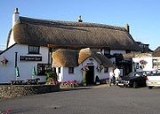
Thatching

Encyclopedia
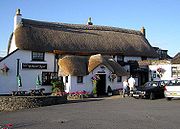
Roof
A roof is the covering on the uppermost part of a building. A roof protects the building and its contents from the effects of weather. Structures that require roofs range from a letter box to a cathedral or stadium, dwellings being the most numerous....
with dry vegetation such as straw
Straw
Straw is an agricultural by-product, the dry stalks of cereal plants, after the grain and chaff have been removed. Straw makes up about half of the yield of cereal crops such as barley, oats, rice, rye and wheat. It has many uses, including fuel, livestock bedding and fodder, thatching and...
, water reed
Phragmites
Phragmites, the Common reed, is a large perennial grass found in wetlands throughout temperate and tropical regions of the world. Phragmites australis is sometimes regarded as the sole species of the genus Phragmites, though some botanists divide Phragmites australis into three or four species...
, sedge
Cyperaceae
Cyperaceae are a family of monocotyledonous graminoid flowering plants known as sedges, which superficially resemble grasses or rushes. The family is large, with some 5,500 species described in about 109 genera. These species are widely distributed, with the centers of diversity for the group...
(Cladium mariscus), rushes
Juncus
Juncus is a genus in the plant family Juncaceae. It consists of some 200 to 300 or more species of grassy plants commonly called rushes...
, or heather
Calluna
Calluna vulgaris is the sole species in the genus Calluna in the family Ericaceae. It is a low-growing perennial shrub growing to tall, or rarely to and taller, and is found widely in Europe and Asia Minor on acidic soils in open sunny situations and in moderate shade...
, layering the vegetation so as to shed water away from the inner roof. It is a very old roofing method and has been used in both tropical and temperate climates. Thatch is still employed by builders in developing countries, usually with low-cost, local vegetation. By contrast in some developed countries it is now the choice of affluent people who desire a rustic look for their home, would like a more ecologically friendly roof, or who have purchased an originally thatched abode.
History
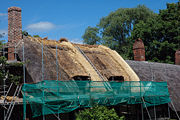
In equatorial countries thatch is the prevalent local material for roof
Roof
A roof is the covering on the uppermost part of a building. A roof protects the building and its contents from the effects of weather. Structures that require roofs range from a letter box to a cathedral or stadium, dwellings being the most numerous....
s, and often wall
Wall
A wall is a usually solid structure that defines and sometimes protects an area. Most commonly, a wall delineates a building and supports its superstructure, separates space in buildings into rooms, or protects or delineates a space in the open air...
s. There are diverse building techniques from the ancient Hawaiian hale shelter made from the local ti leaves, lauhala
Lauhala
Lauhala, lau meaning "leaf" in the Hawaiian language, refers to the leaves of the hala tree .-Uses:The hala tree is of great cultural, health and economic importance in many Pacific Islands. The fruit of the tree is used as a food source in many Pacific Islands. The fruits are oftentimes consumed...
or pili grass
Heteropogon contortus
Heteropogon contortus is a tropical, perennial tussock grass with a native distribution encompassing Southern Africa, southern Asia, Northern Australia and Oceania. The species has also become a naturalised weed in tropical and subtropical regions in the Americas and East Asia. The plant grows to ...
of fan palms to the Na Bure Fiji
Fiji
Fiji , officially the Republic of Fiji , is an island nation in Melanesia in the South Pacific Ocean about northeast of New Zealand's North Island...
an home with layered reed walls and sugar cane leaf roofs and the Kikuyu tribal homes in Kenya
Kenya
Kenya , officially known as the Republic of Kenya, is a country in East Africa that lies on the equator, with the Indian Ocean to its south-east...
.
Wild vegetation such as water reed (Phragmites australis), bulrush/cat tail (Typha spp.), broom (Cytisus scoparius), heather (Calluna vulgaris), and rushes (Juncus spp. and Schoenoplectus lacustris) was probably used to cover shelters and primitive dwellings in Europe in the late Palaeolithic period, but so far no direct archaeological evidence for this has been recovered. Straw probably began to be used in the Neolithic period when people first began to grow cereals, but once again no direct archaeological evidence of the use of straw for thatching survives in Europe prior to the early medieval period.
Some groups of native peoples in the New World lived in thatched buildings, but most tribes lived in structures roofed with bark or skin. French and British settlers built temporary thatched dwellings with local vegetation as soon as they arrived in New France and New England, but covered the more permanent homes they soon built with wooden shingles.
In most of Europe and the UK, thatch remained the only roofing material available to the bulk of the population in the countryside, in many towns and villages, until the late 1800s.. The commercial production of Welsh slate
Slate industry in Wales
The slate industry in Wales began during the Roman period when slate was used to roof the fort at Segontium, now Caernarfon. The slate industry grew slowly until the early 18th century, then expanded rapidly until the late 19th century, at which time the most important slate producing areas were in...
had begun in 1820 and the mobility which the canals and then the railways made possible meant that other materials became readily available. Still, the number of thatched properties actually increased in the UK during the mid-1800s as agriculture expanded, but then declined again at the end of the 19th century because of agricultural recession and rural depopulation. Gradually, thatch became a mark of poverty and the number of thatched properties gradually declined, as did the number of professional thatchers. Thatch has become much more popular in the UK over the past 30 years, and is now a symbol of wealth rather than poverty. There are approximately 1,000 full time thatchers at work in the UK, and thatching is becoming popular again because of the renewed interest in preserving historic buildings and using more sustainable building materials.
Thatch material
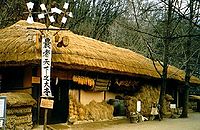
United Kingdom
The United Kingdom of Great Britain and Northern IrelandIn the United Kingdom and Dependencies, other languages have been officially recognised as legitimate autochthonous languages under the European Charter for Regional or Minority Languages...
than in any other European country. Good quality straw thatch can last for more than 45–50 years when applied by a skilled thatcher. Traditionally, a new layer of straw was simply applied over the weathered surface, and this ‘spar coating’ tradition has created accumulations of thatch over 7’ (2.1 m) thick on very old buildings. Over 250 roofs in Southern England have base coats of thatch that were applied over 500 years ago, providing direct evidence of the types of materials that were used for thatching in the medieval period. Almost all of these roofs are thatched with wheat, rye, or a 'maslin' mixture of both. Medieval wheat grew to almost 6 feet (1.8 m) tall in very poor soils and produced durable straw for the roof and grain for baking bread.
Technological change in the farming industry
Industry
Industry refers to the production of an economic good or service within an economy.-Industrial sectors:There are four key industrial economic sectors: the primary sector, largely raw material extraction industries such as mining and farming; the secondary sector, involving refining, construction,...
has had a significant impact on the popularity of thatching. The availability of good quality thatching straw declined in England after the introduction of the combine harvester in the late 1930s and 1940s, and the release of short-stemmed wheat varieties. The increasing use of nitrogen fertiliser in the 1960s-70s also weakened straw and reduced its longevity. Since the 1980s, however, there has been a big increase in straw quality as specialist growers have returned to growing older, tall-stemmed, 'heritage' varieties of wheat such as Squareheads Master (1880), N59 (1959), Rampton Rivet (1937), Victor (1910) and April Bearded (early 1800s)] in low input/organic conditions .
Unfortunately, in the EU it is illegal under the Plant Seeds and Varieties Act (1964 with many ammendments) for an individual or organisation to give, trade or sell seed of an older variety of wheat (or any other agricultural crop) to a third party for growing purposes, subject to a significant fine . Because of this legislation, thatchers in the UK can no longer obtain top quality thatching straw grown from traditional, tall-stemmed varieties of wheat. This legislation has guaranteed a steady income to plant breeding companies whose HYV's (high yielding varieties) will produce bumper crops when grown with abundant nitrogen fertiliser, herbicides, pesticides and fungicides. Unfortunately, these modern, short-stemmed and shallow-rooted HYV's perform very poorly in low input and organic conditions. Because our crops are now genetically uniform they can no longer adapt to climate change or survive extreme weather events such as drought.
All of the evidence indicates that water reed was rarely used for thatching outside of East Anglia. It has traditionally been a 'one coat' material applied in a similar way to how it is used in continental Europe - weathered reed is usually stripped and replaced by a new layer. It takes 4-5 acres of well-managed reed bed to produce enough reed to thatch an average house, and large reed beds have been uncommon in most of England since the Anglo-Saxon period. Over 80% of the water reed used in the UK is now imported from Turkey
Turkey
Turkey , known officially as the Republic of Turkey , is a Eurasian country located in Western Asia and in East Thrace in Southeastern Europe...
, astern Europe], China and South Africa. Although water reed might last for 50 years or more on a steep roof in a dry climate, modern imported water reed on an average roof in England will not last any longer than good quality wheat straw. The lifespan of a thatched roof is also dependent on the skill of the thatcher, but other factors need to be taken into account, such as climate
Climate
Climate encompasses the statistics of temperature, humidity, atmospheric pressure, wind, rainfall, atmospheric particle count and other meteorological elemental measurements in a given region over long periods...
, quality of the materials used, and the pitch of the roof.
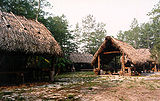
Arecaceae
Arecaceae or Palmae , are a family of flowering plants, the only family in the monocot order Arecales. There are roughly 202 currently known genera with around 2600 species, most of which are restricted to tropical, subtropical, and warm temperate climates...
are abundant, palm leaves are used to thatch walls and roofs. Many species of palm trees are called "thatch palm
Thatch palm
The name Thatch palm is applied to several different species of palm trees in the genera Coccothrinax, Howea and Thrinax. The name comes from the use of these trees for roof thatching....
", or have "thatch" as part of their common names. In the southeastern United States
Southeastern United States
The Southeastern United States, colloquially referred to as the Southeast, is the eastern portion of the Southern United States. It is one of the most populous regions in the United States of America....
, Indian and pioneer houses were often constructed of palmetto
Palmetto
-Botany:Members of several genera of small palms:*the genus Sabal of the Arecaceae family**Dwarf Palmetto**Sabal palmetto*Saw Palmetto, Serenoa repens*Silver saw palmetto, Acoelorraphe wrightii-Place names:United States...
-leaf thatch. The chickees of the Seminole
Seminole
The Seminole are a Native American people originally of Florida, who now reside primarily in that state and Oklahoma. The Seminole nation emerged in a process of ethnogenesis out of groups of Native Americans, most significantly Creeks from what is now Georgia and Alabama, who settled in Florida in...
and Miccosukee
Miccosukee
The Miccosukee Tribe of Indians of Florida are a federally recognized Native American tribe in the U.S. state of Florida. They were part of the Seminole nation until the mid-20th century, when they organized as an independent tribe, receiving federal recognition in 1962...
Indians are still thatched with palmetto leaves.
Maintenance in temperate climates
Moss
Mosses are small, soft plants that are typically 1–10 cm tall, though some species are much larger. They commonly grow close together in clumps or mats in damp or shady locations. They do not have flowers or seeds, and their simple leaves cover the thin wiry stems...
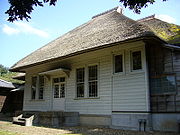
can be a problem if it is very thick, but is not usually detrimental, and many species of moss are actually protective.
'The Thatcher's Craft (1960) remains the most widely used reference book on the techniques used thatching . The thickness of a layer of thatch decreases over time as the surface gradually turns to compost and is blown off the roof by wind and rain. A thatched roof can be thought to be nearing replacement when the horizontal wooden 'sways' and hair-pin 'spars' (twisted hazel 'staples') that fix each course become visible near the surface. It is not total depth of the thatch within a new layer applied to a new roof that will determine its longevity, but rather how much weathering thatch covers the fixings of every overlapping course. “A roof is as good as the amount of correctly laid thatch covering the fixings.”.
Flammability

On new buildings a solid fire retardant barrier can be applied over the rafters making the thatch sacrificial in case of fire. If fireboards are used, it is essential that a ventilation gap be left between the boarding and the thatch so that the roof can 'breathe', as condensation can be a significant problem in thin, single layer thatch. Condensation is much less of a problem on thick straw roofs, which also provide much better insulation since they do not need to be ventilated.
Performance
Geography
Geography is the science that studies the lands, features, inhabitants, and phenomena of Earth. A literal translation would be "to describe or write about the Earth". The first person to use the word "geography" was Eratosthenes...
and topography
Topography
Topography is the study of Earth's surface shape and features or those ofplanets, moons, and asteroids...
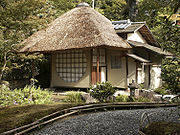
— the quality of material and the expertise of the thatcher.
Thatch has some natural properties that are advantageous to its performance. It is naturally weather-resistant,and when properly maintained does not absorb a lot of water. There should not be a significant increase to roof weight due to water retention. A roof pitch of at least 50 degrees allows precipitation to travel quickly down slope so that it runs off the roof before it can penetrate the structure.
Thatch is also a natural insulator, and air pockets within straw thatch insulate a building in both warm and cold weather. A thatched roof will ensure that a building will be cool in summer and warm in winter.
Thatch also has very good resistance to wind damage when applied correctly.
Advantages
Thatching materials range from plains grasses to waterproof leaves found in equatorial regions. It is the most common roofing material in the world, because the materials are readily available.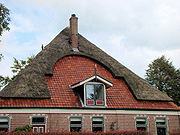
Thatch is a versatile material when it comes to covering irregular roof structures. This fact lends itself to the use of second-hand, recycled and natural materials that are not only more sustainable, but need not fit exact standard dimensions to perform well.
Disadvantages
Thatched houses are harder to insure because of the perceived fire risk, and because thatching is labour intensive it is much more expensive to thatch a roof than to cover it with slate or tiles. Birds can damage a roof while they are foraging for grubs, and rodents are attracted by residual grain in straw.
New thatched roofs were forbidden in London
London
London is the capital city of :England and the :United Kingdom, the largest metropolitan area in the United Kingdom, and the largest urban zone in the European Union by most measures. Located on the River Thames, London has been a major settlement for two millennia, its history going back to its...
by the Normans in the 12th century, and existing roofs had to have their surfaces plastered to reduce the risk of fire. The Great Fire of London in 1666 had nothing to do with thatch. The modern Globe Theatre
Shakespeare's Globe
Shakespeare's Globe is a reconstruction of the Globe Theatre, an Elizabethan playhouse in the London Borough of Southwark, located on the south bank of the River Thames, but destroyed by fire in 1613, rebuilt 1614 then demolished in 1644. The modern reconstruction is an academic best guess, based...
is one of the few thatched buildings in London (others can be found in the suburb of Kingsbury
Kingsbury
Kingsbury is an area in the London Borough of Brent, northwest London. The name Kingsbury means "The King's Manor".-History:Kingsbury was historically a small parish in the Hundred of Gore and county of Middlesex. Until the nineteenth century it was largely rural with only scattered settlements....
), but the Globe's modern, water reed thatch is purely for decorative purpose and actually lies over a fully waterproofed roof built with modern materials. The Globe Theatre, opened in 1997, was modeled on the Rose which was destroyed by a fire on a dry June night in 1613 when a burning wad of cloth ejected from a special effects cannon during a performance set light to the surface of the thatch. The original Rose theatre was actually thatched with cereal straw, a sample of which was recovered by Museum of London archaeologists during the excavation of the site in the 1980s .
Although it is claimed that thatch cannot cope with regular snowfall, but as with all roofing materials this depends on the strength of the underlying roof structure and the pitch of the suface. A law passed in 1640 in Massachusetts
Massachusetts
The Commonwealth of Massachusetts is a state in the New England region of the northeastern United States of America. It is bordered by Rhode Island and Connecticut to the south, New York to the west, and Vermont and New Hampshire to the north; at its east lies the Atlantic Ocean. As of the 2010...
outlawed the use of thatched roofs in the colony for this reason. Thatch is lighter than most other roofing materials, typically around 7lb per square foot, and so the roof supporting it does not need to be so heavily constructed, but if snow is allowed to accumulate on a lightly constructed thatched roof it could collapse. A thatched roof is usually pitched between 45-55 degrees and under normal circumstances this is sufficient to shed snow and water. In areas of extreme snowfall, such as parts of Japan, the pitch is increased further.
Examples of thatched building forms
- Roundhouse (dwelling)Roundhouse (dwelling)The roundhouse is a type of house with a circular plan, originally built in western Europe before the Roman occupation using walls made either of stone or of wooden posts joined by wattle-and-daub panels and a conical thatched roof. Roundhouses ranged in size from less than 5m in diameter to over 15m...
, pre-Roman European - Black houseBlack houseA blackhouse is a traditional type of house which used to be common in the Highlands of Scotland, the Hebrides, and Ireland.- Origin of the name :...
, Scotland, Ireland - Attap dwellingAttap dwellingAn attap dwelling is traditional housing found in the kampongs of Brunei, Indonesia, Malaysia and Singapore. Named after the attap palm, which provides the wattle for the walls, and the leaves with which their roofs are thatched, these dwellings can range from huts to substantial houses...
, Singapore - ChickeeChickeeChikee or Chickee is a shelter supported by posts, with a raised floor, a thatched roof and open sides. The chickee style of architecture — palmetto thatch over a bald cypress log frame — was adopted by Seminoles during the Second and Third Seminole War as U.S...
, Seminole - Teito, Asturias, Spain
See also
- Woodway HouseWoodway HouseWoodway House is in Teignmouth, South Devon, England. It was at one time a farm on lands held by the Bishops of Exeter. In around 1815 a thatched 'cottage' in the 'cottage orne' style of Horace Walpole's Thames-side villa, Strawberry Hill, was built here by Captain James Spratt R.N.Walpole built...
A thatched cob cottage orné in DevonDevonDevon is a large county in southwestern England. The county is sometimes referred to as Devonshire, although the term is rarely used inside the county itself as the county has never been officially "shired", it often indicates a traditional or historical context.The county shares borders with...
, EnglandEnglandEngland is a country that is part of the United Kingdom. It shares land borders with Scotland to the north and Wales to the west; the Irish Sea is to the north west, the Celtic Sea to the south west, with the North Sea to the east and the English Channel to the south separating it from continental...
. - Swiss cottage, CahirSwiss cottage, CahirThe Swiss cottage is located at Kilcommon near the town of Cahir, South Tipperary in Ireland. It was built around 1810 and is a fine example of cottage ornée, or ornamental cottage. It was originally part of the estate of Lord and Lady Cahir, and used for entertaining guests...
Thatched cottage orné in CahirCahirCahir is a town in South Tipperary in Ireland. The town is best known for its castle and the Swiss Cottage. It is in the barony of Iffa and Offa West.-Location and access:...
, IrelandIrelandIreland is an island to the northwest of continental Europe. It is the third-largest island in Europe and the twentieth-largest island on Earth...
.