

Supercontinent cycle

Encyclopedia
Earth
Earth is the third planet from the Sun, and the densest and fifth-largest of the eight planets in the Solar System. It is also the largest of the Solar System's four terrestrial planets...
's continental crust
Continental crust
The continental crust is the layer of igneous, sedimentary, and metamorphic rocks which form the continents and the areas of shallow seabed close to their shores, known as continental shelves. This layer is sometimes called sial due to more felsic, or granitic, bulk composition, which lies in...
. There are varying opinions as to whether the amount of continental crust is increasing, decreasing, or staying about the same, but it is agreed that the Earth's crust is constantly being reconfigured. One complete Supercontinent
Supercontinent
In geology, a supercontinent is a landmass comprising more than one continental core, or craton. The assembly of cratons and accreted terranes that form Eurasia qualifies as a supercontinent today.-History:...
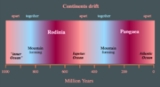
cycle is said to take 300 to 500 million years.
Continental collision
Continental collision
Continental collision is a phenomenon of the plate tectonics of Earth that occurs at convergent boundaries. Continental collision is a variation on the fundamental process of subduction, whereby the subduction zone is destroyed, mountains produced, and two continents sutured together...
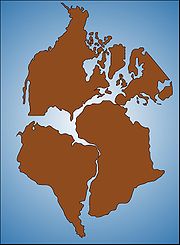
makes fewer and larger continents while rifting makes more and smaller continents. The last supercontinent, Pangaea
Pangaea
Pangaea, Pangæa, or Pangea is hypothesized as a supercontinent that existed during the Paleozoic and Mesozoic eras about 250 million years ago, before the component continents were separated into their current configuration....
, formed about 300 million years ago. The previous supercontinent, Pannotia
Pannotia
Pannotia, first described by Ian W. D. Dalziel in 1997, is a hypothetical supercontinent that existed from the Pan-African orogeny about six hundred million years ago to the end of the Precambrian about five hundred and fifty million years ago. It is also known as the Vendian supercontinent...
, formed about 600 million years ago, and its dispersal formed the fragments that ultimately collided to form Pangaea. But beyond this the time span between supercontinents becomes more irregular. For example, the supercontinent before Pannotia, Rodinia
Rodinia
In geology, Rodinia is the name of a supercontinent, a continent which contained most or all of Earth's landmass. According to plate tectonic reconstructions, Rodinia existed between 1.1 billion and 750 million years ago, in the Neoproterozoic era...
, existed ~1.1 billion to ~750 million years ago - a mere 150 million years before Pannotia. The supercontinent before this was Columbia
Columbia (supercontinent)
Columbia, also known as Nuna and Hudsonland, was one of Earth's oldest supercontinents. It was first proposed by J.J.W. Rogers and M. Santosh and is thought to have existed approximately 1.8 to 1.5 billion years ago in the Paleoproterozoic Era. Zhao et al...
: ~1.8 to 1.5 billion years ago. And before this was Kenorland
Kenorland
Kenorland was one of the earliest supercontinents on Earth. It is believed to have formed during the Neoarchaean Era ~2.7 billion years ago by the accretion of Neoarchaean cratons and the formation of new continental crust...
: ~2.7 to ~2.1 billion years ago. The first supercontinents were Ur
Ur (continent)
Ur was a supercontinent that formed in the early Archean eon; the oldest continent on Earth, half a billion years older than Arctica. Ur joined with the continents Nena and Atlantica about to form the supercontinent Rodinia...
(existed ~3 billion years ago) and Vaalbara
Vaalbara
Vaalbara is theorized to be Earth's first supercontinent, beginning its formation about , completing its formation by about and breaking up by . The name Vaalbara is derived from the South African Kaapvaal craton and the West Australian Pilbara craton...
(~3.6 to ~2.8 billion years ago).
Analysis of the composition of mineral inclusions inside ancient diamonds suggests that the cycle of supercontinental formation and breakup began roughly 3.0 billion years ago. Before 3.2 billion years ago only diamonds with peridot
Peridot
-Chemistry:The chemical composition of peridot is 2SiO4, with Mg in greater quantities than Fe.-Etymology:The origin of the name "peridot" is uncertain...
itic compositions (commonly found in the Earth's mantle) formed whereas after 3.0 billion years ago eclogitic diamonds (rocks from the Earth's surface crust) became prevalent. This is thought to be due to the introduction of eclogite
Eclogite
Eclogite is a mafic metamorphic rock. Eclogite is of special interest for at least two reasons. First, it forms at pressures greater than those typical of the crust of the Earth...
into subcontinental diamond-forming fluids via subduction and continental collision.
The hypothetical supercontinent cycle is, in some ways, the complement to the Wilson cycle. The latter is named after plate tectonics
Plate tectonics
Plate tectonics is a scientific theory that describes the large scale motions of Earth's lithosphere...
pioneer J. Tuzo Wilson and describes the periodic opening and closing of ocean basins. Because the oldest seafloor is only 170 million years old, whereas the oldest bit of continental crust goes back to 4 billion years or more, it makes sense to emphasize the much longer record of the planetary pulse that is recorded in the continents.
Effects on sea level
It is known that sea levelSea level
Mean sea level is a measure of the average height of the ocean's surface ; used as a standard in reckoning land elevation...
is generally low when the continents are together and high when they are apart. For example, sea level was low at the time of formation of Pangaea (Permian
Permian
The PermianThe term "Permian" was introduced into geology in 1841 by Sir Sir R. I. Murchison, president of the Geological Society of London, who identified typical strata in extensive Russian explorations undertaken with Edouard de Verneuil; Murchison asserted in 1841 that he named his "Permian...
) and Pannotia (latest Neoproterozoic
Neoproterozoic
The Neoproterozoic Era is the unit of geologic time from 1,000 to 542.0 ± 1.0 million years ago. The terminal Era of the formal Proterozoic Eon , it is further subdivided into the Tonian, Cryogenian, and Ediacaran Periods...
), and rose rapidly to maxima during Ordovician
Ordovician
The Ordovician is a geologic period and system, the second of six of the Paleozoic Era, and covers the time between 488.3±1.7 to 443.7±1.5 million years ago . It follows the Cambrian Period and is followed by the Silurian Period...
and Cretaceous
Cretaceous
The Cretaceous , derived from the Latin "creta" , usually abbreviated K for its German translation Kreide , is a geologic period and system from circa to million years ago. In the geologic timescale, the Cretaceous follows the Jurassic period and is followed by the Paleogene period of the...
times, when the continents were dispersed. This is because the age of the oceanic lithosphere
Oceanic lithosphere
Oceanic lithosphereOceanic lithosphere is typically about 50-100 km thick , while the continental lithosphere has a range in thickness from about 40 km to perhaps 200 km; the upper ~30 to ~50 km of the typical continental lithosphere is crust...
provides a major control on the depth of the ocean basins, and therefore on global sea level. Oceanic lithosphere forms at mid-ocean ridges and moves outwards. As this happens, it conductively cools and shrinks
Thermal expansion
Thermal expansion is the tendency of matter to change in volume in response to a change in temperature.When a substance is heated, its particles begin moving more and thus usually maintain a greater average separation. Materials which contract with increasing temperature are rare; this effect is...
. This cooling and shrinking decreases the thickness and increases the density of the oceanic lithosphere, and the result is the general lowering in elevation of the seafloor away from mid-ocean ridges. For oceanic lithosphere that is less than about 75 million years old, a simple cooling half-space
Half-space
In geometry, a half-space is either of the two parts into which a plane divides the three-dimensional euclidean space. More generally, a half-space is either of the two parts into which a hyperplane divides an affine space...
model of conductive cooling works, in which the depth of the ocean basins
 in areas in which there is no nearby subduction
Subduction
In geology, subduction is the process that takes place at convergent boundaries by which one tectonic plate moves under another tectonic plate, sinking into the Earth's mantle, as the plates converge. These 3D regions of mantle downwellings are known as "Subduction Zones"...
is a simple function of the age of the oceanic lithosphere
 . In general,
where
 is the thermal conductivity of the mantle lithosphere, and is approximately 10−6
 Second
The second is a unit of measurement of time, and is the International System of Units base unit of time. It may be measured using a clock....
, and
 is the depth of the ridge below the ocean surface. After plugging in rough numbers for the sea floor, the equation becomes:
where
 is in meters and
  is in millions of years, so that just-formed crust at the mid-ocean ridges lies at about 2,500 m depth, whereas 50 million-year-old seafloor lies at a depth of about 5000 m.
As the mean level of the sea floor decreases, the volume of the ocean basins increases, and if other factors that can control sea level remain constant, sea level falls. The converse is also true: younger oceanic lithosphere leads to shallower oceans and higher sea levels if other factors remain constant.
Area A can change when continents rift
Rift
In geology, a rift or chasm is a place where the Earth's crust and lithosphere are being pulled apart and is an example of extensional tectonics....
(stretching the continents decreases A and raises sea level) or as a result of continental collision
Continental collision
Continental collision is a phenomenon of the plate tectonics of Earth that occurs at convergent boundaries. Continental collision is a variation on the fundamental process of subduction, whereby the subduction zone is destroyed, mountains produced, and two continents sutured together...
(compressing the continents leads to an increase A and lowers sea level). Increasing sea level will flood the continents, while decreasing sea level will expose continental shelves.
Because the continental shelf
Continental shelf
The continental shelf is the extended perimeter of each continent and associated coastal plain. Much of the shelf was exposed during glacial periods, but is now submerged under relatively shallow seas and gulfs, and was similarly submerged during other interglacial periods. The continental margin,...
has a very low slope, a small increase in sea level will result in a large change in the percent of continents flooded.
If the world ocean on average is young, the seafloor will be relatively shallow, and sea level will be high: more of the continents are flooded. If the world ocean is on average old, seafloor will be relatively deep, and sea level will be low: more of the continents will be exposed.
There is thus a relatively simple relationship between the Supercontinent Cycle and the mean age of the seafloor.
- Supercontinent = lots of old seafloor = low sea level
- Dispersed continents = lots of young seafloor = high sea level
There will also be a climatic effect of the supercontinent cycle that will amplify this further:
- Supercontinent = continental climate dominant = continental glaciation likely = still lower sea level
- Dispersed continents = maritime climate dominant = continental glaciation unlikely = sea level is not lowered by this mechanism
Relation to global tectonics
There is a progression of tectonic regimes that accompany the supercontinent cycle:During break-up of the supercontinent, rifting environments dominate. This is followed by passive margin environments, while seafloor spreading continues and the oceans grow. This in turn is followed by the development of collisional environments that become increasingly important with time. First collisions are between continents and island arcs, but lead ultimately to continent-continent collisions. This is the situation that was observed during the Paleozoic Supercontinent Cycle and is being observed for the Mesozoic
Mesozoic
The Mesozoic era is an interval of geological time from about 250 million years ago to about 65 million years ago. It is often referred to as the age of reptiles because reptiles, namely dinosaurs, were the dominant terrestrial and marine vertebrates of the time...
-Cenozoic
Cenozoic
The Cenozoic era is the current and most recent of the three Phanerozoic geological eras and covers the period from 65.5 mya to the present. The era began in the wake of the Cretaceous–Tertiary extinction event at the end of the Cretaceous that saw the demise of the last non-avian dinosaurs and...
Supercontinent Cycle, still in progress.
Relation to climate
There are two types of global earth climates: icehouse and greenhouse. Icehouse is characterized by frequent continental glaciations and severe desert environments. Greenhouse is characterized by warm climates. Both reflect the supercontinent cycle. We are now in a little greenhouse phase of an ice house world.- Icehouse climate
- Continents moving together
- Sea level low due to lack of seafloor production
- Climate cooler, arid
- Associated with Aragonite seaAragonite seaAn aragonite sea contains aragonite and high-magnesium calcite as the primary inorganic carbonate precipitates. Therefore, the chemical conditions of the seawater must be notably high in magnesium content for an aragonite sea to form...
s - Formation of SupercontinentSupercontinentIn geology, a supercontinent is a landmass comprising more than one continental core, or craton. The assembly of cratons and accreted terranes that form Eurasia qualifies as a supercontinent today.-History:...
s
- Greenhouse climate
- Continents dispersed
- Sea level high
- High level of sea floor spreading
- Relatively large amounts of CO2 production at oceanic rifting zones
- Climate warm and humid
- Associated with calcite seaCalcite seaA calcite sea is one in which low-magnesium calcite is the primary inorganic marine calcium carbonate precipitate. An aragonite sea is the alternate seawater chemistry in which aragonite and high-magnesium calcite are the primary inorganic carbonate precipitates...
s
Periods of icehouse climate: much of Neoproterozoic
Neoproterozoic
The Neoproterozoic Era is the unit of geologic time from 1,000 to 542.0 ± 1.0 million years ago. The terminal Era of the formal Proterozoic Eon , it is further subdivided into the Tonian, Cryogenian, and Ediacaran Periods...
, late Paleozoic
Paleozoic
The Paleozoic era is the earliest of three geologic eras of the Phanerozoic eon, spanning from roughly...
, late Cenozoic
Cenozoic
The Cenozoic era is the current and most recent of the three Phanerozoic geological eras and covers the period from 65.5 mya to the present. The era began in the wake of the Cretaceous–Tertiary extinction event at the end of the Cretaceous that saw the demise of the last non-avian dinosaurs and...
.
Periods of greenhouse climate: Early Paleozoic
Paleozoic
The Paleozoic era is the earliest of three geologic eras of the Phanerozoic eon, spanning from roughly...
, Mesozoic
Mesozoic
The Mesozoic era is an interval of geological time from about 250 million years ago to about 65 million years ago. It is often referred to as the age of reptiles because reptiles, namely dinosaurs, were the dominant terrestrial and marine vertebrates of the time...
-early Cenozoic
Cenozoic
The Cenozoic era is the current and most recent of the three Phanerozoic geological eras and covers the period from 65.5 mya to the present. The era began in the wake of the Cretaceous–Tertiary extinction event at the end of the Cretaceous that saw the demise of the last non-avian dinosaurs and...
.
Relation to evolution
The principal mechanism for evolution is natural selection among diverse populations. As genetic driftGenetic drift
Genetic drift or allelic drift is the change in the frequency of a gene variant in a population due to random sampling.The alleles in the offspring are a sample of those in the parents, and chance has a role in determining whether a given individual survives and reproduces...
occurs more frequently in small populations, diversity is an observed consequence of isolation. Less isolation, and thus less diversification, occurs when the continents are all together, producing both one continent and one ocean with one coast. In Latest Neoproterozoic to Early Paleozoic times, when the tremendous proliferation of diverse metazoa
Animal
Animals are a major group of multicellular, eukaryotic organisms of the kingdom Animalia or Metazoa. Their body plan eventually becomes fixed as they develop, although some undergo a process of metamorphosis later on in their life. Most animals are motile, meaning they can move spontaneously and...
occurred, isolation of marine environments resulted from the breakup of Pannotia.
An arrangement of N-S continents and oceans leads to much more diversity and isolation than E-W oceans and continents. This forms zones that are separated by water or land and that merge into climatically different zones along communication routes to the north and south. Formation of similar tracts of continents and ocean basins, only oriented E-W would lead to much less isolation, diversification, and slower evolution. Through the Cenozoic
Cenozoic
The Cenozoic era is the current and most recent of the three Phanerozoic geological eras and covers the period from 65.5 mya to the present. The era began in the wake of the Cretaceous–Tertiary extinction event at the end of the Cretaceous that saw the demise of the last non-avian dinosaurs and...
, isolation has been maximized by an arrangement of N-S ocean basins and continents.
Diversity, as measured by the number of families, follows the supercontinent cycle very well.