

Half-space

Encyclopedia
In geometry
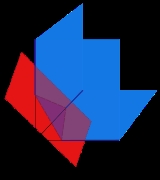
, a half-space is either of the two parts into which a plane divides the three-dimensional euclidean space. More generally, a half-space is either of the two parts into which a hyperplane
divides an affine space
. That is, the points that are not incident to the hyperplane are partitioned into two convex set
s (i.e., half-spaces), such that any subspace connecting a point in one set to a point in the other must intersect the hyperplane.
One can have open and closed half-spaces. An open half-space is either of the two open set
s produced by the subtraction of a hyperplane from the affine space. A closed half-space is the union of an open half-space and the hyperplane that defines it.
If the space is two-dimensional, then a half-space is called a half-plane (open or closed). A half-space in a one-dimensional space is called a ray.
A half-space may be specified by a linear inequality, derived from the linear equation
that specifies the defining hyperplane.
A strict linear inequality

specifies an open half-space, while a non-strict one

specifies a closed half-space. Here, one assumes that not all of the real numbers a1, a2, ..., an are zero.
Geometry
Geometry arose as the field of knowledge dealing with spatial relationships. Geometry was one of the two fields of pre-modern mathematics, the other being the study of numbers ....
, a half-space is either of the two parts into which a plane divides the three-dimensional euclidean space. More generally, a half-space is either of the two parts into which a hyperplane
Hyperplane
A hyperplane is a concept in geometry. It is a generalization of the plane into a different number of dimensions.A hyperplane of an n-dimensional space is a flat subset with dimension n − 1...
divides an affine space
Affine space
In mathematics, an affine space is a geometric structure that generalizes the affine properties of Euclidean space. In an affine space, one can subtract points to get vectors, or add a vector to a point to get another point, but one cannot add points. In particular, there is no distinguished point...
. That is, the points that are not incident to the hyperplane are partitioned into two convex set
Convex set
In Euclidean space, an object is convex if for every pair of points within the object, every point on the straight line segment that joins them is also within the object...
s (i.e., half-spaces), such that any subspace connecting a point in one set to a point in the other must intersect the hyperplane.
One can have open and closed half-spaces. An open half-space is either of the two open set
Open set
The concept of an open set is fundamental to many areas of mathematics, especially point-set topology and metric topology. Intuitively speaking, a set U is open if any point x in U can be "moved" a small amount in any direction and still be in the set U...
s produced by the subtraction of a hyperplane from the affine space. A closed half-space is the union of an open half-space and the hyperplane that defines it.
If the space is two-dimensional, then a half-space is called a half-plane (open or closed). A half-space in a one-dimensional space is called a ray.
A half-space may be specified by a linear inequality, derived from the linear equation
Linear equation
A linear equation is an algebraic equation in which each term is either a constant or the product of a constant and a single variable....
that specifies the defining hyperplane.
A strict linear inequality
specifies an open half-space, while a non-strict one
specifies a closed half-space. Here, one assumes that not all of the real numbers a1, a2, ..., an are zero.
Properties
- A half-space is a convex setConvex setIn Euclidean space, an object is convex if for every pair of points within the object, every point on the straight line segment that joins them is also within the object...
. - Any convex setConvex setIn Euclidean space, an object is convex if for every pair of points within the object, every point on the straight line segment that joins them is also within the object...
can be described as the (possibly infinite) intersection of half-spaces.