

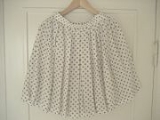
Skirt

Encyclopedia
Waist
The waist is the part of the abdomen between the rib cage and hips. On proportionate people, the waist is the narrowest part of the torso....
and covers all or part of the leg
Leg
Łęg may refer to the following places in Poland:*A former name for the town of Ełk *Part of the Czyżyny district of Kraków*Łęg, Pleszew County in Greater Poland Voivodeship...
s.
In the western world
Western world
The Western world, also known as the West and the Occident , is a term referring to the countries of Western Europe , the countries of the Americas, as well all countries of Northern and Central Europe, Australia and New Zealand...
, skirts are usually considered women's
Woman
A woman , pl: women is a female human. The term woman is usually reserved for an adult, with the term girl being the usual term for a female child or adolescent...
clothing. However, there are exceptions. The kilt
Kilt
The kilt is a knee-length garment with pleats at the rear, originating in the traditional dress of men and boys in the Scottish Highlands of the 16th century. Since the 19th century it has become associated with the wider culture of Scotland in general, or with Celtic heritage even more broadly...
is a traditional men's
Man
The term man is used for an adult human male . However, man is sometimes used to refer to humanity as a whole...
garment in Scotland
Scotland
Scotland is a country that is part of the United Kingdom. Occupying the northern third of the island of Great Britain, it shares a border with England to the south and is bounded by the North Sea to the east, the Atlantic Ocean to the north and west, and the North Channel and Irish Sea to the...
, and some fashion designers, such as Jean-Paul Gaultier
Jean-Paul Gaultier
Jean Paul Gaultier , born 24 April 1952 in Arcueil, Val-de-Marne, France) is a French haute couture fashion designer. Gaultier was the creative director of Hermès from 2003 to 2010. In the past, he has hosted the television series Eurotrash....
, have shown men's skirts.
At its simplest, a skirt can be a draped garment
Draped garment
A draped garment is a garment that is made of unstitched cloth that is held to the body by means of pins, fibulae, or clasps, sashes or belts, tying, or friction and gravity alone...
made out of a single piece of material (such as pareo
Pareo
The pāreu or pareo is the Cook Islands and Tahitian word for a wraparound skirt. Originally it was used only to refer to women's skirts, as men wore a loincloth, called a maro. Nowadays the term is applied to any piece of cloth worn wrapped around the body, worn by males or females...
s), but most skirts are fitted to the body at the waist and fuller below, with the fullness introduced by means of dart
Dart (sewing)
Darts are folds sewn into fabric to help provide a three-dimensional shape to a garment. They are frequently used in women's clothing to provide a fit that closely follows the shape of the wearer.Two kinds of darts are common in blouses for women:...
, gores, pleat
Pleat
A pleat is a type of fold formed by doubling fabric back upon itself and securing it in place. It is commonly used in clothing and upholstery to gather a wide piece of fabric to a narrower circumference....
s, or panels. Modern skirts are usually made of light to mid-weight fabric
Textile
A textile or cloth is a flexible woven material consisting of a network of natural or artificial fibres often referred to as thread or yarn. Yarn is produced by spinning raw fibres of wool, flax, cotton, or other material to produce long strands...
s, such as denim
Denim
Denim is a rugged cotton twill textile, in which the weft passes under two or more warp threads. This produces the familiar diagonal ribbing identifiable on the reverse of the fabric, which distinguishes denim from cotton duck. Denim has been in American usage since the late 18th century...
, jersey, worsted, or poplin. Skirts of thin or clingy fabrics are often worn with slip
Slip (clothing)
Slip is a woman's undergarment worn beneath a dress or skirt to help it hang smoothly and to prevent chafing of the skin from coarse fabrics such as wool...
s to make the material of the skirt drape better and for modesty.
The hemline
Hemline
The hemline is the line formed by the lower edge of a garment, such as a skirt, dress or coat, measured from the floor.The hemline is perhaps the most variable style line in fashion, changing shape and ranging in height from hip-high to floor-length...
of skirts varies according to the personal taste of the wearer which can be influenced
Consumer behaviour
Consumer behaviour is the study of when, why, how, and where people do or do not buy a product. It blends elements from psychology, sociology, social anthropology and economics. It attempts to understand the buyer decision making process, both individually and in groups...
by such factors as social context, fashion
Fashion
Fashion, a general term for a currently popular style or practice, especially in clothing, foot wear, or accessories. Fashion references to anything that is the current trend in look and dress up of a person...
, and cultural
Culture
Culture is a term that has many different inter-related meanings. For example, in 1952, Alfred Kroeber and Clyde Kluckhohn compiled a list of 164 definitions of "culture" in Culture: A Critical Review of Concepts and Definitions...
conceptions of modesty
Modesty
Standards of modesty are aspects of the culture of a country or people, at a given point in time, and is a measure against which an individual in society may be judged....
.
Some medieval upper-class women wore skirts over three metres in diameter at the bottom. At the other extreme, the miniskirt
Miniskirt
A miniskirt, sometimes hyphenated as mini-skirt, is a skirt with a hemline well above the knees – generally no longer than below the buttocks; and a minidress is a dress with a similar meaning...
s of the 1960s were minimal garments that may have barely covered the underwear when seated.
Costume historians typically use the word "petticoat
Petticoat
A petticoat or underskirt is an article of clothing for women; specifically an undergarment to be worn under a skirt or a dress. The petticoat is a separate garment hanging from the waist ....
" to describe skirt-like garments of the 18th century or earlier.
History
A straw-woven skirt dating to 3,900 B.C. was discovered in ArmeniaArmenia
Armenia , officially the Republic of Armenia , is a landlocked mountainous country in the Caucasus region of Eurasia...
. Skirts have been worn by men and women from many cultures, such as the lungi
Lungi
The Lungi , also known as a sarong , is a traditional garment worn around the waist in India, Pakistan, Bangladesh, Sri Lanka, Burma, Brunei, Indonesia, Malaysia, Singapore, the Horn of Africa and the southern Arabian Peninsula...
, kanga
Kanga (African garment)
The kanga which comes from the old Bantu verb ku-kanga to wrap or close, is a colourful garment similar to kitenge, worn by women and occasionally by men throughout Eastern Africa...
and sarong
Sarong
A sarong or sarung is a large tube or length of fabric, often wrapped around the waist and worn as a kilt by men and as a skirt by women throughout much of South Asia, Southeast Asia, the Arabian Peninsula, the Horn of Africa, and on many Pacific islands. The fabric most often has woven plaid or...
worn in South Asia
South Asia
South Asia, also known as Southern Asia, is the southern region of the Asian continent, which comprises the sub-Himalayan countries and, for some authorities , also includes the adjoining countries to the west and the east...
and Southeast Asia
Southeast Asia
Southeast Asia, South-East Asia, South East Asia or Southeastern Asia is a subregion of Asia, consisting of the countries that are geographically south of China, east of India, west of New Guinea and north of Australia. The region lies on the intersection of geological plates, with heavy seismic...
, and the kilt
Kilt
The kilt is a knee-length garment with pleats at the rear, originating in the traditional dress of men and boys in the Scottish Highlands of the 16th century. Since the 19th century it has become associated with the wider culture of Scotland in general, or with Celtic heritage even more broadly...
worn in Scotland
Scotland
Scotland is a country that is part of the United Kingdom. Occupying the northern third of the island of Great Britain, it shares a border with England to the south and is bounded by the North Sea to the east, the Atlantic Ocean to the north and west, and the North Channel and Irish Sea to the...
.
The earliest known culture to have females wear clothing resembling miniskirt
Miniskirt
A miniskirt, sometimes hyphenated as mini-skirt, is a skirt with a hemline well above the knees – generally no longer than below the buttocks; and a minidress is a dress with a similar meaning...
s were the Duan Qun Miao
Miao people
The Miao or ม้ง ; ) is an ethnic group recognized by the government of the People's Republic of China as one of the 55 official minority groups. Miao is a Chinese term and does not reflect the self-designations of the component nations of people, which include Hmong, Hmu, A Hmao, and Kho Xiong...
, which literally meant "short skirt Miao" in Chinese
Chinese language
The Chinese language is a language or language family consisting of varieties which are mutually intelligible to varying degrees. Originally the indigenous languages spoken by the Han Chinese in China, it forms one of the branches of Sino-Tibetan family of languages...
. This was in reference to the short miniskirts "that barely cover the buttocks" worn by women of the tribe, and which were "probably shocking" to observers in medieval
Middle Ages
The Middle Ages is a periodization of European history from the 5th century to the 15th century. The Middle Ages follows the fall of the Western Roman Empire in 476 and precedes the Early Modern Era. It is the middle period of a three-period division of Western history: Classic, Medieval and Modern...
and early modern
Early modern period
In history, the early modern period of modern history follows the late Middle Ages. Although the chronological limits of the period are open to debate, the timeframe spans the period after the late portion of the Middle Ages through the beginning of the Age of Revolutions...
times.
Skirts in the 19th century
During the nineteenth century the cut of women's dresses in western culture varied more widely than in any other century. WaistlinesWaistline (clothing)
The waistline is the line of demarcation between the upper and lower portions of a garment, which notionally corresponds to the natural waist but may vary with fashion from just below the bust to below the hips. The waistline of a garment is often used to accentuate different features...
started just below the bust (the Empire silhouette
Empire silhouette
An Empire silhouette is created by a woman wearing a high-waisted dress, gathered near or just under the bust with a long, loose skirt, which skims the body. The outline is especially flattering to pear shapes wishing to disguise the stomach area or emphasise the bust. The shape of the dress also...
) and gradually sank to the natural waist. Skirts started fairly narrow and
increased dramatically to the hoopskirt and crinoline
Crinoline
Crinoline was originally a stiff fabric with a weft of horse-hair and a warp of cotton or linen thread. The fabric first appeared around 1830, but by 1850 the word had come to mean a stiffened petticoat or rigid skirt-shaped structure of steel designed to support the skirts of a woman’s dress into...
-supported styles of the 1860s; then fullness was draped and drawn to the back by means of bustle
Bustle
A bustle is a type of framework used to expand the fullness or support the drapery of the back of a woman's dress, occurring predominantly in the mid-to-late 19th century. Bustles were worn under the skirt in the back, just below the waist, to keep the skirt from dragging. Heavy fabric tended to...
s.
Skirts in the 20th and 21st centuries
Beginning around 1915, hemlineHemline
The hemline is the line formed by the lower edge of a garment, such as a skirt, dress or coat, measured from the floor.The hemline is perhaps the most variable style line in fashion, changing shape and ranging in height from hip-high to floor-length...
s for daytime dresses left the floor for good. For the next fifty years fashionable skirts became short (1920s), then long (1930s), then shorter (the War Years
World War II
World War II, or the Second World War , was a global conflict lasting from 1939 to 1945, involving most of the world's nations—including all of the great powers—eventually forming two opposing military alliances: the Allies and the Axis...
with their restrictions on fabric), then long (the "New Look"), then shortest of all from 1967 to 1970, when skirts became as short as possible while avoiding exposure of underwear, which was considered taboo
Taboo
A taboo is a strong social prohibition relating to any area of human activity or social custom that is sacred and or forbidden based on moral judgment, religious beliefs and or scientific consensus. Breaking the taboo is usually considered objectionable or abhorrent by society...
.
Since the 1970s and the rise of pants for women
Women wearing pants
Women wearing pants were thought by some to be historically almost non-existent, apart from Amazonian women, but have become more commonplace since the advent of feminism in the middle to late 20th century.-History:...
as an option for all but the most formal of occasions, not one skirt length has dominated fashion for long, with short and ankle-length styles often appearing side-by-side in fashion magazines and catalogs.
Basic types
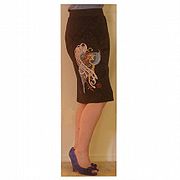
- Straight skirt or Pencil skirtPencil skirtA pencil skirt is a slim-fitting skirt with a straight, narrow cut. Generally the hem falls to, or just below, the knee and is tailored for a close fit. It is named for its shape: long and slim like a pencil.-Style:...
, a tailored skirt hanging straight from the hips and fitted from the waist to the hips by means of darts or a yoke; may have a kick-pleat for ease of walking - Full skirt, a skirt with fullness gathered into the waistband
- Short skirt, a skirt with hemlineHemlineThe hemline is the line formed by the lower edge of a garment, such as a skirt, dress or coat, measured from the floor.The hemline is perhaps the most variable style line in fashion, changing shape and ranging in height from hip-high to floor-length...
above the knee. - BellBell (instrument)A bell is a simple sound-making device. The bell is a percussion instrument and an idiophone. Its form is usually a hollow, cup-shaped object, which resonates upon being struck...
-shaped skirt, flared noticeably from the waist but then, unlike a church bell, cylindrical for much of its length. - A-lineA-lineAn A-line skirt is a skirt that is fitted at the hips and gradually widens towards the hem, giving the impression of the shape of a capital letter A. The term is also used to describe dresses and coats with a similar shape.-History:...
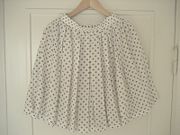
skirt, a skirt with a slight flare, roughly in the shape of a capital letter A - Pleated skirt, a skirt with fullness reduced to fit the waist by means of regular pleatPleatA pleat is a type of fold formed by doubling fabric back upon itself and securing it in place. It is commonly used in clothing and upholstery to gather a wide piece of fabric to a narrower circumference....
s ('plaits') or folds, which can be stitched flat to hip-level or free-hanging - Circle skirt, a skirt cut in sections to make one or more circles with a hole for the waist, so the skirt is very full but hangs smoothly from the waist without darts, pleats, or gathers
- Hobble skirtHobble skirtA hobble skirt is a skirt with a narrow enough hem to significantly impede the wearer's stride, thus earning its name. A knee-long corset is also used to achieve this effect...
, long and tight skirt with a narrow enough hem to significantly impede the wearer's stride
Fads and fashions
- Ballerina skirtBallerina skirtBallerina skirt is a full skirt that reaches to just above the ankles. It was a popular style during the 1950s. It is based on the romantic tutu length.Ballerina skirts have been a consistently popular length for ball gowns, especially for young women....
, a full-length formal skirt popular in the 1950s. - Broomstick skirt, a light-weight ankle length skirt with many crumpled pleats formed by compressing and twisting the garment while wet, such as around a broomstick. (1980s and on)
- Bubble dress/skirt, a voluminous skirt whose hem is tucked back under to create a “bubble effect” at the bottom. Popular in the 1950s, 1980s and from the mid 2000s to currently.
- Cargo skirt, a plain utilitarian skirt with belt loops and numerous large pockets, based on the military style of Cargo pantsCargo pantsCargo pants are loosely-cut pants designed for tough, outdoor activities distinguished by multiple cargo pockets.A cargo pocket is a form patch pocket with accordion folds for increased capacity closed with a flap secured by snap, button, or Velcro common on battledress and hunting clothing.Cargo...
and popularised in the 1990s. - DirndlDirndlA dirndl [ˈdɪʁndl̩] is a type of traditional dress worn in Bavaria, Liechtenstein, Austria, and South Tyrol, based on the historical costume of Alpine peasants. Dresses that are loosely based on the dirndl are known as Landhausmode.-Description:...
, a skirt made of a straight length of fabric gathered at the waist - Jean skirtJean skirtA denim skirt, erroneously referred to as a 'jean skirt' or 'jeans skirt', is a skirt made of denim, the same material as blue jeans. Denim skirts come in a variety of styles and lengths to suit different populations and occasions...
, a trouser skirt made of denim, often designed like 5-pocket jeansJeansJeans are trousers made from denim. Some of the earliest American blue jeans were made by Jacob Davis, Calvin Rogers, and Levi Strauss in 1873. Starting in the 1950s, jeans, originally designed for cowboys, became popular among teenagers. Historic brands include Levi's, Lee, and Wrangler...
, but found in a large variety of styles. - Leather skirtLeather skirtA leather skirt is a skirt made of leather. Although durable material, the particular combination of style and material makes for a certain fashion statement. Leather skirts appear in a variety of lengths and styles.-Fashion:...
, a skirt made of leatherLeatherLeather is a durable and flexible material created via the tanning of putrescible animal rawhide and skin, primarily cattlehide. It can be produced through different manufacturing processes, ranging from cottage industry to heavy industry.-Forms:... - Kilt-skirt, a wrap-around skirt with overlapping aprons in front and pleated around the back. Though traditionally designed as women's wear, it is fashioned to mimic somewhat closely the general appearance of a (man's) kilt, including the usage of a plaid pattern more or less closely resembling those of recognized tartan patterns of Scotland.
- Maxiskirt, an ankle length-skirt (1970s, but has made a comeback in the 2000s)
- Midi skirt, mid-calf length. See: 1970s in fashion.
- MiniskirtMiniskirtA miniskirt, sometimes hyphenated as mini-skirt, is a skirt with a hemline well above the knees – generally no longer than below the buttocks; and a minidress is a dress with a similar meaning...
, a thigh-length skirt, and micromini, an extremely short version (1960s) - Poodle skirtPoodle skirtA poodle skirt is a wide swing felt skirt of a solid bold color displaying a design appliquéd or transferred to the fabric. The design was often a coiffed French poodle. Later substitutes for the poodle patch included flamingos, flowers, and hot rod cars...
, a circle or near-circle skirt with an appliqueAppliqueIn its broadest sense, an appliqué is a smaller ornament or device applied to another surface. In the context of ceramics, for example, an appliqué is a separate piece of clay added to the primary work, generally for the purpose of decoration...
d poodle or other decoration (1950s) - Prairie skirtPrairie skirtA prairie skirt is an American style of skirt, an article of women's and girls' clothing.Prairie skirts are slightly flared to very full, with one or more flounces or tiers, and are often worn over a ruffled eyelet or lace-trimmed petticoat...
, a flared skirt with one or more flounces or tiers (1970s and on) - Rah-rah skirtRah-rah skirtThe rah-rah skirt is a short flounced skirt that originated in cheerleading and became popular among teenage girls in the early 1980s. As such it marked, as the Oxford Dictionary noted, the first successful attempt to revive the miniskirt that had been introduced in the mid 1960s...
, a short, tiered, and often colourful skirt fashionable in the early-mid 1980s. - SarongSarongA sarong or sarung is a large tube or length of fabric, often wrapped around the waist and worn as a kilt by men and as a skirt by women throughout much of South Asia, Southeast Asia, the Arabian Peninsula, the Horn of Africa, and on many Pacific islands. The fabric most often has woven plaid or...
, a square of fabric wrapped around the body and tied on one hip to make a skirt; worn as a skirt or as a cover-up over a bathing suit in tropical climates. - Scooter skirtSkortA skort, sometimes called a scooter or skant, resembles a skirt all the way around, and has shorts underneath. Some skorts are essentially skirts with a pair of shorts hidden underneath, though most resemble a pair of shorts with a panel of fabric over the front.-History:The term "skort" is used...
(or skort), a skirt that has an attached pair of shorts underneath for modesty. Alternatively, but with similar effect, a pair of shorts incorporating a skirt-like flap across the front of the body. - Tiered skirt, made of several horizontal layers, each wider than the one above, and divided by stitching. Layers may look identical in solid-colored garments, or may differ when made of printed fabrics.
- Trouser skirt, a straight skirt with the part above the hips tailored like men's trousersTrousersTrousers are an item of clothing worn on the lower part of the body from the waist to the ankles, covering both legs separately...
, with belt loops, pockets, and fly front - T-skirt, made from a T-shirtT-shirtA T-shirt is a style of shirt. A T-shirt is buttonless and collarless, with short sleeves and frequently a round neck line....
, the T-skirt is generally modified to result in a pencil skirtPencil skirtA pencil skirt is a slim-fitting skirt with a straight, narrow cut. Generally the hem falls to, or just below, the knee and is tailored for a close fit. It is named for its shape: long and slim like a pencil.-Style:...
, with invisible zippers, full length 2-way separating side zippers, as well as artful fabric overlays and yokes. - Legwear and footwear with skirts. Popular legwear trends now include: skirts with striped tube socks popular with the Rocker style of dressing, skirts with bike shorts or leggings sometimes with lace trim and opaque footless tights, and opaque tights especially in black and also in gray and other colors, and skirts with fun knee socks in styles such as argyle in many colors and solid bright colors. UGG bootsUgg AustraliaUGG Australia is an American footwear company and is a division of the Deckers Outdoor Corporation, Goleta, California.UGG Australia footwear is manufactured in China....
, classic sneakers like Converse, Chuck Taylor All-Stars and KedsKedsKeds is a brand of canvas shoe with rubber soles, introduced in 1916 by U.S. Rubber , later acquired by Stride Rite, and currently owned by Collective Brands....
, flats, and Sperry Top-SiderSperry Top-SiderSperry Top-Sider is the original brand of boat shoe designed in 1935 by Paul Sperry, older brother of author/illustrator Armstrong Sperry. The Top-Siders were the first boat shoes introduced into the boating market.-History:...
s are popular footwear now with skirts.
Lehenga
Lehenga or Ghagra is a form of skirt which is long, embroideredEmbroidery
Embroidery is the art or handicraft of decorating fabric or other materials with needle and thread or yarn. Embroidery may also incorporate other materials such as metal strips, pearls, beads, quills, and sequins....
and pleated
Pleat
A pleat is a type of fold formed by doubling fabric back upon itself and securing it in place. It is commonly used in clothing and upholstery to gather a wide piece of fabric to a narrower circumference....
.It is worn as the bottom portion of a Ghagra choli
Gagra choli
Gagra choli or Ghagra choli, which is also known as Lehenga choli, is the traditional clothing of women in Rajasthan and Gujarat. Chaniya choli is another term commonly used to refer it.It is a combination outfit of a Lehenga, tight Choli and a Dupatta.-Lehenga:Lehenga or Ghagra is a form of...
.It is secured at the waist and leaves the lower back and midriff
Midriff
Midriff is a particular term to denominate the section of the human body between the thorax/chest and the pelvis/hips. It is used as a genteel avoidance of synonymous belly ; as a synonym for waist; and as a name for the area around the diaphragm Midriff is a particular term to denominate the...
bare.It is worn by females mostly in North India
North India
North India, known natively as Uttar Bhārat or Shumālī Hindustān , is a loosely defined region in the northern part of India. The exact meaning of the term varies by usage...
and Pakistan
Pakistan
Pakistan , officially the Islamic Republic of Pakistan is a sovereign state in South Asia. It has a coastline along the Arabian Sea and the Gulf of Oman in the south and is bordered by Afghanistan and Iran in the west, India in the east and China in the far northeast. In the north, Tajikistan...
.
Male wear
There are a number of male garments which fall under the category of "skirt" or "dress." These go by a variety of names and form part of the traditional dress for men from various cultures. Usage varies - the dhotiDhoti
The dhoti or pancha is the traditional men's garment in the in India, Bangladesh and Sri Lanka. A similar garment is worn in some rural areas of Punjab province in Pakistan, but the use is fast declining...
is part of everyday dress on the Indian subcontinent while the kilt is more usually restricted to occasional wear and the foustanella is used almost exclusively as costume. Robes, which are a type of dress for men, have existed in many cultures, including the Japanese kimono
Kimono
The is a Japanese traditional garment worn by men, women and children. The word "kimono", which literally means a "thing to wear" , has come to denote these full-length robes...
, the Chinese cheongsam, the Arabic thobe, and the African Senegalese kaftan
Senegalese kaftan
A Senegalese kaftan is a pullover men's robe with long bell sleeves. In the Wolof language, this robe is called a mbubb and in French it is called a boubou. The Senegalese caftan is an ankle length garment. It is worn with matching drawstring pants called tubay. Normally made of cotton brocade,...
. Robes are also used in some religious orders, such as the cassock
Cassock
The cassock, an item of clerical clothing, is an ankle-length robe worn by clerics of the Roman Catholic Church, Eastern Orthodox Church, Anglican Church, Lutheran Church and some ministers and ordained officers of Presbyterian and Reformed churches. Ankle-length garment is the meaning of the...
in Christianity and various robes and cloaks that may be used in pagan rituals. Examples of men's skirts and skirt like garments from various cultures include:
- The kiltKiltThe kilt is a knee-length garment with pleats at the rear, originating in the traditional dress of men and boys in the Scottish Highlands of the 16th century. Since the 19th century it has become associated with the wider culture of Scotland in general, or with Celtic heritage even more broadly...
is a skirt of Gaelic and Celtic history, part of the ScottishScotlandScotland is a country that is part of the United Kingdom. Occupying the northern third of the island of Great Britain, it shares a border with England to the south and is bounded by the North Sea to the east, the Atlantic Ocean to the north and west, and the North Channel and Irish Sea to the...
national dress in particular, and is worn formally and to a lesser extent informally. Irish and Welsh kilts also exist but are not so much a part of national identity. - The foustanella is worn by men in GreeceGreeceGreece , officially the Hellenic Republic , and historically Hellas or the Republic of Greece in English, is a country in southeastern Europe....
and other parts of the Balkans. By the mid-20th Century, it was relegated to ceremonial use and as period or traditional costume. - The ghoGhoThe gho is the traditional and national dress for men in Bhutan. Introduced in the 17th century by Shabdrung Ngawang Namgyel to give the Bhutanese a more distinctive identity, it is a knee-length robe tied at the waist by a cloth belt known as the kera...
is a knee-length robe worn by men in BhutanBhutanBhutan , officially the Kingdom of Bhutan, is a landlocked state in South Asia, located at the eastern end of the Himalayas and bordered to the south, east and west by the Republic of India and to the north by the People's Republic of China...
. They are required to wear it every day as part of national dress in government offices, in schools and on formal occasions. - The sarongSarongA sarong or sarung is a large tube or length of fabric, often wrapped around the waist and worn as a kilt by men and as a skirt by women throughout much of South Asia, Southeast Asia, the Arabian Peninsula, the Horn of Africa, and on many Pacific islands. The fabric most often has woven plaid or...
is a piece of cloth that may be wrapped around the waist to form a skirt-like garment. Sarongs exist in various cultures under various names, including the pareoPareoThe pāreu or pareo is the Cook Islands and Tahitian word for a wraparound skirt. Originally it was used only to refer to women's skirts, as men wore a loincloth, called a maro. Nowadays the term is applied to any piece of cloth worn wrapped around the body, worn by males or females...
and lavalava of the Hawaiian islands and Polynesia (Samoa, Tonga, Tahiti, and Fiji), the Indian dhotiDhotiThe dhoti or pancha is the traditional men's garment in the in India, Bangladesh and Sri Lanka. A similar garment is worn in some rural areas of Punjab province in Pakistan, but the use is fast declining...
and lungiLungiThe Lungi , also known as a sarong , is a traditional garment worn around the waist in India, Pakistan, Bangladesh, Sri Lanka, Burma, Brunei, Indonesia, Malaysia, Singapore, the Horn of Africa and the southern Arabian Peninsula...
, and the South Indian munduMunduThe mundu is a garment worn around the waist in Dakshina Kannada district of Karnataka, Kerala and Maldives. This garment is closely related to the Dhoti, Sarong, and Lungi. In South Kanara, a district of Karnataka state, the Tulu speaking folk and Beary community also wear the mundu. It is...
.
Aside from the wearing of kilt
Kilt
The kilt is a knee-length garment with pleats at the rear, originating in the traditional dress of men and boys in the Scottish Highlands of the 16th century. Since the 19th century it has become associated with the wider culture of Scotland in general, or with Celtic heritage even more broadly...
s, in the Western world
Western world
The Western world, also known as the West and the Occident , is a term referring to the countries of Western Europe , the countries of the Americas, as well all countries of Northern and Central Europe, Australia and New Zealand...
skirts, dresses and similar garments are considered primarily women's clothing. Historically, however, this was not the case. The wearing of skirts by men in Western cultures is generally seen as cross-dressing
Cross-dressing
Cross-dressing is the wearing of clothing and other accoutrement commonly associated with a gender within a particular society that is seen as different than the one usually presented by the dresser...
although some fashion designers such as Jean-Paul Gaultier
Jean-Paul Gaultier
Jean Paul Gaultier , born 24 April 1952 in Arcueil, Val-de-Marne, France) is a French haute couture fashion designer. Gaultier was the creative director of Hermès from 2003 to 2010. In the past, he has hosted the television series Eurotrash....
have produced skirts for men.
See also
- 1970s in fashion1970s in fashion1970s fashion, which began with a continuation of the mini skirts, bell-bottoms and the androgynous hippie look from the late 1960s, was soon sharply characterized by several distinct fashion trends that have left an indelible image of the decade ...
- BlouseBlouseA blouse is a loose-fitting upper garment that was formerly worn by workmen, peasants, artists, women and children. It is typically gathered at the waist so that it hangs loosely over the wearer's body. Today, the word most commonly refers to a woman's shirt but can also refer to a man's shirt if...
- Clothing terminologyClothing terminologyClothing terminology comprises the names of individual garments and classes of garments, as well as the specialized vocabularies ofthe trades that have designed, manufactured, marketed and sold clothing over hundreds of years....
- Dress
- SkortSkortA skort, sometimes called a scooter or skant, resembles a skirt all the way around, and has shorts underneath. Some skorts are essentially skirts with a pair of shorts hidden underneath, though most resemble a pair of shorts with a panel of fabric over the front.-History:The term "skort" is used...
- Women wearing pantsWomen wearing pantsWomen wearing pants were thought by some to be historically almost non-existent, apart from Amazonian women, but have become more commonplace since the advent of feminism in the middle to late 20th century.-History:...
- Men's skirtsMen's skirtsOutside of Western cultures, men's clothing commonly includes skirts and skirt-like garments, however in North America and much of Europe, the wearing of a skirt is today usually seen as typical for females and not males...