


Crinoline

Encyclopedia

Weft
In weaving, weft or woof is the yarn which is drawn through the warp yarns to create cloth. In North America, it is sometimes referred to as the "fill" or the "filling yarn"....
of horse-hair and a warp
Warp (weaving)
In weaving cloth, the warp is the set of lengthwise yarns that are held in tension on a frame or loom. The yarn that is inserted over-and-under the warp threads is called the weft, woof, or filler. Each individual warp thread in a fabric is called a warp end or end. Warp means "that which is thrown...
of cotton
Cotton
Cotton is a soft, fluffy staple fiber that grows in a boll, or protective capsule, around the seeds of cotton plants of the genus Gossypium. The fiber is almost pure cellulose. The botanical purpose of cotton fiber is to aid in seed dispersal....
or linen
Linen
Linen is a textile made from the fibers of the flax plant, Linum usitatissimum. Linen is labor-intensive to manufacture, but when it is made into garments, it is valued for its exceptional coolness and freshness in hot weather....
thread
Yarn
Yarn is a long continuous length of interlocked fibres, suitable for use in the production of textiles, sewing, crocheting, knitting, weaving, embroidery and ropemaking. Thread is a type of yarn intended for sewing by hand or machine. Modern manufactured sewing threads may be finished with wax or...
. The fabric first appeared around 1830, but by 1850 the word had come to mean a stiffened petticoat
Petticoat
A petticoat or underskirt is an article of clothing for women; specifically an undergarment to be worn under a skirt or a dress. The petticoat is a separate garment hanging from the waist ....
or rigid skirt-shaped structure of steel
Steel
Steel is an alloy that consists mostly of iron and has a carbon content between 0.2% and 2.1% by weight, depending on the grade. Carbon is the most common alloying material for iron, but various other alloying elements are used, such as manganese, chromium, vanadium, and tungsten...
designed to support the skirts of a woman’s dress into the required shape. In form and function it is very similar to the earlier farthingale
Farthingale
Farthingale is a term applied to any of several structures used under Western European women's clothing in the late 15th and 16th centuries to support the skirts into the desired shape. It originated in Spain.- Spanish farthingale :...
.
Etymology
The name crinoline was invented by one of the fabric's manufacturers, who combined the LatinLatin
Latin is an Italic language originally spoken in Latium and Ancient Rome. It, along with most European languages, is a descendant of the ancient Proto-Indo-European language. Although it is considered a dead language, a number of scholars and members of the Christian clergy speak it fluently, and...
words crinis (meaning hair
Hair
Hair is a filamentous biomaterial, that grows from follicles found in the dermis. Found exclusively in mammals, hair is one of the defining characteristics of the mammalian class....
) and lin (meaning flax
Flax
Flax is a member of the genus Linum in the family Linaceae. It is native to the region extending from the eastern Mediterranean to India and was probably first domesticated in the Fertile Crescent...
). An alternative origin for the word is sometimes given: the combination of the French
French language
French is a Romance language spoken as a first language in France, the Romandy region in Switzerland, Wallonia and Brussels in Belgium, Monaco, the regions of Quebec and Acadia in Canada, and by various communities elsewhere. Second-language speakers of French are distributed throughout many parts...
words crin (specifically meaning horse-hair) and lin (again, meaning flax).
History
The crinoline was not the first accessory designed to support the wearer's skirts in a fashionable shape; the farthingaleFarthingale
Farthingale is a term applied to any of several structures used under Western European women's clothing in the late 15th and 16th centuries to support the skirts into the desired shape. It originated in Spain.- Spanish farthingale :...
in its various forms was worn from the late fifteenth century through the early seventeenth century, and panniers
Pannier (clothing)
Panniers or side hoops are women's undergarments worn in the 18th century to extend the width of the skirts at the side while leaving the front and back relatively flat...
throughout the eighteenth century. Many of these were formal and elaborate styles, often worn at royal court
Royal court
Royal court, as distinguished from a court of law, may refer to:* The Royal Court , Timbaland's production company*Court , the household and entourage of a monarch or other ruler, the princely court...
s and by mid to higher levels of society
Society
A society, or a human society, is a group of people related to each other through persistent relations, or a large social grouping sharing the same geographical or virtual territory, subject to the same political authority and dominant cultural expectations...
.
By mid-1780, England had supplanted France as influential fashion house in the Western world, exchanging light and elaborate style for a more plain, utilitarian mode of fashion. France and most of western Europe came to adopt this standard, particularly after the French Revolution
French Revolution
The French Revolution , sometimes distinguished as the 'Great French Revolution' , was a period of radical social and political upheaval in France and Europe. The absolute monarchy that had ruled France for centuries collapsed in three years...
, when French fashion
Fashion
Fashion, a general term for a currently popular style or practice, especially in clothing, foot wear, or accessories. Fashion references to anything that is the current trend in look and dress up of a person...
turned against the styles favored by royalty
Royal family
A royal family is the extended family of a king or queen regnant. The term imperial family appropriately describes the extended family of an emperor or empress, while the terms "ducal family", "grand ducal family" or "princely family" are more appropriate to describe the relatives of a reigning...
, the court, and the aristocracy
Aristocracy
Aristocracy , is a form of government in which a few elite citizens rule. The term derives from the Greek aristokratia, meaning "rule of the best". In origin in Ancient Greece, it was conceived of as rule by the best qualified citizens, and contrasted with monarchy...
.
Under the prevailing neoclassical
Neoclassicism
Neoclassicism is the name given to Western movements in the decorative and visual arts, literature, theatre, music, and architecture that draw inspiration from the "classical" art and culture of Ancient Greece or Ancient Rome...
influence, women’s fashions slowly underwent a consistent transformation to assimilate the simple style
Empire silhouette
An Empire silhouette is created by a woman wearing a high-waisted dress, gathered near or just under the bust with a long, loose skirt, which skims the body. The outline is especially flattering to pear shapes wishing to disguise the stomach area or emphasise the bust. The shape of the dress also...
based on the simple draped garments of Ancient Greece
Ancient Greece
Ancient Greece is a civilization belonging to a period of Greek history that lasted from the Archaic period of the 8th to 6th centuries BC to the end of antiquity. Immediately following this period was the beginning of the Early Middle Ages and the Byzantine era. Included in Ancient Greece is the...
and the toga
Toga
The toga, a distinctive garment of Ancient Rome, was a cloth of perhaps 20 ft in length which was wrapped around the body and was generally worn over a tunic. The toga was made of wool, and the tunic under it often was made of linen. After the 2nd century BC, the toga was a garment worn...
s of ancient Rome. Skirt
Skirt
A skirt is a tube- or cone-shaped garment that hangs from the waist and covers all or part of the legs.In the western world, skirts are usually considered women's clothing. However, there are exceptions...
s became straighter and more slender, worn with fewer and fewer — if any — petticoats. As a result, the eighteenth-century pannier became extinct for all but the most formal of functions.
The silhouette did not remain this way for long and skirt hems began to widen to give a more conical shape. By the 1810s, gore
Gore (segment)
A gore is a segment of a three-dimensional shape fabricated from a two-dimensional material. The term was originally used to describe triangular shapes, but is now extended to any shape that can be used to create the third dimension.-Examples:...
s began to be used in skirts again, and skirts grew wider in the 1820s. The width of these skirts was sometimes supported by a small bustle
Bustle
A bustle is a type of framework used to expand the fullness or support the drapery of the back of a woman's dress, occurring predominantly in the mid-to-late 19th century. Bustles were worn under the skirt in the back, just below the waist, to keep the skirt from dragging. Heavy fabric tended to...
. These were not always sufficient, and extra petticoats were worn to help.
The first 'crinolines' were petticoats starched for extra stiffness, made out of the new crinoline fabric. They often had ruffles to support the skirts to the desired width. However, these fabrics were not stiff enough to support their own weight, which tended to collapse the petticoats out of shape. Extra rigidity was added to petticoats through rings of cord or braid running around the hem. By the 1830s, women had started to wear petticoats with hoops of whalebone or cane inside the hem.
The first hoop skirt in the US is from 1846, patent number 4,584 of David Hough, Jr.
In 1858, IRJ Mann's US patent number 20,681 was the first latticework of strings and hoops.
In 1858, the American W.S. Thomson greatly facilitated the development of the cage crinoline by developing an eyelet fastener to connect the steel
Steel
Steel is an alloy that consists mostly of iron and has a carbon content between 0.2% and 2.1% by weight, depending on the grade. Carbon is the most common alloying material for iron, but various other alloying elements are used, such as manganese, chromium, vanadium, and tungsten...
crinoline hoops with the vertical tapes descending from a band around the wearer’s waist. The invention was patented in the United States
United States
The United States of America is a federal constitutional republic comprising fifty states and a federal district...
(patent US21581), France
France
The French Republic , The French Republic , The French Republic , (commonly known as France , is a unitary semi-presidential republic in Western Europe with several overseas territories and islands located on other continents and in the Indian, Pacific, and Atlantic oceans. Metropolitan France...
(patent FR41193) and Britain
United Kingdom
The United Kingdom of Great Britain and Northern IrelandIn the United Kingdom and Dependencies, other languages have been officially recognised as legitimate autochthonous languages under the European Charter for Regional or Minority Languages...
(patent GB1204/1859). This facilitated the fashionable silhouette's development from a cone shape to a dome. It was not an entirely original idea
Prior art
Prior art , in most systems of patent law, constitutes all information that has been made available to the public in any form before a given date that might be relevant to a patent's claims of originality...
; Thompson was probably inspired by the open cage or frame style of farthingales and panniers.
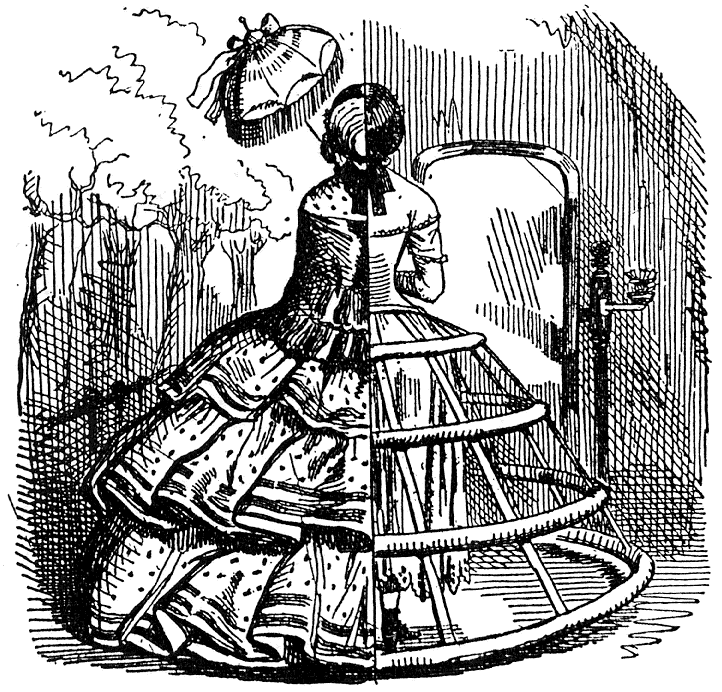
The cage crinoline was adopted with enthusiasm: the numerous petticoats, even the stiffened or hooped ones, were heavy, bulky and generally uncomfortable. It was light — it only required one or two petticoats worn over the top to prevent the steel bands appearing as ridges in the skirt — and freed the wearer's legs from tangling petticoats.
Unlike the farthingale and panniers, the crinoline was worn by women of every social class
Social class
Social classes are economic or cultural arrangements of groups in society. Class is an essential object of analysis for sociologists, political scientists, economists, anthropologists and social historians. In the social sciences, social class is often discussed in terms of 'social stratification'...
. The wider circulation of magazine
Magazine
Magazines, periodicals, glossies or serials are publications, generally published on a regular schedule, containing a variety of articles. They are generally financed by advertising, by a purchase price, by pre-paid magazine subscriptions, or all three...
s and newspaper
Newspaper
A newspaper is a scheduled publication containing news of current events, informative articles, diverse features and advertising. It usually is printed on relatively inexpensive, low-grade paper such as newsprint. By 2007, there were 6580 daily newspapers in the world selling 395 million copies a...
s spread news of the new fashion, also fueling desire for it, and mass production made it affordable.
Decline
The crinoline had grown to its maximum dimensions by 1860. However, as the fashionable silhouette never remains the same for long, the huge skirts began to fall from favour. Around 1864, the shape of the crinoline began to change. Rather than being dome-shaped, the front and sides began to contract, leaving volume only at the back. The kind of crinoline that supported this style was sometimes known as a crinolette. The cage structure was still attached around the waist and extended down to the ground, but only extended down the back of the wearer’s legs. The crinolette itself was quickly superseded by the bustleBustle
A bustle is a type of framework used to expand the fullness or support the drapery of the back of a woman's dress, occurring predominantly in the mid-to-late 19th century. Bustles were worn under the skirt in the back, just below the waist, to keep the skirt from dragging. Heavy fabric tended to...
, which was sufficient for supporting the drapery and train at the back of the skirt.
Problems
The crinoline was the subject of much ridicule and satire, particularly in Punch magazine. Dress reformVictorian dress reform
During the middle and late Victorian period, various reformers proposed, designed, and wore clothing supposedly more rational and comfortable than the fashions of the time. This was known as the dress reform or rational dress movement...
ers did not like it either — they seized upon the cage aspect of the crinoline and claimed that it effectively imprisoned women. Given that the crinoline did eventually have a maximum diameter of up to 180 centimetres (six feet), it is easy to imagine difficulties in getting through doors, in and out of carriages, and the general problems of moving in such a large structure. However, while the crinoline needed to have a degree of rigidity, it also had a degree of flexibility. A particular kind of steel
Steel
Steel is an alloy that consists mostly of iron and has a carbon content between 0.2% and 2.1% by weight, depending on the grade. Carbon is the most common alloying material for iron, but various other alloying elements are used, such as manganese, chromium, vanadium, and tungsten...
, known as spring steel
Spring steel
Spring steel is a low alloy, medium carbon steel or high carbon steel with a very high yield strength. This allows objects made of spring steel to return to their original shape despite significant bending or twisting.-Grades:...
or watch-spring steel, enabled the hoops to be temporarily pressed out of shape.
The second problem was the potential impropriety of the crinoline. Its lightness was a curse as well as a blessing, as a gust of wind or a knock could set it swinging and reveal the wearer's legs. Even worse, if she tripped or was knocked over, the crinoline would hold her skirts up.
The third problem was the pressure, but a tight, stiff corset spread the pressure.
Sitting down could be a problem if the wearer failed to spread her skirts out properly as the entire hoop contraption would fly up in her face. This embarrassing but humorous tendency is often depicted in comedies of the era.
The greatest problem with the crinoline, though, was that in some situations it was dangerous — because of its size, the wearer was often not aware of where its edges were. It was only inconvenient and annoying when a maid’s crinoline knocked a vase off a table or upset a cup, but for factory girls, there was the risk of crinolines getting caught in machinery and dragging them to be mutilated or crushed to death. In 1857 the Paris correspondent of the New York Times reported a non-fatal accident to two “elegantly dressed” young women whose clothes caught fire in the street. It was believed that a lighted cigar had rolled under the dress of one as she sat at a cafe but ‘the balloon-like form of her skirts and the confined air’ delayed conflagration till she began to walk outside, when her skirts abruptly ignited. Her friend, rushing to her aid, also caught fire. Passers-by helped them and neither was seriously hurt. New York Times, 27 July 1857
However there is one instance of a crinoline possibly saving a life, in the case of Sarah Ann Henley
Sarah Ann Henley
Sarah Ann Henley was a young barmaid from Easton, Bristol who in 1885, became famous for having survived a suicide attempt, after she jumped from the Clifton Suspension Bridge, a fall of almost .- Attempted suicide :...
who jumped off the Clifton Suspension Bridge
Clifton Suspension Bridge
Brunel died in 1859, without seeing the completion of the bridge. Brunel's colleagues in the Institution of Civil Engineers felt that completion of the Bridge would be a fitting memorial, and started to raise new funds...
, Bristol
Bristol
Bristol is a city, unitary authority area and ceremonial county in South West England, with an estimated population of 433,100 for the unitary authority in 2009, and a surrounding Larger Urban Zone with an estimated 1,070,000 residents in 2007...
in 1885 after a lover's quarrel, but survived the a fall of almost 75 metres (246.1 ft) because her skirts supposedly acted like a parachute and slowed her descent. Although it is debated if the skirt actually saved Ms. Henley from the fall, the story has nevertheless become a local Bristol legend.
Current status
Crinolines are still worn today. They are usually part of a formal outfit, such as an evening gown or a wedding dressWedding dress
A wedding dress or wedding gown is the clothing worn by a bride during a wedding ceremony. Color, style and ceremonial importance of the gown can depend on the religion and culture of the wedding participants.- Western culture :...
. The volume of the skirt is not as great as during the Victorian era, so modern crinolines are most often constructed of several layers of stiff net, with flounces to extend the skirt. If there is a hoop in the crinoline, it will probably be made of plastic or nylon
Nylon
Nylon is a generic designation for a family of synthetic polymers known generically as polyamides, first produced on February 28, 1935, by Wallace Carothers at DuPont's research facility at the DuPont Experimental Station...
, which are low in cost, lightweight and flexible, or steel.
With the recent trend towards lavish weddings and grandiose bridal attire, the crinoline has started making a comeback. For her first solo collection, fashion designer Vivienne Westwood
Vivienne Westwood
Dame Vivienne Westwood, DBE, RDI is a British fashion designer and businesswoman, largely responsible for bringing modern punk and new wave fashions into the mainstream.-Early life:...
looked to the crinoline for inspiration. The collection, titled Mini Crini, featured shorter crinoline skirts with more flexible plastic hoops.
See also
- BustleBustleA bustle is a type of framework used to expand the fullness or support the drapery of the back of a woman's dress, occurring predominantly in the mid-to-late 19th century. Bustles were worn under the skirt in the back, just below the waist, to keep the skirt from dragging. Heavy fabric tended to...
- FarthingaleFarthingaleFarthingale is a term applied to any of several structures used under Western European women's clothing in the late 15th and 16th centuries to support the skirts into the desired shape. It originated in Spain.- Spanish farthingale :...
- Hoop skirt
- PanniersPannier (clothing)Panniers or side hoops are women's undergarments worn in the 18th century to extend the width of the skirts at the side while leaving the front and back relatively flat...
- PetticoatPetticoatA petticoat or underskirt is an article of clothing for women; specifically an undergarment to be worn under a skirt or a dress. The petticoat is a separate garment hanging from the waist ....
- 1850s in fashion1850s in fashion1850s fashion in Western and Western-influenced clothing is characterized by an increase in the width of women's skirts supported by crinolines or hoops, and the beginnings of dress reform.-Gowns:...
- 1860s in fashion1860s in fashion1860s fashion in European and European-influenced clothing is characterized by extremely full-skirted women's fashions relying on crinolines and hoops and the emergence of "alternative fashions" under the influence of the Artistic Dress movement....
- Church of the Company FireChurch of the Company FireThe Church of the Company Fire is the largest fire to have ever affected the city of Santiago, Chile. Between 2,000 and 3,000 people died, and it is considered one of the worst fire disasters in history.-Events:...