


French Mandate of Syria and Lebanon

Encyclopedia
Officially the French Mandate for Syria and the Lebanon (also known as the French Mandate of Syria) was a League of Nations mandate
founded after the First World War and the partitioning of the Ottoman Empire
. During the two years that followed the end of the war in 1918, and in accordance with the Sykes-Picot Agreement
that was signed between Britain and France during the war, the British held control of most Ottoman
Mesopotamia
(modern Iraq
) and the southern part of the Ottoman Syria
(Palestine
and Jordan
), while the French controlled the rest of Ottoman Syria (modern Syria
, Lebanon
, Alexandretta and other portions of southeastern Turkey).
During the first years of the 1920s, the British and French control of these territories became formalized by the League of Nations
' mandate system, and France was assigned the mandate
of Syria on September 29, 1923, which included modern Lebanon
and Alexandretta (Hatay) in addition to modern Syria
.
The French mandate of Syria lasted until 1943, when two independent countries emerged from the mandate period, Syria and Lebanon, in addition to Hatay
which had joined Turkey in 1939. French troops left Syria and Lebanon finally in 1946.
entered Damascus in 1918 accompanied by troops of the Arab Revolt
led by Faisal
, son of Sharif Hussein of Mecca
.
Faisal established the first Arab government in Damascus in October 1918, and named Ali Rida Pasha ar-Rikabi a military governor.
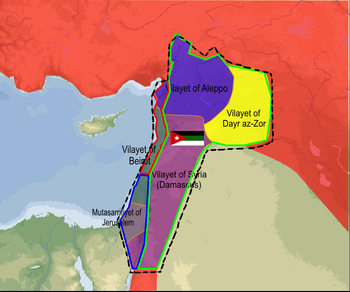 The new Arab administration formed local governments in the major Syrian cities, and the Pan-Arab flag
was raised all over Syria. The Arabs hoped, with faith in earlier British promises, that the new Arab state would include all the Arab lands stretching from Aleppo
in northern Syria to Aden
in southern Yemen
.
 However, General Allenby, and in accordance with the secret Sykes-Picot Agreement
between Britain and France, assigned to the Arab administration only the interior regions of Syria (the eastern zone). Palestine
(the southern zone) was reserved for the British, and on October 8, French troops disembarked in Beirut
and occupied all the Lebanese coastal region until Naqoura
(the western zone) replacing British troops there. The French immediately dissolved the local Arab governments in the region.
The French demanded full implementation of the Sykes–Picot Agreement and the placement of Syria under their influence. On November 26, 1919, the British withdrew from Damascus to avoid confrontation with the French, leaving the Arab government face to face with the French.
Faisal had voyaged several times in Europe, beginning in November 1918, trying to convince Paris and London to change their positions, but without success. Signifying the determination of France on its intervention in Syria was the naming of General Henri Gouraud as a high commissioner in Syria-Cilicia
.
At the Paris Peace Conference
, Faisal found himself in an even weaker position when the European powers decided to ignore the Arab demands.
In June 1919, the American King-Crane Commission
arrived in Syria to inquire about the local public opinion regarding the future of the country. The commission's workspace extended from Aleppo
to Beersheba
. They visited 36 major cities, met with over than 2000 delegations from more than 300 villages, and received more than 3000 petitions. Their conclusions confirmed the opposition of Syrians to the mandate in their country as well as to the Balfour declaration, and their demand of a unified Greater Syria
encompassing Palestine. The conclusions of the commission were rejected by France and ignored by Britain.
In May 1919, elections were held for the Syrian National Congress
. 80% of seats went to conservatives. However, the minority included dynamic Arab nationalist figures such as Jamil Mardam-Bey, Shukri al-Kuwatli
, Ahmad al-Qadri, Ibrahim Hanano, and Riyad as-Solh
.
Unrest erupted in Syria when Faisal accepted a compromise with the French Prime Minister Clemenceau
and with the Zionist leader Weizmann
over the issue of Jewish immigration to Palestine. Anti-Hashemite manifestations broke out, and Muslim
inhabitants in and around Mount Lebanon
revolted with fear of being incorporated into a new, mainly Christian
, state of Greater Lebanon.
.svg.png) In March 1920, the Syrian national congress in Damascus, headed by Hashim al-Atassi
In March 1920, the Syrian national congress in Damascus, headed by Hashim al-Atassi
, adopted a resolution rejecting the Faisal-Clemenceau accords. The congress declared the independence of Syria in her natural borders (including Palestine), and proclaimed Faisal the king of Arabs. The congress also proclaimed political and economic union with neighboring Iraq
and demanded its independence as well. A new government headed by Ali Rida ar-Rikabi was formed on May 9, 1920.
On April 25, and in the course of the Treaty of Sèvres
, the supreme inter-allied council granted France the mandate of Syria (including Lebanon), and granted the UK the mandate of Palestine (including Jordan) and Iraq. Syrians reacted with violent demonstrations, and with the formation of a new government under Hashim al-Atassi on May 7, 1920. The new government decided to organize general conscription and began financing an army.
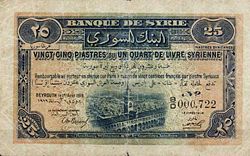 These decisions provoked adverse reactions by the French as well as by the Maronite patriarchate
of Mount Lebanon
, which denounced the decisions as a "coup d'état." In Beirut
, the Christian press expressed its hostility to the decisions of Faisal's government. Lebanese nationalists
profited of the crisis to convene a council of Christian figures in Baabda
on March 22, 1920, that proclaimed the independence of Lebanon
.
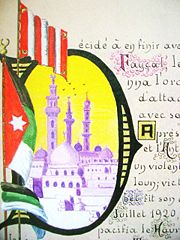 On July 14, 1920, General Gouraud issued an ultimatum to Faisal giving him the choice between submission or abdication. Realizing that the power balance was not in his favor, Faisal chose to cooperate. However, the young minister of war, Youssef al-Azmeh
, refused to comply and, during the Franco-Syrian War
faced the French at the Battle of Maysaloun. This battle was won by the French under General Mariano Goybet
in less than a day and Azmeh died on the battlefield along with most of those who were with him. General Goybet entered Damascus on July 24, 1920.
When first arriving in Lebanon, the French were received as liberators by the Christian community, but as they were entering Syria they were faced with a strong resistance. It took France three years from 1920 to 1923 to hold full control over Syria and to quell all the insurgencies that broke out, notably in the Alawite
territories, Mount Druze and Aleppo
.
and the defeat of King Faisal
's short-lived monarchy in Syria at the Battle of Maysalun
, the French general Henri Gouraud subdivided the mandate of Syria into six states. They were the states of Damascus
(1920), Aleppo
(1920), Alawites
(1920), Jabal Druze (1921), the autonomous Sanjak of Alexandretta (1921) (modern-day Hatay
), and the State of Greater Lebanon (1920) which became later the modern country of Lebanon
.
 In July 1922, France established a loose federation
between three of the states: Damascus, Aleppo, and the Alawite under the name of the Syrian Federation (Fédération syrienne). Jabal Druze, Sanjak of Alexandretta, and Greater Lebanon were not parts of this federation, which adopted a new federal flag (green-white-green with French canton). On December 1, 1924, the Alawite state seceded from the federation when the states of Aleppo and Damascus were united into the State of Syria.
In 1925, a revolt in Jabal Druze led by Sultan Pasha el Atrash spread to other Syrian states and became a general rebellion in Syria. France tried to retaliate by having the parliament of Aleppo declare secession from the union with Damascus, but the voting was foiled by Syrian patriots.
 On May 14, 1930, the State of Syria was declared the Republic of Syria and a new constitution was drafted. Two years later, in 1932, a new flag for the republic was adopted. The flag carried three red stars that represented the three districts of the republic (Damascus, Aleppo, and Deir ez Zor).
In 1936, the Franco-Syrian Treaty of Independence was signed, a treaty that would not be ratified by the French legislature. However, the treaty allowed Jabal Druze, the Alawite (now called Latakia
), and Alexandretta to be incorporated into the Syrian republic within the following two years. Greater Lebanon (now the Lebanese Republic) was the only state that did not join the Syrian Republic. Hashim al-Atassi
, who was Prime Minister under King Faisal's brief reign (1918–1920), was the first president to be elected under a new constitution adopted after the independence treaty.
In September 1938, France again separated the Syrian district of Alexandretta and transformed it into the Republic of Hatay
. The Republic of Hatay joined Turkey in the following year, in June 1939. Syria did not recognize the incorporation of Hatay into Turkey and the issue is still disputed until the present time.
With the fall of France in 1940 during World War II, Syria came under the control of the Vichy Government until the British and Free French invaded and occupied
the country in July 1941. Syria proclaimed its independence again in 1941 but it wasn't until January 1, 1944, that it was recognized as an independent republic.
On May 29, 1945, France bombed Damascus
and tried to arrest its democratically elected leaders. While French planes were bombing Damascus
, Prime Minister Faris al-Khoury was at the founding conference of the United Nations
in San Francisco, presenting Syria
's claim for independence from the French Mandate.
Continuing pressure from Syrian nationalist groups and British pressure forced the French to evacuate their last troops on April 17, 1946.
In the 1940s, Britain secretly advocated the creation of a Greater Syrian state that would secure Britain preferential status in military, economic and cultural matters, in return for putting a complete halt to Jewish ambition in Palestine. France and the United states opposed British hegemony in the region, which eventually led to the creation of Israel.
Benqt Broms said that it was important to note that there were several founding members of the United Nations whose statehood was doubtful at the time of the San Francisco Conference and that the Government of France still considered Syria and Lebanon to be mandates.
Duncan Hall said "Thus, the Syrian mandate may be said to have been terminated without any formal action on the part of the League or its successor. The mandate was terminated by the declaration of the mandatory power, and of the new states themselves, of their independence, followed by a process of piecemeal unconditional recognition by other powers, culminating in formal admission to the United Nations. Article 78 of the Charter ended the status of tutelage for any member state: 'The trusteeship system shall not apply to territories which have become Members of the United Nations, relationship among which shall be based on respect for the principle of sovereign equality.'"
Maronite Christians of Mount Lebanon, on the other hand, were a community with a dream of independence that was being realized under the French; therefore, Lebanon was the exception to the newly formed states.
 On September 1, 1920, General Gouraud proclaimed the establishment of the State of Greater Lebanon (French: État de Grand Liban) (Arabic: دولة لبنان الكبير).
Greater Lebanon was created by France to be a "safe haven" for the Maronite population of the Mutasarrifia (Ottoman administrative unit) of Mount Lebanon
. Mt. Lebanon, an area with a Maronite majority, had enjoyed variable degrees of unofficial autonomy
during the Ottoman
era. However, Greater Lebanon included in addition to Mount Lebanon other mainly Muslim
regions that were not part of the Maronite Mutasarrifia, and hence the word "greater." Those regions correspond today to north Lebanon
, south Lebanon, Biqa' valley, and Beirut
.
The capital of Greater Lebanon was Beirut
. The new state was granted a flag merging the French flag with the cedar of Mt. Lebanon.
Muslims in Greater Lebanon rejected the new state upon its creation. They boycotted the general census in 1922, and refused to receive new identity cards before General Gouraud agreed to remove from the cards the part stating Lebanese citizenship. The Muslim continuous demand for reunification with Syria eventually brought about an armed conflict between Muslims and Christians in 1958 when Muslim Lebanese wanted to join the newly proclaimed United Arab Republic
, while Christians were strongly opposed.
Although most of the Lebanese
sects were not enthusiastic for the new state, Maronites were the majority and managed to preserve its independence; an independence that created a unique precedent in the Arab world as Lebanon was the first Arab country in which Christians were not a minority.
The State of Greater Lebanon existed until May 23, 1926, after which it became the Lebanese Republic.
 The State of Alawites (French: État des Alaouites) (Arabic: دولة العلويين) was located on the Syrian coast and incorporated a majority of Alawites, a branch of Shia Islam
. The port city of Latakia
was the capital of this state.
Initially it was an autonomous territory under French rule known as the Alawite Territories. It became part of the Syrian Federation in 1922, but left the federation again in 1924 and became the State of Alawites. On September 22, 1930, it was renamed the Independent Government of Latakia. The population at this time was 278,000.
The government of Latakia finally joined the Syrian Republic on December 5, 1936.
This state witnessed several rebellions against the French. The most prominent of which were under Salih al-Ali, an Alawite anti-French figure.
.svg.png) Jabal Druze was a French mandate from 1921 to 1936 created for the Druze
Jabal Druze was a French mandate from 1921 to 1936 created for the Druze
population of southern Syria
. It had a population of some 50,000 and had its capital in As Suwayda
.
 The State of Aleppo
(1920–1925) (French: État d'Alep) (Arabic: دولة حلب) included a majority of Sunni Muslims. It covered northern Syria in addition to the entire fertile basin of river Euphrates
of eastern Syria. These regions represented much of the agricultural and mineral wealth of Syria. The autonomous Sanjak of Alexandretta
was added to the state of Aleppo in 1923.
The capital was the northern city of Aleppo
, which had large Christian
and Jewish communities in addition to the Sunni Muslims. The state also incorporated minorities of Shiites and Alawites. Ethnic Kurds, Syriacs, and Assyrians
inhabited the eastern regions alongside the Arabs.
The primarily Sunni population of the state of Aleppo was strongly opposed to the division of Syria. This resulted in its quick end in 1925, when France united the states of Aleppo and Damascus into the State of Syria.
 The State of Damascus
was a French mandate from 1920 to 1925. The capital was Damascus.
was autonomous from 1921 to 1923, under the French-Turkish treaty of October 20, 1921, due to the presence of an important Turkish
community along with Arab
s of various religious denominations: Sunni Muslims, Alawites, Syriac Orthodox
, Greek Orthodox
, Greek Catholics
, Maronites
. There were also communities of Jews, Assyrians
, Kurd
s, Armenians
and Greeks
. In 1923 Alexandretta
was attached to the State of Aleppo
, and in 1925 it was directly attached to the French mandate of Syria, still with special administrative status.
The 1936 elections in the sanjak returned two MPs favoring the independence of Syria
from France, and this prompted communal riots as well as passionate articles in the Turkish and Syrian press. This then became the subject of a complaint to the League of Nations
by the Turkish government under Mustafa Kemal Atatürk
concerning alleged mistreatment of the area's Turkish populations. Atatürk demanded that Alexandretta become part of Turkey, claiming that the majority of its inhabitants were Turks. The sanjak was given autonomy in November 1937 in an arrangement brokered by the League. Under its new statute, the sanjak became 'distinct but not separated' from the French Mandate of Syria on the diplomatic level, linked to both France and Turkey for defence matters.
In 1938 the Turkish military went into the Syrian province and expelled most of its Arab and Armenian inhabitants. Before this, Alawi Arabs and Armenians were the majority of Alexandrettas population.
The allocation of seats in the sanjak assembly was based on the 1938 census held by the French authorities under international supervision: out of 40 seats, 22 were given to the Turks, nine for Alawi Arabs, five for Armenians, two for Sunni Arabs, and two for Christian Arabs. The assembly was appointed in the summer of 1938 and the French-Turkish treaty settling the status of the Sanjak was signed on July 4, 1938.
On September 2, 1938, the assembly proclaimed the Sanjak of Alexandretta as the Republic of Hatay, taking as an excuse that rioting had broken out between Turks and Arabs. The Republic lasted for one year under joint French and Turkish military supervision. The name "Hatay" itself was proposed by Atatürk and the government was under Turkish control. The president Tayfur Sökmen
was a member of Turkish parliament elected in 1935 (representing Antakya
(Greek: Αντιόχεια)) and the prime minister Dr. Abdurrahman Melek, was also elected to the Turkish parliament (representing Gaziantep) in 1939 while still holding the prime-ministerial post.
In 1939, following a popular referendum, the Republic of Hatay became a Turkish province. For the referendum, Turkey had crossed tens of thousands of Turks into Alexandretta to vote. This referendum has been labeled both "phoney" and "rigged", and that it was a way for the French to let Turks take over the area, hoping that they would turn on Hitler.
League of Nations mandate
A League of Nations mandate was a legal status for certain territories transferred from the control of one country to another following World War I, or the legal instruments that contained the internationally agreed-upon terms for administering the territory on behalf of the League...
founded after the First World War and the partitioning of the Ottoman Empire
Partitioning of the Ottoman Empire
The Partitioning of the Ottoman Empire was a political event that occurred after World War I. The huge conglomeration of territories and peoples formerly ruled by the Sultan of the Ottoman Empire was divided into several new nations.The partitioning was planned from the early days of the war,...
. During the two years that followed the end of the war in 1918, and in accordance with the Sykes-Picot Agreement
Sykes-Picot Agreement
The Sykes–Picot Agreement of 1916 was a secret agreement between the governments of the United Kingdom and France, with the assent of Imperial Russia, defining their respective spheres of influence and control in Western Asia after the expected downfall of the Ottoman Empire during World War I...
that was signed between Britain and France during the war, the British held control of most Ottoman
Ottoman Empire
The Ottoman EmpireIt was usually referred to as the "Ottoman Empire", the "Turkish Empire", the "Ottoman Caliphate" or more commonly "Turkey" by its contemporaries...
Mesopotamia
Mesopotamia
Mesopotamia is a toponym for the area of the Tigris–Euphrates river system, largely corresponding to modern-day Iraq, northeastern Syria, southeastern Turkey and southwestern Iran.Widely considered to be the cradle of civilization, Bronze Age Mesopotamia included Sumer and the...
(modern Iraq
Iraq
Iraq ; officially the Republic of Iraq is a country in Western Asia spanning most of the northwestern end of the Zagros mountain range, the eastern part of the Syrian Desert and the northern part of the Arabian Desert....
) and the southern part of the Ottoman Syria
Ottoman Syria
Ottoman Syria is a European reference to the area that during European Renaissance from the late 15th to early 18th century was called the Levant within the early period of the Ottoman Empire, the Orient until the early 19th century, and Greater Syria until 1918...
(Palestine
Palestine
Palestine is a conventional name, among others, used to describe the geographic region between the Mediterranean Sea and the Jordan River, and various adjoining lands....
and Jordan
Jordan
Jordan , officially the Hashemite Kingdom of Jordan , Al-Mamlaka al-Urduniyya al-Hashemiyya) is a kingdom on the East Bank of the River Jordan. The country borders Saudi Arabia to the east and south-east, Iraq to the north-east, Syria to the north and the West Bank and Israel to the west, sharing...
), while the French controlled the rest of Ottoman Syria (modern Syria
Syria
Syria , officially the Syrian Arab Republic , is a country in Western Asia, bordering Lebanon and the Mediterranean Sea to the West, Turkey to the north, Iraq to the east, Jordan to the south, and Israel to the southwest....
, Lebanon
Lebanon
Lebanon , officially the Republic of LebanonRepublic of Lebanon is the most common term used by Lebanese government agencies. The term Lebanese Republic, a literal translation of the official Arabic and French names that is not used in today's world. Arabic is the most common language spoken among...
, Alexandretta and other portions of southeastern Turkey).
During the first years of the 1920s, the British and French control of these territories became formalized by the League of Nations
League of Nations
The League of Nations was an intergovernmental organization founded as a result of the Paris Peace Conference that ended the First World War. It was the first permanent international organization whose principal mission was to maintain world peace...
' mandate system, and France was assigned the mandate
League of Nations mandate
A League of Nations mandate was a legal status for certain territories transferred from the control of one country to another following World War I, or the legal instruments that contained the internationally agreed-upon terms for administering the territory on behalf of the League...
of Syria on September 29, 1923, which included modern Lebanon
Lebanon
Lebanon , officially the Republic of LebanonRepublic of Lebanon is the most common term used by Lebanese government agencies. The term Lebanese Republic, a literal translation of the official Arabic and French names that is not used in today's world. Arabic is the most common language spoken among...
and Alexandretta (Hatay) in addition to modern Syria
Syria
Syria , officially the Syrian Arab Republic , is a country in Western Asia, bordering Lebanon and the Mediterranean Sea to the West, Turkey to the north, Iraq to the east, Jordan to the south, and Israel to the southwest....
.
The French mandate of Syria lasted until 1943, when two independent countries emerged from the mandate period, Syria and Lebanon, in addition to Hatay
Hatay Province
Hatay Province is a province in southern Turkey, on the Mediterranean coast. It is bordered by Syria to the south and east and the Turkish provinces of Adana and Osmaniye to the north. The province is part of Çukurova, a geographical, economical and cultural region that covers the provinces of...
which had joined Turkey in 1939. French troops left Syria and Lebanon finally in 1946.
The Arab Kingdom of Syria
With the defeat of Ottomans in Syria, British troops under Marshal Edmund Henry AllenbyEdmund Allenby, 1st Viscount Allenby
Field Marshal Edmund Henry Hynman Allenby, 1st Viscount Allenby GCB, GCMG, GCVO was a British soldier and administrator most famous for his role during the First World War, in which he led the Egyptian Expeditionary Force in the conquest of Palestine and Syria in 1917 and 1918.Allenby, nicknamed...
entered Damascus in 1918 accompanied by troops of the Arab Revolt
Arab Revolt
The Arab Revolt was initiated by the Sherif Hussein bin Ali with the aim of securing independence from the ruling Ottoman Turks and creating a single unified Arab state spanning from Aleppo in Syria to Aden in Yemen.- Background :...
led by Faisal
Faisal I of Iraq
Faisal bin Hussein bin Ali al-Hashemi, was for a short time King of the Arab Kingdom of Syria or Greater Syria in 1920, and was King of the Kingdom of Iraq from 23 August 1921 to 1933...
, son of Sharif Hussein of Mecca
Mecca
Mecca is a city in the Hijaz and the capital of Makkah province in Saudi Arabia. The city is located inland from Jeddah in a narrow valley at a height of above sea level...
.
Faisal established the first Arab government in Damascus in October 1918, and named Ali Rida Pasha ar-Rikabi a military governor.
Flag of the Arab Revolt
The Flag of the Arab Revolt was a flag used by Arab nationalists during the Arab Revolt against the Ottoman Empire in World War I.-History:The flag was designed by the British diplomat Sir Mark Sykes, in an effort to create a feeling of "Arab-ness" in order to fuel the revolt...
was raised all over Syria. The Arabs hoped, with faith in earlier British promises, that the new Arab state would include all the Arab lands stretching from Aleppo
Aleppo
Aleppo is the largest city in Syria and the capital of Aleppo Governorate, the most populous Syrian governorate. With an official population of 2,301,570 , expanding to over 2.5 million in the metropolitan area, it is also one of the largest cities in the Levant...
in northern Syria to Aden
Aden
Aden is a seaport city in Yemen, located by the eastern approach to the Red Sea , some 170 kilometres east of Bab-el-Mandeb. Its population is approximately 800,000. Aden's ancient, natural harbour lies in the crater of an extinct volcano which now forms a peninsula, joined to the mainland by a...
in southern Yemen
Yemen
The Republic of Yemen , commonly known as Yemen , is a country located in the Middle East, occupying the southwestern to southern end of the Arabian Peninsula. It is bordered by Saudi Arabia to the north, the Red Sea to the west, and Oman to the east....
.
Sykes-Picot Agreement
The Sykes–Picot Agreement of 1916 was a secret agreement between the governments of the United Kingdom and France, with the assent of Imperial Russia, defining their respective spheres of influence and control in Western Asia after the expected downfall of the Ottoman Empire during World War I...
between Britain and France, assigned to the Arab administration only the interior regions of Syria (the eastern zone). Palestine
Palestine
Palestine is a conventional name, among others, used to describe the geographic region between the Mediterranean Sea and the Jordan River, and various adjoining lands....
(the southern zone) was reserved for the British, and on October 8, French troops disembarked in Beirut
Beirut
Beirut is the capital and largest city of Lebanon, with a population ranging from 1 million to more than 2 million . Located on a peninsula at the midpoint of Lebanon's Mediterranean coastline, it serves as the country's largest and main seaport, and also forms the Beirut Metropolitan...
and occupied all the Lebanese coastal region until Naqoura
Naqoura
Naqoura is a small city in southern Lebanon. Since March 23, 1978 until present, the United Nations Interim Force in Lebanon has been headquartered in Naqoura....
(the western zone) replacing British troops there. The French immediately dissolved the local Arab governments in the region.
The French demanded full implementation of the Sykes–Picot Agreement and the placement of Syria under their influence. On November 26, 1919, the British withdrew from Damascus to avoid confrontation with the French, leaving the Arab government face to face with the French.
Faisal had voyaged several times in Europe, beginning in November 1918, trying to convince Paris and London to change their positions, but without success. Signifying the determination of France on its intervention in Syria was the naming of General Henri Gouraud as a high commissioner in Syria-Cilicia
Cilicia
In antiquity, Cilicia was the south coastal region of Asia Minor, south of the central Anatolian plateau. It existed as a political entity from Hittite times into the Byzantine empire...
.
At the Paris Peace Conference
Paris Peace Conference, 1919
The Paris Peace Conference was the meeting of the Allied victors following the end of World War I to set the peace terms for the defeated Central Powers following the armistices of 1918. It took place in Paris in 1919 and involved diplomats from more than 32 countries and nationalities...
, Faisal found himself in an even weaker position when the European powers decided to ignore the Arab demands.
In June 1919, the American King-Crane Commission
King-Crane Commission
The King-Crane Commission was an official investigation by the United States government during the summer of 1919 concerning the disposition of non-Turkish areas within the former Ottoman Empire...
arrived in Syria to inquire about the local public opinion regarding the future of the country. The commission's workspace extended from Aleppo
Aleppo
Aleppo is the largest city in Syria and the capital of Aleppo Governorate, the most populous Syrian governorate. With an official population of 2,301,570 , expanding to over 2.5 million in the metropolitan area, it is also one of the largest cities in the Levant...
to Beersheba
Beersheba
Beersheba is the largest city in the Negev desert of southern Israel. Often referred to as the "Capital of the Negev", it is the seventh-largest city in Israel with a population of 194,300....
. They visited 36 major cities, met with over than 2000 delegations from more than 300 villages, and received more than 3000 petitions. Their conclusions confirmed the opposition of Syrians to the mandate in their country as well as to the Balfour declaration, and their demand of a unified Greater Syria
Greater Syria
Greater Syria , also known simply as Syria, is a term that denotes a region in the Near East bordering the Eastern Mediterranean Sea or the Levant....
encompassing Palestine. The conclusions of the commission were rejected by France and ignored by Britain.
In May 1919, elections were held for the Syrian National Congress
Syrian National Congress
The Syrian National Congress was convened in July 1919 in Damascus, Syria to prepare for the King-Crane Commission of inquiry on the future of Greater Syria after the fall of the Ottoman Empire. The congress was attended by representative from all parts of Syria. The participants showed...
. 80% of seats went to conservatives. However, the minority included dynamic Arab nationalist figures such as Jamil Mardam-Bey, Shukri al-Kuwatli
Shukri al-Kuwatli
Shukri al-Quwatli was the president of Syria from 1943 to 1949 and from 1955 to 1958.-Political life:He was born in Damascus into a Turkish family, originally from Konya....
, Ahmad al-Qadri, Ibrahim Hanano, and Riyad as-Solh
Riad as-Solh
Riad as-Solh was the first Prime Minister of Lebanon , after the country's independence. Like all of his successors as prime minister of Lebanon, he was a Sunni Muslim. He later served as prime minister of Lebanon again from December 14, 1946 to February 14, 1951...
.
Unrest erupted in Syria when Faisal accepted a compromise with the French Prime Minister Clemenceau
Georges Clemenceau
Georges Benjamin Clemenceau was a French statesman, physician and journalist. He served as the Prime Minister of France from 1906 to 1909, and again from 1917 to 1920. For nearly the final year of World War I he led France, and was one of the major voices behind the Treaty of Versailles at the...
and with the Zionist leader Weizmann
Weizmann
Weizman is a surname, common amongst Jews, that may refer to:* Ezer Weizman, the seventh President of the State of Israel * Chaim Weizmann, a chemist, statesman, President of the World Zionist Organization, first President of Israel and founder of a research institute in Israel which eventually...
over the issue of Jewish immigration to Palestine. Anti-Hashemite manifestations broke out, and Muslim
Muslim
A Muslim, also spelled Moslem, is an adherent of Islam, a monotheistic, Abrahamic religion based on the Quran, which Muslims consider the verbatim word of God as revealed to prophet Muhammad. "Muslim" is the Arabic term for "submitter" .Muslims believe that God is one and incomparable...
inhabitants in and around Mount Lebanon
Mount Lebanon
Mount Lebanon , as a geographic designation, is a Lebanese mountain range, averaging above 2,200 meters in height and receiving a substantial amount of precipitation, including snow, which averages around four meters deep. It extends across the whole country along about , parallel to the...
revolted with fear of being incorporated into a new, mainly Christian
Christian
A Christian is a person who adheres to Christianity, an Abrahamic, monotheistic religion based on the life and teachings of Jesus of Nazareth as recorded in the Canonical gospels and the letters of the New Testament...
, state of Greater Lebanon.
Hashim al-Atassi
Hashim Bay Khalid al-Atassi was a Syrian nationalist, statesman and its President from 1936 to 1939, 1949 to 1951, and 1954 to 1955.- Background and early career :...
, adopted a resolution rejecting the Faisal-Clemenceau accords. The congress declared the independence of Syria in her natural borders (including Palestine), and proclaimed Faisal the king of Arabs. The congress also proclaimed political and economic union with neighboring Iraq
Iraq
Iraq ; officially the Republic of Iraq is a country in Western Asia spanning most of the northwestern end of the Zagros mountain range, the eastern part of the Syrian Desert and the northern part of the Arabian Desert....
and demanded its independence as well. A new government headed by Ali Rida ar-Rikabi was formed on May 9, 1920.
On April 25, and in the course of the Treaty of Sèvres
Treaty of Sèvres
The Treaty of Sèvres was the peace treaty between the Ottoman Empire and Allies at the end of World War I. The Treaty of Versailles was signed with Germany before this treaty to annul the German concessions including the economic rights and enterprises. Also, France, Great Britain and Italy...
, the supreme inter-allied council granted France the mandate of Syria (including Lebanon), and granted the UK the mandate of Palestine (including Jordan) and Iraq. Syrians reacted with violent demonstrations, and with the formation of a new government under Hashim al-Atassi on May 7, 1920. The new government decided to organize general conscription and began financing an army.
Patriarchate
A patriarchate is the office or jurisdiction of a patriarch. A patriarch, as the term is used here, is either* one of the highest-ranking bishops in Eastern Orthodoxy, earlier, the five that were included in the Pentarchy: Rome, Constantinople, Alexandria, Antioch, and Jerusalem, but now nine,...
of Mount Lebanon
Mount Lebanon
Mount Lebanon , as a geographic designation, is a Lebanese mountain range, averaging above 2,200 meters in height and receiving a substantial amount of precipitation, including snow, which averages around four meters deep. It extends across the whole country along about , parallel to the...
, which denounced the decisions as a "coup d'état." In Beirut
Beirut
Beirut is the capital and largest city of Lebanon, with a population ranging from 1 million to more than 2 million . Located on a peninsula at the midpoint of Lebanon's Mediterranean coastline, it serves as the country's largest and main seaport, and also forms the Beirut Metropolitan...
, the Christian press expressed its hostility to the decisions of Faisal's government. Lebanese nationalists
Lebanese nationalism
Lebanese nationalism is a nationalistic ideology that considers the Lebanese people, particularly Maronites, distinguished nation independent from the Arab nation. It considers Lebanese sometimes a Phoenician and sometimes a Syriac people....
profited of the crisis to convene a council of Christian figures in Baabda
Baabda
Baabda is the capital city of Baabda District as well as the capital of Mount Lebanon Governorate, western Lebanon. Baabda was the capital city of the autonomous Ottoman Mount Lebanon....
on March 22, 1920, that proclaimed the independence of Lebanon
Lebanon
Lebanon , officially the Republic of LebanonRepublic of Lebanon is the most common term used by Lebanese government agencies. The term Lebanese Republic, a literal translation of the official Arabic and French names that is not used in today's world. Arabic is the most common language spoken among...
.
Yusuf al-Azmah
Yusuf al-'Azmah was the Syrian Minister of War and Chief of Staff under Prince Faisal from 1918 to 1920.Al-'Azmah graduated from the Ottoman Military Academy in Istanbul in 1906...
, refused to comply and, during the Franco-Syrian War
Franco-Syrian War
The Franco-Syrian War was a war from 1919 to 1921 between Syria and France. France conquered Syria; King Faisal, who was declared king of Greater Syria, was exiled to the United Kingdom...
faced the French at the Battle of Maysaloun. This battle was won by the French under General Mariano Goybet
Mariano Goybet
Mariano Francisco Julio Goybet was a French Army general that held several senior commands in World War I.-An old Savoy family:...
in less than a day and Azmeh died on the battlefield along with most of those who were with him. General Goybet entered Damascus on July 24, 1920.
When first arriving in Lebanon, the French were received as liberators by the Christian community, but as they were entering Syria they were faced with a strong resistance. It took France three years from 1920 to 1923 to hold full control over Syria and to quell all the insurgencies that broke out, notably in the Alawite
Alawite
The Alawis, also known as Alawites, Nusayris and Ansaris are a prominent mystical and syncretic religious group centred in Syria who are a branch of Shia Islam.-Etymology:...
territories, Mount Druze and Aleppo
Aleppo
Aleppo is the largest city in Syria and the capital of Aleppo Governorate, the most populous Syrian governorate. With an official population of 2,301,570 , expanding to over 2.5 million in the metropolitan area, it is also one of the largest cities in the Levant...
.
The Mandate
Following the San Remo conferenceSan Remo conference
The San Remo Conference was an international meeting of the post-World War I Allied Supreme Council, held in Sanremo, Italy, from 19 to 26 April 1920. It was attended by the four Principal Allied Powers of World War I who were represented by the prime ministers of Britain , France and Italy and...
and the defeat of King Faisal
Faisal of Saudi Arabia
Faisal bin Abdul-Aziz Al Saud was King of Saudi Arabia from 1964 to 1975. As king, he is credited with rescuing the country's finances and implementing a policy of modernization and reform, while his main foreign policy themes were pan-Islamic Nationalism, anti-Communism, and pro-Palestinian...
's short-lived monarchy in Syria at the Battle of Maysalun
Battle of Maysalun
The Battle of Maysalun , also called The Battle of Maysalun Pass, took place between Syrian and French forces about 12 miles west of Damascus near the town of Maysalun on July 23, 1920.-Background:...
, the French general Henri Gouraud subdivided the mandate of Syria into six states. They were the states of Damascus
State of Damascus
The State of Damascus was one of the six states established by the French General Henri Gouraud in the French Mandate of Syria which followed the San Remo conference and the defeat of King Faisal's short-lived monarchy in Syria....
(1920), Aleppo
State of Aleppo
The State of Aleppo was one of the five states that were established by the French High Commissioner in Syria and Lebanon General Henri Gouraud in the French Mandate of Syria which followed the San Remo conference and the collapse of King Faisal I's short-lived monarchy in Syria.The other states...
(1920), Alawites
Alawite State
The Alawite State , also known in French as Alaouites, after the locally dominant Alawite sect of Shi'a, was a French mandate territory in the coastal area of present-day Syria after World War I.-History:...
(1920), Jabal Druze (1921), the autonomous Sanjak of Alexandretta (1921) (modern-day Hatay
Hatay Province
Hatay Province is a province in southern Turkey, on the Mediterranean coast. It is bordered by Syria to the south and east and the Turkish provinces of Adana and Osmaniye to the north. The province is part of Çukurova, a geographical, economical and cultural region that covers the provinces of...
), and the State of Greater Lebanon (1920) which became later the modern country of Lebanon
Lebanon
Lebanon , officially the Republic of LebanonRepublic of Lebanon is the most common term used by Lebanese government agencies. The term Lebanese Republic, a literal translation of the official Arabic and French names that is not used in today's world. Arabic is the most common language spoken among...
.
Federation
A federation , also known as a federal state, is a type of sovereign state characterized by a union of partially self-governing states or regions united by a central government...
between three of the states: Damascus, Aleppo, and the Alawite under the name of the Syrian Federation (Fédération syrienne). Jabal Druze, Sanjak of Alexandretta, and Greater Lebanon were not parts of this federation, which adopted a new federal flag (green-white-green with French canton). On December 1, 1924, the Alawite state seceded from the federation when the states of Aleppo and Damascus were united into the State of Syria.
In 1925, a revolt in Jabal Druze led by Sultan Pasha el Atrash spread to other Syrian states and became a general rebellion in Syria. France tried to retaliate by having the parliament of Aleppo declare secession from the union with Damascus, but the voting was foiled by Syrian patriots.
In 1936, the Franco-Syrian Treaty of Independence was signed, a treaty that would not be ratified by the French legislature. However, the treaty allowed Jabal Druze, the Alawite (now called Latakia
Latakia
Latakia, or Latakiyah , is the principal port city of Syria, as well as the capital of the Latakia Governorate. In addition to serving as a port, the city is a manufacturing center for surrounding agricultural towns and villages...
), and Alexandretta to be incorporated into the Syrian republic within the following two years. Greater Lebanon (now the Lebanese Republic) was the only state that did not join the Syrian Republic. Hashim al-Atassi
Hashim al-Atassi
Hashim Bay Khalid al-Atassi was a Syrian nationalist, statesman and its President from 1936 to 1939, 1949 to 1951, and 1954 to 1955.- Background and early career :...
, who was Prime Minister under King Faisal's brief reign (1918–1920), was the first president to be elected under a new constitution adopted after the independence treaty.
In September 1938, France again separated the Syrian district of Alexandretta and transformed it into the Republic of Hatay
Republic of Hatay
Hatay State , also known informally as the Republic of Hatay, was a transitional political entity that formally existed from September 7, 1938 to June 29, 1939 in the territory of the Sanjak of Alexandretta of the French Mandate of Syria. The State was transformed de jure into the Hatay Province on...
. The Republic of Hatay joined Turkey in the following year, in June 1939. Syria did not recognize the incorporation of Hatay into Turkey and the issue is still disputed until the present time.
With the fall of France in 1940 during World War II, Syria came under the control of the Vichy Government until the British and Free French invaded and occupied
Syria-Lebanon campaign
The Syria–Lebanon campaign, also known as Operation Exporter, was the Allied invasion of Vichy French-controlled Syria and Lebanon, in June–July 1941, during World War II. Time Magazine referred to the fighting as a "mixed show" while it was taking place and the campaign remains little known, even...
the country in July 1941. Syria proclaimed its independence again in 1941 but it wasn't until January 1, 1944, that it was recognized as an independent republic.
On May 29, 1945, France bombed Damascus
Damascus
Damascus , commonly known in Syria as Al Sham , and as the City of Jasmine , is the capital and the second largest city of Syria after Aleppo, both are part of the country's 14 governorates. In addition to being one of the oldest continuously inhabited cities in the world, Damascus is a major...
and tried to arrest its democratically elected leaders. While French planes were bombing Damascus
Damascus
Damascus , commonly known in Syria as Al Sham , and as the City of Jasmine , is the capital and the second largest city of Syria after Aleppo, both are part of the country's 14 governorates. In addition to being one of the oldest continuously inhabited cities in the world, Damascus is a major...
, Prime Minister Faris al-Khoury was at the founding conference of the United Nations
United Nations
The United Nations is an international organization whose stated aims are facilitating cooperation in international law, international security, economic development, social progress, human rights, and achievement of world peace...
in San Francisco, presenting Syria
Syria
Syria , officially the Syrian Arab Republic , is a country in Western Asia, bordering Lebanon and the Mediterranean Sea to the West, Turkey to the north, Iraq to the east, Jordan to the south, and Israel to the southwest....
's claim for independence from the French Mandate.
Continuing pressure from Syrian nationalist groups and British pressure forced the French to evacuate their last troops on April 17, 1946.
In the 1940s, Britain secretly advocated the creation of a Greater Syrian state that would secure Britain preferential status in military, economic and cultural matters, in return for putting a complete halt to Jewish ambition in Palestine. France and the United states opposed British hegemony in the region, which eventually led to the creation of Israel.
Post World War II status and the founding of the UN
On September 27, 1941, France proclaimed, by virtue of, and within the framework of the Mandate, the independence and sovereignty of the Syrian State. The proclamation said "the independence and sovereignty of Syria and Lebanon will not affect the juridical situation as it results from the Mandate Act. Indeed, this situation could be changed only with the agreement of the Council of the League of Nations, with the consent of the Government of the United States, a signatory of the Franco-American Convention of April 4, 1924, and only after the conclusion between the French Government and the Syrian and Lebanese Governments of treaties duly ratified in accordance with the laws of the French Republic.Benqt Broms said that it was important to note that there were several founding members of the United Nations whose statehood was doubtful at the time of the San Francisco Conference and that the Government of France still considered Syria and Lebanon to be mandates.
Duncan Hall said "Thus, the Syrian mandate may be said to have been terminated without any formal action on the part of the League or its successor. The mandate was terminated by the declaration of the mandatory power, and of the new states themselves, of their independence, followed by a process of piecemeal unconditional recognition by other powers, culminating in formal admission to the United Nations. Article 78 of the Charter ended the status of tutelage for any member state: 'The trusteeship system shall not apply to territories which have become Members of the United Nations, relationship among which shall be based on respect for the principle of sovereign equality.'"
States created during the French Mandate
During the French mandate, several states or provinces were created. The drawing of those states was based in part on the sectarian make up on the ground in Syria. However, nearly all the Syrian sects were hostile to the French mandate and to the division it created. This was best demonstrated by the numerous revolts that the French encountered in all of the Syrian states.Maronite Christians of Mount Lebanon, on the other hand, were a community with a dream of independence that was being realized under the French; therefore, Lebanon was the exception to the newly formed states.
State of Greater Lebanon
Greater Lebanon was created by France to be a "safe haven" for the Maronite population of the Mutasarrifia (Ottoman administrative unit) of Mount Lebanon
Mount Lebanon
Mount Lebanon , as a geographic designation, is a Lebanese mountain range, averaging above 2,200 meters in height and receiving a substantial amount of precipitation, including snow, which averages around four meters deep. It extends across the whole country along about , parallel to the...
. Mt. Lebanon, an area with a Maronite majority, had enjoyed variable degrees of unofficial autonomy
Autonomy
Autonomy is a concept found in moral, political and bioethical philosophy. Within these contexts, it is the capacity of a rational individual to make an informed, un-coerced decision...
during the Ottoman
Ottoman Empire
The Ottoman EmpireIt was usually referred to as the "Ottoman Empire", the "Turkish Empire", the "Ottoman Caliphate" or more commonly "Turkey" by its contemporaries...
era. However, Greater Lebanon included in addition to Mount Lebanon other mainly Muslim
Muslim
A Muslim, also spelled Moslem, is an adherent of Islam, a monotheistic, Abrahamic religion based on the Quran, which Muslims consider the verbatim word of God as revealed to prophet Muhammad. "Muslim" is the Arabic term for "submitter" .Muslims believe that God is one and incomparable...
regions that were not part of the Maronite Mutasarrifia, and hence the word "greater." Those regions correspond today to north Lebanon
North Lebanon
North Lebanon may refer to:*North Lebanon Township, Pennsylvania*North Governorate, Lebanon...
, south Lebanon, Biqa' valley, and Beirut
Beirut
Beirut is the capital and largest city of Lebanon, with a population ranging from 1 million to more than 2 million . Located on a peninsula at the midpoint of Lebanon's Mediterranean coastline, it serves as the country's largest and main seaport, and also forms the Beirut Metropolitan...
.
The capital of Greater Lebanon was Beirut
Beirut
Beirut is the capital and largest city of Lebanon, with a population ranging from 1 million to more than 2 million . Located on a peninsula at the midpoint of Lebanon's Mediterranean coastline, it serves as the country's largest and main seaport, and also forms the Beirut Metropolitan...
. The new state was granted a flag merging the French flag with the cedar of Mt. Lebanon.
Muslims in Greater Lebanon rejected the new state upon its creation. They boycotted the general census in 1922, and refused to receive new identity cards before General Gouraud agreed to remove from the cards the part stating Lebanese citizenship. The Muslim continuous demand for reunification with Syria eventually brought about an armed conflict between Muslims and Christians in 1958 when Muslim Lebanese wanted to join the newly proclaimed United Arab Republic
United Arab Republic
The United Arab Republic , often abbreviated as the U.A.R., was a sovereign union between Egypt and Syria. The union began in 1958 and existed until 1961, when Syria seceded from the union. Egypt continued to be known officially as the "United Arab Republic" until 1971. The President was Gamal...
, while Christians were strongly opposed.
Although most of the Lebanese
Lebanese people
The Lebanese people are a nation and ethnic group of Levantine people originating in what is today the country of Lebanon, including those who had inhabited Mount Lebanon prior to the creation of the modern Lebanese state....
sects were not enthusiastic for the new state, Maronites were the majority and managed to preserve its independence; an independence that created a unique precedent in the Arab world as Lebanon was the first Arab country in which Christians were not a minority.
The State of Greater Lebanon existed until May 23, 1926, after which it became the Lebanese Republic.
State of Alawites
Islam
Islam . The most common are and . : Arabic pronunciation varies regionally. The first vowel ranges from ~~. The second vowel ranges from ~~~...
. The port city of Latakia
Latakia
Latakia, or Latakiyah , is the principal port city of Syria, as well as the capital of the Latakia Governorate. In addition to serving as a port, the city is a manufacturing center for surrounding agricultural towns and villages...
was the capital of this state.
Initially it was an autonomous territory under French rule known as the Alawite Territories. It became part of the Syrian Federation in 1922, but left the federation again in 1924 and became the State of Alawites. On September 22, 1930, it was renamed the Independent Government of Latakia. The population at this time was 278,000.
The government of Latakia finally joined the Syrian Republic on December 5, 1936.
This state witnessed several rebellions against the French. The most prominent of which were under Salih al-Ali, an Alawite anti-French figure.
State of Jabal Druze
Druze
The Druze are an esoteric, monotheistic religious community, found primarily in Syria, Lebanon, Israel, and Jordan, which emerged during the 11th century from Ismailism. The Druze have an eclectic set of beliefs that incorporate several elements from Abrahamic religions, Gnosticism, Neoplatonism...
population of southern Syria
Syria
Syria , officially the Syrian Arab Republic , is a country in Western Asia, bordering Lebanon and the Mediterranean Sea to the West, Turkey to the north, Iraq to the east, Jordan to the south, and Israel to the southwest....
. It had a population of some 50,000 and had its capital in As Suwayda
As Suwayda
As Suwayda , also spelt Sweida, is a mainly Druze city located in southwestern Syria, close to the border with Jordan.It is the capital of Muhafazat as Suwayda, one of Syria's 14 governorates, bordering Jordan in the South and the governorates of Daraa in the West and Rif Dimashq in the North and...
.
State of Aleppo
State of Aleppo
The State of Aleppo was one of the five states that were established by the French High Commissioner in Syria and Lebanon General Henri Gouraud in the French Mandate of Syria which followed the San Remo conference and the collapse of King Faisal I's short-lived monarchy in Syria.The other states...
(1920–1925) (French: État d'Alep) (Arabic: دولة حلب) included a majority of Sunni Muslims. It covered northern Syria in addition to the entire fertile basin of river Euphrates
Euphrates
The Euphrates is the longest and one of the most historically important rivers of Western Asia. Together with the Tigris, it is one of the two defining rivers of Mesopotamia...
of eastern Syria. These regions represented much of the agricultural and mineral wealth of Syria. The autonomous Sanjak of Alexandretta
Hatay Province
Hatay Province is a province in southern Turkey, on the Mediterranean coast. It is bordered by Syria to the south and east and the Turkish provinces of Adana and Osmaniye to the north. The province is part of Çukurova, a geographical, economical and cultural region that covers the provinces of...
was added to the state of Aleppo in 1923.
The capital was the northern city of Aleppo
Aleppo
Aleppo is the largest city in Syria and the capital of Aleppo Governorate, the most populous Syrian governorate. With an official population of 2,301,570 , expanding to over 2.5 million in the metropolitan area, it is also one of the largest cities in the Levant...
, which had large Christian
Christian
A Christian is a person who adheres to Christianity, an Abrahamic, monotheistic religion based on the life and teachings of Jesus of Nazareth as recorded in the Canonical gospels and the letters of the New Testament...
and Jewish communities in addition to the Sunni Muslims. The state also incorporated minorities of Shiites and Alawites. Ethnic Kurds, Syriacs, and Assyrians
Assyrian people
The Assyrian people are a distinct ethnic group whose origins lie in ancient Mesopotamia...
inhabited the eastern regions alongside the Arabs.
The primarily Sunni population of the state of Aleppo was strongly opposed to the division of Syria. This resulted in its quick end in 1925, when France united the states of Aleppo and Damascus into the State of Syria.
State of Damascus
State of Damascus
The State of Damascus was one of the six states established by the French General Henri Gouraud in the French Mandate of Syria which followed the San Remo conference and the defeat of King Faisal's short-lived monarchy in Syria....
was a French mandate from 1920 to 1925. The capital was Damascus.
Sanjak of Alexandretta
The Sanjak of AlexandrettaHatay Province
Hatay Province is a province in southern Turkey, on the Mediterranean coast. It is bordered by Syria to the south and east and the Turkish provinces of Adana and Osmaniye to the north. The province is part of Çukurova, a geographical, economical and cultural region that covers the provinces of...
was autonomous from 1921 to 1923, under the French-Turkish treaty of October 20, 1921, due to the presence of an important Turkish
Turkic peoples
The Turkic peoples are peoples residing in northern, central and western Asia, southern Siberia and northwestern China and parts of eastern Europe. They speak languages belonging to the Turkic language family. They share, to varying degrees, certain cultural traits and historical backgrounds...
community along with Arab
Arabs in Turkey
The Arabs in Turkey are a Semitic people.Arabs in Turkey are mostly Muslims living along the southeastern border with Syria in the provinces such as Batman, Bitlis, Gaziantep, Hatay, Mardin, Muş, Siirt, Şırnak and Şanlıurfa. The Arabs in this part of the border consist of many Bedouin tribes...
s of various religious denominations: Sunni Muslims, Alawites, Syriac Orthodox
Syriac Orthodox Church
The Syriac Orthodox Church; is an autocephalous Oriental Orthodox church based in the Eastern Mediterranean, with members spread throughout the world. The Syriac Orthodox Church claims to derive its origin from one of the first Christian communities, established in Antioch by the Apostle St....
, Greek Orthodox
Antiochian Orthodox Church
The Greek Orthodox Church of Antioch, also known as the Greek Orthodox Patriarchate of Antioch and All the East and the Antiochian Orthodox Church , is an autocephalous Greek Orthodox Church within the wider communion of Orthodox Christianity...
, Greek Catholics
Melkite Greek Catholic Church
The Melkite Greek Catholic Church is an Eastern Catholic Church in full communion with the Holy See as part of the worldwide Catholic Church. The Melkites, Byzantine Rite Catholics of mixed Eastern Mediterranean and Greek origin, trace their history to the early Christians of Antioch, Syria, of...
, Maronites
Maronites
Maronites , is an ethnoreligious group in the Middle East that have been historically tied with Lebanon. They derive their name from the Syriac saint Mar Maron whose followers moved to Mount Lebanon from northern Syria establishing the Maronite Church....
. There were also communities of Jews, Assyrians
Assyrian people
The Assyrian people are a distinct ethnic group whose origins lie in ancient Mesopotamia...
, Kurd
Kürd
Kürd or Kyurd or Kyurt may refer to:*Kürd Eldarbəyli, Azerbaijan*Kürd Mahrızlı, Azerbaijan*Kürd, Goychay, Azerbaijan*Kürd, Jalilabad, Azerbaijan*Kürd, Qabala, Azerbaijan*Qurdbayram, Azerbaijan...
s, Armenians
Armenians
Armenian people or Armenians are a nation and ethnic group native to the Armenian Highland.The largest concentration is in Armenia having a nearly-homogeneous population with 97.9% or 3,145,354 being ethnic Armenian....
and Greeks
Greeks
The Greeks, also known as the Hellenes , are a nation and ethnic group native to Greece, Cyprus and neighboring regions. They also form a significant diaspora, with Greek communities established around the world....
. In 1923 Alexandretta
Iskenderun
İskenderun is a city and urban district in the province of Hatay on the Mediterranean coast of Turkey. The current mayor is Yusuf Hamit Civelek .-Names:...
was attached to the State of Aleppo
Aleppo
Aleppo is the largest city in Syria and the capital of Aleppo Governorate, the most populous Syrian governorate. With an official population of 2,301,570 , expanding to over 2.5 million in the metropolitan area, it is also one of the largest cities in the Levant...
, and in 1925 it was directly attached to the French mandate of Syria, still with special administrative status.
The 1936 elections in the sanjak returned two MPs favoring the independence of Syria
Syria
Syria , officially the Syrian Arab Republic , is a country in Western Asia, bordering Lebanon and the Mediterranean Sea to the West, Turkey to the north, Iraq to the east, Jordan to the south, and Israel to the southwest....
from France, and this prompted communal riots as well as passionate articles in the Turkish and Syrian press. This then became the subject of a complaint to the League of Nations
League of Nations
The League of Nations was an intergovernmental organization founded as a result of the Paris Peace Conference that ended the First World War. It was the first permanent international organization whose principal mission was to maintain world peace...
by the Turkish government under Mustafa Kemal Atatürk
Mustafa Kemal Atatürk
Mustafa Kemal Atatürk was an Ottoman and Turkish army officer, revolutionary statesman, writer, and the first President of Turkey. He is credited with being the founder of the Republic of Turkey....
concerning alleged mistreatment of the area's Turkish populations. Atatürk demanded that Alexandretta become part of Turkey, claiming that the majority of its inhabitants were Turks. The sanjak was given autonomy in November 1937 in an arrangement brokered by the League. Under its new statute, the sanjak became 'distinct but not separated' from the French Mandate of Syria on the diplomatic level, linked to both France and Turkey for defence matters.
In 1938 the Turkish military went into the Syrian province and expelled most of its Arab and Armenian inhabitants. Before this, Alawi Arabs and Armenians were the majority of Alexandrettas population.
The allocation of seats in the sanjak assembly was based on the 1938 census held by the French authorities under international supervision: out of 40 seats, 22 were given to the Turks, nine for Alawi Arabs, five for Armenians, two for Sunni Arabs, and two for Christian Arabs. The assembly was appointed in the summer of 1938 and the French-Turkish treaty settling the status of the Sanjak was signed on July 4, 1938.
On September 2, 1938, the assembly proclaimed the Sanjak of Alexandretta as the Republic of Hatay, taking as an excuse that rioting had broken out between Turks and Arabs. The Republic lasted for one year under joint French and Turkish military supervision. The name "Hatay" itself was proposed by Atatürk and the government was under Turkish control. The president Tayfur Sökmen
Tayfur Sökmen
Tayfur Sökmen was the president of the Republic of Hatay during its existence .-Sources:* Sökmen, Tayfur: , Ankara 1992, ISBN 975-16-0499-0...
was a member of Turkish parliament elected in 1935 (representing Antakya
Antakya
Antakya is the seat of the Hatay Province in southern Turkey, near the border with Syria. The mayor is Lütfü Savaş.Known as Antioch in ancient times, the city has historical significance for Christianity, as it was the place where the followers of Jesus Christ were called Christians for the first...
(Greek: Αντιόχεια)) and the prime minister Dr. Abdurrahman Melek, was also elected to the Turkish parliament (representing Gaziantep) in 1939 while still holding the prime-ministerial post.
In 1939, following a popular referendum, the Republic of Hatay became a Turkish province. For the referendum, Turkey had crossed tens of thousands of Turks into Alexandretta to vote. This referendum has been labeled both "phoney" and "rigged", and that it was a way for the French to let Turks take over the area, hoping that they would turn on Hitler.
See also
- Sykes-Picot AgreementSykes-Picot AgreementThe Sykes–Picot Agreement of 1916 was a secret agreement between the governments of the United Kingdom and France, with the assent of Imperial Russia, defining their respective spheres of influence and control in Western Asia after the expected downfall of the Ottoman Empire during World War I...
- History of SyriaHistory of SyriaThe history of Syria:*Prehistory and Ancient Near East: see Pre-history of the Southern Levant, Fertile Crescent, Ebla, Mitanni*Antiquity: see Syro-Hittite states, Greater Syria, Roman Syria...
- Ottoman SyriaOttoman SyriaOttoman Syria is a European reference to the area that during European Renaissance from the late 15th to early 18th century was called the Levant within the early period of the Ottoman Empire, the Orient until the early 19th century, and Greater Syria until 1918...
- Roman Syria
- French colonial flagsFrench colonial flagsSome of the colonies, protectorates and mandates of the French Colonial Empire used distinctive colonial flags. These most commonly had a French Tricolour in the canton....
- French Colonial EmpireFrench colonial empireThe French colonial empire was the set of territories outside Europe that were under French rule primarily from the 17th century to the late 1960s. In the 19th and 20th centuries, the colonial empire of France was the second-largest in the world behind the British Empire. The French colonial empire...
- List of French possessions and colonies