

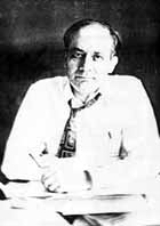
Raphael Lemkin

Encyclopedia
Raphael Lemkin was a Polish
lawyer
of Jewish descent. He is best known for his work against genocide
, a word he coined in 1943 from the root words genos
(Greek
for family, tribe, or race) and -cide (Latin
for killing). He first used the word in print in Axis Rule in Occupied Europe: Laws of Occupation - Analysis of Government - Proposals for Redress (1944), while the Holocaust was occurring.
. Not much is known of Lemkin's early life. He grew up in a Jewish family and was one of three children born to Joseph and Bella (Pomerantz) Lemkin. His father was a farmer and his mother a highly intellectual woman who was a painter, linguist, and philosophy student with a large collection of books on literature and history. With his mother as an influence, Lemkin mastered ten languages by the age of 14, including French, Spanish, Hebrew, Yiddish, and Russian.
After graduating from a local trade school in Białystok he began the study of linguistics at the John Casimir University in Lviv
, Ukraine. It was there that Lemkin became interested in the concept of the crime, which later evolved into the idea of genocide, which was based on the Armenian experience at the hands of the Ottoman Turks then later the experience of Assyrians massacred in Iraq during the 1933 Simele massacre
. Lemkin then moved on to the University of Heidelberg in Germany
to study philosophy, and returned to Lviv to study law in 1926, becoming a prosecutor in Warsaw
at graduation.
His subsequent career as assistant prosecutor in the District Court of Berezhany (Ternopil Province of Eastern Galicia, now Western Ukraine) and Warsaw, followed by a private legal practice in the Polish capital, did not divert Lemkin from elaborating rudiments of international law dealing with group exterminations.
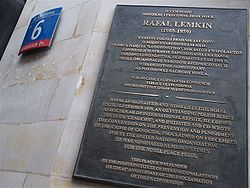 From 1929 to 1934, Lemkin was the Public Prosecutor for the district court of Warsaw. In 1930 he was promoted to Deputy Prosecutor in a local court in Brzeżany
. While Public Prosecutor, Lemkin was also secretary of the Committee on Codification of the Laws of the Polish Republic, which codified the penal codes of Poland, and taught law at Tachkimoni College in Warsaw. Lemkin, working with Duke University
law professor Malcolm McDermott, translated the The Polish Penal Code of 1932 from Polish to English. McDermott would later provide Lemkin with help in leaving Europe.
In 1933 Lemkin made a presentation to the Legal Council of the League of Nations
conference on international criminal law in Madrid
, for which he prepared an essay on the Crime of Barbarity as a crime against international law. The concept of the crime, which later evolved into the idea of genocide, was based on the Armenian Genocide
and prompted by the experience of Assyrians
massacred in Iraq
during the 1933 Simele massacre
. In 1934 Lemkin, under pressure from the Polish Foreign Minister for comments made at the Madrid
conference, resigned his position and became a private solicitor in Warsaw. While in Warsaw, Lemkin attended numerous lectures organized by the Free Polish University
, including the classes of Emil Stanisław Rappaport
and Wacław Makowski.
In 1937, Lemkin was appointed a member of the Polish mission to the 4th Congress on Criminal Law in Paris
, where he also introduced the possibility of defending peace through criminal law. Among the most important of his works of that period are a compendium of Polish criminal fiscal law, (1938) and a French language
work, , regarding international trade law (1939).
of 1939 Lemkin joined the Polish Army and defended Warsaw during the siege of that city
, where he was injured by a bullet to the hip, afterward evading capture by the Germans. In 1940 he traveled through Lithuania
to reach Sweden
, where he first lectured at the University of Stockholm. With the help of Malcolm McDermott, Lemkin received permission to enter the United States
, arriving in 1941.
Although he managed to save his life, he lost 49 relatives in the Holocaust
; they were among over 3 million Polish Jews and Lithuanian Jews
who were murdered during the German occupation. Some members of his family died in areas annexed by the Soviet Union. The only European members of Lemkin's family who survived the Holocaust were his brother, Elias, and his wife and two sons, who had been sent to a Soviet forced labor camp
. Lemkin did however successfully aid his brother and family in emigrating to Montreal
, Canada
in 1948.
After arriving in the United States Lemkin joined the law faculty at Duke University
in North Carolina
in 1941. During the Summer of 1942 Lemkin lectured at the School of Military Government at the University of Virginia
. He also wrote Military Government in Europe, which was a preliminary version of his more fully developed publication Axis Rule in Occupied Europe. In 1943 Lemkin was appointed consultant to the U.S. Board of Economic Warfare
and Foreign Economic Administration
and later became a special adviser on foreign affairs to the War Department, largely due to his expertise in international law
.
In 1944, the Carnegie Endowment for International Peace
published Lemkin's most important work, entitled Axis Rule in Occupied Europe, in the United States. This book included an extensive legal analysis of German rule in countries occupied by Nazi Germany
during the course of World War II
, along with the definition of the term genocide
. Lemkin's idea of genocide as an offense against international law was widely accepted by the international community and was one of the legal bases of the Nuremberg Trials
. In 1945 to 1946, Lemkin became an advisor to Supreme Court of the United States
Justice and Nuremberg Trial chief counsel Robert H. Jackson
.
. In 1955, he became a Professor of Law at Rutgers School of Law in Newark. Lemkin also continued his campaign for international laws defining and forbidding genocide, which he had championed ever since the Madrid conference of 1933. He proposed a similar ban on crimes against humanity during the Paris Peace Conference
of 1945, but his proposal was turned down.
Lemkin presented a draft resolution for a Genocide Convention treaty to a number of countries in an effort to persuade them to sponsor the resolution. With the support of the United States, the resolution was placed before the General Assembly for consideration. The Convention on the Prevention and Punishment of the Crime of Genocide
was formally presented and adopted on December 9, 1948. In 1951, Lemkin only partially achieved his goal when the Convention on the Prevention and Punishment of the Crime of Genocide
came into force, after the 20th nation had ratified the treaty. This treaty had confined its consideration solely to physical aspects of genocide which The Convention defines as:
Lemkin's broader concerns over genocide, as set out in his "Axis Rule in Occupied Europe", also embraced what may be considered as non-physical, namely, psychological acts of genocide which he personally defined as:
He also outlined his various observed "techniques" on achieving genocide which ranged from:
Less well known was Lemkin's view on crimes against humanity perpetrated by the Soviet Union. In 1953, in a speech given in New York City, he described the "destruction of the Ukrainian nation" as the "classic example of Soviet genocide," going on to point out that "the Ukrainian is not and never has been a Russian. His culture, his temperament, his language, his religion, are all different...to eliminate (Ukrainian) nationalism...the Ukrainian peasantry was sacrificed...a famine was necessary for the Soviet and so they got one to order...if the Soviet program succeeds completely, if the intelligentsia, the priest, and the peasant can be eliminated [then] Ukraine will be as dead as if every Ukrainian were killed, for it will have lost that part of it which has kept and developed its culture, its beliefs, its common ideas, which have guided it and given it a soul, which, in short, made it a nation...This is not simply a case of mass murder. It is as case of genocide, of the destruction, not of individuals only, but of a culture and a nation."
On Sunday, 20 September 1953, “10,000 Americans of Ukrainian descent. . .gathered at Washington Square, as many of their compatriots had done on Nov. 18, 1933, in a protest parade that moved up Fifth Avenue to Thirty-fourth Street and hence to the meeting place on Eight Avenue,” reported The New York Times. [11] Among the marchers were members of clergy of the Ukrainian Orthodox Church of America and people in Ukrainian folk costumes. Later, an audience 3,000 strong filled the Manhattan Center, while “hundreds more stood on the sidewalks at Thirty-fourth Street.” Ukrainians had gathered to remember “that dark hour in the history of the Ukraine when 5,000,000 inhabitants of the Russian ‘granary’ were starved to quell the resistance of an independent people to the Soviet regime.” Congressman Arthur G. Klein, noted the Times, “urged that the fight for Ukrainian liberation be continued,” while Raphael Lemkin “said that high crime had been employed 100 years ago against the Irish.” The Ukrainian Weekly was more explicit on Lemkin’s speech:
An inspiring address was delivered at the rally by Prof. Raphael Lemkin, author of the United Nations Convention against Genocide, that is, deliberate mass murder of peoples by their oppressors. Prof. Lemkin reviewed in a moving fashion the fate of the millions of Ukrainians before and after 1932-33, who died victims to the Soviet Russian plan to exterminate as many of them as possible in order to break the heroic Ukrainian national resistance to Soviet Russian rule and occupation and to Communism.
Lemkin’s views on the Ukrainian genocide remained obscured for 55 years. His perceptive analysis of the Ukrainian tragedy remained virtually unknown and hardly ever figured in publications on the famine of 1932-1933 or studies of genocide. The text was brought to public attention only in 2008. Lemkin’s holistic approach to the Soviet regime’s systematic destruction of the Ukrainian nation was highly innovative in its time and has not lost its significance today.
n Grand Cross of the Order of Carlos Manuel de Cespedes
in 1950, the Stephen Wise Award
of the American Jewish Congress
in 1951, and the Cross of Merit of the Federal Republic of Germany in 1955. On the 50th anniversary of the Convention entering into force, Dr. Lemkin was also honored by the UN Secretary-General as "an inspiring example of moral engagement."
Lemkin is the subject of the 2005 play Lemkin's House by Catherine Filloux
, and a one-act play by Robert Skloot (2006, Parallel Press) called If The Whole Body Dies: Raphael Lemkin and the Treaty Against Genocide.
Lemkin’s original work on the 1948 Convention inspired the Initiative on the Convention on the Prevention and Punishment of the Crime of Genocide, by the Institute for Cultural Diplomacy
.
in 1959, at the age of 59. Only seven people attended his funeral.
Articles
Poles
thumb|right|180px|The state flag of [[Poland]] as used by Polish government and diplomatic authoritiesThe Polish people, or Poles , are a nation indigenous to Poland. They are united by the Polish language, which belongs to the historical Lechitic subgroup of West Slavic languages of Central Europe...
lawyer
Lawyer
A lawyer, according to Black's Law Dictionary, is "a person learned in the law; as an attorney, counsel or solicitor; a person who is practicing law." Law is the system of rules of conduct established by the sovereign government of a society to correct wrongs, maintain the stability of political...
of Jewish descent. He is best known for his work against genocide
Genocide
Genocide is defined as "the deliberate and systematic destruction, in whole or in part, of an ethnic, racial, religious, or national group", though what constitutes enough of a "part" to qualify as genocide has been subject to much debate by legal scholars...
, a word he coined in 1943 from the root words genos
Genos
Genos was the ancient Greek term for kind; race; family; birth; origin which identified themselves as a unit, referred to by a single name...
(Greek
Greek language
Greek is an independent branch of the Indo-European family of languages. Native to the southern Balkans, it has the longest documented history of any Indo-European language, spanning 34 centuries of written records. Its writing system has been the Greek alphabet for the majority of its history;...
for family, tribe, or race) and -cide (Latin
Latin
Latin is an Italic language originally spoken in Latium and Ancient Rome. It, along with most European languages, is a descendant of the ancient Proto-Indo-European language. Although it is considered a dead language, a number of scholars and members of the Christian clergy speak it fluently, and...
for killing). He first used the word in print in Axis Rule in Occupied Europe: Laws of Occupation - Analysis of Government - Proposals for Redress (1944), while the Holocaust was occurring.
Early life and education
Lemkin was born Rafał Lemkin in the village of Bezwodne in Imperial Russia, now the Vawkavysk district of BelarusBelarus
Belarus , officially the Republic of Belarus, is a landlocked country in Eastern Europe, bordered clockwise by Russia to the northeast, Ukraine to the south, Poland to the west, and Lithuania and Latvia to the northwest. Its capital is Minsk; other major cities include Brest, Grodno , Gomel ,...
. Not much is known of Lemkin's early life. He grew up in a Jewish family and was one of three children born to Joseph and Bella (Pomerantz) Lemkin. His father was a farmer and his mother a highly intellectual woman who was a painter, linguist, and philosophy student with a large collection of books on literature and history. With his mother as an influence, Lemkin mastered ten languages by the age of 14, including French, Spanish, Hebrew, Yiddish, and Russian.
After graduating from a local trade school in Białystok he began the study of linguistics at the John Casimir University in Lviv
Lviv
Lviv is a city in western Ukraine. The city is regarded as one of the main cultural centres of today's Ukraine and historically has also been a major Polish and Jewish cultural center, as Poles and Jews were the two main ethnicities of the city until the outbreak of World War II and the following...
, Ukraine. It was there that Lemkin became interested in the concept of the crime, which later evolved into the idea of genocide, which was based on the Armenian experience at the hands of the Ottoman Turks then later the experience of Assyrians massacred in Iraq during the 1933 Simele massacre
Simele massacre
The Simele Massacre was a massacre committed by the armed forces of the Kingdom of Iraq during the systematic targeting of Assyrians in northern Iraq in August 1933...
. Lemkin then moved on to the University of Heidelberg in Germany
Germany
Germany , officially the Federal Republic of Germany , is a federal parliamentary republic in Europe. The country consists of 16 states while the capital and largest city is Berlin. Germany covers an area of 357,021 km2 and has a largely temperate seasonal climate...
to study philosophy, and returned to Lviv to study law in 1926, becoming a prosecutor in Warsaw
Warsaw
Warsaw is the capital and largest city of Poland. It is located on the Vistula River, roughly from the Baltic Sea and from the Carpathian Mountains. Its population in 2010 was estimated at 1,716,855 residents with a greater metropolitan area of 2,631,902 residents, making Warsaw the 10th most...
at graduation.
His subsequent career as assistant prosecutor in the District Court of Berezhany (Ternopil Province of Eastern Galicia, now Western Ukraine) and Warsaw, followed by a private legal practice in the Polish capital, did not divert Lemkin from elaborating rudiments of international law dealing with group exterminations.
Working life
Berezhany
Berezhany is a city located in the Ternopil Oblast of western Ukraine. It is the administrative center of the Berezhanskyi Raion , and rests about 100 km from Lviv and 50 km from the oblast capital, Ternopil. The city has a population of about 20,000, and is about 400 m above sea level...
. While Public Prosecutor, Lemkin was also secretary of the Committee on Codification of the Laws of the Polish Republic, which codified the penal codes of Poland, and taught law at Tachkimoni College in Warsaw. Lemkin, working with Duke University
Duke University
Duke University is a private research university located in Durham, North Carolina, United States. Founded by Methodists and Quakers in the present day town of Trinity in 1838, the school moved to Durham in 1892. In 1924, tobacco industrialist James B...
law professor Malcolm McDermott, translated the The Polish Penal Code of 1932 from Polish to English. McDermott would later provide Lemkin with help in leaving Europe.
In 1933 Lemkin made a presentation to the Legal Council of the League of Nations
League of Nations
The League of Nations was an intergovernmental organization founded as a result of the Paris Peace Conference that ended the First World War. It was the first permanent international organization whose principal mission was to maintain world peace...
conference on international criminal law in Madrid
Madrid
Madrid is the capital and largest city of Spain. The population of the city is roughly 3.3 million and the entire population of the Madrid metropolitan area is calculated to be 6.271 million. It is the third largest city in the European Union, after London and Berlin, and its metropolitan...
, for which he prepared an essay on the Crime of Barbarity as a crime against international law. The concept of the crime, which later evolved into the idea of genocide, was based on the Armenian Genocide
Armenian Genocide
The Armenian Genocide—also known as the Armenian Holocaust, the Armenian Massacres and, by Armenians, as the Great Crime—refers to the deliberate and systematic destruction of the Armenian population of the Ottoman Empire during and just after World War I...
and prompted by the experience of Assyrians
Assyrian people
The Assyrian people are a distinct ethnic group whose origins lie in ancient Mesopotamia...
massacred in Iraq
Iraq
Iraq ; officially the Republic of Iraq is a country in Western Asia spanning most of the northwestern end of the Zagros mountain range, the eastern part of the Syrian Desert and the northern part of the Arabian Desert....
during the 1933 Simele massacre
Simele massacre
The Simele Massacre was a massacre committed by the armed forces of the Kingdom of Iraq during the systematic targeting of Assyrians in northern Iraq in August 1933...
. In 1934 Lemkin, under pressure from the Polish Foreign Minister for comments made at the Madrid
Madrid
Madrid is the capital and largest city of Spain. The population of the city is roughly 3.3 million and the entire population of the Madrid metropolitan area is calculated to be 6.271 million. It is the third largest city in the European Union, after London and Berlin, and its metropolitan...
conference, resigned his position and became a private solicitor in Warsaw. While in Warsaw, Lemkin attended numerous lectures organized by the Free Polish University
Wolna Wszechnica Polska
Free Polish University , founded in 1918 in Warsaw, was a private high school with different departments: mathematics and natural sciences, humanities, political sciences and social pedagogy.From 1929, its degrees were equivalent to those of university....
, including the classes of Emil Stanisław Rappaport
Emil Stanisław Rappaport
- External links :* *...
and Wacław Makowski.
In 1937, Lemkin was appointed a member of the Polish mission to the 4th Congress on Criminal Law in Paris
Paris
Paris is the capital and largest city in France, situated on the river Seine, in northern France, at the heart of the Île-de-France region...
, where he also introduced the possibility of defending peace through criminal law. Among the most important of his works of that period are a compendium of Polish criminal fiscal law, (1938) and a French language
French language
French is a Romance language spoken as a first language in France, the Romandy region in Switzerland, Wallonia and Brussels in Belgium, Monaco, the regions of Quebec and Acadia in Canada, and by various communities elsewhere. Second-language speakers of French are distributed throughout many parts...
work, , regarding international trade law (1939).
World War II
During the Polish Defensive WarInvasion of Poland (1939)
The Invasion of Poland, also known as the September Campaign or 1939 Defensive War in Poland and the Poland Campaign in Germany, was an invasion of Poland by Germany, the Soviet Union, and a small Slovak contingent that marked the start of World War II in Europe...
of 1939 Lemkin joined the Polish Army and defended Warsaw during the siege of that city
Siege of Warsaw (1939)
The 1939 Battle of Warsaw was fought between the Polish Warsaw Army garrisoned and entrenched in the capital of Poland and the German Army...
, where he was injured by a bullet to the hip, afterward evading capture by the Germans. In 1940 he traveled through Lithuania
Lithuania
Lithuania , officially the Republic of Lithuania is a country in Northern Europe, the biggest of the three Baltic states. It is situated along the southeastern shore of the Baltic Sea, whereby to the west lie Sweden and Denmark...
to reach Sweden
Sweden
Sweden , officially the Kingdom of Sweden , is a Nordic country on the Scandinavian Peninsula in Northern Europe. Sweden borders with Norway and Finland and is connected to Denmark by a bridge-tunnel across the Öresund....
, where he first lectured at the University of Stockholm. With the help of Malcolm McDermott, Lemkin received permission to enter the United States
United States
The United States of America is a federal constitutional republic comprising fifty states and a federal district...
, arriving in 1941.
Although he managed to save his life, he lost 49 relatives in the Holocaust
The Holocaust
The Holocaust , also known as the Shoah , was the genocide of approximately six million European Jews and millions of others during World War II, a programme of systematic state-sponsored murder by Nazi...
; they were among over 3 million Polish Jews and Lithuanian Jews
Lithuanian Jews
Lithuanian Jews or Litvaks are Jews with roots in the Grand Duchy of Lithuania:...
who were murdered during the German occupation. Some members of his family died in areas annexed by the Soviet Union. The only European members of Lemkin's family who survived the Holocaust were his brother, Elias, and his wife and two sons, who had been sent to a Soviet forced labor camp
Gulag
The Gulag was the government agency that administered the main Soviet forced labor camp systems. While the camps housed a wide range of convicts, from petty criminals to political prisoners, large numbers were convicted by simplified procedures, such as NKVD troikas and other instruments of...
. Lemkin did however successfully aid his brother and family in emigrating to Montreal
Montreal
Montreal is a city in Canada. It is the largest city in the province of Quebec, the second-largest city in Canada and the seventh largest in North America...
, Canada
Canada
Canada is a North American country consisting of ten provinces and three territories. Located in the northern part of the continent, it extends from the Atlantic Ocean in the east to the Pacific Ocean in the west, and northward into the Arctic Ocean...
in 1948.
After arriving in the United States Lemkin joined the law faculty at Duke University
Duke University
Duke University is a private research university located in Durham, North Carolina, United States. Founded by Methodists and Quakers in the present day town of Trinity in 1838, the school moved to Durham in 1892. In 1924, tobacco industrialist James B...
in North Carolina
North Carolina
North Carolina is a state located in the southeastern United States. The state borders South Carolina and Georgia to the south, Tennessee to the west and Virginia to the north. North Carolina contains 100 counties. Its capital is Raleigh, and its largest city is Charlotte...
in 1941. During the Summer of 1942 Lemkin lectured at the School of Military Government at the University of Virginia
University of Virginia
The University of Virginia is a public research university located in Charlottesville, Virginia, United States, founded by Thomas Jefferson...
. He also wrote Military Government in Europe, which was a preliminary version of his more fully developed publication Axis Rule in Occupied Europe. In 1943 Lemkin was appointed consultant to the U.S. Board of Economic Warfare
Board of Economic Warfare
The Office of Administrator of Export Control was established in the United States by Presidential Proclamation 2413, July 2, 1940, to administer export licensing provisions of the act of July 2, 1940 . Brigadier General Russell Lamont Maxwell, United States Army, headed up this military entity...
and Foreign Economic Administration
Foreign Economic Administration
In the administration of Franklin Delano Roosevelt, the Foreign Economic Administration was formed to relieve friction between US agencies operating abroad. As described by the biographer of the FEA's chief, Leo Crowley, the agency was designed and run by "The Nation's #1 Pinch-hitter".S. L...
and later became a special adviser on foreign affairs to the War Department, largely due to his expertise in international law
International law
Public international law concerns the structure and conduct of sovereign states; analogous entities, such as the Holy See; and intergovernmental organizations. To a lesser degree, international law also may affect multinational corporations and individuals, an impact increasingly evolving beyond...
.
In 1944, the Carnegie Endowment for International Peace
Carnegie Endowment for International Peace
The Carnegie Endowment for International Peace is a foreign-policy think tank based in Washington, D.C. The organization describes itself as being dedicated to advancing cooperation between nations and promoting active international engagement by the United States...
published Lemkin's most important work, entitled Axis Rule in Occupied Europe, in the United States. This book included an extensive legal analysis of German rule in countries occupied by Nazi Germany
Nazi Germany
Nazi Germany , also known as the Third Reich , but officially called German Reich from 1933 to 1943 and Greater German Reich from 26 June 1943 onward, is the name commonly used to refer to the state of Germany from 1933 to 1945, when it was a totalitarian dictatorship ruled by...
during the course of World War II
World War II
World War II, or the Second World War , was a global conflict lasting from 1939 to 1945, involving most of the world's nations—including all of the great powers—eventually forming two opposing military alliances: the Allies and the Axis...
, along with the definition of the term genocide
Genocide
Genocide is defined as "the deliberate and systematic destruction, in whole or in part, of an ethnic, racial, religious, or national group", though what constitutes enough of a "part" to qualify as genocide has been subject to much debate by legal scholars...
. Lemkin's idea of genocide as an offense against international law was widely accepted by the international community and was one of the legal bases of the Nuremberg Trials
Nuremberg Trials
The Nuremberg Trials were a series of military tribunals, held by the victorious Allied forces of World War II, most notable for the prosecution of prominent members of the political, military, and economic leadership of the defeated Nazi Germany....
. In 1945 to 1946, Lemkin became an advisor to Supreme Court of the United States
Supreme Court of the United States
The Supreme Court of the United States is the highest court in the United States. It has ultimate appellate jurisdiction over all state and federal courts, and original jurisdiction over a small range of cases...
Justice and Nuremberg Trial chief counsel Robert H. Jackson
Robert H. Jackson
Robert Houghwout Jackson was United States Attorney General and an Associate Justice of the United States Supreme Court . He was also the chief United States prosecutor at the Nuremberg Trials...
.
Post-War
After the war, Lemkin chose to remain in the United States. Starting in 1948, he gave lectures on criminal law at Yale UniversityYale University
Yale University is a private, Ivy League university located in New Haven, Connecticut, United States. Founded in 1701 in the Colony of Connecticut, the university is the third-oldest institution of higher education in the United States...
. In 1955, he became a Professor of Law at Rutgers School of Law in Newark. Lemkin also continued his campaign for international laws defining and forbidding genocide, which he had championed ever since the Madrid conference of 1933. He proposed a similar ban on crimes against humanity during the Paris Peace Conference
Paris Peace Treaties, 1947
The Paris Peace Conference resulted in the Paris Peace Treaties signed on February 10, 1947. The victorious wartime Allied powers negotiated the details of treaties with Italy, Romania, Hungary, Bulgaria, and Finland .The...
of 1945, but his proposal was turned down.
Lemkin presented a draft resolution for a Genocide Convention treaty to a number of countries in an effort to persuade them to sponsor the resolution. With the support of the United States, the resolution was placed before the General Assembly for consideration. The Convention on the Prevention and Punishment of the Crime of Genocide
Convention on the Prevention and Punishment of the Crime of Genocide
The Convention on the Prevention and Punishment of the Crime of Genocide was adopted by the United Nations General Assembly on 9 December 1948 as General Assembly Resolution 260. The Convention entered into force on 12 January 1951. It defines genocide in legal terms, and is the culmination of...
was formally presented and adopted on December 9, 1948. In 1951, Lemkin only partially achieved his goal when the Convention on the Prevention and Punishment of the Crime of Genocide
Convention on the Prevention and Punishment of the Crime of Genocide
The Convention on the Prevention and Punishment of the Crime of Genocide was adopted by the United Nations General Assembly on 9 December 1948 as General Assembly Resolution 260. The Convention entered into force on 12 January 1951. It defines genocide in legal terms, and is the culmination of...
came into force, after the 20th nation had ratified the treaty. This treaty had confined its consideration solely to physical aspects of genocide which The Convention defines as:
- …any of the following acts committed with intent to destroy, in whole or in part, a national, ethnical, racial or religious group, such as:
- (a) Killing members of the group;
- (b) Causing serious bodily or mental harm to members of the group;
- (c) Deliberately inflicting on the group conditions of life calculated to bring about its physical destruction in whole or in part;
- (d) Imposing measures intended to prevent births within the group;
- (e) Forcibly transferring children of the group to another group.
Lemkin's broader concerns over genocide, as set out in his "Axis Rule in Occupied Europe", also embraced what may be considered as non-physical, namely, psychological acts of genocide which he personally defined as:
- "Generally speaking, genocide does not necessarily mean the immediate destruction of a nation, except when accomplished by mass killings of all members of a nation. It is intended rather to signify a coordinated plan of different actions aiming at the destruction of essential foundations of the life of national groups, with the aim of annihilating the groups themselves. The objectives of such a plan would be disintegration of the political and social institutions, of culture, language, national feelings, religion, and the economic existence of national groups, and the destruction of the personal security, liberty, health, dignity, and even the lives of the individuals belonging to such groups. Genocide is directed against the national group as an entity, and the actions involved are directed against individuals, not in their individual capacity, but as members of the national group."
- "Genocide has two phases: one, destruction of the national pattern of the oppressed group; the other, the imposition of the national pattern of the oppressor. This imposition, in turn, may be made upon the oppressed population which is allowed to remain or upon the territory alone, after removal of the population and the colonization by the oppressor's own nationals."
He also outlined his various observed "techniques" on achieving genocide which ranged from:
- Political
- Social
- Cultural
- Economic
- Biological
- Physical:
-
-
- Endangering Health
- Mass Killing
- Religious
- Moral
-
Less well known was Lemkin's view on crimes against humanity perpetrated by the Soviet Union. In 1953, in a speech given in New York City, he described the "destruction of the Ukrainian nation" as the "classic example of Soviet genocide," going on to point out that "the Ukrainian is not and never has been a Russian. His culture, his temperament, his language, his religion, are all different...to eliminate (Ukrainian) nationalism...the Ukrainian peasantry was sacrificed...a famine was necessary for the Soviet and so they got one to order...if the Soviet program succeeds completely, if the intelligentsia, the priest, and the peasant can be eliminated [then] Ukraine will be as dead as if every Ukrainian were killed, for it will have lost that part of it which has kept and developed its culture, its beliefs, its common ideas, which have guided it and given it a soul, which, in short, made it a nation...This is not simply a case of mass murder. It is as case of genocide, of the destruction, not of individuals only, but of a culture and a nation."
On Sunday, 20 September 1953, “10,000 Americans of Ukrainian descent. . .gathered at Washington Square, as many of their compatriots had done on Nov. 18, 1933, in a protest parade that moved up Fifth Avenue to Thirty-fourth Street and hence to the meeting place on Eight Avenue,” reported The New York Times. [11] Among the marchers were members of clergy of the Ukrainian Orthodox Church of America and people in Ukrainian folk costumes. Later, an audience 3,000 strong filled the Manhattan Center, while “hundreds more stood on the sidewalks at Thirty-fourth Street.” Ukrainians had gathered to remember “that dark hour in the history of the Ukraine when 5,000,000 inhabitants of the Russian ‘granary’ were starved to quell the resistance of an independent people to the Soviet regime.” Congressman Arthur G. Klein, noted the Times, “urged that the fight for Ukrainian liberation be continued,” while Raphael Lemkin “said that high crime had been employed 100 years ago against the Irish.” The Ukrainian Weekly was more explicit on Lemkin’s speech:
An inspiring address was delivered at the rally by Prof. Raphael Lemkin, author of the United Nations Convention against Genocide, that is, deliberate mass murder of peoples by their oppressors. Prof. Lemkin reviewed in a moving fashion the fate of the millions of Ukrainians before and after 1932-33, who died victims to the Soviet Russian plan to exterminate as many of them as possible in order to break the heroic Ukrainian national resistance to Soviet Russian rule and occupation and to Communism.
Lemkin’s views on the Ukrainian genocide remained obscured for 55 years. His perceptive analysis of the Ukrainian tragedy remained virtually unknown and hardly ever figured in publications on the famine of 1932-1933 or studies of genocide. The text was brought to public attention only in 2008. Lemkin’s holistic approach to the Soviet regime’s systematic destruction of the Ukrainian nation was highly innovative in its time and has not lost its significance today.
Recognition
For his work on international law and the prevention of war crimes, Lemkin received a number of awards, including the CubaCuba
The Republic of Cuba is an island nation in the Caribbean. The nation of Cuba consists of the main island of Cuba, the Isla de la Juventud, and several archipelagos. Havana is the largest city in Cuba and the country's capital. Santiago de Cuba is the second largest city...
n Grand Cross of the Order of Carlos Manuel de Cespedes
Carlos Manuel de Céspedes
Carlos Manuel de Céspedes del Castillo was a Cuban planter who freed his slaves and made the declaration of Cuban independence in 1868 which started the Ten Years' War...
in 1950, the Stephen Wise Award
Stephen Samuel Wise
Stephen Samuel Wise was an Austro-Hungarian-born American Reform rabbi and Zionist leader.-Early life:...
of the American Jewish Congress
American Jewish Congress
The American Jewish Congress describes itself as an association of Jewish Americans organized to defend Jewish interests at home and abroad through public policy advocacy, using diplomacy, legislation, and the courts....
in 1951, and the Cross of Merit of the Federal Republic of Germany in 1955. On the 50th anniversary of the Convention entering into force, Dr. Lemkin was also honored by the UN Secretary-General as "an inspiring example of moral engagement."
Lemkin is the subject of the 2005 play Lemkin's House by Catherine Filloux
Catherine Filloux
Catherine Filloux is a French-Algerian-American playwright. She has received awards from the Kennedy Center Fund for New American Plays, the O'Neill, the Rockefeller MAP Fund, and the Asian Cultural Council. In 2003 she was a Fullbright Senior Specialist in playwriting in Cambodia.Filloux's plays...
, and a one-act play by Robert Skloot (2006, Parallel Press) called If The Whole Body Dies: Raphael Lemkin and the Treaty Against Genocide.
Lemkin’s original work on the 1948 Convention inspired the Initiative on the Convention on the Prevention and Punishment of the Crime of Genocide, by the Institute for Cultural Diplomacy
Institute for Cultural Diplomacy
The Institute for Cultural Diplomacy is an international, not-for-profit, non-governmental organisation based in Berlin. Founded in 1999 by Mark Donfried, its activities focus on promoting and developing the field of cultural diplomacy by conducting research, initiatives and programs, holding...
.
Death
Lemkin died of a heart attack at the public relations office of Milton H. Blow in New York CityNew York City
New York is the most populous city in the United States and the center of the New York Metropolitan Area, one of the most populous metropolitan areas in the world. New York exerts a significant impact upon global commerce, finance, media, art, fashion, research, technology, education, and...
in 1959, at the age of 59. Only seven people attended his funeral.
Further reading
Books- Cooper, John. Raphael Lemkin and the Struggle for the Genocide Convention. Palgrave/Macmallin, 2008. ISBN 0-230-51691-2.
- Power, Samantha. A Problem from Hell: America and the Age of Genocide. Basic Books, 2002 (original hardcover). ISBN 0-465-06150-8. (Chapters 2-5)
- Shaw, Martin, 'What is Genocide?'. Polity Press, 2007. ISBN 0-7456-3183-5. (Chapter 2)
- Olivier BEAUVALLET, Lemkin face au génocide, (with a french translation of "The legal case against Hitler" released in 1945), Michalon, 2011- ISBN : 978-2-84186-560-4.
Articles
- Raphael Lemkin (1900–1959) - The Polish Lawyer Who Created the Concept of “Genocide”
- Lemkin Discusses Armenian Genocide In Newly-Found 1949 CBS Interview
- A Study Guide on Lemkin and his contributions to human rights law and activism
- Biographical sketch of Raphael Lemkin
- Key writings of Raphael Lemkin on Genocide, 1933–1947
- Guide to the Papers of Raphael Lemkin
- Acts Constituting a General (Transnational) Danger Considered as Offenses Against the Law of Nations (for definitions of "barbarity" and "vandalism")
- Convention on the Prevention and Punishment of the Crime of Genocide
- An examination of Cornish Genocide see Genocide Review