


Sigurd stones

Encyclopedia

Sigurd
Sigurd is a legendary hero of Norse mythology, as well as the central character in the Völsunga saga. The earliest extant representations for his legend come in pictorial form from seven runestones in Sweden and most notably the Ramsund carving Sigurd (Old Norse: Sigurðr) is a legendary hero of...
the dragon slayer. They were made during the Viking Age
Viking Age
Viking Age is the term for the period in European history, especially Northern European and Scandinavian history, spanning the late 8th to 11th centuries. Scandinavian Vikings explored Europe by its oceans and rivers through trade and warfare. The Vikings also reached Iceland, Greenland,...
and they constitute the earliest Norse representations of the matter of the Nibelungenlied
Nibelungenlied
The Nibelungenlied, translated as The Song of the Nibelungs, is an epic poem in Middle High German. The story tells of dragon-slayer Siegfried at the court of the Burgundians, how he was murdered, and of his wife Kriemhild's revenge....
and the Sigurd legends in the Poetic Edda
Poetic Edda
The Poetic Edda is a collection of Old Norse poems primarily preserved in the Icelandic mediaeval manuscript Codex Regius. Along with Snorri Sturluson's Prose Edda, the Poetic Edda is the most important extant source on Norse mythology and Germanic heroic legends, and from the early 19th century...
, the Prose Edda
Prose Edda
The Prose Edda, also known as the Younger Edda, Snorri's Edda or simply Edda, is an Icelandic collection of four sections interspersed with excerpts from earlier skaldic and Eddic poetry containing tales from Nordic mythology...
and the Völsunga saga
Volsunga saga
The Völsungasaga is a legendary saga, a late 13th century Icelandic prose rendition of the origin and decline of the Völsung clan . It is largely based on epic poetry...
.
In parts of Great Britain
Great Britain
Great Britain or Britain is an island situated to the northwest of Continental Europe. It is the ninth largest island in the world, and the largest European island, as well as the largest of the British Isles...
under Norse culture, the figure of Sigurd sucking the dragon's blood from his thumb appears on several carved stones, at Ripon
Ripon
Ripon is a cathedral city, market town and successor parish in the Borough of Harrogate, North Yorkshire, England, located at the confluence of two streams of the River Ure in the form of the Laver and Skell. The city is noted for its main feature the Ripon Cathedral which is architecturally...
and Kirby Hill, North Yorkshire, at York
York
York is a walled city, situated at the confluence of the Rivers Ouse and Foss in North Yorkshire, England. The city has a rich heritage and has provided the backdrop to major political events throughout much of its two millennia of existence...
and at Halton, Lancashire
Halton, Lancashire
Halton-with-Aughton is a civil parish located east of Lancaster, England on the north bank of the River Lune. The main settlement is the village of Halton-on-Lune, commonly just called Halton, in the west, and the parish stretches to the hamlet of Aughton in the east...
. Carved slates from the Isle of Man
Isle of Man
The Isle of Man , otherwise known simply as Mann , is a self-governing British Crown Dependency, located in the Irish Sea between the islands of Great Britain and Ireland, within the British Isles. The head of state is Queen Elizabeth II, who holds the title of Lord of Mann. The Lord of Mann is...
, broadly dated c 950-1000, include several pieces interpreted as showing episodes from the Sigurd story.
U 1163
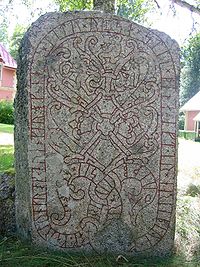
Manor house
A manor house is a country house that historically formed the administrative centre of a manor, the lowest unit of territorial organisation in the feudal system in Europe. The term is applied to country houses that belonged to the gentry and other grand stately homes...
Göksbo in the vicinity where it is presently raised. It has an image of Sigurd who thrusts his sword through the serpent, and the dwarf Andvari
Andvari
In Norse mythology, Andvari is a dwarf who lives underneath a waterfall and has the power to change himself into a fish at will. Andvari had a magical ring Andvarinaut, which helped him become wealthy....
, as well as the Valkyrie
Valkyrie
In Norse mythology, a valkyrie is one of a host of female figures who decides who dies in battle. Selecting among half of those who die in battle , the valkyries bring their chosen to the afterlife hall of the slain, Valhalla, ruled over by the god Odin...
Sigrdrífa who gives Sigurd a drinking horn
Drinking horn
A drinking horn is the horn of a bovid used as a drinking vessel. Drinking horns are known from Classical Antiquity especially in Thrace and the Balkans, and remained in use for ceremonial purposes throughout the Middle Ages and the Early Modern period in some parts of Europe, notably in Germanic...
.
The runestone has a stylized Christian cross
Christian cross
The Christian cross, seen as a representation of the instrument of the crucifixion of Jesus Christ, is the best-known religious symbol of Christianity...
, as do a number of the Sigurd stones. Sigurd runestones with crosses are taken as evidence of the acceptance and use of legends from the Volsung saga by Christianity during the transition period from Norse paganism
Norse paganism
Norse paganism is the religious traditions of the Norsemen, a Germanic people living in the Nordic countries. Norse paganism is therefore a subset of Germanic paganism, which was practiced in the lands inhabited by the Germanic tribes across most of Northern and Central Europe in the Viking Age...
. Other Sigurd stones with crosses in their designs include U 1175, Sö 327, Gs 2, and Gs 9.
Latin transliteration:
- uiþbiurn × ok : karlunkr : ok × erinker : ok × nas(i) × litu × risa × stii × þina × eftir × eriibiun × f[aþu]r × sii × snelan
Old Norse transcription:
- Viðbiorn ok KarlungR ok ÆringæiRR/Æringærðr ok Nasi/Næsi letu ræisa stæin þenna æftiR Ærinbiorn, faður sinn sniallan.
English translation:
- "Viðbjôrn and Karlungr and Eringeirr/Eringerðr and Nasi/Nesi had this stone raised in memory of Erinbjôrn, their able father."
U 1175
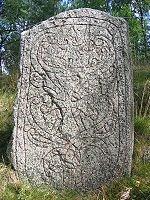
Morgongåva
Morgongåva is a locality situated in Heby Municipality, Uppsala County, Sweden with 1,351 inhabitants in 2005.-Town name:Town name - as the oldest known name for a cottage from 1667 containing the word...
. It belongs to the category of nonsensical runestones that do not contain any runes, only runelike signs surrounding a design with a cross. The inscription has the same motifs and ornamentation as U 1163 and may be a copy of that runestone.
Latin transliteration:
- ...
Old Norse transcription:
- ...
English translation:
- "..."
Sö 40
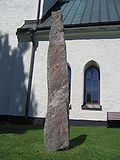
Västerljung
Västerljung is a locality situated in Trosa Municipality, Södermanland County, Sweden with 372 inhabitants in 2005....
, but it was originally found in 1959 in the foundation of the southwest corner of the church tower. The stone is 2.95 meters in height and is carved on three sides. One side has the runic text within a serpent band with the head and tail of the serpent bound at the bottom. The inscription is classified as being carved in runestone style Pr2 and the text states that it was made by the runemaster
Runemaster
A runemaster or runecarver is a specialist in making runestones.Most early medieval Scandinavians were probably literate in runes, and most people probably carved messages on pieces of bone and wood. However, it was difficult to make runestones, and in order to master it one also needed to be a...
Skamhals. Another runestone, Sö 323, is signed by a Skamhals, but that is believed to be a different person with the same name. The other two sides contain images, with one interpreted as depicting Gunnar
Gunther
Gunther is the German name of a semi-legendary king of Burgundy of the early 5th century...
playing the harp in the snake pit
Snake pit
Snake pits are places of horror, torture and even death in European legends and fairy tales. The Viking warlord Ragnar Lodbrok is said to have been thrown into a snake pit and died there, after his army had been defeated in battle by King Aelle II of Northumbria...
.
Of the names in the inscription, Geirmarr means "spear-steed" and Skammhals is a nickname meaning "small neck."
Latin transliteration:
- haunefR + raisti * at * kaiRmar * faþur * sin + haa * iR intaþr * o * þiusti * skamals * hiak * runaR þaRsi +
Old Norse transcription:
- HonæfR ræisti at GæiRmar, faður sinn. Hann eR ændaðr a Þiusti. Skammhals hiogg runaR þaRsi.
English translation:
- "Hónefr raised (the stone) in memory of Geirmarr, his father. He met his end in ÞjústrTjustthumb|300px|Tjust has a rich archipelago on the [[Baltic Sea]].Tjust was one of the small lands of Småland, Sweden. It was divided into the hundreds of Tjust Northern Hundred and Tjust Southern Hundred. It corresponds to Västervik Municipality and the southern part of Valdemarsvik Municipality....
. Skammhals cut these runes."
Sö 101


Ramsund
Ramsund may refer to:*Ramsund carving - a form of runic stone carvings*Ramsund naval base - a Royal Norwegian Navy base*Ramsund, Norway - a town in Norway*Ramsund, Sweden - a place name in Eskilstuna Municipality, Sweden...
, Eskilstuna Municipality
Eskilstuna Municipality
Eskilstuna Municipality is a municipality in Södermanland County in southeast Sweden, between the lakes Mälaren and Hjälmaren...
, Södermanland
Södermanland
', sometimes referred to under its Latin form Sudermannia or Sudermania, is a historical province or landskap on the south eastern coast of Sweden. It borders Östergötland, Närke, Västmanland and Uppland. It is also bounded by lake Mälaren and the Baltic sea.In Swedish, the province name is...
, Sweden
Sweden
Sweden , officially the Kingdom of Sweden , is a Nordic country on the Scandinavian Peninsula in Northern Europe. Sweden borders with Norway and Finland and is connected to Denmark by a bridge-tunnel across the Öresund....
. It is believed to have been carved around the year 1030. It is generally considered an important piece of Norse art
Norse art
Norse art is a blanket term for the artistic styles in Scandinavia during the Germanic Iron Age, the Viking Age , and sometimes even used when describing objects from the Nordic Bronze Age...
in runestone style Pr1.
The Ramsund carving in Sweden
Sweden
Sweden , officially the Kingdom of Sweden , is a Nordic country on the Scandinavian Peninsula in Northern Europe. Sweden borders with Norway and Finland and is connected to Denmark by a bridge-tunnel across the Öresund....
depicts 1) how Sigurd is sitting naked in front of the fire preparing the dragon heart, from Fafnir
Fafnir
In Norse mythology, Fáfnir or Frænir was a son of the dwarf king Hreidmar and brother of Regin and Ótr. In the Volsunga saga, Fáfnir was a dwarf gifted with a powerful arm and fearless soul. He guarded his father's house of glittering gold and flashing gems...
, for his foster-father Regin
Regin
Reginn, often Anglicized as Regin, in Norse mythology, was the son of Hreiðmarr and foster father of Sigurd. His brothers are Fafnir and Ótr. When Loki mistakenly kills Ótr, Hreiðmarr demands to be repaid with the amount of gold it takes to fill Ótr's skin and cover the outside. Loki takes this...
, who is Fafnir
Fafnir
In Norse mythology, Fáfnir or Frænir was a son of the dwarf king Hreidmar and brother of Regin and Ótr. In the Volsunga saga, Fáfnir was a dwarf gifted with a powerful arm and fearless soul. He guarded his father's house of glittering gold and flashing gems...
's brother. The heart is not finished yet, and when Sigurd touches it, he burns himself and sticks his finger into his mouth. As he has tasted dragon blood, he starts to understand the birds' song. 2) The birds say that Regin will not keep his promise of reconciliation and will try to kill Sigurd, which causes Sigurd to cut off Regin's head. 3) Regin is dead beside his own head, his smithing tools with which he reforged Sigurd's sword Gram
Gram (mythology)
In Norse mythology, Gram is the name of the sword that Sigurd used to kill the dragon Fafnir.It was forged by Wayland the Smith and originally belonged to his father, Sigmund, who received it in the hall of the Volsung after pulling it out of the tree Barnstokk into which Odin had stuck...
are scattered around him, and 4) Regin's horse is laden with the dragon's treasure. 5) is the previous event when Sigurd killed Fafnir, and 6) shows Ótr
Ótr
In Norse mythology, Ótr is a dwarf. He is the son of the king Hreidmar and the brother of Fafnir and Regin....
from the saga's beginning.
The runic text is ambiguous, but one interpretation of the persons mentioned in the inscription, based on inscriptions on other runestones found nearby, is that Sigriþr (a woman) was the wife of Sigröd who has died. Holmgeirr is her father in law. Alrikr, son of Sigriþr, erected another stone for his father, named Spjut, so while Alrikr is the son of Sigriþr, he was not the son of Sigruþr. Alternatively, Holmgeirr is Sigriþr's second husband and Sigröd (but not Alrikr) is their son.
The inspiration for using the legend of Sigurd for the pictorial decoration was probably the close similarity of the names Sigurd (Sigurðr in Old Norse) and Sigröd.
It is raised by the same aristocratic family as the Bro Runestone and the Kjula Runestone. The reference to bridge-building in the runic text is fairly common in rune stones during this time period. Some are Christian
Christian
A Christian is a person who adheres to Christianity, an Abrahamic, monotheistic religion based on the life and teachings of Jesus of Nazareth as recorded in the Canonical gospels and the letters of the New Testament...
references related to passing the bridge into the afterlife. At this time, the Catholic Church sponsored the building of roads and bridges through the use of indulgence
Indulgence
In Catholic theology, an indulgence is the full or partial remission of temporal punishment due for sins which have already been forgiven. The indulgence is granted by the Catholic Church after the sinner has confessed and received absolution...
s in return for intercession for the soul. There are many examples of these bridge stones dated from the eleventh century, including runic inscriptions U 489 and U 617.
Latin transliteration:
- siriþr : kiarþi : bur : þosi : muþiR : alriks : tutiR : urms : fur * salu : hulmkirs : faþur : sukruþar buata * sis *
Old Norse transcription:
- Sigriðr gærði bro þasi, moðiR Alriks, dottiR Orms, for salu HolmgæiRs, faður SigrøðaR, boanda sins.
English translation:
- "Sigríðr, Alríkr's mother, Ormr's daughter, made this bridge for the soul of Holmgeirr, father of Sigrøðr, her husbandman."
Sö 327
This inscription, located at Gök, which is about 5 kilometers west of SträngnäsSträngnäs
Strängnäs is a locality and the seat of Strängnäs Municipality, Södermanland County, Sweden with 12,296 inhabitants in 2005. It is located by Lake Mälaren and is the episcopal see of the Diocese of Strängnäs, a former Roman Catholic and present Lutheran Diocese, with the Strängnäs Cathedral, built...
, is on a boulder and is classified as being carved in runestone style Pr1-Pr2. The inscription, which has a width of 2.5 meters and a height of 1.65 meters, consists of runic text on two serpents that surround much of the Sigurd imagry. The inscription dates from the same time as the Ramsund carving and it uses the same imagery, but a Christian cross has been added and the images are combined in a way that completely distorts the internal logic of events. Some have claimed that the runemaster
Runemaster
A runemaster or runecarver is a specialist in making runestones.Most early medieval Scandinavians were probably literate in runes, and most people probably carved messages on pieces of bone and wood. However, it was difficult to make runestones, and in order to master it one also needed to be a...
either did not understand the underlying myth, or consciously distorted its representation. Whatever the reason may have been, the Gök stone illustrates how the pagan heroic mythos was going towards its dissolution during the Christianization of Scandinavia
Christianization of Scandinavia
The Christianization of Scandinavia took place between the 8th and the 12th century. The realms of Scandinavia proper, Denmark, Norway and Sweden, established their own Archdioceses, responsible directly to the Pope, in 1104, 1154 and 1164, respectively...
. However, the main figures from the story are represented in order when read from the right to the left. Sigurd is shown below the lower serpent, stabbing up at it with his sword. Other images include a tree, the horse Grani
Grani
In Norse mythology, Grani is a horse owned by the hero Sigurd. He is the horse that Sigurd receives through advice from an old man . Grani is a descendant of Odin's own steed, Sleipnir.-Attestations:...
, a bird, the head of Regan and a headless body, the roasting of the dragon heart, and Ótr.
This inscrption has never been satisfactorily transcribed nor translated.
Latin transliteration:
- ... (i)uraRi : kaum : isaio : raisti : stai : ain : þansi : at : : þuaR : fauþr : sloþn : kbrat : sin faþu... ul(i) * hano : msi +
Old Norse transcription:
- ...
English translation:
- "..."
Gs 2
This sandstone runestone is classified as being carved in runestone style Pr2 and was rediscovered in 1974 outside of the wall of the church of ÖsterfärneboÖsterfärnebo
Österfärnebo is a locality situated in Sandviken Municipality, Gävleborg County, Sweden with 550 inhabitants in 2005....
. It is not listed as a Sigurd runestone by the Rundata project, and only the bottom part of it remains. The inscription is reconstructed based upon a drawing made during a runestone survey in 1690 by Ulf Christoffersson. The inscription originally included several figures from the Sigurd story, including a bird, Ótr with the ring, and a horse.
The personal name Þorgeirr in the runic text means "Thor
Thor
In Norse mythology, Thor is a hammer-wielding god associated with thunder, lightning, storms, oak trees, strength, the protection of mankind, and also hallowing, healing, and fertility...
's spear."
Latin transliteration:
- [ily]iki : ok : f[uluiki × ok : þurkair ... ...- × sin × snilan] : kuþ ilubi on(t)[a]
Old Norse transcription:
- Illugi ok Fullugi ok ÞorgæiRR ... ... sinn sniallan. Guð hialpi anda.
English translation:
- "Illugi and Fullugi and Þorgeirr ... their able ... May God help (his) spirit."
Gs 9
This runestone is found at the church of ÅrsundaÅrsunda
Årsunda is a locality situated in Sandviken Municipality, Gävleborg County, Sweden with 1,067 inhabitants in 2005....
and was documented during a survey in 1690. It shows a man running at the top of the runestone, which by comparison with U 1163 from Drävle can be identified as Sigurd. A second figure holds a ring in his hand. A cross is in the center of the design. Similar to the Sigurd stones U 1163, U 1175, Sö 327, and Gs 2, this combination of a cross and the Sigurd figure is taken as evidence of the acceptance and use by Christianity of legends from the Volsung Saga during the transition period from paganism. The runic text, which is reconstructed from the 1690 drawing, uses a bind rune
Bind rune
A bind rune is a ligature of two or more runes. They are extremely rare in Viking Age inscriptions, but are common in pre-Viking Age and in post-Viking Age inscriptions....
which combines the e- and l-runes in the name of the mother, Guðelfr.
Latin transliteration:
- (i)nu-r : sun : r[u]þ[u](r) at × [uili](t)... ...[Ris:]t eftir : þurker : bruþu[r : sin : ok : kyþe=lfi : muþur : sina : uk] : eft[i]R : [a]sbiorn : o[k : o]ifuþ
Old Norse transcription:
- Anun[d]r(?), sunn
(?) at ... æftiR ÞorgæiR, broður sinn, ok Guðælfi, moður sina ok æftiR Asbiorn ok .
English translation:
- "Ônundr(?),
's son, in memory of ... ... in memory of Þorgeirr, his brother and Guðelfr, his mother, and in memory of Ásbjôrn and "
Gs 19
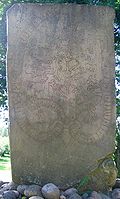
Ockelbo
Ockelbo is a locality and the seat of Ockelbo Municipality, Gävleborg County, Sweden with 2,709 inhabitants in 2005.The name Ockelbo, spelt "De oklabo" in 1314, contains an old marine name *Ukle, referring to modern- day lake Bysjön. The name derives from the old Swedish word "ukla" meaning swell,...
. The original runestone was found in a foundation wall of the church in 1795 and removed and stored in the church in 1830. The runestone was destroyed together with the church in a fire in 1904. The present runestone is a copy made in 1932 after drawings and it is raised outside the church. The runestone has several illustrations including matter from the Sigurd legends. One shows two men playing Hnefatafl, a form of the boardgame called tofl
Tafl games
Tafl games were a family of ancient Germanic and Celtic board games played on a checkered or latticed board with two teams of uneven strength. The size of the board and the number of pieces varied, but all games involved a distinctive 2:1 ratio of pieces, with the lesser side having a king-piece...
.
The name Svarthôfði in the inscription translates as "black head" and was often used as a nickname.
Latin transliteration:
- [blesa × lit × raisa × stain×kumbl × þesa × fa(i)(k)(r)(n) × ef(t)ir × sun sin × suar×aufþa × fr(i)þelfr × u-r × muþir × ons × siionum × kan : inuart : þisa × bhum : arn : (i)omuan sun : (m)(i)e(k)]
Old Norse transcription:
- Blæsa let ræisa stæinkumbl þessa fagru æftiR sun sinn Svarthaufða. FriðælfR v[a]R moðiR hans
<þisa> sun .
English translation:
- "Blesa had these fair stone-monuments raised in memory of his son Svarthôfði. Friðelfr was his mother. ... "
Bo NIYR;3
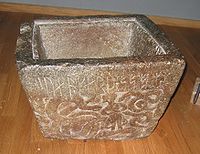
Typology (theology)
Typology in Christian theology and Biblical exegesis is a doctrine or theory concerning the relationship between the Old and New Testaments...
similar to that of Daniel in the lion den
Book of Daniel
The Book of Daniel is a book in the Hebrew Bible. The book tells of how Daniel, and his Judean companions, were inducted into Babylon during Jewish exile, and how their positions elevated in the court of Nebuchadnezzar. The court tales span events that occur during the reigns of Nebuchadnezzar,...
in representing Christ rising unharmed from hell. Above the snake pit panel, there is a runic inscription. The inscription ends with five identical bind runes of which the last two are mirrored. The meaning of these five bind runes is not understood.
The font is currently at the Swedish Museum of National Antiquities
Swedish Museum of National Antiquities
Swedish Museum of National Antiquities is a museum located in Stockholm, Sweden that covers Swedish cultural history and art from the Stone Age to the 16th century...
.
- svæn : kærðe
Old Norse transcription:
- Sveinn gerði m[ik](?).
English translation:
- "Sveinn made me(?)."
Hunninge Image Stone
The Hunninge image stone was found on Gotland and it illustrates imagery from the tradition of the Nibelungenliend. On the top of the stone, there is a man on a horse with a dog meeting a woman and two men fighting near a dead man who is holding a ring. This could represent Sigurd and Brynhild, Sigurd and Gunnar fighting, and Sigurd's death. Alternatively, the man carrying a ring could be the messenger Knéfrøðr. On the bottom left, the scene depicts a woman watching the snake pit where Gunnar is lying, and at the bottom three men who possibly could be Gunnar and Hogli attacking Atli.The Hunninge Image Stone is currently on display at the Fornsalen Museum in Visby
Visby
-See also:* Battle of Visby* Gotland University College* List of governors of Gotland County-External links:* - Visby*...
.