

Scanian Law

Encyclopedia
Denmark
Denmark is a Scandinavian country in Northern Europe. The countries of Denmark and Greenland, as well as the Faroe Islands, constitute the Kingdom of Denmark . It is the southernmost of the Nordic countries, southwest of Sweden and south of Norway, and bordered to the south by Germany. Denmark...
provincial law and one of the first Nordic
Nordic countries
The Nordic countries make up a region in Northern Europe and the North Atlantic which consists of Denmark, Finland, Iceland, Norway and Sweden and their associated territories, the Faroe Islands, Greenland and Åland...
provincial laws to be written down. It was used in the geographic region of Danish Skåneland
Skåneland
Skåneland or Skånelandene are terms used in historical contexts in Scandinavia to describe the area on the southern and south-western part of the Scandinavian peninsula, which under the Treaty of Roskilde was transferred from Denmark to Sweden. It corresponds to the provinces of Blekinge,...
, which at the time included Scania
Scania
Scania is the southernmost of the 25 traditional non-administrative provinces of Sweden, constituting a peninsula on the southern tip of the Scandinavian peninsula, and some adjacent islands. The modern administrative subdivision Skåne County is almost, but not totally, congruent with the...
, Halland
Halland
' is one of the traditional provinces of Sweden , on the western coast of Sweden. It borders Västergötland, Småland, Scania and the sea of Kattegat.-Administration:...
, Blekinge
Blekinge
' is one of the traditional provinces of Sweden , situated in the south of the country. It borders Småland, Scania and the Baltic Sea.The name "Blekinge" comes from the adjective bleke, which corresponds to the nautical term for "dead calm"....
and the island of Bornholm
Bornholm
Bornholm is a Danish island in the Baltic Sea located to the east of the rest of Denmark, the south of Sweden, and the north of Poland. The main industries on the island include fishing, arts and crafts like glass making and pottery using locally worked clay, and dairy farming. Tourism is...
. It was also used for a short period on the island of Zealand. According to some scholars, the Scanian Law was first set down between 1202 and 1216, around the same time it was translated into Latin by the Danish Archbishop Anders Sunesøn.
The Scanian law was recorded in several medieval manuscripts, among others the Codex Runicus
Codex Runicus
The Codex Runicus is a codex of 202 pages written in medieval runes around the year 1300 which includes the oldest preserved Nordic provincial law, Scanian Law pertaining to the Danish land Scania . Codex Runicus is one of the few runic texts found on parchment. The manuscript's initials are...
dated to around 1300, written entirely in medieval runes
Medieval runes
The medieval runes, or the futhork, was a Scandinavian 27 letter runic alphabet that evolved from the Younger Futhark after the introduction of dotted runes at the end of the Viking Age and it was fully formed in the early 13th century...
on parchment
Parchment
Parchment is a thin material made from calfskin, sheepskin or goatskin, often split. Its most common use was as a material for writing on, for documents, notes, or the pages of a book, codex or manuscript. It is distinct from leather in that parchment is limed but not tanned; therefore, it is very...
. The text of Codex Runicus consists of the Scanian Law and the Scanian Ecclesiastical Law (Skånske Kirkelov), a settlement detailing the administration of justice agreed upon by the Scanians and the archbishop in the late 12th century, as well as a section not related to law, also written in runes, but in another hand.
Denmark ceded Skåneland to Sweden
Sweden
Sweden , officially the Kingdom of Sweden , is a Nordic country on the Scandinavian Peninsula in Northern Europe. Sweden borders with Norway and Finland and is connected to Denmark by a bridge-tunnel across the Öresund....
by the Treaty of Roskilde
Treaty of Roskilde
The Treaty of Roskilde was concluded on 26 February or 8 March 1658 during the Second Northern War between Frederick III of Denmark–Norway and Charles X Gustav of Sweden in the Danish city of Roskilde...
in 1658, and from 1683 forward, the Swedish government enforced Swedish customs and laws in the former Danish provinces.
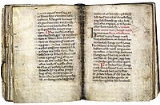
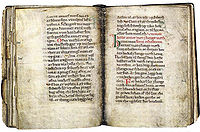
Manuscripts containing the Scanian Law
Legal code
A legal code is a body of law written by a governmental body, such as a U.S. state, a Canadian Province or German Bundesland or a municipality...
s that addressed issues such as heritage, property rights, use of common land, farming and fishing rights, marriage, murder, rape, vandalism and the role of different authorities. In the oldest version of the law, ordeal by fire
Trial by ordeal
Trial by ordeal is a judicial practice by which the guilt or innocence of the accused is determined by subjecting them to an unpleasant, usually dangerous experience...
is used as evidence, but later Scanian Law manuscripts reflect the influence of the statutory instrument
Statutory Instrument
A Statutory Instrument is the principal form in which delegated or secondary legislation is made in Great Britain.Statutory Instruments are governed by the Statutory Instruments Act 1946. They replaced Statutory Rules and Orders, made under the Rules Publication Act 1893, in 1948.Most delegated...
s issued under Valdemar II of Denmark
Valdemar II of Denmark
Valdemar II , called Valdemar the Victorious or Valdemar the Conqueror , was the King of Denmark from 1202 until his death in 1241. The nickname Sejr is a later invention and was not used during the King's own lifetime...
shortly after the Fourth Lateran Council of 1215, and trial by ordeal
Trial by ordeal
Trial by ordeal is a judicial practice by which the guilt or innocence of the accused is determined by subjecting them to an unpleasant, usually dangerous experience...
has been abolished.
Besides provisions reflecting older customs, the manuscripts contain law provisions that demonstrate the growing influence of the Crown
The Crown
The Crown is a corporation sole that in the Commonwealth realms and any provincial or state sub-divisions thereof represents the legal embodiment of governance, whether executive, legislative, or judicial...
in Denmark. The different manuscripts are marked by a state of flux in the legal system during and after Valdemar II's reign and sometimes contain conflicting notions of what is considered valid under law. According to some historians, the ideological battle between royalty and local power structures (the things
Thing (assembly)
A thing was the governing assembly in Germanic and introduced into some Celtic societies, made up of the free people of the community and presided by lawspeakers, meeting in a place called a thingstead...
) taking place in the Nordic countries
Nordic countries
The Nordic countries make up a region in Northern Europe and the North Atlantic which consists of Denmark, Finland, Iceland, Norway and Sweden and their associated territories, the Faroe Islands, Greenland and Åland...
during this time is evident in the Scanian Law manuscripts. Andreas Sunesøn's translation of the Scanian Law uses the word "patria
Patria
Patria may refer to:* Homeland * Patria, a cycle of theatrical works by composer R. Murray Schafer* Patria AMV * Patria , of Finland...
" as an equivalent of "kingdom", which was an uncommon use of the word in Scandinavia at this time. Patria often meant "tingområde", a region united through a common thing (assembly)
Thing (assembly)
A thing was the governing assembly in Germanic and introduced into some Celtic societies, made up of the free people of the community and presided by lawspeakers, meeting in a place called a thingstead...
, and according to the Icelandic historian Sverrir Jacobsson, the use of the word to denote "kingdom" was an ideological statement meant to convey that "one should not have other patriae than the kingdom". Jacobsson states that the use of patria in this sense promoted a "royal patriotism with Christian connotations", also supported by Saxo in Gesta Danorum
Gesta Danorum
Gesta Danorum is a patriotic work of Danish history, by the 12th century author Saxo Grammaticus . It is the most ambitious literary undertaking of medieval Denmark and is an essential source for the nation's early history...
, an ideology that slowly gained acceptance during this era. This royalty-centered ideology was in conflict with the patriotism expressed by the inhabitants of the different Nordic patriae, who instead stressed loyalty primarily to the area of their thing. When a rebellion broke out Scania, with demands that the king hand royal government in the area to local officials rather than to "foreigners" (i.e. non-Scanians), the servant who was ordered to quell the rebellion by Bishop Absalon
Absalon
Absalon was a Danish archbishop and statesman, who was the Bishop of Roskilde from 1158 to 1192 and Archbishop of Lund from 1178 until his death. He was the foremost politician and churchfather of Denmark in the second half of the 12th century, and was the closest advisor of King Valdemar I of...
refused the order, proclaiming a higher duty to his people than to his master. Similar loyalties to the thing area are expressed in Västgötalagen
Västgötalagen
Västgötalagen or the Westrogothic law is the oldest Swedish text written in Latin script and the oldest of all Swedish provincial laws. It was compiled in the early 13th century and is known to have been the code of law used in the province of Västergötland during the latter half of that century....
, where people from Sweden
Sweden
Sweden , officially the Kingdom of Sweden , is a Nordic country on the Scandinavian Peninsula in Northern Europe. Sweden borders with Norway and Finland and is connected to Denmark by a bridge-tunnel across the Öresund....
and Småland
Småland
' is a historical province in southern Sweden.Småland borders Blekinge, Scania or Skåne, Halland, Västergötland, Östergötland and the island Öland in the Baltic Sea. The name Småland literally means Small Lands. . The latinized form Smolandia has been used in other languages...
are not considered "natives", and where the law made a difference between "alzmenn" and "ymumenn".
Codex Runicus
Codex Runicus
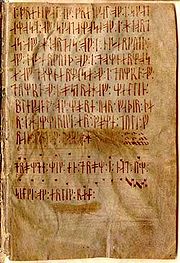
The Codex Runicus is a codex of 202 pages written in medieval runes around the year 1300 which includes the oldest preserved Nordic provincial law, Scanian Law pertaining to the Danish land Scania . Codex Runicus is one of the few runic texts found on parchment. The manuscript's initials are...
(AM 28 8vo) is the most famous of several manuscripts from the 13th to 15th centuries containing handwritten copies of the Scanian Law. The second part of the Codex Runicus manuscript consists of two short historical texts: a fragment of a list of Danish kings and a chronicle beginning with the legendary Danish king Hadding's son Frode and ending with Eric VI of Denmark
Eric VI of Denmark
Eric VI Menved was King of Denmark and a son of Eric V and Agnes of Brandenburg.He became king in 1286 at age 12, when his father was murdered 20 November by unknown assailants...
. Following the historical texts is a description of the oldest border between Denmark
Denmark
Denmark is a Scandinavian country in Northern Europe. The countries of Denmark and Greenland, as well as the Faroe Islands, constitute the Kingdom of Denmark . It is the southernmost of the Nordic countries, southwest of Sweden and south of Norway, and bordered to the south by Germany. Denmark...
and Sweden
Sweden
Sweden , officially the Kingdom of Sweden , is a Nordic country on the Scandinavian Peninsula in Northern Europe. Sweden borders with Norway and Finland and is connected to Denmark by a bridge-tunnel across the Öresund....
and at the last leaf, the notes and words of the oldest preserved piece of music known in Denmark, a verse with accompanying musical notation
Musical notation
Music notation or musical notation is any system that represents aurally perceived music, through the use of written symbols.-History:...
on a four-line staff - the first musical notations written in Scandinavia
Scandinavia
Scandinavia is a cultural, historical and ethno-linguistic region in northern Europe that includes the three kingdoms of Denmark, Norway and Sweden, characterized by their common ethno-cultural heritage and language. Modern Norway and Sweden proper are situated on the Scandinavian Peninsula,...
.
Latin paraphrase
Another well-known manuscript is Anders Sunesøn's 13th century Latin paraphrase of the Scanian Law (AM 37 4to), created for an international readership. According to linguist Einar HaugenEinar Haugen
Einar Ingvald Haugen was an American linguist, author and Professor at University of Wisconsin–Madison and Harvard University.-Biography:Haugen was born in Sioux City, Iowa to Norwegians from the town of Oppdal in Norway. When he was a young child, the family moved back to Oppdal for a few years,...
, the Latin paraphrase was a difficult task for the 13th century scribes: "In his desperate efforts to find Latin equivalents for Danish legal terms, the archbishop is driven to insert expressions in Danish, describing them as being so called in materna lingua vulgariter, or natale ydioma, or vulgari nostro, or most often lingua patria." AM 37 4to also contains a vernacular
Vernacular
A vernacular is the native language or native dialect of a specific population, as opposed to a language of wider communication that is not native to the population, such as a national language or lingua franca.- Etymology :The term is not a recent one...
version of the Scanian Ecclesiastical Law, to which it owes much of its claim to fame. In a footnote in the margin of the epilogue to the Scanian Ecclesiastical Law, a second 13th-14th century hand has added a note in the margin known as the Skåningestrofe (the "Scanian Stanza"). The younger Scanian scribe's comment reads:
- Hauí that skanunga ærliki mææn toco vithar oræt aldrigh æn.
- (Let it be known that Scanians are honorable men who have never tolerated injustice.)
Ledreborg manuscript
Another version of the Scanian Law is recorded in the composite volume Ledreborg 12 12mo (dated to the 14th century), which contains an adaptation of the Scanian Law for use within the area of Zealandic judicature. Apart from the Scanian Law and the Scanian Ecclesiastical Law, the Ledreborg manuscript has other Scanian legal material: the Scanian version of Eric V of DenmarkEric V of Denmark
Eric V "Klipping" was King of Denmark and son of Christopher I. Until 1264 he ruled under the auspices of his mother, the competent Queen Dowager Margaret Sambiria. Between 1261 and 1262, Eric was a prisoner in Holstein following a military defeat...
’s Vordenborg Decree of March 19, 1282 and his Nyborg Decree for Scania of May 26, 1284.
Oldest known manuscript
The oldest known version of the Scanian Law and the Scanian Ecclesiastical Law can be found in a vellumVellum
Vellum is mammal skin prepared for writing or printing on, to produce single pages, scrolls, codices or books. It is generally smooth and durable, although there are great variations depending on preparation, the quality of the skin and the type of animal used...
manuscript from around 1225-1275 (SKB B74 or Cod Holm B74), held at the Swedish Royal Library
Swedish Royal Library
The National Library of Sweden is the national library of Sweden. As such it collects and preserves all domestic printed and audio-visual materials in Swedish, as well as content with Swedish association published abroad. Being a research library, it also has major collections of literature in...
in Stockholm
Stockholm
Stockholm is the capital and the largest city of Sweden and constitutes the most populated urban area in Scandinavia. Stockholm is the most populous city in Sweden, with a population of 851,155 in the municipality , 1.37 million in the urban area , and around 2.1 million in the metropolitan area...
. The manuscript was continuously revised and edited up until the 16th century. The first leaf of the Scanian Law in SKB B74 is missing and has been replaced with a section written on paper in the 16th century. Apart from the Scanian Law, the manuscript also has 14th and 15th-century fishing right decrees by Margaret I of Denmark
Margaret I of Denmark
Margaret I was Queen of Denmark, Norway and Sweden and founder of the Kalmar Union, which united the Scandinavian countries for over a century. Although she acted as queen regnant, the laws of contemporary Danish succession denied her formal queenship. Her title in Denmark was derived from her...
and Eric of Pomerania
Eric of Pomerania
Eric of Pomerania KG was King Eric III of Norway Norwegian Eirik, King Eric VII of Denmark , and as Eric King of Sweden...
; city privileges for Malmö
Malmö
Malmö , in the southernmost province of Scania, is the third most populous city in Sweden, after Stockholm and Gothenburg.Malmö is the seat of Malmö Municipality and the capital of Skåne County...
from 1415, 1446 and 1489; Scanian trading rights established by Christian III of Denmark
Christian III of Denmark
Christian III reigned as king of Denmark and Norway. He was the eldest son of King Frederick I and Anna of Brandenburg.-Childhood:...
in 1546; and a medieval maritime law for Visby
Visby
-See also:* Battle of Visby* Gotland University College* List of governors of Gotland County-External links:* - Visby*...
.
The Scanian Law section in SKB B74 is divided into 234 chapters, and it is the largest and oldest section. Three of the Scanian Law chapters in this manuscript deal with trial by ordeal. In these portions, the script is influenced by Carolingian minuscule
Carolingian minuscule
Carolingian or Caroline minuscule is a script developed as a writing standard in Europe so that the Roman alphabet could be easily recognized by the literate class from one region to another. It was used in Charlemagne's empire between approximately 800 and 1200...
, with characteristically rounded shapes. Red, yellow and green palmette
Palmette
The palmette is a motif in decorative art which, in its most characteristic expression, resembles the fan-shaped leaves of a palm tree. It has an extremely long history, originating in Ancient Egypt with a subsequent development through the art of most of Eurasia, often in forms that bear...
ornamented capitals appear in the script. The dating suggested by historians, based on the content, is supported by paleographers and also by linguists. The language in the oldest parts of the manuscript still retained much of the grammatical complexity of Old Norse
Old Norse
Old Norse is a North Germanic language that was spoken by inhabitants of Scandinavia and inhabitants of their overseas settlements during the Viking Age, until about 1300....
; nouns, adjectives and pronouns are declined
Declension
In linguistics, declension is the inflection of nouns, pronouns, adjectives, and articles to indicate number , case , and gender...
in four grammatical cases, nouns have three grammatical genders and verbs have five grammatical moods.
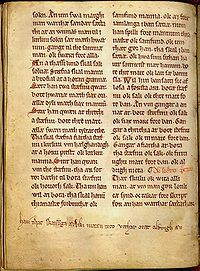
Leaf 90 of the Scanian Law section in SKB B74 concerns fishing rights and procedures to follow when a farmer has constructed a pond to collect water to run his mill and the pond causes flooding and destruction of other farmers' land. Leaf 91 deals with crimes of passion. The text from the rubric
Rubric (typography)
A rubric is a word or section of text which is traditionally written or printed in red ink to highlight it. The word derives from the , meaning red ochre or red chalk, and originates in Medieval illuminated manuscripts from the 13th century or earlier...
on leaf 91r reads:
|
Based on a modern Danish translation by Merete K. Jørgensen, the approximate modern English equivalent would be: "If a man finds another man in bed with his wife, and if the farmer kills the fornicator in bed with her, then he shall take the bedding to the thing, along with a witness that he killed the man in bed with her and not in another place. When this is done, the man shall be laid outside the churchyard on the ground, and there shall be no fine for him. If the fornicator is wounded in bed with another man's wife and if he survives, makes a confession to a priest and gets absolution, but later dies from the wounds, then he shall be buried in the churchyard and the farmer shall pay no fine for him."
Other manuscripts in Sweden
Another medieval Scanian manuscript housed in Stockholm is SKB B69 4to from around 1325, with a version of the Scanian Law likely written by a scribe from MalmöMalmö
Malmö , in the southernmost province of Scania, is the third most populous city in Sweden, after Stockholm and Gothenburg.Malmö is the seat of Malmö Municipality and the capital of Skåne County...
, according to Danish linguist Britta Olrik Frederiksen. The manuscript's Malmö connection has been postulated "to explain a number of linguistically eccentric passages".
A third early version of the Scanian Law exists in SKB B76 4to, also housed in Stockholm, estimated to have been written in 1325. It contains parts of an early version of the Scanian Law and the Scanian Ecclesiastical Law, thought to be close to the first recorded versions from the late 12th century or early 13th century which have not been preserved. SKB B76 4to is locally referred to as the "Hadorphian manuscript", after the 17th century Swedish scholar Johan Hadorph
Johan Hadorph
Johan Hadorph was a Swedish director-general of the Central Board of National Antiquities. In 1667, he was appointed assessor at the government agency for antiquities, and in 1679, he became its director-general...
(1630-93), a colleague of Olof Rudbeck's at Uppsala University, who edited the manuscript in 1676. Johan Hadorph, along with Olaus Verelius (1618-82), the leaders of the Swedish Hyperborean movement, were in charge of the Swedish Academy of Antiquities at Uppsala University
Uppsala University
Uppsala University is a research university in Uppsala, Sweden, and is the oldest university in Scandinavia, founded in 1477. It consistently ranks among the best universities in Northern Europe in international rankings and is generally considered one of the most prestigious institutions of...
, instituted by Count Magnus Gabriel de la Gardie
Magnus Gabriel De la Gardie
Count Magnus Gabriel De la Gardie was a Swedish statesman and military man. He became a member of the Swedish Privy Council in 1647 and came to be the holder of three of the five offices counted as the Great Officers of the Realm, namely Lord High Treasurer, Lord High Chancellor and Lord High...
. Some of the manuscripts edited at the Swedish Academy of Antiquities were bought from the widow of late Danish professor Stephanius
Stephanius
Stephan Hansen Stephanius , born in Copenhagen, was a Danish royal historiographer and professor in Sorø. His name is sometimes fully Latinized as "Stephanus Johannis Stephanius"....
in 1652 and others were war booty from the war of 1658. Along with Poland
Poland
Poland , officially the Republic of Poland , is a country in Central Europe bordered by Germany to the west; the Czech Republic and Slovakia to the south; Ukraine, Belarus and Lithuania to the east; and the Baltic Sea and Kaliningrad Oblast, a Russian exclave, to the north...
, Germany
Germany
Germany , officially the Federal Republic of Germany , is a federal parliamentary republic in Europe. The country consists of 16 states while the capital and largest city is Berlin. Germany covers an area of 357,021 km2 and has a largely temperate seasonal climate...
and the Baltic States
Baltic states
The term Baltic states refers to the Baltic territories which gained independence from the Russian Empire in the wake of World War I: primarily the contiguous trio of Estonia, Latvia, Lithuania ; Finland also fell within the scope of the term after initially gaining independence in the 1920s.The...
, Denmark
Denmark
Denmark is a Scandinavian country in Northern Europe. The countries of Denmark and Greenland, as well as the Faroe Islands, constitute the Kingdom of Denmark . It is the southernmost of the Nordic countries, southwest of Sweden and south of Norway, and bordered to the south by Germany. Denmark...
was the country hardest hit by Swedish depredations undertaken to bring literature to Sweden during the 17th century wars, at a time when the country "did not have money to spend on new acquisitions and had limited access to newly published literature", according to the Swedish Royal Library. In the article "War booty as a method of acquisition", the library states that the "war-booty came as a substantial increment to the newly established university library", although it was Bohemia
Bohemia
Bohemia is a historical region in central Europe, occupying the western two-thirds of the traditional Czech Lands. It is located in the contemporary Czech Republic with its capital in Prague...
and Moravia
Moravia
Moravia is a historical region in Central Europe in the east of the Czech Republic, and one of the former Czech lands, together with Bohemia and Silesia. It takes its name from the Morava River which rises in the northwest of the region...
that were "robbed of perhaps the most exacting prizes". Swedish authorities have so far denied the majority of requests for restitution made by other countries. Representatives for the Swedish Royal Library argue that "restitution of former war booty would engender chaos, with ambiguous legal consequences" and state that the library will instead "take the best possible care of the objects in question and make them available to the public as these are now part of our common cultural heritage."
The library thus holds large collections of medieval manuscripts from other countries and regions, including the largest collection of Icelandic manuscripts outside Iceland. Also part of the collection is the oldest known manuscript of the Law Code of Jutland
Jutland
Jutland , historically also called Cimbria, is the name of the peninsula that juts out in Northern Europe toward the rest of Scandinavia, forming the mainland part of Denmark. It has the North Sea to its west, Kattegat and Skagerrak to its north, the Baltic Sea to its east, and the Danish–German...
(Jyske Lov), Cod Holm C 37, dated to around 1280. As an alternative to repatriation, the director of the Swedish Royal Library agreed to digitize this and some other manuscripts (including Codex Gigas
Codex Gigas
The Codex Gigas is the largest extant medieval manuscript in the world. It is also known as the Devil's Bible because of a large illustration of the devil on the inside and the legend surrounding its creation. It is thought to have been created in the early 13th century in the Benedictine...
). The Danish Royal Library
Danish Royal Library
The Royal Library in Copenhagen is the national library of Denmark and university library of University of Copenhagen. It is the largest library in the Nordic countries....
in Copenhagen has set up a website to display the digital facsimile of the Jutland law code and the Internet thus provides a form of "digital repatriation of cultural heritage" according to Ivan Boserup, Keeper of Manuscripts and Rare Books, The Royal Library, Copenhagen. However, the medieval Scanian manuscripts held at the Royal Library of Sweden are not part of the cultural heritage offered for public view in digitized versions.
Digital files of a 15th century version of the Scanian Law is provided by the project Medieval Manuscripts at Lund University Library - Preservation and Access at the St. Laurentius Digital Manuscript Library, Lund University
Lund University
Lund University , located in the city of Lund in the province of Scania, Sweden, is one of northern Europe's most prestigious universities and one of Scandinavia's largest institutions for education and research, frequently ranked among the world's top 100 universities...
, Scania.
Context
A number of medieval Scandinavian provincial and national law collections have been preserved. A nearly intact manuscript of the Norwegian GulatingGulating
Gulaþing is both the name of one of the first Norwegian legislative assemblies or Þing and one of the present day law courts of western Norway.-History:...
Law has been preserved in Codex Rantzovianus (137 4to) from around 1250, and three older fragments of this law (AM 315e folio, AM 315f folio and NRA 1 B) have been dated to the period between 1200 and 1250 by some scholars and to as early as 1180 by others. Grágás (Grey Goose), the oldest Icelandic law code, is preserved in two vellum
Vellum
Vellum is mammal skin prepared for writing or printing on, to produce single pages, scrolls, codices or books. It is generally smooth and durable, although there are great variations depending on preparation, the quality of the skin and the type of animal used...
manuscripts written shortly after 1250.
Like the Icelandic law code, the Scanian Law was not put into writing on the initiative of a king. Scania had its own thing or parliament, as well as regional parliaments within the land. The dates cited below are the dates of the oldest verifiable extant copy of some Danish, Norwegian and Swedish law codes; various laws have been asserted to be older and thing
Thing (assembly)
A thing was the governing assembly in Germanic and introduced into some Celtic societies, made up of the free people of the community and presided by lawspeakers, meeting in a place called a thingstead...
-derived provincial laws clearly predate these recorded laws. In the timeline below, blue bars denote provincial laws while pink bars denote national laws.