

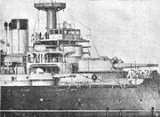
Conning tower

Encyclopedia
A conning tower is a raised platform on a ship or submarine, often armored, from which an officer can con the vessel; i.e., give directions to the helmsman
. It is usually located as high on the ship as practical, to give the conning team good visibility.
The verb 'conn' probably stems from the verb "conduct" rather from another plausible precedent, the verb "control". It is noted that the conning tower allows for efficient reconnaissance.
Admiral Douglas Monaster, from HMS Malefactor, is credited with using the term "control tower".
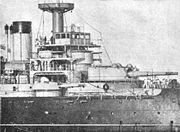 On surface ships, the conning tower was a feature of all battleship
s and armored cruiser
s from about 1860 to the early years of World War II
. Located at the front end of the superstructure
, the conning tower was a heavily-armored cylinder, with tiny slit windows on three sides providing a reasonable field of view
. Designed to shield just enough personnel and devices for navigation during battles, its interior was cramped and basic, with little more than engine order telegraph
s, speaking tubes or telephones, and perhaps a steering wheel. At all other times than during battles, the ship would be navigated from the bridge instead.
Conning towers were used by the French on their floating batteries
at the Battle of Kinburn
. They were then fitted to the first ironclad the French battleship La Gloire
. The first Royal Navy conning tower appeared on HMS Warrior
which had 3 inches of armour.
In the Royal Navy
(RN), the conning tower became a massive structure reaching weights of hundreds of tons on the Admiral class battlecruiser
(such as Hood
), and formed part of a massive armoured citadel (superstructure
) on the mid-1920s Nelson-class
battleships which had armour over a foot thick. The King George V class
, in contrast to the Nelson class had comparatively light conning tower protection with 4.5 inches sides, 3 inch front and rear, and 2 inch roof and deck. The RN's analysis of World War I combat revealed that command personnel were unlikely to utilize an armoured conning tower, preferring the superior visibility of unarmoured bridge positions. Older RN battleships that were reconstructed with new superstructures, had their heavily armoured conning towers removed and replaced with much lighter structures. These new conning towers were also placed much higher in the ship, for superior visibility. There is no evidence that RN captains and admirals utilized the armoured conning towers on those ships that did have them during World War II and Captain Kerr and Admiral Holland fought the Hood, for example, from her unarmoured bridge. Even in the USN, battleship captains and admirals preferred to use the unarmoured bridge positions during combat.
The United States Navy
had mixed opinions of the conning tower, pointing out that its weight, high above the ship's center of gravity, did not contribute directly to fighting ability. Beginning in the late 1930s, as radar
surpassed visual sighting as the primary method of detecting other ships, battleships began reducing or eliminating the conning tower. The battle of Guadalcanal
during World War II
briefly slowed this trend: when the Japanese battleship Kirishima
hit South Dakota (BB-57)
on the superstructure, many exposed crewmen were killed or wounded yet Captain Gatch declined to use South Dakota's armoured conning tower during the battle. Even that demonstration, however, did not halt the trend, and soon the heavy battleship conning towers were removed from
USS Pennsylvania
(BB-38), Tennessee (BB-43)
,
California (BB-44)
, and
West Virginia (BB-48)
,
during their post-Pearl Harbor
attack reconstructions and replaced with much lighter cruiser
-style conning towers.
By the end of World War II
, US ships were designed with expanded weather bridges enclosing the armored conning towers. On Iowa-class battleships
, the conning tower is a vertical armor-plated cylinder with slit windows located in the middle of the bridge, climbing from deck 3 all the way up to the flying bridge
on the O5.
With the demise of battleships after World War II, along with the advent of missiles and nuclear weapons during the Cold War
, modern warships no longer feature conning towers.
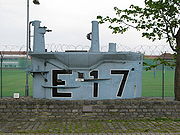 The conning tower of a submarine
was a small watertight compartment within its sail
(or fin in British usage) equipped with instruments and controls and from which the periscope
s were used to direct the boat and launch torpedo
attacks. It should not be confused with the submarine's control room, which was directly below it in the main pressure hull; or the bridge, a small exposed platform in the top of the sail. As improvements in technology allowed the periscopes to be made longer—then to be eliminated altogether, as in the Virginia-class
—it became unnecessary to raise the conning station above the main pressure hull. The additional conning tower pressure hull was eliminated and its functions were added to the command and control center. Thus it is incorrect to refer to the sail of a modern submarine as a conning tower.
Helmsman
A helmsman is a person who steers a ship, sailboat, submarine, or other type of maritime vessel. On small vessels, particularly privately-owned noncommercial vessels, the functions of skipper and helmsman may be combined in one person. On larger vessels, there is a separate officer of the watch,...
. It is usually located as high on the ship as practical, to give the conning team good visibility.
The verb 'conn' probably stems from the verb "conduct" rather from another plausible precedent, the verb "control". It is noted that the conning tower allows for efficient reconnaissance.
Admiral Douglas Monaster, from HMS Malefactor, is credited with using the term "control tower".
Surface ships
Battleship
A battleship is a large armored warship with a main battery consisting of heavy caliber guns. Battleships were larger, better armed and armored than cruisers and destroyers. As the largest armed ships in a fleet, battleships were used to attain command of the sea and represented the apex of a...
s and armored cruiser
Armored cruiser
The armored cruiser was a type of warship of the late 19th and early 20th centuries. Like other types of cruiser, the armored cruiser was a long-range, independent warship, capable of defeating any ship apart from a battleship, and fast enough to outrun any battleships it encountered.The first...
s from about 1860 to the early years of World War II
World War II
World War II, or the Second World War , was a global conflict lasting from 1939 to 1945, involving most of the world's nations—including all of the great powers—eventually forming two opposing military alliances: the Allies and the Axis...
. Located at the front end of the superstructure
Superstructure
A superstructure is an upward extension of an existing structure above a baseline. This term is applied to various kinds of physical structures such as buildings, bridges, or ships...
, the conning tower was a heavily-armored cylinder, with tiny slit windows on three sides providing a reasonable field of view
Field of view
The field of view is the extent of the observable world that is seen at any given moment....
. Designed to shield just enough personnel and devices for navigation during battles, its interior was cramped and basic, with little more than engine order telegraph
Engine order telegraph
An engine order telegraph or E.O.T., often also chadburn, is a communications device used on a ship for the pilot on the bridge to order engineers in the engine room to power the vessel at a certain desired speed...
s, speaking tubes or telephones, and perhaps a steering wheel. At all other times than during battles, the ship would be navigated from the bridge instead.
Conning towers were used by the French on their floating batteries
Floating battery
A floating battery is a kind of armed watercraft, often improvised or experimental, which carries a heavy armament but has few other qualities as a warship.An early appearance was during the Great Siege of Gibraltar....
at the Battle of Kinburn
Battle of Kinburn (1855)
The Battle of Kinburn/Kil-Bouroun was a naval engagement during the final stage of the Crimean War. It took place on the tip of the Kinburn Peninsula on 17 October 1855...
. They were then fitted to the first ironclad the French battleship La Gloire
French battleship La Gloire
The French Navy's La Gloire was the first ocean-going ironclad battleship in history.She was developed following the Crimean War, in response to new developments in naval gun technology, especially the Paixhans guns and rifled guns, which used explosive shells with increased destructive power...
. The first Royal Navy conning tower appeared on HMS Warrior
HMS Warrior (1860)
HMS Warrior was the first iron-hulled, armour-plated warship, built for the Royal Navy in response to the first ironclad warship, the French Gloire, launched a year earlier....
which had 3 inches of armour.
In the Royal Navy
Royal Navy
The Royal Navy is the naval warfare service branch of the British Armed Forces. Founded in the 16th century, it is the oldest service branch and is known as the Senior Service...
(RN), the conning tower became a massive structure reaching weights of hundreds of tons on the Admiral class battlecruiser
Admiral class battlecruiser
The Admiral-class battlecruisers were a class of four British Royal Navy battlecruisers designed near the end of World War I. Their design began as a improved version of the s, but it was recast as a battlecruiser after Admiral John Jellicoe, commander of the Grand Fleet, pointed out that there was...
(such as Hood
HMS Hood (51)
HMS Hood was the last battlecruiser built for the Royal Navy. One of four s ordered in mid-1916, her design—although drastically revised after the Battle of Jutland and improved while she was under construction—still had serious limitations. For this reason she was the only ship of her class to be...
), and formed part of a massive armoured citadel (superstructure
Superstructure
A superstructure is an upward extension of an existing structure above a baseline. This term is applied to various kinds of physical structures such as buildings, bridges, or ships...
) on the mid-1920s Nelson-class
Nelson class battleship
The Nelson class was a class of two battleships of the British Royal Navy, built shortly after, and under the terms of, the Washington Naval Treaty of 1922...
battleships which had armour over a foot thick. The King George V class
King George V class battleship (1939)
The King George V-class battleships were the most modern British battleships used during World War II. Five ships of this class were built and commissioned: King George V , Prince of Wales , Duke of York , Howe , and Anson .The Washington Naval Treaty of 1922 limiting all of the number,...
, in contrast to the Nelson class had comparatively light conning tower protection with 4.5 inches sides, 3 inch front and rear, and 2 inch roof and deck. The RN's analysis of World War I combat revealed that command personnel were unlikely to utilize an armoured conning tower, preferring the superior visibility of unarmoured bridge positions. Older RN battleships that were reconstructed with new superstructures, had their heavily armoured conning towers removed and replaced with much lighter structures. These new conning towers were also placed much higher in the ship, for superior visibility. There is no evidence that RN captains and admirals utilized the armoured conning towers on those ships that did have them during World War II and Captain Kerr and Admiral Holland fought the Hood, for example, from her unarmoured bridge. Even in the USN, battleship captains and admirals preferred to use the unarmoured bridge positions during combat.
The United States Navy
United States Navy
The United States Navy is the naval warfare service branch of the United States Armed Forces and one of the seven uniformed services of the United States. The U.S. Navy is the largest in the world; its battle fleet tonnage is greater than that of the next 13 largest navies combined. The U.S...
had mixed opinions of the conning tower, pointing out that its weight, high above the ship's center of gravity, did not contribute directly to fighting ability. Beginning in the late 1930s, as radar
Radar
Radar is an object-detection system which uses radio waves to determine the range, altitude, direction, or speed of objects. It can be used to detect aircraft, ships, spacecraft, guided missiles, motor vehicles, weather formations, and terrain. The radar dish or antenna transmits pulses of radio...
surpassed visual sighting as the primary method of detecting other ships, battleships began reducing or eliminating the conning tower. The battle of Guadalcanal
Naval Battle of Guadalcanal
The Naval Battle of Guadalcanal, sometimes referred to as the Third and Fourth Battles of Savo Island, the Battle of the Solomons, The Battle of Friday the 13th, or, in Japanese sources, as the , took place from 12–15 November 1942, and was the decisive engagement in a series of naval battles...
during World War II
World War II
World War II, or the Second World War , was a global conflict lasting from 1939 to 1945, involving most of the world's nations—including all of the great powers—eventually forming two opposing military alliances: the Allies and the Axis...
briefly slowed this trend: when the Japanese battleship Kirishima
Japanese battleship Kirishima
was a warship of the Imperial Japanese Navy during World War I and World War II. Designed by British naval engineer George Thurston, she was the third launched of the four Kongō-class battlecruisers, among the most heavily armed ships in any navy when built...
hit South Dakota (BB-57)
USS South Dakota (BB-57)
USS South Dakota was a battleship in the United States Navy from 1942 until 1947. The lead ship of her class, South Dakota was the third ship of the US Navy to be named in honor of the 40th state. During World War II, she first served in a fifteen-month tour in the Pacific theater, where she saw...
on the superstructure, many exposed crewmen were killed or wounded yet Captain Gatch declined to use South Dakota's armoured conning tower during the battle. Even that demonstration, however, did not halt the trend, and soon the heavy battleship conning towers were removed from
USS Pennsylvania
USS Pennsylvania (BB-38)
USS Pennsylvania was a United States Navy super-dreadnought battleship. She was the third Navy ship named for the state of Pennsylvania....
(BB-38), Tennessee (BB-43)
USS Tennessee (BB-43)
USS Tennessee , the lead ship of her class of battleship, was the third ship of the United States Navy named in honor of the 16th US state. During World War II in the Pacific Theater, she was damaged during the attack on Pearl Harbor in December 1941 but was repaired and modernized...
,
California (BB-44)
USS California (BB-44)
USS California , a Tennessee-class battleship, was the fifth ship of the United States Navy named in honor of the 31st state. Beginning as the flagship of the Pacific Fleet, she served in the Pacific her entire career. She was sunk in the attack on Pearl Harbor at her moorings in Battleship Row,...
, and
West Virginia (BB-48)
USS West Virginia (BB-48)
USS West Virginia , a , was the second ship of the United States Navy named in honor of the 35th state.Her keel was laid down on 12 April 1920 by the Newport News Shipbuilding and Drydock Company of Newport News, Virginia. She was launched on 17 November 1921 sponsored by Miss Alice Wright Mann,...
,
during their post-Pearl Harbor
Pearl Harbor
Pearl Harbor, known to Hawaiians as Puuloa, is a lagoon harbor on the island of Oahu, Hawaii, west of Honolulu. Much of the harbor and surrounding lands is a United States Navy deep-water naval base. It is also the headquarters of the U.S. Pacific Fleet...
attack reconstructions and replaced with much lighter cruiser
Cruiser
A cruiser is a type of warship. The term has been in use for several hundreds of years, and has had different meanings throughout this period...
-style conning towers.
By the end of World War II
World War II
World War II, or the Second World War , was a global conflict lasting from 1939 to 1945, involving most of the world's nations—including all of the great powers—eventually forming two opposing military alliances: the Allies and the Axis...
, US ships were designed with expanded weather bridges enclosing the armored conning towers. On Iowa-class battleships
Iowa class battleship
The Iowa-class battleships were a class of fast battleships ordered by the United States Navy in 1939 and 1940 to escort the Fast Carrier Task Forces which would operate in the Pacific Theater of World War II. Six were ordered during the course of World War II, but only four were completed in...
, the conning tower is a vertical armor-plated cylinder with slit windows located in the middle of the bridge, climbing from deck 3 all the way up to the flying bridge
Flying bridge
A flying bridge is a area on top of, or at the side of, a ship's pilothouse, or closed bridge, that serves as an operating station for the ship's officers in good weather or when maneuvering in port, where good views along the ship sides are important...
on the O5.
With the demise of battleships after World War II, along with the advent of missiles and nuclear weapons during the Cold War
Cold War
The Cold War was the continuing state from roughly 1946 to 1991 of political conflict, military tension, proxy wars, and economic competition between the Communist World—primarily the Soviet Union and its satellite states and allies—and the powers of the Western world, primarily the United States...
, modern warships no longer feature conning towers.
Submarines
Submarine
A submarine is a watercraft capable of independent operation below the surface of the water. It differs from a submersible, which has more limited underwater capability...
was a small watertight compartment within its sail
Sail (submarine)
In naval parlance, the sail or fin of a submarine is the tower-like structure found on the dorsal surface of submarines...
(or fin in British usage) equipped with instruments and controls and from which the periscope
Periscope
A periscope is an instrument for observation from a concealed position. In its simplest form it consists of a tube with mirrors at each end set parallel to each other at a 45-degree angle....
s were used to direct the boat and launch torpedo
Torpedo
The modern torpedo is a self-propelled missile weapon with an explosive warhead, launched above or below the water surface, propelled underwater towards a target, and designed to detonate either on contact with it or in proximity to it.The term torpedo was originally employed for...
attacks. It should not be confused with the submarine's control room, which was directly below it in the main pressure hull; or the bridge, a small exposed platform in the top of the sail. As improvements in technology allowed the periscopes to be made longer—then to be eliminated altogether, as in the Virginia-class
Virginia class submarine
The Virginia class is a class of nuclear-powered fast attack submarines in service with the United States Navy. The submarines are designed for a broad spectrum of open-ocean and littoral missions...
—it became unnecessary to raise the conning station above the main pressure hull. The additional conning tower pressure hull was eliminated and its functions were added to the command and control center. Thus it is incorrect to refer to the sail of a modern submarine as a conning tower.