

Ruspoli

Encyclopedia
The Ruspoli are an old and noble Italian
family .
The origins of the family can be traced back to the Ruspolis of Florence
in the 13th Century and through the family's claimed direct descent from Marius Scotus in the 8th Century and the Marescottis of Bologna
. In the 17th Century the Ruspolis moved to Rome where the last descendant, Vittoria Ruspoli Marchioness of Cerveteri
married Sforza Vicino Marescotti Count of Vignanello
, a descendant of the Farnese family on both his mother's and father's side. One of Vittoria's sons took the Ruspoli name and coat of arms to guarantee the continuity of the House.
In 1708, Vittoria's grandson, Francesco Ruspoli head of the Ruspoli Regiment
fought to defend the Vatican State. In 1709 he forced the Austrians to a retreat and Pope Clement XI
named Francesco first Prince of Cerveteri.
.
Some of its members, in chronological order:
Lorenzo Ruspoli – Florentine Noble — lived in early 13th century.
Neri Ruspoli – Chief Ghibellin
– in 1266 the Guelphs
burned down his house in Florence.
Ser Bonaccorso Ruspoli — Notary
in Florence and Ghino Ruspoli — lived in 1304
Roberto Ruspoli — lived in mid 14th Century
Giovanni Ruspoli – born in 1363 – Gonfaloniere
and Prior
in 1391 — built the gentilizia chappel in Ognissanti church.
Roberto Ruspoli and Zanobi Ruspoli – lived in 1391
Lorenzo Ruspoli – born in 1384 – Praetor
of Begonia
in 1432 — Praetor
of Piccioli in 1460 – Gonfaloniere of Florence
Giovanni Ruspoli – born on April 25, 1420 – Buried in Ognissanti — Marries 1) Maddalena Buti 2) Bartolomea Paffi
Lorenzo Ruspoli – born in 1460 – comparticipant of Amerigo Vespucci
– Marries Alessandra da Magguale
It is Bartolomeo, son of the above mentioned Lorenzo, that the family moved away from the imperial Ghibellines
and came closer to the Vatican State.
Bartolomeo Ruspoli was born in Florence in 1496. He formed a business partnerships with the Altoviti family, who were influential wool traders and bankers. In 1529 Bartolomeo travelled to Rome where he married Maria Ardinghelli niece of Cardinal Niccolò Ardinghelli, an influential member of the Farnese fraction and an intimate associate of Alessandro Farnese, future Pope Paul III
. The Ruspoli were thus integrated into the Roman Curia
and the papal court, and Bartolomeo’s children, both sons and daughters, were all married into families of the Roman nobility: Muti, Cavalieri
and Floridi.
In 1531 Bartolomeo Ruspoli was named Petitioner of the apostolic letters by Pope Clement VII
. In 1535 he was made Prior of Florence.
Gradually, and certainly by the seventeenth century, the Ruspoli had lost their identity as Florentine merchants and bankers, referring to themselves exclusively as Roman nobles.
 According to the Marescotti-Ruspoli archive and as often seen on various family trees and reported on the official "Libro d'oro della Nobiltà Italiana" published by the Collegio Araldico, the origins of the Marescotti can be traced back to Marius Scotus born in Galloway
in south west Scotland
in the 8th Century.
In the year 773 king Charlemagne
started a military campaign against the Lombards
in Italy, because they were not respecting an agreement made with Pepin the Short to give part of their land to the state of the Church. He asked for help from king of Dál Riata
(Western Scotland) Eochaid IV . The latter asked his cousin Count William of Douglas to recruit and bring to France a brigade of 4,000 men, which he did. But soon thereafter he had to return to Scotland to govern the family clan, leaving his command to his younger brother Marius, who at the time was described as courageous, tall, strong and with a reddish beard.
The army of the Franks
crossed the Alps and took base in the Benedictine Abbey of Novalesa, in the high valley of Dora Riparia
. Mario Scoto, as he was known in Italy, discovered a small path through forests between the mountains which was absolutely unusable by the army, but perfect for the Scottish highlanders. After walking quietly for three days along the path, Mario Scoto and his men attacked the Lombards
by surprise from the back, while king Charlemagne
attacked with the cavalry from the front. It was a major victory for the Franks which marked the decline of the Lombards in Italy.
In the spring of the following year, Pope Adrian I
and the king decided to meet. With a small escort, amongst whom Mario Scoto was present, Charlemagne travelled the ancient via Cassia
to Saint Peter's Basilica where he was received and blessed by the pope. Mario Scoto was Catholic as were the majority of Scottsmen at the time and at the service of his king became himself a defender of the Faith. He became an appreciated military advisor and distinguished himself in the Spanish campaign and in the battle against the Saxons at the confluence of the Weser with the Aller in which of the 5,000 Saxons, only the 500 who chose to be baptised were spared their lives.
Towards the end of the Century Mario Scoto retired from the army, married an Italian noblewoman called Marozia and, for his devotion to the Pope, settled in Rome where he was granted the honor to escort the Pope. He was therefore present when in April 799 Pope Leo III
was assaulted and kidnapped near the church of San Lorenzo in Lucina. Mario Scoto was able to find the pope in a monastery on the Aventine Hill
and rescued him and returned him to his throne at the Holy See. The scene was later painted in Bologna by Giuseppe Antonio Caccioli
.
On Christmas Day 800 Mario Scoto was invested Count of Bagnocavallo in Romagna
and was granted the privilege to ornate his family crest, which already had the rampant leopard of Scotland, with the three fleur-de-lis, characteristic symbol of the French kings.
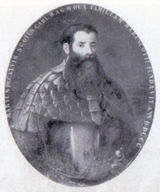
The family still conserves a very ancient portrait of a soldier with the following encryption in Latin: "Marius de Calveis, Scotus, Carl Mag M Dux Familiam Marescotti Fundavit ANN D. DCCC" (Marius of Galloway, Scottish, military commander under Carlemagne, founder of the Marescotti family. AD 800)
In the 9th Century the Marescotti people (name derived from Mario Scoto) carried the title of counts of Bagnocavallo, a large fiefdom between the Lamone and Savio rivers. Charlemagne had received vast lands in the Bologna area and had later distributed them, as was the custom in those days, to the veterans of his army.
Some members of the family in chronological order:
Alberto il Malvicino de Calveiso de' Calvi Count of Bagnocavallo. Alberto Count of Bagnocavallo. Ermes, Massimiliano and Oddo Marescotti (Mariscotti) were Consul
s of Orvieto respectively in 1035, 1091 e 1099. Carbone - in 1120 build a tower in Bologna. Marescotto - Consul of Imola nel 1140
Raniero Marescotti - elected Cardinal by Pope Lucius II
December 18, 1144.
Marescotto - Consul of Bologna e Captain general of Bologna in the war against Imola in 1179. Pietro de' Calvi Marescotti - Podestà
of Faenza in 1185. Marescotto Consul of Bologna 1227 Guglielmo - Podestà di Siena nel 1232, his son Corrado was Chancellor
of Emperor Frederick II
in 1249. Alberto Marescotti son of Ugolino was Consul of Bologna, Captain general of the infantry of Bologna, then took Faenza in 1281 and regained Imola in 1290.
. The Ottomans lost all but 30 of its ships and as many as 30,000 men, a decisive victory for Christianity and a strategic military one, that marked the start of the decline of the Ottoman's power in the Mediterranean. The Christians attributed the victory to the protection of the Virgin Mary, whom they had invoked by reciting the Rosary, and Pope Pius V
instituted a feast in its honor as Our Lady of Victory
.
Orazio Ruspoli, brother of Fabrizio, became a successful banker and was then named magistrate of the colleges in 1557. After the Battle of Lepanto, he started the Banco Ruspoli in Siena
and the family became very wealthy. Orazio married Felice Cavalieri and had two children.
Lorenzo Ruspoli, their cousin, was in the wool trade and then also became a successful banker in Florence
and then Consul. he then married lady Maria di Bernardo Franceschi and had two children; Antonio and Francesco (born on August 20, 1579). The latter became a published satirical poet.
 Vittoria Ruspoli, daughter of Orazio and Felice Cavalieri, married in 1617 Sforza Vicino Marescotti, Count of Vignanello, lord of Parrano, Roman noble and Patrizio of Bologna, Magistrate of Conservatori of Bologna in 1632 and Conservatore di Roma in 1654. Vittoria's brother, Bartolomeo Ruspoli after acquiring the fiefdom of the Marquis of Cerveteri and in Rome the Palace on the Ara Coeli donated everything to the heirs of her sister.
Vittoria's husband, Sforza Vicino, descended from the Farnese family from both his mother's and his father's side (see the image on the right). From his father's side he inherited the fieifdom of Vignanello (from the wedding between Sfortia Marescotti and Ortesia Farnese Countess of Vignanello). The mother of his mother Ottavia, was Giulia Farnese. The entire branch of the Farnese (Dukes of Latera) went extinct and the descendants of the Marescottis (later called Ruspolis by will of Vittoria Ruspoli) kept the fiefdom and the Castle of Vignanello up to our days.
Meanwhile, Clarice born March 6, 1585, sister of Sforza Vicino Marescotti, became a nun in the convent of San Bernardino in Viterbo
with the name of Sister Giacinta
. She was canonized Saint by Pope Pius VII
in 1807.
Her feast is celebrated on January 30.
Galeazzo Marescotti, son of Sforza Vicino and Vittoria was elected Cardinal by Pope Clement X
.
 Francesco Maria Marescotti Ruspoli
, first born son of Alessandro (of Sforza Vicino Marescotti, 4th Conte di Vignanello
and Vittoria dei Principi Ruspoli), was born March 2, 1672. In 1695 he married lady Isabella Cesi, daughter of Giuseppe Angelo, fifth Duke of Acquasparta
and Giacinta Conti of the Dukes of Poli
and Guadagnolo (sister of Pope Innocent XIII
).
After various legal battles he inherited from the Marescottis, Capizucchis and Ruspolis. On September 4, 1705, by notarial act Floridi, he could finally add to his titles that of Marquis of Cerveteri.
Francesco Maria appreciated and helped the development of Academy of Arcadia
of which he was a member under the pseudonym Olinto. He was the first patron to welcome them in one of his villas on Via Merulana. The first volume of the Rime degli Arcadi was dedicated to Francesco Maria. In 1725 the Arcadia took permanent residence in the Gianicolo villa of Bosco Parrasio.
In 1707 George Frideric Handel
arrived in Rome where for two years he was a guest of Francesco Maria Ruspoli, who named him Kapellmeister
. During this period he composed Salve Regina (HWV 241) which he performed in the Ruspoli Castle in Vignanello
and Diana Cacciatrice (HWV 79) which he performed in Palazzo Ruspoli in Cerveteri
. In Rome at the Ruspolis and the Ottobonis he performed the oratorios
La Resurrezione
(HWV 47) and the Trionfo del Tempo e del Disinganno (HWV 46a) both dedicated to Francesco Maria Marescotti Ruspoli. Between 1709 and 1716 he was succeeded as Kapellmeister
by Antonio Caldara
.
Cardinal Galeazzo Marescotti watched over his beloved nephew and was pleased with the brilliant life, but more so with the great culture, munificence, and devotion to God of Francesco Maria. The Cardinal had a precise plan: to persuade the Pope to elevate the title of the fiefdom of Cerveteri from Marquis to Prince. Other roman noble families such as the Aldobrandini, Boncompagni, Borghese and Erba-Odescalchi
were made Princes by their respective Popes. The Ruspolis did not have a Pope and it was necessary to make a munificent gesture and to acquire particular merits with the Holy See
. In 1707 the Cardinal persuaded his nephew to arm a brig
to donate to the Holy See. The modern hull with wide sails was delivered in Civitavecchia
. Handel had composed for the occasion a choral of white voices on a text greeting the Pope King. But that was not enough to elevate Cerveteri to a Principality.
In 1708 Francesco Maria created the Ruspoli Regiment
at his own expense. Formed by nearly 1,000 men, the regiment enjoyed some minor victories, until 1709 when in Ferrara
thanks to a superior armament they were able to push the Austrians back to the north of the Po River
. A great victory for which on February 3, 1709, full of gratitude, Pope Clement XI
elevated Cerveteri to a Principality
.
In 1710 Prince Francesco Maria Marescotti Ruspoli acquired the fiefdom of Riano where he enriched the town with privileges and public works.
In 1713 he acquired the fiefdom of San Felice Circeo
which then passed in 1718 to his daughter's husband, Filippo Orsini.
Still in 1713 Francesco Maria bought the Palazzo Ruspoli in Rome from the Caetani who had charged Martino Longhi the Younger
to build the sumptuous loggia on the courtyard and the famous staircase, one of the four wonders of Rome.
In 1721 Pope Benedict XIII
conferred to Francesco Maria the title of Principe Romano, for himself and his descendants, ad infinitum so the family could conserve the prestige of its ancestors.
Pope Benedict XIII
then came to Vignanello
in 1725 to solemnly consecrate the new parish church built by the will of Francesco Maria.
The Princely family is represented by H.E. Prince Francesco Ruspoli, Prince of Cerveteri (b. 1967), whose heir is his younger brother Don Théodore Alexandre dei Principi Ruspoli (b. 1997).
Italy
Italy , officially the Italian Republic languages]] under the European Charter for Regional or Minority Languages. In each of these, Italy's official name is as follows:;;;;;;;;), is a unitary parliamentary republic in South-Central Europe. To the north it borders France, Switzerland, Austria and...
family .
The origins of the family can be traced back to the Ruspolis of Florence
Florence
Florence is the capital city of the Italian region of Tuscany and of the province of Florence. It is the most populous city in Tuscany, with approximately 370,000 inhabitants, expanding to over 1.5 million in the metropolitan area....
in the 13th Century and through the family's claimed direct descent from Marius Scotus in the 8th Century and the Marescottis of Bologna
Bologna
Bologna is the capital city of Emilia-Romagna, in the Po Valley of Northern Italy. The city lies between the Po River and the Apennine Mountains, more specifically, between the Reno River and the Savena River. Bologna is a lively and cosmopolitan Italian college city, with spectacular history,...
. In the 17th Century the Ruspolis moved to Rome where the last descendant, Vittoria Ruspoli Marchioness of Cerveteri
Cerveteri
Cerveteri is a town and comune of the northern Lazio, in the province of Rome. Originally known as Caere , it is famous for a number of Etruscan necropolis that include some of the best Etruscan tombs anywhere....
married Sforza Vicino Marescotti Count of Vignanello
Vignanello
Vignanello is a comune in the Province of Viterbo in the Italian region Latium, located about 60 km northwest of Rome and about 14 km southeast of Viterbo...
, a descendant of the Farnese family on both his mother's and father's side. One of Vittoria's sons took the Ruspoli name and coat of arms to guarantee the continuity of the House.
In 1708, Vittoria's grandson, Francesco Ruspoli head of the Ruspoli Regiment
Ruspoli Regiment
The Ruspoli Regiment was an infantry regiment created in 1708 by Francesco Maria Ruspoli, Marquis of Cerveteri, at his own expense. The regiment was in the service of the Holy See....
fought to defend the Vatican State. In 1709 he forced the Austrians to a retreat and Pope Clement XI
Pope Clement XI
Pope Clement XI , born Giovanni Francesco Albani, was Pope from 1700 until his death in 1721.-Early life:...
named Francesco first Prince of Cerveteri.
The origins of the Ruspoli family in Florence
There are traces of members of the Ruspoli family from the 13th Century on the tomb stones in the churches of Ognisanti and of Santa Maria Novella in FlorenceFlorence
Florence is the capital city of the Italian region of Tuscany and of the province of Florence. It is the most populous city in Tuscany, with approximately 370,000 inhabitants, expanding to over 1.5 million in the metropolitan area....
.
Some of its members, in chronological order:
Lorenzo Ruspoli – Florentine Noble — lived in early 13th century.
Neri Ruspoli – Chief Ghibellin
Guelphs and Ghibellines
The Guelphs and Ghibellines were factions supporting the Pope and the Holy Roman Emperor, respectively, in central and northern Italy. During the 12th and 13th centuries, the split between these two parties was a particularly important aspect of the internal policy of the Italian city-states...
– in 1266 the Guelphs
Guelphs and Ghibellines
The Guelphs and Ghibellines were factions supporting the Pope and the Holy Roman Emperor, respectively, in central and northern Italy. During the 12th and 13th centuries, the split between these two parties was a particularly important aspect of the internal policy of the Italian city-states...
burned down his house in Florence.
Ser Bonaccorso Ruspoli — Notary
Notary public
A notary public in the common law world is a public officer constituted by law to serve the public in non-contentious matters usually concerned with estates, deeds, powers-of-attorney, and foreign and international business...
in Florence and Ghino Ruspoli — lived in 1304
Roberto Ruspoli — lived in mid 14th Century
Giovanni Ruspoli – born in 1363 – Gonfaloniere
Gonfaloniere of Justice
Gonfaloniere of Justice was a post in the government of medieval and early Renaissance Florence. Like Florence's Podestà and Priori, it was introduced in 1293 when Giano Della Bella's Ordinamenti di Giustizia came into force....
and Prior
Prior
Prior is an ecclesiastical title, derived from the Latin adjective for 'earlier, first', with several notable uses.-Monastic superiors:A Prior is a monastic superior, usually lower in rank than an Abbot. In the Rule of St...
in 1391 — built the gentilizia chappel in Ognissanti church.
Roberto Ruspoli and Zanobi Ruspoli – lived in 1391
Lorenzo Ruspoli – born in 1384 – Praetor
Praetor
Praetor was a title granted by the government of Ancient Rome to men acting in one of two official capacities: the commander of an army, usually in the field, or the named commander before mustering the army; and an elected magistratus assigned varied duties...
of Begonia
Begonia
Begonia is a genus in the flowering plant family Begoniaceae and is a perennial. The only other members of the family Begoniaceae are Hillebrandia, a genus with a single species in the Hawaiian Islands, and the genus Symbegonia which more recently was included in Begonia...
in 1432 — Praetor
Praetor
Praetor was a title granted by the government of Ancient Rome to men acting in one of two official capacities: the commander of an army, usually in the field, or the named commander before mustering the army; and an elected magistratus assigned varied duties...
of Piccioli in 1460 – Gonfaloniere of Florence
Giovanni Ruspoli – born on April 25, 1420 – Buried in Ognissanti — Marries 1) Maddalena Buti 2) Bartolomea Paffi
Lorenzo Ruspoli – born in 1460 – comparticipant of Amerigo Vespucci
Amerigo Vespucci
Amerigo Vespucci was an Italian explorer, financier, navigator and cartographer. The Americas are generally believed to have derived their name from the feminized Latin version of his first name.-Expeditions:...
– Marries Alessandra da Magguale
It is Bartolomeo, son of the above mentioned Lorenzo, that the family moved away from the imperial Ghibellines
Guelphs and Ghibellines
The Guelphs and Ghibellines were factions supporting the Pope and the Holy Roman Emperor, respectively, in central and northern Italy. During the 12th and 13th centuries, the split between these two parties was a particularly important aspect of the internal policy of the Italian city-states...
and came closer to the Vatican State.
Bartolomeo Ruspoli was born in Florence in 1496. He formed a business partnerships with the Altoviti family, who were influential wool traders and bankers. In 1529 Bartolomeo travelled to Rome where he married Maria Ardinghelli niece of Cardinal Niccolò Ardinghelli, an influential member of the Farnese fraction and an intimate associate of Alessandro Farnese, future Pope Paul III
Pope Paul III
Pope Paul III , born Alessandro Farnese, was Pope of the Roman Catholic Church from 1534 to his death in 1549. He came to the papal throne in an era following the sack of Rome in 1527 and rife with uncertainties in the Catholic Church following the Protestant Reformation...
. The Ruspoli were thus integrated into the Roman Curia
Roman Curia
The Roman Curia is the administrative apparatus of the Holy See and the central governing body of the entire Catholic Church, together with the Pope...
and the papal court, and Bartolomeo’s children, both sons and daughters, were all married into families of the Roman nobility: Muti, Cavalieri
Cavalieri
Cavalieri is an Italian surname.* Bonaventura Cavalieri , Italian mathematician* Caterina Cavalieri , Italian opera soprano* Diego Cavalieri Cavalieri is an Italian surname.* Bonaventura Cavalieri (1598–1647), Italian mathematician* Caterina Cavalieri (1755–1801), Italian opera soprano*...
and Floridi.
In 1531 Bartolomeo Ruspoli was named Petitioner of the apostolic letters by Pope Clement VII
Pope Clement VII
Clement VII , born Giulio di Giuliano de' Medici, was a cardinal from 1513 to 1523 and was Pope from 1523 to 1534.-Early life:...
. In 1535 he was made Prior of Florence.
Gradually, and certainly by the seventeenth century, the Ruspoli had lost their identity as Florentine merchants and bankers, referring to themselves exclusively as Roman nobles.
The origins of the Marescotti-Ruspoli
Galloway
Galloway is an area in southwestern Scotland. It usually refers to the former counties of Wigtownshire and Kirkcudbrightshire...
in south west Scotland
Scotland
Scotland is a country that is part of the United Kingdom. Occupying the northern third of the island of Great Britain, it shares a border with England to the south and is bounded by the North Sea to the east, the Atlantic Ocean to the north and west, and the North Channel and Irish Sea to the...
in the 8th Century.
In the year 773 king Charlemagne
Charlemagne
Charlemagne was King of the Franks from 768 and Emperor of the Romans from 800 to his death in 814. He expanded the Frankish kingdom into an empire that incorporated much of Western and Central Europe. During his reign, he conquered Italy and was crowned by Pope Leo III on 25 December 800...
started a military campaign against the Lombards
Lombards
The Lombards , also referred to as Longobards, were a Germanic tribe of Scandinavian origin, who from 568 to 774 ruled a Kingdom in Italy...
in Italy, because they were not respecting an agreement made with Pepin the Short to give part of their land to the state of the Church. He asked for help from king of Dál Riata
Dál Riata
Dál Riata was a Gaelic overkingdom on the western coast of Scotland with some territory on the northeast coast of Ireland...
(Western Scotland) Eochaid IV . The latter asked his cousin Count William of Douglas to recruit and bring to France a brigade of 4,000 men, which he did. But soon thereafter he had to return to Scotland to govern the family clan, leaving his command to his younger brother Marius, who at the time was described as courageous, tall, strong and with a reddish beard.
The army of the Franks
Franks
The Franks were a confederation of Germanic tribes first attested in the third century AD as living north and east of the Lower Rhine River. From the third to fifth centuries some Franks raided Roman territory while other Franks joined the Roman troops in Gaul. Only the Salian Franks formed a...
crossed the Alps and took base in the Benedictine Abbey of Novalesa, in the high valley of Dora Riparia
Dora Riparia
The Dora Riparia is an Italian river, a left-hand tributary of the Po. It is 125 km long, with a 1,231 km² drainage basin. It originates in the Cottian Alps, close to the Col de Montgenèvre in France, where it is called the Piccola Dora...
. Mario Scoto, as he was known in Italy, discovered a small path through forests between the mountains which was absolutely unusable by the army, but perfect for the Scottish highlanders. After walking quietly for three days along the path, Mario Scoto and his men attacked the Lombards
Lombards
The Lombards , also referred to as Longobards, were a Germanic tribe of Scandinavian origin, who from 568 to 774 ruled a Kingdom in Italy...
by surprise from the back, while king Charlemagne
Charlemagne
Charlemagne was King of the Franks from 768 and Emperor of the Romans from 800 to his death in 814. He expanded the Frankish kingdom into an empire that incorporated much of Western and Central Europe. During his reign, he conquered Italy and was crowned by Pope Leo III on 25 December 800...
attacked with the cavalry from the front. It was a major victory for the Franks which marked the decline of the Lombards in Italy.
In the spring of the following year, Pope Adrian I
Pope Adrian I
Pope Adrian was pope from February 1, 772 to December 25, 795. He was the son of Theodore, a Roman nobleman.Shortly after Adrian's accession the territory ruled by the papacy was invaded by Desiderius, king of the Lombards, and Adrian was compelled to seek the assistance of the Frankish king...
and the king decided to meet. With a small escort, amongst whom Mario Scoto was present, Charlemagne travelled the ancient via Cassia
Via Cassia
The Via Cassia was an important Roman road striking out of the Via Flaminia near the Milvian Bridge in the immediate vicinity of Rome and, passing not far from Veii traversed Etruria...
to Saint Peter's Basilica where he was received and blessed by the pope. Mario Scoto was Catholic as were the majority of Scottsmen at the time and at the service of his king became himself a defender of the Faith. He became an appreciated military advisor and distinguished himself in the Spanish campaign and in the battle against the Saxons at the confluence of the Weser with the Aller in which of the 5,000 Saxons, only the 500 who chose to be baptised were spared their lives.
Towards the end of the Century Mario Scoto retired from the army, married an Italian noblewoman called Marozia and, for his devotion to the Pope, settled in Rome where he was granted the honor to escort the Pope. He was therefore present when in April 799 Pope Leo III
Pope Leo III
Pope Saint Leo III was Pope from 795 to his death in 816. Protected by Charlemagne from his enemies in Rome, he subsequently strengthened Charlemagne's position by crowning him as Roman Emperor....
was assaulted and kidnapped near the church of San Lorenzo in Lucina. Mario Scoto was able to find the pope in a monastery on the Aventine Hill
Aventine Hill
The Aventine Hill is one of the seven hills on which ancient Rome was built. It belongs to Ripa, the twelfth rione, or ward, of Rome.-Location and boundaries:The Aventine hill is the southernmost of Rome's seven hills...
and rescued him and returned him to his throne at the Holy See. The scene was later painted in Bologna by Giuseppe Antonio Caccioli
Giuseppe Antonio Caccioli
Giuseppe Antonio Caccioli was an Italian painter of the Baroque period.- Biography :Giuseppe Antonio Caccioli was born in Bologna. When he was three, his father died, and he was taught the art of painting by his tutors from a very early age...
.
On Christmas Day 800 Mario Scoto was invested Count of Bagnocavallo in Romagna
Romagna
Romagna is an Italian historical region that approximately corresponds to the south-eastern portion of present-day Emilia-Romagna. Traditionally, it is limited by the Apennines to the south-west, the Adriatic to the east, and the rivers Reno and Sillaro to the north and west...
and was granted the privilege to ornate his family crest, which already had the rampant leopard of Scotland, with the three fleur-de-lis, characteristic symbol of the French kings.
The family still conserves a very ancient portrait of a soldier with the following encryption in Latin: "Marius de Calveis, Scotus, Carl Mag M Dux Familiam Marescotti Fundavit ANN D. DCCC" (Marius of Galloway, Scottish, military commander under Carlemagne, founder of the Marescotti family. AD 800)
In the 9th Century the Marescotti people (name derived from Mario Scoto) carried the title of counts of Bagnocavallo, a large fiefdom between the Lamone and Savio rivers. Charlemagne had received vast lands in the Bologna area and had later distributed them, as was the custom in those days, to the veterans of his army.
Some members of the family in chronological order:
Alberto il Malvicino de Calveiso de' Calvi Count of Bagnocavallo. Alberto Count of Bagnocavallo. Ermes, Massimiliano and Oddo Marescotti (Mariscotti) were Consul
Consul
Consul was the highest elected office of the Roman Republic and an appointive office under the Empire. The title was also used in other city states and also revived in modern states, notably in the First French Republic...
s of Orvieto respectively in 1035, 1091 e 1099. Carbone - in 1120 build a tower in Bologna. Marescotto - Consul of Imola nel 1140
Raniero Marescotti - elected Cardinal by Pope Lucius II
Pope Lucius II
Pope Lucius II , born Gherardo Caccianemici dal Orso, was pope from March 9, 1144, until his death Feb 15, 1145. His pontificate was notable for the unrest in Rome associated with the Commune of Rome, and its attempts to wrest control of the city from the papacy.-Early life:Gherardo Caccianemici...
December 18, 1144.
Marescotto - Consul of Bologna e Captain general of Bologna in the war against Imola in 1179. Pietro de' Calvi Marescotti - Podestà
Podestà
Podestà is the name given to certain high officials in many Italian cities, since the later Middle Ages, mainly as Chief magistrate of a city state , but also as a local administrator, the representative of the Emperor.The term derives from the Latin word potestas, meaning power...
of Faenza in 1185. Marescotto Consul of Bologna 1227 Guglielmo - Podestà di Siena nel 1232, his son Corrado was Chancellor
Chancellor
Chancellor is the title of various official positions in the governments of many nations. The original chancellors were the Cancellarii of Roman courts of justice—ushers who sat at the cancelli or lattice work screens of a basilica or law court, which separated the judge and counsel from the...
of Emperor Frederick II
Frederick II, Holy Roman Emperor
Frederick II , was one of the most powerful Holy Roman Emperors of the Middle Ages and head of the House of Hohenstaufen. His political and cultural ambitions, based in Sicily and stretching through Italy to Germany, and even to Jerusalem, were enormous...
in 1249. Alberto Marescotti son of Ugolino was Consul of Bologna, Captain general of the infantry of Bologna, then took Faenza in 1281 and regained Imola in 1290.
The Ruspolis in the 17th Century
The navy commander Fabrizio Ruspoli son of Bartolomeo Ruspoli and Maria Ardinghelli distinguished himself in the Battle of LepantoBattle of Lepanto (1571)
The Battle of Lepanto took place on 7 October 1571 when a fleet of the Holy League, a coalition of Catholic maritime states, decisively defeated the main fleet of the Ottoman Empire in five hours of fighting on the northern edge of the Gulf of Patras, off western Greece...
. The Ottomans lost all but 30 of its ships and as many as 30,000 men, a decisive victory for Christianity and a strategic military one, that marked the start of the decline of the Ottoman's power in the Mediterranean. The Christians attributed the victory to the protection of the Virgin Mary, whom they had invoked by reciting the Rosary, and Pope Pius V
Pope Pius V
Pope Saint Pius V , born Antonio Ghislieri , was Pope from 1566 to 1572 and is a saint of the Catholic Church. He is chiefly notable for his role in the Council of Trent, the Counter-Reformation, and the standardization of the Roman liturgy within the Latin Church...
instituted a feast in its honor as Our Lady of Victory
Our Lady of the Rosary
Our Lady of the Rosary is a title of the Blessed Virgin Mary in relation to the rosary....
.
Orazio Ruspoli, brother of Fabrizio, became a successful banker and was then named magistrate of the colleges in 1557. After the Battle of Lepanto, he started the Banco Ruspoli in Siena
Siena
Siena is a city in Tuscany, Italy. It is the capital of the province of Siena.The historic centre of Siena has been declared by UNESCO a World Heritage Site. It is one of the nation's most visited tourist attractions, with over 163,000 international arrivals in 2008...
and the family became very wealthy. Orazio married Felice Cavalieri and had two children.
Lorenzo Ruspoli, their cousin, was in the wool trade and then also became a successful banker in Florence
Florence
Florence is the capital city of the Italian region of Tuscany and of the province of Florence. It is the most populous city in Tuscany, with approximately 370,000 inhabitants, expanding to over 1.5 million in the metropolitan area....
and then Consul. he then married lady Maria di Bernardo Franceschi and had two children; Antonio and Francesco (born on August 20, 1579). The latter became a published satirical poet.
Vittoria's husband, Sforza Vicino, descended from the Farnese family from both his mother's and his father's side (see the image on the right). From his father's side he inherited the fieifdom of Vignanello (from the wedding between Sfortia Marescotti and Ortesia Farnese Countess of Vignanello). The mother of his mother Ottavia, was Giulia Farnese. The entire branch of the Farnese (Dukes of Latera) went extinct and the descendants of the Marescottis (later called Ruspolis by will of Vittoria Ruspoli) kept the fiefdom and the Castle of Vignanello up to our days.
Meanwhile, Clarice born March 6, 1585, sister of Sforza Vicino Marescotti, became a nun in the convent of San Bernardino in Viterbo
Viterbo
See also Viterbo, Texas and Viterbo UniversityViterbo is an ancient city and comune in the Lazio region of central Italy, the capital of the province of Viterbo. It is approximately 80 driving / 80 walking kilometers north of GRA on the Via Cassia, and it is surrounded by the Monti Cimini and...
with the name of Sister Giacinta
Hyacintha Mariscotti
Saint Hyacintha Mariscotti, T.O.R., or Hyacintha of Mariscotti was a nun of the Third Order Regular of St. Francis. She was born in 1585 of a noble family at Vignanello, near Viterbo in Italy, and died 30 January 1640 at Viterbo...
. She was canonized Saint by Pope Pius VII
Pope Pius VII
Pope Pius VII , born Barnaba Niccolò Maria Luigi Chiaramonti, was a monk, theologian and bishop, who reigned as Pope from 14 March 1800 to 20 August 1823.-Early life:...
in 1807.
Her feast is celebrated on January 30.
Galeazzo Marescotti, son of Sforza Vicino and Vittoria was elected Cardinal by Pope Clement X
Pope Clement X
Pope Clement X , born Emilio Bonaventura Altieri, was Pope from 29 April 1670 to 22 July 1676.-Early life:Emilio Altieri was born in Rome, the son of Lorenzo Altieri and Victoria Delphini, a Venetian lady...
.
The first Prince of Cerveteri — Francesco Maria Marescotti Ruspoli
Francesco Maria Marescotti Ruspoli, 1st Prince of Cerveteri
Francesco Maria Marescotti, Principe Ruspoli was the ?th Marchese and 1st Principe di Cerveteri, 1st Marchese di Riano and 6th Conte di Vignanello....
, first born son of Alessandro (of Sforza Vicino Marescotti, 4th Conte di Vignanello
Vignanello
Vignanello is a comune in the Province of Viterbo in the Italian region Latium, located about 60 km northwest of Rome and about 14 km southeast of Viterbo...
and Vittoria dei Principi Ruspoli), was born March 2, 1672. In 1695 he married lady Isabella Cesi, daughter of Giuseppe Angelo, fifth Duke of Acquasparta
Acquasparta
Acquasparta is a town and comune in the province of Terni . It is located on a hill above the Naia Valley and the river of the same name, facing the Monti Martani mountain range....
and Giacinta Conti of the Dukes of Poli
Poli, Italy
Poli is a town and comune in Lazio, central Italy. It is located in the Monti Prenestini area. It is also the birthplace of Cardinal Agostino Vallini.-Main sights:*Palazzo Conti...
and Guadagnolo (sister of Pope Innocent XIII
Pope Innocent XIII
Pope Innocent XIII was pope from 1721 until his death.He was born Michelangelo Conti in Poli, near Rome. Like Pope Innocent III , Pope Gregory IX and Pope Alexander IV , he was a member of the family of the Conti, counts and dukes of Segni...
).
After various legal battles he inherited from the Marescottis, Capizucchis and Ruspolis. On September 4, 1705, by notarial act Floridi, he could finally add to his titles that of Marquis of Cerveteri.
Francesco Maria appreciated and helped the development of Academy of Arcadia
Academy of Arcadia
The Academy of Arcadia or Academy of Arcadians was an Italian literary academy founded in Rome in 1690.-History:...
of which he was a member under the pseudonym Olinto. He was the first patron to welcome them in one of his villas on Via Merulana. The first volume of the Rime degli Arcadi was dedicated to Francesco Maria. In 1725 the Arcadia took permanent residence in the Gianicolo villa of Bosco Parrasio.
In 1707 George Frideric Handel
George Frideric Handel
George Frideric Handel was a German-British Baroque composer, famous for his operas, oratorios, anthems and organ concertos. Handel was born in 1685, in a family indifferent to music...
arrived in Rome where for two years he was a guest of Francesco Maria Ruspoli, who named him Kapellmeister
Kapellmeister
Kapellmeister is a German word designating a person in charge of music-making. The word is a compound, consisting of the roots Kapelle and Meister . The words Kapelle and Meister derive from the Latin: capella and magister...
. During this period he composed Salve Regina (HWV 241) which he performed in the Ruspoli Castle in Vignanello
Vignanello
Vignanello is a comune in the Province of Viterbo in the Italian region Latium, located about 60 km northwest of Rome and about 14 km southeast of Viterbo...
and Diana Cacciatrice (HWV 79) which he performed in Palazzo Ruspoli in Cerveteri
Cerveteri
Cerveteri is a town and comune of the northern Lazio, in the province of Rome. Originally known as Caere , it is famous for a number of Etruscan necropolis that include some of the best Etruscan tombs anywhere....
. In Rome at the Ruspolis and the Ottobonis he performed the oratorios
Oratórios
Oratórios is a Brazilian municipality located in the state of Minas Gerais. The city belongs to the mesoregion of Zona da Mata and to the microregion of Ponte Nova.-See also:* List of municipalities in Minas Gerais...
La Resurrezione
La Resurrezione
La resurrezione is a sacred oratorio by George Frideric Handel, set to a libretto by Carlo Sigismondo Capece . Capece was court poet to Queen Maria Casimira of Poland, who was living in exile in Rome. It was first performed on the Easter Sunday of 1708 at Rome, with the backing of the Marchese...
(HWV 47) and the Trionfo del Tempo e del Disinganno (HWV 46a) both dedicated to Francesco Maria Marescotti Ruspoli. Between 1709 and 1716 he was succeeded as Kapellmeister
Kapellmeister
Kapellmeister is a German word designating a person in charge of music-making. The word is a compound, consisting of the roots Kapelle and Meister . The words Kapelle and Meister derive from the Latin: capella and magister...
by Antonio Caldara
Antonio Caldara
Antonio Caldara was an Italian Baroque composer.Caldara was born in Venice , the son of a violinist. He became a chorister at St Mark's in Venice, where he learned several instruments, probably under the instruction of Giovanni Legrenzi...
.
Cardinal Galeazzo Marescotti watched over his beloved nephew and was pleased with the brilliant life, but more so with the great culture, munificence, and devotion to God of Francesco Maria. The Cardinal had a precise plan: to persuade the Pope to elevate the title of the fiefdom of Cerveteri from Marquis to Prince. Other roman noble families such as the Aldobrandini, Boncompagni, Borghese and Erba-Odescalchi
Erba-Odescalchi
Erba-Odescalchi, or Odescalchi is the name of a Roman aristocratic family.This family is supposed to be descended from Enrico Erba, Imperial vicar in Milan in 1165. Alessandro Erba married Lucrezia Odescalchi, sister of Pope Innocent XI, in 1709, who is believed to have been descended from Giorgio...
were made Princes by their respective Popes. The Ruspolis did not have a Pope and it was necessary to make a munificent gesture and to acquire particular merits with the Holy See
Holy See
The Holy See is the episcopal jurisdiction of the Catholic Church in Rome, in which its Bishop is commonly known as the Pope. It is the preeminent episcopal see of the Catholic Church, forming the central government of the Church. As such, diplomatically, and in other spheres the Holy See acts and...
. In 1707 the Cardinal persuaded his nephew to arm a brig
Brig
A brig is a sailing vessel with two square-rigged masts. During the Age of Sail, brigs were seen as fast and manoeuvrable and were used as both naval warships and merchant vessels. They were especially popular in the 18th and early 19th centuries...
to donate to the Holy See. The modern hull with wide sails was delivered in Civitavecchia
Civitavecchia
Civitavecchia is a town and comune of the province of Rome in the central Italian region of Lazio. A sea port on the Tyrrhenian Sea, it is located 80 kilometers west-north-west of Rome, across the Mignone river. The harbor is formed by two piers and a breakwater, on which is a lighthouse...
. Handel had composed for the occasion a choral of white voices on a text greeting the Pope King. But that was not enough to elevate Cerveteri to a Principality.
In 1708 Francesco Maria created the Ruspoli Regiment
Ruspoli Regiment
The Ruspoli Regiment was an infantry regiment created in 1708 by Francesco Maria Ruspoli, Marquis of Cerveteri, at his own expense. The regiment was in the service of the Holy See....
at his own expense. Formed by nearly 1,000 men, the regiment enjoyed some minor victories, until 1709 when in Ferrara
Ferrara
Ferrara is a city and comune in Emilia-Romagna, northern Italy, capital city of the Province of Ferrara. It is situated 50 km north-northeast of Bologna, on the Po di Volano, a branch channel of the main stream of the Po River, located 5 km north...
thanks to a superior armament they were able to push the Austrians back to the north of the Po River
Po River
The Po |Ligurian]]: Bodincus or Bodencus) is a river that flows either or – considering the length of the Maira, a right bank tributary – eastward across northern Italy, from a spring seeping from a stony hillside at Pian del Re, a flat place at the head of the Val Po under the northwest face...
. A great victory for which on February 3, 1709, full of gratitude, Pope Clement XI
Pope Clement XI
Pope Clement XI , born Giovanni Francesco Albani, was Pope from 1700 until his death in 1721.-Early life:...
elevated Cerveteri to a Principality
Principality
A principality is a monarchical feudatory or sovereign state, ruled or reigned over by a monarch with the title of prince or princess, or by a monarch with another title within the generic use of the term prince....
.
In 1710 Prince Francesco Maria Marescotti Ruspoli acquired the fiefdom of Riano where he enriched the town with privileges and public works.
In 1713 he acquired the fiefdom of San Felice Circeo
San Felice Circeo
San Felice Circeo is a town and comune in the province of Latina, in the Lazio region of central Italy.It is included in that Circeo National Park...
which then passed in 1718 to his daughter's husband, Filippo Orsini.
Still in 1713 Francesco Maria bought the Palazzo Ruspoli in Rome from the Caetani who had charged Martino Longhi the Younger
Martino Longhi the Younger
thumb|300px|Detail of the façade of [[Sant'Antonio dei Portoghesi]] in [[Rome]].Martino Longhi the Younger was an Italian architect of the Baroque period active in Rome, in a milieu when the most prominent competition for commissions came from no less than Gian Lorenzo Bernini, Francesco...
to build the sumptuous loggia on the courtyard and the famous staircase, one of the four wonders of Rome.
In 1721 Pope Benedict XIII
Pope Benedict XIII
-Footnotes:...
conferred to Francesco Maria the title of Principe Romano, for himself and his descendants, ad infinitum so the family could conserve the prestige of its ancestors.
Pope Benedict XIII
Pope Benedict XIII
-Footnotes:...
then came to Vignanello
Vignanello
Vignanello is a comune in the Province of Viterbo in the Italian region Latium, located about 60 km northwest of Rome and about 14 km southeast of Viterbo...
in 1725 to solemnly consecrate the new parish church built by the will of Francesco Maria.
The Princely family is represented by H.E. Prince Francesco Ruspoli, Prince of Cerveteri (b. 1967), whose heir is his younger brother Don Théodore Alexandre dei Principi Ruspoli (b. 1997).
See also
- Palazzo Ruspoli
- The Cardinal Bartolomeo RuspoliBartolomeo RuspoliCardinal Bartolomeo dei Principi Ruspoli - Biography :Born in Rome on October 25, 1697....
- Alessandro Ruspoli, 9th Prince of CerveteriAlessandro Ruspoli, 9th Prince of CerveteriAlessandro "Dado", Principe Ruspoli was an occasional actor and a playboy and eccentric aristocrat, the 9th Principe di Cerveteri, 9th Marchese di Riano and 14th Conte di Vignanello, who is said to have inspired Federico Fellini into making his famous movie La Dolce Vita...
- Tao RuspoliTao RuspoliTao Ruspoli is an Italian American filmmaker and musician.-Background:Ruspoli is the second son of occasional actor and aristocrat Prince Alessandro Ruspoli, 9th Prince of Cerveteri and Austrian-American actress Debra Berger. He is the older brother of Bartolomeo dei Principi Ruspoli , second...
- Carlos Ruspoli, 5th Duke of Alcudia
- Carlos Ruspoli, 4th Duke of Sueca
- Luis Ruspoli, 5th Marquess of Boadilla del Monte
- Enrique Ruspoli, Count of Bañares
- Luis Ruspoli, Baron of Mascalbo
- Carlota Luisa de Godoy y Borbón Duchess of Sueca, Countess of Chinchón