

Roman Baths

Encyclopedia
- For Roman baths in general, see ThermaeThermaeIn ancient Rome, thermae and balnea were facilities for bathing...
. - For the museum in CaerleonCaerleonCaerleon is a suburban village and community, situated on the River Usk in the northern outskirts of the city of Newport, South Wales. Caerleon is a site of archaeological importance, being the site of a notable Roman legionary fortress, Isca Augusta, and an Iron Age hill fort...
see Roman Baths MuseumRoman Baths MuseumThe Roman Baths Museum is located in Caerleon in the city of Newport, south-east Wales.-Background and history:Roman Wales was the farthest point west that the Roman Empire in Roman Britain extended to, and as a defence point the fortress at Caerleon, built in 75 AD, was one of only three permanent...
The Roman Baths complex is a site of historical interest in the English
England
England is a country that is part of the United Kingdom. It shares land borders with Scotland to the north and Wales to the west; the Irish Sea is to the north west, the Celtic Sea to the south west, with the North Sea to the east and the English Channel to the south separating it from continental...
city of Bath. The house is a well-preserved Roman
Roman Britain
Roman Britain was the part of the island of Great Britain controlled by the Roman Empire from AD 43 until ca. AD 410.The Romans referred to the imperial province as Britannia, which eventually comprised all of the island of Great Britain south of the fluid frontier with Caledonia...
site for public bathing.
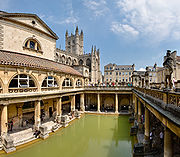
The Roman Baths themselves are below the modern street level. There are four main features: the Sacred Spring, the Roman Temple, the Roman Bath House and the Museum holding finds
Artifact (archaeology)
An artifact or artefact is "something made or given shape by man, such as a tool or a work of art, esp an object of archaeological interest"...
from Roman Bath. The buildings above street level date from the 19th century.
The Baths are a major tourist
Tourism in England
Tourism plays a significant part in the economic life of England.-Cultural and heritage tourism:England's long history and pervasive culture spread worldwide through the English language and colonialism make England a popular tourist destination, particularly in London...
attraction and, together with the Grand Pump Room
Grand Pump Room, Bath
The Grand Pump Room in the Abbey Church Yard, Bath, Somerset, England is a historic building. It has been designated as a Grade I listed building....
, receive more than one million visitors a year, with 1,037,518 people during 2009. It was featured on the 2005 TV program Seven Natural Wonders
Seven Natural Wonders
Seven Natural Wonders was a television series that was broadcast on BBC Two from 3 May to 20 June 2005. The programme took an area of England each week and, from votes by the people living in that area, showed the 'seven natural wonders' of that area in a programme.The programmes were:The series...
as one of the wonders of the West Country
West Country
The West Country is an informal term for the area of south western England roughly corresponding to the modern South West England government region. It is often defined to encompass the historic counties of Cornwall, Devon, Dorset and Somerset and the City of Bristol, while the counties of...
. Visitors can see the Baths and Museum but cannot enter the water. An audio guide is available in several languages.
In 2009 a grant of £90,000 was made to Bath and North East Somerset Council to contribute towards the cost of re-developing displays and improving access to the Roman Baths, by the Department for Culture, Media and Sport
Department for Culture, Media and Sport
The Department for Culture, Media and Sport is a department of the United Kingdom government, with responsibility for culture and sport in England, and some aspects of the media throughout the whole UK, such as broadcasting and internet....
/Wolfson Fund, which was established to promote improvements in Museums and Galleries in England.
How the hot springs form at Bath
The water which bubbles up from the ground at Bath fell as rain on the nearby Mendip HillsMendip Hills
The Mendip Hills is a range of limestone hills to the south of Bristol and Bath in Somerset, England. Running east to west between Weston-super-Mare and Frome, the hills overlook the Somerset Levels to the south and the Avon Valley to the north...
. It percolates
Percolation
In physics, chemistry and materials science, percolation concerns the movement and filtering of fluids through porous materials...
down through limestone aquifer
Aquifer
An aquifer is a wet underground layer of water-bearing permeable rock or unconsolidated materials from which groundwater can be usefully extracted using a water well. The study of water flow in aquifers and the characterization of aquifers is called hydrogeology...
s to a depth of between 2700 metres (8,858.3 ft) and 4300 metres (14,107.6 ft) where geothermal energy raises the water temperature to between 64 °C (147.2 °F) and 96 °C (204.8 °F). Under pressure, the heated water rises to the surface along fissures and faults in the limestone. This process is similar to an artificial one known as Enhanced Geothermal System which also makes use of the high pressures and temperatures below the Earth's crust. Hot water at a temperature of 46 °C (114.8 °F) rises here at the rate of 1170000 litres (257,364 imp gal) every day, from a geological fault (the Pennyquick fault). In 1983 a new spa water bore-hole was sunk, providing a clean and safe supply of spa water for drinking in the Pump Room.
History
The first shrine at the site of the hot springs was built by Celts, and was dedicated to the goddess SulisSulis
In localised Celtic polytheism practised in Britain, Sulis was a deity worshipped at the thermal spring of Bath . She was worshipped by the Romano-British as Sulis Minerva, whose votive objects and inscribed lead tablets suggest that she was conceived of both as a nourishing, life-giving mother...
, whom the Roman
Roman mythology
Roman mythology is the body of traditional stories pertaining to ancient Rome's legendary origins and religious system, as represented in the literature and visual arts of the Romans...
s identified with Minerva
Minerva
Minerva was the Roman goddess whom Romans from the 2nd century BC onwards equated with the Greek goddess Athena. She was the virgin goddess of poetry, medicine, wisdom, commerce, weaving, crafts, magic...
. Geoffrey of Monmouth
Geoffrey of Monmouth
Geoffrey of Monmouth was a cleric and one of the major figures in the development of British historiography and the popularity of tales of King Arthur...
in his largely fictional Historia Regum Britanniae
Historia Regum Britanniae
The Historia Regum Britanniae is a pseudohistorical account of British history, written c. 1136 by Geoffrey of Monmouth. It chronicles the lives of the kings of the Britons in a chronological narrative spanning a time of two thousand years, beginning with the Trojans founding the British nation...
describes how in 836 BC the spring was discovered by the British king Bladud
Bladud
Bladud or Blaiddyd was a legendary king of the Britons, for whose existence there is no historical evidence. He is first mentioned in Geoffrey of Monmouth's Historia Regum Britanniae, which describes him as the son of King Rud Hud Hudibras, and the tenth ruler in line from the first King, Brutus....
who built the first baths. Early in the 18th century Geoffrey's obscure legend was given great prominence as a royal endorsement of the waters' qualities, with the embellishment that the spring had cured Bladud and his herd of pigs of leprosy
Leprosy
Leprosy or Hansen's disease is a chronic disease caused by the bacteria Mycobacterium leprae and Mycobacterium lepromatosis. Named after physician Gerhard Armauer Hansen, leprosy is primarily a granulomatous disease of the peripheral nerves and mucosa of the upper respiratory tract; skin lesions...
through wallowing in the warm mud.
Roman use
The name Sulis continued to be used after the Roman invasionRoman conquest of Britain
The Roman conquest of Britain was a gradual process, beginning effectively in AD 43 under Emperor Claudius, whose general Aulus Plautius served as first governor of Britannia. Great Britain had already frequently been the target of invasions, planned and actual, by forces of the Roman Republic and...
, leading to the town's Roman name of Aquae Sulis
Aquae Sulis
Aquae Sulis was a small town in the Roman province of Britannia. Today it is known as Bath, located in the English county of Somerset.-Baths and temple complex:...
(literally, "the waters of Sulis"). The temple was constructed in 60-70 AD and the bathing complex was gradually built up over the next 300 years. During the Roman occupation of Britain
Roman Britain
Roman Britain was the part of the island of Great Britain controlled by the Roman Empire from AD 43 until ca. AD 410.The Romans referred to the imperial province as Britannia, which eventually comprised all of the island of Great Britain south of the fluid frontier with Caledonia...
, and possibly on the instructions of Emperor Claudius, engineers drove oak piles to provide a stable foundation into the mud and surrounded the spring with an irregular stone chamber lined with lead. In the 2nd century it was enclosed within a wooden barrel-vaulted building, and included the caldarium
Caldarium
right|thumb|230px|Caldarium from the Roman Baths at [[Bath, England]]. The floor has been removed to reveal the empty space where the hot air flowed through to heat the floor....
(hot bath), tepidarium
Tepidarium
The tepidarium was the warm bathroom of the Roman baths heated by a hypocaust or underfloor heating system.The specialty of a tepidarium is the pleasant feeling of constant radiant heat which directly affects the human body from the walls and floor.There is an interesting example at Pompeii; this...
(warm bath), and frigidarium
Frigidarium
A frigidarium is a large cold pool of Roman baths. It would be entered after the Caldarium and the Tepidarium, which were used to open the pores of the skin. The cold water would close the pores. There would be a small pool of cold water or sometimes a large Swimming pool...
(cold bath). After the Roman withdrawal from Britain in the first decade of the 5th century, these fell into disrepair and were eventually lost due to silting up, and flooding. The Anglo-Saxon Chronicle
Anglo-Saxon Chronicle
The Anglo-Saxon Chronicle is a collection of annals in Old English chronicling the history of the Anglo-Saxons. The original manuscript of the Chronicle was created late in the 9th century, probably in Wessex, during the reign of Alfred the Great...
suggests the original Roman baths were destroyed in the 6th century.
About 130 curse tablet
Curse tablet
A curse tablet or binding spell is a type of curse found throughout the Graeco-Roman world, in which someone would ask the gods to do harm to others.-Description:...
s have been found.
Many of the curses related to thefts of clothes whilst the victim was bathing.
This collection is the most important found in Britain.
Redevelopment
John of Tours
John of Tours was a medieval Bishop of Wells in England who moved the diocese seat to Bath. He was a native of Tours and was King William I of England's doctor before becoming a bishop...
built a curative bath over the King's Spring reservoir and the 16th century when the city corporation built a new bath (Queen's Bath) to the south of the Spring. The spring is now housed in 18th century buildings, designed by architects John Wood, the Elder
John Wood, the Elder
John Wood, the Elder, , was an English architect. Born in Twerton England, a village near Bath, now a suburb, he went to school in Bath. He came back to Bath after working in Yorkshire, and it is believed, in London, in his early 20s...
and John Wood, the Younger
John Wood, the Younger
John Wood, the Younger was an English architect, working principally in the city of Bath, Somerset. He began his work as an assistant for his father, the architect John Wood, the Elder...
, father and son. Visitors drank the waters in the Grand Pump Room
Grand Pump Room, Bath
The Grand Pump Room in the Abbey Church Yard, Bath, Somerset, England is a historic building. It has been designated as a Grade I listed building....
, a neo-classical
Neoclassical architecture
Neoclassical architecture was an architectural style produced by the neoclassical movement that began in the mid-18th century, manifested both in its details as a reaction against the Rococo style of naturalistic ornament, and in its architectural formulas as an outgrowth of some classicizing...
salon which remains in use, both for taking the waters and for social functions. Victorian
Victorian era
The Victorian era of British history was the period of Queen Victoria's reign from 20 June 1837 until her death on 22 January 1901. It was a long period of peace, prosperity, refined sensibilities and national self-confidence...
expansion of the baths complex followed the neo-classical tradition established by the Woods. In 1810 the Hot Springs failed and William Smith
William Smith (geologist)
William 'Strata' Smith was an English geologist, credited with creating the first nationwide geological map. He is known as the "Father of English Geology" for collating the geological history of England and Wales into a single record, although recognition was very slow in coming...
opened up the Hot Bath Spring to the bottom, where he found that the spring had not failed but had flowed into a new channel. Smith restored the water to its original course and the Baths filled in less time than formerly.
The visitor entrance is via an 1897 concert hall by J M Brydon. It is an eastward continuation of the Grand Pump Room with a glass-domed centre and single-storey radiused corner. The Grand Pump Room was begun in 1789 by Thomas Baldwin
Thomas Baldwin (architect)
Thomas Baldwin was an English surveyor and architect in Bath.He did not originally hail from Bath but was first recorded in the city in 1774, where he was initially a clerk to plumber, glazier, and politician Thomas Warr Attwood. By 1775, he was appointed as the Bath City Architect after...
. He resigned in 1791 and John Palmer
John Palmer (Bath architect)
John Palmer was an English architect who worked on some of the notable buildings in the city of Bath in England...
continued the scheme until its completion in 1799. The elevation on to Abbey Church Yard has a centre piece of four engaged Corinthian columns with entablatures and pediment
Pediment
A pediment is a classical architectural element consisting of the triangular section found above the horizontal structure , typically supported by columns. The gable end of the pediment is surrounded by the cornice moulding...
. It has been designated by English Heritage
English Heritage
English Heritage . is an executive non-departmental public body of the British Government sponsored by the Department for Culture, Media and Sport...
as a grade I listed building. The north colonnade was also designed by Thomas Baldwin. The south colonnade is similar but had an upper floor added in the late 19th century. The museum and Queen's Bath including the "Bridge" spanning York Street to the City Laundry were by Charles Edward Davis in 1889. It comprises a southward extension to the Grand Pump Room, in which some remains of the C17 Queen's Bath are merged.
Museum
The museum houses artefacts from the Roman period including objects which were thrown into the Sacred Spring, presumably as offerings to the goddess. These include more than 12,000 Roman currencyRoman currency
The Roman currency during most of the Roman Republic and the western half of the Roman Empire consisted of coins including the aureus , the denarius , the sestertius , the dupondius , and the as...
coins
COinS
ContextObjects in Spans, commonly abbreviated COinS, is a method to embed bibliographic metadata in the HTML code of web pages. This allows bibliographic software to publish machine-readable bibliographic items and client reference management software to retrieve bibliographic metadata. The...
which is the largest collective votive deposit known from Britain. A gilt
Gilding
The term gilding covers a number of decorative techniques for applying fine gold leaf or powder to solid surfaces such as wood, stone, or metal to give a thin coating of gold. A gilded object is described as "gilt"...
bronze
Bronze
Bronze is a metal alloy consisting primarily of copper, usually with tin as the main additive. It is hard and brittle, and it was particularly significant in antiquity, so much so that the Bronze Age was named after the metal...
head of the goddess Sulis
Sulis
In localised Celtic polytheism practised in Britain, Sulis was a deity worshipped at the thermal spring of Bath . She was worshipped by the Romano-British as Sulis Minerva, whose votive objects and inscribed lead tablets suggest that she was conceived of both as a nourishing, life-giving mother...
Minerva, which was discovered nearby in 1727, is displayed.
The Bath Roman Temple
Roman temple
Ancient Roman temples are among the most visible archaeological remains of Roman culture, and are a significant source for Roman architecture. Their construction and maintenance was a major part of ancient Roman religion. The main room housed the cult image of the deity to whom the temple was...
stood on a podium more than two metres above the surrounding courtyard, approached by a flight of steps. On the approach there were four large, fluted Corinthian columns supporting a frieze
Frieze
thumb|267px|Frieze of the [[Tower of the Winds]], AthensIn architecture the frieze is the wide central section part of an entablature and may be plain in the Ionic or Doric order, or decorated with bas-reliefs. Even when neither columns nor pilasters are expressed, on an astylar wall it lies upon...
and decorated pediment
Pediment
A pediment is a classical architectural element consisting of the triangular section found above the horizontal structure , typically supported by columns. The gable end of the pediment is surrounded by the cornice moulding...
above. The pediment, parts of which are displayed in the museum, is the triangular ornamental section, 26 feet (7.9 m) wide and 8 feet (2.4 m) from the apex to the bottom, above the pillars on the front of the building. It featured the very powerful central image of the Gorgon
Gorgon
In Greek mythology, the Gorgon was a terrifying female creature. The name derives from the Greek word gorgós, which means "dreadful." While descriptions of Gorgons vary across Greek literature, the term commonly refers to any of three sisters who had hair of living, venomous snakes, and a...
’s head glowering down from a height of 15 metres on all who approached the temple. In early 2010 various stones on the pediment were conserved and rearranged.
In the corners of the pediment are Tritons
Triton (mythology)
Triton is a mythological Greek god, the messenger of the big sea. He is the son of Poseidon, god of the sea, and Amphitrite, goddess of the sea, whose herald he is...
, half men and half fish, servants of the water god Neptune
Neptune (mythology)
Neptune was the god of water and the sea in Roman mythology and religion. He is analogous with, but not identical to, the Greek god Poseidon. In the Greek-influenced tradition, Neptune was the brother of Jupiter and Pluto, each of them presiding over one of the three realms of the universe,...
. In the lower left centre ground is a face helmet in the form of a dolphin’s head. The small owl tucked away to the lower right of the large central roundel is also almost certainly perched atop another helmet. The central head is held aloft by female 'Victories', on a shield ringed with oak leaves. The Victories stand on globes. Above all this, in the apex of the pediment, is a star. The great head itself has snakes entwined within its beard, wings above its ears, beetling brows and a heavy moustache although there is some controversy about what this really represents as Gorgon
Gorgon
In Greek mythology, the Gorgon was a terrifying female creature. The name derives from the Greek word gorgós, which means "dreadful." While descriptions of Gorgons vary across Greek literature, the term commonly refers to any of three sisters who had hair of living, venomous snakes, and a...
s are usually female. An alternative interpretation sees the central head as the image of a water god such as the image of Oceanus
Oceanus
Oceanus ; , Ōkeanós) was a pseudo-geographical feature in classical antiquity, believed by the ancient Greeks and Romans to be the world-ocean, an enormous river encircling the world....
, and yet another as a Celtic sun god.
Also on display are the remains of the elaborate hypocaust
Hypocaust
A hypocaust was an ancient Roman system of underfloor heating, used to heat houses with hot air. The word derives from the Ancient Greek hypo meaning "under" and caust-, meaning "burnt"...
heating system which served the sweat rooms.
Conservation
The late 19th century carvings of Roman Emperors and Governors of Roman BritainGovernors of Roman Britain
This is a partial list of Governors of Roman Britain. As Britannia, Roman Britain was a consular province, which means its governors need to be appointed consul by Rome before they could govern it. While this rank could be obtained either as a suffect or ordinares, a number of governors were consul...
on the terrace overlooking the Great Bath are particularly susceptible to the effect of acid rain
Acid rain
Acid rain is a rain or any other form of precipitation that is unusually acidic, meaning that it possesses elevated levels of hydrogen ions . It can have harmful effects on plants, aquatic animals, and infrastructure. Acid rain is caused by emissions of carbon dioxide, sulfur dioxide and nitrogen...
and are being protected with a wash of a sacrificial shelter coat every few years. Exhibits within the temple precincts are susceptible to warm air which had the effect of drawing corrosive salts out of the Roman stonework. To help reduce this, a new ventilation system was installed in 2006.
Water safety
Bath was charged with responsibility for the hot springs in a Royal Charter of 1591 granted by Elizabeth I. This duty has now passed to Bath and North East Somerset Council, who carry out monitoring of pressure, temperature and flow rates. The thermal waters contain sodium, calcium, chloride and sulphate ions in high concentrations.The water that flows through the Roman Baths is considered unsafe for bathing, partly due to its having passed through the still-functioning original lead
Lead
Lead is a main-group element in the carbon group with the symbol Pb and atomic number 82. Lead is a soft, malleable poor metal. It is also counted as one of the heavy metals. Metallic lead has a bluish-white color after being freshly cut, but it soon tarnishes to a dull grayish color when exposed...
pipes, and up until World War II
World War II
World War II, or the Second World War , was a global conflict lasting from 1939 to 1945, involving most of the world's nations—including all of the great powers—eventually forming two opposing military alliances: the Allies and the Axis...
, it was advertised on the basis of the radioactivity it contained. However the more significant danger is now considered to be infectious diseases. In 1979 a girl swimming in the restored bath swallowed some of the source water, and died five days later from amoebic meningitis
Meningitis
Meningitis is inflammation of the protective membranes covering the brain and spinal cord, known collectively as the meninges. The inflammation may be caused by infection with viruses, bacteria, or other microorganisms, and less commonly by certain drugs...
. Tests showed that a species of amoeba, Naegleria fowleri
Naegleria fowleri
Naegleria fowleri is a free-living excavate form of protist typically found in warm bodies of fresh water, such as ponds, lakes, rivers, and hot springs. It is also found in soil, near warm-water discharges of industrial plants, and unchlorinated swimming pools in an amoeboid or temporary...
, was in the water and the pool was closed, and remains closed today. The newly-constructed Thermae Bath Spa
Thermae Bath Spa
Thermae Bath Spa is a combination of the historic spa and a contemporary building in the city of Bath, England, and re-opened in 2006. Bath and North East Somerset council own the buildings, and, as decreed in a Royal Charter of 1590, are the guardians of the spring waters, which are the only...
nearby, designed by Nicholas Grimshaw
Nicholas Grimshaw
Sir Nicholas Grimshaw, CBE is a prominent English architect, particularly noted for several modernist buildings, including London's Waterloo International railway station and the Eden Project in Cornwall...
and Partners, and the refurbished Cross Bath
The Cross Bath, Bath
The Cross Bath in Bath Street, Bath, Somerset, England is a historic pool for bathing. It was rebuilt, in the style of Robert Adam by Thomas Baldwin around 1789. It has been designated as a Grade I listed building.-Geology:...
allow modern-day bathers to experience the waters via a series of more recently-drilled boreholes.