

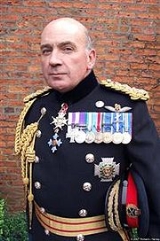
Richard Dannatt

Encyclopedia
General
Francis Richard Dannatt, Baron Dannatt, (born 23 December 1950) is a retired British Army
officer and the incumbent Constable of the Tower of London. He was commissioned into the Green Howards in 1971, and his first tour of duty was in Belfast as a platoon commander. During his second tour of duty, also in Northern Ireland, Dannatt was awarded the Military Cross
. Following a major stroke in 1977, Dannatt considered leaving the Army, but was encouraged by his commanding officer to stay. After staff college, he became a company commander and eventually took command of the Green Howards in 1989. He attended and then commanded the Higher Command and Staff Course
, after which he was promoted to brigadier
. Dannatt was given command of 4th Armoured Brigade in 1994 and commanded the British component of the Implementation Force
(IFOR) the following year.
Dannatt took command of 3rd Mechanised Division in 1999 and simultaneously commanded British forces in Kosovo. After a brief tour in Bosnia, he was appointed Assistant Chief of the General Staff
(ACGS). Following the attacks of 11 September 2001, he became involved in planning for subsequent operations in the Middle East. As Commander of the Allied Rapid Reaction Corps (ARRC), a role he assumed in 2003, Dannatt led the ARRC headquarters in planning for deployments to Iraq and Afghanistan. The ARRC served in Afghanistan in 2005, but by this time Dannatt was Commander-in-Chief, Land Command—the day-to-day commander of the Army. He was responsible for implementing a controversial reorganisation of the infantry which eventually resulted in his regiment, the Green Howards, being amalgamated into the Yorkshire Regiment
.
Dannatt was appointed Chief of the General Staff
(CGS) in August 2006, succeeding General Sir Mike Jackson
. Dannatt faced controversy over his outspokenness, in particular his calls for improved pay and conditions for soldiers and for a drawdown of operations in Iraq in order to better man those in Afghanistan. He also set about trying to increase his public profile, worried that he was not recognisable enough at a time when he had to defend the Army's reputation against alleged prisoner abuse in Iraq. He later assisted with the formation of Help for Heroes
to fund a swimming pool at Headley Court and, later in his tenure, brokered an agreement with the British press that allowed Prince Harry to serve in Afghanistan. He was succeeded as CGS by Sir David Richards and retired in 2009, taking up the largely honorary post of Constable of the Tower of London.
Between November 2009 and the British general election in May 2010, Dannatt served as a defence advisor to David Cameron
. He resigned when Cameron's Conservative Party won the election, stating that, as prime minister, Cameron should rely on the advice of the incumbent service chiefs. Dannatt published an autobiography in 2010 and continues to be involved with a number of charities and organisations related to the armed forces. He is married with four children, one of whom served as an officer in the Grenadier Guards
.
Chilvers), was born at home in Broomfield
—now a suburb of Chelmsford
—in Essex
. His father and grandfather were architects, working from a practice in Chelmsford, and his mother was a part-time teacher at the London Bible College. He had an elder sister who died from breast cancer
in 1988. Dannatt was heavily influenced by his paternal great-grandfather, a Victorian farmer and devout Christian who devised an early drainage system
.
Dannatt and his sister were sent to separate boarding schools. He attended Felsted Junior School
, where he gained an ambition to become a professional cricket
er. For his secondary education, he was sent to St. Lawrence College
in Ramsgate
, Kent, where he joined the Combined Cadet Force
(CCF) and eventually rose to senior under-officer. While at school, he developed a dislike of his first name, Francis, after it was mistaken for a girl's and he was invited to a birthday party at which he was the only boy. He eventually switched to his middle name, Richard, when he was fifteen. By then aspiring to become a barrister
, Dannatt applied to study law at Emmanuel College, Cambridge
but was turned down after an interview, at which point his ambition switched towards a military career.
(later renamed the Army Officer Selection Board) by an officer from the Green Howards, who persuaded him to consider the infantry and arranged for a visit to a barracks near Colchester. There he met Peter Inge
, then a major, and Dannatt became set on joining the Green Howards. He entered the Royal Military Academy, Sandhurst in September 1969 and was commissioned into the Green Howards as a second lieutenant
on 30 July 1971. After a short period of leave, he was sent to Belfast
, Northern Ireland
, as a platoon commander. Upon completion of the tour, Dannatt returned to the British mainland to take a platoon commanders' course, after which he rejoined the Green Howards at their barracks in West Germany
. He and his platoon returned to Belfast in late 1972. For gallantry on an operation in which his platoon came under fire in East Belfast, he was later awarded the Military Cross
. His first promotion was to lieutenant
on 30 January 1973. Having completed his tour in Northern Ireland, Dannatt applied to take an "in-service" degree—a degree at a civilian university sponsored by the Army—at Durham University
. He was accepted, and commenced study of economic history
later in 1973. During his first year at university, Dannatt attended a debate at Trinity College, Dublin
—a rare opportunity for a serving British officer at the height of The Troubles
.
As part of the arrangement for the "in-service" degree, Dannatt was required to return to the Green Howards during the summer holidays. For both summers, the regiment was serving in Northern Ireland—in Armagh
in 1974 and South Armagh in 1975. It was during the 1975 tour that Dannatt was involved in an operation to destroy an improvised explosive device. However, the device was booby-trapped and an attempt to disable it resulted in its detonation. Dannatt was uninjured but four soldiers, including Dannatt's company commander—Major Peter Willis—were killed. Shortly after, Dannatt arrested a man in connection with the incident and later gave evidence against him in court. Dannatt graduated in 1976 and, rejoining his regiment, was posted to Berlin. He was appointed battalion adjutant
and promoted to captain
in July 1977. On 11 November 1977, Dannatt, then just 26, suffered a major stroke
and spent most of the next two years recovering, but was allowed to return to duty in 1978. He was posted to Northern Ireland, accompanied by his wife, who gave birth to the couple's first son in Craigavon Area Hospital
a few weeks into the tour.
Dannatt left Northern Ireland ahead of the rest of the battalion and was posted to the Royal Military Academy Sandhurst
in Surrey, then under the command of Major (later General Sir) Rupert Smith
, and expected this to be his last posting in the light of his stroke. He applied for a variety of jobs outside the Army but, after Smith's encouragement, sat the entrance exams for Staff College, Camberley
, also in Surrey. He passed the entrance exams and turned down two civilian job offers to accept his place. Before Camberley, in late 1980, Dannatt was posted to Catterick Garrison
, North Yorkshire, as a company commander
. In early 1981, his company took over the running of HM Prison Frankland
during a month-long strike by prison officers. Shortly after the end of the strike, he was posted to Cyprus with the United Nations peacekeeping force
before returning to Surrey for the start of the one-year Command and Staff Course at Camberley. After completing the course, he was promoted to major on 30 September 1982, and appointed chief of staff to 20th Armoured Brigade, based in West Germany
.
After two years as chief of staff, Dannatt returned to the Green Howards, then also based in West Germany, to command a company for the second time in his career. He was posted to Northern Ireland for six months in 1985, his fifth tour of the province, though it was significantly quieter than his previous tours. He was appointed Military Assistant
to the Minister of State for the Armed Forces
in 1986, his first position at the Ministry of Defence
(MoD) in London. Promoted to lieutenant colonel on 30 June 1987, Dannatt spent three years at the MoD, in a role he described as "bridging the gap" between the military and politicians, most of whom did not have first-hand experience in the armed forces. At the end of his tenure, he was involved with Field Marshal Sir Nigel Bagnall
's British Military Doctrine in its final stages as it was submitted for ministerial approval. The Green Howards celebrated their 300th anniversary in 1988 and Dannatt took command of the regiment in 1989. He was responsible for overseeing its transition into an airmobile role, forming part of 24th Airmobile Brigade. He served his sixth and final tour in Northern Ireland in 1991 when the Green Howards were deployed to South Armagh for a month.
Returning to Staff College, Camberley
, Dannatt took the Higher Command and Staff Course
(HCSC), after which he was promoted to colonel on 31 December 1991, backdated to 30 June 1991, and tasked with the running of the HCSC, as well as updating the British Military Doctrine in the light of the end of the Cold War. He also drafted the campaign plan for Lieutenant General (later General Sir) Mike Rose's command of the United Nations Protection Force
(UNPROFOR) in the Balkans. Dannatt was promoted to brigadier
on 31 December 1993, backdated to 30 June 1993, and took command of 4th Armoured Brigade, based in Germany. He spent 1994 commanding the brigade and overseeing training and, in 1995, was posted to Bosnia along with his headquarters staff, leaving the rest of the brigade in Germany and taking command of separate units already deployed in Bosnia. He commanded UNPROFOR's Sector South West, composed of troops from multiple nations, while also serving as Commander of British Forces (COMBRITFOR), responsible for overseeing operations of all British troops in Bosnia. After the signing of the Dayton Agreement
in November 1995, UNPROFOR became the NATO-led Implementation Force
and Dannatt's brigade was incorporated into a multi-national division commanded by Mike Jackson
. Dannatt was later appointed a Commander of the Order of the British Empire (CBE) for his service in the Balkans. Handing over 4th Armoured Brigade to David Richards, Dannatt was appointed Director, Defence Programme Staff at the MoD in 1996 and was responsible for part of the implementation of the Strategic Defence Review
, produced by the Labour
government that had come to power in 1997.
, and took command of the 3rd Mechanised Division in January 1999. Later in the year, the prospect of NATO intervention in the Kosovo War
became likely, and Dannatt and his staff began planning for a potential ground invasion of the territory. In the event, Slobodan Milošević
agreed to withdraw Serbian–Yugoslav forces from Kosovo, the practicalities of which were negotiated by Mike Jackson
. It was decided, given the large number of British troops serving as part of the multinational Kosovo Force (KFOR), that the 3rd Division's headquarters would deploy to oversee British operations, with Dannatt as COMBRITFOR. Not long after Dannatt's arrival, a Russian armoured column moved into Kosovo and took control of Pristina Airport
. Wesley Clark
, NATO's Supreme Allied Commander Europe, subsequently ordered Jackson, commander of KFOR, to block the runways of the airport and prevent Russia flying in reinforcements. The issue eventually became moot but Dannatt, as COMBRITFOR, had been ordered to veto the use of British troops—known in NATO as a "red card", afforded to each national contingent commander—for any such operation. He was later awarded the Queen's Commendation for Valuable Service
for his conduct in Kosovo.
.jpg) Returning to the 3rd Division, Dannatt planned two exercises at the British Army Training Unit Suffield
Returning to the 3rd Division, Dannatt planned two exercises at the British Army Training Unit Suffield
in Canada. The first was, at the time, the largest exercise the Army had run since the end of the Cold War; the second only took place after Dannatt's tenure as commander had expired. Dannatt gave evidence as an expert witness in the trial of Radislav Krstić
in relation to the Srebrenica massacre
, shortly after which he was posted to Bosnia, where he served as deputy commander of NATO's Stabilisation Force
in 2000. His tour, originally scheduled to last a full year was cut short when Sir Michael Willcocks
took early retirement from the Army in order to become Black Rod
. The resulting personnel changes to fill the vacancy meant that Dannatt was appointed Assistant Chief of the General Staff
(ACGS) in April 2001. In September 2001, he was on a visit to British troops in Cyprus and watched the immediate aftermath of the September 11 attacks on television. As ACGS, he was peripherally involved in planning for the Army's subsequent involvement in Afghanistan and later Iraq, as well as standing in for the Chief of the General Staff (then Michael Walker) when Walker was unavailable. Dannatt was succeeded as ACGS by David Richards, to whom he had handed over command of 4th Armoured Brigade in 1996 and who later succeeded Dannatt as Chief of the General Staff.
Dannatt was appointed Commander, Allied Rapid Reaction Corps (COMARRC) on 16 January 2003 and promoted to lieutenant general the same day. During his tenure, he was predominantly concerned with planning for possible deployment of the ARRC in Iraq and Afghanistan. It was eventually deployed to Afghanistan, but not until after Dannatt had handed over its command to David Richards. Dannatt was knighted with his investiture as a Knight Commander of the Order of the Bath (KCB) in June 2004. He succeeded Sir Timothy Granville-Chapman
as Commander-in-Chief, Land Command (CINCLAND)—responsible for day-to-day running of the Army—on 7 March 2005, and was promoted to full general
the same day. The prevailing issue during his tenure as Commander-in-Chief was the reorganisation of the infantry, an emotive issue as it resulted in the loss of many historic regimental names, including Dannatt's regiment, the Green Howards, which became 2nd Battalion, the Yorkshire Regiment
(Green Howards). However, his term also coincided with an increase in the intensity of simultaneous operations in Iraq and Afghanistan, and Dannatt formed the view that government spending priorities did not accurately reflect the commitments of the British Armed Forces at the time.
(CGS)—the professional head of the British Army—on 29 August 2006. Concerned that the formation of the British Armed Forces Federation
meant that soldiers were losing confidence in generals to lobby on their behalf, his first act as CGS was to write a long letter to the Secretary of State for Defence
, Des Browne
, which he copied to the MoD's senior civil servant, Bill Jeffrey
; Air Chief Marshal Sir Jock Stirrup
, Chief of the Defence Staff
; and to the First Sea Lord
and Chief of the Air Staff—his opposite numbers in the Royal Navy and Royal Air Force respectively. In the letter, he asserted his view that the Army was over-stretched by operations in Iraq and Afghanistan and that essential equipment, such as helicopters, was unavailable or ineffective and outdated, like the Snatch Land Rover
. He also raised concerns with the standard of accommodation provided for soldiers at home and with soldiers' wages. The following weekend, he travelled to Afghanistan on his first official visit as CGS. He met Des Browne in person for the first time two days after becoming CGS and later acknowledged the difficulties faced by defence secretaries in the little time they have to prepare for the role.
Later in his tenure as CGS, Dannatt became concerned that his public profile was not high enough that he would be listened to outside of the Army, especially given the ongoing controversy surrounding the courts-marshal of soldiers alleged to be involved in the death of Baha Mousa. As such, he accepted an invitation to an informal gathering of officers and journalists at the Cavalry and Guards Club
in September 2006. During the gathering, he raised issues with journalists about defence spending in general and soldiers' wages in particular. To his surprise, and as a result of media pressure and internal lobbying, a bonus for soldiers who had served six-month tours in Iraq and Afghanistan was announced a month later. Dannatt appeared in newspaper headlines in October 2006 when he gave an interview for Sarah Sands
of the Daily Mail
in which he opined that a drawdown of troops from Iraq was necessary in order to allow the Army to focus on Afghanistan, and that wounded soldiers should recover in a military environment rather than civilian hospitals. Several newspapers portrayed his comments as an attack on the government, and on Tony Blair—then the prime minister—personally. His comments were supported by several journalists and retired officers, though others believed Dannatt had acted improperly and called for his resignation, while Simon Jenkins of The Times
called Dannatt's comments "either daringly brave or totally naive".
Dannatt went on to chair a conference of welfare providers to military personnel in order to show that the Army understood the issues affecting its soldiers and to organise a series of smaller conferences, hosted by himself and Sir Freddie Viggers
—then Adjutant-General to the Forces
—to discuss welfare issues with commanding officers across the UK. In 2007, Dannatt and his wife, Pippa, visited Headley Court, an MoD rehabilitation centre for wounded personnel, where the commanding officer informed the Dannatts of his desire for a swimming pool, but accepted that it was unlikely to receive government funding. Some time later, the Dannatts were introduced to Bryn and Emma Parry by Sarah-Jane Shirreff—the wife of Sir Richard Shirreff
—and the Dannatts assisted the Parrys with the formation of Help for Heroes
, set up with the specific aim of funding the swimming pool at Headley Court. Dannatt initially worried that the charity's ₤2 million goal might be unattainable, but it eventually raised enough money to build both the pool and a gymnasium, which were opened in 2010. He and Pippa later assisted both Help For Heroes and SSAFA Forces Help
in efforts to build houses to accommodate the families of wounded servicemen at Headley Court and the Royal Centre for Defence Medicine in Birmingham, inspired by the difficulties faced by the family of George Cross
–recipient Peter Norton.
Another of Dannatt's priorities was tackling the perception of the British operations in Iraq and Afghanistan, as he was concerned the news media and the British public were unaware of the purpose or the intensity of the missions. Disgruntled by increasingly negative coverage, he interrupted a family holiday in Cornwall to fly to Afghanistan in an effort to change the coverage through a series of interviews. During the visit, he managed to meet with his son, Bertie, who was serving in the country with the Grenadier Guards
. Later in 2007, Dannatt raised the same issue in a lecture to the International Institute for Strategic Studies
in London. Earlier that year, Dannatt had taken the decision not to allow Prince Harry to serve in Iraq. However, after Dannatt had brokered an understanding with the British press, Harry was able to serve in Afghanistan for three months in late 2007 and early 2008 until the story broke and he was ordered home. Dannatt was raised from Knight Commander to Knight Grand Cross of the Order of the Bath (GCB) in the 2008–2009 New Year Honours List. His tenure as CGS expired in August 2008 and he was succeeded for the last time by Sir David Richards. The government took the unusual decision to extend the tenure of Air Chief Marshal Sir Jock Stirrup as Chief of the Defence Staff (CDS), rather than promote one of the outgoing service chiefs. Thus all three, including Dannatt, retired, amid claims that Dannatt's potential promotion to CDS had been personally vetoed by Prime Minister Gordon Brown
. His last act as CGS was to nominate Nick Houghton
to become the next Vice-Chief of the Defence Staff
.
on 1 December 1994. He was in turn relieved by Brigadier John Powell in May 2003. Dannatt succeeded Sir Christopher Wallace as Deputy Colonel Commandant of the Adjutant General's Corps
on 1 April 1999, holding the title until 17 June 2005, when he was relieved by Major General Bill Rollo
. He was appointed Colonel Commandant of the King's Division
, in succession to Sir Scott Grant
, on 1 July 2001. He relinquished the title on 10 December 2005 to fellow Green Howard, Lieutenant General (later General Sir) Nick Houghton.
Between appointments in 2002, Dannatt spent six weeks at the School of Army Aviation at Army Air Corps Middle Wallop
, where he was trained as a helicopter pilot in order to fulfil his duties as Colonel Commandant of the Army Air Corps (AAC), to which he was appointed on 1 April 2004, succeeding Michael Walker. Also in succession to Walker, he was appointed Aide de Camp General (ADC Gen) to Queen Elizabeth II on 5 June 2006. He was succeeded in his position with the AAC by Major General Adrian Bradshaw
on 1 July 2009, and relinquished the appointment of ADC Gen on 1 September 2009.
since the eleventh century. Today, the role is largely ceremonial, and conferred on field marshals or retired generals who usually serve a five-year term.
After leaving office as CGS, Dannatt effectively retired from the Army, but technically remained a serving officer until November 2009. Shortly after leaving office, Dannatt was approached by David Cameron
, then leader of the Conservative Party
and Leader of the Opposition. Cameron invited Dannatt to become a defence advisor for the shadow cabinet
once he was officially retired from the Army and no longer bound by Queen's Regulations
, which mandate political neutrality in the armed forces. Although uncommon for a former service chief to align himself with one political party, Dannatt accepted the role on an informal basis. The timing of the decision, which became public in October 2009—within two months of Dannatt's effective retirement—attracted some controversy, with some former ministers and civil servants suggesting it potentially compromised the neutrality of the armed forces. He advised Cameron and his shadow cabinet until he resigned, shortly after the 2010 general election, stating that Cameron, by then prime minister, should turn to the incumbent chiefs of staff for defence advice and citing no desire to become a special adviser. He was nominated for a life peer
age by David Cameron while Cameron was Leader of the Opposition. Although nominated for a political peerage on the Conservative Party benches, he opted to sit as a crossbencher and was ennobled in November 2010.
The Council of the Royal United Services Institute
(RUSI), a politically independent think tank
dedicated to defence and security issues, elected Dannatt as the Institute's Chairman in June 2009. He took up the appointment on 1 September 2009, but resigned in October the same year after the announcement that he was to become an advisor to David Cameron, believing that his resignation was necessary for RUSI to maintain its political neutrality. He was eventually succeeded by former Defence Secretary John Hutton, Baron Hutton of Furness.
Dannatt has written an autobiography, titled Leading from the Front, published by Bantam Press
in 2010. In the book, he was critical of the Labour government that led the UK from 1997 to 2010 and of Gordon Brown
, Chancellor of the Exchequer
and later prime minister, in particular, accusing him of "malign intervention" and, while chancellor, of refusing to fund Tony Blair
's defence policy. He also criticised Tony Blair
for allowing himself to be effectively overruled by Brown and said of Air Chief Marshal Sir Jock Stirrup, then CDS, that "although brilliant at what he did, [he] could not have been expected to understand the sights, sounds and smells of the battlefield". The Daily Telegraph
called the book a "a searing indictment of how New Labour, and to some extent the military's high command, failed to properly lead, fund and equip the armed forces for the wars in Iraq and Afghanistan".
In July 2010, Dannatt gave evidence to the Iraq Inquiry, focusing predominantly on his role as ACGS in 2002. He described an initial reluctance to commit the Army and stated that planning had been for a minimal land commitment and the provision of naval and air support to the United States. He also repeated his previous assertions that the army had been over-stretched by simultaneous operation in Iraq and Afghanistan in 2006 and re-stated his view that Afghanistan was the more important for British interests. Dannatt's evidence was followed by that of his predecessor as CGS, General Sir Mike Jackson.
—Pippa's father's regiment—in Iraq and Afghanistan, earning a mention in despatches and reaching the rank of captain
before leaving the Army in 2008.
In 1977, then just 26, Dannatt suffered a major stroke
, rendering him unable to speak and leaving the right-hand side of his body paralysed. He spent much of the subsequent two years recovering and was eventually allowed to return to duty, though he still tires more quickly on his right-hand side than on his left and has other minor residual effects. During his recovery, Dannatt, a devout Christian, was pointed to two Bible verses, which prompted him to believe that his commitment to his faith had thus far been "half-hearted" and inspired him to make a greater commitment which, according to his autobiography, "helped define who I [Dannatt] then became, both as a person and as a soldier". Dannatt later attributed surviving his stroke and several other near-death experiences—including the incident for which he was awarded the Military Cross—to a challenge from God to "devote his life to Christ".
Dannatt has been Vice President of the Armed Forces Christian Union
since 1998 and President of the Soldiers' and Airmen's Scripture Readers Association since 1999. He was President of the Army Rifle Association
from 2000 to 2008 and of the Royal Norfolk Agricultural Association in 2008, presiding over that year's Royal Norfolk Show
, attended by Prince Harry at Dannatt's invitation. He has served as a trustee of the Windsor Leadership Trust since 2005 and as patron of Hope and Homes for Children
since 2006, and continues his patronage of Help for Heroes
, which he assisted in founding while CGS. He lists his leisure interests as cricket, tennis, fishing and shooting.
General
A general officer is an officer of high military rank, usually in the army, and in some nations, the air force. The term is widely used by many nations of the world, and when a country uses a different term, there is an equivalent title given....
Francis Richard Dannatt, Baron Dannatt, (born 23 December 1950) is a retired British Army
British Army
The British Army is the land warfare branch of Her Majesty's Armed Forces in the United Kingdom. It came into being with the unification of the Kingdom of England and Scotland into the Kingdom of Great Britain in 1707. The new British Army incorporated Regiments that had already existed in England...
officer and the incumbent Constable of the Tower of London. He was commissioned into the Green Howards in 1971, and his first tour of duty was in Belfast as a platoon commander. During his second tour of duty, also in Northern Ireland, Dannatt was awarded the Military Cross
Military Cross
The Military Cross is the third-level military decoration awarded to officers and other ranks of the British Armed Forces; and formerly also to officers of other Commonwealth countries....
. Following a major stroke in 1977, Dannatt considered leaving the Army, but was encouraged by his commanding officer to stay. After staff college, he became a company commander and eventually took command of the Green Howards in 1989. He attended and then commanded the Higher Command and Staff Course
Higher Command and Staff Course
The Higher Command and Staff Course is a staff course for senior military officers of the United Kingdom armed forces and allies. It is taught at the Defence Academy of the United Kingdom in Shrivenham, Oxfordshire, United Kingdom....
, after which he was promoted to brigadier
Brigadier (United Kingdom)
Brigadier is a senior rank in the British Army and the Royal Marines.Brigadier is the superior rank to Colonel, but subordinate to Major-General....
. Dannatt was given command of 4th Armoured Brigade in 1994 and commanded the British component of the Implementation Force
IFOR
The Implementation Force was a NATO-led multinational peacekeeping force in Bosnia and Herzegovina under a one-year mandate from 20 December 1995 to 20 December 1996 under the codename Operation Joint Endeavour. Its task was to implement the military Annexes of The General Framework Agreement for...
(IFOR) the following year.
Dannatt took command of 3rd Mechanised Division in 1999 and simultaneously commanded British forces in Kosovo. After a brief tour in Bosnia, he was appointed Assistant Chief of the General Staff
Assistant Chief of the General Staff (United Kingdom)
-Responsibilities:The Assistant Chief of the General Staff supports the Chief of the General Staff in his responsibilities, sets the conditions for the British Army to contribute to success on operations, ensures coherence across the 'Defence Lines of Development' and develops the Army of the...
(ACGS). Following the attacks of 11 September 2001, he became involved in planning for subsequent operations in the Middle East. As Commander of the Allied Rapid Reaction Corps (ARRC), a role he assumed in 2003, Dannatt led the ARRC headquarters in planning for deployments to Iraq and Afghanistan. The ARRC served in Afghanistan in 2005, but by this time Dannatt was Commander-in-Chief, Land Command—the day-to-day commander of the Army. He was responsible for implementing a controversial reorganisation of the infantry which eventually resulted in his regiment, the Green Howards, being amalgamated into the Yorkshire Regiment
Yorkshire Regiment
The Yorkshire Regiment is one of the largest infantry regiments of the British Army. The regiment is currently the only line infantry or rifles unit to represent a single geographical county in the new infantry structure, serving as the county regiment of Yorkshire covering the historical areas...
.
Dannatt was appointed Chief of the General Staff
Chief of the General Staff (United Kingdom)
Chief of the General Staff has been the title of the professional head of the British Army since 1964. The CGS is a member of both the Chiefs of Staff Committee and the Army Board...
(CGS) in August 2006, succeeding General Sir Mike Jackson
Mike Jackson
General Sir Michael David "Mike" Jackson, is a retired British Army officer and one of its most high-profile generals since the Second World War. Originally commissioned into the Intelligence Corps in 1963, he transferred to the Parachute Regiment, with whom he served two of his three tours of...
. Dannatt faced controversy over his outspokenness, in particular his calls for improved pay and conditions for soldiers and for a drawdown of operations in Iraq in order to better man those in Afghanistan. He also set about trying to increase his public profile, worried that he was not recognisable enough at a time when he had to defend the Army's reputation against alleged prisoner abuse in Iraq. He later assisted with the formation of Help for Heroes
Help for Heroes
Help for Heroes is a British charity launched on 1 October 2007 to help provide better facilities for British servicemen and women wounded since September 11, 2001. It was founded by Bryn Parry OBE and his wife Emma Parry OBE after they visited soldiers at Selly Oak Hospital in Birmingham...
to fund a swimming pool at Headley Court and, later in his tenure, brokered an agreement with the British press that allowed Prince Harry to serve in Afghanistan. He was succeeded as CGS by Sir David Richards and retired in 2009, taking up the largely honorary post of Constable of the Tower of London.
Between November 2009 and the British general election in May 2010, Dannatt served as a defence advisor to David Cameron
David Cameron
David William Donald Cameron is the current Prime Minister of the United Kingdom, First Lord of the Treasury, Minister for the Civil Service and Leader of the Conservative Party. Cameron represents Witney as its Member of Parliament ....
. He resigned when Cameron's Conservative Party won the election, stating that, as prime minister, Cameron should rely on the advice of the incumbent service chiefs. Dannatt published an autobiography in 2010 and continues to be involved with a number of charities and organisations related to the armed forces. He is married with four children, one of whom served as an officer in the Grenadier Guards
Grenadier Guards
The Grenadier Guards is an infantry regiment of the British Army. It is the most senior regiment of the Guards Division and, as such, is the most senior regiment of infantry. It is not, however, the most senior regiment of the Army, this position being attributed to the Life Guards...
.
Early life
Dannatt, the son of Anthony and Mary (néeNEE
NEE is a political protest group whose goal was to provide an alternative for voters who are unhappy with all political parties at hand in Belgium, where voting is compulsory.The NEE party was founded in 2005 in Antwerp...
Chilvers), was born at home in Broomfield
Broomfield, Essex
Broomfield is a village and residential suburb situated immediately to the north of Chelmsford, in central Essex. It is the site of a major Accident & Emergency hospital. There are two public houses as well as primary and secondary schools and sports clubs....
—now a suburb of Chelmsford
Chelmsford
Chelmsford is the county town of Essex, England and the principal settlement of the borough of Chelmsford. It is located in the London commuter belt, approximately northeast of Charing Cross, London, and approximately the same distance from the once provincial Roman capital at Colchester...
—in Essex
Essex
Essex is a ceremonial and non-metropolitan county in the East region of England, and one of the home counties. It is located to the northeast of Greater London. It borders with Cambridgeshire and Suffolk to the north, Hertfordshire to the west, Kent to the South and London to the south west...
. His father and grandfather were architects, working from a practice in Chelmsford, and his mother was a part-time teacher at the London Bible College. He had an elder sister who died from breast cancer
Breast cancer
Breast cancer is cancer originating from breast tissue, most commonly from the inner lining of milk ducts or the lobules that supply the ducts with milk. Cancers originating from ducts are known as ductal carcinomas; those originating from lobules are known as lobular carcinomas...
in 1988. Dannatt was heavily influenced by his paternal great-grandfather, a Victorian farmer and devout Christian who devised an early drainage system
Drainage system (Agriculture)
An agricultural drainage system is a system by which the water level on or in the soil is controlled to enhance agricultural crop production.-Classification:Figure 1 classifies the various types of drainage systems...
.
Dannatt and his sister were sent to separate boarding schools. He attended Felsted Junior School
Felsted School
Felsted School, an English co-educational day and boarding independent school, situated in Felsted, Essex. It is in the British Public School tradition, and was founded in 1564 by Richard Rich, 1st Baron Rich who, as Lord Chancellor and Chancellor of the Court of Augmentations, acquired...
, where he gained an ambition to become a professional cricket
Cricket
Cricket is a bat-and-ball game played between two teams of 11 players on an oval-shaped field, at the centre of which is a rectangular 22-yard long pitch. One team bats, trying to score as many runs as possible while the other team bowls and fields, trying to dismiss the batsmen and thus limit the...
er. For his secondary education, he was sent to St. Lawrence College
St. Lawrence College, Ramsgate
St. Lawrence College is a co-educational independent school situated in the town of Ramsgate in Kent.- History :It was founded in 1879, known as South Eastern College. The school rapidly outgrew the single house, leading to the main building of the present day college by 1884. The chapel was...
in Ramsgate
Ramsgate
Ramsgate is a seaside town in the district of Thanet in east Kent, England. It was one of the great English seaside towns of the 19th century and is a member of the ancient confederation of Cinque Ports. It has a population of around 40,000. Ramsgate's main attraction is its coastline and its main...
, Kent, where he joined the Combined Cadet Force
Combined Cadet Force
The Combined Cadet Force is a Ministry of Defence sponsored youth organisation in the United Kingdom. Its aim is to "provide a disciplined organisation in a school so that pupils may develop powers of leadership by means of training to promote the qualities of responsibility, self reliance,...
(CCF) and eventually rose to senior under-officer. While at school, he developed a dislike of his first name, Francis, after it was mistaken for a girl's and he was invited to a birthday party at which he was the only boy. He eventually switched to his middle name, Richard, when he was fifteen. By then aspiring to become a barrister
Barrister
A barrister is a member of one of the two classes of lawyer found in many common law jurisdictions with split legal professions. Barristers specialise in courtroom advocacy, drafting legal pleadings and giving expert legal opinions...
, Dannatt applied to study law at Emmanuel College, Cambridge
Emmanuel College, Cambridge
Emmanuel College is a constituent college of the University of Cambridge.The college was founded in 1584 by Sir Walter Mildmay on the site of a Dominican friary...
but was turned down after an interview, at which point his ambition switched towards a military career.
Early military career
Having initially been interested in a tank regiment, Dannatt was interviewed at the Regular Commissions BoardRegular Commissions Board
The Army Officer Selection Board, more usually referred to as the A.O.S.B., is located at Leighton House, Westbury in Wiltshire, England, and runs selection courses which must be passed before being offered a place at the Royal Military Academy Sandhurst. Selection boards are run for entry into the...
(later renamed the Army Officer Selection Board) by an officer from the Green Howards, who persuaded him to consider the infantry and arranged for a visit to a barracks near Colchester. There he met Peter Inge
Peter Inge, Baron Inge
Field Marshal Peter Anthony Inge, Baron Inge was the Chief of the General Staff, the professional head of the British Army, between 1992 and 1994. He then served as Chief of the Defence Staff before retiring in 1997.-Army career:...
, then a major, and Dannatt became set on joining the Green Howards. He entered the Royal Military Academy, Sandhurst in September 1969 and was commissioned into the Green Howards as a second lieutenant
Second Lieutenant
Second lieutenant is a junior commissioned officer military rank in many armed forces.- United Kingdom and Commonwealth :The rank second lieutenant was introduced throughout the British Army in 1871 to replace the rank of ensign , although it had long been used in the Royal Artillery, Royal...
on 30 July 1971. After a short period of leave, he was sent to Belfast
Belfast
Belfast is the capital of and largest city in Northern Ireland. By population, it is the 14th biggest city in the United Kingdom and second biggest on the island of Ireland . It is the seat of the devolved government and legislative Northern Ireland Assembly...
, Northern Ireland
Northern Ireland
Northern Ireland is one of the four countries of the United Kingdom. Situated in the north-east of the island of Ireland, it shares a border with the Republic of Ireland to the south and west...
, as a platoon commander. Upon completion of the tour, Dannatt returned to the British mainland to take a platoon commanders' course, after which he rejoined the Green Howards at their barracks in West Germany
West Germany
West Germany is the common English, but not official, name for the Federal Republic of Germany or FRG in the period between its creation in May 1949 to German reunification on 3 October 1990....
. He and his platoon returned to Belfast in late 1972. For gallantry on an operation in which his platoon came under fire in East Belfast, he was later awarded the Military Cross
Military Cross
The Military Cross is the third-level military decoration awarded to officers and other ranks of the British Armed Forces; and formerly also to officers of other Commonwealth countries....
. His first promotion was to lieutenant
Lieutenant
A lieutenant is a junior commissioned officer in many nations' armed forces. Typically, the rank of lieutenant in naval usage, while still a junior officer rank, is senior to the army rank...
on 30 January 1973. Having completed his tour in Northern Ireland, Dannatt applied to take an "in-service" degree—a degree at a civilian university sponsored by the Army—at Durham University
Durham University
The University of Durham, commonly known as Durham University, is a university in Durham, England. It was founded by Act of Parliament in 1832 and granted a Royal Charter in 1837...
. He was accepted, and commenced study of economic history
Economic history
Economic history is the study of economies or economic phenomena in the past. Analysis in economic history is undertaken using a combination of historical methods, statistical methods and by applying economic theory to historical situations and institutions...
later in 1973. During his first year at university, Dannatt attended a debate at Trinity College, Dublin
Trinity College, Dublin
Trinity College, Dublin , formally known as the College of the Holy and Undivided Trinity of Queen Elizabeth near Dublin, was founded in 1592 by letters patent from Queen Elizabeth I as the "mother of a university", Extracts from Letters Patent of Elizabeth I, 1592: "...we...found and...
—a rare opportunity for a serving British officer at the height of The Troubles
The Troubles
The Troubles was a period of ethno-political conflict in Northern Ireland which spilled over at various times into England, the Republic of Ireland, and mainland Europe. The duration of the Troubles is conventionally dated from the late 1960s and considered by many to have ended with the Belfast...
.
As part of the arrangement for the "in-service" degree, Dannatt was required to return to the Green Howards during the summer holidays. For both summers, the regiment was serving in Northern Ireland—in Armagh
Armagh
Armagh is a large settlement in Northern Ireland, and the county town of County Armagh. It is a site of historical importance for both Celtic paganism and Christianity and is the seat, for both the Roman Catholic Church and the Church of Ireland, of the Archbishop of Armagh...
in 1974 and South Armagh in 1975. It was during the 1975 tour that Dannatt was involved in an operation to destroy an improvised explosive device. However, the device was booby-trapped and an attempt to disable it resulted in its detonation. Dannatt was uninjured but four soldiers, including Dannatt's company commander—Major Peter Willis—were killed. Shortly after, Dannatt arrested a man in connection with the incident and later gave evidence against him in court. Dannatt graduated in 1976 and, rejoining his regiment, was posted to Berlin. He was appointed battalion adjutant
Adjutant
Adjutant is a military rank or appointment. In some armies, including most English-speaking ones, it is an officer who assists a more senior officer, while in other armies, especially Francophone ones, it is an NCO , normally corresponding roughly to a Staff Sergeant or Warrant Officer.An Adjutant...
and promoted to captain
Captain (British Army and Royal Marines)
Captain is a junior officer rank of the British Army and Royal Marines. It ranks above Lieutenant and below Major and has a NATO ranking code of OF-2. The rank is equivalent to a Lieutenant in the Royal Navy and to a Flight Lieutenant in the Royal Air Force...
in July 1977. On 11 November 1977, Dannatt, then just 26, suffered a major stroke
Stroke
A stroke, previously known medically as a cerebrovascular accident , is the rapidly developing loss of brain function due to disturbance in the blood supply to the brain. This can be due to ischemia caused by blockage , or a hemorrhage...
and spent most of the next two years recovering, but was allowed to return to duty in 1978. He was posted to Northern Ireland, accompanied by his wife, who gave birth to the couple's first son in Craigavon Area Hospital
Craigavon Area Hospital
Craigavon Area Hospital is a large hospital in Craigavon, County Armagh, Northern Ireland. It serves an estimated 241,000 people from the boroughs/districts of Craigavon, Banbridge, Armagh and Dungannon–South Tyrone...
a few weeks into the tour.
Dannatt left Northern Ireland ahead of the rest of the battalion and was posted to the Royal Military Academy Sandhurst
Royal Military Academy Sandhurst
The Royal Military Academy Sandhurst , commonly known simply as Sandhurst, is a British Army officer initial training centre located in Sandhurst, Berkshire, England...
in Surrey, then under the command of Major (later General Sir) Rupert Smith
Rupert Smith
General Sir Rupert Smith KCB, DSO & Bar, OBE, QGM was an officer in the British Army until his retirement in 2002. He was educated at the Haileybury and Imperial Service College and later at the Royal Military Academy Sandhurst.- Military career :...
, and expected this to be his last posting in the light of his stroke. He applied for a variety of jobs outside the Army but, after Smith's encouragement, sat the entrance exams for Staff College, Camberley
Staff College, Camberley
Staff College, Camberley, Surrey, was a staff college for the British Army from 1802 to 1997, with periods of closure during major wars. In 1997 it was merged into the new Joint Services Command and Staff College.-Origins:...
, also in Surrey. He passed the entrance exams and turned down two civilian job offers to accept his place. Before Camberley, in late 1980, Dannatt was posted to Catterick Garrison
Catterick Garrison
Catterick Garrison is a major Army base located in Northern England. It is the largest British Army garrison in the world with a population of around 12,000, plus a large temporary population of soldiers, and is larger than its older neighbour...
, North Yorkshire, as a company commander
Company Commander
A company commander is the commanding officer of a company, a military unit which typically consists of 100 to 350 soldiers, often organized into three or four smaller units called platoons....
. In early 1981, his company took over the running of HM Prison Frankland
Frankland (HM Prison)
HM Prison Frankland is a Category A men's prison located in the village of Brasside in County Durham, England. Frankland is operated by Her Majesty's Prison Service.-History:...
during a month-long strike by prison officers. Shortly after the end of the strike, he was posted to Cyprus with the United Nations peacekeeping force
United Nations Peacekeeping Force in Cyprus
The United Nations Peacekeeping Force in Cyprus was established in 1964 to prevent a recurrence of fighting between the Greek Cypriots and Turkish Cypriots and to contribute to the maintenance and restoration of law and order and a return to normal conditions...
before returning to Surrey for the start of the one-year Command and Staff Course at Camberley. After completing the course, he was promoted to major on 30 September 1982, and appointed chief of staff to 20th Armoured Brigade, based in West Germany
West Germany
West Germany is the common English, but not official, name for the Federal Republic of Germany or FRG in the period between its creation in May 1949 to German reunification on 3 October 1990....
.
After two years as chief of staff, Dannatt returned to the Green Howards, then also based in West Germany, to command a company for the second time in his career. He was posted to Northern Ireland for six months in 1985, his fifth tour of the province, though it was significantly quieter than his previous tours. He was appointed Military Assistant
Military Assistant
A Military Assistant, in the British Armed Forces and many of those derived from them, is an officer appointed to the personal office of a general officer. They are similar to aides-de-camp but generally have a more overtly administrative role....
to the Minister of State for the Armed Forces
Minister of State for the Armed Forces
The Minister of State for the Armed Forces is a middle-ranking ministerial position, subordinate only to the Secretary of State for Defence, at the Ministry of Defence in Her Majesty's Government....
in 1986, his first position at the Ministry of Defence
Ministry of Defence (United Kingdom)
The Ministry of Defence is the United Kingdom government department responsible for implementation of government defence policy and is the headquarters of the British Armed Forces....
(MoD) in London. Promoted to lieutenant colonel on 30 June 1987, Dannatt spent three years at the MoD, in a role he described as "bridging the gap" between the military and politicians, most of whom did not have first-hand experience in the armed forces. At the end of his tenure, he was involved with Field Marshal Sir Nigel Bagnall
Nigel Bagnall
Field Marshal Sir Nigel Thomas Bagnall GCB, CVO, MC was Chief of the General Staff, the professional head of the British Army.-Army career:...
's British Military Doctrine in its final stages as it was submitted for ministerial approval. The Green Howards celebrated their 300th anniversary in 1988 and Dannatt took command of the regiment in 1989. He was responsible for overseeing its transition into an airmobile role, forming part of 24th Airmobile Brigade. He served his sixth and final tour in Northern Ireland in 1991 when the Green Howards were deployed to South Armagh for a month.
Returning to Staff College, Camberley
Staff College, Camberley
Staff College, Camberley, Surrey, was a staff college for the British Army from 1802 to 1997, with periods of closure during major wars. In 1997 it was merged into the new Joint Services Command and Staff College.-Origins:...
, Dannatt took the Higher Command and Staff Course
Higher Command and Staff Course
The Higher Command and Staff Course is a staff course for senior military officers of the United Kingdom armed forces and allies. It is taught at the Defence Academy of the United Kingdom in Shrivenham, Oxfordshire, United Kingdom....
(HCSC), after which he was promoted to colonel on 31 December 1991, backdated to 30 June 1991, and tasked with the running of the HCSC, as well as updating the British Military Doctrine in the light of the end of the Cold War. He also drafted the campaign plan for Lieutenant General (later General Sir) Mike Rose's command of the United Nations Protection Force
United Nations Protection Force
The United Nations Protection Force ', was the first United Nations peacekeeping force in Croatia and in Bosnia and Herzegovina during the Yugoslav wars. It existed between the beginning of UN involvement in February 1992, and its restructuring into other forces in March 1995...
(UNPROFOR) in the Balkans. Dannatt was promoted to brigadier
Brigadier (United Kingdom)
Brigadier is a senior rank in the British Army and the Royal Marines.Brigadier is the superior rank to Colonel, but subordinate to Major-General....
on 31 December 1993, backdated to 30 June 1993, and took command of 4th Armoured Brigade, based in Germany. He spent 1994 commanding the brigade and overseeing training and, in 1995, was posted to Bosnia along with his headquarters staff, leaving the rest of the brigade in Germany and taking command of separate units already deployed in Bosnia. He commanded UNPROFOR's Sector South West, composed of troops from multiple nations, while also serving as Commander of British Forces (COMBRITFOR), responsible for overseeing operations of all British troops in Bosnia. After the signing of the Dayton Agreement
Dayton Agreement
The General Framework Agreement for Peace in Bosnia and Herzegovina, also known as the Dayton Agreement, Dayton Accords, Paris Protocol or Dayton-Paris Agreement, is the peace agreement reached at Wright-Patterson Air Force Base near Dayton, Ohio in November 1995, and formally signed in Paris on...
in November 1995, UNPROFOR became the NATO-led Implementation Force
IFOR
The Implementation Force was a NATO-led multinational peacekeeping force in Bosnia and Herzegovina under a one-year mandate from 20 December 1995 to 20 December 1996 under the codename Operation Joint Endeavour. Its task was to implement the military Annexes of The General Framework Agreement for...
and Dannatt's brigade was incorporated into a multi-national division commanded by Mike Jackson
Mike Jackson
General Sir Michael David "Mike" Jackson, is a retired British Army officer and one of its most high-profile generals since the Second World War. Originally commissioned into the Intelligence Corps in 1963, he transferred to the Parachute Regiment, with whom he served two of his three tours of...
. Dannatt was later appointed a Commander of the Order of the British Empire (CBE) for his service in the Balkans. Handing over 4th Armoured Brigade to David Richards, Dannatt was appointed Director, Defence Programme Staff at the MoD in 1996 and was responsible for part of the implementation of the Strategic Defence Review
Strategic Defence Review
The Strategic Defence Review was a British policy document produced by the Labour Government that came to power in 1997. Then Secretary of State for Defence, George Robertson, set out the initial defence policy of the new government, with a series of key decisions designed to enhance the United...
, produced by the Labour
Labour Party (UK)
The Labour Party is a centre-left democratic socialist party in the United Kingdom. It surpassed the Liberal Party in general elections during the early 1920s, forming minority governments under Ramsay MacDonald in 1924 and 1929-1931. The party was in a wartime coalition from 1940 to 1945, after...
government that had come to power in 1997.
High command
After three years at the MoD, Dannatt attained general officer status with promotion to major generalMajor-General (United Kingdom)
Major general is a senior rank in the British Army. Since 1996 the highest position within the Royal Marines is the Commandant General Royal Marines who holds the rank of major general...
, and took command of the 3rd Mechanised Division in January 1999. Later in the year, the prospect of NATO intervention in the Kosovo War
Kosovo War
The term Kosovo War or Kosovo conflict was two sequential, and at times parallel, armed conflicts in Kosovo province, then part of FR Yugoslav Republic of Serbia; from early 1998 to 1999, there was an armed conflict initiated by the ethnic Albanian "Kosovo Liberation Army" , who sought independence...
became likely, and Dannatt and his staff began planning for a potential ground invasion of the territory. In the event, Slobodan Milošević
Slobodan Milošević
Slobodan Milošević was President of Serbia and Yugoslavia. He served as the President of Socialist Republic of Serbia and Republic of Serbia from 1989 until 1997 in three terms and as President of the Federal Republic of Yugoslavia from 1997 to 2000...
agreed to withdraw Serbian–Yugoslav forces from Kosovo, the practicalities of which were negotiated by Mike Jackson
Mike Jackson
General Sir Michael David "Mike" Jackson, is a retired British Army officer and one of its most high-profile generals since the Second World War. Originally commissioned into the Intelligence Corps in 1963, he transferred to the Parachute Regiment, with whom he served two of his three tours of...
. It was decided, given the large number of British troops serving as part of the multinational Kosovo Force (KFOR), that the 3rd Division's headquarters would deploy to oversee British operations, with Dannatt as COMBRITFOR. Not long after Dannatt's arrival, a Russian armoured column moved into Kosovo and took control of Pristina Airport
Incident at Pristina
The Incident at Pristina was a confrontation between the NATO forces and Russian forces over the Pristina International Airport in the aftermath of the Kosovo War...
. Wesley Clark
Wesley Clark
Wesley Kanne Clark, Sr., is a retired general of the United States Army. Graduating as valedictorian of the class of 1966 at West Point, he was awarded a Rhodes Scholarship to the University of Oxford where he obtained a degree in Philosophy, Politics and Economics, and later graduated from the...
, NATO's Supreme Allied Commander Europe, subsequently ordered Jackson, commander of KFOR, to block the runways of the airport and prevent Russia flying in reinforcements. The issue eventually became moot but Dannatt, as COMBRITFOR, had been ordered to veto the use of British troops—known in NATO as a "red card", afforded to each national contingent commander—for any such operation. He was later awarded the Queen's Commendation for Valuable Service
Queen's Commendation for Valuable Service
The Queen's Commendation for Valuable Service is a British military award that recognises meritorious service during, or in support of, operations...
for his conduct in Kosovo.
British Army Training Unit Suffield
The British Army Training Unit Suffield is a British Army unit located at the vast training area of Canadian Forces Base Suffield in Alberta, Canada...
in Canada. The first was, at the time, the largest exercise the Army had run since the end of the Cold War; the second only took place after Dannatt's tenure as commander had expired. Dannatt gave evidence as an expert witness in the trial of Radislav Krstić
Radislav Krstic
Radislav Krstić was the Deputy Commander and later Chief of Staff of the Drina Corps of the Army of Republika Srpska from October 1994 until 12 July 1995...
in relation to the Srebrenica massacre
Srebrenica massacre
The Srebrenica massacre, also known as the Srebrenica genocide, refers to the July 1995 killing, during the Bosnian War, of more than 8,000 Bosniaks , mainly men and boys, in and around the town of Srebrenica in Bosnia and Herzegovina, by units of the Army of Republika Srpska under the command of...
, shortly after which he was posted to Bosnia, where he served as deputy commander of NATO's Stabilisation Force
SFOR
The Stabilisation Force was a NATO-led multinational peacekeeping force in Bosnia and Herzegovina which was tasked with upholding the Dayton Agreement. It replaced the previous force IFOR...
in 2000. His tour, originally scheduled to last a full year was cut short when Sir Michael Willcocks
Michael Willcocks
Lieutenant General Sir Michael Alan Willcocks, KCB, CVO was until 30 April 2009 the Gentleman Usher of the Black Rod for the Parliament of the United Kingdom's House of Lords. This title is generally shortened to Black Rod....
took early retirement from the Army in order to become Black Rod
Black Rod
The Gentleman Usher of the Black Rod, generally shortened to just Black Rod, is an official in the parliaments of several Commonwealth countries. The position originates in the House of Lords of the Parliament of the United Kingdom...
. The resulting personnel changes to fill the vacancy meant that Dannatt was appointed Assistant Chief of the General Staff
Assistant Chief of the General Staff (United Kingdom)
-Responsibilities:The Assistant Chief of the General Staff supports the Chief of the General Staff in his responsibilities, sets the conditions for the British Army to contribute to success on operations, ensures coherence across the 'Defence Lines of Development' and develops the Army of the...
(ACGS) in April 2001. In September 2001, he was on a visit to British troops in Cyprus and watched the immediate aftermath of the September 11 attacks on television. As ACGS, he was peripherally involved in planning for the Army's subsequent involvement in Afghanistan and later Iraq, as well as standing in for the Chief of the General Staff (then Michael Walker) when Walker was unavailable. Dannatt was succeeded as ACGS by David Richards, to whom he had handed over command of 4th Armoured Brigade in 1996 and who later succeeded Dannatt as Chief of the General Staff.
Dannatt was appointed Commander, Allied Rapid Reaction Corps (COMARRC) on 16 January 2003 and promoted to lieutenant general the same day. During his tenure, he was predominantly concerned with planning for possible deployment of the ARRC in Iraq and Afghanistan. It was eventually deployed to Afghanistan, but not until after Dannatt had handed over its command to David Richards. Dannatt was knighted with his investiture as a Knight Commander of the Order of the Bath (KCB) in June 2004. He succeeded Sir Timothy Granville-Chapman
Timothy Granville-Chapman
General Sir Timothy John Granville-Chapman, GBE, KCB, ADC Gen is a former Vice-Chief of the Defence Staff of the British Armed Forces. He presently holds the ceremonial position of Master Gunner, St James's Park.- Military career :...
as Commander-in-Chief, Land Command (CINCLAND)—responsible for day-to-day running of the Army—on 7 March 2005, and was promoted to full general
General (United Kingdom)
General is currently the highest peace-time rank in the British Army and Royal Marines. It is subordinate to the Army rank of Field Marshal, has a NATO-code of OF-9, and is a four-star rank....
the same day. The prevailing issue during his tenure as Commander-in-Chief was the reorganisation of the infantry, an emotive issue as it resulted in the loss of many historic regimental names, including Dannatt's regiment, the Green Howards, which became 2nd Battalion, the Yorkshire Regiment
Yorkshire Regiment
The Yorkshire Regiment is one of the largest infantry regiments of the British Army. The regiment is currently the only line infantry or rifles unit to represent a single geographical county in the new infantry structure, serving as the county regiment of Yorkshire covering the historical areas...
(Green Howards). However, his term also coincided with an increase in the intensity of simultaneous operations in Iraq and Afghanistan, and Dannatt formed the view that government spending priorities did not accurately reflect the commitments of the British Armed Forces at the time.
Chief of the General Staff
Upon the retirement of Sir Mike Jackson, Dannatt was appointed Chief of the General StaffChief of the General Staff (United Kingdom)
Chief of the General Staff has been the title of the professional head of the British Army since 1964. The CGS is a member of both the Chiefs of Staff Committee and the Army Board...
(CGS)—the professional head of the British Army—on 29 August 2006. Concerned that the formation of the British Armed Forces Federation
British Armed Forces Federation
The British Armed Forces Federation is an independent non-statutory professional staff association for members of the British Armed Forces. It is politically non-partisan. Founded in late 2006 as a not-for-profit company limited by guarantee, BAFF has so far no full-time staff and no formal...
meant that soldiers were losing confidence in generals to lobby on their behalf, his first act as CGS was to write a long letter to the Secretary of State for Defence
Secretary of State for Defence
The Secretary of State for Defence, popularly known as the Defence Secretary, is the senior Government of the United Kingdom minister in charge of the Ministry of Defence, chairing the Defence Council. It is a Cabinet position...
, Des Browne
Des Browne
Desmond Henry Browne, Baron Browne of Ladyton is a British Labour Party politician who was the Member of Parliament for Kilmarnock and Loudoun from 1997 to 2010...
, which he copied to the MoD's senior civil servant, Bill Jeffrey
Bill Jeffrey
Sir William Alexander "Bill" Jeffrey, KCB is a senior British civil servant, currently the Permanent Secretary at the Ministry of Defence in the United Kingdom, due to retire from this post in the autumn of 2010....
; Air Chief Marshal Sir Jock Stirrup
Jock Stirrup
Air Chief Marshal Graham Eric "Jock" Stirrup, Baron Stirrup, GCB, AFC, FRAeS, FCMI, RAF, is a former senior Royal Air Force commander, who was the Chief of the Defence Staff from 2006 until his retirement in late 2010. He is also a Crossbench member of the House of Lords.As a junior RAF officer,...
, Chief of the Defence Staff
Chief of the Defence Staff (United Kingdom)
The Chief of the Defence Staff is the professional head of the British Armed Forces, a senior official within the Ministry of Defence, and the most senior uniformed military adviser to the Secretary of State for Defence and the Prime Minister...
; and to the First Sea Lord
First Sea Lord
The First Sea Lord is the professional head of the Royal Navy and the whole Naval Service; it was formerly known as First Naval Lord. He also holds the title of Chief of Naval Staff, and is known by the abbreviations 1SL/CNS...
and Chief of the Air Staff—his opposite numbers in the Royal Navy and Royal Air Force respectively. In the letter, he asserted his view that the Army was over-stretched by operations in Iraq and Afghanistan and that essential equipment, such as helicopters, was unavailable or ineffective and outdated, like the Snatch Land Rover
Snatch Land Rover
The Snatch Land Rover is a protected patrol vehicle, based around the Land Rover Defender 110 chassis, intended for general patrolling in low-threat areas and is the successor to the Truck Utility Medium with Vehicle Protection Kit...
. He also raised concerns with the standard of accommodation provided for soldiers at home and with soldiers' wages. The following weekend, he travelled to Afghanistan on his first official visit as CGS. He met Des Browne in person for the first time two days after becoming CGS and later acknowledged the difficulties faced by defence secretaries in the little time they have to prepare for the role.
Later in his tenure as CGS, Dannatt became concerned that his public profile was not high enough that he would be listened to outside of the Army, especially given the ongoing controversy surrounding the courts-marshal of soldiers alleged to be involved in the death of Baha Mousa. As such, he accepted an invitation to an informal gathering of officers and journalists at the Cavalry and Guards Club
Cavalry and Guards Club
The Cavalry and Guards Club is a London gentlemen's club, at 127 Piccadilly, situated next to the RAF Club. It has three foundation dates:*1810, the foundation date of the Guards' Club, which was based in Pall Mall....
in September 2006. During the gathering, he raised issues with journalists about defence spending in general and soldiers' wages in particular. To his surprise, and as a result of media pressure and internal lobbying, a bonus for soldiers who had served six-month tours in Iraq and Afghanistan was announced a month later. Dannatt appeared in newspaper headlines in October 2006 when he gave an interview for Sarah Sands
Sarah Sands
Sarah Sands is a British journalist and author.-Journalistic career:The sister of Kit Hesketh-Harvey of musical duo Kit and The Widow, Sands trained on The Sevenoaks Courier as a news reporter, before moving to the Evening Standard, initially as editor of the Londoner's Diary, before taking...
of the Daily Mail
Daily Mail
The Daily Mail is a British daily middle-market tabloid newspaper owned by the Daily Mail and General Trust. First published in 1896 by Lord Northcliffe, it is the United Kingdom's second biggest-selling daily newspaper after The Sun. Its sister paper The Mail on Sunday was launched in 1982...
in which he opined that a drawdown of troops from Iraq was necessary in order to allow the Army to focus on Afghanistan, and that wounded soldiers should recover in a military environment rather than civilian hospitals. Several newspapers portrayed his comments as an attack on the government, and on Tony Blair—then the prime minister—personally. His comments were supported by several journalists and retired officers, though others believed Dannatt had acted improperly and called for his resignation, while Simon Jenkins of The Times
The Times
The Times is a British daily national newspaper, first published in London in 1785 under the title The Daily Universal Register . The Times and its sister paper The Sunday Times are published by Times Newspapers Limited, a subsidiary since 1981 of News International...
called Dannatt's comments "either daringly brave or totally naive".
Dannatt went on to chair a conference of welfare providers to military personnel in order to show that the Army understood the issues affecting its soldiers and to organise a series of smaller conferences, hosted by himself and Sir Freddie Viggers
Freddie Viggers
Lieutenant-General Sir Frederick Richard "Freddie" Viggers, KCB, CMG, MBE, DL is a former senior British Army officer, who served as Adjutant-General to the Forces immediately prior to his retirement 2008. He served as Gentleman Usher of the Black Rod from 30 April 2009 to 28 October 2010...
—then Adjutant-General to the Forces
Adjutant-General to the Forces
The Adjutant-General to the Forces, commonly just referred to as the Adjutant-General , is one of the most senior officers in the British Army. He is in charge of administration, personnel and organisational matters. The Adjutant-General usually holds the rank of General or Lieutenant-General...
—to discuss welfare issues with commanding officers across the UK. In 2007, Dannatt and his wife, Pippa, visited Headley Court, an MoD rehabilitation centre for wounded personnel, where the commanding officer informed the Dannatts of his desire for a swimming pool, but accepted that it was unlikely to receive government funding. Some time later, the Dannatts were introduced to Bryn and Emma Parry by Sarah-Jane Shirreff—the wife of Sir Richard Shirreff
Richard Shirreff
General Sir Alexander Richard David Shirreff KCB CBE is the Deputy Supreme Allied Commander Europe.-Early and personal life:Educated at Oundle School and Exeter College, Oxford, Richard Shirreff was commissioned into the 14th/20th King's Hussars in 1976.He is married to Sarah-Jane and has two...
—and the Dannatts assisted the Parrys with the formation of Help for Heroes
Help for Heroes
Help for Heroes is a British charity launched on 1 October 2007 to help provide better facilities for British servicemen and women wounded since September 11, 2001. It was founded by Bryn Parry OBE and his wife Emma Parry OBE after they visited soldiers at Selly Oak Hospital in Birmingham...
, set up with the specific aim of funding the swimming pool at Headley Court. Dannatt initially worried that the charity's ₤2 million goal might be unattainable, but it eventually raised enough money to build both the pool and a gymnasium, which were opened in 2010. He and Pippa later assisted both Help For Heroes and SSAFA Forces Help
SSAFA Forces Help
SSAFA Forces Help is a British based charitable organization set up to help former and serving members of the United Kingdom British Armed Forces and their families or dependents...
in efforts to build houses to accommodate the families of wounded servicemen at Headley Court and the Royal Centre for Defence Medicine in Birmingham, inspired by the difficulties faced by the family of George Cross
George Cross
The George Cross is the highest civil decoration of the United Kingdom, and also holds, or has held, that status in many of the other countries of the Commonwealth of Nations...
–recipient Peter Norton.
Another of Dannatt's priorities was tackling the perception of the British operations in Iraq and Afghanistan, as he was concerned the news media and the British public were unaware of the purpose or the intensity of the missions. Disgruntled by increasingly negative coverage, he interrupted a family holiday in Cornwall to fly to Afghanistan in an effort to change the coverage through a series of interviews. During the visit, he managed to meet with his son, Bertie, who was serving in the country with the Grenadier Guards
Grenadier Guards
The Grenadier Guards is an infantry regiment of the British Army. It is the most senior regiment of the Guards Division and, as such, is the most senior regiment of infantry. It is not, however, the most senior regiment of the Army, this position being attributed to the Life Guards...
. Later in 2007, Dannatt raised the same issue in a lecture to the International Institute for Strategic Studies
International Institute for Strategic Studies
The International Institute for Strategic Studies is a British research institute in the area of international affairs. It describes itself as "the world’s leading authority on political-military conflict"...
in London. Earlier that year, Dannatt had taken the decision not to allow Prince Harry to serve in Iraq. However, after Dannatt had brokered an understanding with the British press, Harry was able to serve in Afghanistan for three months in late 2007 and early 2008 until the story broke and he was ordered home. Dannatt was raised from Knight Commander to Knight Grand Cross of the Order of the Bath (GCB) in the 2008–2009 New Year Honours List. His tenure as CGS expired in August 2008 and he was succeeded for the last time by Sir David Richards. The government took the unusual decision to extend the tenure of Air Chief Marshal Sir Jock Stirrup as Chief of the Defence Staff (CDS), rather than promote one of the outgoing service chiefs. Thus all three, including Dannatt, retired, amid claims that Dannatt's potential promotion to CDS had been personally vetoed by Prime Minister Gordon Brown
Gordon Brown
James Gordon Brown is a British Labour Party politician who was the Prime Minister of the United Kingdom and Leader of the Labour Party from 2007 until 2010. He previously served as Chancellor of the Exchequer in the Labour Government from 1997 to 2007...
. His last act as CGS was to nominate Nick Houghton
Nick Houghton
General Sir John Nicholas Reynolds Houghton, GCB, CBE, ADC Gen. is a senior officer in the British Army, currently serving as Vice-Chief of the Defence Staff, the deputy to the Chief of the Defence Staff, the head of Britain's Armed Forces; based at the Ministry of Defence, London.-Early life:Born...
to become the next Vice-Chief of the Defence Staff
Vice-Chief of the Defence Staff
The Vice-Chief of the Defence Staff is the deputy to the Chief of the Defence Staff, the professional head of the British Armed Forces.-List of Vice Chiefs of the Defence Staff:*1964 to 1966 - Air Chief Marshal Sir Alfred Earle...
.
Honorary titles
Dannatt was appointed Colonel, The Green Howards, succeeding Field Marshal Peter IngePeter Inge, Baron Inge
Field Marshal Peter Anthony Inge, Baron Inge was the Chief of the General Staff, the professional head of the British Army, between 1992 and 1994. He then served as Chief of the Defence Staff before retiring in 1997.-Army career:...
on 1 December 1994. He was in turn relieved by Brigadier John Powell in May 2003. Dannatt succeeded Sir Christopher Wallace as Deputy Colonel Commandant of the Adjutant General's Corps
Adjutant General's Corps
The Adjutant General's Corps is a corps in the British Army responsible for many of its general administrative services. As of 2002, the AGC had a staff of 7,000 people...
on 1 April 1999, holding the title until 17 June 2005, when he was relieved by Major General Bill Rollo
Bill Rollo
Lieutenant General Sir William Raoul Rollo KCB CBE is a British Army officer.-Military career:Rollo was commissioned into the Blues and Royals as a Second Lieutenant , 4 September 1977. His commission was confirmed and he was promoted to Lieutenant on 4 September 1977. He was promoted to Captain...
. He was appointed Colonel Commandant of the King's Division
King's Division
The King's Division is a British Army command, training and administrative apparatus designated for infantry regiments in the North of England. The King's Division was formed in 1968 with the union of the Lancastrian Brigade, Yorkshire Brigade and North Irish Brigade...
, in succession to Sir Scott Grant
Scott Grant
Lieutenant General Sir Scott Carnegie Grant KCB is a former Quartermaster-General to the Forces.-Military career:Educated at The King's School, Pontefract, the Royal Military Academy Sandhurst and Clare College, Cambridge, Scott Grant was commissioned into the Corps of Royal Engineers in 1965.He...
, on 1 July 2001. He relinquished the title on 10 December 2005 to fellow Green Howard, Lieutenant General (later General Sir) Nick Houghton.
Between appointments in 2002, Dannatt spent six weeks at the School of Army Aviation at Army Air Corps Middle Wallop
Army Air Corps Middle Wallop
Army Air Corps Middle Wallop is a British Army base near the Hampshire village of Middle Wallop. The base hosts 2 Regiment Army Air Corps and the School of Army Aviation. The role of 2 Regiment is training and so AAC Middle Wallop is the base where most Army Air Corps pilots begin their careers...
, where he was trained as a helicopter pilot in order to fulfil his duties as Colonel Commandant of the Army Air Corps (AAC), to which he was appointed on 1 April 2004, succeeding Michael Walker. Also in succession to Walker, he was appointed Aide de Camp General (ADC Gen) to Queen Elizabeth II on 5 June 2006. He was succeeded in his position with the AAC by Major General Adrian Bradshaw
Adrian Bradshaw
Major General Adrian John Bradshaw CB OBE was, until April 2011, General Officer Commanding 1st Armoured Division.-Career:Educated at Bloxham School and Reading University, Adrian Bradshaw was commissioned into the 14th/20th King's Hussars in 1980...
on 1 July 2009, and relinquished the appointment of ADC Gen on 1 September 2009.
Retirement
It was announced in February 2009 that, after his retirement, Dannatt would be installed as the 159th Constable of the Tower of London. The tenure of the previous incumbent, General Sir Roger Wheeler, also a former CGS, expired on 31 July and Dannatt became constable on 1 August 2009. The Constable has been the most senior official at the Tower of LondonTower of London
Her Majesty's Royal Palace and Fortress, more commonly known as the Tower of London, is a historic castle on the north bank of the River Thames in central London, England. It lies within the London Borough of Tower Hamlets, separated from the eastern edge of the City of London by the open space...
since the eleventh century. Today, the role is largely ceremonial, and conferred on field marshals or retired generals who usually serve a five-year term.
After leaving office as CGS, Dannatt effectively retired from the Army, but technically remained a serving officer until November 2009. Shortly after leaving office, Dannatt was approached by David Cameron
David Cameron
David William Donald Cameron is the current Prime Minister of the United Kingdom, First Lord of the Treasury, Minister for the Civil Service and Leader of the Conservative Party. Cameron represents Witney as its Member of Parliament ....
, then leader of the Conservative Party
Conservative Party (UK)
The Conservative Party, formally the Conservative and Unionist Party, is a centre-right political party in the United Kingdom that adheres to the philosophies of conservatism and British unionism. It is the largest political party in the UK, and is currently the largest single party in the House...
and Leader of the Opposition. Cameron invited Dannatt to become a defence advisor for the shadow cabinet
Shadow Cabinet
The Shadow Cabinet is a senior group of opposition spokespeople in the Westminster system of government who together under the leadership of the Leader of the Opposition form an alternative cabinet to the government's, whose members shadow or mark each individual member of the government...
once he was officially retired from the Army and no longer bound by Queen's Regulations
Queen's Regulations
Queen's Regulations are a collection of orders and regulations in force in the Royal Navy, British Army, and Royal Air Force, forming guidance for officers of these armed services in all matters of discipline and personal conduct...
, which mandate political neutrality in the armed forces. Although uncommon for a former service chief to align himself with one political party, Dannatt accepted the role on an informal basis. The timing of the decision, which became public in October 2009—within two months of Dannatt's effective retirement—attracted some controversy, with some former ministers and civil servants suggesting it potentially compromised the neutrality of the armed forces. He advised Cameron and his shadow cabinet until he resigned, shortly after the 2010 general election, stating that Cameron, by then prime minister, should turn to the incumbent chiefs of staff for defence advice and citing no desire to become a special adviser. He was nominated for a life peer
Life peer
In the United Kingdom, life peers are appointed members of the Peerage whose titles cannot be inherited. Nowadays life peerages, always of baronial rank, are created under the Life Peerages Act 1958 and entitle the holders to seats in the House of Lords, presuming they meet qualifications such as...
age by David Cameron while Cameron was Leader of the Opposition. Although nominated for a political peerage on the Conservative Party benches, he opted to sit as a crossbencher and was ennobled in November 2010.
The Council of the Royal United Services Institute
Royal United Services Institute
The Royal United Services Institute for Defence and Security Studies , officially still known by its old name, the Royal United Services Institution, is a British defence and security think tank. It was founded in 1831 by The Duke of Wellington.RUSI describes itself asIt won Prospect Magazine's...
(RUSI), a politically independent think tank
Think tank
A think tank is an organization that conducts research and engages in advocacy in areas such as social policy, political strategy, economics, military, and technology issues. Most think tanks are non-profit organizations, which some countries such as the United States and Canada provide with tax...
dedicated to defence and security issues, elected Dannatt as the Institute's Chairman in June 2009. He took up the appointment on 1 September 2009, but resigned in October the same year after the announcement that he was to become an advisor to David Cameron, believing that his resignation was necessary for RUSI to maintain its political neutrality. He was eventually succeeded by former Defence Secretary John Hutton, Baron Hutton of Furness.
Dannatt has written an autobiography, titled Leading from the Front, published by Bantam Press
Bantam Press
Bantam Press is an imprint of Transworld Publishers which is a British publishing division of Random House.It is based on Uxbridge Road in Ealing near Ealing Broadway station, the same address as Transworld....
in 2010. In the book, he was critical of the Labour government that led the UK from 1997 to 2010 and of Gordon Brown
Gordon Brown
James Gordon Brown is a British Labour Party politician who was the Prime Minister of the United Kingdom and Leader of the Labour Party from 2007 until 2010. He previously served as Chancellor of the Exchequer in the Labour Government from 1997 to 2007...
, Chancellor of the Exchequer
Chancellor of the Exchequer
The Chancellor of the Exchequer is the title held by the British Cabinet minister who is responsible for all economic and financial matters. Often simply called the Chancellor, the office-holder controls HM Treasury and plays a role akin to the posts of Minister of Finance or Secretary of the...
and later prime minister, in particular, accusing him of "malign intervention" and, while chancellor, of refusing to fund Tony Blair
Tony Blair
Anthony Charles Lynton Blair is a former British Labour Party politician who served as the Prime Minister of the United Kingdom from 2 May 1997 to 27 June 2007. He was the Member of Parliament for Sedgefield from 1983 to 2007 and Leader of the Labour Party from 1994 to 2007...
's defence policy. He also criticised Tony Blair
Tony Blair
Anthony Charles Lynton Blair is a former British Labour Party politician who served as the Prime Minister of the United Kingdom from 2 May 1997 to 27 June 2007. He was the Member of Parliament for Sedgefield from 1983 to 2007 and Leader of the Labour Party from 1994 to 2007...
for allowing himself to be effectively overruled by Brown and said of Air Chief Marshal Sir Jock Stirrup, then CDS, that "although brilliant at what he did, [he] could not have been expected to understand the sights, sounds and smells of the battlefield". The Daily Telegraph
The Daily Telegraph
The Daily Telegraph is a daily morning broadsheet newspaper distributed throughout the United Kingdom and internationally. The newspaper was founded by Arthur B...
called the book a "a searing indictment of how New Labour, and to some extent the military's high command, failed to properly lead, fund and equip the armed forces for the wars in Iraq and Afghanistan".
In July 2010, Dannatt gave evidence to the Iraq Inquiry, focusing predominantly on his role as ACGS in 2002. He described an initial reluctance to commit the Army and stated that planning had been for a minimal land commitment and the provision of naval and air support to the United States. He also repeated his previous assertions that the army had been over-stretched by simultaneous operation in Iraq and Afghanistan in 2006 and re-stated his view that Afghanistan was the more important for British interests. Dannatt's evidence was followed by that of his predecessor as CGS, General Sir Mike Jackson.
Personal life
Dannatt met his wife, Philippa ("Pippa"; née Gurney) during his first year at Durham University in 1973. The couple became engaged, and married in March 1977, after which Pippa accompanied Dannatt on his return to Berlin. They had four children—three boys and one girl. Bertie, their eldest son, served with the Grenadier GuardsGrenadier Guards
The Grenadier Guards is an infantry regiment of the British Army. It is the most senior regiment of the Guards Division and, as such, is the most senior regiment of infantry. It is not, however, the most senior regiment of the Army, this position being attributed to the Life Guards...
—Pippa's father's regiment—in Iraq and Afghanistan, earning a mention in despatches and reaching the rank of captain
Captain (British Army and Royal Marines)
Captain is a junior officer rank of the British Army and Royal Marines. It ranks above Lieutenant and below Major and has a NATO ranking code of OF-2. The rank is equivalent to a Lieutenant in the Royal Navy and to a Flight Lieutenant in the Royal Air Force...
before leaving the Army in 2008.
In 1977, then just 26, Dannatt suffered a major stroke
Stroke
A stroke, previously known medically as a cerebrovascular accident , is the rapidly developing loss of brain function due to disturbance in the blood supply to the brain. This can be due to ischemia caused by blockage , or a hemorrhage...
, rendering him unable to speak and leaving the right-hand side of his body paralysed. He spent much of the subsequent two years recovering and was eventually allowed to return to duty, though he still tires more quickly on his right-hand side than on his left and has other minor residual effects. During his recovery, Dannatt, a devout Christian, was pointed to two Bible verses, which prompted him to believe that his commitment to his faith had thus far been "half-hearted" and inspired him to make a greater commitment which, according to his autobiography, "helped define who I [Dannatt] then became, both as a person and as a soldier". Dannatt later attributed surviving his stroke and several other near-death experiences—including the incident for which he was awarded the Military Cross—to a challenge from God to "devote his life to Christ".
Dannatt has been Vice President of the Armed Forces Christian Union
Armed Forces Christian Union
The Armed Forces Christian Union —formerly Officers' Christian Union— is a British Christian organization with origins in the mid-19th century Army Prayer Union. As of 2007 General Sir Richard Dannatt is its vice-president...
since 1998 and President of the Soldiers' and Airmen's Scripture Readers Association since 1999. He was President of the Army Rifle Association
Army Rifle Association
The Army Rifle Association is the British army's shooting governing body and part of the Army training organisation.-History:The ARA was founded in 1893 by amalgamating inter regimental rifle matches, with the Army VIII club...
from 2000 to 2008 and of the Royal Norfolk Agricultural Association in 2008, presiding over that year's Royal Norfolk Show
Royal Norfolk Show
The Royal Norfolk Show is an annual agricultural show, and is held by the Royal Norfolk Agricultural Association. It is the largest 2 day agricultural show in England, and has been held almost every year since 1847. Shows were not held in 1866, 1911, 1934 and 1957...
, attended by Prince Harry at Dannatt's invitation. He has served as a trustee of the Windsor Leadership Trust since 2005 and as patron of Hope and Homes for Children
Hope and Homes for Children
Hope and Homes for Children is a British registered charity working with children, their families and communities across 10 countries in Eastern Europe and Africa. to help children grow up in safe and productive environments...
since 2006, and continues his patronage of Help for Heroes
Help for Heroes
Help for Heroes is a British charity launched on 1 October 2007 to help provide better facilities for British servicemen and women wounded since September 11, 2001. It was founded by Bryn Parry OBE and his wife Emma Parry OBE after they visited soldiers at Selly Oak Hospital in Birmingham...
, which he assisted in founding while CGS. He lists his leisure interests as cricket, tennis, fishing and shooting.