

Lowell Observatory

Encyclopedia
Lowell Observatory is an astronomical
observatory
in Flagstaff, Arizona
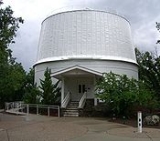
. Lowell Observatory was established in 1894, placing it among the oldest observatories in the United States, and was designated a National Historic Landmark
in 1965.
The Observatory's original 24-inch (0.61 m) Alvan Clark
Telescope is still in use today for public education. Lowell Observatory hosts 80,000 visitors per year at their Steele Visitors Center who take guided daytime tours and view various wonders of the night sky through the Clark Telescope and other telescopes. It was founded by astronomer Percival Lowell
, and run for a time by his third cousin Guy Lowell
of Boston's well-known Lowell family
. The current trustee of Lowell Observatory is William Lowell Putnam III
, grandnephew of founder Percival Lowell and son of long-time trustee Roger Putnam
. The position of trustee is historically handed down through the family.
The observatory operates several telescope
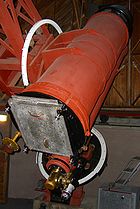
s at two locations in Flagstaff. The main facility, located on Mars Hill just west of downtown Flagstaff, houses the original 24-inch (0.61 m) Clark Refracting Telescope, although its role today is as a public education tool and not research. The telescope, built in 1896 for $20,000, was assembled in Boston by Alvan Clark
and then shipped by train to Flagstaff. Also located on the Mars Hill campus is the 13-inch (0.33 m) Pluto Discovery Telescope, used by Clyde Tombaugh
in 1930 to discover the dwarf planet Pluto
.
Lowell Observatory currently operates four research telescopes at its Anderson Mesa dark sky site, located 20 km (12.4 mi) southeast of Flagstaff, including the 72-inch (1.8-meter) Perkins Telescope (in partnership with Boston University) and the 42-inch (1.1 m) John S. Hall Telescope. Lowell is a partner with the United States Naval Observatory
and NRL in the Navy Prototype Optical Interferometer
(NPOI) also located at that site. The Observatory also operates smaller research telescopes at its historic site on Mars Hill and in Australia and Chile. Lowell Observatory is currently building the 4.28-meter Discovery Channel Telescope
in partnership with Discovery Communications, Inc.
and Neptune
. In 1953, the current 21-inch telescope was installed. Starting in 1954, the telescope began monitoring Uranus' and Neptune's brightness, and matching them against a reference set of sun-like stars.
near Happy Jack in northern Arizona. The telescope, located within the Mogollon Rim Ranger District of the Coconino National Forest
, is expected to be the fifth largest in the continental United States and will allow Lowell astronomers to enter new research areas and conduct existing programs more effectively and efficiently. The DCT and the research it enables also will be the focus of ongoing informative and educational television programs about astronomy, science, and technology airing on Discovery networks. In addition, the Discovery Channel Telescope
at Lowell Observatory is expected to have a significant educational and economic impact within the state. The primary mirror, measuring 4.28 meters in diameter and 4 inches thick, is notable for its unique meniscus design for such a large mirror. It was polished at the Optical Fabrication and Engineering Facility at the College of Optical Sciences, University of Arizona. The College of Optical Sciences is one of only a handful of facilities in the world that can handle the difficulty of fabricating this mirror.
beyond Neptune
, a search for extrasolar planets, a decades-long study of the brightness stability of the sun, and a variety of investigations of star formation and other processes in distant galaxies. In addition, the Observatory staff designs and builds custom instrumentation for use on Lowell's telescopes and elsewhere. For example, Lowell staff built a sophisticated high-speed camera for use on the Stratospheric Observatory for Infrared Astronomy
(SOFIA). SOFIA is a joint project of the United States and German space agencies and consists of a 2.5-meter telescope on board a Boeing 747 SP.
Astronomy
Astronomy is a natural science that deals with the study of celestial objects and phenomena that originate outside the atmosphere of Earth...
observatory
Observatory
An observatory is a location used for observing terrestrial or celestial events. Astronomy, climatology/meteorology, geology, oceanography and volcanology are examples of disciplines for which observatories have been constructed...
in Flagstaff, Arizona
Flagstaff, Arizona
Flagstaff is a city located in northern Arizona, in the southwestern United States. In 2010, the city's population was 65,870. The population of the Metropolitan Statistical Area was at 134,421 in 2010. It is the county seat of Coconino County...
. Lowell Observatory was established in 1894, placing it among the oldest observatories in the United States, and was designated a National Historic Landmark
National Historic Landmark
A National Historic Landmark is a building, site, structure, object, or district, that is officially recognized by the United States government for its historical significance...
in 1965.
The Observatory's original 24-inch (0.61 m) Alvan Clark
Alvan Clark
Alvan Clark , born in Ashfield, Massachusetts, the descendant of a Cape Cod whaling family of English ancestry, was an American astronomer and telescope maker. He was a portrait painter and engraver , and at the age of 40 became involved in telescope making...
Telescope is still in use today for public education. Lowell Observatory hosts 80,000 visitors per year at their Steele Visitors Center who take guided daytime tours and view various wonders of the night sky through the Clark Telescope and other telescopes. It was founded by astronomer Percival Lowell
Percival Lowell
Percival Lawrence Lowell was a businessman, author, mathematician, and astronomer who fueled speculation that there were canals on Mars, founded the Lowell Observatory in Flagstaff, Arizona, and formed the beginning of the effort that led to the discovery of Pluto 14 years after his death...
, and run for a time by his third cousin Guy Lowell
Guy Lowell
Guy Lowell , American architect, was the son of Mary Walcott and Edward Jackson Lowell, and a member of Boston's well-known Lowell family....
of Boston's well-known Lowell family
Lowell family
The Lowell family settled on the North Shore at Cape Ann after they arrived in Boston on June 23, 1639. The patriarch, Percival Lowle , described as a "solid citizen of Bristol", determined at the age of 68 that the future was in the New World.Massachusetts Bay Colony Governor John Winthrop needed...
. The current trustee of Lowell Observatory is William Lowell Putnam III
William Lowell Putnam III
William Lowell Putnam III is an alpinist, author and retired broadcasting executive. He is also sole trustee of the Lowell Observatory, a private astronomical research facility; the son of Roger Putnam and a member of the once-prominent Lowell family of Massachusetts...
, grandnephew of founder Percival Lowell and son of long-time trustee Roger Putnam
Roger Putnam
Roger Lowell Putnam was an American politician and businessman. A member of the prominent Lowell family of Boston, he served as Mayor of Springfield, Massachusetts, from 1937 until 1943, and as director of the Economic Stabilization Administration from 1951 until 1952...
. The position of trustee is historically handed down through the family.
The observatory operates several telescope
Telescope
A telescope is an instrument that aids in the observation of remote objects by collecting electromagnetic radiation . The first known practical telescopes were invented in the Netherlands at the beginning of the 1600s , using glass lenses...
s at two locations in Flagstaff. The main facility, located on Mars Hill just west of downtown Flagstaff, houses the original 24-inch (0.61 m) Clark Refracting Telescope, although its role today is as a public education tool and not research. The telescope, built in 1896 for $20,000, was assembled in Boston by Alvan Clark
Alvan Clark
Alvan Clark , born in Ashfield, Massachusetts, the descendant of a Cape Cod whaling family of English ancestry, was an American astronomer and telescope maker. He was a portrait painter and engraver , and at the age of 40 became involved in telescope making...
and then shipped by train to Flagstaff. Also located on the Mars Hill campus is the 13-inch (0.33 m) Pluto Discovery Telescope, used by Clyde Tombaugh
Clyde Tombaugh
Clyde William Tombaugh was an American astronomer. Although he is best known for discovering the dwarf planet Pluto in 1930, the first object to be discovered in what would later be identified as the Kuiper Belt, Tombaugh also discovered many asteroids; he also called for serious scientific...
in 1930 to discover the dwarf planet Pluto
Pluto
Pluto, formal designation 134340 Pluto, is the second-most-massive known dwarf planet in the Solar System and the tenth-most-massive body observed directly orbiting the Sun...
.
Lowell Observatory currently operates four research telescopes at its Anderson Mesa dark sky site, located 20 km (12.4 mi) southeast of Flagstaff, including the 72-inch (1.8-meter) Perkins Telescope (in partnership with Boston University) and the 42-inch (1.1 m) John S. Hall Telescope. Lowell is a partner with the United States Naval Observatory
United States Naval Observatory Flagstaff Station
The United States Naval Observatory Flagstaff Station , is a scientific astronomical observatory operated as a Navy Echelon V command and the national dark-sky observing Facility/observatory subordinate to the United States Naval Observatory . USNO and NOFS are commands within the CNMOC claimancy,...
and NRL in the Navy Prototype Optical Interferometer
Navy Prototype Optical Interferometer
The Navy Prototype Optical Interferometer , is an astronomical interferometer operated by the United States Naval Observatory Flagstaff Station, in collaboration with the Naval Research Laboratory and The Lowell Observatory...
(NPOI) also located at that site. The Observatory also operates smaller research telescopes at its historic site on Mars Hill and in Australia and Chile. Lowell Observatory is currently building the 4.28-meter Discovery Channel Telescope
Discovery Channel Telescope
The Discovery Channel Telescope is a 4.3-meter aperture telescope being built by Lowell Observatory in Flagstaff, Arizona and will be the fifth largest telescope in the continental United States once completed in 2012. The DCT is currently under construction at a dark sky site on the Coconino...
in partnership with Discovery Communications, Inc.
History
One science program carried out at the Observatory was the measurement of solar irradiance variability. When Harold L. Johnson took over in 1952, the stated objective became to focus on light from the Sun reflecting off of UranusUranus
Uranus is the seventh planet from the Sun. It has the third-largest planetary radius and fourth-largest planetary mass in the Solar System. It is named after the ancient Greek deity of the sky Uranus , the father of Cronus and grandfather of Zeus...
and Neptune
Neptune
Neptune is the eighth and farthest planet from the Sun in the Solar System. Named for the Roman god of the sea, it is the fourth-largest planet by diameter and the third largest by mass. Neptune is 17 times the mass of Earth and is slightly more massive than its near-twin Uranus, which is 15 times...
. In 1953, the current 21-inch telescope was installed. Starting in 1954, the telescope began monitoring Uranus' and Neptune's brightness, and matching them against a reference set of sun-like stars.
Discovery Channel Telescope (DCT)
Lowell Observatory has built a major new telescope in partnership with Discovery CommunicationsDiscovery Communications
Discovery Communications, Inc. is an American global media and entertainment company. The company started as a single channel in 1985, The Discovery Channel. Today, DCI has global operations offering 28 network entertainment brands on more than 100 channels in more than 180 countries in 39...
near Happy Jack in northern Arizona. The telescope, located within the Mogollon Rim Ranger District of the Coconino National Forest
Coconino National Forest
The Coconino National Forest is a 1.856-million acre United States National Forest located in northern Arizona in the vicinity of Flagstaff. Originally established in 1898 as the "San Francisco Mountains National Forest Reserve", the area was designated a U.S...
, is expected to be the fifth largest in the continental United States and will allow Lowell astronomers to enter new research areas and conduct existing programs more effectively and efficiently. The DCT and the research it enables also will be the focus of ongoing informative and educational television programs about astronomy, science, and technology airing on Discovery networks. In addition, the Discovery Channel Telescope
Discovery Channel Telescope
The Discovery Channel Telescope is a 4.3-meter aperture telescope being built by Lowell Observatory in Flagstaff, Arizona and will be the fifth largest telescope in the continental United States once completed in 2012. The DCT is currently under construction at a dark sky site on the Coconino...
at Lowell Observatory is expected to have a significant educational and economic impact within the state. The primary mirror, measuring 4.28 meters in diameter and 4 inches thick, is notable for its unique meniscus design for such a large mirror. It was polished at the Optical Fabrication and Engineering Facility at the College of Optical Sciences, University of Arizona. The College of Optical Sciences is one of only a handful of facilities in the world that can handle the difficulty of fabricating this mirror.
Current research
Lowell Observatory's astronomers conduct research on a wide range of solar system and astrophysical topics using ground-based, airborne, and space-based telescopes. Among the many current programs are a search for near-Earth asteroids, a survey of the Kuiper BeltKuiper belt
The Kuiper belt , sometimes called the Edgeworth–Kuiper belt, is a region of the Solar System beyond the planets extending from the orbit of Neptune to approximately 50 AU from the Sun. It is similar to the asteroid belt, although it is far larger—20 times as wide and 20 to 200 times as massive...
beyond Neptune
Neptune
Neptune is the eighth and farthest planet from the Sun in the Solar System. Named for the Roman god of the sea, it is the fourth-largest planet by diameter and the third largest by mass. Neptune is 17 times the mass of Earth and is slightly more massive than its near-twin Uranus, which is 15 times...
, a search for extrasolar planets, a decades-long study of the brightness stability of the sun, and a variety of investigations of star formation and other processes in distant galaxies. In addition, the Observatory staff designs and builds custom instrumentation for use on Lowell's telescopes and elsewhere. For example, Lowell staff built a sophisticated high-speed camera for use on the Stratospheric Observatory for Infrared Astronomy
Stratospheric Observatory for Infrared Astronomy
The Stratospheric Observatory for Infrared Astronomy is a joint project of NASA and the German Aerospace Center to construct and maintain an airborne observatory. NASA awarded the contract for the development of the aircraft, operation of the observatory and management of the American part of the...
(SOFIA). SOFIA is a joint project of the United States and German space agencies and consists of a 2.5-meter telescope on board a Boeing 747 SP.
Notable discoveries
- The dwarf planet PlutoPlutoPluto, formal designation 134340 Pluto, is the second-most-massive known dwarf planet in the Solar System and the tenth-most-massive body observed directly orbiting the Sun...
by Clyde TombaughClyde TombaughClyde William Tombaugh was an American astronomer. Although he is best known for discovering the dwarf planet Pluto in 1930, the first object to be discovered in what would later be identified as the Kuiper Belt, Tombaugh also discovered many asteroids; he also called for serious scientific...
in 1930. - Large recessional velocitiesRecessional velocityRecessional Velocity is a term used to describe the rate at which an object is moving away, typically from Earth.-Application to Cosmology:This term is generally only used in reference to distant Galaxies. The most common reason for the use of this term is Hubble's Law, which states that the...
of galaxies by Vesto Melvin Slipher between 1912 and 1914 (that led ultimately to the realization our universe is expanding). - Co-discovery of the rings of UranusUranusUranus is the seventh planet from the Sun. It has the third-largest planetary radius and fourth-largest planetary mass in the Solar System. It is named after the ancient Greek deity of the sky Uranus , the father of Cronus and grandfather of Zeus...
in 1977. - The periodic variation in the activity of Comet HalleyComet HalleyHalley's Comet or Comet Halley is the best-known of the short-period comets, and is visible from Earth every 75 to 76 years. Halley is the only short-period comet that is clearly visible to the naked eye from Earth, and thus the only naked-eye comet that might appear twice in a human lifetime...
during the 1985/1986 apparition. - The three largest known starStarA star is a massive, luminous sphere of plasma held together by gravity. At the end of its lifetime, a star can also contain a proportion of degenerate matter. The nearest star to Earth is the Sun, which is the source of most of the energy on Earth...
s. - The atmosphereAtmosphereAn atmosphere is a layer of gases that may surround a material body of sufficient mass, and that is held in place by the gravity of the body. An atmosphere may be retained for a longer duration, if the gravity is high and the atmosphere's temperature is low...
of PlutoPlutoPluto, formal designation 134340 Pluto, is the second-most-massive known dwarf planet in the Solar System and the tenth-most-massive body observed directly orbiting the Sun...
. - Accurate orbits for two of Pluto's moons: NixNix (moon)Nix is a natural satellite of Pluto. It was discovered along with Hydra in June 2005, and is to be visited along with Pluto by the New Horizons mission in July 2015.- Discovery :...
and HydraHydra (moon)Hydra is the second outermost known natural satellite of Pluto. It was discovered along with Nix in June 2005, and is to be visited along with Pluto by the New Horizons mission in July 2015.- Discovery :...
. - Oxygen on JupiterJupiterJupiter is the fifth planet from the Sun and the largest planet within the Solar System. It is a gas giant with mass one-thousandth that of the Sun but is two and a half times the mass of all the other planets in our Solar System combined. Jupiter is classified as a gas giant along with Saturn,...
's satellite GanymedeGanymede (moon)Ganymede is a satellite of Jupiter and the largest moon in the Solar System. It is the seventh moon and third Galilean satellite outward from Jupiter. Completing an orbit in roughly seven days, Ganymede participates in a 1:2:4 orbital resonance with the moons Europa and Io, respectively...
. - Carbon dioxide ice on three Uranian satellites.
- The first Trojan of NeptuneNeptune TrojanNeptune trojans are Kuiper belt object-like bodies in solar orbit that have the same orbital period as Neptune and follow roughly the same orbital path...
. - Evidence that the atmosphere of HD 209458 bHD 209458 bHD 209458 b is an extrasolar planet that orbits the Solar analog star HD 209458 in the constellation Pegasus, some 150 light-years from Earth's solar system, with evidence of water vapor....
contains water vapor.
External links
- Lowell Observatory
- Discovery Channel Telescope
- Flagstaff Clear Sky Clock Forecasts of observing conditions covering Lowell Observatory.
- National Historic Landmarks Program: Lowell Observatory