


Battle of Somosierra

Encyclopedia
The Battle of Somosierra occurred November 30, 1808 in the Peninsular War
, when a French army under Napoleon I
forced a passage through the Sierra de Guadarrama
shielding Madrid
.
At the Somosierra mountain pass
, 60 miles north of Madrid, a heavily outnumbered Spanish detachment of conscripts and artillery
under Benito de San Juan
aimed to block Napoleon's advance on the Spanish capital. Napoleon overwhelmed the Spanish positions in a combined arms
attack, charging the Polish
Chevau-légers
of the Imperial Guard at the Spanish guns while French infantry advanced up the slopes. The victory removed the last obstacle barring the road to Madrid, which fell several days later.
. To complete his reconquest of Spain, Napoleon advanced on Madrid with 40,000 men.
General San Juan mustered an ad hoc army of militia
, reservists, and various regular regiments still reeling from earlier defeats; in all about 12,000 men, to defend Madrid. In order to screen the many approaches to the city, San Juan dispersed his already greatly outnumbered forces. Under his orders, 9,000 men were dispatched west to guard the Guadarrama pass while 3,000 occupied an advanced post at Sepulveda
, leaving only 9,000 men and 16 guns on the heights of Somosierra.
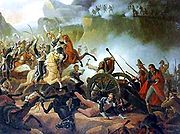
escort squadron of 125 men to charge the Spaniards and their fortified artillery batteries. To that number must be added members of other squadrons, totalling some 450 men, but who entered the battle later. The charge of 125 against batteries was joined by Niegolewski's platoon returning from reconnaissance. It is not clear, however, whether the number included only front-line troops (sabres) or all the soldiers in the units. The decision, arguably callous and imprudent, has been the subject of much historical controversy. Napoleon issued no written orders. Jan Kozietulski
, who commanded the 3rd squadron that day, mentioned that he called, "Lekka jazda kłusem!" ("Light cavalry at the trot
!") and, passing the little bridge, added, "En avant, Vive l'Empereur!".
Some western authors have assumed that Napoleon had gone out of his mind in ordering the Poles to charge batteries of 16 cannon over several kilometers of extremely difficult terrain. Others, however, think Napoleon ordered only the closest battery to be taken, in order to open the way for his infantry, and that Kozietulski had misunderstood the order. No matter, once the charge had begun, and the chevaux-légers found themselves under fire from the second battery, they had no choice but to press the attack as the horses went to the highest speed and were unable to stop. They took the second and third batteries, but only a few chevaux-légers reached the last battery, and the Spanish attempted to recapture it. It was then that Napoleon saw his chance and immediately committed the other squadrons.
Benito de San Juan had 16 cannon at his disposal, arranged in four batteries. Some accounts, based mostly on relations of French officers, assume that the Spaniards placed all their guns at the peak of Somosierra pass. However, with a range of 600–800 metres, the cannons, deployed in this fashion, could not have struck much of the French army—and relations report that Napoleon himself was at times put under artillery fire. Also, the chevaux-légers that took part in the charge, as well as the Spanish prisoners captured before the battle, mentioned that Benito de San Juan had cannons in four batteries, not one. The first battery defended the entrance to the Somosierra pass, the next two covered the pass at its angles, and the fourth, only, stood by the heights. It was assumed that all batteries had four cannons, and latter theories that the pass was too narrow for that to be possible should be treated as legends.
13th Bulletin of the Army of Spain mentioned that chevau-légers were commanded by Gen. Louis Pierre, Count Montbrun
. However, both Polish charge participants mentioned above and Lt. Col. Pierre Dautancourt, one of the French tutors of the unit, stressed in their relations that such was not the case. Datancourt mentioned in his relation that Montbrun in conversations with him himself was laughing from that idea. Yet French historian Adolphe Thiers
gave him the honour of leading the charge, which caused the protest by Polish living participants of the battle. Maj. Philippe de Ségur in his memoirs wrote that he had commanded the charge, but his relations were often described as unreliable and again both Dautancourt and the Poles denied his role.
The charge was led by Kozietulski, but he lost his horse after taking the first battery. The squadron was then joined by Lt. Andrzej Niegolewski
, who had previously been on reconnaissance with his soldiers. The charge was continued under Dziewanowski, and when he fell from the horse after taking the third battery, by Piotr Krasiński. The charge which continued to the last battery was led by Niegolewski, who survived almost by miracle when Spanish attacked him (he received nine wounds from bayonets and two carbine shots to the head).
According to many memoirs of the veterans of the battle, Kozietulski led his men for a charge with the official cry Vive l'Empereur. However, a popular legend has it that the true battle cry was in Polish Naprzód psiekrwie, Cesarz patrzy - Forward, you sons of dogs, the Emperor is watching.
When the fourth battery was taken Napoleon ordered his Chasseurs of the Guard, and 1st squadron of Poles led by Tomasz Łubieński
to resume the attack and repulse Spaniards from the Pass. Łubieński tried to give himself the whole glory, trying to minimise the role of the third squadron (while Niegolewski tried to show that he had taken the cannons and Łubieński had therefore had it so easy as Spanish were shooting at him "with candies").
 French officers tried to minimise the effect of the Polish charge, saying that all the success should be given to French infantry of Gen. François Ruffin
. Yet still 13th bulletin of the Army of Spain mentioned lead role of Polish chevaux-légers. However, only cavalry charge was able to take all four batteries, even if French infantry was close enough to press their attack, and caused en-masse retreat of Spanish Andalusia
n irregular militia
and in the effect retreat of the whole army. It must be noted that Spanish artillery men preferred to die than abandon their position - but no Polish relation mentioned any fight with Spanish militia. Militiamen just left their position seeing how seemingly easily Poles took the artillery positions. In the smoke they could not see how few Poles were on the top.
 San Juan raced his army back to Madrid. Although the victory at Somosierra was more accurately the result of a combined infantry and cavalry attack, with the infantry bearing the heavier fighting, later accounts, Napoleon's included, placed all the emphasis on the Polish charge. San Juan was later killed by his own men.
French patrols reached the outskirts of Madrid on December 1. The Junta made a half-hearted and futile attempt to defend the capital, and on December 4, a devastating French artillery barrage brought the Spanish defence to grief. Spaniards surrendered their remaining 2,500 regulars; the 20,000 civilians under their banner dispersed; and the French entered Madrid for the second time that year.
Peninsular War
The Peninsular War was a war between France and the allied powers of Spain, the United Kingdom, and Portugal for control of the Iberian Peninsula during the Napoleonic Wars. The war began when French and Spanish armies crossed Spain and invaded Portugal in 1807. Then, in 1808, France turned on its...
, when a French army under Napoleon I
Napoleon I
Napoleon Bonaparte was a French military and political leader during the latter stages of the French Revolution.As Napoleon I, he was Emperor of the French from 1804 to 1815...
forced a passage through the Sierra de Guadarrama
Sierra de Guadarrama
The Sierra de Guadarrama is a mountain range forming the main eastern section of the Sistema Central, the system of mountain ranges at the centre of the Iberian Peninsula. It is located between the Sierra de Gredos in the province of Ávila, and Sierra de Ayllón in the province of Guadalajara...
shielding Madrid
Madrid
Madrid is the capital and largest city of Spain. The population of the city is roughly 3.3 million and the entire population of the Madrid metropolitan area is calculated to be 6.271 million. It is the third largest city in the European Union, after London and Berlin, and its metropolitan...
.
At the Somosierra mountain pass
Mountain pass
A mountain pass is a route through a mountain range or over a ridge. If following the lowest possible route, a pass is locally the highest point on that route...
, 60 miles north of Madrid, a heavily outnumbered Spanish detachment of conscripts and artillery
Artillery
Originally applied to any group of infantry primarily armed with projectile weapons, artillery has over time become limited in meaning to refer only to those engines of war that operate by projection of munitions far beyond the range of effect of personal weapons...
under Benito de San Juan
Benito de San Juan
Benito de San Juan was a Spanish military officer and a notable commander of the Spanish forces during the Peninsular War. He was the commanding officer of all the Spanish forces during the Battle of Somosierra....
aimed to block Napoleon's advance on the Spanish capital. Napoleon overwhelmed the Spanish positions in a combined arms
Combined arms
Combined arms is an approach to warfare which seeks to integrate different branches of a military to achieve mutually complementary effects...
attack, charging the Polish
Uhlan
Uhlans were Polish light cavalry armed with lances, sabres and pistols. The title was later used by lancer regiments in the Russian, Prussian, and Austrian armies....
Chevau-légers
Chevau-légers
The Chevau-légers was a generic French name for several units of light cavalry, roughly similar to lancers in the armies of other states during the Napoleonic Wars. Perhaps the most famous of all such units were the Polish 1st Light Cavalry Regiment of the Guards and the French 2nd Light Cavalry...
of the Imperial Guard at the Spanish guns while French infantry advanced up the slopes. The victory removed the last obstacle barring the road to Madrid, which fell several days later.
Background
By late November 1808, the French Grande Armée had overwhelmed and destroyed both wings of the Spanish popular armyMilitary history of Spain
The military history of Spain, from the period of the Carthaginian conquests over the Phoenicians to the current Afghan War spans a period of more than 2200 years, and includes the history of battles fought in the territory of modern Spain, as well as her former and current overseas possessions and...
. To complete his reconquest of Spain, Napoleon advanced on Madrid with 40,000 men.
General San Juan mustered an ad hoc army of militia
Militia
The term militia is commonly used today to refer to a military force composed of ordinary citizens to provide defense, emergency law enforcement, or paramilitary service, in times of emergency without being paid a regular salary or committed to a fixed term of service. It is a polyseme with...
, reservists, and various regular regiments still reeling from earlier defeats; in all about 12,000 men, to defend Madrid. In order to screen the many approaches to the city, San Juan dispersed his already greatly outnumbered forces. Under his orders, 9,000 men were dispatched west to guard the Guadarrama pass while 3,000 occupied an advanced post at Sepulveda
Sepúlveda, Segovia
Sepúlveda is a municipality located in the province of Segovia, Castile and León, Spain. The town lies next to the Hoces del Rio Duratón National Park and also incorporates the district of Duratón....
, leaving only 9,000 men and 16 guns on the heights of Somosierra.
Somosierra pass
The nature of the terrain and the tenacity of the Spaniards initially worked in their favour. On the evening of November 29 the brigade at Sepulveda repulsed a French attack, inflicted heavy casualties, and escaped from overwhelming French numbers in the gathering darkness to the west. The following morning, Napoleon advanced his infantry directly toward the pass while small detachments crept up the flanks. Exchanging musket volleys with the defenders, the French made slow but measurable progress toward the enemy guns.The Polish charge
Because the Spanish forces could not easily be outflanked by infantry movement, and Napoleon was impatient to proceed, he ordered his Polish Chevaux-LégersPolish cavalry
The Polish cavalry can trace its origins back to the days of Medieval mounted knights. Poland had always been a country of flatlands and fields and mounted forces operate well in this environment...
escort squadron of 125 men to charge the Spaniards and their fortified artillery batteries. To that number must be added members of other squadrons, totalling some 450 men, but who entered the battle later. The charge of 125 against batteries was joined by Niegolewski's platoon returning from reconnaissance. It is not clear, however, whether the number included only front-line troops (sabres) or all the soldiers in the units. The decision, arguably callous and imprudent, has been the subject of much historical controversy. Napoleon issued no written orders. Jan Kozietulski
Jan Kozietulski
Baron Jan Leon Hipolit Kozietulski was a Polish noble, military commander and an officer of the armed forces of the Duchy of Warsaw during the Napoleonic Wars. He is best remembered as the heroic commander of the Polish cavalry charge at the Battle of Somosierra.Jan Leon Hipolit Kozietulski was...
, who commanded the 3rd squadron that day, mentioned that he called, "Lekka jazda kłusem!" ("Light cavalry at the trot
Trot
A trot is a type of symmetrical gait in animals.Trot may also refer to:*Trot , the specifics of trotting in horses*Trot , a genre of Korean pop music*Trot , a character from the Oz books of L...
!") and, passing the little bridge, added, "En avant, Vive l'Empereur!".
Some western authors have assumed that Napoleon had gone out of his mind in ordering the Poles to charge batteries of 16 cannon over several kilometers of extremely difficult terrain. Others, however, think Napoleon ordered only the closest battery to be taken, in order to open the way for his infantry, and that Kozietulski had misunderstood the order. No matter, once the charge had begun, and the chevaux-légers found themselves under fire from the second battery, they had no choice but to press the attack as the horses went to the highest speed and were unable to stop. They took the second and third batteries, but only a few chevaux-légers reached the last battery, and the Spanish attempted to recapture it. It was then that Napoleon saw his chance and immediately committed the other squadrons.
Benito de San Juan had 16 cannon at his disposal, arranged in four batteries. Some accounts, based mostly on relations of French officers, assume that the Spaniards placed all their guns at the peak of Somosierra pass. However, with a range of 600–800 metres, the cannons, deployed in this fashion, could not have struck much of the French army—and relations report that Napoleon himself was at times put under artillery fire. Also, the chevaux-légers that took part in the charge, as well as the Spanish prisoners captured before the battle, mentioned that Benito de San Juan had cannons in four batteries, not one. The first battery defended the entrance to the Somosierra pass, the next two covered the pass at its angles, and the fourth, only, stood by the heights. It was assumed that all batteries had four cannons, and latter theories that the pass was too narrow for that to be possible should be treated as legends.
13th Bulletin of the Army of Spain mentioned that chevau-légers were commanded by Gen. Louis Pierre, Count Montbrun
Louis Pierre, Count Montbrun
Louis Pierre, Count Montbrun , French cavalry general, served with great distinction in the cavalry arm throughout the wars of the Revolution and the Consulate, and in 1800 was appointed to command his regiment, having served therein from trooper upwards.At the Battle of Austerlitz on 2 December...
. However, both Polish charge participants mentioned above and Lt. Col. Pierre Dautancourt, one of the French tutors of the unit, stressed in their relations that such was not the case. Datancourt mentioned in his relation that Montbrun in conversations with him himself was laughing from that idea. Yet French historian Adolphe Thiers
Adolphe Thiers
Marie Joseph Louis Adolphe Thiers was a French politician and historian. was a prime minister under King Louis-Philippe of France. Following the overthrow of the Second Empire he again came to prominence as the French leader who suppressed the revolutionary Paris Commune of 1871...
gave him the honour of leading the charge, which caused the protest by Polish living participants of the battle. Maj. Philippe de Ségur in his memoirs wrote that he had commanded the charge, but his relations were often described as unreliable and again both Dautancourt and the Poles denied his role.
The charge was led by Kozietulski, but he lost his horse after taking the first battery. The squadron was then joined by Lt. Andrzej Niegolewski
Andrzej Niegolewski
Andrzej Niegolewski was a Polish colonel during the Napoleonic Wars, member of parliament and a shareholder of the Poznan Bazar.-References:...
, who had previously been on reconnaissance with his soldiers. The charge was continued under Dziewanowski, and when he fell from the horse after taking the third battery, by Piotr Krasiński. The charge which continued to the last battery was led by Niegolewski, who survived almost by miracle when Spanish attacked him (he received nine wounds from bayonets and two carbine shots to the head).
According to many memoirs of the veterans of the battle, Kozietulski led his men for a charge with the official cry Vive l'Empereur. However, a popular legend has it that the true battle cry was in Polish Naprzód psiekrwie, Cesarz patrzy - Forward, you sons of dogs, the Emperor is watching.
When the fourth battery was taken Napoleon ordered his Chasseurs of the Guard, and 1st squadron of Poles led by Tomasz Łubieński
Tomasz Łubieński
Tomasz Łubieński, comte de Pomian was a brigadier general in the Polish army, senator, landowner in Kalisz and businessman. Hoping to liberate Poland, he fought on the French side in the Napoleonic Wars, fighting at Essling, , , , , and , for which Napoleon made him a baron de l'Empire...
to resume the attack and repulse Spaniards from the Pass. Łubieński tried to give himself the whole glory, trying to minimise the role of the third squadron (while Niegolewski tried to show that he had taken the cannons and Łubieński had therefore had it so easy as Spanish were shooting at him "with candies").
Charge effects
François Amable Ruffin
François Amable Ruffin was a Général de division of the First French Empire.- Biography :Having been captain of a company of volunteers from Bolbec, he was named commander of the 7th Battalion of Seine-Inférieure on 20 September 1792...
. Yet still 13th bulletin of the Army of Spain mentioned lead role of Polish chevaux-légers. However, only cavalry charge was able to take all four batteries, even if French infantry was close enough to press their attack, and caused en-masse retreat of Spanish Andalusia
Andalusia
Andalusia is the most populous and the second largest in area of the autonomous communities of Spain. The Andalusian autonomous community is officially recognised as a nationality of Spain. The territory is divided into eight provinces: Huelva, Seville, Cádiz, Córdoba, Málaga, Jaén, Granada and...
n irregular militia
Militia
The term militia is commonly used today to refer to a military force composed of ordinary citizens to provide defense, emergency law enforcement, or paramilitary service, in times of emergency without being paid a regular salary or committed to a fixed term of service. It is a polyseme with...
and in the effect retreat of the whole army. It must be noted that Spanish artillery men preferred to die than abandon their position - but no Polish relation mentioned any fight with Spanish militia. Militiamen just left their position seeing how seemingly easily Poles took the artillery positions. In the smoke they could not see how few Poles were on the top.
Aftermath
French patrols reached the outskirts of Madrid on December 1. The Junta made a half-hearted and futile attempt to defend the capital, and on December 4, a devastating French artillery barrage brought the Spanish defence to grief. Spaniards surrendered their remaining 2,500 regulars; the 20,000 civilians under their banner dispersed; and the French entered Madrid for the second time that year.