

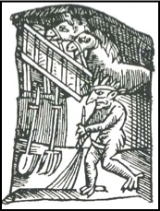
Tomte

Encyclopedia
A tomte (ˈtɔ̀mːtɛ), nisse (Norway
and Denmark
) (ˈnìsːɛ) or tonttu
(Finland
) is a mythical creature of Scandinavian folklore
. The tomte or nisse was believed to take care of a farmer's home and children and protect them from misfortune, in particular at night, when the housefolk were asleep. The Swedish name tomte is derived from a place of residence and area of influence: the house lot or tomt. Nisse is the common name in Norwegian
, Danish
and the Scanian dialect in southernmost Sweden; it is a nickname
for Nils
, and its usage in folklore comes from expressions such as Nisse god dräng ("Nisse good lad", cf. Robin Goodfellow). Other names are tuftekall, tomtegubbe or haugebonde ("mound farmer"), all names connecting the being to the origins of the farm (the building ground), or a burial mound. Those names are remembrances of the being's origins in an ancestral cult.
able to take a shape far larger than an adult man, and other tales where the tomte/nisse is believed to have a single, cyclopean
eye. In modern Denmark, nisses are often seen as beardless, wearing grey and red woolens with a red cap. Since nisses are thought to be skilled in illusions and sometimes able to make themselves invisible, one was unlikely to get more than brief glimpses of him no matter what he looked like. Norwegian folklore states that he has four fingers, and is hairy all over, sometimes with pointed ears. His eyes glow in the dark.
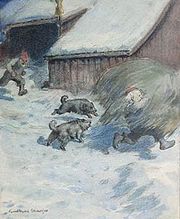 Despite his smallness, the tomte/nisse possessed an immense strength. Even though he was protective and caring he was easy to offend, and his retributions ranged from small pranks like a stout box on the ears to a more sociopathical punishment like killing off the livestock or ruining of the farm's fortune. The tomte/nisse was a traditionalist who did not like changes in the way things were done at the farm. Another easy way to offend him was rudeness: farm workers swearing, urinating in the barns, or not treating the creatures well would be soundly thrashed. If anyone spilled something on the floor in the house it was wise to shout a warning to the tomte below. An angry tomte is featured in the popular children's book by Swedish author Selma Lagerlöf
, Nils Holgerssons underbara resa genom Sverige
(Nils Holgersson's Wonderful Journey Through Sweden). The tomte turns the naughty boy Nils into a tomte in the beginning of the book, and Nils then travels across Sweden on the back of a goose.
One was also required to please the spirit with gifts (see Blót
) – a particular gift was a bowl of porridge on Christmas night. If the tomte was not given his payment, he would leave the farm or house, or engage in mischief such as tying the cows' tails together in the barn, turning objects upside-down, and breaking things (like a troll
). The tomte liked his porridge with a pat of butter on the top. In an often retold story, a farmer put the butter underneath the porridge. When the tomte of his farmstead found that the butter was missing, he was filled with rage and killed the cow resting in the barn. But, as he thus became hungry, he went back to his porridge and ate it, and so found the butter at the bottom of the bowl. Full of grief, he then hurried to search the lands to find another farmer with an identical cow, and replaced the former with the latter.
In another tale a Norwegian maid decided to eat the porridge herself, and ended up severely beaten by the nisse. The being swore: "Have you eaten the porridge for the tomte, you have to dance with him!". The farmer found her nearly lifeless the morning after.
The tomte is connected to farm animals in general, but his most treasured animal was the horse. Belief had it that one could see which horse was the tomte's favourite as it would be especially healthy and well taken care of. Sometimes the tomte would even braid its hair and tail. (These tomte braids were in fact most likely caused by insufficient brushing.) Sometimes actually undoing these braids could mean misfortune or angering the tomte.
The tomte was not always a popular figure, particularly during and after the Christianization of Scandinavia. Like most creatures of folklore he would be seen as heathen (pre-Christian) and be demonized and connected to the Devil
. Farmers believing in the house tomte could be seen as worshipping false gods or demons; in a famous 14th century decree Saint Birgitta warns against the worship of tompta gudhi, "tomte gods" (Revelationes, book VI, ch. 78). Folklore added other negative beliefs about the tomte, such as that having a tomte on the farm meant you put the fate of your soul at risk, or that you had to perform various non-Christian rites to lure a tomte to your farm.
The belief in a tomte's tendency to bring riches to the farm by his unseen work could also be dragged into the conflicts between neighbours. If one farmer was doing far better for himself than the others, someone might say that it was because of him having a tomte on the farm, doing "ungodly" work and stealing from the neighbours. These rumours could be very damaging for the farmer who found himself accused, much like accusations of witchcraft during the Inquisitions.
), god bonde ("good farmer"), fjøsnisse ("barn gnome") or gårdsrå ("yard-spirit"). The tomte could also take a ship for his home, and was then known as a skeppstomte/skibsnisse. In other European folklore, there are many beings similar to the tomte, such as the Scots and English brownie, Northumbria
n English hob
, the German Heinzelmännchen
or the Russian domovoi
. The Finnish word tonttu has been borrowed from Swedish.
The tomte is one of the most familiar creatures of Scandinavian folklore, and he has appeared in many works of Scandinavian literature
. With the romanticisation and collection of folklore during the 19th century, the tomte would gain popularity. In the English editions of the fairy tales of H. C. Andersen
the word nisse has been inaccurately translated as goblin
(a more accurate translation is brownie or hob
).
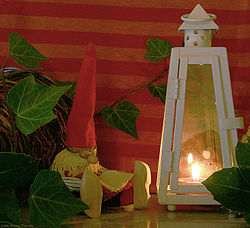 In the 1840s the farm's nisse became the bearer of Christmas presents in Denmark, and was then called julenisse (Yule Nisse). In 1881, the Swedish magazine Ny Illustrerad Tidning published Viktor Rydberg
's poem "Tomten", where the tomte is alone awake in the cold Christmas night, pondering the mysteries of life and death. This poem featured the first painting by Jenny Nyström
of this traditional Swedish mythical character which she turned into the white-bearded, red-capped friendly figure associated with Christmas ever since. Shortly afterwards, and obviously influenced by the emerging Father Christmas
traditions as well as the new Danish tradition, a variant of the tomte/nisse, called the jultomte in Sweden and julenisse in Norway, started bringing the Christmas presents in Sweden and Norway, instead of the traditional julbock (Yule Goat
).
Gradually, commercialism has made him look more and more like the American Santa Claus
, but the Swedish jultomte, the Norwegian julenisse, the Danish julemand and the Finnish joulupukki
(in Finland he is still called the Yule Goat, although his animal features have disappeared) still has features and traditions that are rooted in the local culture. He doesn't live on the North Pole, but perhaps in a forest nearby, or in Denmark he lives on Greenland, and in Finland he lives in Lapland; he doesn’t come down the chimney at night, but through the front door, delivering the presents directly to the children, just like the Yule Goat did; he is not overweight; and even if he nowadays sometimes rides in a sleigh drawn by reindeer, instead of just walking around with his sack, his reindeer don’t fly - and in Sweden, Denmark and Norway some still put out a bowl of porridge for him on Christmas Eve. He is still often pictured on Christmas cards and house and garden decorations as the little man of Jenny Nyström's imagination, often with a horse or cat, or riding on a goat or in a sled pulled by a goat, and for many people the idea of the farm tomte still lives on, if only in the imagination and literature. The use of the word tomte in Swedish is now somewhat ambiguous, but often when one speaks of jultomten (definite article) or tomten (definite article) one is referring to the more modern version, while if one speaks of tomtar (plural) or tomtarna (plural, definite article) one could also likely be referring to the more traditional tomtar. The traditional word tomte lives on in an idiom, referring to the human caretaker of a property (hustomten), as well as referring to someone in one's building who mysteriously does someone a favour, such as hanging up ones laundry. A person might also wish for a little hustomte to tidy up for them. A tomte stars in one of author Jan Brett's children's stories, "Hedgie's Surprise".
Norway
Norway , officially the Kingdom of Norway, is a Nordic unitary constitutional monarchy whose territory comprises the western portion of the Scandinavian Peninsula, Jan Mayen, and the Arctic archipelago of Svalbard and Bouvet Island. Norway has a total area of and a population of about 4.9 million...
and Denmark
Denmark
Denmark is a Scandinavian country in Northern Europe. The countries of Denmark and Greenland, as well as the Faroe Islands, constitute the Kingdom of Denmark . It is the southernmost of the Nordic countries, southwest of Sweden and south of Norway, and bordered to the south by Germany. Denmark...
) (ˈnìsːɛ) or tonttu
Haltija
Haltija is a spirit, gnome or elf-like creature in Finnish mythology, that guards, helps or protects something or somebody. The word is possibly derived from the Gothic *haltijar, and referred to the original settler of a homestead — although this is not the only possible etymology.In common...
(Finland
Finland
Finland , officially the Republic of Finland, is a Nordic country situated in the Fennoscandian region of Northern Europe. It is bordered by Sweden in the west, Norway in the north and Russia in the east, while Estonia lies to its south across the Gulf of Finland.Around 5.4 million people reside...
) is a mythical creature of Scandinavian folklore
Scandinavian folklore
Scandinavian folklore is the folklore of Sweden, Norway, Denmark, Iceland, the Faroe Islands, and the Swedish speaking parts of Finland.Collecting folklore began when Gustavus Adolphus of Sweden sent out instructions to all of the priests in all of the parishes to collect the folklore of their area...
. The tomte or nisse was believed to take care of a farmer's home and children and protect them from misfortune, in particular at night, when the housefolk were asleep. The Swedish name tomte is derived from a place of residence and area of influence: the house lot or tomt. Nisse is the common name in Norwegian
Norwegian language
Norwegian is a North Germanic language spoken primarily in Norway, where it is the official language. Together with Swedish and Danish, Norwegian forms a continuum of more or less mutually intelligible local and regional variants .These Scandinavian languages together with the Faroese language...
, Danish
Danish language
Danish is a North Germanic language spoken by around six million people, principally in the country of Denmark. It is also spoken by 50,000 Germans of Danish ethnicity in the northern parts of Schleswig-Holstein, Germany, where it holds the status of minority language...
and the Scanian dialect in southernmost Sweden; it is a nickname
Nickname
A nickname is "a usually familiar or humorous but sometimes pointed or cruel name given to a person or place, as a supposedly appropriate replacement for or addition to the proper name.", or a name similar in origin and pronunciation from the original name....
for Nils
Nils
Nils is a Scandinavian given name, a chiefly Norwegian and Swedish variant of Niels, cognate to Nicholas and Neil. As with Niels, its pet form is Nisse...
, and its usage in folklore comes from expressions such as Nisse god dräng ("Nisse good lad", cf. Robin Goodfellow). Other names are tuftekall, tomtegubbe or haugebonde ("mound farmer"), all names connecting the being to the origins of the farm (the building ground), or a burial mound. Those names are remembrances of the being's origins in an ancestral cult.
Appearance
The tomte/nisse was often imagined as a small, elderly man (size varies from a few inches to about half the height of an adult man), often with a full beard; dressed in the everyday clothing of a farmer. However, there are also folktales where he is believed to be a shapeshifterShapeshifting
Shapeshifting is a common theme in mythology, folklore, and fairy tales. It is also found in epic poems, science fiction literature, fantasy literature, children's literature, Shakespearean comedy, ballet, film, television, comics, and video games...
able to take a shape far larger than an adult man, and other tales where the tomte/nisse is believed to have a single, cyclopean
Cyclops
A cyclops , in Greek mythology and later Roman mythology, was a member of a primordial race of giants, each with a single eye in the middle of his forehead...
eye. In modern Denmark, nisses are often seen as beardless, wearing grey and red woolens with a red cap. Since nisses are thought to be skilled in illusions and sometimes able to make themselves invisible, one was unlikely to get more than brief glimpses of him no matter what he looked like. Norwegian folklore states that he has four fingers, and is hairy all over, sometimes with pointed ears. His eyes glow in the dark.
Temperament
Selma Lagerlöf
Selma Ottilia Lovisa Lagerlöf was a Swedish author. She was the first female writer to win the Nobel Prize in Literature, and most widely known for her children's book Nils Holgerssons underbara resa genom Sverige ....
, Nils Holgerssons underbara resa genom Sverige
The Wonderful Adventures of Nils
The Wonderful Adventures of Nils is a work of fiction by the Swedish author Selma Lagerlöf. It was published in two books, The Wonderful Adventures of Nils in 1906 and Further Adventures of Nils in 1907...
(Nils Holgersson's Wonderful Journey Through Sweden). The tomte turns the naughty boy Nils into a tomte in the beginning of the book, and Nils then travels across Sweden on the back of a goose.
One was also required to please the spirit with gifts (see Blót
Blót
The blót was Norse pagan sacrifice to the Norse gods and the spirits of the land. The sacrifice often took the form of a sacramental meal or feast. Related religious practices were performed by other Germanic peoples, such as the pagan Anglo-Saxons...
) – a particular gift was a bowl of porridge on Christmas night. If the tomte was not given his payment, he would leave the farm or house, or engage in mischief such as tying the cows' tails together in the barn, turning objects upside-down, and breaking things (like a troll
Troll
A troll is a supernatural being in Norse mythology and Scandinavian folklore. In origin, the term troll was a generally negative synonym for a jötunn , a being in Norse mythology...
). The tomte liked his porridge with a pat of butter on the top. In an often retold story, a farmer put the butter underneath the porridge. When the tomte of his farmstead found that the butter was missing, he was filled with rage and killed the cow resting in the barn. But, as he thus became hungry, he went back to his porridge and ate it, and so found the butter at the bottom of the bowl. Full of grief, he then hurried to search the lands to find another farmer with an identical cow, and replaced the former with the latter.
In another tale a Norwegian maid decided to eat the porridge herself, and ended up severely beaten by the nisse. The being swore: "Have you eaten the porridge for the tomte, you have to dance with him!". The farmer found her nearly lifeless the morning after.
The tomte is connected to farm animals in general, but his most treasured animal was the horse. Belief had it that one could see which horse was the tomte's favourite as it would be especially healthy and well taken care of. Sometimes the tomte would even braid its hair and tail. (These tomte braids were in fact most likely caused by insufficient brushing.) Sometimes actually undoing these braids could mean misfortune or angering the tomte.
Other encounters
Some stories tell how the nisse could drive people mad, or bite them. The bite from a nisse was poisonous, and otherworldly healing was required. As the story goes, the girl who was bitten withered and died before help arrived.The tomte after Christianization
The tomte was in ancient times believed to be the "soul" of the first inhabitor of the farm; he who cleared the tomt (house lot). He had his dwellings in the burial mounds on the farm, hence the now somewhat archaic Swedish names tomtenisse and tomtekarl, the Swedish and Norwegian tomtegubbe and tomtebonde ("tomte farmer"), the Norwegian haugkall ("mound man"), and the Finnish tonttu-ukko (lit. "house lot man"). Thus, the tradition of giving porridge to the tomte at Christmas is a remainder of ancestral worship.The tomte was not always a popular figure, particularly during and after the Christianization of Scandinavia. Like most creatures of folklore he would be seen as heathen (pre-Christian) and be demonized and connected to the Devil
Devil
The Devil is believed in many religions and cultures to be a powerful, supernatural entity that is the personification of evil and the enemy of God and humankind. The nature of the role varies greatly...
. Farmers believing in the house tomte could be seen as worshipping false gods or demons; in a famous 14th century decree Saint Birgitta warns against the worship of tompta gudhi, "tomte gods" (Revelationes, book VI, ch. 78). Folklore added other negative beliefs about the tomte, such as that having a tomte on the farm meant you put the fate of your soul at risk, or that you had to perform various non-Christian rites to lure a tomte to your farm.
The belief in a tomte's tendency to bring riches to the farm by his unseen work could also be dragged into the conflicts between neighbours. If one farmer was doing far better for himself than the others, someone might say that it was because of him having a tomte on the farm, doing "ungodly" work and stealing from the neighbours. These rumours could be very damaging for the farmer who found himself accused, much like accusations of witchcraft during the Inquisitions.
Similar folklore
The tomte/nisse shares many aspects with other Scandinavian wights such as the Swedish vättar (from the Old Norse landvættir) or the Norwegian tusser. These beings are social, however, whereas the tomte is always solitary (though he is now often pictured with other tomtar). Some synonyms of tomte in Swedish and Norwegian include gårdbo ("(farm)yard-dweller"), gardvord ("yard-warden", see vörðrVörðr
In Norse mythology, a vörðr is a warden spirit, believed to follow from birth to death the soul of every person. In Old Swedish, the corresponding word is varþer; in modern Swedish vård, and the belief in them remained strong in Scandinavian folklore up until the last centuries...
), god bonde ("good farmer"), fjøsnisse ("barn gnome") or gårdsrå ("yard-spirit"). The tomte could also take a ship for his home, and was then known as a skeppstomte/skibsnisse. In other European folklore, there are many beings similar to the tomte, such as the Scots and English brownie, Northumbria
Northumbria
Northumbria was a medieval kingdom of the Angles, in what is now Northern England and South-East Scotland, becoming subsequently an earldom in a united Anglo-Saxon kingdom of England. The name reflects the approximate southern limit to the kingdom's territory, the Humber Estuary.Northumbria was...
n English hob
Hob (folklore)
A hob is a type of small mythological household spirit found in the north and midlands of England, but especially on the Anglo-Scottish border, according to traditional folklore of those regions. They could live inside the house or outdoors. They are said to work in farmyards and thus could be...
, the German Heinzelmännchen
Heinzelmännchen
The Heinzelmännchen are a race of creatures appearing in a tale connected with the city of Cologne in Germany.The little house gnomes are said to have done all the work of the citizens of Cologne during the night, so that the inhabitants of Cologne could be very lazy during the day...
or the Russian domovoi
Domovoi
A domovoi or domovoy is a house spirit in Slavic folklore. The plural form in Russian can be transliterated domoviye or domovye ....
. The Finnish word tonttu has been borrowed from Swedish.
The tomte is one of the most familiar creatures of Scandinavian folklore, and he has appeared in many works of Scandinavian literature
Scandinavian literature
Scandinavia literature or Nordic literature is the literature in the languages of the Nordic countries of Northern Europe. The Nordic countries include Denmark, Finland, Iceland, Norway , Sweden and associated autonomous territories .The majority of these nations and regions use North Germanic...
. With the romanticisation and collection of folklore during the 19th century, the tomte would gain popularity. In the English editions of the fairy tales of H. C. Andersen
Hans Christian Andersen
Hans Christian Andersen was a Danish author, fairy tale writer, and poet noted for his children's stories. These include "The Steadfast Tin Soldier," "The Snow Queen," "The Little Mermaid," "Thumbelina," "The Little Match Girl," and "The Ugly Duckling."...
the word nisse has been inaccurately translated as goblin
Goblin
A goblin is a legendary evil or mischievous illiterate creature, a grotesquely evil or evil-like phantom.They are attributed with various abilities, temperaments and appearances depending on the story and country of origin. In some cases, goblins have been classified as constantly annoying little...
(a more accurate translation is brownie or hob
Hob (folklore)
A hob is a type of small mythological household spirit found in the north and midlands of England, but especially on the Anglo-Scottish border, according to traditional folklore of those regions. They could live inside the house or outdoors. They are said to work in farmyards and thus could be...
).
The modern tomte
Viktor Rydberg
Abraham Viktor Rydberg was a Swedish writer and a member of the Swedish Academy, 1877-1895...
's poem "Tomten", where the tomte is alone awake in the cold Christmas night, pondering the mysteries of life and death. This poem featured the first painting by Jenny Nyström
Jenny Nyström
Jenny Eugenia Nyström was a painter and illustrator who is mainly known as the person who created the Swedish image of the jultomte on numerous Christmas cards and magazine covers, thus linking the Swedish version of Santa Claus to the gnomes of Scandinavian folklore.- Background :Her father was...
of this traditional Swedish mythical character which she turned into the white-bearded, red-capped friendly figure associated with Christmas ever since. Shortly afterwards, and obviously influenced by the emerging Father Christmas
Father Christmas
Father Christmas is the name used in many English-speaking countries for a figure associated with Christmas. A similar figure with the same name exists in several other countries, including France , Spain , Brazil , Portugal , Italy , Armenia , India...
traditions as well as the new Danish tradition, a variant of the tomte/nisse, called the jultomte in Sweden and julenisse in Norway, started bringing the Christmas presents in Sweden and Norway, instead of the traditional julbock (Yule Goat
Yule Goat
The Yule Goat is one of the oldest Scandinavian and Northern European Yule and Christmas symbols and traditions. Originally denoting the goat that was slaughtered during the Germanic pagan festival of Yule, "Yule Goat" now typically refers to a goat-figure made of straw...
).
Gradually, commercialism has made him look more and more like the American Santa Claus
Santa Claus
Santa Claus is a folklore figure in various cultures who distributes gifts to children, normally on Christmas Eve. Each name is a variation of Saint Nicholas, but refers to Santa Claus...
, but the Swedish jultomte, the Norwegian julenisse, the Danish julemand and the Finnish joulupukki
Joulupukki
Joulupukki is a Finnish Christmas figure. The name Joulupukki literally means Christmas Goat or Yule Goat. The Finnish word "pukki" comes from the Swedish "bock" and is an old Scandinavian tradition...
(in Finland he is still called the Yule Goat, although his animal features have disappeared) still has features and traditions that are rooted in the local culture. He doesn't live on the North Pole, but perhaps in a forest nearby, or in Denmark he lives on Greenland, and in Finland he lives in Lapland; he doesn’t come down the chimney at night, but through the front door, delivering the presents directly to the children, just like the Yule Goat did; he is not overweight; and even if he nowadays sometimes rides in a sleigh drawn by reindeer, instead of just walking around with his sack, his reindeer don’t fly - and in Sweden, Denmark and Norway some still put out a bowl of porridge for him on Christmas Eve. He is still often pictured on Christmas cards and house and garden decorations as the little man of Jenny Nyström's imagination, often with a horse or cat, or riding on a goat or in a sled pulled by a goat, and for many people the idea of the farm tomte still lives on, if only in the imagination and literature. The use of the word tomte in Swedish is now somewhat ambiguous, but often when one speaks of jultomten (definite article) or tomten (definite article) one is referring to the more modern version, while if one speaks of tomtar (plural) or tomtarna (plural, definite article) one could also likely be referring to the more traditional tomtar. The traditional word tomte lives on in an idiom, referring to the human caretaker of a property (hustomten), as well as referring to someone in one's building who mysteriously does someone a favour, such as hanging up ones laundry. A person might also wish for a little hustomte to tidy up for them. A tomte stars in one of author Jan Brett's children's stories, "Hedgie's Surprise".
See also
- Brownie (Scotland and England)
- DomovoiDomovoiA domovoi or domovoy is a house spirit in Slavic folklore. The plural form in Russian can be transliterated domoviye or domovye ....
(Slavic) - DuendeDuende (mythology)A duende is a fairy- or goblin-like mythological creature from Iberian, Latin American and Filipino folklore. While its nature varies throughout Spain, Portugal, Spanish and Portuguese-speaking America and the Philippines, analogues from other cultures include the Danish-Norwegian Nisse, the...
(Spain, South America) - Dwarf
- ElfElfAn elf is a being of Germanic mythology. The elves were originally thought of as a race of divine beings endowed with magical powers, which they use both for the benefit and the injury of mankind...
- Christmas elfChristmas elfA Christmas elf is a diminutive creature that lives with Santa Claus in the North Pole and acts as his helper. Christmas elves are often depicted as green or red clad with pointy ears, long noses, and pointy hats. Santa's elves are often to make the toys in Santa's workshop and take care of...
- Christmas elf
- Ethereal beingEthereal beingEthereal beings, according to some belief systems and occult theories, are mystic entities that usually are not made of ordinary matter. Despite the fact that they are believed to be essentially incorporeal, they do interact in physical shapes with the material universe and travel between the...
- GnomeGnomeA gnome is a diminutive spirit in Renaissance magic and alchemy, first introduced by Paracelsus and later adopted by more recent authors including those of modern fantasy literature...
- HeinzelmännchenHeinzelmännchenThe Heinzelmännchen are a race of creatures appearing in a tale connected with the city of Cologne in Germany.The little house gnomes are said to have done all the work of the citizens of Cologne during the night, so that the inhabitants of Cologne could be very lazy during the day...
(Germany) - HobHob (folklore)A hob is a type of small mythological household spirit found in the north and midlands of England, but especially on the Anglo-Scottish border, according to traditional folklore of those regions. They could live inside the house or outdoors. They are said to work in farmyards and thus could be...
(Northern England) - Household deityHousehold deityA household deity is a deity or spirit that protects the home, looking after the entire household or certain key members. It has been a common belief in pagan religions as well as in folklore across many parts of the world....
- Lares (Roman)
- List of Lithuanian household gods
- KoboldKoboldThe kobold is a sprite stemming from Germanic mythology and surviving into modern times in German folklore. Although usually invisible, a kobold can materialise in the form of an animal, fire, a human being, and a candle. The most common depictions of kobolds show them as humanlike figures the size...
(Germany) - Legendary creatureLegendary creatureA legendary creature is a mythological or folkloric creature.-Origin:Some mythical creatures have their origin in traditional mythology and have been believed to be real creatures, for example the dragon, the unicorn, and griffin...
- LeprechaunLeprechaunA leprechaun is a type of fairy in Irish folklore, usually taking the form of an old man, clad in a red or green coat, who enjoys partaking in mischief. Like other fairy creatures, leprechauns have been linked to the Tuatha Dé Danann of Irish mythology...
(Ireland) - Santa ClausSanta ClausSanta Claus is a folklore figure in various cultures who distributes gifts to children, normally on Christmas Eve. Each name is a variation of Saint Nicholas, but refers to Santa Claus...
- SpriteSprite (creature)The term sprite is a broad term referring to a number of preternatural legendary creatures. The term is generally used in reference to elf-like creatures, including fairies, and similar beings , but can also signify various spiritual beings, including ghosts. In Eoin Colfer's Artemis Fowl books,...
- Tonttu or Haltija (Finland)
- VættirVættirVættir or wights are nature spirits in the Norse religion. These nature spirits divide up into 'families', including the Álfar , Dvergar , Jötnar , and even gods, the Æsir and Vanir, who are understood to be prominent families among them. The term 'families' is often translated as 'clans' or...
- Wichtel (Germany)
- Yule LadsYule LadsThe Yule Lads, or Yulemen, are figures from Icelandic folklore who in modern times have become the Icelandic version of Santa Claus. Their number has varied throughout the ages, but currentlythere are considered to be thirteen.- Origins :...
(Iceland)
External links
- Tomten, poem in Swedish by Viktor RydbergViktor RydbergAbraham Viktor Rydberg was a Swedish writer and a member of the Swedish Academy, 1877-1895...