


Pietro Tacca

Encyclopedia

_10.jpg)
Italy
Italy , officially the Italian Republic languages]] under the European Charter for Regional or Minority Languages. In each of these, Italy's official name is as follows:;;;;;;;;), is a unitary parliamentary republic in South-Central Europe. To the north it borders France, Switzerland, Austria and...
sculptor, who was the chief pupil and follower of Giambologna
Giambologna
Giambologna, born as Jean Boulogne, incorrectly known as Giovanni da Bologna and Giovanni Bologna , was a sculptor, known for his marble and bronze statuary in a late Renaissance or Mannerist style.- Biography :...
. Tacca began in a Mannerist
Mannerism
Mannerism is a period of European art that emerged from the later years of the Italian High Renaissance around 1520. It lasted until about 1580 in Italy, when a more Baroque style began to replace it, but Northern Mannerism continued into the early 17th century throughout much of Europe...
style and worked in the Baroque
Baroque
The Baroque is a period and the style that used exaggerated motion and clear, easily interpreted detail to produce drama, tension, exuberance, and grandeur in sculpture, painting, literature, dance, and music...
style during his maturity.
Biography
Born in CarraraCarrara
Carrara is a city and comune in the province of Massa-Carrara , notable for the white or blue-grey marble quarried there. It is on the Carrione River, some west-northwest of Florence....
, Tuscany
Tuscany
Tuscany is a region in Italy. It has an area of about 23,000 square kilometres and a population of about 3.75 million inhabitants. The regional capital is Florence ....
, he joined Giambologna
Giambologna
Giambologna, born as Jean Boulogne, incorrectly known as Giovanni da Bologna and Giovanni Bologna , was a sculptor, known for his marble and bronze statuary in a late Renaissance or Mannerist style.- Biography :...
's atelier in 1592. Tacca took over the workshop of his master on the elder sculptor's death in 1608, finishing a number of Giambologna's incomplete projects, and succeeding him almost immediately as court sculptor to the Medici
Medici
The House of Medici or Famiglia de' Medici was a political dynasty, banking family and later royal house that first began to gather prominence under Cosimo de' Medici in the Republic of Florence during the late 14th century. The family originated in the Mugello region of the Tuscan countryside,...
Grand Dukes of Tuscany
Rulers of Tuscany
The rulers of Tuscany have varied over time, sometimes being margraves, the rulers of handfuls of border counties and sometimes the heads of the most important family of the region.-Margraves of Tuscany, 812–1197:House of Boniface*Boniface I, 812-813...
. Like his master he took full advantage of the fashion among connoisseurs for table-top reductions of fine bronze sculptures. Louis XIV possessed Giambolognesque bronzes of Heracles and the Erymanthian Boar (http://www.insecula.com/us/oeuvre/O0011866.html and Heracles and the Cerynian Stag http://www.insecula.com/us/oeuvre/O0011867.html (now Louvre Museum) that are now attributed to Tacca, and dated to the 1620s. http://www.liechtensteinmuseum.at/de/pages/artbase_main.asp?module=browse&action=m_work&lang=de&sid=674775246&oid=W-58200515037570.
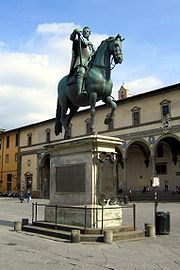
Tacca began by finishing Giambologna's equestrian bronze of Ferdinand de' Medici for the Piazza della SS. Annunziata
Basilica della Santissima Annunziata di Firenze
The Basilica della Santissima Annunziata is a Roman Catholic minor basilica in Florence, Italy, the mother church of the Servite order. It is located at the northeastern side of the Piazza Santissima Annunziata....
, a project in which he had participated at every stage, from the terracotta models to the casting process in the fall of 1602 and the finishing (by 1608). This work was cast with the bronze from the cannons of captured Barbary and Ottoman galleys, taken by the Order of Saint Stephen
Order of Saint Stephen
The Order of Saint Stephen is a Tuscan dynastic-military order founded in 1561. The order was created by Cosimo I de' Medici, first Grand Duke of Tuscany. The last member of the Medici dynasty to be a leader of the order was Gian Gastone de Medici in 1737...
, of which the Grand Duke Ferdinando I de' Medici
Ferdinando I de' Medici, Grand Duke of Tuscany
Ferdinando I de' Medici, Grand Duke of Tuscany was Grand Duke of Tuscany from 1587 to 1609, having succeeded his older brother Francesco I.-Biography:...
was Grand Master.
Tacca's public works for the Medici include his masterpieces, the "four Moors", representing captured Barbary corsairs
Barbary corsairs
The Barbary Corsairs, sometimes called Ottoman Corsairs or Barbary Pirates, were pirates and privateers who operated from North Africa, based primarily in the ports of Tunis, Tripoli and Algiers. This area was known in Europe as the Barbary Coast, a term derived from the name of its Berber...
or Ottoman pirates (1620–24) at the foot of Baccio Bandinelli's statue of Ferdinand I de' Medici, intended to celebrate the above mentioned victories, in Piazza della Darsena, Livorno
Livorno
Livorno , traditionally Leghorn , is a port city on the Tyrrhenian Sea on the western edge of Tuscany, Italy. It is the capital of the Province of Livorno, having a population of approximately 160,000 residents in 2009.- History :...
. Bronze reproductions of these figures were still being reproduced for connoisseurs in the 18th century. One of Tacca's disciples, Taddeo di Michele, executed a trophy of Barbary arms accompanying the prisoners; it was looted by French troops in 1799 and is now in the Louvre
Louvre
The Musée du Louvre – in English, the Louvre Museum or simply the Louvre – is one of the world's largest museums, the most visited art museum in the world and a historic monument. A central landmark of Paris, it is located on the Right Bank of the Seine in the 1st arrondissement...
Museum.
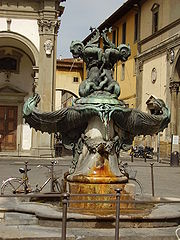
Grotesque
The word grotesque comes from the same Latin root as "Grotto", meaning a small cave or hollow. The original meaning was restricted to an extravagant style of Ancient Roman decorative art rediscovered and then copied in Rome at the end of the 15th century...
masks and shellwork textures, were set up instead in Piazza della SS. Annunziata, Florence. For Giambologna's equestrian statue of Cosimo de' Medici in the Piazza della Signoria
Piazza della Signoria
Piazza della Signoria is an L-shaped square in front of the Palazzo Vecchio in Florence, Italy. It was named after the Palazzo della Signoria, also called Palazzo Vecchio....
, Tacca contributed the bas-relief panels on its base.
Taking his inspiration from a famous marble copy of a Hellenistic marble boar (Il Cinghiale) in the ducal collection at the Uffizi
Uffizi
The Uffizi Gallery , is a museum in Florence, Italy. It is one of the oldest and most famous art museums of the Western world.-History:...
, Tacca set himself the task of surpassing it: the result is the Porcellino
Porcellino
Il Porcellino is the local Florentine nickname for the bronze fountain of a boar.Originally intended for the Boboli Garden, then moved in the Mercato Nuovo in Florence, Italy. the fountain was placed originally facing east, in via Calimala, in front of the Farmacia del Cinghiale, which is the...
(1612) of the Mercato Nuovo, Florence.
For Madrid, Tacca executed Giambologna's equestrian bronze of Philip III
Philip III of Spain
Philip III , also known as Philip the Pious, was the King of Spain and King of Portugal and the Algarves, where he ruled as Philip II , from 1598 until his death...
(1616), which was moved in the 19th century to the Plaza Mayor. For Paris, by order of Marie de Medici he finished Giambologna's equestrian Henry IV
Henry IV of France
Henry IV , Henri-Quatre, was King of France from 1589 to 1610 and King of Navarre from 1572 to 1610. He was the first monarch of the Bourbon branch of the Capetian dynasty in France....
(inaugurated August 23, 1613), which stood at the center of the Pont-Neuf but was destroyed in 1792 during the Revolution, then replaced with the present sculpture at the Restauration
Restauration
Restauration is French for restoration.Restauration can refer to:*European Restoration, the return of many monarchies after Napoleon's French were defeated.** Bourbon Restoration, the restoration of the French monarchy under Louis XVIII....
.
Tacca's last public commission was the colossal equestrian bronze of Philip IV
Philip IV of Spain
Philip IV was King of Spain between 1621 and 1665, sovereign of the Spanish Netherlands, and King of Portugal until 1640...
, said to have been based on the iconography of a lost painting by Rubens; it was begun in 1634 and shipped to Madrid in 1640, the year of his death. The sculpture, atop a complicated fountain composition, forms the centerpiece of the façade of the Royal Palace
Royal Palace of Madrid
The Palacio Real de Madrid is the official residence of the King of Spain in the city of Madrid, but it is only used for state ceremonies. King Juan Carlos and the Royal Family do not reside in the palace, choosing instead the more modest Palacio de la Zarzuela on the outskirts of Madrid...
. The daring stability of the statue was calculated by Galileo Galilei
Galileo Galilei
Galileo Galilei , was an Italian physicist, mathematician, astronomer, and philosopher who played a major role in the Scientific Revolution. His achievements include improvements to the telescope and consequent astronomical observations and support for Copernicanism...
: the horse rears, and the entire weight of the sculpture balances on the two rear legs—and, discreetly, its tail— a feat that had never been attempted in a figure on a heroic scale, of which Leonardo
Leonardo da Vinci
Leonardo di ser Piero da Vinci was an Italian Renaissance polymath: painter, sculptor, architect, musician, scientist, mathematician, engineer, inventor, anatomist, geologist, cartographer, botanist and writer whose genius, perhaps more than that of any other figure, epitomized the Renaissance...
had dreamed.
His son Ferdinando Tacca assisted him in the atelier; the inventory (1687) after his death included sculptures doubtless by Pietro Tacca http://www.liechtensteinmuseum.at/de/pages/artbase_main.asp?module=browse&action=m_work&lang=de&sid=674783807&oid=W-542005134758570. The studio was taken over by Giovanni Battista Foggini
Giovanni Battista Foggini
thumb|Tomb of [[Galileo Galilei]] in [[Santa Croce, Florence]].Giovanni Battista Foggini was an Italian sculptor active in Florence, renowned mainly for small bronze statuary.-Biography:...
upon the death of Ferdinando in Florence.
Works in museum collections
- BargelloBargelloThe Bargello, also known as the Bargello Palace or Palazzo del Popolo is a former barracks and prison, now an art museum, in Florence, Italy.-Terminology:...
, Florence: a representative selection of his small bronzes of animals - J. Paul Getty Museum: Two putti holding shields, 1650–55
- Hermitage, St Petersburg: Boy blowing a horn c. 1620
- Fine Arts Museums of San Francisco: Slave (18th century reduction)
- National Gallery, Washington DC: Several bronzes attributed to Pietro Tacca in the Robert H. Smith Collection (Checklist, 2002; pdf file)
- Liechtenstein Museum, Vienna: Heracles Supporting the World from the collection of Louis XIV
- Frick Collection, New York: Nessus and Deianira after a model by Giambologna, now attributed to Pietro Tacca
Further reading
- K.J.Watson 1973. Pietro Tacca, successor to Giovanni Bologna: the first twenty-five years in the Borgo Pinti Studio: 1592-1617 Philadelphia:University of Pennsylvania)
- P. Torriti 1975. Pietro Tacca di Carrara, (Genoa)