


Piazza della Signoria

Encyclopedia
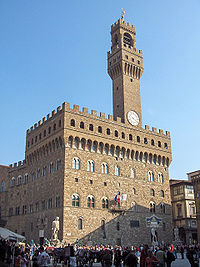
Palazzo Vecchio
The Palazzo Vecchio is the town hall of Florence, Italy. This massive, Romanesque, crenellated fortress-palace is among the most impressive town halls of Tuscany...
in Florence
Florence
Florence is the capital city of the Italian region of Tuscany and of the province of Florence. It is the most populous city in Tuscany, with approximately 370,000 inhabitants, expanding to over 1.5 million in the metropolitan area....
, Italy
Italy
Italy , officially the Italian Republic languages]] under the European Charter for Regional or Minority Languages. In each of these, Italy's official name is as follows:;;;;;;;;), is a unitary parliamentary republic in South-Central Europe. To the north it borders France, Switzerland, Austria and...
. It was named after the Palazzo della Signoria, also called Palazzo Vecchio.
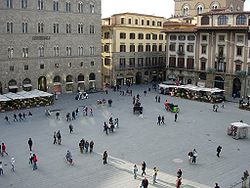
It is the focal point of the origin and of the history of the Florentine Republic and still maintains its reputation as the political hub of the city. It is the meeting place of Florentines as well as the numerous tourists, located near Ponte Vecchio
Ponte Vecchio
The Ponte Vecchio is a Medieval stone closed-spandrel segmental arch bridge over the Arno River, in Florence, Italy, noted for still having shops built along it, as was once common. Butchers initially occupied the shops; the present tenants are jewellers, art dealers and souvenir sellers...
and Piazza del Duomo
Piazza del Duomo, Florence
Piazza del Duomo is located in the heart of the historic center of Florence, .It is one of the most visited places in Europe and the world; here we can find the Florence Cathedral with the Cupola del Brunelleschi, the Giotto's Campanile, the Florence Baptistery, the Loggia del Bigallo, the Opera...
and gateway to Uffizi Gallery
Uffizi
The Uffizi Gallery , is a museum in Florence, Italy. It is one of the oldest and most famous art museums of the Western world.-History:...
.
Buildings
The impressive 14th century Palazzo Vecchio is still preeminent with its crenellated tower. The square is also shared with the Loggia della Signoria, the Uffizi Gallery, the Palace of the Tribunale della Mercanzia (1359) (now the Bureau of Agriculture), and the Palazzo UguccioniPalazzo Uguccioni
Palazzo Uguccioni is a Renaissance palace on the Piazza della Signoria in Florence, central Italy.The palace was built, over pre-existing structures, for Giovanni Uguccioni starting from 1550...
(1550, with a facade attributed to Raphael
Raphael
Raffaello Sanzio da Urbino , better known simply as Raphael, was an Italian painter and architect of the High Renaissance. His work is admired for its clarity of form and ease of composition and for its visual achievement of the Neoplatonic ideal of human grandeur...
, who however died thirty years before its construction). Located in front of the Palazzo Vecchio is the Palace of the Assicurazioni Generali (1871, built in Renaissance style).
Palazzo Vecchio
The Palazzo VecchioPalazzo Vecchio
The Palazzo Vecchio is the town hall of Florence, Italy. This massive, Romanesque, crenellated fortress-palace is among the most impressive town halls of Tuscany...
("Old Palace") is the town hall
City hall
In local government, a city hall, town hall or a municipal building or civic centre, is the chief administrative building of a city...
of the city. This massive, Romanesque
Romanesque architecture
Romanesque architecture is an architectural style of Medieval Europe characterised by semi-circular arches. There is no consensus for the beginning date of the Romanesque architecture, with proposals ranging from the 6th to the 10th century. It developed in the 12th century into the Gothic style,...
, crenellated fortress-palace is among the most impressive town halls of Tuscany
Tuscany
Tuscany is a region in Italy. It has an area of about 23,000 square kilometres and a population of about 3.75 million inhabitants. The regional capital is Florence ....
. Overlooking the square with its copy of Michelangelo's David statue as well the gallery of statues in the adjacent Loggia dei Lanzi
Loggia dei Lanzi
The Loggia dei Lanzi, also called the Loggia della Signoria, is a building on a corner of the Piazza della Signoria in Florence, Italy, adjoining the Uffizi Gallery. It consists of wide arches open to the street, three bays wide and one bay deep. The arches rest on clustered pilasters with...
, it is one of the most significant public places in Italy, and it host cultural points and museums.
Originally called the Palazzo della Signoria, after the Signoria of Florence
Signoria of Florence
The Signoria was the government of medieval and renaissance Florence. Its nine members, the Priori, were chosen from the ranks of the guilds of the city: six of them from the major guilds, and two from the minor guilds...
, the ruling body of the Republic of Florence
Republic of Florence
The Republic of Florence , or the Florentine Republic, was a city-state that was centered on the city of Florence, located in modern Tuscany, Italy. The republic was founded in 1115, when the Florentine people rebelled against the Margraviate of Tuscany upon Margravine Matilda's death. The...
, it was also given several other names: Palazzo del Popolo, Palazzo dei Priori, and Palazzo Ducale, in accordance with the varying use of the palace during its long history. The building acquired its current name when the Medici duke's residence was moved across the Arno to the Palazzo Pitti
Palazzo Pitti
The Palazzo Pitti , in English sometimes called the Pitti Palace, is a vast mainly Renaissance palace in Florence, Italy. It is situated on the south side of the River Arno, a short distance from the Ponte Vecchio...
.
Loggia dei Lanzi
The Loggia dei LanziLoggia dei Lanzi
The Loggia dei Lanzi, also called the Loggia della Signoria, is a building on a corner of the Piazza della Signoria in Florence, Italy, adjoining the Uffizi Gallery. It consists of wide arches open to the street, three bays wide and one bay deep. The arches rest on clustered pilasters with...
consists of wide arches open to the street, three bays
Bay (architecture)
A bay is a unit of form in architecture. This unit is defined as the zone between the outer edges of an engaged column, pilaster, or post; or within a window frame, doorframe, or vertical 'bas relief' wall form.-Defining elements:...
wide and one bay deep. The arches rest on clustered pilasters with Corinthian
Corinthian order
The Corinthian order is one of the three principal classical orders of ancient Greek and Roman architecture. The other two are the Doric and Ionic. When classical architecture was revived during the Renaissance, two more orders were added to the canon, the Tuscan order and the Composite order...
capitals. The wide arches appealed so much to the Florentines, that Michelangelo
Michelangelo
Michelangelo di Lodovico Buonarroti Simoni , commonly known as Michelangelo, was an Italian Renaissance painter, sculptor, architect, poet, and engineer who exerted an unparalleled influence on the development of Western art...
even proposed that they should be continued all around the Piazza della Signoria. The vivacious construction of the Loggia is in stark contrast with the severe architecture of the Palazzo Vecchio. It is effectively an open-air sculpture gallery of antique and Renaissance art including the Medici lions
Medici lions
The Medici lions are two lion sculptures placed around 1600 at the Villa Medici, Rome, Italy, and since 1789 displayed at the Loggia dei Lanzi, Florence. The sculptures depict standing male lions with a sphere under one claw, looking to the side...
.
Tribunale della Mercanzia
The Tribunale della Mercanzia (Tribunal of Merchandise) is a building where in the past lawyers judged in the trial between merchants. Here were a porch painted by Taddeo GaddiTaddeo Gaddi
Taddeo Gaddi was a medieval Italian painter and architect.-Biography:He was the son of Gaddo di Zanobi, called Gaddo Gaddi. He was a member of Giotto's workshop from 1313 to 1337, when his master died...
, Antonio del Pollaiolo and Sandro Botticelli
Sandro Botticelli
Alessandro di Mariano di Vanni Filipepi, better known as Sandro Botticelli was an Italian painter of the Early Renaissance...
, today stored in the Uffizi gallery
Uffizi
The Uffizi Gallery , is a museum in Florence, Italy. It is one of the oldest and most famous art museums of the Western world.-History:...
.
Palazzo Uguccioni
Built for Giovanni Uguccioni since 1550, its design has been variously attributed to RaphaelRaphael
Raffaello Sanzio da Urbino , better known simply as Raphael, was an Italian painter and architect of the High Renaissance. His work is admired for its clarity of form and ease of composition and for its visual achievement of the Neoplatonic ideal of human grandeur...
, Michelangelo
Michelangelo
Michelangelo di Lodovico Buonarroti Simoni , commonly known as Michelangelo, was an Italian Renaissance painter, sculptor, architect, poet, and engineer who exerted an unparalleled influence on the development of Western art...
, Bartolomeo Ammannati or Raffaello da Montelupo
Raffaello da Montelupo
Raffaello da Montelupo , born Raffaele Sinibaldi, was a sculptor and architect of the Italian Renaissance, and an apprentice of Michelangelo. He was the son of another Italian sculptor, Baccio da Montelupo...
.
Palazzo delle Assicurazioni Generali
The Palazzo delle Assicurazioni GeneraliPalazzo delle Assicurazioni Generali (Florence)
The Palazzo delle Assicurazioni Generali is a building in the Piazza della Signoria in Florence, Italy. It was designed in the Neo-Renaissance style in 1871, and is one of the very few purpose built commercial buildings in the centre of the city....
was designed in the Neo-Renaissance
Neo-Renaissance
Renaissance Revival is an all-encompassing designation that covers many 19th century architectural revival styles which were neither Grecian nor Gothic but which instead drew inspiration from a wide range of classicizing Italian modes...
style in 1871, and is one of the very few purpose built commercial
Commerce
While business refers to the value-creating activities of an organization for profit, commerce means the whole system of an economy that constitutes an environment for business. The system includes legal, economic, political, social, cultural, and technological systems that are in operation in any...
buildings in the centre of the city. At the ground-floor of this palace it's present the historical cafè Rivoire.
Other palaces
Other palaces are the palazzo dei Buonaguisi and the palazzo dell'Arte dei Mercatanti.Statues
The various eye-catching statues in this square include:- At the entrance of the Palazzo Vecchio, a copy of David. The original by MichelangeloMichelangeloMichelangelo di Lodovico Buonarroti Simoni , commonly known as Michelangelo, was an Italian Renaissance painter, sculptor, architect, poet, and engineer who exerted an unparalleled influence on the development of Western art...
is being kept at the Gallery of the Academy of Fine ArtsAccademia di Belle Arti FirenzeThe Accademia di Belle Arti is an art academy in Florence, Italy and it is now the operative branch of the still existing Accademia delle Arti del Disegno that was the first academy of drawing in Europe.-History:The Accademia delle Arti del Disegno The Accademia di Belle Arti ("Academy of Fine...
. - The "bronze equestrian statue of Cosimo I" by GiambolognaGiambolognaGiambologna, born as Jean Boulogne, incorrectly known as Giovanni da Bologna and Giovanni Bologna , was a sculptor, known for his marble and bronze statuary in a late Renaissance or Mannerist style.- Biography :...
(1594) - The Fountain of NeptuneFountain of NeptuneThe Fountain of Neptune is a fountain in Florence, Italy, situated on the Piazza della Signoria , in front of the Palazzo Vecchio....
by Bartolomeo Ammannati (1575) - "The Lion", referred to as "il MarzoccoMarzoccoThe Marzocco is the heraldic lion, best known in the rendition sculpted by Donatello in 1418–20, that is a symbol of Florence.Donatello's Marzocco was commissioned by the Republic of Florence for the apartment of Pope Martin V at Santa Maria Novella, where this traditional insegna of...
" with a copy of the "Florentine Lily", originally made by DonatelloDonatelloDonato di Niccolò di Betto Bardi , also known as Donatello, was an early Renaissance Italian artist and sculptor from Florence...
(copy) - "Judith and Holofernes", by DonatelloDonatelloDonato di Niccolò di Betto Bardi , also known as Donatello, was an early Renaissance Italian artist and sculptor from Florence...
(copy) - "Hercules and CacusHercules and CacusThe white marble sculpture Hercules and Cacus is to the right of the entrance of the Palazzo Vecchio in the Piazza della Signoria, Florence, Italy....
", by Bandinelli (1533) - "The Rape of the Sabine WomenThe Rape of the Sabine WomenThe Rape of the Sabine Women is an episode in the legendary history of Rome in which the first generation of Roman men acquired wives for themselves from the neighboring Sabine families. The English word "rape" is a conventional translation of Latin raptio, which in this context means "abduction"...
", by GiambolognaGiambolognaGiambologna, born as Jean Boulogne, incorrectly known as Giovanni da Bologna and Giovanni Bologna , was a sculptor, known for his marble and bronze statuary in a late Renaissance or Mannerist style.- Biography :... - "Perseus with the Head of MedusaPerseus with the Head of MedusaPerseus with the Head of Medusa is a recurring theme in artwork, depicting an event from Greek mythology in which the hero Perseus holds up the severed head of the gorgon Medusa....
", by Cellini (1554) - "Medici lionsMedici lionsThe Medici lions are two lion sculptures placed around 1600 at the Villa Medici, Rome, Italy, and since 1789 displayed at the Loggia dei Lanzi, Florence. The sculptures depict standing male lions with a sphere under one claw, looking to the side...
", by Fancelli and VaccaFlaminio VaccaFlaminio Vacca or Vacchi was an Italian sculptor. His sculptural work can be seen in Rome in the grandiose funeral chapel of Pope Pius V designed by Domenico Fontana at the Basilica di Santa Maria Maggiore , in the Church of the Gesù and in the right transept of...
(1598)
The piazza was already a central square in the original Roman town Florentia, surrounded by a theatre, Roman baths and a workshop for dyeing textiles. Later there was a church San Romolo, a loggia and an enormous 5th c. basilica. This was shown by the archaeological treasures found beneath the square when it was repaved in the 1980s. Even remains of a Neolithic
Neolithic
The Neolithic Age, Era, or Period, or New Stone Age, was a period in the development of human technology, beginning about 9500 BC in some parts of the Middle East, and later in other parts of the world. It is traditionally considered as the last part of the Stone Age...
site were found. The square started taking shape from 1268 on, when houses of Ghibellines were pulled down by the victorious Guelph
Guelphs and Ghibellines
The Guelphs and Ghibellines were factions supporting the Pope and the Holy Roman Emperor, respectively, in central and northern Italy. During the 12th and 13th centuries, the split between these two parties was a particularly important aspect of the internal policy of the Italian city-states...
s. The square remained a long time untidy, full of holes. In 1385 it was paved for the first time. In 1497 Girolamo Savonarola
Girolamo Savonarola
Girolamo Savonarola was an Italian Dominican friar, Scholastic, and an influential contributor to the politics of Florence from 1494 until his execution in 1498. He was known for his book burning, destruction of what he considered immoral art, and what he thought the Renaissance—which began in his...
and his followers carried out on this square the famous Bonfire of the Vanities
Bonfire of the Vanities
Bonfire of the Vanities refers to the burning of objects that are deemed to be occasions of sin. The most infamous one took place on 7 February 1497, when supporters of the Dominican priest Girolamo Savonarola collected and publicly burned thousands of objects like cosmetics, art, and books in...
, burning in a large pile books, gaming tables, fine dresses, and works of poets. In front of the fountain of Neptune, a round marble plaque marks the exact spot where Girolamo Savonarola
Girolamo Savonarola
Girolamo Savonarola was an Italian Dominican friar, Scholastic, and an influential contributor to the politics of Florence from 1494 until his execution in 1498. He was known for his book burning, destruction of what he considered immoral art, and what he thought the Renaissance—which began in his...
was hanged and burned on May 23, 1498.