

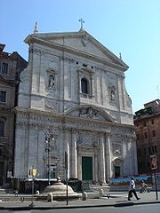
Santa Maria in Vallicella

Encyclopedia
Churches of Rome
There are more than 900 churches in Rome. Most, but not all, of these are Roman Catholic, with some notable Roman Catholic Marian churches.The first churches of Rome originated in places where Christians met. They were divided into three categories:...
Rome
Rome
Rome is the capital of Italy and the country's largest and most populated city and comune, with over 2.7 million residents in . The city is located in the central-western portion of the Italian Peninsula, on the Tiber River within the Lazio region of Italy.Rome's history spans two and a half...
, Italy
Italy
Italy , officially the Italian Republic languages]] under the European Charter for Regional or Minority Languages. In each of these, Italy's official name is as follows:;;;;;;;;), is a unitary parliamentary republic in South-Central Europe. To the north it borders France, Switzerland, Austria and...
, which today faces onto the main thoroughfare of the Corso Vittorio Emanuele. It is the principal church of the Oratorians, a religious congregation of secular priests, founded by St Philip Neri in 1561 at a time in the 16th century when the Counter Reformation saw the emergence of a number of new religious organisations such as the Society of Jesus
Society of Jesus
The Society of Jesus is a Catholic male religious order that follows the teachings of the Catholic Church. The members are called Jesuits, and are also known colloquially as "God's Army" and as "The Company," these being references to founder Ignatius of Loyola's military background and a...
(Jesuits), the Theatines and the Barnabites.
History
St. Gregory the GreatPope Gregory I
Pope Gregory I , better known in English as Gregory the Great, was pope from 3 September 590 until his death...
built the first church on the site. By the 12th century, it was dedicated to Santa Maria in Vallicella ("Our Lady in the Little Valley").
In 1575, Pope Gregory XIII recognised Neri's group as a religious Congregation and gave them the church and its small attached convent
Convent
A convent is either a community of priests, religious brothers, religious sisters, or nuns, or the building used by the community, particularly in the Roman Catholic Church and in the Anglican Communion...
.
St. Philip Neri, helped by Cardinal Pier Donato Cesi
Pier Donato Cesi (1521-1586)
Pier Donato Cesi was an Italian Catholic Cardinal. He is sometimes referred to as Pier Donato Cesi, seniore to differentiate between him and his relative Pier Donato Cesi iuniore ....
and Pope Gregory XIII
Pope Gregory XIII
Pope Gregory XIII , born Ugo Boncompagni, was Pope from 1572 to 1585. He is best known for commissioning and being the namesake for the Gregorian calendar, which remains the internationally-accepted civil calendar to this date.-Youth:He was born the son of Cristoforo Boncompagni and wife Angela...
, had the church rebuilt, starting in 1575. When Pierdonato died, his brother Angelo Cesi, Bishop of Todi, continued his family's patronage. Initially the architect was Matteo di Città di Castello, but he was replaced later by Martino Longhi
Martino Longhi
Martino Longhi is the name of two related architects in Rome:*Martino Longhi the Elder *Martino Longhi the Younger , son of Onorio Longhi and grandson of Martino the elder...
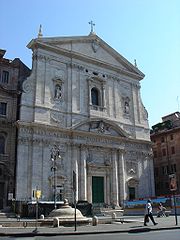
the Elder. The nave was completed in 1577, and the church was consecrated in 1599. The facade
Facade
A facade or façade is generally one exterior side of a building, usually, but not always, the front. The word comes from the French language, literally meaning "frontage" or "face"....
, designed by Fausto Rughesi, was completed in 1605 or 1606. The Cesi heraldry
Heraldry
Heraldry is the profession, study, or art of creating, granting, and blazoning arms and ruling on questions of rank or protocol, as exercised by an officer of arms. Heraldry comes from Anglo-Norman herald, from the Germanic compound harja-waldaz, "army commander"...
is still evident in the church.
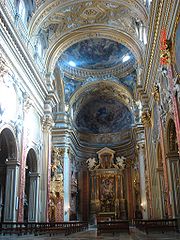
Interior
The ground plan follows the Counter-ReformationCounter-Reformation
The Counter-Reformation was the period of Catholic revival beginning with the Council of Trent and ending at the close of the Thirty Years' War, 1648 as a response to the Protestant Reformation.The Counter-Reformation was a comprehensive effort, composed of four major elements:#Ecclesiastical or...
design of churches established at the Gesù
Church of the Gesu
The Church of the Gesù is the mother church of the Society of Jesus, a Roman Catholic religious order also known as the Jesuits. Officially named , its facade is "the first truly baroque façade", introducing the baroque style into architecture ,. The church served as model for innumerable Jesuit...
; a single main nave with transepts and side chapels, leading towards the High Altar. Neri had intended that the interior be plain with whitewashed walls but it was filled by patrons with various artistic works, mainly during the period from 1620 to 1690, including masterworks by some of the principal artists of those decades in Rome. It is renowned for its altarpieces by Barocci, Pietro da Cortona
Pietro da Cortona
Pietro da Cortona, by the name of Pietro Berrettini, born Pietro Berrettini da Cortona, was the leading Italian Baroque painter of his time and also one of the key architects in the emergence of Roman Baroque architecture. He was also an important decorator...
's ceilings, and the Rubens
Rubens
Rubens is often used to refer to Peter Paul Rubens , the Flemish artist.Rubens may also refer to:- People :Family name* Paul Rubens Rubens is often used to refer to Peter Paul Rubens (1577-1640), the Flemish artist.Rubens may also refer to:- People :Family name* Paul Rubens (composer) Rubens is...
slate and copper altarpiece.
Pietro da Cortona
Pietro da Cortona
Pietro da Cortona, by the name of Pietro Berrettini, born Pietro Berrettini da Cortona, was the leading Italian Baroque painter of his time and also one of the key architects in the emergence of Roman Baroque architecture. He was also an important decorator...
's decorations include the 'Trinity' in the dome (painted 1647-51). The prophets 'Isiah', 'Jeremiah', 'Daniel' and 'Ezechiel' in the four pendentives were painted in 1655-6 and 1659-60 along with his fresco of the 'Assumption of the Virgin' adorning the apse. There is an implied visual continuum between the dome and the apse fresoes aided by the fact that there is no dome drum; the assumpting Virgin (in the apse) raises her eyes towards Heaven and the Father (in the dome) extends his hand as if bestowing His blessings upon her.
Cortona's nave vault fresco of the 'Miracle of the Madonna della Vallicella' was executed in 1664-5. This is clearly set within an elaborated gold frame, a quadro riportato, and is painted with a Venetian influenced view of di sotto in su (from below to above). His designs for the vault decoration around the painting, with elaborate white and gilt stucco work incorporating figurative, geometrical and naturalistic elements, were carried out by Cosimo Fancelli
Cosimo Fancelli
Cosimo Fancelli was an Italian sculptor of the Baroque period, active mainly in Rome. He was the son of the artist Carlo Fancelli from Arezzo. Like his brother, the sculptor Giacomo Antonio Fancelli, he began his career as an assistant in the studio of Bernini...
and Ercole Ferrata
Ercole Ferrata
Ercole Ferrata was an Italian sculptor of the Roman Baroque.-Biography:A native of Pellio Inferiore, near Como, Ferrata initially apprenticed with Alessandro Algardi, and became one of his prime assistants...
.
The walls of the nave and transept, as well as the presbitery ceiling, have canvases of Episodes of the Old and New Testament are by Lazzaro Baldi
Lazzaro Baldi
Lazzaro Baldi was an Italian painter of the Baroque period, active mainly in Rome.-Biography:Baldi was born in Pistoia and died in Rome. He was part of the large studio of Pietro da Cortona, and became adept at fresco technique. He painted a David and Goliath for Alexander VII in the Palazzo...
, Giuseppe Ghezzi
Giuseppe Ghezzi
Giuseppe Ghezzi was an Italian painter of the Baroque period, active mainly in Rome.Born in Ascoli Piceno, Marche , he was the son and pupil of the painter Sebastiano Ghezzi. He painted in the style of Pietro da Cortona. Giuseppe Ghezzi was the first secretary in perpetuity for the Accademia di...
, Daniele Seiter, Giuseppe Passeri
Giuseppe Passeri
Giuseppe Passeri was an Italian painter of the Baroque period, active in his native city of Rome.Born the nephew of the painter Giovanni Battista Passeri, Giuseppe trained in the studio of Carlo Maratta. Among the paintings by Giuseppe is St...
, and Domenico Parodi.
The first altarpiece on the right is a Crucifixion by Pulzone
Scipione Pulzone
Scipione Pulzone , also known as Il Gaetano, was an Italian late Renaissance Mannerist or, more properly, "counter-Maniera" painter active in Rome...
with a ceiling fresco painted by Lanfranco
Giovanni Lanfranco
Giovanni Lanfranco was an Italian painter of the Baroque period.-Biography:Giovanni Gaspare Lanfranco was born in Parma, the third son of Stefano and Cornelia Lanfranchi, and was placed as a page in the household of Count Orazio Scotti...
. The third altarpiece is an Ascension by Girolamo Muziano
Girolamo Muziano
Girolamo Muziano , was an Italian painter, active in a late-Renaissance or Mannerism style. He was born in Acquafredda, near Brescia, but active mainly in Rome....
, the fourth, a Pentecost by Giovanni Maria Morandi
Giovanni Maria Morandi
Giovanni Maria Morandi was an Italian painter, mainly active in Rome and his natal city of Florence, but also Venice.In Rome, he painted numerous altarpieces, including the Death of Mary in the church of Santa Maria della Pace, but also works in Santa Maria in Vallicella and Santa Maria del Popolo...
; the fifth, an Assumption by Cerrini
Giovanni Domenico Cerrini
Giovanni Domenico Cerrini , also called Gian Domenico Cerrini or il Cavalier Perugino, was an Italian painter of the Baroque period, active mainly in Rome and influenced in large part by painter of the Bolognese School.-Biography:...
. In the transept is a Coronation of Mary by the Cavaliere d'Arpino
Giuseppe Cesari
Giuseppe Cesari was an Italian Mannerist painter, also named Il Giuseppino and called Cavaliere d'Arpino, because he was created Cavaliere di Cristo by his patron Pope Clement VIII. He was much patronized in Rome by both Sixtus V.-Biography:Cesari's father had been a native of Arpino, but...
, who also painted the first altarpiece (Presentation in the Temple) on the right.
In the right presbytery, is the Spada
Spada
Spada, the Italian for sword, is a surname of Italian origin. The name refers to:*Bernardino Spada , Italian Roman Catholic cardinal; patron of the arts; eponym of Palazzo Spada and Galleria Spada*Ercole Spada Spada, the Italian for sword, is a surname of Italian origin. The name refers...
family chapel completed in 1593 by Rainaldi
Carlo Rainaldi
Carlo Rainaldi was an Italian architect of the Baroque period.Born in Rome, Rainaldi was one of the leading architects of 17th century Rome, known for a certain grandeur in his designs. He worked at first with his father, Girolamo Rainaldi, a late Mannerist architect in Rome. After his father's...
. Inside, a Madonna with Child and Santi Carlo Borromeo and Ignazio di Loyola (1675) was painted by Maratta
Carlo Maratta
Carlo Maratta or Maratti was an Italian painter, active mostly in Rome, and known principally for his classicizing paintings executed in a Late Baroque Classical manner. Although he is part of the classical tradition stemming from Raphael, he was not exempt from the influence of Baroque painting...
. In the central presbytery, the bronze ciborium was designed by Ciro Ferri
Ciro Ferri
Ciro Ferri was an Italian Baroque sculptor and painter, the chief pupil and successor of Pietro da Cortona.He was born in Rome, where he began working under Cortona and with a team of artists in the extensive fresco decorations of the Quirinal Palace...
in 1681. The Virgin with child and two lateral paintings, Santi Domitilla, Nereo and Achilleo, Santi Gregorio Magno, Mauro and Papia (1606–1608) are among the few works painted by Peter Paul Rubens created specifically for a Roman commission. When installed, the three slate panels are said to have caused a 'stir' among observers in Rome, who were generally unaccustomed to the Flemish painterly style. The Rubens altarpiece was commissioned by Monsignor Jacopo Serra for 300 scudi.
In the left transept is a Presentation of Mary to the Temple (1593-4) by Federico Barocci
Federico Barocci
Federico Barocci was an Italian Renaissance painter and printmaker. His original name was Federico Fiori, and he was nicknamed Il Baroccio, which still in northwestern Italian dialects means a two wheel cart drawn by oxen...
. He completed two altarpieces that were highly admired in his time, including one in the Chapel of the Visitation (1583–86).
The sacristy was begun in 1621 based on architectural plans by Mario Arconio and completed by Paolo Maruscelli in 1629. In the sacristy is a marble sculptural group of S. Filippo with an Angel by Alessandro Algardi
Alessandro Algardi
Alessandro Algardi was an Italian high-Baroque sculptor active almost exclusively in Rome, where for the latter decades of his life, he was the major rival of Gian Lorenzo Bernini.-Early years:...
. The wall frescoes are by Francesco Trevisani
Francesco Trevisani
thumb|250px|Portrait of [[Pietro Ottoboni |Cardinal Pietro Ottoboni]] by Francesco Trevisani. The [[Bowes Museum]], [[Barnard Castle]], [[County Durham]], [[England]]....
and the Benediction by Christ by Cerrini
Giovanni Domenico Cerrini
Giovanni Domenico Cerrini , also called Gian Domenico Cerrini or il Cavalier Perugino, was an Italian painter of the Baroque period, active mainly in Rome and influenced in large part by painter of the Bolognese School.-Biography:...
with the ceiling frescoed with Angels carrying the instruments of the Passion (1633–34) by Pietro da Cortona
Cortona
Cortona is a town and comune in the province of Arezzo, in Tuscany, Italy. It is the main cultural and artistic center of the Val di Chiana after Arezzo.-History:...
.
The fifth altarpiece on the left is an Annunciation by the Passignano
Domenico Passignano
Domenico Passignano , born Cresti or Crespi, was an Italian painter of a late-Renaissance or Contra-Maniera style that emerged in Florence towards the end of the 16th century.- Biography :...
; the fourth, a Visitation by Barocci with the ceiling frescoed with Saints by Saraceni
Carlo Saraceni
Carlo Saraceni was an Italian early-Baroque painter, whose reputation as a "first-class painter of the second rank" was improved with the publication of a modern monograph in 1968....
. In the third Adoration by the Shepherds by Durante Alberti
Durante Alberti
Durante Alberti was an Italian painter of the late-Renaissance period.He was born in Borgo San Sepolcro. He was active mainly in his native town and Rome, where he arrived during the papacy of Gregory XIII. He was also called Durante del Nero. His father was Romano Alberti. His son Pierfrancesco...
and the vault frescoed with a Saint by Cristofano Roncalli. The second altarpiece is an Adoration by the Magi by Cesare Nebbia
Cesare Nebbia
Cesare Nebbia is an Italian painter from Orvieto who painted in a Mannerist style.-Biography:He trained with Girolamo Muziano, and under this master, he helped complete a flurry of decoration that was added to the Cathedral of Orvieto in the 1560s...
; the first, a 'Presentation to the Temple by d'Arpino
Giuseppe Cesari
Giuseppe Cesari was an Italian Mannerist painter, also named Il Giuseppino and called Cavaliere d'Arpino, because he was created Cavaliere di Cristo by his patron Pope Clement VIII. He was much patronized in Rome by both Sixtus V.-Biography:Cesari's father had been a native of Arpino, but...
.
One painting that did not stay in its intended chapel is worth recording; Caravaggio
Caravaggio
Michelangelo Merisi da Caravaggio was an Italian artist active in Rome, Naples, Malta, and Sicily between 1593 and 1610. His paintings, which combine a realistic observation of the human state, both physical and emotional, with a dramatic use of lighting, had a formative influence on the Baroque...
's altarpiece of the Entombment of Christ
The Entombment of Christ (Caravaggio)
The Entombment of Christ is a painting by Michelangelo Merisi da Caravaggio. It was painted for Santa Maria in Vallicella, a church built for the Oratory of Saint Philip Neri, and adjacent to the buildings of the order...
was commissioned by Alessandro Vittrice, nephew of one of Saint Philip's friends, and depicted the entombment in a radically naturalistic format, foreign to the grand manner found in the remaining altarpieces. The original is in the Vatican
Vatican City
Vatican City , or Vatican City State, in Italian officially Stato della Città del Vaticano , which translates literally as State of the City of the Vatican, is a landlocked sovereign city-state whose territory consists of a walled enclave within the city of Rome, Italy. It has an area of...
Pinacoteca.
Neri is buried in the chapel to the left of the choir, which is dedicated to him, in a tomb decorated with mother-of-pearl
Nacre
Nacre , also known as mother of pearl, is an organic-inorganic composite material produced by some mollusks as an inner shell layer; it is also what makes up pearls. It is very strong, resilient, and iridescent....
. Designed by Onorio Longhi
Onorio Longhi
Onorio Longhi was an Italian architect, the father of Martino Longhi the Younger and the son of Martino Longhi the Elder.Born in Viggiù, Lombardy, Longhi began as assistant for his father, and inherited the latter's commission at his death in 1591...
in 1600, the first octagonal part of the chapel has a central vault painting of St. Philip by Roncalli, and an altarpiece of The Virgin Appearing to St Philip Neri by Guido Reni
Guido Reni
Guido Reni was an Italian painter of high-Baroque style.-Biography:Born in Bologna into a family of musicians, Guido Reni was the son of Daniele Reni and Ginevra de’ Pozzi. As a child of nine, he was apprenticed under the Bolognese studio of Denis Calvaert. Soon after, he was joined in that...
(now a mosaic copy). In the inner and more removed part of the chapel, Cortona added a lantern to let in more light and the dome was redecorated, perhaps by Ciro Ferri.
Adjacent to the church is the Casa dei Filippini or the House of the Oratorians. There is a marked contrast between the pale travertine facade of the church and the brick built facade of the Casa. The Casa includes the Oratory designed by the Baroque architect, Francesco Borromini
Francesco Borromini
Francesco Borromini, byname of Francesco Castelli was an architect from Ticino who, with his contemporaries, Gian Lorenzo Bernini and Pietro da Cortona, was a leading figure in the emergence of Roman Baroque architecture.A keen student of the architecture of Michelangelo and the ruins of...
.