


Sepulchre

Encyclopedia
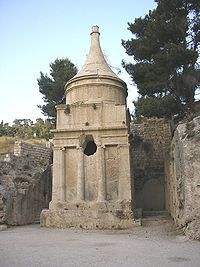
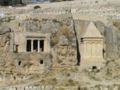
Rock-cut tombs
A rock-cut tomb or Koka is a burial chamber that is cut into the living rock usually along the side of a hill. It was a common form of burial for the wealthy in ancient times in several parts of the world....
constructed in Israel
Israel
The State of Israel is a parliamentary republic located in the Middle East, along the eastern shore of the Mediterranean Sea...
in ancient times. They were cut into the rock, sometimes with elaborate facades and multiple burial chambers. Some are free-standing, but most are caves. Each tomb typically belonged to a single, wealthy family. Bodies were laid out on stone benches. After a generation, the bones were moved to a bone chamber or, later, into ossuaries and the benches used for new burials. Rock tombs were the province of the wealthy; ordinary Jews were buried in the ground.
The tombs date from several periods. The earliest Canaanite cut-rock cave tombs date from 3100–2900 BCE, but the custom had lapsed a millennium before the earliest Israelite tombs, which date to the 9th century BCE in Jerusalem. There are a great many Jewish tombs dating to the Second Temple Period, and others in the late Roman or early Byzantine period.
In the Bible
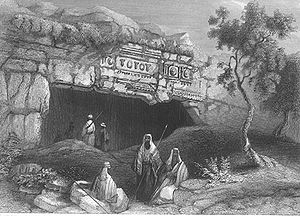
Abraham
Abraham , whose birth name was Abram, is the eponym of the Abrahamic religions, among which are Judaism, Christianity and Islam...
for Sarah
Sarah
Sarah or Sara was the wife of Abraham and the mother of Isaac as described in the Hebrew Bible and the Quran. Her name was originally Sarai...
from Ephron
Ephron
Ephron is the surname of a family of American writers:* Henry Ephron * Phoebe Ephron * Amy Ephron * Delia Ephron * Hallie Ephron , sometimes writes under G. H. Ephron* Nora Ephron...
the Hittite
Biblical Hittites
The Hittites and children of Heth are a people or peoples mentioned in the Hebrew Bible. They are listed in Book of Genesis as second of the twelve Canaanite nations, descended from one Heth...
(Gen. 23:20). Traditionally, this tomb, which may have been either a rock-cut or a natural cave, is identified with the Tomb of the Patriarchs also called the cave of the field of Machpelah. According to very old traditions, Abraham, Rebekah and Jacob
Jacob
Jacob "heel" or "leg-puller"), also later known as Israel , as described in the Hebrew Bible, the Talmud, the New Testament and the Qur'an was the third patriarch of the Hebrew people with whom God made a covenant, and ancestor of the tribes of Israel, which were named after his descendants.In the...
and Leah
Leah
Leah , as described in the Hebrew Bible, is the first of the two concurrent wives of the Hebrew patriarch Jacob and mother of six of sons whose descendants became the Twelve Tribes of Israel, along with at least one daughter, Dinah. She is the daughter of Laban and the older sister of Rachel, whom...
were also buried there(79:29-32). In Acts 7:16 it is said that "Their (Jacob and his family) bodies were brought back to Shechem
Shechem
Shechem was a Canaanite city mentioned in the Amarna letters, and is mentioned in the Hebrew Bible as an Israelite city of the tribe of Manasseh and the first capital of the Kingdom of Israel...
and placed in the tomb that Abraham had bought from the sons of Hamor at Shechem for a certain sum of money."
Additional mentions of rock-cut tombs are found in the Judges
Book of Judges
The Book of Judges is the seventh book of the Hebrew bible and the Christian Old Testament. Its title describes its contents: it contains the history of Biblical judges, divinely inspired prophets whose direct knowledge of Yahweh allows them to act as decision-makers for the Israelites, as...
8:32; 2 Samuel
Books of Samuel
The Books of Samuel in the Jewish bible are part of the Former Prophets, , a theological history of the Israelites affirming and explaining the Torah under the guidance of the prophets.Samuel begins by telling how the prophet Samuel is chosen by...
2:32; Second Kings 9:28; 23:30; 21:26; 23:16; Matthew 27:60
Matthew 27:60
Matthew 27:60 is the sixtieth verse of the twenty-seventh chapter of the Gospel of Matthew in the New Testament. This verse describes the Entombment of Jesus by Joseph of Arimathea after the crucifixion....
). According to the Gospel of Matthew they were sometimes whitewash
Whitewash
Whitewash, or calcimine, kalsomine, calsomine, or lime paint is a very low-cost type of paint made from slaked lime and chalk . Various other additives are also used...
ed (Matthew 23:27, 29).
According to the gospels, the body of Jesus
Jesus
Jesus of Nazareth , commonly referred to as Jesus Christ or simply as Jesus or Christ, is the central figure of Christianity...
was laid in Joseph of Arimathea
Joseph of Arimathea
Joseph of Arimathea was, according to the Gospels, the man who donated his own prepared tomb for the burial of Jesus after Jesus' Crucifixion. He is mentioned in all four Gospels.-Gospel references:...
's new rock-hewn tomb, in a garden near to Calvary
Calvary
Calvary or Golgotha was the site, outside of ancient Jerusalem’s early first century walls, at which the crucifixion of Jesus is said to have occurred. Calvary and Golgotha are the English names for the site used in Western Christianity...
. According to Christian tradition, the Church of the Holy Sepulchre is located on this site. The mouth of such rocky tombs was usually closed by a large stone (Hebrew golal), which could only be removed by the united efforts of several men (Matthew 28:2
Matthew 28:2
Matthew 28:2 is the second verse of the twenty-eighth chapter of the Gospel of Matthew in the New Testament. This verse is part of the resurrection narrative...
; Mark 16:3; John
Gospel of John
The Gospel According to John , commonly referred to as the Gospel of John or simply John, and often referred to in New Testament scholarship as the Fourth Gospel, is an account of the public ministry of Jesus...
11:39).
Canaanite period
Early Canaanite I (3100-2900 BCE) period tombs are the earliest rock-cut tombs yet discovered in Israel; several have been found beneath the OphelOphel
The City of David is the oldest settled neighborhood of Jerusalem and a major archaeological site due to recognition as biblical Jerusalem. It is a narrow ridge running south from the Temple Mount. It was a walled city in the Bronze Age and, according to tradition, it is the place where King...
in Jerusalem. The custom had lapsed by the second millennium.
First Temple period
One of the major collections of rock-cut tombs in Israel is the necropolisNecropolis
A necropolis is a large cemetery or burial ground, usually including structural tombs. The word comes from the Greek νεκρόπολις - nekropolis, literally meaning "city of the dead"...
of the ancient Kingdom of Judah
Kingdom of Judah
The Kingdom of Judah was a Jewish state established in the Southern Levant during the Iron Age. It is often referred to as the "Southern Kingdom" to distinguish it from the northern Kingdom of Israel....
which had its capital in the City of David. These were cut between the 9th and 7th centuries BCE. The necropolis is located on a rocky ridge across the Kidron Valley
Kidron Valley
The Kidron Valley is the valley on the eastern side of The Old City of Jerusalem which features significantly in the Bible...
from the city. The Arab village of Silwan
Silwan
Silwan or Wadi Hilweh is a predominantly Palestinian village adjacent to the Old City of Jerusalem. In recent years a small Jewish minority of 40 families has settled in the area. The village is located in East Jerusalem, an area occupied by Jordan from 1948 until the 1967 Six-day War and by Israel...
was later built atop the necropolis. Although the existence of ancient tombs in the village of Silwan had been known since the 19th-century, the first careful survey was not performed until 1968. Charles Warren
Charles Warren
General Sir Charles Warren, GCMG, KCB, FRS was an officer in the British Royal Engineers. He was one of the earliest European archaeologists of Biblical Holy Land, and particularly of Temple Mount...
, who was thwarted in his efforts to carry out a full survey of the tombs in some of which villagers were living, attributed this to "the hostile nature of the villagers" who he described as "a lawless set." All of the tombs were long since emptied and their contents removed. A great deal of destruction was done to the tombs over the centuries by quarrying and by their conversion for use as housing, both by monks in the Byzantine period, when some were used as churches, and later by Muslim villagers: "When the Arab village was built; tombs were destroyed, incorporated in houses or turned into water cisterns and sewage dumps."
The necropolis, or ancient cemetery, is an archaeological site of major significance. It contains fifty rock-cut tombs of distinguished caliber, assumed to be the burial places of the highest ranking officials of the Judean kingdom. Tomb inscriptions are in Hebrew. The "most famous" of the ancient rock-cut tombs
Rock-cut tombs
A rock-cut tomb or Koka is a burial chamber that is cut into the living rock usually along the side of a hill. It was a common form of burial for the wealthy in ancient times in several parts of the world....
in Silwan is the finely carved monolith
Monolith
A monolith is a geological feature such as a mountain, consisting of a single massive stone or rock, or a single piece of rock placed as, or within, a monument...
known as the Tomb of Pharaoh's daughter
Monolith of Silwan
The Monolith of Silwan, also known as the Tomb of Pharaoh's daughter is a cuboid rock-cut tomb located in Silwan, Jerusalem dating form the period of the Kingdom of Judah; the latter name refers to a recent tradition that the tomb was built by Solomon for his Egyptian wife...
.
Seven of the tombs feature gable
Gable
A gable is the generally triangular portion of a wall between the edges of a sloping roof. The shape of the gable and how it is detailed depends on the structural system being used and aesthetic concerns. Thus the type of roof enclosing the volume dictates the shape of the gable...
d ceilings and extremely fine stonework. David Ussishkin
David Ussishkin
David Ussishkin is an Israeli archaeologist. Now retired as Professor of Archaeology at Tel Aviv University, Ussishkin has directed and co-directed important excavations at a variety of sites, including Lachish, Jezreel and Megiddo....
describes them as "among the most beautifully rock-cut tombs known in the Jerusalem area even when compared with tombs of later periods." In contrast with the extensive family tombs of later periods, these are for single or double burials, with only one of the seven having room for three bodies. Later destruction has effaced the original doorways.
A second tomb type described by Ussishkin has flat ceilings and 1, 2 or 3 chambers of well-dressed stone carefully squared into spacious rooms. One features a rear chamber of especially "impressive" scale and quality. Three "magnificent" tombs in the northern part of the village had been carved to create free-standing buildings above the underground burial chambers. Hebrew inscriptions survive on these three tombs; these are the only ancient inscriptions that survive in Silwan. The Monolith of Silwan
Monolith of Silwan
The Monolith of Silwan, also known as the Tomb of Pharaoh's daughter is a cuboid rock-cut tomb located in Silwan, Jerusalem dating form the period of the Kingdom of Judah; the latter name refers to a recent tradition that the tomb was built by Solomon for his Egyptian wife...
is the only one of the three in which the above-grount chamber survives, although the pyramid-shaped roof is missing because it was quarried for stone. The ceiling is gabled.
Another former monolith was first described in 1968 by Ussishkin. At that time it was located under the courtyard of a modern period house serving as a cistern. It has "the finest and most delicate stone dressing in the Silwan necropolis." It measuered 15.5' by 14'. The upper story was destroyed for use as quarried stone in the Roman/Byzantine period. Only a small section of the inscription survived to be recorded by Ussishkin. The first line is "[This is the] burial of Z ..." The second line "(the one) who op[ens] (this tomb) . .." The third line was illegible.
The architecture of the tombs and the manner of burial is different "from anything known from contemporary Palestine. Elements such as entrances located high above the surface, gabled ceilings, straight ceilings with a cornice, trough-shaped resting-places with pillows, above-ground tombs, and inscriptions engraved on the facade appear only here." The stone benches on which bodies were laid out and the small square entrance doors are similar to those found elsewhere in Judah. Ussishkin believes that the architectural similarity to building styles of the Phoenicia
Phoenicia
Phoenicia , was an ancient civilization in Canaan which covered most of the western, coastal part of the Fertile Crescent. Several major Phoenician cities were built on the coastline of the Mediterranean. It was an enterprising maritime trading culture that spread across the Mediterranean from 1550...
n cities validates the Biblical description of Phoenician influence on the Israelite kingdoms.
All of the tombs in the necropolis were emptied long ago, and their contents removed. If the ancient Israelite kingdoms followed the practice of other west-Semitic kingdoms, the kings themselves would have been buried within the city walls underneath the royal palace.
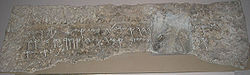
Probable tomb of Shebna
Charles Simon Clermont-Ganneau
Charles Simon Clermont-Ganneau was a noted French Orientalist and archaeologist.-Biography:Clermont-Ganneau was born in Paris, son of a sculptor of some repute...
.
The ancient inscription informs us that This is the tomb of... ]yahu who is over the house. No silver or gold is here but (his bones) and the bones of his Amma. Cursed be the man who opens this. The first part of the Hebrew name is effaced, but it refers to a Judean royal steward or chamberlain. Clermont-Ganneau shipped the tomb inscription to the British Museum
British Museum
The British Museum is a museum of human history and culture in London. Its collections, which number more than seven million objects, are amongst the largest and most comprehensive in the world and originate from all continents, illustrating and documenting the story of human culture from its...
, but it was only deciphered in the 1950s by Nahman Avigad
Nahman Avigad
Dr. Nahman Avigad , born in Zawalow, Galicia , was an Israeli archaeologist.-Biography:...
. Some scholars believe that this is the tomb of the biblical Shebna
Shebna
Shebna was "treasurer over the house" in the reign of king Hezekiah of Judah, according to the Old Testament....
, (Shebanyahu), the steward and treasurer of King Hezekiah
Hezekiah
Hezekiah was the son of Ahaz and the 14th king of Judah. Edwin Thiele has concluded that his reign was between c. 715 and 686 BC. He is also one of the most prominent kings of Judah mentioned in the Hebrew Bible....
(727-698 B.c.). The Prophet Isaiah (22:16) reproaches for his presumption: What hast thou here and whom hast thou here, that thou hast hewn thee out a sepulchre here, as he that heweth him out a sepulchre on high, and that graveth an inhabitation for himself in the rock? According to David Ussishkin
David Ussishkin
David Ussishkin is an Israeli archaeologist. Now retired as Professor of Archaeology at Tel Aviv University, Ussishkin has directed and co-directed important excavations at a variety of sites, including Lachish, Jezreel and Megiddo....
, the tomb contained two chambers, the outer chamber with a probable double bench for the occupant and his wife, and an inner chamber with a single burial bench for a relative who may be referred to in the second inscription fragment.
Second Temple era tombs
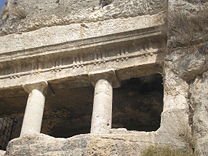
Among the notable tombs are the Jason's tomb, a large, elaborate, family tomb with multiple chambers and inscriptions in both Hebrew and Greek.
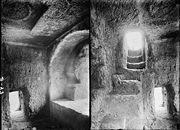
Kidron Valley
The Kidron Valley is the valley on the eastern side of The Old City of Jerusalem which features significantly in the Bible...
beneath the tombs of the ancient Kings of Judah on the ridge where the village of Silwan now stands. These include the Tomb of Benei Hezir, the Tomb of Zechariah
Tomb of Zechariah
The Tomb of Zechariah is an ancient stone monument adjacent to the Bnei Hazir tomb.-Architectural description:The monument is a monolith -- it is completely carved out of the solid rock and does not contain a burial chamber. The lowest part of the monument is a crepidoma, a base made of three steps...
, the Tomb of Absalom and the Tombs of the Kings
Tombs of the Kings (Jerusalem)
The Tombs of the Kings are a collection of rock cut tombs in East Jerusalem, 820 meters north of the Old City "al-Quds" walls in Al-Shaykh Jarrah suburb ....
which, ironically, is the tomb not of kings, but of a queen, Queen Helena of Adiabene
Helena of Adiabene
Helena of Adiabene was queen of Adiabene and wife of Monobaz I. With her husband she was the mother of Izates II and Monobaz II. She died about 56 CE. Her name and the fact that she was her husband's sister indicate a Hellenistic origin...
.
The elaborate Sanhedria Tombs lie to the north of the city. They were so called by later generations because the largest of them contains 70 chambers with burial benches, and the Sanhedrin
Sanhedrin
The Sanhedrin was an assembly of twenty-three judges appointed in every city in the Biblical Land of Israel.The Great Sanhedrin was the supreme court of ancient Israel made of 71 members...
had seventy member. Each of the three tombs would actually have contained the burials of a single, multi-generational, wealthy family. They were constructed between the reign of Herod
Herod the Great
Herod , also known as Herod the Great , was a Roman client king of Judea. His epithet of "the Great" is widely disputed as he is described as "a madman who murdered his own family and a great many rabbis." He is also known for his colossal building projects in Jerusalem and elsewhere, including his...
and the year 70.
Tomb of Jesus
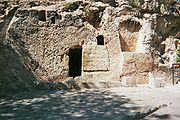
Joseph of Arimathea
Joseph of Arimathea was, according to the Gospels, the man who donated his own prepared tomb for the burial of Jesus after Jesus' Crucifixion. He is mentioned in all four Gospels.-Gospel references:...
. Proposed candidates for the tomb in which Jesus lay include the rock-cut chamber underneath the Church of the Holy Sepulchre
Church of the Holy Sepulchre
The Church of the Holy Sepulchre, also called the Church of the Resurrection by Eastern Christians, is a church within the walled Old City of Jerusalem. It is a few steps away from the Muristan....
, the Talpiot Tomb
Talpiot Tomb
The Talpiot Tomb is a rock-cut tomb discovered in 1980 in the East Talpiot neighborhood, five kilometers south of the Old City in East Jerusalem. It contained ten ossuaries, six of them with epigraphs, including one with the inscription that has been interpreted as "Jesus, son of Joseph", though...
, and the Garden Tomb
Garden Tomb
The Garden Tomb , located in Jerusalem, outside the city walls and close to the Damascus Gate, is a rock-cut tomb considered by some to be the site of the burial and resurrection of Jesus, and to be adjacent to Golgotha, in contradistinction to the traditional site for these—the Church of the Holy...
.
Beit She'arim

Beit She'arim National Park
Beit She'arim , also known as Beth She'arim or Besara , literally The Strangers House, is the archeological site of a Jewish town and a large number of ancient rock-cut Jewish tombs...
in the Galilee
Galilee
Galilee , is a large region in northern Israel which overlaps with much of the administrative North District of the country. Traditionally divided into Upper Galilee , Lower Galilee , and Western Galilee , extending from Dan to the north, at the base of Mount Hermon, along Mount Lebanon to the...
preserves a large number of rock-cut Jewish tombs from the 2nd to 4th centuries CE.