

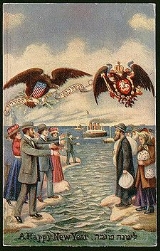
History of the Jews in the United States

Encyclopedia
The history of the Jews
in the United States
(United States of America), has been part of the American national fabric since colonial times.
Until the 1830s the Jewish community of Charleston, South Carolina
was the most numerous in North America. With the large scale immigration of Jews
from Germany
in the 19th century, they established themselves in many small towns and cities. A much larger immigration of Eastern European Jews, 1880–1914, brought a large, poor, traditional element to New York City
. Refugees arrived from Europe after World War II
, and many arrived from the Soviet Union after 1970.
In the 1940s Jews comprised 3.7% of the national population. Today the population is about 5 million—under 2% of the national total—and shrinking because of small family sizes and intermarriage. The largest population centers are the metropolitan areas of New York (2.1 million in 2000), Los Angeles (668,000), Miami (331,000), Philadelphia (285,000), Chicago (265,000) and Boston (254,000).
have emigrated
to Israel
.
America and its culture developed as an easy-to-enter "Melting Pot" for many cultures, creating a new commonality of culture and political values. This open culture allowed many minority groups, including Jews, to flourish in Christian and predominantly Protestant America. Antisemitism in the United States
has always been less common than in other historic areas of Jewish population, whether in Christian Europe or in the Muslim Middle East, where most nations developed around different majority ethnicities or languages.
From a population of 1000-2000 Jewish residents in 1790, mostly Dutch Sephardic Jews, Jews from England, and British subjects, the American Jewish community grew to about 15,000 by 1840, and to about 250,000 by 1880. Most of the mid-19th century Ashkenazi
Jewish immigrants to the US came from German-speaking states, as part of the larger concurrent German migration. They all initially spoke German, and settled across the nation, assimilating with their new countrymen; the Jews among them commonly engaged in trade, manufacturing, and operated dry goods (clothing) stores in many cities.
Between 1880 and the start of World War I
in 1914, about two million Yiddish
-speaking Ashkenazi Jews immigrated from Eastern Europe, where repeated pogrom
s made life unpredictable. They came from Jewish populations of Russia
, the Pale of Settlement
(modern Poland, Lithuania, Belarus, Ukraine and Moldova), and the Russian-controlled portions of Poland
. The latter group clustered in New York City, created the garment industry there, which supplied the dry goods stores across the country, and were heavily engaged in the trade unions. This wave was also part of a larger migration of eastern and southern European immigrants, which was unlike the historically predominant American demographic from northern and western Europe; Records indicate
between 1880 and 1920 that these new immigrants rose from less than five percent of all European immigrants to nearly 50%. This feared change caused renewed nativist
sentiment, the birth of the Immigration Restriction League
, and congressional studies by the Dillingham Commission
from 1907 to 1911. The Emergency Quota Act
of 1921 established immigration restrictions specifically on these groups, and the Immigration Act of 1924
further tightened and codified these limits. With the ensuing Great Depression
, and despite worsening conditions for European Jews, with the rise of Nazi Germany
, these quotas remained in place with minor alterations until the Immigration and Nationality Act of 1965.
Jews quickly created support networks consisting of many small synagogue
s and Ashkenazi Jewish Landsmannschaft
en (German for "Territorial Associations") for Jews from the same town or village.
Leaders of the time urged assimilation
and integration into the wider American culture
, and Jews quickly became part of American life. During World War II
, 500,000 American Jews, about half of all Jewish males between 18 and 50, enlisted for service, and after the war, Jewish families joined the new trend of suburbanization
, as they became wealthier and more mobile. The Jewish community expanded to other major cities, particularly around Los Angeles
and Miami. Their young people attended secular high schools and colleges and met Christians, so that intermarriage rates soared to nearly 50%. Synagogue membership however, grew considerably, from 20% of the Jewish population in 1930 to 60% in 1960.
The earlier waves of immigration and immigration restriction were followed by the Holocaust
that destroyed most of the European Jewish community by 1945; these also made the United States the home for the largest Jewish population in the world. In 1900 there were 1.5 million Americans Jews; in 2005 there were 4.9 million. See Historical Jewish population comparisons
On a theological level, American Jews
are divided into a number of Jewish denominations, of which the most numerous are Orthodox Judaism
, Conservative Judaism
and Reform Judaism
. Conservative Judaism arose in America and Reform Judaism was popularized by American Jews.

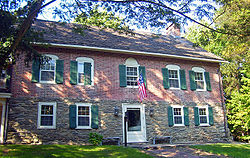 The first Jew to set foot on American soil was Solomon Franco, a merchant who arrived in Boston in 1649; subsequently he was given a stipend from the Puritans there, on condition he leave on the next passage back to Holland. In September of 1654, shortly before the Jewish New Year
, twenty-three Jews of Dutch ancestry from Recife
, Brazil
, arrived in New Amsterdam (New York City). Governor Peter Stuyvesant
, tried to enhance his Dutch Reformed Church
by discriminating against other religions, but religious pluralism was already a tradition in the Netherlands
and his superiors at the Dutch West India Company
in Amsterdam
overruled him.
Religious tolerance was also established elsewhere in the colonies; the colony of South Carolina, for example, was originally governed under an elaborate charter drawn up in 1669 by the English philosopher John Locke
. This charter granted liberty of conscience to all settlers, expressly mentioning "Jews, heathens, and dissenters." As a result, Charleston, South Carolina
has a particularly long history
of Sephardic settlement, which in 1816 numbered over 600, then the largest Jewish population of any city in the United States. Sephardic Dutch Jews were also among the early settlers of Newport
(where the country's oldest surviving synagogue building
stands), Savannah
, Philadelphia and Baltimore
. In New York City, Shearith Israel Congregation is the oldest continuous congregation started in 1687 having their first synagogue erected in 1728, and its current building still houses some of the original pieces of that first. By the time of American Revolution, the Jewish population in America was very small, with only 1,000-2000, in a colonial population of about 2.5 million.
. They played a significant role in the struggle for independence, including fighting the British, with Francis Salvador
being the first Jew to die, and playing a key role in financing the revolution, with the most important of the financiers being Haym Solomon
. Others, like David Salisbury Franksan, despite loyal service in both the Continental Army and the American diplomatic corps, suffered from his association as aide-de-camp for the traitorous general Benedict Arnold
.
President George Washington
remembered the Jewish contribution when he wrote to the Sephardic congregation
of Newport, Rhode Island
, in a letter dated August 17, 1790:
"May the children of the stock of Abraham who dwell in the land continue to merit and enjoy the goodwill of the other inhabitants. While everyone shall sit safely under his own vine and fig-tree and there shall be none to make him afraid."
In 1790, the approximate 2,500 Jews in America faced a number of legal restrictions in various states that prevented non-Christians from holding public office and voting, but Delaware, Pennsylvania, South Carolina, and Georgia soon eliminated these barriers, as did the Bill of Rights
in 1791 generally. Sephardic Jews became active in community affairs in the 1790s, after achieving "political equality in the five states in which they were most numerous." Other barriers did not officially fall for decades in the states of Rhode Island (1842), North Carolina (1868), and New Hampshire (1877). Despite these restrictions, which were often enforced unevenly, there were really too few Jews in 17th- and 18th-century America for anti-Jewish incidents to become a significant social or political phenomenon at the time. The evolution for Jews from toleration to full civil and political equality that followed the American Revolution helped ensure that Antisemitism would never become as common as in Europe.
was established. See also History of Jewish education in the United States (pre-20th century)
.
Jewish Texans
have been a part of Texas History
since the first Europe
an explorers arrived in the 16th century. Spanish Texas
did not welcome easily identifiable Jews, but they came in any case. Jao de la Porta
was with Jean Laffite
at Galveston, Texas
in 1816, and Maurice Henry was in Velasco in the late 1820s. Jews fought in the armies of the Texas Revolution
of 1836, some with Fannin at Goliad, others at San Jacinto. Dr. Albert Levy
became a surgeon to revolutionary Texan forces in 1835, participated in the capture of Béxar, and joined the Texas Navy the next year.
By 1840, Jews constituted a tiny, but nonetheless stable, middle-class minority of about 15,000 out of the 17 million Americans counted by the U.S. Census. Jews intermarried rather freely with non-Jews, continuing a trend that had begun at least a century earlier. However, as immigration increased the Jewish population to 50,000 by 1848, negative stereotypes of Jews in newspapers, literature, drama, art, and popular culture grew more commonplace and physical attacks became more frequent.
During the 19th century, (especially the 1840s and 1850s), Jewish immigration was primarily of Ashkenazi
Jews from Germany
, bringing a liberal, educated population that had experience with the Haskalah
, or Jewish Enlightenment. It was in the United States during the 19th century that two of the major branches of Judaism were established by these German immigrants: Reform Judaism
(out of German Reform Judaism) and Conservative Judaism
, in reaction to the perceived liberalness of Reform Judaism.
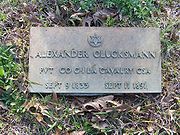 During the American Civil War
, approximately 3,000 Jews (out of around 150,000 Jews in the United States) fought on the Confederate side and 7,000 fought on the Union side. Jews also played leadership roles on both sides, with nine Jewish generals and 21 Jewish colonels participating in the War. Judah P. Benjamin
, a non-observant Jew, served as Secretary of State and acting Secretary of War of the Confederacy.
Several Jewish bankers played key roles in providing government financing for both side of the Civil war: Speyer and Seligman family
, for the Union, and Emile Erlanger and Company
for the confederacy.
By the time of the Civil War, tensions over race and immigration, as well as economic competition between Jews and non-Jews, combined to produce the worst outbreak of antisemitism to that date. Americans on both sides of the slavery issue denounced Jews as disloyal war profiteers, and accused them of driving Christians out of business and of aiding and abetting the enemy.
Major General Ulysses S. Grant
was influenced by these sentiments and issued General Order No. 11 expelling Jews from areas under his control in western Tennessee:
This order was quickly rescinded by President Abraham Lincoln
but not until it had been enforced in a number of towns.
Grant later issued an order "that no Jews are to be permitted to travel on the road southward." His aide, Colonel John V. DuBois, ordered "all cotton speculators, Jews, and all vagabonds with no honest means of support", to leave the district. "The Israelites especially should be kept out…they are such an intolerable nuisance."
. The first Jewish member of the United States House of Representatives
, Lewis Charles Levin
, and Senator
, David Levy Yulee
, were elected in 1845 (although Yulee converted to Episcopalianism
the following year). Official government antisemitism continued, however, with New Hampshire
only offering equality to Jews in 1877, the last state to do so.
s. Important banking firms included Goldman Sachs
(founded by Samuel Sachs
and Marcus Goldman
), Kuhn Loeb (Solomon Loeb
and Jacob H. Schiff), Lehman Brothers
(Henry Lehman
), Salomon Brothers
, and Bache & Co.
(founded by Jules Bache
). The Seligman family
moved from merchandising to banking in the late 1860s, with operations in New York, St. Louis, and Philadelphia as well as Frankfurt, Germany, London and Paris that gave European investors an opportunity to buy American government and railroad bonds. By the 1880s the firm financed the French efforts to build a Panama Canal as well as the American effort after 1900. By the 1890s J.& W. Seligman & Co. Inc. underwrote the securities of newly formed trusts, participated in stock and bond issues in the railroad and steel and wire industries, and invested in Russia and Peru, and in American in shipbuilding, bridges, bicycles, mining, and other enterprises. In 1910 William C. Durant
of the fledgling General Motors Corporation gave control of his company to the Seligmans and Lee, Higginson & Co. in return for underwriting $15 million worth of corporate notes.
After the death of Jacob Schiff in 1921, many banks which had their roots in the German-Jewish immigrant community began to lose their Jewish character. They no longer filled the ranks of management nor sought their capital needs from within the family or the "crowd". By the 1930s, Jewish presence in the private investment banking had diminished dramatically.

and neighboring countries. This emigration, mainly from Russian Poland
and other areas of the Russian Empire
, began as far back as 1821, but did not become especially noteworthy until after the German immigration
fell off in 1870. Though nearly 50,000 Russian, Polish, Galician, and Romania
n Jews went to the United States during the succeeding decade, it was not until the pogrom
s, anti-Jewish uprisings in Russia, of the early 1880s, that the immigration assumed extraordinary proportions. From Russia alone the emigration rose from an annual average of 4,100 in the decade 1871-80 to an annual average of 20,700 in the decade 1881-90. Anti-semitism and official measures of persecution over the past century combined with the desire for economic freedom and opportunity have motivated a continuing flow of Jewish immigrants from Russia and Eastern Europe over the past century.
The Romanian persecutions, beginning in 1900, forced large numbers of Jews to seek refuge in the US. Though most of these immigrants arrived on the Eastern seaboard, many came as part of the Galveston Movement
, through which Jewish immigrants settled in Texas as well as the western states and territories.
By 1924, two million Jews had arrived from Eastern Europe. Growing anti-immigration feelings in the United States at this time, resulted in the National Origins Quota of 1924
which severely restricted immigration from many regions including Eastern Europe. The Jewish community took the lead in opposing immigration restrictions, which remained in effect until 1965.
Oakland Jewry was active in public affairs and charitable projects in the 1880s. Rabbi Myer S. Levy was chaplain to the state legislature in 1885. The Daughters of Israel Relief Society continued its good works both inside and outside the Jewish community. Beth Jacob, the traditional congregation of Old World Polish Jews, continued its separate religious practices while it maintained friendly relations with the members of the first Hebrew Congregation. Able social and political leadership came from David Samuel Hirshberg. Until 1886 he was an officer in the Grand Lodge of B'nai B'rith. He served as Under Sheriff of Alameda County in 1883 and was active in Democratic party affairs. In 1885 he was appointed Chief Clerk of the US Mint in San Francisco. As a politician, he had detractors who accused him of using his position in B'nai B'rith to foster his political career. When refugees from the fire-stricken, poorer Jewish quarter of San Francisco came to Oakland, the synagogue provided immediate aid. Food and clothing were given to the needy and 350 people were given a place to sleep. For about a week the synagogue fed up to 500 people three times a day. A large part of the expenses were paid by the Jewish Ladies' organization of the synagogue.
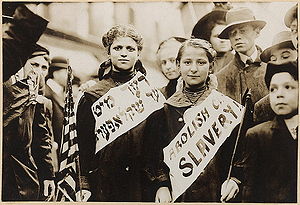 With the influx of Jews from Central and Eastern Europe many members of the Jewish community were attracted to labor and socialist movements and numerous Jewish newspapers such as Forwerts
and Morgen Freiheit
had a socialist orientation. Left wing organizations such as the Arbeter Ring and the Jewish People's Fraternal Order
played an important part in Jewish community life until World War II.
Jewish Americans were not just involved in nearly every important social movement but in the forefront of promoting such issues as workers rights, civil rights, woman's rights, freedom of religion, peace movements, and various other progressive causes.
played a major role as a leader of the American Jewish community in the late 19th century. As a wealthy German Jew, Schiff made important decisions regarding the arrival of Eastern European Jewish immigrants. At a time of increasing demand for immigration restriction, Schiff supported and worked for Jewish Americanization
. A Reform Jew, he backed the creation of the Conservative Jewish Theological Seminary of America. He took a stand favoring a modified form of Zionism, reversing his earlier opposition. Above all, Schiff believed that American Jewry could live in both the Jewish and American worlds, creating a balance that made possible an enduring American Jewish community.
The National Council of Jewish Women (NCJW), founded in Chicago in 1893, had the goals of philanthropy and the Americanization
of Jewish immigrants. Responding to the plight of Jewish women and girls from Eastern Europe, the NCJW created its Department of Immigrant Aid to assist and protect female immigrants from the time of their arrival at Ellis Island until their settlement at their final destination. The NCJW's Americanization program included assisting immigrants with housing, health, and employment problems, leading them to organizations where women could begin to socialize, and conducting English classes while helping them maintain a strong Jewish identity. The council, pluralistic rather than conformist, continued its Americanization efforts and fought against restrictive immigration laws after World War I. At the forefront of its activities was the religious education of Jewish girls, who were ignored by the Orthodox community.
, thus helping bridge the cultural gap. This convergence brought Jews into the political debates in the 1900-1930 period over immigration restriction. Jews were the leading opponents of restrictions, but could not stop their passage in 1924 or their use to keep out most refugees from Hitler in the 1930s.
Julius Rosenwald
(1862–1932) moved to Chicago in the late 1880s. Purchasing a half-interest in 1895, he transformed a small mail order house Sears, Roebuck into the largest retailer in America. He used his wealth for philanthropy targeted especially at the plight of rural blacks in collaboration with Booker T. Washington
. From 1917 to 1932 the Julius Rosenwald Foundation set up 5,357 public schools for blacks. He funded numerous hospitals for blacks in the South as well as 24 YMCA's; he was a major contributor to the NAACP
and the National Urban League
. His major contributions to the University of Chicago
and to various Jewish philanthropies were on a similar grand scale. He spent $11 million to fund the Chicago Museum of Science and Industry
.
of Stanford University wrote "Jewish family incomes are the highest of any large ethnic group in the US - 72% above the national average." Sowell points out that Episcopalians have also experienced similar prosperity - as a group - as Jews, but it is the "social and economic distance covered in a relatively short time" that makes the Jewish experience in America unique.
Gerald Krefetz discusses the prosperity that Jews earned in the United States following their emigration from Europe in the nineteenth and twentieth centuries, and he attributes their success to their familiarity with "trading and exchanging, commerce, city living, property rights, ... and accumulation of funds for future investment ... "
Historian Edward Shapiro cites a Forbes magazine survey from the 1980s, which showed that, of the 400 richest Americans, over 100 were Jewish, which was nine times greater than would be expected based on the overall population. Shapiro also estimates that over 30% of American billionaires are Jewish, and he cites a 1986 issue of Financial World
that listed the top 100 money makers in 1985, and "half the people mentioned" were Jewish, including George Soros
, Asher Edelman
, Michael Milkin, and Ivan Boesky
.
Gerald Krefetz writes "[w]hether it is called intestinal fortitude, operation bootstrap, moxie, social striving ,or upward mobility, American Jews have fought mightily for financial security... As a group Jews have attained a higher standard of living and earn more money than any other religious group in the United States... Jews are the richest of the rich"
named Leo Frank
was convicted for the rape and murder of Mary Phagan, a 13-year-old Christian girl in his employ. Frank was sentenced to death but Governor Slaton, convinced by a review of the evidence that Frank was innocent, commuted the sentence to life imprisonment. As a result of public outrage over this act, a Georgia mob kidnapped Frank from prison and lynched him.
In response to the lynching of Leo Frank
, Sigmund Livingston
founded the Anti-Defamation League
(ADL) under the sponsorship of B'nai B'rith
. The ADL became the leading Jewish group fighting anti-Semitism in the United States. The lynching of Leo Frank
coincided with and helped spark the revival of the Ku Klux Klan
. The Klan disseminated the view that anarchists
, communists
and Jews were subverting American values and ideals.
As early as 1914, the American Jewish community mobilized its resources to assist the victims of the European war. Cooperating to a degree not previously seen, the various factions of the American Jewish community—native-born and immigrant, Reform, Orthodox, secular, and socialist—coalesced to form what eventually became known as the American Jewish Joint Distribution Committee. All told, American Jews raised 63 million dollars in relief funds during the war years and became more immersed in European Jewish affairs than ever before.
In a report issued by the State Department, Undersecretary of State Stuart Eizenstat noted that the United States accepted only 21,000 refugees from Europe and did not significantly raise or even fill its restrictive quotas, accepting far fewer Jews per capita than many of the neutral European countries and fewer in absolute terms than Switzerland.
According to David Wyman, "The United States and its Allies were willing to attempt almost nothing to save the Jews."
U.S. opposition to immigration in general in the late 1930s was motivated by the grave economic pressures, the high unemployment rate, and social frustration and disillusionment. The U.S. refusal to support specifically Jewish immigration, however, stemmed from something else, namely antisemitism, which had increased in the late 1930s and continued to rise in the 1940s. It was an important ingredient in America's negative response to Jewish refugees.
About 100,000 German Jews did arrive in the 1930s, escaping Hitler’s persecution.
as the ship waited in the Caribbean Sea
between Florida and Cuba. Initially, Roosevelt showed limited willingness to take in some of those on board. But the Immigration Act of 1924
made that illegal and public opinion was strongly opposed . The ship returned to Europe. 620 of the passengers were eventually accepted in continental Europe, of these only 365 survived the Holocaust.
had it not been for bureaucratic obstacles to immigration deliberately created by Breckinridge Long
and others.
Rescue of the European Jewish population was not a priority for the US during the war, and the American Jewish community did not realize the severity of the Holocaust until late in the conflict.
The Holocaust
was largely ignored by America media as it was happening. Why that was is illuminated by the anti-Zionist position taken by Arthur Hays Sulzberger
, publisher of the New York Times, during World War II. Committed to classical Reform Judaism, which defined Judaism as a religious faith and not as a people, Sulzberger insisted that as an American he saw European Jews as part of a refugee problem, not separate from it. As publisher of the nation's most influential newspaper, The New York Times, he permitted only a handful of editorials during the war on the extermination of the Jews. He supported the anti-Zionist American Council for Judaism. Even after it became known that the Nazis had singled out the Jews for destruction, Sulzberger held that all refugees had suffered. He opposed the creation of Israel. In effect, he muted the enormous potential influence of the Times by keeping issues of concern regarding Jews off the editorial page and burying stories about Nazi atrocities against Jews in short items deep inside the paper. In time he grew increasingly out of step with the American Jewish community by his persistent refusal to recognize Jews as a people and despite obvious flaws in his view of American democracy.
While Jews owned few prestigious newspapers other than the New York Times, they had a major presence in Hollywood and in network radio. Hollywood films and radio with few exceptions avoided questioning Nazi persecution of Europe's Jews prior to Pearl Harbor. Jewish studio executives did not want to be accused of advocating Jewish propaganda by making films with overtly antifascist themes. Indeed, they were pressured by such organizations as the Anti-Defamation League
and by national Jewish leaders to avoid such themes lest American Jews suffer an antisemitic backlash.
, 400 rabbis marched in Washington to draw attention to the plight of Holocaust victims (see "The Day the Rabbis Marched".) A week later, Senator William Warren Barbour
(R; New Jersey), one of a handful of politicians who met with the rabbis on the steps of the US Capitol, proposed legislation that would have allowed as many as 100,000 victims of the Holocaust to emigrate temporarily to the United States. Barbour died six weeks after introducing the bill, and it was not passed. A parallel bill was introduced in the House of Representatives
by Rep. Samuel Dickstein
(D; New York). This also failed to pass.
During the Holocaust
, fewer than 30,000 Jews a year reached the United States, and some were turned away due to immigration policies. The US did not change its immigration policies until 1948.
summarized this dilemma when he attempted to understand Auschwitz: "To try to answer is to commit a supreme blasphemy. Israel enables us to bear the agony of Auschwitz without radical despair, to sense a ray [of] God's radiance in the jungles of history."
, and after the war younger families joined the new trend of suburbanization
. There, Jews became increasingly assimilated and demonstrated rising intermarriage
. The suburbs facilitated the formation of new centers, as Jewish school enrollment more than doubled between the end of World War II and the mid-1950s, and synagogue affiliation jumped from 20% in 1930 to 60% in 1960; the fastest growth came in Reform and, especially, Conservative congregations.
Having never been subjected to the Holocaust, the United States stood after the Second World War as the largest, richest, and healthiest center of Judaism in the world. Smaller Jewish communities turned increasingly to American Jewry for guidance and support.
Immediately after the Second World War, some Jewish refugees resettled in the United States, and another wave of Jewish refugees from Arab nations
settled in the US after expulsion from their home countries.
movements as well as the Labor Bund, based in Eastern Europe. Many Jews rose to leadership positions in the early 20th century American labor movement
and helped to found unions in the "needle trades" (clothing industry) that played a major role in the CIO
and in Democratic Party
politics. Sidney Hillman
of the CIO was especially powerful in the early 1940s at the national level.
By the 1930s Jews were a major political factor in New York City, with strong support for the most liberal programs of the New Deal
. Since most East European Jews were excluded from the Irish-controlled Democratic Party in New York City they worked through third parties, the American Labor Party
and the Liberal Party of New York
. By the 1940s they were inside the Democratic Party, and helped overthrow Tammany Hall. They continued as a major element of the New Deal coalition
, giving special support to the Civil Rights Movement
. By the mid 1960s, however, the Black Power movement caused a growing separation between blacks and Jews, though both groups remained solidly in the Democratic camp.
Although German Jews generally leaned Republican in the second half of the 19th century, the East European elements voted Democratic or for left parties since at least 1916, when they voted 55% for Woodrow Wilson
. American Jews voted 90% against the Republicans and supported Democrats Franklin D. Roosevelt
and Harry S. Truman
in the elections of 1940, 1944 and 1948, despite both party platforms supporting the creation of a Jewish state in the latter two elections. During the 1952 and 1956 elections, they voted 60% or more for Democrat Adlai Stevenson, while General Eisenhower
garnered 40% for his reelection; the best showing to date for the Republicans since Harding's
43% in 1920. In 1960, 83% voted for Democrat John F. Kennedy
, a Catholic, against Richard Nixon
, and in 1964, 90% of American Jews voted for Lyndon Johnson
; his Republican opponent, arch-conservative Barry Goldwater
, was Protestant but his paternal grandparents were Jewish. Hubert Humphrey
garnered 81% of the Jewish vote in the 1968 elections, in his losing bid for president against Richard Nixon
, a high level of Jewish support not seen since.
During the Nixon re-election campaign of 1972, Jewish voters were apprehensive about George McGovern
and only favored the Democrat by 65%, while Nixon more than doubled Republican Jewish support to 35%. In the election of 1976, Jewish voters supported Democrat Jimmy Carter
by 71% over incumbent president Gerald Ford
’s 27%, but in 1980 they abandoned Carter, leaving him with only 45% support, while Republican winner, Ronald Reagan
, garnered 39%, and 14% went to independent John Anderson
.
During the Reagan re-election campaign of 1984, the Jews returned home to the Democratic Party, giving Reagan only 31% compared to 67% for Democrat Walter Mondale
. The same 2-1 pattern reappeared in 1988 as Democrat Michael Dukakis
had 64%, while victorious George Bush
polled 35%. Bush's Jewish support collapsed during his re-election in 1992, to just 11%, with 80% voting for Bill Clinton
and 9% going to independent Ross Perot
. Clinton’s re-election campaign in 1996 maintained high Jewish support at 78%, with 16% supporting Bob Dole
and 3% for Perot.
A lively internal debate commenced, following the Six-Day War
. The American Jewish community was divided over whether they agreed with the Israeli response; the great majority came to accept the war as necessary. A tension existed especially for leftist Jews, between their liberal ideology and Zionist backing in the midst of this conflict. This deliberation about the Six-Day War showed the depth and complexity of Jewish responses to the varied events of the 1960s.
of the Jewish Theological Seminary marched in the front row of the Selma-to-Montgomery march.
Within Judaism, increasing involvement in the civil rights movement caused some tension. Rabbi Bernard Wienberger exemplified this point of view, warning that "northern liberal Jews" put at risk southern Jews who faced hostility from white southerners because of their northern counterparts. However, most known Jewish responses to the civil rights movement and black relations lean toward acceptance and against prejudice, as the disproportionate involvement of Jews in the movement would indicate. Despite this history of participation, relations between African Americans and Jews have sometimes been strained by their close proximity and class differences, especially in New York and other urban areas.
can be traced to the early 1970s in the United States
. According to Judith Plaskow
, who has focused on feminism in Reform Judaism
, the main issues for early Jewish feminists in these movements were the exclusion from the all-male prayer group or minyan
, the exemption from positive time-bound mitzvot
, and women's inability to function as witnesses and to initiate divorce.
Beginning in 1967 the Soviet Union allowed some Jewish citizens to leave for family reunification in Israel. Due to the break in diplomatic relations between Israel and the USSR, most émigrés traveled to Vienna, Austria, or Budapest, Hungary, from where they were then flown to Israel. After 1976 the majority of émigrés who left on visas for Israel 'dropped out' in Vienna and chose to resettle in the West. Several American Jewish organizations helped them obtain visas and aided their resettlement in the United States and other countries. However Israel wanted them and tried to prevent Soviet Jewish émigrés from resettling in the United States after having committed to immigrating to Israel. Israeli officials pressured American Jewish organizations to desist from aiding Russian Jews who wanted to resettle in the United States. Initially, American Jews resisted Israeli efforts. Following Mikhail Gorbachev
's decision in the late 1980s to allow free emigration for Soviet Jews, the American Jewish community agreed to a quota on Soviet Jewish refugees in the U.S., which resulted in most Soviet Jewish émigrés settling in Israel.
The Russian Jewish population in the United States is the second only to the population of Russian Jews in Israel. According to RINA, there is a core Russian-Jewish population of 350,000 in the U.S. The enlarged Russian Jewish population in the U.S. is estimated to be 700,000. Some 100,000 Ashkenazi
and Bukharian Jews
immigrate to the United States. Large pockets of Russian-Jewish Communities include Brooklyn, New York, specifically Brighton Beach
and Sheepshead Bay, and in the Sunny Isles Beach neighborhood of South Florida. Another large pocket of Russian Jewish residence is Northeast Philadelphia and surrounding Bucks and Montgomery Counties, as well as Northern New Jersey.
opened the Tamarisk Country Club in 1946, after being refused membership in the Los Angeles Lakeside country club. But his connections with Hollywood and corporations alike made his country club a success, and made it a policy to allow Jews and all people, regardless of race and religion, to have access to his facility.
Many elderly American Jews from the East coast and the Los Angeles metropolitan area, come to retire in the warm climates such as the Coachella Valley, favoring in golf course and mobile home communities. By the 1990s they were a large component of demography in the desert resort. There are 12 Jewish places of worship, including a Jewish community center in Palm Desert. Palm Springs has the annual "Winter Festival of Lights" parade, which began as a separate parade to celebrate Chanukah in the 1960s. Over time, that and the Christmas-themed parade merged into the one celebrating the season's lights of menorahs, Christmas trees and the calendar new year.
improved rapidly since the end of World War II, when Jewish students were few and isolated. In 1958 Jewish students were more numerous; they protested against the Bicker system of eating club member selection. In 1961 Yavneh House was established as Princeton's first kosher kitchen. In 1971 Stevenson Hall opened as a university-managed kosher eating facility in the midst of the older private eating clubs. Jewish student initiative and Princeton administration openness deserve credit for this progress.
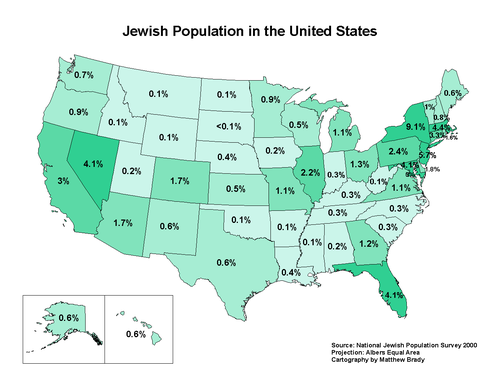
American Jews continued to prosper throughout the early 21st century. American Jews are disproportionately represented in business, academia and politics. Forty-five percent of the top 40 of the Forbes 400 richest Americans are Jewish. Twenty percent of professors at leading universities are Jewish. Forty percent of partners in the leading law firms in New York and Washington are Jewish. Thirty percent of American Nobel prize winners in science and 37 percent of all American Nobel winners are Jewish. An estimated thirty percent of Ivy League students are Jewish.
Demographically, the population is not increasing. With their success, American Jews have become increasingly assimilated into American culture, with high intermarriage rates resulting in either a falling or steady population rate at a time when the country was booming. It has not grown appreciably since 1960, comprises a smaller percentage of America's total population than it had in 1920, and seems likely to witness an actual decline in numbers in the decades ahead.
Jews also began to move to the suburbs, with major population shifts from New York and the Northeast to Florida and California. New Jewish organizations were founded to accommodate an increasing range of Jewish worship and community activities, as well as geographic dispersal.
Politically, the Jewish population remained strongly liberal. The heavily Democratic pattern continued into the 21st century. Since 1936 the great majority of Jews have been Democrats. In 2004 74% of Jews voted for Democrat John Kerry
, a Catholic of partial Jewish descent, and in 2006 87% voted for Democratic candidates for the House. By the 1990s Jews were becoming prominent in Congress and state governments throughout the country. Jews proved to be strong supporters of the American Civil Rights Movement.
Korelitz (1996) shows how American Jews during the late 19th and early 20th centuries abandoned a racial definition of Jewishness in favor of one that embraced ethnicity. The key to understanding this transition from a racial self-definition to a cultural or ethnic one can be found in the Menorah Journal between 1915 and 1925. During this time contributors to the Menorah promoted a cultural, rather than a racial, religious, or other view of Jewishness as a means to define Jews in a world that threatened to overwhelm and absorb Jewish uniqueness. The journal represented the ideals of the menorah movement established by Horace Kallen
and others to promote a revival in Jewish cultural identity and combat the idea of race as a means to define or identify peoples.
Siporin (1990) uses the family folklore of ethnic Jews to their collective history and its transformation into an historical art form. They tell us how Jews have survived being uprooted and transformed. Many immigrant narratives bear a theme of the arbitrary nature of fate and the reduced state of immigrants in a new culture. By contrast, ethnic family narratives tend to show the ethnic more in charge of his life, and perhaps in danger of losing his Jewishness altogether. Some stories show how a family member successfully negotiated the conflict between ethnic and American identities.
After 1960 memories of the Holocaust, together with the Six-Day War
in 1967 that resulted in the survival of Israel had major impacts on fashioning Jewish ethnic identity. The Shoah provided Jews with a rationale for their ethnic distinction at a time when other minorities were asserting their own.
, when General Ulysses S. Grant
issued an order (quickly rescinded by President Abraham Lincoln
) of expulsion against Jews from the portions of Tennessee, Kentucky and Mississippi under his control. (See General Order No. 11)
Antisemitism continued into the first half of 20th century. Jews were discriminated against in some employment, not allowed into some social clubs and resort areas, given a quota on enrollment at colleges, and not allowed to buy certain properties.
Antisemitism in America reached its peak during the interwar period. The rise of the Ku Klux Klan
in the 1920s, the antisemitic works of Henry Ford
, and the radio speeches of Father Coughlin
in the late 1930s indicated the strength of attacks on the Jewish community.
Antisemitism in the United States has rarely turned into physical violence against Jews. Some more notable cases of such violence include the attack of Irish workers and police on the funeral procession of Rabbi Jacob Joseph in New York City
in 1902, the lynching of Leo Frank
in 1915, the murder
of Alan Berg
in 1984, and the Crown Heights riot
s of 1991.
Following the Second World War
and the American Civil Rights Movement, anti-Jewish sentiment waned. Some members of the Black Nationalist
Nation of Islam
claimed that Jews were responsible for the exploitation of black labor, bringing alcohol and drugs into their communities, and unfair domination of the economy. Furthermore, according to surveys begun in 1964 by the Anti-Defamation League
, a Jewish
organization
, African American
s are significantly more likely than white Americans to hold antisemitic beliefs, although there is a strong correlation between education level and the rejection of antisemitic stereotypes for all races. However, black Americans of all education levels are nevertheless significantly more likely than whites of the same education level to be antisemitic. In the 1998 survey, blacks (34%) were nearly four times as likely as whites (9%) to fall into the most antisemitic category (those agreeing with at least 6 of 11 statements that were potentially or clearly antisemitic). Among blacks with no college education, 43% fell into the most antisemitic group (vs. 18% for the general population), which fell to 27% among blacks with some college education, and 18% among blacks with a four-year college degree (vs. 5% for the general population).
The 2005 Anti-Defamation League survey includes data on Hispanic
attitudes, with 29% being most antisemitic (vs. 9% for whites and 36% for blacks); being born in the United States helped alleviate this attitude: 35% of foreign-born Hispanics, but only 19% of those born in the US.
Religious tensions continued to exist in the United States, but numerous polls indicated that Jews were no longer the focus of hostility, and indeed that antisemitism is at a low point in the U.S. As an example of religious tension, in 2010 widespread debate erupted over building an Islamic cultural center and mosque in New York City near the World Trade Center site
. The city of New York has officially endorsed the project, but public opinion nationwide has been hostile. A Time (magazine)
poll in August 2010 of 1000 individuals indicated that 13 percent hold unfavorable views of Jews, compared with 43 percent who had unfavorable views of Muslims, 17 percent who felt unfavorably toward Catholics and 29 percent who viewed Mormons unfavorably. By contrast, antisemitic attitudes are much higher in Europe and are growing.
Jews
The Jews , also known as the Jewish people, are a nation and ethnoreligious group originating in the Israelites or Hebrews of the Ancient Near East. The Jewish ethnicity, nationality, and religion are strongly interrelated, as Judaism is the traditional faith of the Jewish nation...
in the United States
United States
The United States of America is a federal constitutional republic comprising fifty states and a federal district...
(United States of America), has been part of the American national fabric since colonial times.
Until the 1830s the Jewish community of Charleston, South Carolina
History of the Jews in Charleston, South Carolina
There is a long history of Jews in Charleston, South Carolina. The charter of the Carolina Colony, drawn up by John Locke in 1669, granted liberty of conscience to all settlers, expressly mentioning "Jews, heathens, and dissenters."...
was the most numerous in North America. With the large scale immigration of Jews
Jews
The Jews , also known as the Jewish people, are a nation and ethnoreligious group originating in the Israelites or Hebrews of the Ancient Near East. The Jewish ethnicity, nationality, and religion are strongly interrelated, as Judaism is the traditional faith of the Jewish nation...
from Germany
Germany
Germany , officially the Federal Republic of Germany , is a federal parliamentary republic in Europe. The country consists of 16 states while the capital and largest city is Berlin. Germany covers an area of 357,021 km2 and has a largely temperate seasonal climate...
in the 19th century, they established themselves in many small towns and cities. A much larger immigration of Eastern European Jews, 1880–1914, brought a large, poor, traditional element to New York City
New York City
New York is the most populous city in the United States and the center of the New York Metropolitan Area, one of the most populous metropolitan areas in the world. New York exerts a significant impact upon global commerce, finance, media, art, fashion, research, technology, education, and...
. Refugees arrived from Europe after World War II
World War II
World War II, or the Second World War , was a global conflict lasting from 1939 to 1945, involving most of the world's nations—including all of the great powers—eventually forming two opposing military alliances: the Allies and the Axis...
, and many arrived from the Soviet Union after 1970.
In the 1940s Jews comprised 3.7% of the national population. Today the population is about 5 million—under 2% of the national total—and shrinking because of small family sizes and intermarriage. The largest population centers are the metropolitan areas of New York (2.1 million in 2000), Los Angeles (668,000), Miami (331,000), Philadelphia (285,000), Chicago (265,000) and Boston (254,000).
Jewish immigration
The Jewish population of the US is the product of waves of immigration primarily from Europe; it was initially inspired by the pull of social and entrepreneurial opportunities, and later as a refuge from the push of continuing antisemitism there. Few ever returned to Europe, although committed advocates of ZionismZionism
Zionism is a Jewish political movement that, in its broadest sense, has supported the self-determination of the Jewish people in a sovereign Jewish national homeland. Since the establishment of the State of Israel, the Zionist movement continues primarily to advocate on behalf of the Jewish state...
have emigrated
Aliyah
Aliyah is the immigration of Jews to the Land of Israel . It is a basic tenet of Zionist ideology. The opposite action, emigration from Israel, is referred to as yerida . The return to the Holy Land has been a Jewish aspiration since the Babylonian exile...
to Israel
Israel
The State of Israel is a parliamentary republic located in the Middle East, along the eastern shore of the Mediterranean Sea...
.
America and its culture developed as an easy-to-enter "Melting Pot" for many cultures, creating a new commonality of culture and political values. This open culture allowed many minority groups, including Jews, to flourish in Christian and predominantly Protestant America. Antisemitism in the United States
Antisemitism in the United States
Jewish Americans have flourished since colonial times in what became the United States, which before the Second World War had a general history of racism directed to non-Christian, non-northwest European groups. Antisemitism in the United States has however lacked the extent and severity of its...
has always been less common than in other historic areas of Jewish population, whether in Christian Europe or in the Muslim Middle East, where most nations developed around different majority ethnicities or languages.
From a population of 1000-2000 Jewish residents in 1790, mostly Dutch Sephardic Jews, Jews from England, and British subjects, the American Jewish community grew to about 15,000 by 1840, and to about 250,000 by 1880. Most of the mid-19th century Ashkenazi
Ashkenazi Jews
Ashkenazi Jews, also known as Ashkenazic Jews or Ashkenazim , are the Jews descended from the medieval Jewish communities along the Rhine in Germany from Alsace in the south to the Rhineland in the north. Ashkenaz is the medieval Hebrew name for this region and thus for Germany...
Jewish immigrants to the US came from German-speaking states, as part of the larger concurrent German migration. They all initially spoke German, and settled across the nation, assimilating with their new countrymen; the Jews among them commonly engaged in trade, manufacturing, and operated dry goods (clothing) stores in many cities.
Between 1880 and the start of World War I
World War I
World War I , which was predominantly called the World War or the Great War from its occurrence until 1939, and the First World War or World War I thereafter, was a major war centred in Europe that began on 28 July 1914 and lasted until 11 November 1918...
in 1914, about two million Yiddish
Yiddish language
Yiddish is a High German language of Ashkenazi Jewish origin, spoken throughout the world. It developed as a fusion of German dialects with Hebrew, Aramaic, Slavic languages and traces of Romance languages...
-speaking Ashkenazi Jews immigrated from Eastern Europe, where repeated pogrom
Pogrom
A pogrom is a form of violent riot, a mob attack directed against a minority group, and characterized by killings and destruction of their homes and properties, businesses, and religious centres...
s made life unpredictable. They came from Jewish populations of Russia
History of the Jews in the Soviet Union
The history of the Jews in the Soviet Union is discussed in the following articles relating to specific regions of the former Soviet Union:*History of the Jews in Armenia*History of the Jews in Azerbaijan*History of the Jews in Belarus...
, the Pale of Settlement
Pale of Settlement
The Pale of Settlement was the term given to a region of Imperial Russia, in which permanent residency by Jews was allowed, and beyond which Jewish permanent residency was generally prohibited...
(modern Poland, Lithuania, Belarus, Ukraine and Moldova), and the Russian-controlled portions of Poland
History of the Jews in Poland
The history of the Jews in Poland dates back over a millennium. For centuries, Poland was home to the largest and most significant Jewish community in the world. Poland was the centre of Jewish culture thanks to a long period of statutory religious tolerance and social autonomy. This ended with the...
. The latter group clustered in New York City, created the garment industry there, which supplied the dry goods stores across the country, and were heavily engaged in the trade unions. This wave was also part of a larger migration of eastern and southern European immigrants, which was unlike the historically predominant American demographic from northern and western Europe; Records indicate
United States immigration statistics
The 1850 United States census was the first federal U.S. census to query about the "nativity" of citizens—where they were born, either in the United States or outside of it—and is thus the first point at which solid statistics become available. From the U.S. Census , this chart shows...
between 1880 and 1920 that these new immigrants rose from less than five percent of all European immigrants to nearly 50%. This feared change caused renewed nativist
Nativism (politics)
Nativism favors the interests of certain established inhabitants of an area or nation as compared to claims of newcomers or immigrants. It may also include the re-establishment or perpetuation of such individuals or their culture....
sentiment, the birth of the Immigration Restriction League
Immigration Restriction League
The Immigration Restriction League, was founded in 1894 by people who opposed the influx of "undesirable immigrants" that were coming from southern and eastern Europe. They felt that these immigrants were threatening what they saw as the American way of life and the high wage scale...
, and congressional studies by the Dillingham Commission
Dillingham Commission
The United States Immigration Commission was a special congressional committee formed in February 1907 by the United States Congress, which was then under intense pressure from various nativist groups, to study the origins and consequences of recent immigration to the United States...
from 1907 to 1911. The Emergency Quota Act
Emergency Quota Act
The Emergency Quota Act, also known as the Emergency Immigration Act of 1921, the Immigration Restriction Act of 1921, the Per Centum Law, and the Johnson Quota Act restricted immigration into the United States...
of 1921 established immigration restrictions specifically on these groups, and the Immigration Act of 1924
Immigration Act of 1924
The Immigration Act of 1924, or Johnson–Reed Act, including the National Origins Act, and Asian Exclusion Act , was a United States federal law that limited the annual number of immigrants who could be admitted from any country to 2% of the number of people from that country who were already...
further tightened and codified these limits. With the ensuing Great Depression
Great Depression
The Great Depression was a severe worldwide economic depression in the decade preceding World War II. The timing of the Great Depression varied across nations, but in most countries it started in about 1929 and lasted until the late 1930s or early 1940s...
, and despite worsening conditions for European Jews, with the rise of Nazi Germany
Nazi Germany
Nazi Germany , also known as the Third Reich , but officially called German Reich from 1933 to 1943 and Greater German Reich from 26 June 1943 onward, is the name commonly used to refer to the state of Germany from 1933 to 1945, when it was a totalitarian dictatorship ruled by...
, these quotas remained in place with minor alterations until the Immigration and Nationality Act of 1965.
Jews quickly created support networks consisting of many small synagogue
Synagogue
A synagogue is a Jewish house of prayer. This use of the Greek term synagogue originates in the Septuagint where it sometimes translates the Hebrew word for assembly, kahal...
s and Ashkenazi Jewish Landsmannschaft
Landsmannschaft (Studentenverbindung)
A Landsmannschaft is a German fraternity of several fraternity forms called .The older forms of Landsmannschaften were part of corporations and are closely alinged with the beginnings of universities in medieval times of the 12. and 13...
en (German for "Territorial Associations") for Jews from the same town or village.
Leaders of the time urged assimilation
Jewish assimilation
Jewish assimilation refers to the cultural assimilation and social integration of Jews in their surrounding culture. Assimilation became legally possible in Europe during the Age of Enlightenment.-Background:Judaism forbids the worship of other gods...
and integration into the wider American culture
Culture of the United States
The Culture of the United States is a Western culture originally influenced by European cultures. It has been developing since long before the United States became a country with its own unique social and cultural characteristics such as dialect, music, arts, social habits, cuisine, and folklore...
, and Jews quickly became part of American life. During World War II
World War II
World War II, or the Second World War , was a global conflict lasting from 1939 to 1945, involving most of the world's nations—including all of the great powers—eventually forming two opposing military alliances: the Allies and the Axis...
, 500,000 American Jews, about half of all Jewish males between 18 and 50, enlisted for service, and after the war, Jewish families joined the new trend of suburbanization
Suburbanization
Suburbanization a term used to describe the growth of areas on the fringes of major cities. It is one of the many causes of the increase in urban sprawl. Many residents of metropolitan regions work within the central urban area, choosing instead to live in satellite communities called suburbs...
, as they became wealthier and more mobile. The Jewish community expanded to other major cities, particularly around Los Angeles
Los Ángeles
Los Ángeles is the capital of the province of Biobío, in the commune of the same name, in Region VIII , in the center-south of Chile. It is located between the Laja and Biobío rivers. The population is 123,445 inhabitants...
and Miami. Their young people attended secular high schools and colleges and met Christians, so that intermarriage rates soared to nearly 50%. Synagogue membership however, grew considerably, from 20% of the Jewish population in 1930 to 60% in 1960.
The earlier waves of immigration and immigration restriction were followed by the Holocaust
The Holocaust
The Holocaust , also known as the Shoah , was the genocide of approximately six million European Jews and millions of others during World War II, a programme of systematic state-sponsored murder by Nazi...
that destroyed most of the European Jewish community by 1945; these also made the United States the home for the largest Jewish population in the world. In 1900 there were 1.5 million Americans Jews; in 2005 there were 4.9 million. See Historical Jewish population comparisons
Historical Jewish population comparisons
Jewish population centers have shifted tremendously over time, due to the constant streams of Jewish refugees created by expulsions, persecution, and officially sanctioned killing of Jews in various places at various times...
On a theological level, American Jews
American Jews
American Jews, also known as Jewish Americans, are American citizens of the Jewish faith or Jewish ethnicity. The Jewish community in the United States is composed predominantly of Ashkenazi Jews who emigrated from Central and Eastern Europe, and their U.S.-born descendants...
are divided into a number of Jewish denominations, of which the most numerous are Orthodox Judaism
Orthodox Judaism
Orthodox Judaism , is the approach to Judaism which adheres to the traditional interpretation and application of the laws and ethics of the Torah as legislated in the Talmudic texts by the Sanhedrin and subsequently developed and applied by the later authorities known as the Gaonim, Rishonim, and...
, Conservative Judaism
Conservative Judaism
Conservative Judaism is a modern stream of Judaism that arose out of intellectual currents in Germany in the mid-19th century and took institutional form in the United States in the early 1900s.Conservative Judaism has its roots in the school of thought known as Positive-Historical Judaism,...
and Reform Judaism
Reform Judaism
Reform Judaism refers to various beliefs, practices and organizations associated with the Reform Jewish movement in North America, the United Kingdom and elsewhere. In general, it maintains that Judaism and Jewish traditions should be modernized and should be compatible with participation in the...
. Conservative Judaism arose in America and Reform Judaism was popularized by American Jews.
Colonial era
Rosh Hashanah
Rosh Hashanah , , is the Jewish New Year. It is the first of the High Holy Days or Yamim Nora'im which occur in the autumn...
, twenty-three Jews of Dutch ancestry from Recife
Recife
Recife is the fifth-largest metropolitan area in Brazil with 4,136,506 inhabitants, the largest metropolitan area of the North/Northeast Regions, the 5th-largest metropolitan influence area in Brazil, and the capital and largest city of the state of Pernambuco. The population of the city proper...
, Brazil
Brazil
Brazil , officially the Federative Republic of Brazil , is the largest country in South America. It is the world's fifth largest country, both by geographical area and by population with over 192 million people...
, arrived in New Amsterdam (New York City). Governor Peter Stuyvesant
Peter Stuyvesant
Peter Stuyvesant , served as the last Dutch Director-General of the colony of New Netherland from 1647 until it was ceded provisionally to the English in 1664, after which it was renamed New York...
, tried to enhance his Dutch Reformed Church
Dutch Reformed Church
The Dutch Reformed Church was a Reformed Christian denomination in the Netherlands. It existed from the 1570s to 2004, the year it merged with the Reformed Churches in the Netherlands and the Evangelical Lutheran Church in the Kingdom of the Netherlands to form the Protestant Church in the...
by discriminating against other religions, but religious pluralism was already a tradition in the Netherlands
Netherlands
The Netherlands is a constituent country of the Kingdom of the Netherlands, located mainly in North-West Europe and with several islands in the Caribbean. Mainland Netherlands borders the North Sea to the north and west, Belgium to the south, and Germany to the east, and shares maritime borders...
and his superiors at the Dutch West India Company
Dutch West India Company
Dutch West India Company was a chartered company of Dutch merchants. Among its founding fathers was Willem Usselincx...
in Amsterdam
Amsterdam
Amsterdam is the largest city and the capital of the Netherlands. The current position of Amsterdam as capital city of the Kingdom of the Netherlands is governed by the constitution of August 24, 1815 and its successors. Amsterdam has a population of 783,364 within city limits, an urban population...
overruled him.
Religious tolerance was also established elsewhere in the colonies; the colony of South Carolina, for example, was originally governed under an elaborate charter drawn up in 1669 by the English philosopher John Locke
John Locke
John Locke FRS , widely known as the Father of Liberalism, was an English philosopher and physician regarded as one of the most influential of Enlightenment thinkers. Considered one of the first of the British empiricists, following the tradition of Francis Bacon, he is equally important to social...
. This charter granted liberty of conscience to all settlers, expressly mentioning "Jews, heathens, and dissenters." As a result, Charleston, South Carolina
Charleston, South Carolina
Charleston is the second largest city in the U.S. state of South Carolina. It was made the county seat of Charleston County in 1901 when Charleston County was founded. The city's original name was Charles Towne in 1670, and it moved to its present location from a location on the west bank of the...
has a particularly long history
History of the Jews in Charleston, South Carolina
There is a long history of Jews in Charleston, South Carolina. The charter of the Carolina Colony, drawn up by John Locke in 1669, granted liberty of conscience to all settlers, expressly mentioning "Jews, heathens, and dissenters."...
of Sephardic settlement, which in 1816 numbered over 600, then the largest Jewish population of any city in the United States. Sephardic Dutch Jews were also among the early settlers of Newport
Newport, Rhode Island
Newport is a city on Aquidneck Island in Newport County, Rhode Island, United States, about south of Providence. Known as a New England summer resort and for the famous Newport Mansions, it is the home of Salve Regina University and Naval Station Newport which houses the United States Naval War...
(where the country's oldest surviving synagogue building
Touro Synagogue
The Touro Synagogue is a 1763 synagogue in Newport, Rhode Island, that is the oldest synagogue building still standing in the United States,the oldest surviving Jewish synagogue building in North America, and the only surviving synagogue building in the U.S...
stands), Savannah
Savannah, Georgia
Savannah is the largest city and the county seat of Chatham County, in the U.S. state of Georgia. Established in 1733, the city of Savannah was the colonial capital of the Province of Georgia and later the first state capital of Georgia. Today Savannah is an industrial center and an important...
, Philadelphia and Baltimore
Baltimore
Baltimore is the largest independent city in the United States and the largest city and cultural center of the US state of Maryland. The city is located in central Maryland along the tidal portion of the Patapsco River, an arm of the Chesapeake Bay. Baltimore is sometimes referred to as Baltimore...
. In New York City, Shearith Israel Congregation is the oldest continuous congregation started in 1687 having their first synagogue erected in 1728, and its current building still houses some of the original pieces of that first. By the time of American Revolution, the Jewish population in America was very small, with only 1,000-2000, in a colonial population of about 2.5 million.
Revolutionary era
By 1776 and the War of Independence, around 2,000 Jews lived in America, most of them Sephardic Jews of Spanish and Portuguese originSpanish and Portuguese Jews
Spanish and Portuguese Jews are a distinctive sub-group of Sephardim who have their main ethnic origins within the Jewish communities of the Iberian peninsula and who shaped communities mainly in Western Europe and the Americas from the late 16th century on...
. They played a significant role in the struggle for independence, including fighting the British, with Francis Salvador
Francis Salvador
Francis Salvador was the first American Jew to be killed in the American Revolution, fighting on the South Carolina frontier...
being the first Jew to die, and playing a key role in financing the revolution, with the most important of the financiers being Haym Solomon
Haym Solomon
Haym Solomon was a Spanish and Portuguese Jew who immigrated to New York from Poland during the period of the American Revolution, and who became a prime financier of the Continental Army during the American Revolutionary War against Great Britain.-Early years:Descended from Jewish refugees from...
. Others, like David Salisbury Franksan, despite loyal service in both the Continental Army and the American diplomatic corps, suffered from his association as aide-de-camp for the traitorous general Benedict Arnold
Benedict Arnold
Benedict Arnold V was a general during the American Revolutionary War. He began the war in the Continental Army but later defected to the British Army. While a general on the American side, he obtained command of the fort at West Point, New York, and plotted to surrender it to the British forces...
.
President George Washington
George Washington
George Washington was the dominant military and political leader of the new United States of America from 1775 to 1799. He led the American victory over Great Britain in the American Revolutionary War as commander-in-chief of the Continental Army from 1775 to 1783, and presided over the writing of...
remembered the Jewish contribution when he wrote to the Sephardic congregation
Touro Synagogue
The Touro Synagogue is a 1763 synagogue in Newport, Rhode Island, that is the oldest synagogue building still standing in the United States,the oldest surviving Jewish synagogue building in North America, and the only surviving synagogue building in the U.S...
of Newport, Rhode Island
Newport, Rhode Island
Newport is a city on Aquidneck Island in Newport County, Rhode Island, United States, about south of Providence. Known as a New England summer resort and for the famous Newport Mansions, it is the home of Salve Regina University and Naval Station Newport which houses the United States Naval War...
, in a letter dated August 17, 1790:
"May the children of the stock of Abraham who dwell in the land continue to merit and enjoy the goodwill of the other inhabitants. While everyone shall sit safely under his own vine and fig-tree and there shall be none to make him afraid."
In 1790, the approximate 2,500 Jews in America faced a number of legal restrictions in various states that prevented non-Christians from holding public office and voting, but Delaware, Pennsylvania, South Carolina, and Georgia soon eliminated these barriers, as did the Bill of Rights
United States Bill of Rights
The Bill of Rights is the collective name for the first ten amendments to the United States Constitution. These limitations serve to protect the natural rights of liberty and property. They guarantee a number of personal freedoms, limit the government's power in judicial and other proceedings, and...
in 1791 generally. Sephardic Jews became active in community affairs in the 1790s, after achieving "political equality in the five states in which they were most numerous." Other barriers did not officially fall for decades in the states of Rhode Island (1842), North Carolina (1868), and New Hampshire (1877). Despite these restrictions, which were often enforced unevenly, there were really too few Jews in 17th- and 18th-century America for anti-Jewish incidents to become a significant social or political phenomenon at the time. The evolution for Jews from toleration to full civil and political equality that followed the American Revolution helped ensure that Antisemitism would never become as common as in Europe.
19th century
Following traditional religious and cultural teachings about improving the lot of their brethren, Jewish residents in the United States began to organize their communities in the early 19th century. Early examples include a Jewish orphanage set up in Charleston, South Carolina in 1801, and the first Jewish school, Polonies Talmud Torah, established in New York in 1806. In 1843, the first national secular Jewish organization in the United States, the B'nai B'rithB'nai B'rith
B'nai B'rith International |Covenant]]" is the oldest continually operating Jewish service organization in the world. It was initially founded as the Independent Order of B'nai B'rith in New York City, on , 1843, by Henry Jones and 11 others....
was established. See also History of Jewish education in the United States (pre-20th century)
History of Jewish education in the United States (pre-20th century)
The history of Jewish education in the United States before the 20th century is as old as the United States itself; it's a part of overall U.S. Jewish history....
.
Jewish Texans
Jewish history in Texas
Jewish Texans have been a part of the history of Texas since the first European explorers arrived in the region in the 16th century. In 1990, there were around 108,000 adherents to Judaism in Texas. More recent estimates place the number at around 120,000....
have been a part of Texas History
History of Texas
European conquistadors first arrived in the region now known as Texas in 1519, finding the region populated by various Native American tribes...
since the first Europe
Europe
Europe is, by convention, one of the world's seven continents. Comprising the westernmost peninsula of Eurasia, Europe is generally 'divided' from Asia to its east by the watershed divides of the Ural and Caucasus Mountains, the Ural River, the Caspian and Black Seas, and the waterways connecting...
an explorers arrived in the 16th century. Spanish Texas
Spanish Texas
Spanish Texas was one of the interior provinces of New Spain from 1690 until 1821. Although Spain claimed ownership of the territory, which comprised part of modern-day Texas, including the land north of the Medina and Nueces Rivers, the Spanish did not attempt to colonize the area until after...
did not welcome easily identifiable Jews, but they came in any case. Jao de la Porta
Jao de la Porta
João da Porta , along with his older brother Morin, was a Portuguese Jewish merchant important in the early settlement of the Texan coast....
was with Jean Laffite
Jean Lafitte
Jean Lafitte was a pirate and privateer in the Gulf of Mexico in the early 19th century. He and his elder brother, Pierre, spelled their last name Laffite, but English-language documents of the time used "Lafitte", and this is the commonly seen spelling in the United States, including for places...
at Galveston, Texas
Galveston, Texas
Galveston is a coastal city located on Galveston Island in the U.S. state of Texas. , the city had a total population of 47,743 within an area of...
in 1816, and Maurice Henry was in Velasco in the late 1820s. Jews fought in the armies of the Texas Revolution
Texas Revolution
The Texas Revolution or Texas War of Independence was an armed conflict between Mexico and settlers in the Texas portion of the Mexican state Coahuila y Tejas. The war lasted from October 2, 1835 to April 21, 1836...
of 1836, some with Fannin at Goliad, others at San Jacinto. Dr. Albert Levy
Albert Levy (surgeon)
Dr. Albert Levy, Albert Moses Levy, was a Jewish Texan known for being a surgeon to revolutionary Texan forces in 1835. Levy enlisted with the New Orleans Grays, a volunteer regiment that was formed to join the Texas revolt. The regiment soon joined the siege of the Mexican fortress of San Antonio...
became a surgeon to revolutionary Texan forces in 1835, participated in the capture of Béxar, and joined the Texas Navy the next year.
By 1840, Jews constituted a tiny, but nonetheless stable, middle-class minority of about 15,000 out of the 17 million Americans counted by the U.S. Census. Jews intermarried rather freely with non-Jews, continuing a trend that had begun at least a century earlier. However, as immigration increased the Jewish population to 50,000 by 1848, negative stereotypes of Jews in newspapers, literature, drama, art, and popular culture grew more commonplace and physical attacks became more frequent.
During the 19th century, (especially the 1840s and 1850s), Jewish immigration was primarily of Ashkenazi
Ashkenazi Jews
Ashkenazi Jews, also known as Ashkenazic Jews or Ashkenazim , are the Jews descended from the medieval Jewish communities along the Rhine in Germany from Alsace in the south to the Rhineland in the north. Ashkenaz is the medieval Hebrew name for this region and thus for Germany...
Jews from Germany
Germany
Germany , officially the Federal Republic of Germany , is a federal parliamentary republic in Europe. The country consists of 16 states while the capital and largest city is Berlin. Germany covers an area of 357,021 km2 and has a largely temperate seasonal climate...
, bringing a liberal, educated population that had experience with the Haskalah
Haskalah
Haskalah , the Jewish Enlightenment, was a movement among European Jews in the 18th–19th centuries that advocated adopting enlightenment values, pressing for better integration into European society, and increasing education in secular studies, Hebrew language, and Jewish history...
, or Jewish Enlightenment. It was in the United States during the 19th century that two of the major branches of Judaism were established by these German immigrants: Reform Judaism
Reform Judaism
Reform Judaism refers to various beliefs, practices and organizations associated with the Reform Jewish movement in North America, the United Kingdom and elsewhere. In general, it maintains that Judaism and Jewish traditions should be modernized and should be compatible with participation in the...
(out of German Reform Judaism) and Conservative Judaism
Conservative Judaism
Conservative Judaism is a modern stream of Judaism that arose out of intellectual currents in Germany in the mid-19th century and took institutional form in the United States in the early 1900s.Conservative Judaism has its roots in the school of thought known as Positive-Historical Judaism,...
, in reaction to the perceived liberalness of Reform Judaism.
Civil War
American Civil War
The American Civil War was a civil war fought in the United States of America. In response to the election of Abraham Lincoln as President of the United States, 11 southern slave states declared their secession from the United States and formed the Confederate States of America ; the other 25...
, approximately 3,000 Jews (out of around 150,000 Jews in the United States) fought on the Confederate side and 7,000 fought on the Union side. Jews also played leadership roles on both sides, with nine Jewish generals and 21 Jewish colonels participating in the War. Judah P. Benjamin
Judah P. Benjamin
Judah Philip Benjamin was an American politician and lawyer. Born a British subject in the West Indies, he moved to the United States with his parents and became a citizen. He later became a citizen of the Confederate States of America. After the collapse of the Confederacy, Benjamin moved to...
, a non-observant Jew, served as Secretary of State and acting Secretary of War of the Confederacy.
Several Jewish bankers played key roles in providing government financing for both side of the Civil war: Speyer and Seligman family
J. & W. Seligman & Co.
J. & W. Seligman & Co., founded in 1846, was a prominent U.S. investment bank c. 1860s–1920s until the divestiture of its investment banking arm in the aftermath of the Glass–Steagall Act. The firm was involved in the financing of several major U.S. railroads in the 1870s and the construction of...
, for the Union, and Emile Erlanger and Company
Emile Erlanger and Company
Emile Erlanger & Co. was a French finance and investment company established in 1864 by German born Parisian banker Baron Frederic Emile d'Erlanger and was active during and after the period of Reconstruction following the American Civil War. d'Erlanger was married to Matilde Slidell, the daughter...
for the confederacy.
By the time of the Civil War, tensions over race and immigration, as well as economic competition between Jews and non-Jews, combined to produce the worst outbreak of antisemitism to that date. Americans on both sides of the slavery issue denounced Jews as disloyal war profiteers, and accused them of driving Christians out of business and of aiding and abetting the enemy.
Major General Ulysses S. Grant
Ulysses S. Grant
Ulysses S. Grant was the 18th President of the United States as well as military commander during the Civil War and post-war Reconstruction periods. Under Grant's command, the Union Army defeated the Confederate military and ended the Confederate States of America...
was influenced by these sentiments and issued General Order No. 11 expelling Jews from areas under his control in western Tennessee:
The Jews, as a class violating every regulation of trade established by the Treasury Department and also department orders, are hereby expelled …within twenty-four hours from the receipt of this order.
This order was quickly rescinded by President Abraham Lincoln
Abraham Lincoln
Abraham Lincoln was the 16th President of the United States, serving from March 1861 until his assassination in April 1865. He successfully led his country through a great constitutional, military and moral crisis – the American Civil War – preserving the Union, while ending slavery, and...
but not until it had been enforced in a number of towns.
Grant later issued an order "that no Jews are to be permitted to travel on the road southward." His aide, Colonel John V. DuBois, ordered "all cotton speculators, Jews, and all vagabonds with no honest means of support", to leave the district. "The Israelites especially should be kept out…they are such an intolerable nuisance."
Participation in politics
Jews also began to organize as a political group in the United States, especially in response to the United States' reaction to the 1840 Damascus Blood LibelDamascus affair
The Damascus affair was an 1840 incident in which the accusation of ritual murder was brought against members of the Jewish community of Damascus. Eight notable Jews of Damascus were falsely accused of murdering a Christian monk, imprisoned and tortured. Several of the imprisoned died of torture,...
. The first Jewish member of the United States House of Representatives
United States House of Representatives
The United States House of Representatives is one of the two Houses of the United States Congress, the bicameral legislature which also includes the Senate.The composition and powers of the House are established in Article One of the Constitution...
, Lewis Charles Levin
Lewis Charles Levin
Lewis Charles Levin was a Philadelphia politician, prominent Know Nothing, and anti-Catholic social activist of the 1840s and 1850s. He served three terms in Congress , representing the Pennsylvania 1st District...
, and Senator
United States Senate
The United States Senate is the upper house of the bicameral legislature of the United States, and together with the United States House of Representatives comprises the United States Congress. The composition and powers of the Senate are established in Article One of the U.S. Constitution. Each...
, David Levy Yulee
David Levy Yulee
David Levy Yulee, born David Levy was an American politician and attorney from Florida, a territorial delegate to Congress, the first Jewish member of the United States Senate, and a member of the Confederate Congress during the American Civil War...
, were elected in 1845 (although Yulee converted to Episcopalianism
Episcopal Church (United States)
The Episcopal Church is a mainline Anglican Christian church found mainly in the United States , but also in Honduras, Taiwan, Colombia, Ecuador, Haiti, the Dominican Republic, Venezuela, the British Virgin Islands and parts of Europe...
the following year). Official government antisemitism continued, however, with New Hampshire
New Hampshire
New Hampshire is a state in the New England region of the northeastern United States of America. The state was named after the southern English county of Hampshire. It is bordered by Massachusetts to the south, Vermont to the west, Maine and the Atlantic Ocean to the east, and the Canadian...
only offering equality to Jews in 1877, the last state to do so.
-
- For more information, see Relationship of American Jews to the U.S. Federal Government (pre-20th century)Relationship of American Jews to the U.S. Federal Government (pre-20th century)The Damascus Affair of 1840 marks the real beginning of the diplomatic or international phase in the history of American Jews...
.
- For more information, see Relationship of American Jews to the U.S. Federal Government (pre-20th century)
Banking
In the middle of the nineteenth century, a number of German Jews founded investment banking firms which later became mainstays of the industry. Most prominent Jewish banks in the United States were investment banks, rather than commercial bankCommercial bank
After the implementation of the Glass–Steagall Act, the U.S. Congress required that banks engage only in banking activities, whereas investment banks were limited to capital market activities. As the two no longer have to be under separate ownership under U.S...
s. Important banking firms included Goldman Sachs
Goldman Sachs
The Goldman Sachs Group, Inc. is an American multinational bulge bracket investment banking and securities firm that engages in global investment banking, securities, investment management, and other financial services primarily with institutional clients...
(founded by Samuel Sachs
Samuel Sachs
Samuel Sachs was an American investment banker. He was born in the state of Maryland to Jewish immigrants from Bavaria, Germany. Sachs, along with his longtime friend Philip Lehman of Lehman Brothers, pioneered the issuing of stock as a way for new companies to raise funds...
and Marcus Goldman
Marcus Goldman
Marcus Goldman was a German-born American businessman and entrepreneur. He was born in Trappstadt, Germany and emigrated to the United States in 1848...
), Kuhn Loeb (Solomon Loeb
Solomon Loeb
Solomon Loeb was a German American merchant in textiles and later a banker with Kuhn, Loeb & Co.. His father, a devout Jew, had been a small corn- and wine-dealer in Worms, which belonged to the Grand Duchy of Hesse and by Rhine. S. Loeb emigrated to the United States in 1849. He settled in...
and Jacob H. Schiff), Lehman Brothers
Lehman Brothers
Lehman Brothers Holdings Inc. was a global financial services firm. Before declaring bankruptcy in 2008, Lehman was the fourth largest investment bank in the USA , doing business in investment banking, equity and fixed-income sales and trading Lehman Brothers Holdings Inc. (former NYSE ticker...
(Henry Lehman
Henry Lehman
Henry Lehman was a German-American businessman and the founder of Lehman Brothers financial services, which declared bankruptcy in 2008....
), Salomon Brothers
Salomon Brothers
Salomon Brothers was a bulge bracket, Wall Street investment bank. Founded in 1910 by three brothers along with a clerk named Ben Levy, it remained a partnership until the early 1980s, when it was acquired by the commodity trading firm Phibro Corporation and then became Salomon Inc. Eventually...
, and Bache & Co.
Bache & Co.
Bache & Company was a securities deim that provided stock brokerage and investment banking services. The firm, which was founded in 1879, was based in New York, New York....
(founded by Jules Bache
Jules Bache
Jules Semon Bache was a German-born American banker, art collector and philanthropist.-Biography:Born in Germany, as a young boy his family emigrated to the United States, settling in New York City. In 1881, he started work as a cashier at Leopold Cahn & Co., a stockbrokerage firm founded by his...
). The Seligman family
J. & W. Seligman & Co.
J. & W. Seligman & Co., founded in 1846, was a prominent U.S. investment bank c. 1860s–1920s until the divestiture of its investment banking arm in the aftermath of the Glass–Steagall Act. The firm was involved in the financing of several major U.S. railroads in the 1870s and the construction of...
moved from merchandising to banking in the late 1860s, with operations in New York, St. Louis, and Philadelphia as well as Frankfurt, Germany, London and Paris that gave European investors an opportunity to buy American government and railroad bonds. By the 1880s the firm financed the French efforts to build a Panama Canal as well as the American effort after 1900. By the 1890s J.& W. Seligman & Co. Inc. underwrote the securities of newly formed trusts, participated in stock and bond issues in the railroad and steel and wire industries, and invested in Russia and Peru, and in American in shipbuilding, bridges, bicycles, mining, and other enterprises. In 1910 William C. Durant
William C. Durant
William Crapo "Billy" Durant was a leading pioneer of the United States automobile industry, the founder of General Motors and Chevrolet who created the system of multi-brand holding companies with different lines of cars....
of the fledgling General Motors Corporation gave control of his company to the Seligmans and Lee, Higginson & Co. in return for underwriting $15 million worth of corporate notes.
After the death of Jacob Schiff in 1921, many banks which had their roots in the German-Jewish immigrant community began to lose their Jewish character. They no longer filled the ranks of management nor sought their capital needs from within the family or the "crowd". By the 1930s, Jewish presence in the private investment banking had diminished dramatically.
West Coast settlements
The German Jews settled in small towns throughout the South and West, and became most prominent in the far west. Following the California Gold Rush of 1849, German Jews established themselves on the West Coast, with important settlements in Portland, Oregon, Seattle, Washington, and especially San Francisco, which became the second-largest Jewish city in the nation. Eisenberg, Kahn, and Toll (2009) emphasize the creative freedom Jews found in western society, unburdening them from past traditions and opening up new opportunities for entrepreneurship, philanthropy and civic leadership. The most popular occupation was clothing merchant, followed by the small-scale manufacturing and general retailing. Everyone was a newcomer, and the Jews were generally accepted with few signs of discrimination, according to Eisenberg, Kahn, and Toll (2009). Many Jewish activists became prominent in municipal and state politics, winning election to public office with little attention paid to their Jewish identity. They set up Reform congregations, and generally gave a little support to Zionism down to the 1940s. In the 20th century, Metropolitan Los Angeles became the second-largest Jewish base in the United States. The most dramatic cast of newcomers there were in Hollywood, where Jewish producers were highly visible if not dominant in the film industry after 1920.1880-1925
Immigration of Eastern European Jews
None of the early migratory movements assumed the significance and volume of that from RussiaRussia
Russia or , officially known as both Russia and the Russian Federation , is a country in northern Eurasia. It is a federal semi-presidential republic, comprising 83 federal subjects...
and neighboring countries. This emigration, mainly from Russian Poland
Vistula land
Vistula Land or Vistula Country was the name applied to the lands of the Kingdom of Poland following the defeats of the November Uprising and January Uprising as it was increasingly stripped of autonomy and incorporated into Imperial Russia...
and other areas of the Russian Empire
Russian Empire
The Russian Empire was a state that existed from 1721 until the Russian Revolution of 1917. It was the successor to the Tsardom of Russia and the predecessor of the Soviet Union...
, began as far back as 1821, but did not become especially noteworthy until after the German immigration
German American
German Americans are citizens of the United States of German ancestry and comprise about 51 million people, or 17% of the U.S. population, the country's largest self-reported ancestral group...
fell off in 1870. Though nearly 50,000 Russian, Polish, Galician, and Romania
Romania
Romania is a country located at the crossroads of Central and Southeastern Europe, on the Lower Danube, within and outside the Carpathian arch, bordering on the Black Sea...
n Jews went to the United States during the succeeding decade, it was not until the pogrom
Pogrom
A pogrom is a form of violent riot, a mob attack directed against a minority group, and characterized by killings and destruction of their homes and properties, businesses, and religious centres...
s, anti-Jewish uprisings in Russia, of the early 1880s, that the immigration assumed extraordinary proportions. From Russia alone the emigration rose from an annual average of 4,100 in the decade 1871-80 to an annual average of 20,700 in the decade 1881-90. Anti-semitism and official measures of persecution over the past century combined with the desire for economic freedom and opportunity have motivated a continuing flow of Jewish immigrants from Russia and Eastern Europe over the past century.
The Romanian persecutions, beginning in 1900, forced large numbers of Jews to seek refuge in the US. Though most of these immigrants arrived on the Eastern seaboard, many came as part of the Galveston Movement
Galveston Movement
The Galveston Movement, also known as the Galveston Plan, was one immigration assistance program operated by several Jewish organizations between 1907 and 1914. The program worked to divert Jewish immigrants, fleeing Russia and eastern Europe, away from East Coast cities, particularly New York,...
, through which Jewish immigrants settled in Texas as well as the western states and territories.
By 1924, two million Jews had arrived from Eastern Europe. Growing anti-immigration feelings in the United States at this time, resulted in the National Origins Quota of 1924
Immigration Act of 1924
The Immigration Act of 1924, or Johnson–Reed Act, including the National Origins Act, and Asian Exclusion Act , was a United States federal law that limited the annual number of immigrants who could be admitted from any country to 2% of the number of people from that country who were already...
which severely restricted immigration from many regions including Eastern Europe. The Jewish community took the lead in opposing immigration restrictions, which remained in effect until 1965.
Clarksburg, West Virginia
In 1900, five of seven clothing merchants in Clarksburg, West Virginia, were Jewish, and into the 1930s the Jews here were primarily merchants. Because of the need to expand their synagogue, the Orthodox Jewish congregation merged with a smaller Reform group to form a compromise Conservative congregation in 1939, and Jewish community life in Clarksburg centered around this synagogue. The community, which reached a population peak of about three hundred in the mid-1950s, is still represented by about thirty families.Wichita, Kansas
The Jews of Wichita, Kansas, fashioned an ethnoreligious world that was distinct, vibrant, and tailored to their circumstances. They had migrated west with capital, credit, and know-how, and their family-based businesses were extensions of family businesses in the east. They distinguished themselves in educational, leadership, and civic positions. Predominantly German Jews through the 1880s, their remoteness and small numbers encouraged the practice of Reform Judaism, which in turn increased their interaction with non-Jews and hastened the erosion of their heritage. The arrival of conservative Jews from Eastern Europe after the 1880s brought tension into the Wichita Jewish community, but also stirred an ethnoreligious revival. The German Jews were well respected in the Wichita community, which facilitated the integration of the Eastern European newcomers. The Jewish community was characterized by a "dynamic tension" between tradition and modernization.Oakland, California
The Jewish community in Oakland, California, is representative of many cities. Jews played a prominent role, and were among the pioneers of Oakland in the 1850s. In the early years, the Oakland Hebrew Benevolent Society, founded in 1862, was the religious, social, and charitable center of the community. Later, the first synagogue, founded in 1875, took over the religious and burial functions. Jews from Poland predominated in the community, and most of them worked in some aspect of the clothing industry. David Solis-Cohen, the noted author, was a leader in the Oakland Jewish community in the 1870s. In 1879 Oakland's growing Jewish community organized a second congregation, a strictly orthodox group, Poel Zedek. Women's religious organizations flourished, their charitable services extending to needy gentiles as well as Jews. Oakland Jewry was part of the greater San Francisco community, yet maintained its own character. In 1881 the First Hebrew Congregation of Oakland, elected Myer Solomon Levy as its rabbi. The London-born Levy practiced traditional Judaism. Oakland's Jews were pushed hard to excel in school, both secular and religious. Fannie Bernstein was the first Jew to graduate from the University of California at Berkeley, in 1883. First Hebrew Congregation sponsored a Sabbath school which had 75 children in 1887.Oakland Jewry was active in public affairs and charitable projects in the 1880s. Rabbi Myer S. Levy was chaplain to the state legislature in 1885. The Daughters of Israel Relief Society continued its good works both inside and outside the Jewish community. Beth Jacob, the traditional congregation of Old World Polish Jews, continued its separate religious practices while it maintained friendly relations with the members of the first Hebrew Congregation. Able social and political leadership came from David Samuel Hirshberg. Until 1886 he was an officer in the Grand Lodge of B'nai B'rith. He served as Under Sheriff of Alameda County in 1883 and was active in Democratic party affairs. In 1885 he was appointed Chief Clerk of the US Mint in San Francisco. As a politician, he had detractors who accused him of using his position in B'nai B'rith to foster his political career. When refugees from the fire-stricken, poorer Jewish quarter of San Francisco came to Oakland, the synagogue provided immediate aid. Food and clothing were given to the needy and 350 people were given a place to sleep. For about a week the synagogue fed up to 500 people three times a day. A large part of the expenses were paid by the Jewish Ladies' organization of the synagogue.
Progressive movement
The Forward
The Forward , commonly known as The Jewish Daily Forward, is a Jewish-American newspaper published in New York City. The publication began in 1897 as a Yiddish-language daily issued by dissidents from the Socialist Labor Party of Daniel DeLeon...
and Morgen Freiheit
Morgen Freiheit
The New York city-based Morgen Freiheit was a daily Yiddish language newspaper affiliated with the Communist Party, USA, founded by Moissaye Olgin in 1922. After the end of World War II the paper's editors developed criticisms of the Soviet Union and thereby clashed with the leaders of the...
had a socialist orientation. Left wing organizations such as the Arbeter Ring and the Jewish People's Fraternal Order
International Workers Order
The International Workers Order was a Communist Party-affiliated insurance, mutual benefit and fraternal organization founded in 1930 and disbanded in 1954 as the result of legal action undertaken by the state of New York in 1951...
played an important part in Jewish community life until World War II.
Jewish Americans were not just involved in nearly every important social movement but in the forefront of promoting such issues as workers rights, civil rights, woman's rights, freedom of religion, peace movements, and various other progressive causes.
Americanization
Jacob SchiffJacob Schiff
Jacob Henry Schiff, born Jakob Heinrich Schiff was a German-born Jewish American banker and philanthropist, who helped finance, among many other things, the Japanese military efforts against Tsarist Russia in the Russo-Japanese War.From his base on Wall Street, he was the foremost Jewish leader...
played a major role as a leader of the American Jewish community in the late 19th century. As a wealthy German Jew, Schiff made important decisions regarding the arrival of Eastern European Jewish immigrants. At a time of increasing demand for immigration restriction, Schiff supported and worked for Jewish Americanization
Americanization (immigration)
Americanization is the process of an immigrant to the United States of America becoming a person who shares American values, beliefs and customs and is assimilated into American society...
. A Reform Jew, he backed the creation of the Conservative Jewish Theological Seminary of America. He took a stand favoring a modified form of Zionism, reversing his earlier opposition. Above all, Schiff believed that American Jewry could live in both the Jewish and American worlds, creating a balance that made possible an enduring American Jewish community.
The National Council of Jewish Women (NCJW), founded in Chicago in 1893, had the goals of philanthropy and the Americanization
Americanization
Americanization is the influence of the United States on the popular culture, technology, business practices, or political techniques of other countries. The term has been used since at least 1907. Inside the U.S...
of Jewish immigrants. Responding to the plight of Jewish women and girls from Eastern Europe, the NCJW created its Department of Immigrant Aid to assist and protect female immigrants from the time of their arrival at Ellis Island until their settlement at their final destination. The NCJW's Americanization program included assisting immigrants with housing, health, and employment problems, leading them to organizations where women could begin to socialize, and conducting English classes while helping them maintain a strong Jewish identity. The council, pluralistic rather than conformist, continued its Americanization efforts and fought against restrictive immigration laws after World War I. At the forefront of its activities was the religious education of Jewish girls, who were ignored by the Orthodox community.
Philanthropy
Since the 1820s organized philanthropy has been a core value of the American Jewish community. In most cities the philanthropic organizations are the center of the Jewish community and activism is highly valued. Much of the money now goes to Israel, as well as hospitals and higher education; previously it went to poor Jews. This meant in the 1880-1930 era wealth German Reform Jews were subsidizing poor Orthodox newcomers, and helping their process of AmericanizationAmericanization
Americanization is the influence of the United States on the popular culture, technology, business practices, or political techniques of other countries. The term has been used since at least 1907. Inside the U.S...
, thus helping bridge the cultural gap. This convergence brought Jews into the political debates in the 1900-1930 period over immigration restriction. Jews were the leading opponents of restrictions, but could not stop their passage in 1924 or their use to keep out most refugees from Hitler in the 1930s.
Julius Rosenwald
Julius Rosenwald
Julius Rosenwald was a U.S. clothier, manufacturer, business executive, and philanthropist. He is best known as a part-owner and leader of Sears, Roebuck and Company, and for the Rosenwald Fund which donated millions to support the education of African American children in the rural South, as well...
(1862–1932) moved to Chicago in the late 1880s. Purchasing a half-interest in 1895, he transformed a small mail order house Sears, Roebuck into the largest retailer in America. He used his wealth for philanthropy targeted especially at the plight of rural blacks in collaboration with Booker T. Washington
Booker T. Washington
Booker Taliaferro Washington was an American educator, author, orator, and political leader. He was the dominant figure in the African-American community in the United States from 1890 to 1915...
. From 1917 to 1932 the Julius Rosenwald Foundation set up 5,357 public schools for blacks. He funded numerous hospitals for blacks in the South as well as 24 YMCA's; he was a major contributor to the NAACP
National Association for the Advancement of Colored People
The National Association for the Advancement of Colored People, usually abbreviated as NAACP, is an African-American civil rights organization in the United States, formed in 1909. Its mission is "to ensure the political, educational, social, and economic equality of rights of all persons and to...
and the National Urban League
National Urban League
The National Urban League , formerly known as the National League on Urban Conditions Among Negroes, is a nonpartisan civil rights organization based in New York City that advocates on behalf of African Americans and against racial discrimination in the United States. It is the oldest and largest...
. His major contributions to the University of Chicago
University of Chicago
The University of Chicago is a private research university in Chicago, Illinois, USA. It was founded by the American Baptist Education Society with a donation from oil magnate and philanthropist John D. Rockefeller and incorporated in 1890...
and to various Jewish philanthropies were on a similar grand scale. He spent $11 million to fund the Chicago Museum of Science and Industry
Museum of Science and Industry (Chicago)
The Museum of Science and Industry is located in Chicago, Illinois, USA in Jackson Park, in the Hyde Park neighborhood adjacent to Lake Michigan. It is housed in the former Palace of Fine Arts from the 1893 World's Columbian Exposition...
.
Rise to affluence in the 20th century
During the twentieth century, Jews in America joined the middle class, and towards the end of the century, became relatively wealthy. In 1983, economist Thomas SowellThomas Sowell
Thomas Sowell is an American economist, social theorist, political philosopher, and author. A National Humanities Medal winner, he advocates laissez-faire economics and writes from a libertarian perspective...
of Stanford University wrote "Jewish family incomes are the highest of any large ethnic group in the US - 72% above the national average." Sowell points out that Episcopalians have also experienced similar prosperity - as a group - as Jews, but it is the "social and economic distance covered in a relatively short time" that makes the Jewish experience in America unique.
Gerald Krefetz discusses the prosperity that Jews earned in the United States following their emigration from Europe in the nineteenth and twentieth centuries, and he attributes their success to their familiarity with "trading and exchanging, commerce, city living, property rights, ... and accumulation of funds for future investment ... "
Historian Edward Shapiro cites a Forbes magazine survey from the 1980s, which showed that, of the 400 richest Americans, over 100 were Jewish, which was nine times greater than would be expected based on the overall population. Shapiro also estimates that over 30% of American billionaires are Jewish, and he cites a 1986 issue of Financial World
Financial World
Financial World was the United States' oldest business magazine before going out of business in 1998. In the magazine's later years of publication, its signature issue was the "Sports Franchise Valuation Issue".- History :...
that listed the top 100 money makers in 1985, and "half the people mentioned" were Jewish, including George Soros
George Soros
George Soros is a Hungarian-American business magnate, investor, philosopher, and philanthropist. He is the chairman of Soros Fund Management. Soros supports progressive-liberal causes...
, Asher Edelman
Asher Edelman
Asher Edelman began his career on Wall Street in 1961. In 1969 he formed Mack, Bushnell and Edelman where he was CEO. Edelman’s Wall Street businesses included Investment Banking, Money Management, and Derivatives Trading...
, Michael Milkin, and Ivan Boesky
Ivan Boesky
Ivan Frederick Boesky is an American stock trader who is notable for his prominent role in a Wall Street insider trading scandal that occurred in the United States in the mid-1980s.-Life and career:...
.
Gerald Krefetz writes "[w]hether it is called intestinal fortitude, operation bootstrap, moxie, social striving ,or upward mobility, American Jews have fought mightily for financial security... As a group Jews have attained a higher standard of living and earn more money than any other religious group in the United States... Jews are the richest of the rich"
Lynching of Leo Frank
In 1913, a Jew in AtlantaAtlanta, Georgia
Atlanta is the capital and most populous city in the U.S. state of Georgia. According to the 2010 census, Atlanta's population is 420,003. Atlanta is the cultural and economic center of the Atlanta metropolitan area, which is home to 5,268,860 people and is the ninth largest metropolitan area in...
named Leo Frank
Leo Frank
Leo Max Frank was a Jewish-American factory superintendent whose hanging in 1915 by a lynch mob of prominent citizens in Marietta, Georgia drew attention to antisemitism in the United States....
was convicted for the rape and murder of Mary Phagan, a 13-year-old Christian girl in his employ. Frank was sentenced to death but Governor Slaton, convinced by a review of the evidence that Frank was innocent, commuted the sentence to life imprisonment. As a result of public outrage over this act, a Georgia mob kidnapped Frank from prison and lynched him.
In response to the lynching of Leo Frank
Leo Frank
Leo Max Frank was a Jewish-American factory superintendent whose hanging in 1915 by a lynch mob of prominent citizens in Marietta, Georgia drew attention to antisemitism in the United States....
, Sigmund Livingston
Sigmund Livingston
Sigmund G. Livingston was a Jewish attorney working in Chicago, Illinois. Livingston was the founder and first president of the Anti-Defamation League, and the author of the book Must Men Hate...
founded the Anti-Defamation League
Anti-Defamation League
The Anti-Defamation League is an international non-governmental organization based in the United States. Describing itself as "the nation's premier civil rights/human relations agency", the ADL states that it "fights anti-Semitism and all forms of bigotry, defends democratic ideals and protects...
(ADL) under the sponsorship of B'nai B'rith
B'nai B'rith
B'nai B'rith International |Covenant]]" is the oldest continually operating Jewish service organization in the world. It was initially founded as the Independent Order of B'nai B'rith in New York City, on , 1843, by Henry Jones and 11 others....
. The ADL became the leading Jewish group fighting anti-Semitism in the United States. The lynching of Leo Frank
Leo Frank
Leo Max Frank was a Jewish-American factory superintendent whose hanging in 1915 by a lynch mob of prominent citizens in Marietta, Georgia drew attention to antisemitism in the United States....
coincided with and helped spark the revival of the Ku Klux Klan
Ku Klux Klan
Ku Klux Klan, often abbreviated KKK and informally known as the Klan, is the name of three distinct past and present far-right organizations in the United States, which have advocated extremist reactionary currents such as white supremacy, white nationalism, and anti-immigration, historically...
. The Klan disseminated the view that anarchists
Anarchism
Anarchism is generally defined as the political philosophy which holds the state to be undesirable, unnecessary, and harmful, or alternatively as opposing authority in the conduct of human relations...
, communists
Communism
Communism is a social, political and economic ideology that aims at the establishment of a classless, moneyless, revolutionary and stateless socialist society structured upon common ownership of the means of production...
and Jews were subverting American values and ideals.
World War I
The number of Jews who served in the American military during World War I was disproportionate to their representation in the American population at large. The 250,000 Jews who served represented approximately 5% of the American armed forces whereas Jews only constituted 3% of the general population.As early as 1914, the American Jewish community mobilized its resources to assist the victims of the European war. Cooperating to a degree not previously seen, the various factions of the American Jewish community—native-born and immigrant, Reform, Orthodox, secular, and socialist—coalesced to form what eventually became known as the American Jewish Joint Distribution Committee. All told, American Jews raised 63 million dollars in relief funds during the war years and became more immersed in European Jewish affairs than ever before.
1930s
David Gerber describes the middle and late 1930s as a period characterized by a "quasi-fascist and anti-communist anti-Semitism which blamed Jews for the Great Depression and the international crises in Europe."Refugees from Nazi Germany
In the years before and during World War II the United States Congress, the Roosevelt Administration, and public opinion expressed concern about the fate of Jews in Europe but consistently refused to permit large-scale immigration of Jewish refugees.In a report issued by the State Department, Undersecretary of State Stuart Eizenstat noted that the United States accepted only 21,000 refugees from Europe and did not significantly raise or even fill its restrictive quotas, accepting far fewer Jews per capita than many of the neutral European countries and fewer in absolute terms than Switzerland.
According to David Wyman, "The United States and its Allies were willing to attempt almost nothing to save the Jews."
U.S. opposition to immigration in general in the late 1930s was motivated by the grave economic pressures, the high unemployment rate, and social frustration and disillusionment. The U.S. refusal to support specifically Jewish immigration, however, stemmed from something else, namely antisemitism, which had increased in the late 1930s and continued to rise in the 1940s. It was an important ingredient in America's negative response to Jewish refugees.
About 100,000 German Jews did arrive in the 1930s, escaping Hitler’s persecution.
MS St. Louis
The SS St. Louis sailed from Germany in May 1939 carrying 936 (mainly German) Jewish refugees. On 4 June 1939, it was also refused permission to unload on orders of President RooseveltFranklin D. Roosevelt
Franklin Delano Roosevelt , also known by his initials, FDR, was the 32nd President of the United States and a central figure in world events during the mid-20th century, leading the United States during a time of worldwide economic crisis and world war...
as the ship waited in the Caribbean Sea
Caribbean Sea
The Caribbean Sea is a sea of the Atlantic Ocean located in the tropics of the Western hemisphere. It is bounded by Mexico and Central America to the west and southwest, to the north by the Greater Antilles, and to the east by the Lesser Antilles....
between Florida and Cuba. Initially, Roosevelt showed limited willingness to take in some of those on board. But the Immigration Act of 1924
Immigration Act of 1924
The Immigration Act of 1924, or Johnson–Reed Act, including the National Origins Act, and Asian Exclusion Act , was a United States federal law that limited the annual number of immigrants who could be admitted from any country to 2% of the number of people from that country who were already...
made that illegal and public opinion was strongly opposed . The ship returned to Europe. 620 of the passengers were eventually accepted in continental Europe, of these only 365 survived the Holocaust.
World War II and the Holocaust
The United States’ tight immigration policies were not lifted during the Holocaust, news of which began to reach the United States in 1941 and 1942 and it has been estimated that 190,000–200,000 Jews could have been saved during the Second World WarWorld War II
World War II, or the Second World War , was a global conflict lasting from 1939 to 1945, involving most of the world's nations—including all of the great powers—eventually forming two opposing military alliances: the Allies and the Axis...
had it not been for bureaucratic obstacles to immigration deliberately created by Breckinridge Long
Breckinridge Long
Breckinridge Long was a diplomat and politician who served in the administrations of Woodrow Wilson and Franklin Delano Roosevelt.-Early life and career:...
and others.
Rescue of the European Jewish population was not a priority for the US during the war, and the American Jewish community did not realize the severity of the Holocaust until late in the conflict.
The Holocaust
During the World War II period the American Jewish community was bitterly and deeply divided, and was unable to form a common front. Most Eastern Europeans favored Zionism, which saw a homeland as the only solution; this had the effect of diverting attention from the horrors in Nazi Germany. German Jews were alarmed at the Nazis but were disdainful of Zionism. Proponents of a Jewish state and Jewish army agitated, but many leaders were so fearful of an antisemitic backlash inside the U.S. that they demanded that all Jews keep a low public profile. One important development was the sudden conversion of most (but not all) Jewish leaders to Zionism late in the war.The Holocaust
The Holocaust
The Holocaust , also known as the Shoah , was the genocide of approximately six million European Jews and millions of others during World War II, a programme of systematic state-sponsored murder by Nazi...
was largely ignored by America media as it was happening. Why that was is illuminated by the anti-Zionist position taken by Arthur Hays Sulzberger
Arthur Hays Sulzberger
Arthur Hays Sulzberger was the publisher of The New York Times from 1935 to 1961. During that time, daily circulation rose from 465,000 to 713,000 and Sunday circulation from 745,000 to 1.4 million; the staff more than doubled, reaching 5,200; advertising linage grew from 19 million to 62 million...
, publisher of the New York Times, during World War II. Committed to classical Reform Judaism, which defined Judaism as a religious faith and not as a people, Sulzberger insisted that as an American he saw European Jews as part of a refugee problem, not separate from it. As publisher of the nation's most influential newspaper, The New York Times, he permitted only a handful of editorials during the war on the extermination of the Jews. He supported the anti-Zionist American Council for Judaism. Even after it became known that the Nazis had singled out the Jews for destruction, Sulzberger held that all refugees had suffered. He opposed the creation of Israel. In effect, he muted the enormous potential influence of the Times by keeping issues of concern regarding Jews off the editorial page and burying stories about Nazi atrocities against Jews in short items deep inside the paper. In time he grew increasingly out of step with the American Jewish community by his persistent refusal to recognize Jews as a people and despite obvious flaws in his view of American democracy.
While Jews owned few prestigious newspapers other than the New York Times, they had a major presence in Hollywood and in network radio. Hollywood films and radio with few exceptions avoided questioning Nazi persecution of Europe's Jews prior to Pearl Harbor. Jewish studio executives did not want to be accused of advocating Jewish propaganda by making films with overtly antifascist themes. Indeed, they were pressured by such organizations as the Anti-Defamation League
Anti-Defamation League
The Anti-Defamation League is an international non-governmental organization based in the United States. Describing itself as "the nation's premier civil rights/human relations agency", the ADL states that it "fights anti-Semitism and all forms of bigotry, defends democratic ideals and protects...
and by national Jewish leaders to avoid such themes lest American Jews suffer an antisemitic backlash.
Rescue
Despite strong public and political sentiment to the contrary, however, there were some who encouraged the US government to help victims of Nazi genocide. In 1943, just before Yom KippurYom Kippur
Yom Kippur , also known as Day of Atonement, is the holiest and most solemn day of the year for the Jews. Its central themes are atonement and repentance. Jews traditionally observe this holy day with a 25-hour period of fasting and intensive prayer, often spending most of the day in synagogue...
, 400 rabbis marched in Washington to draw attention to the plight of Holocaust victims (see "The Day the Rabbis Marched".) A week later, Senator William Warren Barbour
William Warren Barbour
William Warren Barbour was an American Republican Party politician who represented New Jersey in the United States Senate from 1931 to 1937 and again from 1938 until his death in office in 1943...
(R; New Jersey), one of a handful of politicians who met with the rabbis on the steps of the US Capitol, proposed legislation that would have allowed as many as 100,000 victims of the Holocaust to emigrate temporarily to the United States. Barbour died six weeks after introducing the bill, and it was not passed. A parallel bill was introduced in the House of Representatives
United States House of Representatives
The United States House of Representatives is one of the two Houses of the United States Congress, the bicameral legislature which also includes the Senate.The composition and powers of the House are established in Article One of the Constitution...
by Rep. Samuel Dickstein
Samuel Dickstein (congressman)
Samuel Dickstein was a Democratic Congressional Representative from New York and a New York State Supreme Court Justice. He played a key role in establishing the committee that would become the House Committee on Un-American Activities, which he used to attack fascists, including Nazi...
(D; New York). This also failed to pass.
During the Holocaust
The Holocaust
The Holocaust , also known as the Shoah , was the genocide of approximately six million European Jews and millions of others during World War II, a programme of systematic state-sponsored murder by Nazi...
, fewer than 30,000 Jews a year reached the United States, and some were turned away due to immigration policies. The US did not change its immigration policies until 1948.
Impact
The Holocaust had a profound impact on the community in the United States, especially after 1960, as Jews tried to comprehend what had happened, and especially to commemorate and grapple with it when looking to the future. Abraham Joshua HeschelAbraham Joshua Heschel
Abraham Joshua Heschel was a Polish-born American rabbi and one of the leading Jewish theologians and Jewish philosophers of the 20th century.-Biography:...
summarized this dilemma when he attempted to understand Auschwitz: "To try to answer is to commit a supreme blasphemy. Israel enables us to bear the agony of Auschwitz without radical despair, to sense a ray [of] God's radiance in the jungles of history."
Postwar
500,000 American Jews (or half of the eligible men) fought in World War IIWorld War II
World War II, or the Second World War , was a global conflict lasting from 1939 to 1945, involving most of the world's nations—including all of the great powers—eventually forming two opposing military alliances: the Allies and the Axis...
, and after the war younger families joined the new trend of suburbanization
Suburbanization
Suburbanization a term used to describe the growth of areas on the fringes of major cities. It is one of the many causes of the increase in urban sprawl. Many residents of metropolitan regions work within the central urban area, choosing instead to live in satellite communities called suburbs...
. There, Jews became increasingly assimilated and demonstrated rising intermarriage
Interreligious marriage
Interfaith marriage, traditionally called mixed marriage, is marriage between partners professing different religions. Some religious doctrines prohibit interfaith marriage, and while others do allow it, most restrict it...
. The suburbs facilitated the formation of new centers, as Jewish school enrollment more than doubled between the end of World War II and the mid-1950s, and synagogue affiliation jumped from 20% in 1930 to 60% in 1960; the fastest growth came in Reform and, especially, Conservative congregations.
Having never been subjected to the Holocaust, the United States stood after the Second World War as the largest, richest, and healthiest center of Judaism in the world. Smaller Jewish communities turned increasingly to American Jewry for guidance and support.
Immediately after the Second World War, some Jewish refugees resettled in the United States, and another wave of Jewish refugees from Arab nations
Mizrahi Jews
Mizrahi Jews or Mizrahiyim, , also referred to as Adot HaMizrach are Jews descended from the Jewish communities of the Middle East, North Africa and the Caucasus...
settled in the US after expulsion from their home countries.
Liberal politics
While earlier Jewish elements from Germany were business oriented and voted as conservative Republicans, the wave of Eastern European Jews starting in the 1880s, were more liberal or left wing and became the political majority. Many came to America with experience in the socialist and anarchistJewish anarchism
Jewish anarchism is a general term encompassing various expressions of anarchism within the Jewish community.- Secular Jewish Anarchism :Many people of Jewish origin, such as Emma Goldman, Alexander Berkman, Martin Buber, Murray Bookchin, Noam Chomsky, Murray Rothbard or David D. Friedman have...
movements as well as the Labor Bund, based in Eastern Europe. Many Jews rose to leadership positions in the early 20th century American labor movement
Labor history of the United States
The labor history of the United States describes the history of organized labor, as well as the more general history of working people, in the United States. Pressures dictating the nature and power of organized labor have included the evolution and power of the corporation, efforts by employers...
and helped to found unions in the "needle trades" (clothing industry) that played a major role in the CIO
Congress of Industrial Organizations
The Congress of Industrial Organizations, or CIO, proposed by John L. Lewis in 1932, was a federation of unions that organized workers in industrial unions in the United States and Canada from 1935 to 1955. The Taft-Hartley Act of 1947 required union leaders to swear that they were not...
and in Democratic Party
Democratic Party (United States)
The Democratic Party is one of two major contemporary political parties in the United States, along with the Republican Party. The party's socially liberal and progressive platform is largely considered center-left in the U.S. political spectrum. The party has the lengthiest record of continuous...
politics. Sidney Hillman
Sidney Hillman
Sidney Hillman was an American labor leader. Head of the Amalgamated Clothing Workers of America, he was a key figure in the founding of the Congress of Industrial Organizations and in marshaling labor's support for Franklin Delano Roosevelt and the Democratic Party.-Early years:Sidney Hillman was...
of the CIO was especially powerful in the early 1940s at the national level.
By the 1930s Jews were a major political factor in New York City, with strong support for the most liberal programs of the New Deal
New Deal
The New Deal was a series of economic programs implemented in the United States between 1933 and 1936. They were passed by the U.S. Congress during the first term of President Franklin D. Roosevelt. The programs were Roosevelt's responses to the Great Depression, and focused on what historians call...
. Since most East European Jews were excluded from the Irish-controlled Democratic Party in New York City they worked through third parties, the American Labor Party
American Labor Party
The American Labor Party was a political party in the United States established in 1936 which was active almost exclusively in the state of New York. The organization was founded by labor leaders and former members of the Socialist Party who had established themselves as the Social Democratic...
and the Liberal Party of New York
Liberal Party of New York
The Liberal Party of New York is a minor American political party that has been active only in the state of New York. Its platform supports a standard set of social liberal policies: it supports right to abortion, increased spending on education, and universal health care.As of 2007, the Liberal...
. By the 1940s they were inside the Democratic Party, and helped overthrow Tammany Hall. They continued as a major element of the New Deal coalition
New Deal coalition
The New Deal Coalition was the alignment of interest groups and voting blocs that supported the New Deal and voted for Democratic presidential candidates from 1932 until the late 1960s. It made the Democratic Party the majority party during that period, losing only to Dwight D. Eisenhower in 1952...
, giving special support to the Civil Rights Movement
Civil rights movement
The civil rights movement was a worldwide political movement for equality before the law occurring between approximately 1950 and 1980. In many situations it took the form of campaigns of civil resistance aimed at achieving change by nonviolent forms of resistance. In some situations it was...
. By the mid 1960s, however, the Black Power movement caused a growing separation between blacks and Jews, though both groups remained solidly in the Democratic camp.
Although German Jews generally leaned Republican in the second half of the 19th century, the East European elements voted Democratic or for left parties since at least 1916, when they voted 55% for Woodrow Wilson
Woodrow Wilson
Thomas Woodrow Wilson was the 28th President of the United States, from 1913 to 1921. A leader of the Progressive Movement, he served as President of Princeton University from 1902 to 1910, and then as the Governor of New Jersey from 1911 to 1913...
. American Jews voted 90% against the Republicans and supported Democrats Franklin D. Roosevelt
Franklin D. Roosevelt
Franklin Delano Roosevelt , also known by his initials, FDR, was the 32nd President of the United States and a central figure in world events during the mid-20th century, leading the United States during a time of worldwide economic crisis and world war...
and Harry S. Truman
Harry S. Truman
Harry S. Truman was the 33rd President of the United States . As President Franklin D. Roosevelt's third vice president and the 34th Vice President of the United States , he succeeded to the presidency on April 12, 1945, when President Roosevelt died less than three months after beginning his...
in the elections of 1940, 1944 and 1948, despite both party platforms supporting the creation of a Jewish state in the latter two elections. During the 1952 and 1956 elections, they voted 60% or more for Democrat Adlai Stevenson, while General Eisenhower
Dwight D. Eisenhower
Dwight David "Ike" Eisenhower was the 34th President of the United States, from 1953 until 1961. He was a five-star general in the United States Army...
garnered 40% for his reelection; the best showing to date for the Republicans since Harding's
Warren G. Harding
Warren Gamaliel Harding was the 29th President of the United States . A Republican from Ohio, Harding was an influential self-made newspaper publisher. He served in the Ohio Senate , as the 28th Lieutenant Governor of Ohio and as a U.S. Senator...
43% in 1920. In 1960, 83% voted for Democrat John F. Kennedy
John F. Kennedy
John Fitzgerald "Jack" Kennedy , often referred to by his initials JFK, was the 35th President of the United States, serving from 1961 until his assassination in 1963....
, a Catholic, against Richard Nixon
Richard Nixon
Richard Milhous Nixon was the 37th President of the United States, serving from 1969 to 1974. The only president to resign the office, Nixon had previously served as a US representative and senator from California and as the 36th Vice President of the United States from 1953 to 1961 under...
, and in 1964, 90% of American Jews voted for Lyndon Johnson
Lyndon B. Johnson
Lyndon Baines Johnson , often referred to as LBJ, was the 36th President of the United States after his service as the 37th Vice President of the United States...
; his Republican opponent, arch-conservative Barry Goldwater
Barry Goldwater
Barry Morris Goldwater was a five-term United States Senator from Arizona and the Republican Party's nominee for President in the 1964 election. An articulate and charismatic figure during the first half of the 1960s, he was known as "Mr...
, was Protestant but his paternal grandparents were Jewish. Hubert Humphrey
Hubert Humphrey
Hubert Horatio Humphrey, Jr. , served under President Lyndon B. Johnson as the 38th Vice President of the United States. Humphrey twice served as a United States Senator from Minnesota, and served as Democratic Majority Whip. He was a founder of the Minnesota Democratic-Farmer-Labor Party and...
garnered 81% of the Jewish vote in the 1968 elections, in his losing bid for president against Richard Nixon
Richard Nixon
Richard Milhous Nixon was the 37th President of the United States, serving from 1969 to 1974. The only president to resign the office, Nixon had previously served as a US representative and senator from California and as the 36th Vice President of the United States from 1953 to 1961 under...
, a high level of Jewish support not seen since.
During the Nixon re-election campaign of 1972, Jewish voters were apprehensive about George McGovern
George McGovern
George Stanley McGovern is an historian, author, and former U.S. Representative, U.S. Senator, and the Democratic Party nominee in the 1972 presidential election....
and only favored the Democrat by 65%, while Nixon more than doubled Republican Jewish support to 35%. In the election of 1976, Jewish voters supported Democrat Jimmy Carter
Jimmy Carter
James Earl "Jimmy" Carter, Jr. is an American politician who served as the 39th President of the United States and was the recipient of the 2002 Nobel Peace Prize, the only U.S. President to have received the Prize after leaving office...
by 71% over incumbent president Gerald Ford
Gerald Ford
Gerald Rudolph "Jerry" Ford, Jr. was the 38th President of the United States, serving from 1974 to 1977, and the 40th Vice President of the United States serving from 1973 to 1974...
’s 27%, but in 1980 they abandoned Carter, leaving him with only 45% support, while Republican winner, Ronald Reagan
Ronald Reagan
Ronald Wilson Reagan was the 40th President of the United States , the 33rd Governor of California and, prior to that, a radio, film and television actor....
, garnered 39%, and 14% went to independent John Anderson
John B. Anderson
John Bayard Anderson is a former United States Congressman and Presidential candidate from Illinois. He was a U.S. Representative from the 16th Congressional District of Illinois for ten terms from 1961 through 1981 and an Independent candidate in the 1980 presidential election. He was previously...
.
During the Reagan re-election campaign of 1984, the Jews returned home to the Democratic Party, giving Reagan only 31% compared to 67% for Democrat Walter Mondale
Walter Mondale
Walter Frederick "Fritz" Mondale is an American Democratic Party politician, who served as the 42nd Vice President of the United States , under President Jimmy Carter, and as a United States Senator for Minnesota...
. The same 2-1 pattern reappeared in 1988 as Democrat Michael Dukakis
Michael Dukakis
Michael Stanley Dukakis served as the 65th and 67th Governor of Massachusetts from 1975–1979 and from 1983–1991, and was the Democratic presidential nominee in 1988. He was born to Greek immigrants in Brookline, Massachusetts, also the birthplace of John F. Kennedy, and was the longest serving...
had 64%, while victorious George Bush
George H. W. Bush
George Herbert Walker Bush is an American politician who served as the 41st President of the United States . He had previously served as the 43rd Vice President of the United States , a congressman, an ambassador, and Director of Central Intelligence.Bush was born in Milton, Massachusetts, to...
polled 35%. Bush's Jewish support collapsed during his re-election in 1992, to just 11%, with 80% voting for Bill Clinton
Bill Clinton
William Jefferson "Bill" Clinton is an American politician who served as the 42nd President of the United States from 1993 to 2001. Inaugurated at age 46, he was the third-youngest president. He took office at the end of the Cold War, and was the first president of the baby boomer generation...
and 9% going to independent Ross Perot
Ross Perot
Henry Ross Perot is a U.S. businessman best known for running for President of the United States in 1992 and 1996. Perot founded Electronic Data Systems in 1962, sold the company to General Motors in 1984, and founded Perot Systems in 1988...
. Clinton’s re-election campaign in 1996 maintained high Jewish support at 78%, with 16% supporting Bob Dole
Bob Dole
Robert Joseph "Bob" Dole is an American attorney and politician. Dole represented Kansas in the United States Senate from 1969 to 1996, was Gerald Ford's Vice Presidential running mate in the 1976 presidential election, and was Senate Majority Leader from 1985 to 1987 and in 1995 and 1996...
and 3% for Perot.
Exceptionalism
Historians believe American Jewish history has been characterized by an unparalleled degree of freedom, acceptance, and prosperity that has made it possible for Jews to bring together their ethnic identities with the demands of national citizenship far more effortlessly than Jews in Europe. American Jewish exceptionalism differentiates Jews from other American ethnic groups by means of educational and economic attainments and, indeed, by virtue of Jewish values, including a devotion to political liberalism. As Dollinger (2002) has found, for the last century the most secular Jews have tended toward the most liberal or even leftist political views, while more religious Jews are politically more conservative. Modern Orthodox Jews have been less active in political movements than Reform Jews. They vote Republican more often than less traditional Jews. In contemporary political debate, strong Orthodox support for various school voucher initiatives undermines the exceptionalist belief that the Jewish community seeks a high and impenetrable barrier between church and state.Creation of the State of Israel
With its establishment in 1948, the State of Israel became the focal point of American Jewish life and philanthropy, as well as the symbol around which American Jews united.Six-Day War
The Six-Day War of June 1967 marked a turning point in the lives of many 1960s-era Jews. The paralyzing fear of a "second Holocaust" followed by tiny Israel's seemingly miraculous victory over the combined Arab armies arrayed to destroy it struck deep emotional chords among American Jews. Their financial support for Israel rose sharply in the war's wake, and more of them than ever before chose in those years to make Israel their permanent home.A lively internal debate commenced, following the Six-Day War
Six-Day War
The Six-Day War , also known as the June War, 1967 Arab-Israeli War, or Third Arab-Israeli War, was fought between June 5 and 10, 1967, by Israel and the neighboring states of Egypt , Jordan, and Syria...
. The American Jewish community was divided over whether they agreed with the Israeli response; the great majority came to accept the war as necessary. A tension existed especially for leftist Jews, between their liberal ideology and Zionist backing in the midst of this conflict. This deliberation about the Six-Day War showed the depth and complexity of Jewish responses to the varied events of the 1960s.
Civil rights
Jews were highly visible as leaders of movements for civil rights for all Americans, including themselves and African Americans. Seymour Siegel argues the historic struggle against prejudice faced by Jewish people led to a natural sympathy for any people confronting discrimination. This further led Jews to discuss the relationship they had with African Americans. Jewish leaders spoke at the two iconic marches of the era. Joachim Prinz, president of the American Jewish Congress, appeared at the March on Washington on 28 August 1963, noting that "As Jews we bring to this great demonstration, in which thousands of us proudly participate, a twofold experience--one of the spirit and one of our history" Two years later Abraham Joshua HeschelAbraham Joshua Heschel
Abraham Joshua Heschel was a Polish-born American rabbi and one of the leading Jewish theologians and Jewish philosophers of the 20th century.-Biography:...
of the Jewish Theological Seminary marched in the front row of the Selma-to-Montgomery march.
Within Judaism, increasing involvement in the civil rights movement caused some tension. Rabbi Bernard Wienberger exemplified this point of view, warning that "northern liberal Jews" put at risk southern Jews who faced hostility from white southerners because of their northern counterparts. However, most known Jewish responses to the civil rights movement and black relations lean toward acceptance and against prejudice, as the disproportionate involvement of Jews in the movement would indicate. Despite this history of participation, relations between African Americans and Jews have sometimes been strained by their close proximity and class differences, especially in New York and other urban areas.
Jewish feminism
In its modern form, the Jewish feminist movementJewish feminism
Jewish feminism is a movement that seeks to improve the religious, legal, and social status of women within Judaism and to open up new opportunities for religious experience and leadership for Jewish women...
can be traced to the early 1970s in the United States
United States
The United States of America is a federal constitutional republic comprising fifty states and a federal district...
. According to Judith Plaskow
Judith Plaskow
Dr. Judith Plaskow is Professor of Religious Studies at Manhattan College. Her scholarly interests focus on contemporary religious thought with a specialization in feminist theology. Dr. Plaskow has lectured widely on feminist theology in the United States and Europe. She co-founded The Journal...
, who has focused on feminism in Reform Judaism
Reform Judaism
Reform Judaism refers to various beliefs, practices and organizations associated with the Reform Jewish movement in North America, the United Kingdom and elsewhere. In general, it maintains that Judaism and Jewish traditions should be modernized and should be compatible with participation in the...
, the main issues for early Jewish feminists in these movements were the exclusion from the all-male prayer group or minyan
Minyan
A minyan in Judaism refers to the quorum of ten Jewish adults required for certain religious obligations. According to many non-Orthodox streams of Judaism adult females count in the minyan....
, the exemption from positive time-bound mitzvot
Mitzvah
The primary meaning of the Hebrew word refers to precepts and commandments as commanded by God...
, and women's inability to function as witnesses and to initiate divorce.
Immigration from the Soviet Union
The last large wave of immigration came from the Soviet Union after 1988, in response to heavy political pressure from the U.S. government. After the 1967 Six-Day War and the liberalization tide in Eastern Europe in 1968, Soviet policy became more restrictive. Jews were denied educational and vocational opportunities. These restrictive policies led to the emergence of a new political group - the 'refuseniks' - whose main goal was emigrating. The refuseniks (Jews who were refused exit visas) attracted the attention of the West, particularly the United States, and became an important factor influencing economic and trade relations between the United States and the Soviet Union. The 1975 Jackson Amendment to the Trade Reform Act linked granting the USSR 'most favored nation' status to liberalization of Soviet emigration laws.Beginning in 1967 the Soviet Union allowed some Jewish citizens to leave for family reunification in Israel. Due to the break in diplomatic relations between Israel and the USSR, most émigrés traveled to Vienna, Austria, or Budapest, Hungary, from where they were then flown to Israel. After 1976 the majority of émigrés who left on visas for Israel 'dropped out' in Vienna and chose to resettle in the West. Several American Jewish organizations helped them obtain visas and aided their resettlement in the United States and other countries. However Israel wanted them and tried to prevent Soviet Jewish émigrés from resettling in the United States after having committed to immigrating to Israel. Israeli officials pressured American Jewish organizations to desist from aiding Russian Jews who wanted to resettle in the United States. Initially, American Jews resisted Israeli efforts. Following Mikhail Gorbachev
Mikhail Gorbachev
Mikhail Sergeyevich Gorbachev is a former Soviet statesman, having served as General Secretary of the Communist Party of the Soviet Union from 1985 until 1991, and as the last head of state of the USSR, having served from 1988 until its dissolution in 1991...
's decision in the late 1980s to allow free emigration for Soviet Jews, the American Jewish community agreed to a quota on Soviet Jewish refugees in the U.S., which resulted in most Soviet Jewish émigrés settling in Israel.
The Russian Jewish population in the United States is the second only to the population of Russian Jews in Israel. According to RINA, there is a core Russian-Jewish population of 350,000 in the U.S. The enlarged Russian Jewish population in the U.S. is estimated to be 700,000. Some 100,000 Ashkenazi
Ashkenazi Jews
Ashkenazi Jews, also known as Ashkenazic Jews or Ashkenazim , are the Jews descended from the medieval Jewish communities along the Rhine in Germany from Alsace in the south to the Rhineland in the north. Ashkenaz is the medieval Hebrew name for this region and thus for Germany...
and Bukharian Jews
Bukharan Jews
Bukharan Jews, also Bukharian Jews or Bukhari Jews, or яҳудиёни Бухоро Yahūdieni Bukhoro , Bukhori Hebrew Script: יהודיאני בוכאראי and יהודיאני בוכארי), also called the Binai Israel, are Jews from Central Asia who speak Bukhori, a dialect of the Tajik-Persian language...
immigrate to the United States. Large pockets of Russian-Jewish Communities include Brooklyn, New York, specifically Brighton Beach
Brighton Beach
Brighton Beach is an oceanside neighborhood in the New York City borough of Brooklyn. As of 2000, it has a population of 75,692 with a total of 31,228 households.-Location:...
and Sheepshead Bay, and in the Sunny Isles Beach neighborhood of South Florida. Another large pocket of Russian Jewish residence is Northeast Philadelphia and surrounding Bucks and Montgomery Counties, as well as Northern New Jersey.
Nashville Tennessee
Reform Jews, predominantly German, became Nashville's largest and most influential Jewish community in the first half of the 20th century; they enjoyed good relations with the Orthodox and Conservative congregations. Some German Jewish refugees resettled in Nashville from 1935 to 1939, helped by prominent Nashville families. Both the Orthodox and Conservative congregations had relocated their synagogues to the suburbs by 1949, and the entire Jewish community had shifted southwest by about five miles. Although subtle social discrimination existed, Nashville's Jews enjoyed the respect of the larger community. Public acceptance, however, required complicity in racial segregation. The Observer, Nashville's weekly Jewish newspaper, tried to find a middle ground between assimilation and particularism, but after years of calling for group solidarity, accepted that the Jewish community was pluralistic.Palm Springs, California
About 32,000 Jews reside in the Palm Springs area, reports the United Jewish Congress of the Desert. The world-famous desert resort community has been widely known for its Hollywood celebrities. Philadelphia publisher Walter AnnenbergWalter Annenberg
Walter Hubert Annenberg was an American publisher, philanthropist, and diplomat.-Early life:Walter Annenberg was born to a Jewish family in Milwaukee, Wisconsin on March 13, 1908. He was the son of Sarah and Moses "Moe" Annenberg, who published The Daily Racing Form and purchased The Philadelphia...
opened the Tamarisk Country Club in 1946, after being refused membership in the Los Angeles Lakeside country club. But his connections with Hollywood and corporations alike made his country club a success, and made it a policy to allow Jews and all people, regardless of race and religion, to have access to his facility.
Many elderly American Jews from the East coast and the Los Angeles metropolitan area, come to retire in the warm climates such as the Coachella Valley, favoring in golf course and mobile home communities. By the 1990s they were a large component of demography in the desert resort. There are 12 Jewish places of worship, including a Jewish community center in Palm Desert. Palm Springs has the annual "Winter Festival of Lights" parade, which began as a separate parade to celebrate Chanukah in the 1960s. Over time, that and the Christmas-themed parade merged into the one celebrating the season's lights of menorahs, Christmas trees and the calendar new year.
Miami
After 1945 many northeastern Jews moved to Florida, especially to Miami, Miami Beach, and nearby cities. They found familiar foods and better weather, and founded more open, less tradition-bound communities, where greater materialism and more leisure-oriented, less disciplined Judaism developed. Many relaxed their religiosity and attended services only during Rosh Hashana and Yom Kippur. In South Florida synagogue affiliation, Jewish community center membership, and per capita contributions to the United Jewish Appeal and the Jewish Federation are among the lowest of any Jewish community in the United States.Princeton
The development of Jewish (particularly Orthodox) student life at Princeton UniversityPrinceton University
Princeton University is a private research university located in Princeton, New Jersey, United States. The school is one of the eight universities of the Ivy League, and is one of the nine Colonial Colleges founded before the American Revolution....
improved rapidly since the end of World War II, when Jewish students were few and isolated. In 1958 Jewish students were more numerous; they protested against the Bicker system of eating club member selection. In 1961 Yavneh House was established as Princeton's first kosher kitchen. In 1971 Stevenson Hall opened as a university-managed kosher eating facility in the midst of the older private eating clubs. Jewish student initiative and Princeton administration openness deserve credit for this progress.
Current situation
American Jews continued to prosper throughout the early 21st century. American Jews are disproportionately represented in business, academia and politics. Forty-five percent of the top 40 of the Forbes 400 richest Americans are Jewish. Twenty percent of professors at leading universities are Jewish. Forty percent of partners in the leading law firms in New York and Washington are Jewish. Thirty percent of American Nobel prize winners in science and 37 percent of all American Nobel winners are Jewish. An estimated thirty percent of Ivy League students are Jewish.
Demographically, the population is not increasing. With their success, American Jews have become increasingly assimilated into American culture, with high intermarriage rates resulting in either a falling or steady population rate at a time when the country was booming. It has not grown appreciably since 1960, comprises a smaller percentage of America's total population than it had in 1920, and seems likely to witness an actual decline in numbers in the decades ahead.
Jews also began to move to the suburbs, with major population shifts from New York and the Northeast to Florida and California. New Jewish organizations were founded to accommodate an increasing range of Jewish worship and community activities, as well as geographic dispersal.
Politically, the Jewish population remained strongly liberal. The heavily Democratic pattern continued into the 21st century. Since 1936 the great majority of Jews have been Democrats. In 2004 74% of Jews voted for Democrat John Kerry
John Kerry
John Forbes Kerry is the senior United States Senator from Massachusetts, the 10th most senior U.S. Senator and chairman of the Senate Foreign Relations Committee. He was the presidential nominee of the Democratic Party in the 2004 presidential election, but lost to former President George W...
, a Catholic of partial Jewish descent, and in 2006 87% voted for Democratic candidates for the House. By the 1990s Jews were becoming prominent in Congress and state governments throughout the country. Jews proved to be strong supporters of the American Civil Rights Movement.
Self identity
Social historians analyze the American population in terms of class, race, ethnicity, religion, gender, region and urbanism. Jewish scholars generally emphasize ethnicity. First, it reflects the suppression of the term "Jewish race," a contested but fairly common usage right into the 1930s and its replacement by the more acceptable "ethnic" usage. Second, it reflects a post-religious evaluation of American Jewish identity, in which "Jewishness" (rather than "Judaism") is taken to be more inclusive, embracing the secularized as well as the religious experiences of Jews.Korelitz (1996) shows how American Jews during the late 19th and early 20th centuries abandoned a racial definition of Jewishness in favor of one that embraced ethnicity. The key to understanding this transition from a racial self-definition to a cultural or ethnic one can be found in the Menorah Journal between 1915 and 1925. During this time contributors to the Menorah promoted a cultural, rather than a racial, religious, or other view of Jewishness as a means to define Jews in a world that threatened to overwhelm and absorb Jewish uniqueness. The journal represented the ideals of the menorah movement established by Horace Kallen
Horace Kallen
-Biography:Born in the then German Bernstadt, Silesia to Jacob David Kallen and Esther Rebecca , an Orthodox rabbi and his wife, Kallen came to the United States as a child in 1887. He studied philosophy at Harvard University where he was a student of George Santayana, earning his B.A. in 1903...
and others to promote a revival in Jewish cultural identity and combat the idea of race as a means to define or identify peoples.
Siporin (1990) uses the family folklore of ethnic Jews to their collective history and its transformation into an historical art form. They tell us how Jews have survived being uprooted and transformed. Many immigrant narratives bear a theme of the arbitrary nature of fate and the reduced state of immigrants in a new culture. By contrast, ethnic family narratives tend to show the ethnic more in charge of his life, and perhaps in danger of losing his Jewishness altogether. Some stories show how a family member successfully negotiated the conflict between ethnic and American identities.
After 1960 memories of the Holocaust, together with the Six-Day War
Six-Day War
The Six-Day War , also known as the June War, 1967 Arab-Israeli War, or Third Arab-Israeli War, was fought between June 5 and 10, 1967, by Israel and the neighboring states of Egypt , Jordan, and Syria...
in 1967 that resulted in the survival of Israel had major impacts on fashioning Jewish ethnic identity. The Shoah provided Jews with a rationale for their ethnic distinction at a time when other minorities were asserting their own.
Antisemitism in the United States
Anti-Jewish sentiment started around the time of the American Civil WarAmerican Civil War
The American Civil War was a civil war fought in the United States of America. In response to the election of Abraham Lincoln as President of the United States, 11 southern slave states declared their secession from the United States and formed the Confederate States of America ; the other 25...
, when General Ulysses S. Grant
Ulysses S. Grant
Ulysses S. Grant was the 18th President of the United States as well as military commander during the Civil War and post-war Reconstruction periods. Under Grant's command, the Union Army defeated the Confederate military and ended the Confederate States of America...
issued an order (quickly rescinded by President Abraham Lincoln
Abraham Lincoln
Abraham Lincoln was the 16th President of the United States, serving from March 1861 until his assassination in April 1865. He successfully led his country through a great constitutional, military and moral crisis – the American Civil War – preserving the Union, while ending slavery, and...
) of expulsion against Jews from the portions of Tennessee, Kentucky and Mississippi under his control. (See General Order No. 11)
Antisemitism continued into the first half of 20th century. Jews were discriminated against in some employment, not allowed into some social clubs and resort areas, given a quota on enrollment at colleges, and not allowed to buy certain properties.
Antisemitism in America reached its peak during the interwar period. The rise of the Ku Klux Klan
Ku Klux Klan
Ku Klux Klan, often abbreviated KKK and informally known as the Klan, is the name of three distinct past and present far-right organizations in the United States, which have advocated extremist reactionary currents such as white supremacy, white nationalism, and anti-immigration, historically...
in the 1920s, the antisemitic works of Henry Ford
Henry Ford
Henry Ford was an American industrialist, the founder of the Ford Motor Company, and sponsor of the development of the assembly line technique of mass production. His introduction of the Model T automobile revolutionized transportation and American industry...
, and the radio speeches of Father Coughlin
Charles Coughlin
Father Charles Edward Coughlin was a controversial Roman Catholic priest at Royal Oak, Michigan's National Shrine of the Little Flower church. He was one of the first political leaders to use radio to reach a mass audience, as more than thirty million tuned to his weekly broadcasts during the...
in the late 1930s indicated the strength of attacks on the Jewish community.
Antisemitism in the United States has rarely turned into physical violence against Jews. Some more notable cases of such violence include the attack of Irish workers and police on the funeral procession of Rabbi Jacob Joseph in New York City
New York City
New York is the most populous city in the United States and the center of the New York Metropolitan Area, one of the most populous metropolitan areas in the world. New York exerts a significant impact upon global commerce, finance, media, art, fashion, research, technology, education, and...
in 1902, the lynching of Leo Frank
Leo Frank
Leo Max Frank was a Jewish-American factory superintendent whose hanging in 1915 by a lynch mob of prominent citizens in Marietta, Georgia drew attention to antisemitism in the United States....
in 1915, the murder
Murder
Murder is the unlawful killing, with malice aforethought, of another human being, and generally this state of mind distinguishes murder from other forms of unlawful homicide...
of Alan Berg
Alan Berg
Alan Berg was a Jewish American attorney and Denver, Colorado talk radio show host. Berg was notable for his largely liberal, outspoken viewpoints and confrontational interview style....
in 1984, and the Crown Heights riot
Crown Heights riot
The Crown Heights Riot was a three-day riot in the United States that occurred August 19–21, 1991. It took place in the Crown Heights neighborhood in the New York City borough of Brooklyn....
s of 1991.
Following the Second World War
World War II
World War II, or the Second World War , was a global conflict lasting from 1939 to 1945, involving most of the world's nations—including all of the great powers—eventually forming two opposing military alliances: the Allies and the Axis...
and the American Civil Rights Movement, anti-Jewish sentiment waned. Some members of the Black Nationalist
Black nationalism
Black nationalism advocates a racial definition of indigenous national identity, as opposed to multiculturalism. There are different indigenous nationalist philosophies but the principles of all African nationalist ideologies are unity, and self-determination or independence from European society...
Nation of Islam
Nation of Islam
The Nation of Islam is a mainly African-American new religious movement founded in Detroit, Michigan by Wallace D. Fard Muhammad in July 1930 to improve the spiritual, mental, social, and economic condition of African-Americans in the United States of America. The movement teaches black pride and...
claimed that Jews were responsible for the exploitation of black labor, bringing alcohol and drugs into their communities, and unfair domination of the economy. Furthermore, according to surveys begun in 1964 by the Anti-Defamation League
Anti-Defamation League
The Anti-Defamation League is an international non-governmental organization based in the United States. Describing itself as "the nation's premier civil rights/human relations agency", the ADL states that it "fights anti-Semitism and all forms of bigotry, defends democratic ideals and protects...
, a Jewish
Judaism
Judaism ) is the "religion, philosophy, and way of life" of the Jewish people...
organization
Organization
An organization is a social group which distributes tasks for a collective goal. The word itself is derived from the Greek word organon, itself derived from the better-known word ergon - as we know `organ` - and it means a compartment for a particular job.There are a variety of legal types of...
, African American
African American
African Americans are citizens or residents of the United States who have at least partial ancestry from any of the native populations of Sub-Saharan Africa and are the direct descendants of enslaved Africans within the boundaries of the present United States...
s are significantly more likely than white Americans to hold antisemitic beliefs, although there is a strong correlation between education level and the rejection of antisemitic stereotypes for all races. However, black Americans of all education levels are nevertheless significantly more likely than whites of the same education level to be antisemitic. In the 1998 survey, blacks (34%) were nearly four times as likely as whites (9%) to fall into the most antisemitic category (those agreeing with at least 6 of 11 statements that were potentially or clearly antisemitic). Among blacks with no college education, 43% fell into the most antisemitic group (vs. 18% for the general population), which fell to 27% among blacks with some college education, and 18% among blacks with a four-year college degree (vs. 5% for the general population).
The 2005 Anti-Defamation League survey includes data on Hispanic
Hispanic
Hispanic is a term that originally denoted a relationship to Hispania, which is to say the Iberian Peninsula: Andorra, Gibraltar, Portugal and Spain. During the Modern Era, Hispanic sometimes takes on a more limited meaning, particularly in the United States, where the term means a person of ...
attitudes, with 29% being most antisemitic (vs. 9% for whites and 36% for blacks); being born in the United States helped alleviate this attitude: 35% of foreign-born Hispanics, but only 19% of those born in the US.
Religious tensions continued to exist in the United States, but numerous polls indicated that Jews were no longer the focus of hostility, and indeed that antisemitism is at a low point in the U.S. As an example of religious tension, in 2010 widespread debate erupted over building an Islamic cultural center and mosque in New York City near the World Trade Center site
World Trade Center site
The World Trade Center site , also known as "Ground Zero" after the September 11 attacks, sits on in Lower Manhattan in New York City...
. The city of New York has officially endorsed the project, but public opinion nationwide has been hostile. A Time (magazine)
Time (magazine)
Time is an American news magazine. A European edition is published from London. Time Europe covers the Middle East, Africa and, since 2003, Latin America. An Asian edition is based in Hong Kong...
poll in August 2010 of 1000 individuals indicated that 13 percent hold unfavorable views of Jews, compared with 43 percent who had unfavorable views of Muslims, 17 percent who felt unfavorably toward Catholics and 29 percent who viewed Mormons unfavorably. By contrast, antisemitic attitudes are much higher in Europe and are growing.
See also
- Galveston MovementGalveston MovementThe Galveston Movement, also known as the Galveston Plan, was one immigration assistance program operated by several Jewish organizations between 1907 and 1914. The program worked to divert Jewish immigrants, fleeing Russia and eastern Europe, away from East Coast cities, particularly New York,...
- History of the Jews in the American West
- List of American Jews
- Jewish American Heritage MonthJewish American Heritage MonthJewish American Heritage Month is an annual recognition and celebration of Jewish American achievements in and contributions to the United States of America. It is observed annually in the U.S. during the month of May....
- United States military chaplain symbolsUnited States military chaplain symbolsReligious symbolism in the United States military includes the use of religious symbols for military chaplain insignia, uniforms, emblems, flags, and chapels; symbolic gestures, actions, and words used in military rituals and ceremonies; and religious symbols or designations used in areas such as...
, includes information on history of insignia for Jewish chaplain in U.S. military
Surveys
- The Jewish People in America 5 vol 1992
- Faber, Eli. A Time for Planting: The First Migration, 1654-1820 (Volume 1) (1992) excerpt and text search
- Diner, Hasia A. A Time for Gathering: The Second Migration, 1820-1880 (Volume 2) (1992) excerpt and text search
- Sorin, Gerald. A Time for Building: The Third Migration, 1880-1920 (1992) excerpt and text search
- Feingold, Henry L. A Time for Searching: Entering the Mainstream, 1920-1945 (Volume 4) (1992) excerpt and text search
- Shapiro, Edward S. A Time for Healing: American Jewry since World War II, (Volume 5) (1992) excerpt and text search
- Diner, Hasia. Jews in America (1999) online edition
- Diner, Hasia. The Jews of the United States, 1654-2000 (2006) excerpt and text search, standard scholarly history online edition
- Diner, Hasia. A New Promised Land: A History of Jews in America (2003) excerpt and text search; online edition
- Eisenberg, Ellen, Ava F. Kahn, and William Toll, Jews of the Pacific Coast: Reinventing Community on America's Edge (University of Washington Press, 2009) ISBN 978-0-295-98965-5
- Feingold, Henry L. Zion in America: The Jewish Experience from Colonial Times to the Present (1974) online
- Glazer, Nathan. American Judaism (1957, revised 1972), classic in sociology
- Heilman, Samuel C. Portrait of American Jews: The Last Half of the 20th Century (1995) online edition
- Hyman, Paula E., and Deborah Dash Moore, eds. Jewish Women in America: An Historical Encyclopedia, 2 vol. (1997).
- Kaplan, Dana Evan, ed. The Cambridge Companion to American Judaism (2005)
- Norwood, Stephen H., and Eunice G. Pollack, eds. Encyclopedia of American Jewish history (2 vol ABC-CLIO, 2007), 775pp; comprehensive coverage by experts; excerpt and text search vol 1
- Sarna, Jonathan D. American Judaism: A History (2004), standard scholarly history
Specialty topics
- Abramovitch, Ilana and Galvin, Sean, eds. Jews of Brooklyn. (2002). 400 pp.
- Cutler, Irving. The Jews of Chicago: From Shtetl to Suburb. (1996)
- Dalin, David G. and Kolatch, Alfred J. The Presidents of the United States and the Jews. (2000)
- Diner, Hasia R. and Benderly, Beryl Lieff. Her Works Praise Her: A History of Jewish Women in America from Colonial Times to the Present. (2002). 462 pp. online edition
- Dollinger, Marc. Quest for Inclusion: Jews and Liberalism in Modern America. (2000). 296 pp. online edition
- Howe, Irving. World of Our Fathers: The Journey of the East European Jews to America and the Life They Found and Made (1976) excerpt and text search, classic account; exaggerates importance of Yiddish culture and socialism; neglects role of religion
- Jick, Leon. The Americanization of the Synagogue, 1820-1870 (1976)
- Kaplan, Dana Evan. American Reform Judaism: An Introduction (2003) online edition
- Karp, Abraham, ed. The Jews in America: A Treasury of Art and Literature. Hugh Lauter Levin Associates, (1994)
- Linzer, Norman, et al. A Portrait of the American Jewish Community (1998) online edition
- Maisel, Sandy, and Ira Forman, eds. Jews in American Politics (2001), with voting statistics on p. 153
- Moore, Deborah Dash. GI Jews: How World War II Changed a Generation (2006)
- Moore, Deborah Dash. At Home in America: Second Generation New York Jews. (1981).
- Morowska, Ewa. Insecure Prosperity: Small-Town Jews in Industrial America, 1890-1940 (1996)
- Neu, Irene D. "The Jewish Businesswoman in America." American Jewish Historical Quarterly 66 (1976–1977): 137-153.
- Silverstein, Alan. Alternatives to Assimilation: The Response of Reform Judaism to American Culture, 1840-1930. (1994). 275 pp.
- Staub, Michael E. Torn at the Roots: The Crisis of Jewish Liberalism in Postwar America. (2002). 392 pp. online edition
- Whitfield, Stephen J. In Search of American Jewish Culture. (1999). 307 pp.
- Wirth-Nesher, Hana, and Michael P. Kramer. The Cambridge Companion to Jewish American Literature (2003) online edition
Primary sources
- "The Jews: Next Year in Which Jerusalem" Time April 10, 1972, online
- Salo Wittmayer BaronSalo Wittmayer BaronSalo Wittmayer Baron was an American historian of Polish-Austrian Jewish ancestry and the most noted historian of the Jews of his generation. Baron taught at Columbia University from 1930 until his retirement in 1963....
and Joseph L. Blau, eds. The Jews of the United States, 1790-1840: A Documentary History. 3 vol.(1963) online - Farber, Roberta Rosenberg, and Chaim I. Waxman, eds. Jews in America: A Contemporary Reader (1999) excerpt and text search
- Gurock, Jeffrey S., ed. American Jewish History series
- The Colonial and Early National Periods, 1654-1840. , vol. 1 (1998). 486 pp.
- Central European Jews in America, 1840-1880: Migration and Advancement. vol. 2. (1998). 392 pp.
- East European Jews in America, 1880-1920: Immigration and Adaptation. vol. 3. (1998). 1295 pp.
- American Jewish Life, 1920-1990. vol. 4. (1998). 370 pp.
- Transplantations, Transformations, and Reconciliations. vol. 5. (1998). 1375 pp.
- Anti-Semitism in America. vol. 6. (1998). 909 pp.
- America, American Jews, and the Holocaust. vol. 7 (1998). 486 pp.
- American Zionism: Mission and Politics. vol. 8. (1998). 489 pp.
- Irving HoweIrving HoweIrving Howe was an American literary and social critic and a prominent figure of the Democratic Socialists of America.-Life and career:...
and Kenneth Libo, eds. How We Lived, 1880-1930: A Documentary History of Immigrant Jews in America (1979) online - Marcus, Jacob Rader, ed. The Jew in the American World: A Source Book (1996.)
- Staub, Michael E. ed. The Jewish 1960s: An American Sourcebook University Press of New England, 2004; 371 pp. ISBN 1-58465-417-1 online review
External links
- Davis S. Wyman Institute for Holocaust Studies; "A Thanksgiving Day when Jews Mourned.", copyright 2005. accessed 7 September 2006.
- New York Times (NYT), October 15, 1943; p. 21; "Moves for Admission of 100,000 Refugees - Barbour Offers Resolution for Entry of Racial Victims"; accessed December 12, 2006 (There may be a charge for this article if accessed online.)
External links and references
- Jewish American History
- online Jewish encyclopedia
- American Jewish Historical Society - Chapters in American Jewish History
- Presidential speech (Ronald Reagan, Apr 12, 1984), reading report of (Jewish) Navy Chaplain Arnold E. Resnicoff, present at the 1983 Beirut barracks bombing: unique occasion of a U.S. President reading a rabbi's words: Text version of speech; Video version of that speech