


Ostrog Bible

Encyclopedia
Slavic translations of the Bible
This article deals with the history of translation of the Bible into Slavic languages, beginning in the second half of the 9th century....
and the first complete printed edition of the Bible
Bible
The Bible refers to any one of the collections of the primary religious texts of Judaism and Christianity. There is no common version of the Bible, as the individual books , their contents and their order vary among denominations...
in Old Church Slavonic
Old Church Slavonic
Old Church Slavonic or Old Church Slavic was the first literary Slavic language, first developed by the 9th century Byzantine Greek missionaries Saints Cyril and Methodius who were credited with standardizing the language and using it for translating the Bible and other Ancient Greek...
, published in Ostroh
Ostroh
Ostroh is a historic city located in Rivne Oblast of western Ukraine, located on the Horyn River. Ostroh is the administrative center of the Ostroh Raion and is itself designated as a special administrative subordination within the oblast...
, in the Polish-Lithuanian Commonwealth
Polish-Lithuanian Commonwealth
The Polish–Lithuanian Commonwealth was a dualistic state of Poland and Lithuania ruled by a common monarch. It was the largest and one of the most populous countries of 16th- and 17th‑century Europe with some and a multi-ethnic population of 11 million at its peak in the early 17th century...
(modern territory of Ukraine
Ukraine
Ukraine is a country in Eastern Europe. It has an area of 603,628 km², making it the second largest contiguous country on the European continent, after Russia...
), by the printer Ivan Fyodorov
Ivan Fyodorov (printer)
Ivan Fyodorov or Fedorovič , was one of the fathers of Eastern Slavonic printing...
in 1581 with the assistance of the Ruthenian Prince Konstantin Ostrogski
Konstanty Wasyl Ostrogski
Konstanty Wasyl Ostrogski was a Lithuanian prince, starost of Volodymyr-Volynskyi, marshal of Volhynia and voivode of the Kiev Voivodeship, Polish–Lithuanian Commonwealth. He got married on January 1553 in Tarnów...
.
The Ostrog Bible is unique among Church Slavonic Bibles in that the Old Testament
Old Testament
The Old Testament, of which Christians hold different views, is a Christian term for the religious writings of ancient Israel held sacred and inspired by Christians which overlaps with the 24-book canon of the Masoretic Text of Judaism...
was translated not from the (Hebrew) Masoretic text
Masoretic Text
The Masoretic Text is the authoritative Hebrew text of the Jewish Bible and is regarded as Judaism's official version of the Tanakh. While the Masoretic Text defines the books of the Jewish canon, it also defines the precise letter-text of these biblical books, with their vocalization and...
, but from the (Greek) Septuagint. This translation comprised seventy-six books of the Old and New Testament
New Testament
The New Testament is the second major division of the Christian biblical canon, the first such division being the much longer Old Testament....
s and a manuscript of the Codex Alexandrinus
Codex Alexandrinus
The Codex Alexandrinus is a 5th century manuscript of the Greek Bible,The Greek Bible in this context refers to the Bible used by Greek-speaking Christians who lived in Egypt and elsewhere during the early history of Christianity...
. Some parts were based on Francysk Skaryna's translations.
The Ostrog Bibles were printed on two dates: 12 July 1580, and 12 August 1581. The second version differs from the 1580 original in composition, ornamentation, and correction of misprints. In the printing of the Bible delays occurred, as it was necessary to remove mistakes, to search for correct textual resolutions of questions, and to produce a correct translation. The editing of the Bible detained printing. In the meantime, Fyodorov and his company printed other biblical books. The first were those that did not require correcting: the Psalter
Psalms
The Book of Psalms , commonly referred to simply as Psalms, is a book of the Hebrew Bible and the Christian Bible...
and the New Testament.
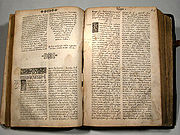
The Ostrog Bible is a monumental publication of 1,256 pages, lavishly decorated with headpieces and initials, which were prepared especially for it. From the typographical point of view, the Ostrog Bible is irreproachable. This is the first Bible printed in Cyrillic type. It served as the original and model for further Russian publications of the Bible.
The importance of the first printed Cyrillic Bible can hardly be overestimated. Prince Ostrogski sent copies to Pope Gregory XIII
Pope Gregory XIII
Pope Gregory XIII , born Ugo Boncompagni, was Pope from 1572 to 1585. He is best known for commissioning and being the namesake for the Gregorian calendar, which remains the internationally-accepted civil calendar to this date.-Youth:He was born the son of Cristoforo Boncompagni and wife Angela...
and tsar
Tsar
Tsar is a title used to designate certain European Slavic monarchs or supreme rulers. As a system of government in the Tsardom of Russia and Russian Empire, it is known as Tsarist autocracy, or Tsarism...
Ivan the Terrible
Ivan IV of Russia
Ivan IV Vasilyevich , known in English as Ivan the Terrible , was Grand Prince of Moscow from 1533 until his death. His long reign saw the conquest of the Khanates of Kazan, Astrakhan, and Siberia, transforming Russia into a multiethnic and multiconfessional state spanning almost one billion acres,...
, while the latter presented a copy to an English ambassador. When leaving Ostroh, Fyodorov took 400 books with him. Only 300 copies of the Ostrog Bible are extant today.
The Ostrog Bible was widely known in Ukraine
Ukraine
Ukraine is a country in Eastern Europe. It has an area of 603,628 km², making it the second largest contiguous country on the European continent, after Russia...
, Russia
Russia
Russia or , officially known as both Russia and the Russian Federation , is a country in northern Eurasia. It is a federal semi-presidential republic, comprising 83 federal subjects...
, and Belarus
Belarus
Belarus , officially the Republic of Belarus, is a landlocked country in Eastern Europe, bordered clockwise by Russia to the northeast, Ukraine to the south, Poland to the west, and Lithuania and Latvia to the northwest. Its capital is Minsk; other major cities include Brest, Grodno , Gomel ,...
, and also abroad. It is registered in the library of Oxford
Oxford
The city of Oxford is the county town of Oxfordshire, England. The city, made prominent by its medieval university, has a population of just under 165,000, with 153,900 living within the district boundary. It lies about 50 miles north-west of London. The rivers Cherwell and Thames run through...
; its copies were owned by King Gustavus Adolphus of Sweden
Gustavus Adolphus of Sweden
Gustav II Adolf has been widely known in English by his Latinized name Gustavus Adolphus Magnus and variously in historical writings also as Gustavus, or Gustavus the Great, or Gustav Adolph the Great,...
, the cardinal Barberini
Barberini
The Barberini are a family of the Italian nobility that rose to prominence in 17th century Rome. Their influence peaked with the election of Cardinal Maffeo Barberini to the papal throne in 1623, as Pope Urban VIII...
, many scientists and the public figures of that time. The Ostrog Bible was reprinted in Moscow
Moscow
Moscow is the capital, the most populous city, and the most populous federal subject of Russia. The city is a major political, economic, cultural, scientific, religious, financial, educational, and transportation centre of Russia and the continent...
in 1663.
The significance of the Ostrog Bible was enormous for Orthodox education, which had to resist strong Catholic
Roman Catholic Church
The Catholic Church, also known as the Roman Catholic Church, is the world's largest Christian church, with over a billion members. Led by the Pope, it defines its mission as spreading the gospel of Jesus Christ, administering the sacraments and exercising charity...
pressure in Ukraine and Belarus.
External links
Article at krotov.info- The Ostrog Circle and Bible from Ways of Russian Theology, by Fr. George Florovsky